HubSpot Breeze promises to make "impossible growth impossibly easy." That's a bold claim from a company that's built one of the most popular CRM platforms in the world. But strip away the marketing and you're left with a question that matters for your budget: is HubSpot Breeze actually worth the investment?
The short answer is: it depends heavily on what you're already using and what you're willing to spend. Breeze delivers genuine value for some teams while being a poor fit for others. This review breaks down exactly what you get, what it costs, and whether it makes sense for your situation.
What is HubSpot Breeze AI?
HubSpot Breeze is the company's unified AI suite, launched in late 2024 to replace earlier features like ChatSpot. Think of it as an umbrella term for everything AI-related inside HubSpot. Some features are available on all plans, including free. Others require Professional or Enterprise subscriptions, and that's where costs climb fast.
Breeze is split into three main components:
- Breeze Assistant: A conversational AI that helps with day-to-day tasks inside HubSpot
- Breeze Agents: Autonomous AI teammates that handle specific workflows like customer support or sales prospecting
- Breeze Intelligence: Data enrichment and buyer intent tools powered by HubSpot's acquisition of Clearbit
The suite is designed to give marketing, sales, and service teams a productivity boost within HubSpot's existing ecosystem. For teams already deep in HubSpot, the convenience of built-in AI has real value. But if you're looking for AI support without the HubSpot premium, alternatives like eesel AI offer cross-platform flexibility at a different price point.
Breaking down the three Breeze components
Breeze Assistant (the AI companion)
Breeze Assistant is HubSpot's answer to the AI chat tools popping up in every software platform. It's a conversational interface that sits inside your HubSpot account and can summarize CRM records, draft emails, answer questions about your data, and help with content creation.
The Assistant is available on all HubSpot plans, including free, which makes it the most accessible part of Breeze. But there are rate limits to know about: roughly 30 requests per minute and 1,000 per day. For most users, that's plenty. For power users or teams running heavy automation, you might hit those caps.
Where Assistant genuinely shines is CRM-specific tasks. Ask it to summarize a long email thread and create follow-up tasks with due dates directly on the contact record. Use it for meeting prep by pulling context from contacts, companies, deals, and call recordings into one summary. It won't replace a dedicated writing tool for deep research, but as a quick helper inside your existing workflow, it delivers.
Breeze Agents (the autonomous workers)
This is where HubSpot's platform shows its ambition. Breeze Agents are specialized AIs designed to handle entire workflows autonomously. Unlike Assistant, which responds to your questions, Agents run independently. They monitor data, take actions, and complete tasks on their own.
The lineup includes:
- Customer Agent: An AI chatbot for support that answers customer questions using your knowledge base
- Prospecting Agent: Researches target companies and crafts personalized outreach for sales teams
- Content Agent: Helps create blog posts, landing pages, and marketing content
- Data Agent: Monitors your CRM for quality issues like duplicates and missing fields
Here's the catch: most Agents require Professional or Enterprise plans. That means a minimum of $450 to $800 per month before you send a single AI conversation. And even on those plans, Agents consume credits that cost extra beyond a small monthly allowance.
Customer Agent, for example, costs 100 HubSpot credits per conversation. At current rates, that's approximately $1 per conversation. Professional plans include 3,000 credits per month, which covers about 30 conversations. After that, you're buying more credits at $10 per 1,000.
Many Agents are also still in Beta. HubSpot has stated they'll "aim to provide 30 days notice before beta features start consuming credits." That means a feature you're using for free today could start costing money with minimal warning.
Breeze Intelligence (the data layer)
If there's a standout feature in the Breeze suite, this is it. Breeze Intelligence leverages data from HubSpot's acquisition of Clearbit to deliver three core capabilities:
- Data enrichment: Automatically fills in missing CRM fields like company size, industry, and job titles
- Buyer intent: Identifies companies visiting your website and researching topics related to your business
- Form shortening: Pre-fills form fields for returning visitors, reducing friction and boosting conversions
Intelligence draws from a database of over 200 million company and contact profiles. For sales-heavy B2B teams, this eliminates the need for separate data enrichment subscriptions like ZoomInfo or Apollo. The value here is concrete: better data quality, prioritized outreach, and higher conversion rates on lead capture forms.
Pricing for Intelligence operates on its own credit system, separate from Agent credits. Packs start at $45 per month for 5,000 credits and scale up to $700 per month for larger volumes.
HubSpot Breeze pricing: The full picture
Let's talk numbers, because this is where Breeze gets complicated. The pricing isn't a single figure. It depends on your plan, which features you use, and how much you use them.
Plan requirements and base costs
| Plan | Monthly Cost | Breeze Access | Credits Included |
|---|---|---|---|
| Free/Starter | $0-20/seat | Assistant only (limited) | 500 |
| Professional | $800-890/mo | Full Agents + Intelligence | 3,000/mo |
| Enterprise | $3,600+/mo | Everything + advanced features | 5,000/mo |
Source: HubSpot Pricing
Professional plan prices vary by Hub. Service Hub Professional starts at $90 per seat per month, while Marketing Hub Professional is $800 per month. New Professional customers also face mandatory onboarding fees starting at $1,500 for Service Hub and $3,000 for Marketing Hub.
How the credit system works
Most Breeze Agents consume credits from a shared pool. Additional credits cost $10 per 1,000 on monthly plans or $9 per 1,000 on annual plans. Credits don't roll over. Unused credits vanish at the end of each billing cycle.
| Feature | Credit Cost | Real Cost |
|---|---|---|
| Customer Agent | 100 credits/conversation | ~$1.00 |
| Prospecting Agent (monitoring) | 100 credits/contact/month | ~$1.00 |
| Prospecting Agent (research) | 10 credits/company | ~$0.10 |
| Data Agent | 10 credits/response | ~$0.10 |
Source: HubSpot Service Hub Pricing
Real-world cost examples
Here's what Customer Agent actually costs at different volumes, assuming you're on a Professional plan:
| Monthly Conversations | Plan Cost | Extra Credits Needed | Extra Credit Cost | Total Monthly Cost |
|---|---|---|---|---|
| 100 | $800 | 7,000 | $70 | ~$870 |
| 500 | $800 | 47,000 | $470 | ~$1,270 |
| 1,000 | $800 | 97,000 | $970 | ~$1,770 |
These figures assume credits are used exclusively for Customer Agent. If your team also uses Prospecting Agent, Data Agent, or other Breeze features, the same credit pool gets consumed faster.
There's also a less obvious cost risk. The default "auto-upgrade" setting increases your credit tier automatically when you exceed your allowance. This locks you into higher costs for the rest of your contract. Switch to "Pay-as-you-go Overage" immediately if you want control over spending.
Where Breeze delivers value
For the right teams, Breeze justifies its cost. Here's where it shines.
Native integration for HubSpot-centric teams
If HubSpot is already your primary CRM, marketing, sales, and support platform, Breeze adds meaningful AI functionality without forcing you to switch tools or manage data silos. The AI has direct access to your CRM data, so responses are contextual and accurate. Audit cards on Enterprise plans provide timestamped records of every AI action for compliance.
Breeze Intelligence as the standout
Most reviewers agree: if you're going to pay for any part of Breeze, Intelligence offers the clearest ROI. The data enrichment alone can replace separate ZoomInfo or Apollo subscriptions. Buyer intent signals help sales teams prioritize outreach to companies already researching solutions like yours. Form shortening has a direct, measurable impact on conversion rates.
Customer support automation
HubSpot claims 65% or more of conversations are resolved automatically, with top teams hitting 90%. Customer Agent works across chat, email, WhatsApp, Facebook Messenger, and other channels. It can hand off to human agents when needed. For teams already paying for Professional or Enterprise plans, adding Customer Agent is a logical next step.
We have lowered the number of tickets handled by customer support by 77% while simultaneously improving the conversion rate through 24-hour support. Breeze customer agent is a key tool for generating revenue and increasing customer satisfaction.
The limitations you should know
Breeze is capable, but it has real limitations worth knowing before you commit.
Pricing concerns
Per-conversation pricing creates unpredictable monthly costs for Customer Agent. The credit system has no spending guardrails. One user reported accidentally enriching a large contact list and watching helplessly as credits burned through thousands of dollars in minutes. Because HubSpot uses annual contracts, a single mistake can multiply across the entire year.
Credits don't roll over, so buying too many means wasting money. Buying too few means hitting limits mid-month. It's a balancing act that adds operational overhead.
Functional gaps
Customer Agent has no custom instructions. You can't tell the bot to promote specific offers or ask questions in a particular way. External knowledge sources like Notion, Google Drive, or Confluence require workarounds rather than native integration. Many agents are still in Beta with no guaranteed timeline for full release.
There's also a quality dependency. As one community member put it: "If the AI is only fed a sparse or outdated help centre, it's just going to be confidently wrong." Companies that lack thorough documentation will struggle to get good results regardless of the AI's capabilities.
Ecosystem lock-in
Breeze is optimized for data inside HubSpot. If your knowledge base, documentation, or customer data lives partly outside HubSpot, the AI's accuracy drops. Switching away from Breeze means losing any agent configurations and Knowledge Vault content you've built.
Like most things HubSpot does, there are far better point solutions available, but it's good enough if you factor in it's wrapped up with all the other tools HubSpot includes.

Who should (and shouldn't) invest in Breeze
Not every business will get the same value from Breeze.
Good fit for:
- Large teams already on Professional or Enterprise plans who want AI embedded in their existing workflow
- Sales-driven B2B organizations that benefit from Prospecting Agent and Intelligence
- Businesses already using HubSpot as their primary CRM, marketing, and support platform
- Companies with budget to absorb credit costs at scale
Poor fit for:
- SMBs on HubSpot's Free or Starter plans. Upgrading to Professional ($800+/mo) just for AI access makes little financial sense. You'd pay $9,600+ per year before a single AI conversation happens.
- Budget-conscious businesses where $1 per support conversation is too expensive
- Teams that need AI for customer support specifically but don't need the full HubSpot Professional suite
- Businesses with knowledge bases in external tools (Notion, Google Drive, Confluence) where Breeze has limited integrations
One HubSpot Solutions Partner reported that after demoing Breeze to four clients, all four declined to upgrade. The gap between marketing promise and practical value was too wide for their budgets.
A flexible alternative for support teams
If Breeze's pricing or plan requirements don't work for your business, dedicated AI support tools offer a different approach. For teams that need AI-powered customer support without the HubSpot premium, we built eesel AI to fill that gap.
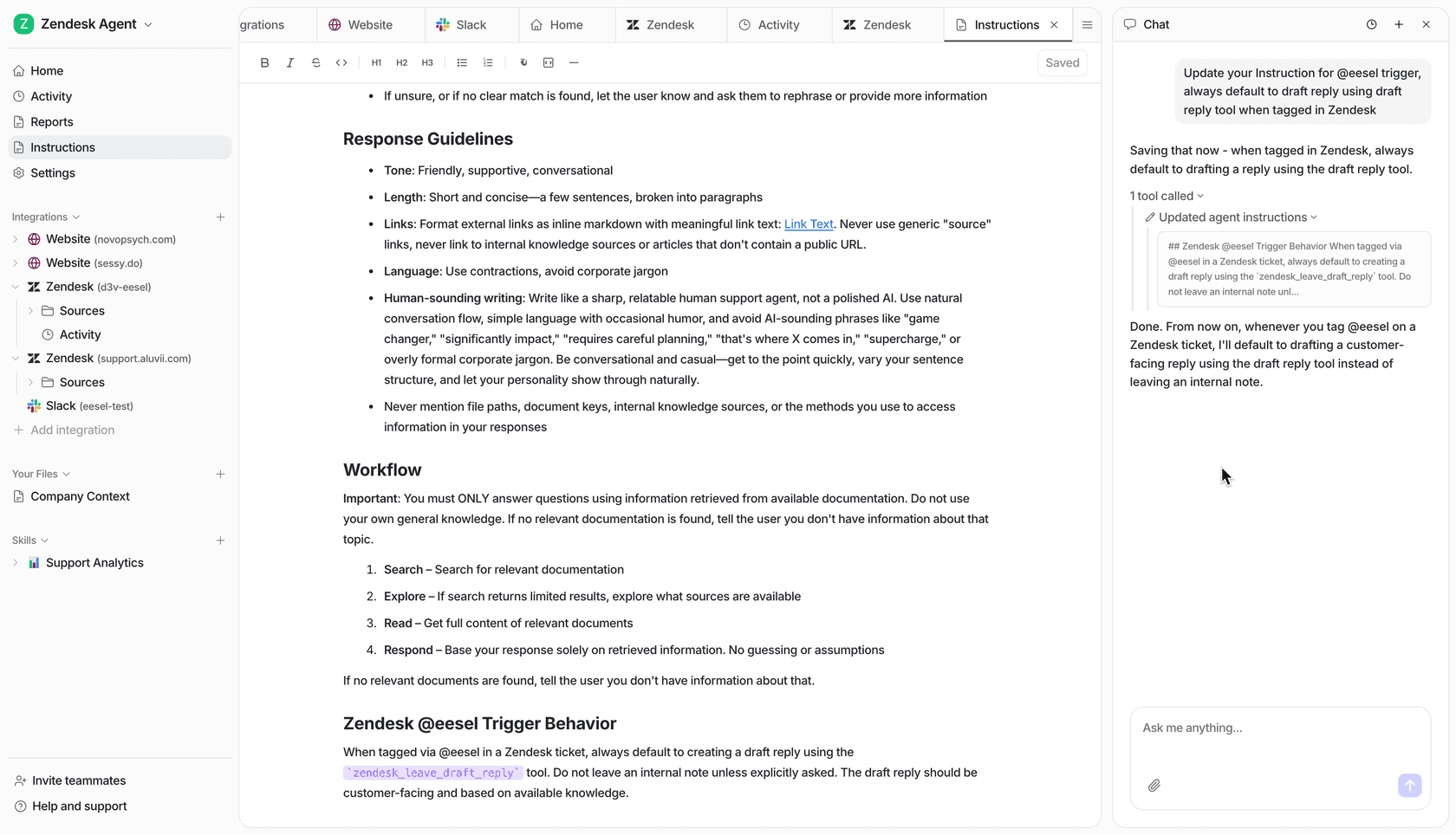
Our AI Agent works alongside HubSpot or independently, connecting to your help desk while also bringing in context from Slack, Confluence, or Google Docs. Instead of per-conversation pricing that creates unpredictable bills, we offer flat monthly rates. You can run simulations on past tickets to verify quality before going live, something Breeze doesn't offer natively.
For teams that want AI assistance without full automation, our AI Copilot drafts replies for human agents to review and send. You define escalation rules in plain English. No code, no rigid decision trees.
If you're curious how we compare specifically with HubSpot's setup, check out our HubSpot integration page.
Making your decision about HubSpot Breeze
So is HubSpot Breeze worth it? The answer depends on your starting point.
If you're already paying for HubSpot Professional or Enterprise, Breeze adds meaningful AI capabilities without requiring you to switch platforms. Breeze Intelligence, in particular, offers clear value for sales teams. The convenience of native integration is real.
But if you're on Free or Starter plans, the math is harder to justify. Paying $800+ per month plus $1 per conversation for AI support is a significant jump. For high-volume support teams, those per-conversation costs add up fast.
The value proposition also changes based on how centralized your data is. Breeze works best when everything lives in HubSpot. If your knowledge is scattered across multiple tools, you'll face limitations.
Bottom line: Breeze is a powerful choice for HubSpot-centric enterprises with budget flexibility. For smaller teams or those primarily needing AI support without the full HubSpot suite, exploring alternatives makes sense. The key is matching the tool to your actual needs, not the marketing promise.