


What chatbot development services actually are
When someone searches "chatbot development services," they're usually at a specific moment: they've decided they want a chatbot, and now they're figuring out who builds it. The phrase covers a real market of agencies and freelance developers who scope, design, and build a bespoke bot, then wire it into your website, app, or helpdesk. That build might be a service desk bot for an internal team, a live chat widget on a storefront, or a sales assistant on a landing page.
That's distinct from the no-code chatbot platform market, where you don't commission anything, you sign up and configure a product that already exists. The two get lumped together in search, but they're very different purchases: one is a custom software project, the other is a subscription.
Almost everyone who starts by looking for a development service could get what they need from the buy path instead. The reason so many people don't realize that is the search intent itself: "I need a chatbot built" quietly assumes building is the only way to get one. It usually isn't.
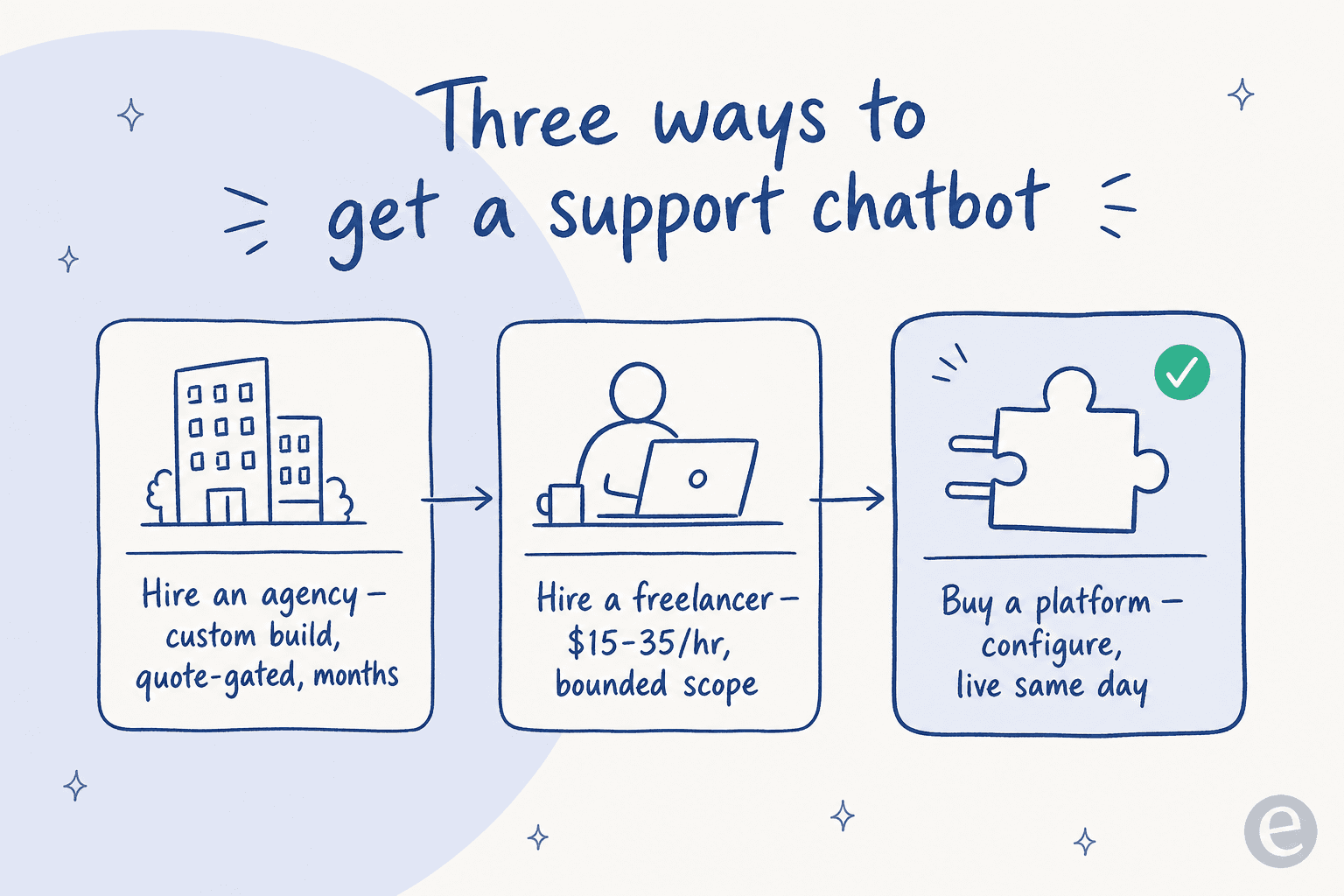
The three paths, and who each one is for
Path 1: hire an agency
A chatbot development agency scopes your use case, designs the conversation flows, builds the bot, tests it, launches it, and (if you keep paying) maintains it. Master of Code Global is a representative example: founded in 2004, 200+ staff, 1,000+ projects delivered, a 4.7/5 rating, and a pitch built around a 30-day validation pilot before the full build. Their delivery flow runs eight stages, from requirements and NDA through discovery, development, QA, launch, and "maintenance and scaling."
The strength of the agency path is real: full control, full ownership, and a team that will build truly custom logic (a voice agent for an automotive dealer, a generative-AI product quiz for a floral subscription company) that no off-the-shelf tool ships out of the box. The catch is upfront cost and time to launch. Agencies almost universally quote-gate their pricing. Master of Code collects a "Project Budget in USD" on a lead form rather than publishing a rate card, and that pattern holds across the market. You won't know what it costs until you're already in a sales conversation, and the answer is usually five figures and several months.
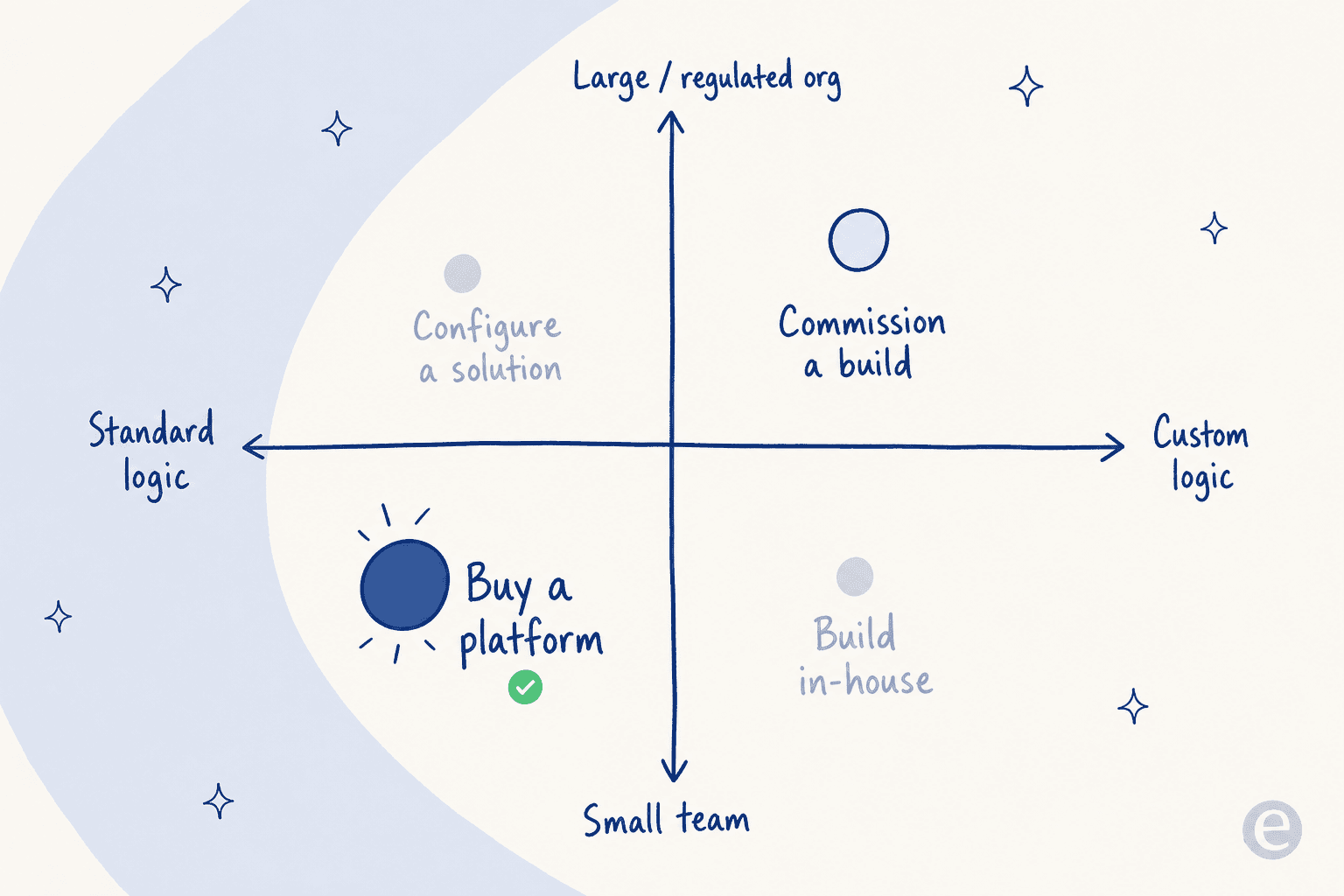
Best for: large or regulated organizations with bespoke requirements and a budget that can absorb both the build and the ongoing upkeep.
Path 2: hire a freelancer
One rung down in cost and commitment is hiring a freelance chatbot developer off a marketplace. On Upwork's chatbot-developer hire page, the top profiles rate roughly $15 to $35 an hour, against a 4.8/5 average across 1,109 client reviews. That's a fraction of an agency's blended rate, and for a small, well-scoped bot it can be the pragmatic middle ground.
The trade-off is scope and continuity. A freelancer is great for a defined build ("connect this bot to my Shopify order data") and less great for a system you'll need supported, retrained, and scaled for years. When the freelancer moves on, the maintenance burden lands back on you.
Best for: a specific, bounded build where you have someone in-house who can own it afterward.
Path 3: buy a platform and configure it
The third path skips the build entirely. You buy a ready-made AI chatbot platform and configure it. Tidio's Lyro AI Agent plans start at $24.17/month (Starter, 100 billable conversations) and $49.17/month (Growth, 250 conversations), scaling on usage rather than a fixed dev bill. The Plus tier starts at $749/month for higher volume with a dedicated CSM. At the enterprise end, Zendesk includes AI agents in its Suite Team plan from $55/agent/month paid yearly, and Ada prices its AI agent through a custom quote after a demo call.
The point isn't Tidio specifically, it's the shape of the deal: $24 to $49 a month buys a working chatbot on day one, with no dev team, no discovery phase, no months-long timeline. For the vast majority of support use cases (answer from a help center, deflect FAQs, tag and route tickets, hand off to a human when stuck), a configured platform does everything a custom build would, minus the build.
Best for: almost everyone. This is the default, and you should have a specific reason before you leave it.
What chatbot development actually costs
Here's the uncomfortable truth about cost: the sticker price is the least of it. A custom build has three cost layers, and only the first one is visible when you're comparing quotes.
- The build. The upfront project fee. Quote-gated for agencies, roughly $15 to $35/hour for freelancers on Upwork.
- The maintenance. Models change, your docs change, edge cases pile up, and someone has to keep retraining and fixing the bot. This is the layer that gets waved away in the sales pitch and dominates the real chatbot cost over time.
- The opportunity cost. Every engineering hour spent maintaining a home-grown bot is an hour not spent on your actual product.
That maintenance tail is exactly why a flat monthly platform fee, or a predictable per-ticket rate, usually wins on total cost of ownership even when the custom build looks competitive on the initial quote.
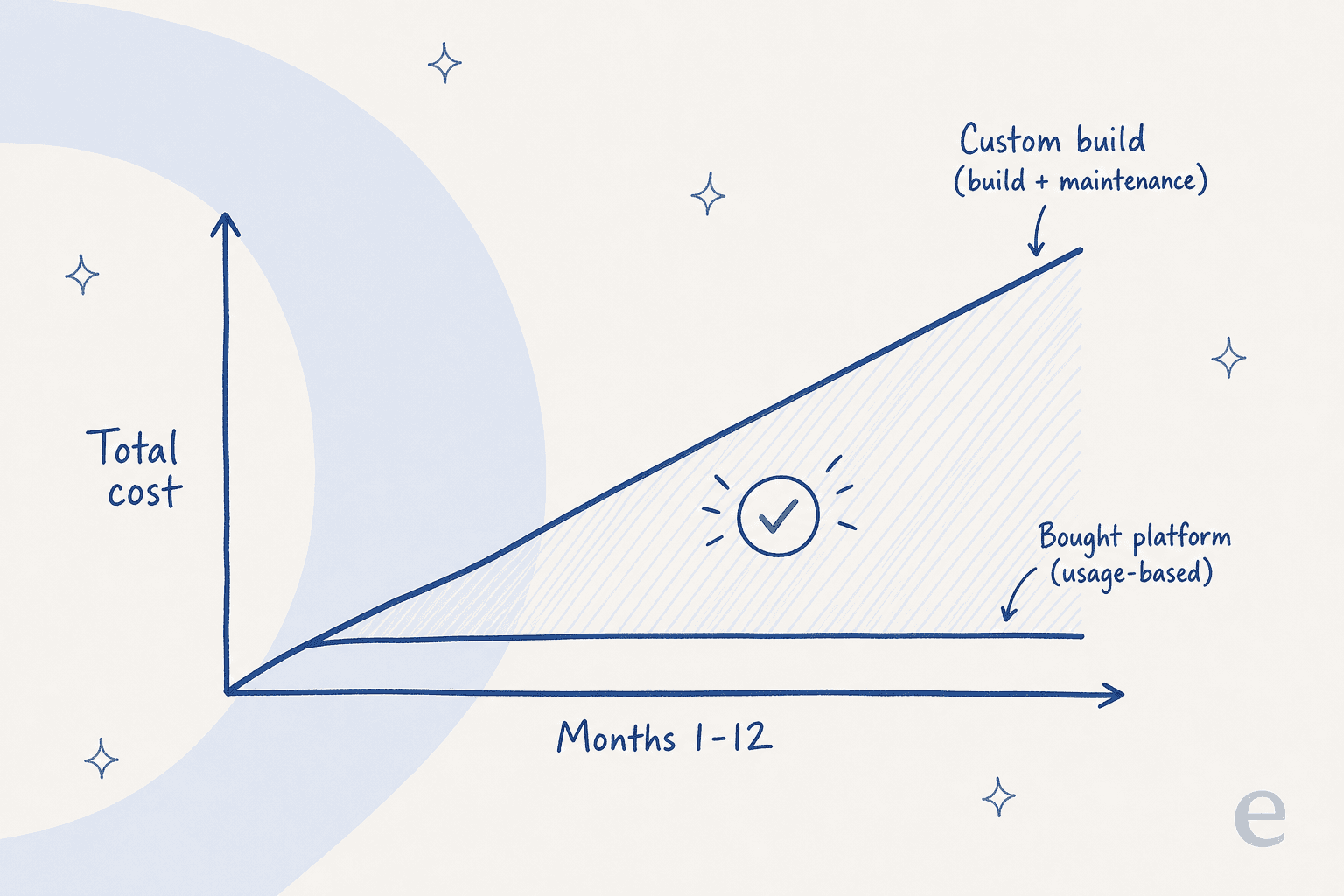
I've watched this play out in eesel's own numbers. Build-in-house is a recurring reason technical customers leave, and several of them (including an AR/construction-tech firm and a DTC beauty brand) churned specifically to build on the Claude API directly. Some come back. The maintenance wall is real, and it's higher than the demo makes it look.
It isn't just me saying it. A builder on Hacker News described exactly this arc after shipping a support bot for a large crypto exchange:
"we previously built Coinbase's automated chatbot and we used a flowchart type builder to do that. This was a intent-entity based system that used deep learning models. It started great, but pretty quickly it became a nightmare to manage."
Build vs buy: the calculation that actually matters
Strip away the marketing and the build-vs-buy decision comes down to one question: is your support logic standard or custom?
Standard means the things every support team needs: answering questions from your knowledge base, deflecting repetitive FAQs, tagging and routing tickets, escalating cleanly to a human. If that's your list, off-the-shelf tools already do it, and building it yourself is reinventing a wheel that a dozen vendors ship for a subscription.
Genuinely custom means logic no platform offers: a proprietary underwriting flow, a regulated banking script, a voice agent tied to dealer inventory systems. That's where a development service earns its fee.
One eesel customer put the trade-off more plainly than any framework could. An engineering lead at a Bitcoin-ATM company, running a 300+ article Confluence knowledge base, weighed building their own and chose to buy:
"We could try to write our own LLM application but we didn't want to invest our time into that. We wanted something that we would not have to maintain."
That's the whole calculation in two sentences. The build is never really "done." Buying moves the maintenance burden onto the vendor, which is what you're actually paying for.
Work out your own build-vs-buy number
The abstract argument only gets you so far. Plug in your real ticket volume and see where the lines cross:
The numbers are deliberately rough (a $30k build with 20% annual maintenance, buying the monthly credit plan that fits your handled tickets, from $299 for 500 credits), but the shape holds across almost every real scenario: unless your volume is enormous or your logic is exotic, buying comes out ahead in year one and further ahead every year after.
How AI agents change the whole calculation
For years, "get a chatbot built" made more sense than it does now, because the old decision-tree bots actually needed custom development. Someone had to script every branch, wire up every intent, and maintain the whole flowchart. That's the world chatbot development services grew up in.
Modern AI agents collapse most of that work. Instead of scripting flows, you point the agent at your existing help center and past tickets, and it learns to answer from them. The "development" that used to take an agency months (teaching the bot what your product does, how to handle common questions) now happens by training the AI on your knowledge base in an afternoon.
This is the part that reshapes the search. If you're looking for chatbot development services because you assumed a support bot requires custom engineering, the assumption is a couple of years out of date. The FAQ automation, the escalation logic, the multichannel reach that agencies used to bill for are now configuration, not code.
The honest exceptions still exist. If your bot needs to execute a regulated workflow, drive proprietary hardware, or reason over a data model no vendor supports, a development service (or your own engineers) is still the answer. But that's a much smaller slice of the market than the search volume implies.
Try eesel
If what you actually want is a support chatbot that works without a development project, this is where eesel fits. eesel is an AI teammate you plug into your existing helpdesk (Zendesk, Freshdesk, Gorgias, and others) and it learns from your past tickets and help docs on day one, no scripting, no discovery phase, no build.
The differentiator against both the build and buy paths: eesel simulates every rollout against your historical tickets before it ever answers a live customer, so you see the resolution rate and the exact replies it would have sent before you trust it. It's priced as a fixed monthly plan from $299 for 500 credits (1 credit per ticket), with no per-seat fees, so the maintenance tail that sinks custom builds simply isn't yours to carry. You can try eesel free with 100 credits and point it at your own helpdesk in a few minutes.

For most teams, that's the version of "chatbot development services" that actually makes sense in 2026: not a build to commission, but a teammate to hire.