
AI has evolved beyond single models answering questions into an era of complex, multi-agent systems where different AIs collaborate to solve intricate problems. This approach is powerful, but coordinating multiple agents presents a significant challenge for developers, requiring specialized tooling.
There are so many agent frameworks now. I've lost count of them. They will all die in half a year. All of them are just copies or slightly different flavors of the same thing. I don't really see the advantage of using them if they could all disappear or be recreated pretty easily

The Google Agent Development Kit (ADK) is designed to address this challenge. It's an open-source framework from Google that aims to make building advanced AI agents more akin to regular software development. In this post, we'll take a practical look at the ADK, what it is, how it works, and its intended audience, to help you decide if it's the right tool for your project.
What is the Google Agent Development Kit?
The Google Agent Development Kit (ADK) is an open-source, code-first framework for building, deploying, and managing AI agents, particularly those designed to work in multi-agent systems. It's made for developers, with official support for common languages like Python, TypeScript, Go, and Java, allowing you to work in a familiar environment.
The core principle of ADK is to offer a flexible, modular foundation that is not tied to a single model or deployment style. While it's optimized for Google's Gemini models, it is designed to be an open ecosystem. Through an official LiteLLM integration, it can work with over 100 other providers, including OpenAI and Anthropic. This freedom allows developers to select the most suitable model for a specific task.
ADK is also deployment-agnostic. You can run agents locally for testing and then scale them on a fully managed cloud service. This flexibility is beneficial for projects that start small with the potential for significant growth.
Core architecture and key features of the Google Agent Development Kit
To understand ADK's capabilities, it's important to examine its architecture. It's a well-thought-out framework for building complex, long-running agent workflows.
How the event-driven architecture works
Instead of a basic request-response model, ADK uses an event-driven architecture. ADK processes a continuous stream of information, or "events," flowing between the user, the AI models, and any connected external tools. This setup allows ADK to manage complex, multi-step conversations and tasks.
Here are the main parts:
-
The Runner: The Runner acts as the main coordinator. It handles user sessions and keeps track of agent activities.
-
Events: Events are a core component of the system. Every action, a user's message, a tool being used, a model's reply, is logged as a permanent event. This ensures clean and dependable communication between system components.
-
Session Services: Session Services manage memory and state. It retains the conversation's context, so the agent remembers what has been said and done over time.
This structure enables real-time feedback and lets you build agents that can tackle long-running tasks without forgetting the context. The following graphic illustrates how these components work together.
Building with specialized and workflow agents
ADK is particularly effective for building multi-agent systems. The framework's design principle is to decompose large, complex problems into smaller, manageable pieces, with a specialized agent assigned to each one.
ADK provides a few different agent types:
-
LLM Agents: These agents use large language models for reasoning, planning, and making decisions.
-
Workflow Agents: These agents follow predefined logic to control the flow of a task, which makes processes predictable.
-
Custom Agents: For other needs, you can build your own custom agents to handle specific, non-LLM logic.
To coordinate these, ADK offers core workflow agents like the SequentialAgent for step-by-step tasks, the ParallelAgent for concurrent operations, and the LoopAgent for repeating an action until a condition is met.
A notable feature is the AgentTool, which lets one agent use another as a tool. This allows for advanced delegation, where a "manager" agent can assign specific jobs to "worker" agents, keeping the application design clean and organized.
Flexible ecosystem of tools and models
A key advantage of ADK is its model-agnostic design. While it's fine-tuned for Gemini models, you are not limited to them. The LiteLLM integration supports models from OpenAI, Anthropic, Cohere, and many others. It also supports open and local models through tools like Ollama, giving you complete control over your tech stack.
I followed the quick start to the letter, with the exception that I replaced the model in the agent for a local one using the [LiteLLM integration for ollama] and it resulted in an infinite loop of tool_calling, no matter if I used a model with tool calling capabilities or not... so I assume the ollama integration mentioned in the docs just isn't... quite ready, I guess.
The tool ecosystem is also extensive. You get pre-built tools for tasks like Google Search and Code Execution, and you can build custom functions in Python or another supported language. It also integrates with popular third-party libraries like LangChain, allowing you to incorporate existing tools and workflows.
The developer experience: Building and deploying with the ADK
ADK is designed with the developer experience in mind. The process, from coding to deployment, is intended to be familiar and efficient.
Getting started with the local development toolkit
The framework includes tools to streamline the build-test-debug cycle. The command-line interface (CLI) lets you get started fast with commands like adk create to set up a new project and adk run to launch it.
A notable feature is the built-in visual Web UI. It provides a simple chat interface for testing agents locally, but its primary strength is debugging. The UI lets you inspect the entire event stream and session state in real time. You can see every user input, tool call, model response, and state change as it occurs. This level of visibility is highly valuable for debugging complex, asynchronous systems.
The path to production: Deployment options
ADK is designed for production environments, not just local development. It provides a clear path for moving an agent from a local machine to a scalable, live environment.
You have two main deployment options:
-
Containerization: You can wrap your agent application in a Docker container and deploy it on any infrastructure that supports containers. Google Cloud Run is a common choice, as it lets you run your agent in a serverless environment where you only pay for what you use.
-
Vertex AI Agent Engine: For a managed solution, you can use Google's fully managed service, which is built to deploy, manage, and scale agents made with frameworks like ADK. This enterprise-level solution handles the infrastructure for you.
This flexibility allows you to pick the deployment strategy that best fits your team's skills, budget, and scaling needs.
The learning curve and common challenges
While ADK is powerful, it has a notable learning curve, particularly for developers new to agent-based systems. Understanding concepts like asynchronous agents, event handling, and managing state between different agent types (LlmAgent, SequentialAgent, LoopAgent) can be challenging.
Frameworks like ADK are most valuable when they empower beginners and intermediate developers to build confidently. But right now, the developer experience feels like it's optimized for advanced users only. The ideas are strong, but the complexity and boilerplate may turn away the very people who’d benefit most.
The official documentation notes that building a completely custom agent from scratch is an advanced concept. It's recommended to become comfortable with the standard agent types before attempting deep customization. Ultimately, the ADK is best suited for experienced AI engineers and software developers creating custom, complex agent systems who need fine-grained control.
Google Agent Development Kit: A framework to build vs. an AI teammate to hire
The Google Agent Development Kit is a toolkit for building custom AI solutions. This DIY approach is suitable for specific use cases but may not be the best fit for all situations.
The ideal user for the Google Agent Development Kit
ADK is designed for AI engineering teams and software developers who are building highly customized agent applications from scratch. It is a suitable choice when the agent system itself is the product and the team needs deep control over orchestration, agent behavior, and cloud infrastructure.
When an AI teammate is a better fit
For teams whose primary goal is to solve immediate business problems, such as automating customer support or streamlining internal knowledge management, a pre-built solution may be more direct. An alternative to a development framework is a ready-to-deploy AI platform, often referred to as an "AI teammate."
A development framework like ADK requires setting up a local environment, writing code, and managing cloud infrastructure. In contrast, a platform like eesel AI is designed for rapid onboarding, typically connecting to existing business tools like Zendesk, Slack, or Confluence to learn from existing data without manual training.
The management approach also differs. ADK requires defining agent behavior through code. Other platforms, such as eesel, allow for management using natural language instructions. You can start with a supervised AI Copilot mode, where it drafts replies for human review, and later transition to a fully autonomous AI Agent that handles tickets independently.
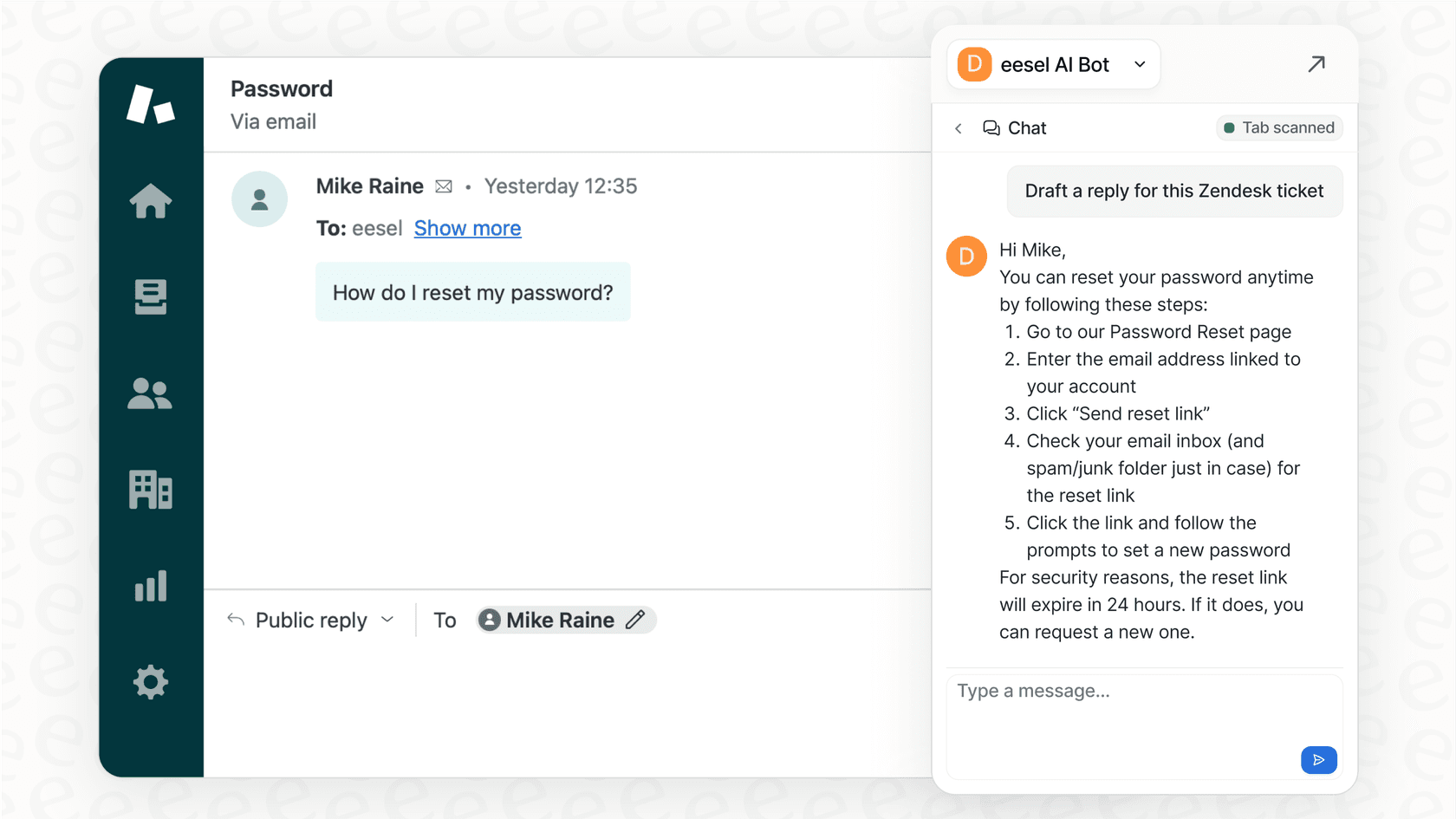
This approach is designed for rapid implementation and can lead to immediate automation of tasks. For example, eesel AI can autonomously resolve a significant portion of support conversations after being connected to a company's knowledge sources.

Here’s a quick breakdown of the two approaches:
| Factor | Framework Approach (Google ADK) | AI Teammate Approach (eesel AI) |
|---|---|---|
| Primary User | AI Engineers & Software Developers | Support Managers, Ops Teams, Business Leaders |
| Setup Time | Days to weeks | Minutes |
| Required Skills | Python/Go, Cloud Infrastructure, AI Concepts | None (connects to existing tools) |
| Control Method | Code, configuration files, complex logic | Plain English instructions |
| Go-Live Strategy | Deploy to a staging/production environment | Simulate on past tickets, then roll out progressively |
| Core Goal | Build a custom agentic application | Automate tickets, answer questions, and resolve issues |
Google Agent Development Kit pricing
The ADK framework is open-source and free to use under the Apache 2.0 license.
However, there are associated costs. The total cost of ownership comes from two main sources:
-
LLM API Calls: Each time an agent calls a language model, you will be billed for that usage. This applies whether you are using Gemini on Vertex AI or a model from another provider.
-
Infrastructure: You must also cover the costs of the cloud services that host and run your agents. This could be compute time on Google Cloud Run or usage-based fees for the fully managed Vertex AI Agent Engine, which has its own pricing and a monthly free tier.
While the framework is free, the final cost depends on agent usage and the chosen deployment setup.
For a hands-on introduction to building your first agent, this video from Google provides a helpful walkthrough of the initial setup and core concepts.
Final thoughts
The Google Agent Development Kit is a powerful and flexible framework for developers building custom multi-agent AI systems. It provides fine-grained control over agent architecture, model choice, and deployment strategy. It’s a production-ready toolkit for creating the next generation of AI applications.
This level of control requires a significant investment in engineering time for building, deploying, and maintaining the system. It is fundamentally a tool for developers.
For business teams focused on immediate outcomes, such as automating support or improving knowledge access, a ready-to-use solution can offer a more direct path to achieving those goals. This highlights the distinction between building a custom solution and adopting a pre-built one. Teams can evaluate whether their needs are better met by the deep customization of a framework like the Google Agent Development Kit or the rapid deployment of a platform like eesel AI.
Frequently asked questions
What is the main purpose of the Google Agent Development Kit?
The Google Agent Development Kit (ADK) is an open-source framework designed for developers to build, deploy, and manage complex AI agent systems. It's especially useful for creating multi-agent applications where different AIs collaborate on tasks, streamlining the process to resemble traditional software development.
Is the Google Agent Development Kit free to use?
Yes, the framework itself is open-source and free under the Apache 2.0 license. However, you'll still have costs associated with using it, such as paying for LLM API calls (to models like Gemini or others) and the cloud infrastructure needed to host and run your agents.
Can I use models other than Google's Gemini with the Google Agent Development Kit?
Yes. While it's optimized for Gemini, the Google Agent Development Kit is model-agnostic. Thanks to its integration with LiteLLM, it supports over 100 different models from providers like OpenAI, Anthropic, and Cohere. It also works with local models via tools like Ollama.
Who is the ideal user for the Google Agent Development Kit?
The ADK is best suited for experienced AI engineers and software developers who need deep, granular control to build custom, complex agent-based applications from scratch. It's a tool for teams where the AI system itself is a core part of the product they're building.
What programming languages does the Google Agent Development Kit support?
The Google Agent Development Kit has official support for several popular programming languages, including Python, TypeScript, Go, and Java. This allows development teams to work in an environment they are already familiar with.
How does the Google Agent Development Kit handle complex, long-running tasks?
It uses an event-driven architecture. Instead of simple request-response interactions, every action is treated as an event in a continuous stream. This, combined with its session services for memory, allows the Google Agent Development Kit to manage multi-step tasks over time without losing context.