
CCaaS pricing in 2026 runs $65 to $249 per agent a month for a full contact center seat on the rate cards vendors still publish, with most voice-plus-digital tiers between $89 and $165. The seat price is the least interesting number on the bill, though. The licence unit (named, concurrent or hourly), per-minute usage and AI units move a real invoice more than the gap between two vendors' list prices. Amazon Connect, which charges about 4 cents a voice minute and no seats, beats a $75 seat until an agent talks more than 31 hours a month.
The biggest saving I see is buying voice-only seats and keeping email and chat in the helpdesk, where an AI teammate like eesel works those tickets. With the eesel CLI, a coding agent can load your saved replies and help articles as knowledge, then ask test questions and check the answers before anything goes live. Connecting the helpdesk itself still needs an admin to approve it.
How much does CCaaS cost per agent in 2026?
A full contact center seat costs $65 to $249 per agent a month on published list prices, checked on each vendor's own pricing page on November 4, 2026. Here is every major vendor, the unit it bills on, and what the entry price actually buys.
| Vendor | Entry price | Top published price | Unit | Billing | Voice and digital on entry tier? |
|---|---|---|---|---|---|
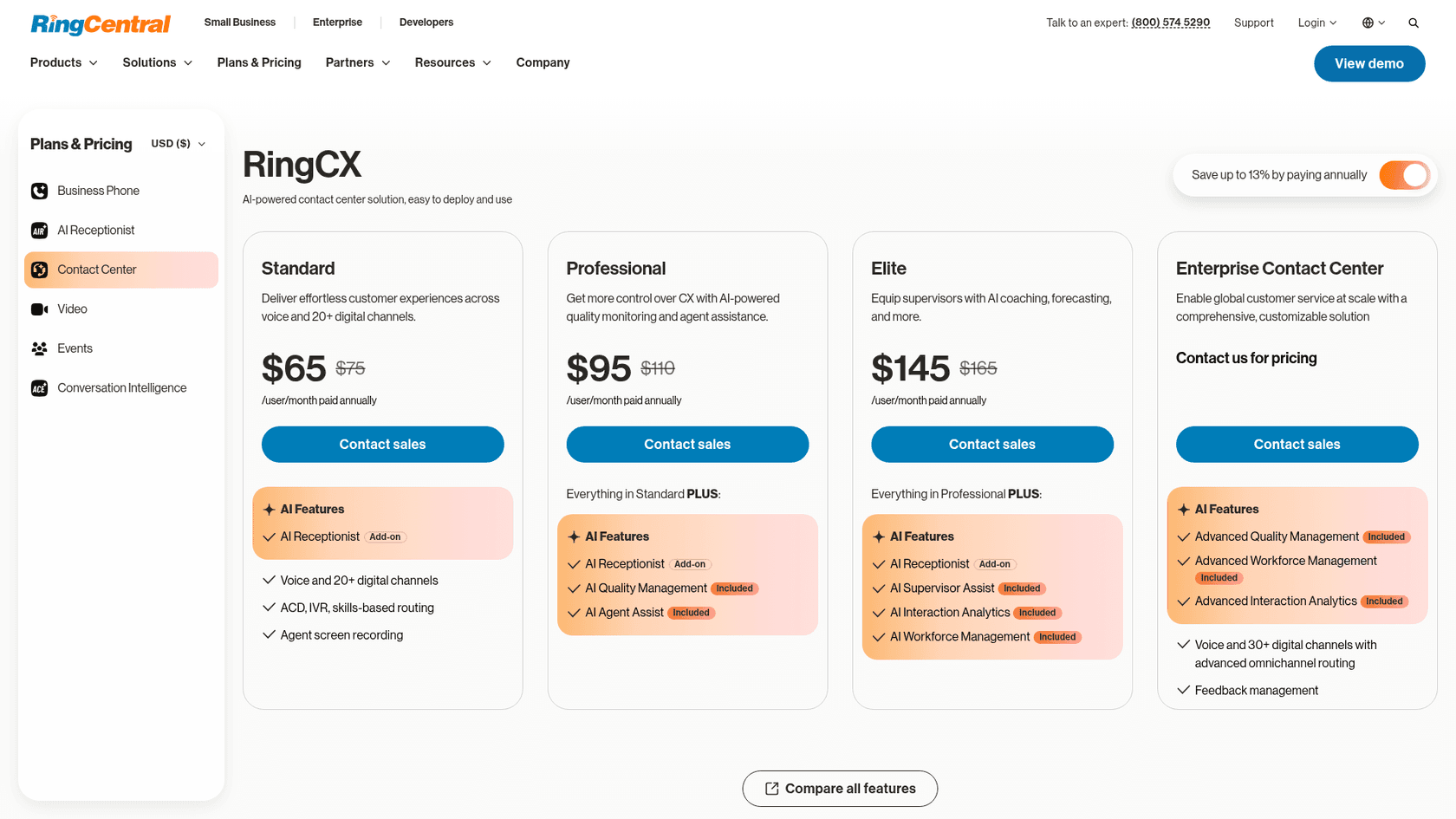
| RingCentral RingCX | $65 ($75 monthly) | $145 ($165 monthly) | Per user | Annual or monthly | Yes, voice plus 20+ digital channels |
| Genesys Cloud CX | $75 named | $240 named | Named, concurrent or hourly | Annual | No, CX 1 is voice only |
| Dialpad Support | $89 ($109 monthly) | $149 (annual only) | Per user | Annual or monthly | Yes |
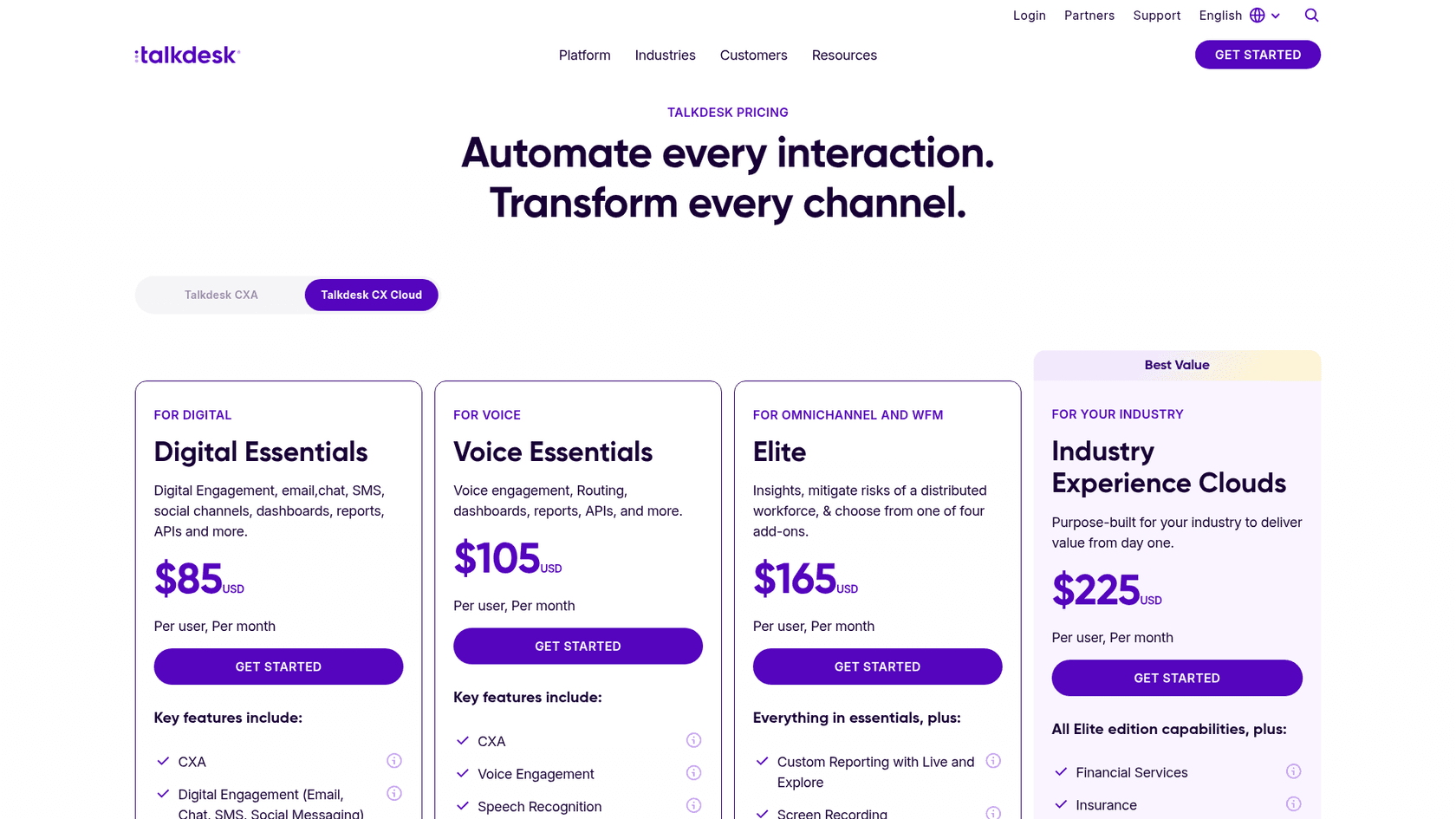
| Talkdesk | $85 digital / $105 voice | $225 | Per user | Not stated | No, voice and digital are separate plans until Elite |
| NICE CXone | $110 | $249 + $0.25/session | Per agent | Monthly in arrears | Yes |
| Zendesk Suite (helpdesk with voice) | $55 ($69 monthly) | $115 ($149 monthly) on public tiers | Per agent | Annual or monthly | Yes, minutes and numbers are add-ons |
| Amazon Connect | $0.038 per voice minute | n/a | Per minute / per message | Pay as you go | Yes, no seats |
| Five9 | Quote only | Quote only | Not published | Not published | Digital bundle is digital only |
| 8x8 | Quote only | Quote only | Not published | Not published | Not published |
Prices are USD, annual billing unless noted. Two things jump out of that table before I even get to usage.
First, Five9 has pulled its prices. In August its page showed Digital at $119 and Core at $159 per concurrent seat with a 50-seat minimum. By November the old URL redirected to the homepage and every bundle went quote-only. If an older comparison quotes those numbers to you, it is quoting a page that no longer exists.
Second, entry tiers are not like for like. Genesys CX 1 and Talkdesk Voice Essentials cover voice only, so the "cheap" seat is cheap partly because it leaves out the channels a support team also runs. If you are earlier in the process and still choosing a category, my roundup of call center software sits one step before this.
What are you actually paying for on a CCaaS bill?
Every contact center invoice I have read breaks into three meters, and only one of them is on the pricing page in big type.
- The seat licence. A monthly fee per agent, but "per agent" can mean three different things (more on that below).
- Usage. Call minutes, phone numbers, messages and, more and more, AI. Genesys meters AI in "Experience Units", NICE charges $0.25 per session on its Ultimate suite, and Amazon Connect bills everything per minute or per message.
- The commitment. Annual terms, seat minimums and add-ons that only sales will price.
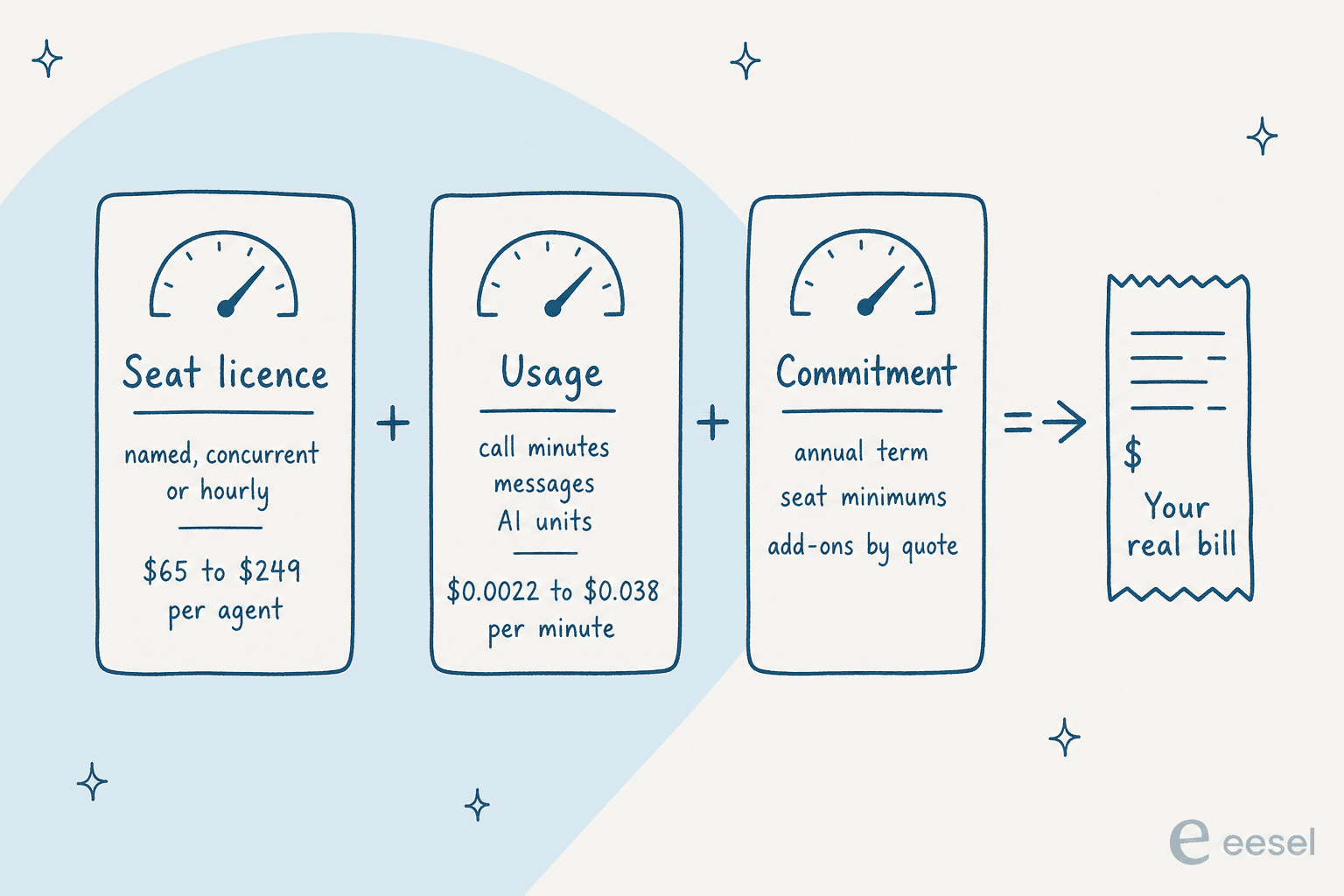
The reason this matters: a buyer comparing two seat prices that are $20 apart can lose that saving several times over on usage terms nobody compared. Plenty of cost guides quote tidy planning ranges for AI and workforce add-ons. The vendors mostly don't publish those prices at all, which is the more useful thing to know going into a sales call.
What does each CCaaS vendor charge?
Below is each vendor's published rate card, plan by plan. I have kept to what each vendor states on its own pricing page, so where a cell says "not published", that is the honest answer, not a gap in my notes.
RingCentral RingCX
RingCX is RingCentral's contact center product, separate from its business phone plans. It is the lowest published full contact center seat on this list.
| Plan | Annual | Monthly | What it adds |
|---|---|---|---|
| Standard | $65 | $75 | Voice and 20+ digital channels, ACD, IVR, skills-based routing, agent screen recording |
| Professional | $95 | $110 | AI Quality Management and AI Agent Assist included |
| Elite | $145 | $165 | AI Supervisor Assist, AI Interaction Analytics, AI Workforce Management included |
| Enterprise Contact Center | Contact us | Contact us | Voice and 30+ digital channels, advanced QM and WFM |
The RingCX pricing page lists the AI Receptionist as an add-on on every tier, with no price on that page. Its business phone page puts AI Receptionist from $39. If you already run RingCentral phones, my guide to AI for RingCentral covers what sits on top.
Genesys Cloud CX
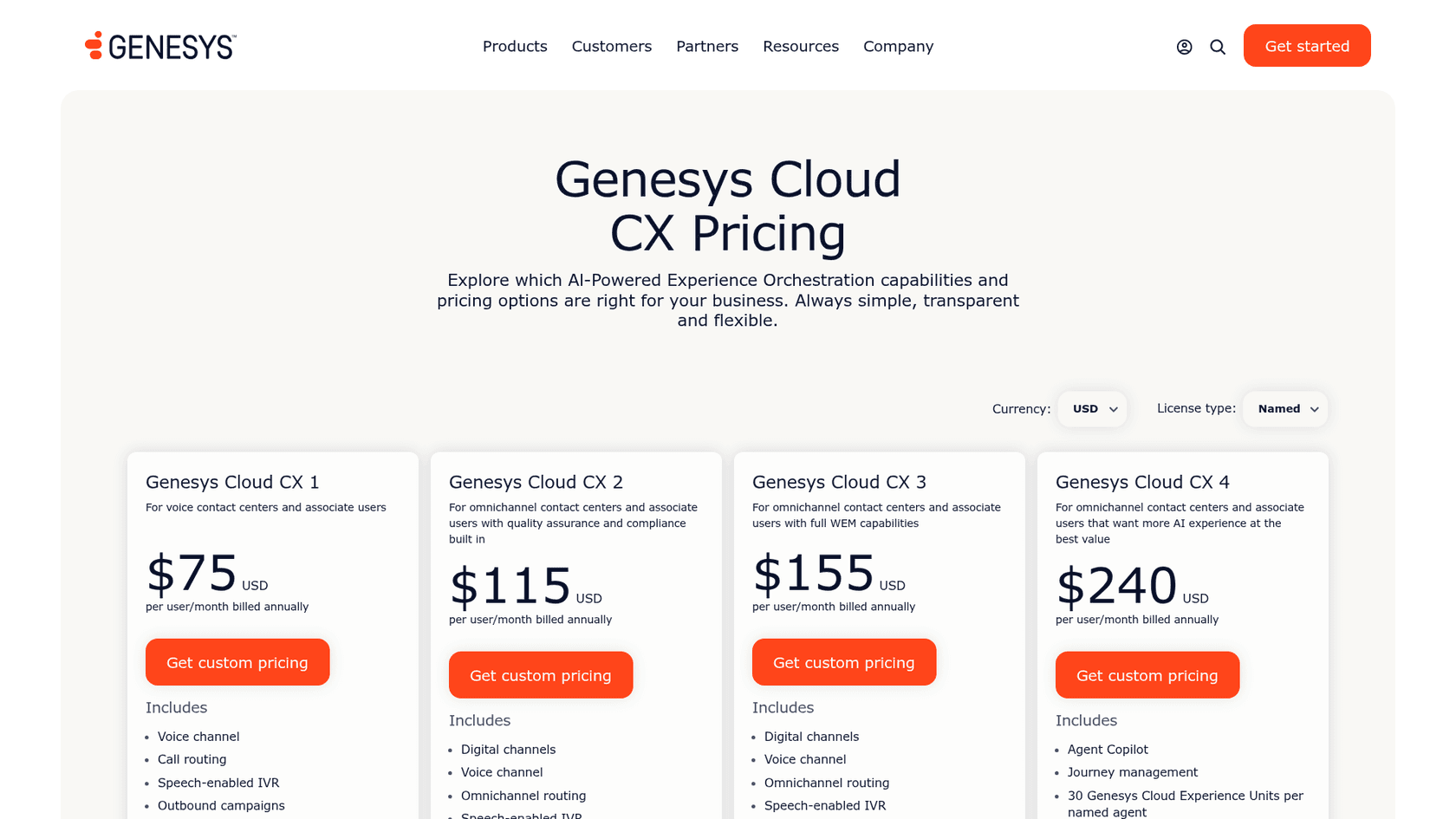
Genesys publishes the most complete rate card in the category: four tiers, eight currencies and three licence types. That is generous of them, and it makes Genesys the best reference point for how licence units change a bill.
| Tier | Named (per user/mo) | Concurrent (per user/mo) | Hourly | Positioning |
|---|---|---|---|---|
| CX 1 | $75 | $110 | $1.50 | Voice contact centers |
| CX 2 | $115 | $170 | $2.30 | Omnichannel, with quality and compliance |
| CX 3 | $155 | $230 | $3.10 | Omnichannel with full workforce engagement (WEM) |
| CX 4 | $240 | $360 | $4.80 | More AI included |
All prices are on an annual commitment, and the page adds that "usage-based pricing may apply" (Genesys pricing). AI runs on Genesys Cloud Experience Units: every org gets 250 a month on named licences or 350 on concurrent, CX 4 adds 30 per agent, and extra units are "purchased based on usage or at a discounted rate upfront" with no price shown. WEM and digital channels are add-ons on the lower tiers, also unpriced.
Dialpad Support
Dialpad sells its contact center as "Support", separate from its Connect phone plans. Voice and digital routing are both in the entry tier, which makes the $89 seat better value than its position in the table suggests.
| Plan | Annual | Monthly | What it adds |
|---|---|---|---|
| Essentials | $89 | $109 | Voice and digital routing, AI transcripts and recaps, screen recording, CC analytics |
| Advanced | $119 | $145 | Live Coach and Quality Management |
| Premium | $149 | Annual only | Workforce Management, admin and reporting APIs |
AI agents are sold separately on custom credit pricing, and the Dialpad pricing page says credits are only used when the AI looks something up or takes an action. My full Dialpad pricing breakdown goes plan by plan.
Talkdesk
Talkdesk splits its entry level by channel: Digital Essentials at $85 and Voice Essentials at $105, both per user per month. Voice plus digital means Elite at $165, which also brings workforce management and screen recording. Industry Experience Clouds start at $225. Every AI add-on (Copilot, Autopilot, Navigator, Interaction Analytics) is "contact sales", and the page doesn't say whether prices are annual or monthly.
There is one small-team route: Talkdesk Express, for US and Canadian businesses under 50 employees, with no contract and $100 of free credit, though the seat price is not shown.
That missing usage rate card is the part buyers notice. One support lead put it this way on Reddit:
"I'm looking everywhere for TalkDesk usage pricing but I find nothing. Apparently, you need to be an existing customer in order to access that info."

NICE CXone
NICE publishes five suites, each per agent per month, billed "monthly in arrears, no prepay" (NICE pricing). Voice and digital channels are included from the cheapest suite up.
| Suite | Price | Notable inclusions |
|---|---|---|
| Omnichannel | $110 | Voice and digital, omnichannel routing, recording |
| Essential | $135 | Adds workforce engagement and screen recording |
| Core | $169 | Adds quality management and workforce management |
| Complete | $209 | Adds performance management and voice of the customer |
| Ultimate | $249 + $0.25/session | Adds interaction analytics, automated summary, all three Copilots, AI agents for self-service |
On every suite below Ultimate, the Copilots, AI routing and AI agents are add-ons with no published price. NICE marks them "consumption based", so they meter on top of the seat.
Zendesk Suite
Zendesk is a helpdesk with a phone channel built in, which makes it the natural comparison for support teams whose tickets already live there. Suite Team is $55 per agent a month annually and includes calls, voicemail and group routing. Suite Professional at $115 adds IVR, call monitoring and barging, callbacks and overflow routing. Phone numbers and minutes are add-ons on both, and the full Contact Center add-on (advanced IVR, real-time transcription, call summaries) is $83 per agent a month. My Zendesk pricing guide covers the rest of the plan, and the digital vs external lines guide explains the phone setup.
Five9 and 8x8
Both are quote-only. Five9's launch post still describes five bundles: Digital, Core (all channels plus AI essentials), Plus, Pro (with a choice of WEM vendor) and Enterprise. But no price, unit or minimum appears anywhere live on its site. 8x8's pricing URLs return a "page doesn't exist" message, and its only calls to action are chat with sales or request a quote. That isn't unusual for enterprise software. It just means the first sales call should produce a written rate card, not a verbal range.
Phone-first call center tools
If your support team mostly needs queues, IVR and call monitoring, a call center phone system costs far less than full CCaaS. CloudTalk Expert is $49 per user (3-licence minimum) with live monitoring and wallboards, plus an 11% cost-recovery fee for US and Canadian billing. Aircall Professional is $50 with a 3-seat minimum. They don't carry email routing or workforce management, so they suit teams whose email already lives in a helpdesk.
If phones are most of your volume, my Aircall alternatives roundup compares the group, and the CloudTalk pricing post goes plan by plan.
Named, concurrent or hourly: which licence is cheaper?
A concurrent licence is cheaper whenever your peak logged-in headcount is well under your total headcount, which is true for most teams that work shifts. A named licence is one per person who can log in. A concurrent licence covers however many people are logged in at once, at a premium. Genesys says plainly that "a premium is charged for concurrent user licenses", and on its rate card that premium is about 1.5x.
Take 30 agents covering three shifts, with 10 logged in at any moment, on Genesys CX 1:
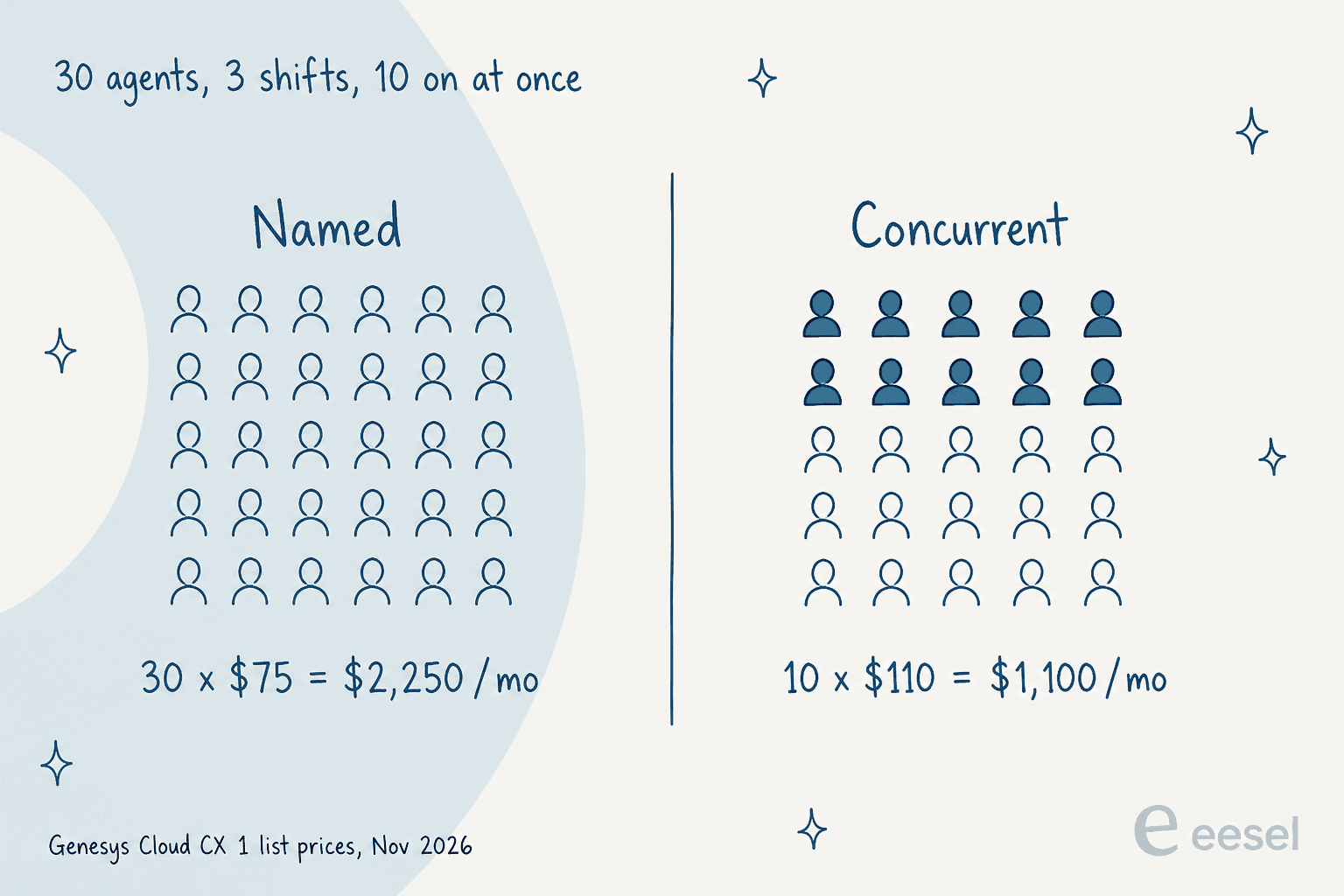
Named costs 30 x $75 = $2,250 a month. Concurrent costs 10 x $110 = $1,100. Same team, half the bill, and nothing about the vendor or the tier changed. Flip it to a single-shift team of 12 where all 12 are on at once and concurrent costs $1,320 against $900 named. Genesys also says named and concurrent "may not be mixed", so you pick one model for the whole org.
The hourly licence ($1.50 an hour on CX 1) is built for occasional users: a back-office team that takes overflow calls a few hours a week. Before you choose, pull a month of real login data. A forecasting pass on your own queue beats any vendor's sizing worksheet.
When does pay-per-minute beat a seat?
Amazon Connect is the outlier in this market: no seats, no minimums, no contracts. Its Connect Customer plan charges $0.038 per voice minute with AI features bundled, plus telephony. AWS's own examples put a US phone number at $0.030 a day and inbound calling at $0.0022 a minute. Chat is $0.010 per message and email $0.080 per email. A cheaper Customer Basic plan charges $0.018 a minute, with AI and analytics billed separately.
So the real question is talk time. At about 4 cents a minute all in, here is where pay-per-minute crosses a flat seat:
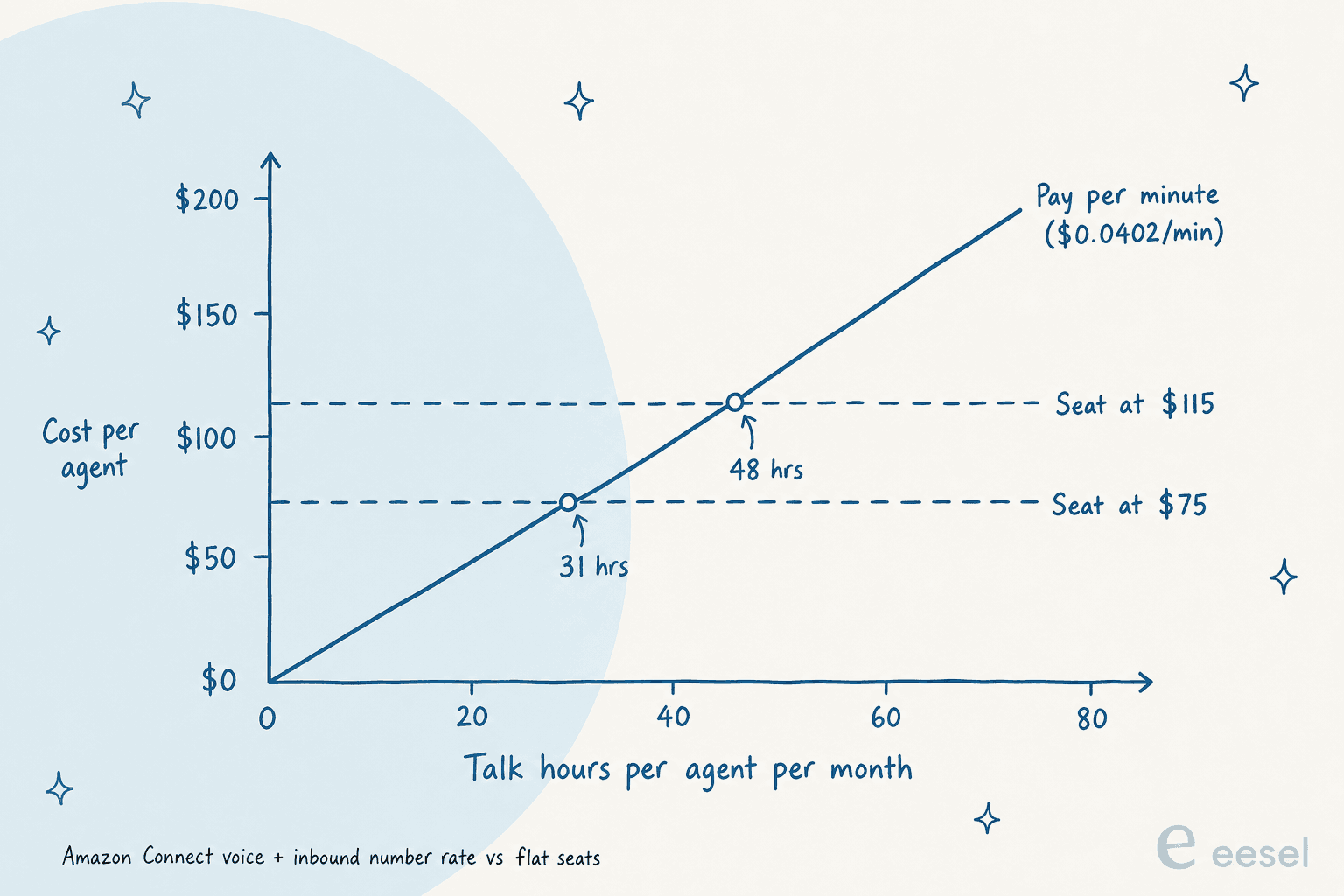
Below about 31 talk hours per agent a month, Amazon Connect is cheaper than a $75 seat, and below about 48 hours it beats a $115 seat. A full-time phone agent at high occupancy talks well past that. A support team where phones are one channel among several often doesn't. AWS's own worked example: 75 agents handling 100,000 voice minutes, 50,000 chat messages and 20,000 SMS a month comes to $4,800.90, or about $64 per agent.
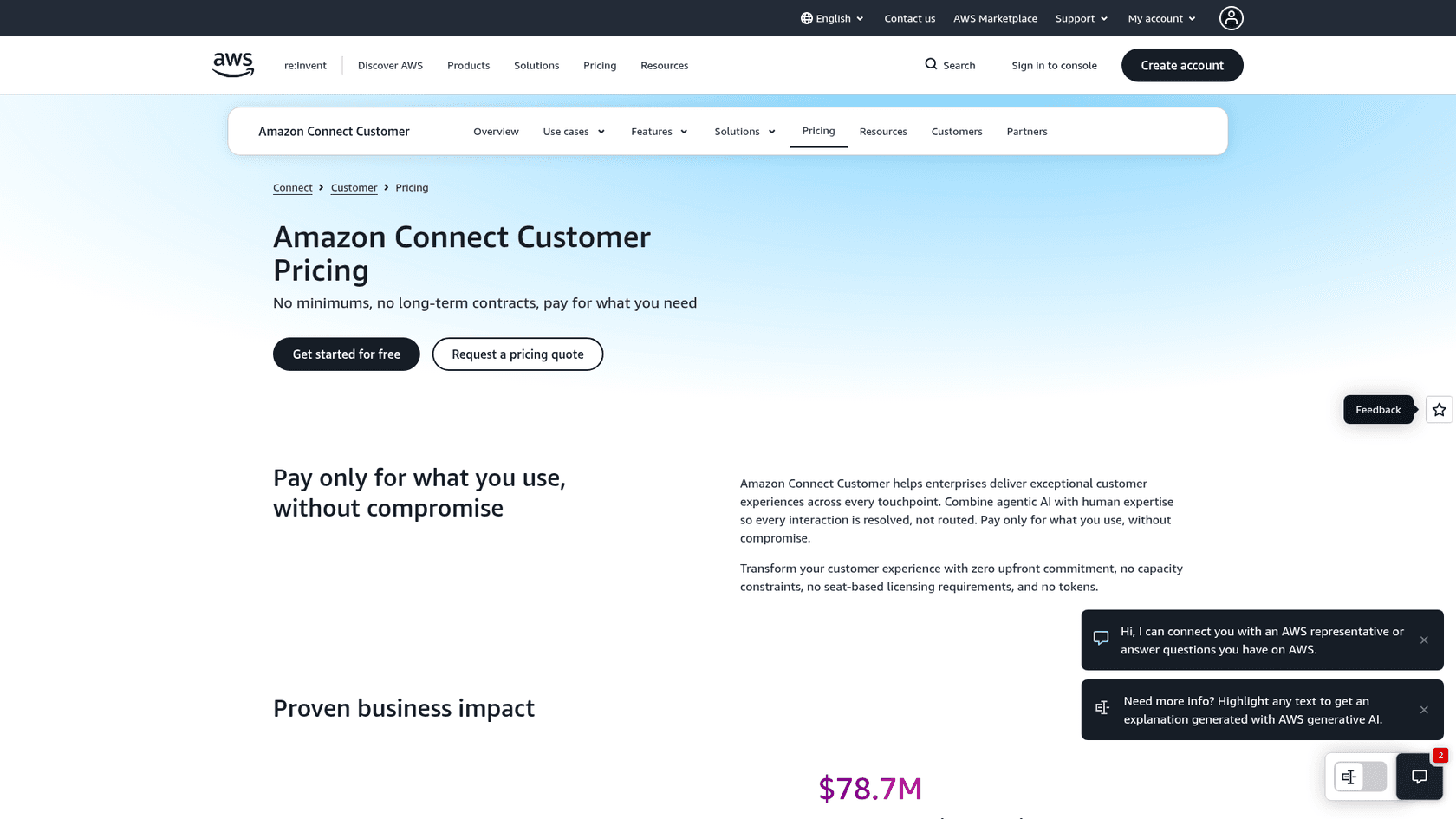
The tradeoff isn't price. Amazon Connect is a build-it-yourself platform: you assemble flows, integrations and agent desktops in AWS, or pay a partner to. A packaged CCaaS seat buys you that setup work up front. Budget for the engineering time honestly before you call the per-minute rate a saving.
What would your support team pay per month?
Here is the same comparison as a calculator. Put in your own headcount and talk time to see seat costs side by side with the per-minute option.
At the defaults (20 agents, all on at once, 40 talk hours each), CloudTalk's phone-only Expert plan is lowest at $1,088 a month, RingCX Standard is the cheapest full CCaaS seat at $1,300, and Amazon Connect is about $1,930 in usage. Drop talk time to 20 hours and Amazon Connect falls to roughly $966, below every seat-based full CCaaS option. Set peak to 8 of 20 and Genesys CX 2 concurrent drops from $3,400 to $1,360, under its own named price of $2,300.
What hidden fees come with CCaaS pricing?
The fees that surprise teams are almost never on the plan cards. These are the ones to get in writing:
- Telephony on seat plans. Zendesk sells numbers and minutes as add-ons, with per-minute rates by country in a help center article. Genesys covers bring-your-own-carrier minutes, IVR minutes and API calls under a fair use policy that "90% of customers" stay inside, with "competitive rates" above it.
- AI units. Genesys Experience Units, NICE's per-session charge and consumption-based Copilots, Dialpad's AI agent credits and Talkdesk's AI add-ons all sit outside the seat price. Only NICE Ultimate's $0.25 per session is actually published.
- Add-ons sold by quote. Workforce management, quality management and digital channels are add-ons on lower tiers at Genesys, NICE and Talkdesk, and none of them publish the add-on price.
- Regional fees. CloudTalk adds an 11% cost-recovery fee on the software subscription for US and Canadian billing.
- Minimums and terms. Genesys prices on annual commitment, Dialpad Premium is annual only, CloudTalk Expert and Aircall need 3 licences, and Five9's last published terms carried a 50-seat minimum.
Workforce teams feel the add-on line most. A Genesys user in a workforce management thread:
"My favorite part is basic features you’d see free in Assembled, have to be purchased extra or built out yourself with the API."
The last one is the most expensive mistake. An annual contract sized for this year's peak is a fixed cost through next year's slow season.
Renewal clauses deserve the same attention. A sysadmin on a RingCentral contract described the surprise:
"My biggest gripe is that I signed up for a 2 year contract. When that contract expired, they renewed the contract for the ENTIRE TERM. In other words, I am locked in for another full TWO YEARS."
Evergreen renewals are common across enterprise software, so this isn't unique to one vendor. Read the notice window before you sign. If you're writing a vendor brief, my RFP template and evaluation checklist both have a line for each of these. The guide to vendor lock-in covers what to negotiate before you sign.
Do you need omnichannel seats for your email queue?
Often not, and this is where I'd look for the biggest saving. The jump from voice-only to omnichannel is large on every rate card that splits them: Talkdesk goes from $105 to $165, and Genesys from $75 to $115. Across 20 agents that is $1,200 and $800 a month respectively, paid so the contact center can also route email and chat.
If your email and chat already live in a helpdesk like Zendesk, Freshdesk or Gorgias, you may be paying for that routing twice. A common setup I see on support teams that run both: phones on a contact center or call center tool, sized only for the people who take calls, and written tickets in the helpdesk. That is where an AI teammate does most of its work. My omnichannel vs multichannel explainer covers when one platform is actually worth it.
That is the job I'd give eesel. It joins your helpdesk like a new hire, learns from your past tickets and help center, and drafts or sends replies on the written queue, so fewer of your people need a seat that does everything. Lesson Pro runs it across a family of lesson brands in Zendesk: in one month it worked 1,900 tickets, left 1,700 internal notes and drafted 560 replies for the team to send. Voicemails are skipped on purpose and left to people. XAP on Freshdesk does the same with tickets logged from a phone call, which go to the team. That is the honest boundary: eesel is the teammate on the written queue, not a replacement for your phone system.
eesel can also answer live calls and transfer to your team, but the eesel team sets that up with you rather than it being self-serve, and on a call it only looks things up (phone calls docs).
Pricing is by volume rather than seat: eesel's plans start at $299 a month for 500 tickets or chats, with unlimited agents on every plan. That compares cleanly with a per-seat line in your budget. My cost per ticket benchmarks and cost per resolution posts show how to price the written queue on its own.
And if the real question is whether to run support yourself at all, Managed Support is a flat $5,000 a month for every channel, phone calls included, inside your own tools. My outsourcing cost guide compares that with an agency.
How do you pick the right CCaaS plan?
Start from your call data, not the vendor's tier names. Here's the order I'd work through it:
- Measure peak concurrency and monthly talk hours per agent. Those two numbers decide named vs concurrent and seat vs per-minute before any demo.
- Split channels. Decide whether email and chat move into the contact center or stay in your helpdesk. That one choice decides voice-only vs omnichannel tiers.
- Price one stated team across three vendors. Use the calculator above, then ask each vendor to quote the same team with telephony, AI usage and add-ons written in.
- Ask what AI costs per unit. Get the unit (session, minute, token, credit) and the rate. "Included up to fair use" needs a number.
- Check the exit. Term length, renewal uplift and what happens to your recordings if you leave.
For the wider picture, my guide to call center technology covers the stack, and AI for phone support covers what to layer on top.
Once it's live, the call center ROI guide shows how to prove the spend, and call center automation covers the next wins.
Try eesel on the written side of your contact center
If your phones sit in a contact center and your email and chat sit in a helpdesk, eesel is the AI teammate for the helpdesk half. It plugs into Zendesk, Freshdesk, Gorgias and more in minutes, learns from your past tickets, and works the written queue so your contact center seats only cover the people on calls. You can test it against your real tickets first, and it starts free.