


Yes, AI can carry a big part of reseller support: order status, activation steps, warranty policy and known fixes, plus the first pass on every technical escalation. The bigger win is less obvious: most reseller tickets aren't hard, they're incomplete. The question has travelled from the end customer to the reseller to you, and the serial number, purchase date and error text got lost on the way. An AI that collects those and checks the record before a person opens the ticket saves more time than one that only answers FAQs.
Keep four things human: RMA approvals, license transfers, order changes and anything to do with price. The AI's job there is to hand your team a case that's ready to approve.
If your reseller tickets land in Zendesk, Freshdesk or Salesforce, eesel works as an AI helpdesk teammate that does exactly this: it drafts the reply, looks up the order or license, and holds anything irreversible for approval. IC Intracom, which makes networking gear sold through resellers, runs it on 2,100 product records so a reseller asking about a part number at 9pm gets the spec sheet answer without waiting for the office to open.
Can AI help you support your resellers?
It can, and the reason it fits so well is the shape of the ticket. I work the support queue every day, and a reseller ticket is a different animal from a direct customer ticket. It's second-hand. The end customer told the reseller something, the reseller summarised it, and by the time it reaches your desk it says "unit not working, please advise."
Most vendors describe the setup the same way: the reseller is your first line of support and your team is the second line. That's right, and it's also the problem. Your second line spends its first reply asking for things the first line should have sent.
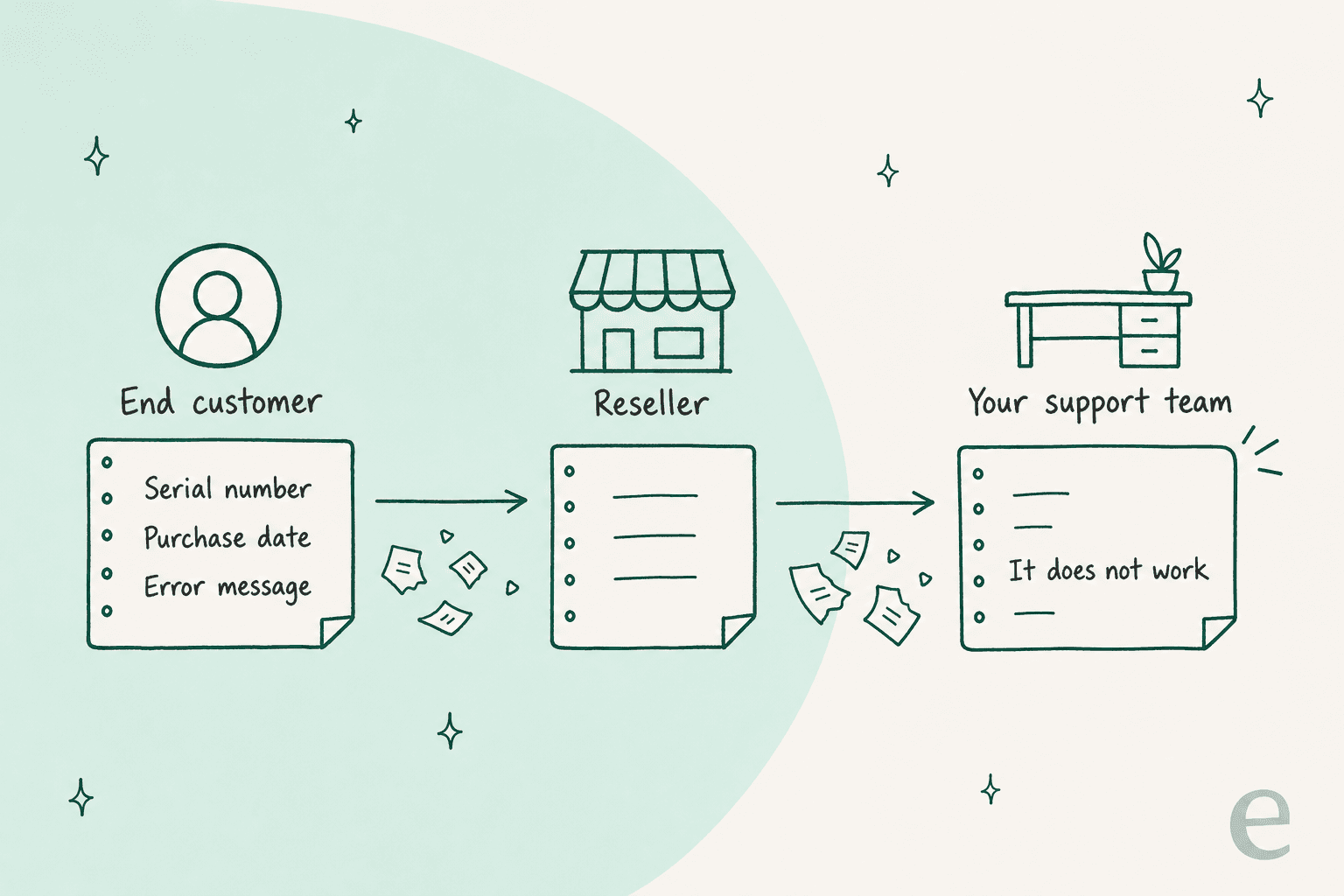
That's where AI earns its keep. It reads the ticket the moment it lands, works out what kind of request it is, checks what's already on file and asks the reseller for whatever is still missing. When a person finally opens it, the case is complete.
Some vendors also give resellers a direct line to the AI: a chat on the reseller portal or the website that answers spec, stock and how-to questions at any hour. IC Intracom does this on its two brand stores, and notes that the person asking about a PoE extender or a quote for a thousand units "is often a reseller or an IT team with a deadline." Both approaches work. Most teams I talk to start inside the helpdesk and add the reseller-facing chat later.
Which reseller questions can AI handle?
Reseller tickets sort into four kinds, and each one splits into the same three lanes: what AI can answer from documents, what it can check in a live record, and what a person has to decide.
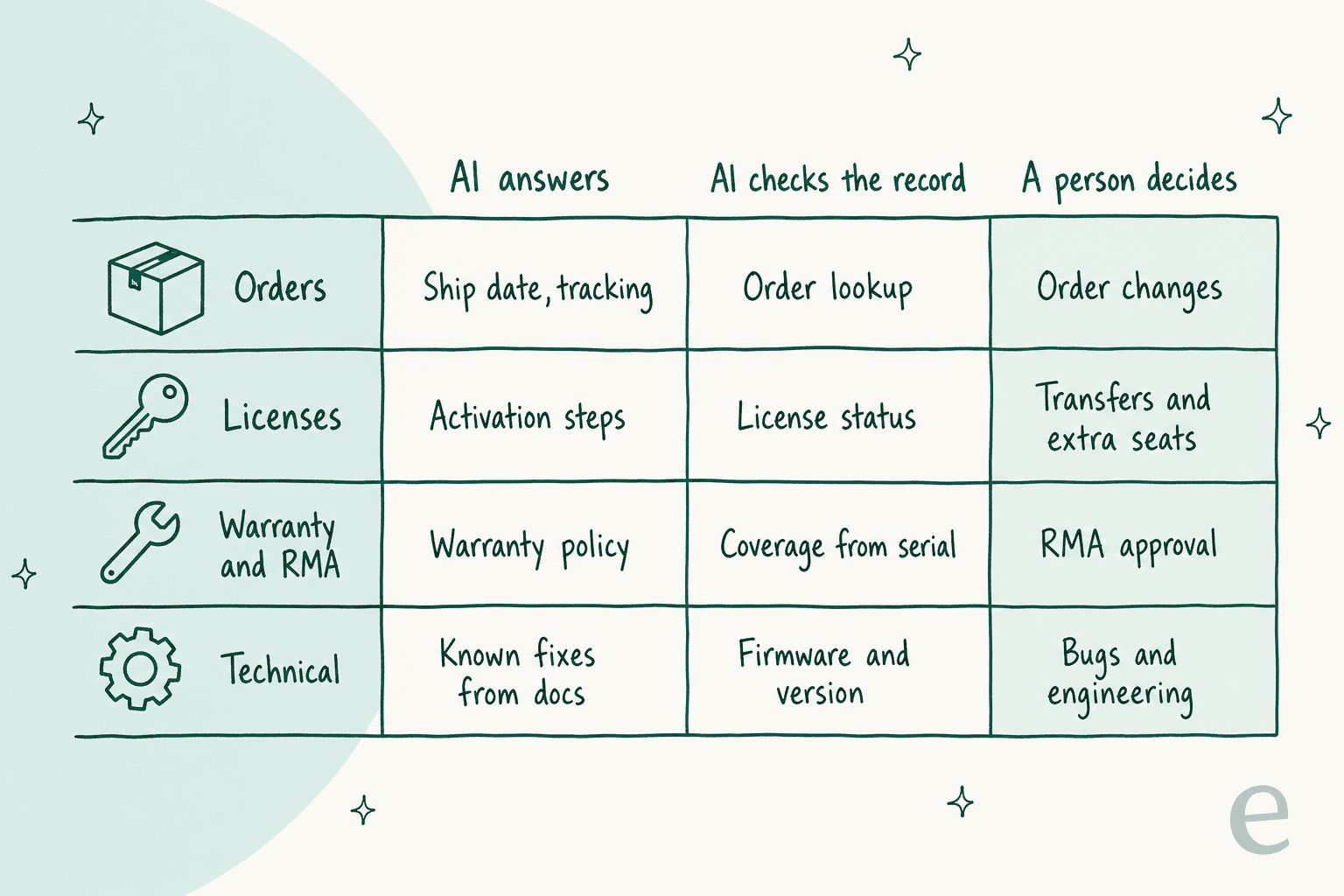
| Ticket type | AI answers from docs | AI checks in the record | A person decides |
|---|---|---|---|
| Orders | Lead times, shipping rules, how to order | Order status, tracking, invoice | Order changes, cancellations, credit |
| Licenses | Activation steps, renewal process | License status, seats used, expiry | Transfers, extra seats, exceptions |
| Warranty and RMA | Warranty terms, what an RMA needs | Coverage from serial and purchase date | Approving the RMA, goodwill replacements |
| Technical | Known fixes, firmware notes, compatibility | Product version, past tickets on that unit | Bugs, engineering escalations |
The left column is the easy win. It's the same work as any AI knowledge base setup: point the AI at your manuals, spec sheets and past tickets, and it answers the reseller in their own words.
The middle column is where reseller support gets interesting, because the answer lives in a system, not a document. "Has order 4412 shipped?" needs your order system. "Is this unit still under warranty?" needs the serial number matched to a purchase date. An AI that can only read your help center will politely say it doesn't know. One that can read the record answers in seconds.
The right column never moves to the AI. I'll come back to why in the what to keep human section.
Why do reseller tickets arrive incomplete?
Because every hop drops detail. The end customer knows the serial number but not that you need it. The reseller knows you need it but is juggling 40 brands and sends what they have. Google's own Workspace support lead put the split plainly when a customer asked why they couldn't reach Google after moving to a reseller:
"Your reseller is responsible for your billing so you will need to contact them for any questions or issues related to billing or your subscription such as your charges, changing editions, or adding users."

Every vendor draws that line somewhere, and every ticket that crosses it loses context. The same thread has the other side of it: a good reseller often knows the customer's setup better than the vendor ever will.
"Depending on the quality of your reseller they often have more context and general industry knowledge than the direct support route."
So the fix isn't to bypass the reseller. It's to make the ticket they send you complete, every time, without your team chasing it. Here's the checklist I'd give the AI for each ticket type. Pick one to see what it should collect, what it can look up on its own, and where it stops.
What should the AI collect before a person sees the ticket?
Choose the reseller's request type.
- Order or PO number
- Reseller account name
- What they need: status, change or invoice
- Order status and ship date
- Tracking number
- Whether the order belongs to this reseller
- Changes or cancellations
- Credit notes and pricing
- Orders under another account
- License key or reference
- Product and version
- Exact error text
- License status and expiry
- Seats used vs bought
- Activation steps for that version
- Transfers to a new device or customer
- Extra seats or extensions
- Anything that changes the license
- Serial number
- Invoice or purchase date
- Photos and steps already tried
- Coverage from serial and date
- Warranty terms for that product
- Earlier RMAs on the same unit
- Approving the RMA
- Out-of-warranty goodwill
- Repeat failures on one batch
- Product, model and firmware
- The customer's setup
- Error text, logs, what changed
- Known fixes in docs and past tickets
- Release notes for that version
- Open issues on the same symptom
- New bugs for engineering
- Anything needing remote access
- Outages affecting many resellers
Zendesk's own pricing hints at how much this first pass is worth. Under the automated resolution tiers it introduced on May 18, 2026, an "assisted escalation", where the AI collected data or did routing before a human resolved the ticket, doesn't count against your resolution allowance. Zendesk is telling you case-completion is a normal, expected job for an AI agent, not a failure to resolve.
How should AI handle warranty claims and RMAs?
This is the ticket type where the case-completer idea pays off the most. An RMA request from a reseller usually arrives as a single line. Turning it into something your returns team can approve takes four or five back-and-forth emails, each one a day apart because the reseller has to go back to their customer.
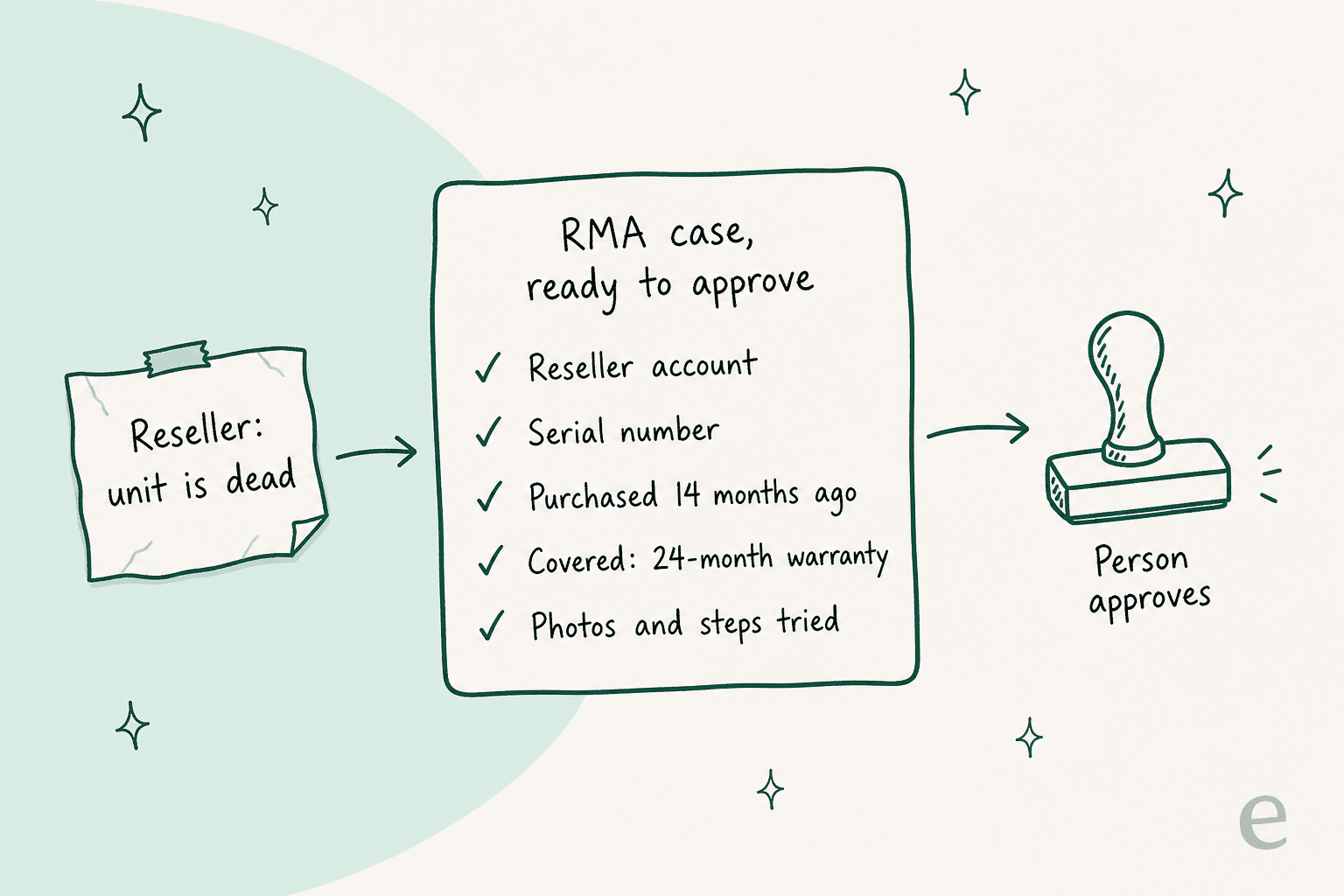
Here's what the AI should do, in order:
- Identify the reseller account from the sender, so everything after this is checked against their orders only.
- Ask for the serial number and invoice if they aren't in the message. Most of the time they aren't.
- Match the serial to a purchase date in your order or warranty system, and compare it with the warranty term for that product.
- Run the one or two checks your team always runs first, like a reset or a cable swap, and record the result.
- Write the case as an internal note with everything above, and route it to whoever approves RMAs.
Innr, the smart lighting company, set its rules up this way on Freshdesk. A lamp that stops working after days or weeks is treated as a hardware issue, not a setup problem: one quick test, then the return process, asking for the order number as proof of purchase. Warranty claims go to a person with a note that says why and what's needed. IC Intracom sends returns to its RMA form with a reminder to have the invoice ready.
What the AI shouldn't do is approve the RMA. A goodwill replacement on a unit two months out of warranty might be the right call for a reseller who moves a lot of your stock, and that's a judgement about the relationship, not the ticket. For the full returns workflow, see my notes on AI for warranty claims and returns management.
How does AI handle license activations and transfers?
License tickets are the cleanest split of the four. The classic example: a reseller's customer gets "license already activated" because the key is still tied to an old computer. The AI can explain what that error means, check the license status and tell the reseller the key is bound to one device. It shouldn't move the license.
| Request | Who handles it | Why |
|---|---|---|
| "How do I activate on version 4.2?" | AI | Documented steps, same for everyone |
| "Why is the key rejected?" | AI, with a lookup | Status and seat count are in the license record |
| "When does this expire?" | AI, with a lookup | Read-only field |
| "Move this license to the new PC" | Person, AI prepares it | Changes who holds the license |
| "Can we get five more seats?" | Person | It's a sale, and margins differ per reseller |
To get the middle rows, the AI needs read access to wherever licenses live. If that's an internal system with an API, eesel's network access lets the agent call it with an authentication header you set, so the key never sits in the prompt. If licenses live in your CRM, the Salesforce or HubSpot integration reads the record directly.
Whose customer is it, the reseller's or yours?
The reseller's, for support purposes, even when you could technically reach the end customer. This sounds like a channel-management point, not a support one, but it shapes how you configure the AI.
Three rules I'd set on day one:
- Reply to the account that opened the ticket. If a reseller writes in about their customer, the answer goes to the reseller. An AI that helpfully emails the end customer directly has just gone around your partner.
- Only show a reseller their own records. Order details, license lists and RMA history belong to the account that bought them. IC Intracom gives order details only to the person who placed the order, and asks for the email the order was placed under first.
- Make each reseller an organization in your helpdesk. It's the plumbing that makes the other two rules work. Zendesk calls these organizations; Freshdesk calls them companies.
If your distributor also runs Zendesk, it's worth knowing Zendesk lists ticket sharing between multiple Zendesk accounts on its plan grid. A distributor's ticket can arrive in your queue with its history, instead of being retyped into an email. There's more on that in my guide to Zendesk ticket sharing.
Partners notice when vendors get this wrong. On r/msp, one MSP owner described the first months with a new vendor's product as the point where you "have to fight with the poor support," and another said the MSP world is small enough that a vendor who burns its partners runs out of them.
"The MSP world is small, there isn't a lot of new ones, so once you burn them all your business is dead."
What should AI never do in reseller support?
Anything that commits you to something. The rule I use: if a person would need a manager's sign-off to do it, the AI needs a person's sign-off too.
- Approve RMAs or replacements. Collect, check and prepare, then stop.
- Transfer, extend or add licenses. Explain and look up, never change.
- Change or cancel orders. Order changes ripple into invoicing and stock.
- Quote prices or discounts. Reseller pricing often differs per account and per deal. The partner support guide covers how to keep one reseller's price list away from another.
- Promise a fix date for a bug. Engineering owns that answer.
This doesn't mean the AI goes quiet on those tickets. It means the action waits for a person. In eesel, every action is set to run on its own, ask first, or stay off, per agent, as the actions and approvals docs explain. You can start with every reply on "needs approval" and move routine order lookups to auto once the drafts are consistently right.
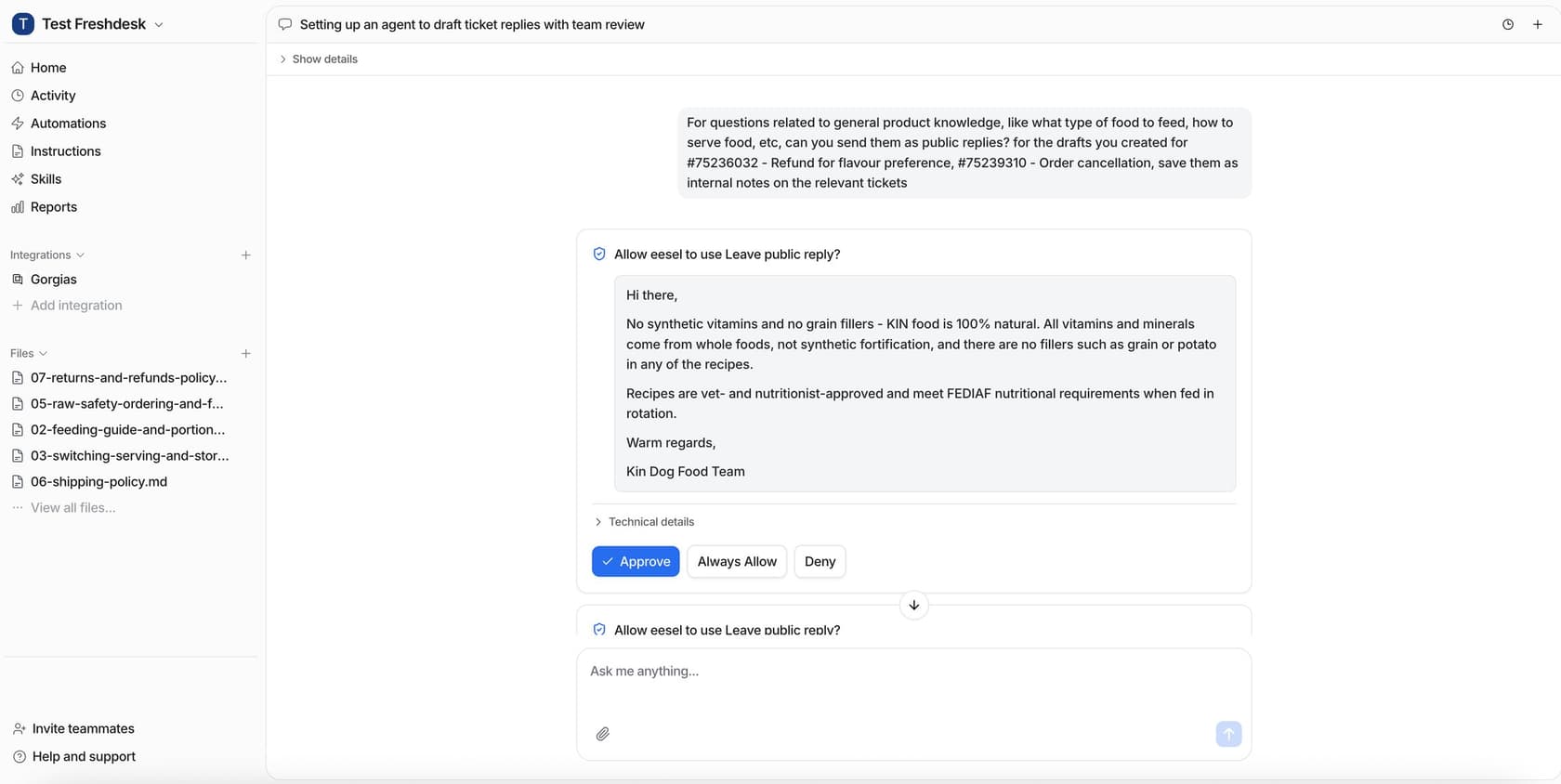
A drafted reply waiting for approval in eesel. The same card shows up in Slack if the run started there.
Which tools do you need for AI reseller support?
You need three things: a helpdesk that groups tickets by reseller account, a place your documents live, and an AI that can read both plus your order or license records. The tools buyers usually shortlist are Zendesk, Freshdesk, Salesforce Agentforce, Pylon and Plain, which is a fair spread. Here's how they price out for one buyer: a 5-agent team handling 600 reseller tickets a month, using list prices on each vendor's own pricing page.
| Tool | List price (5 agents) | How the AI is billed | 600 tickets a month, roughly | Good fit when | Source |
|---|---|---|---|---|---|
| Zendesk Suite Team | $55/agent/month annual = $275 | 5 automated resolutions per agent included, then $1.50 committed or $2.00 pay-as-you-go | $275 + $187.50 if AI fully resolves 150 tickets = about $463 | Resellers are organizations, distributor also on Zendesk | Pricing |
| Freshdesk Pro | $55/agent/month annual = $275 | 500 AI Agent sessions included, then $49 per 100; Copilot $29/agent | $275 + $49 + $145 Copilot = about $469 | Email-heavy reseller queue | Pricing |
| Salesforce Agentforce | Service Cloud seats on top | $2 per conversation, or Flex Credits at $500 per 100k | $1,200 in conversations, plus Service Cloud seats | Orders and licenses already live in Salesforce | Pricing |
| Pylon Professional | $89/seat annual = $445 | Credits, $0.30 each pay-as-you-go, sized by sales | $445 plus credits | Resellers talk to you in Slack or Teams | Pricing |
| Plain Foundation | $45/user/month annual = $225 | 1,000 credits a month included | about $225 | Technical resellers, Linear or Jira escalations | Pricing |
| eesel | No seat fees | 1 credit per ticket; $499/month for 1,000 credits | $499, on top of your current helpdesk | You want to keep your helpdesk and add the AI teammate | Pricing |
A few notes so the comparison is fair. The Zendesk figure assumes the AI fully resolves a quarter of tickets; resolve more and it climbs by $1.50 each. The Freshdesk sessions are defined per conversation window, so a long back-and-forth is one session. Pylon doesn't publish credits per ticket, so I can't price it end to end. And eesel isn't a helpdesk, it works inside the one you already pay for, so its line is an add-on cost. Prices come from each vendor's own pricing page, checked November 1, 2026.
My take: if your resellers already email a Zendesk or Freshdesk queue, don't move helpdesks to get AI. The helpdesk's built-in AI is strongest on answering from your help center. What reseller support needs most is the middle lane, looking up the order, license or serial in another system, and that's where an add-on that reads across your tools pulls ahead. For a wider list of options, I compared tools in my best AI for B2B support roundup.
How do you set up AI for reseller support?
Plan on two to four weeks for a careful rollout, most of it spent on the checklists, not the software. My implementation timeline guide has the week-by-week version.
- Make every reseller an organization or company in your helpdesk, with the account ID that matches your order system. Without this the AI can't tell which records it's allowed to show.
- Write the checklist for each ticket type. Use the four in the widget above as a starting point and add your own required fields. This is the single most useful page you'll write.
- Connect the knowledge. Manuals, spec sheets, warranty terms, release notes and, most valuable of all, your past reseller tickets. Past tickets carry the answers your team actually gives.
- Give read access to the records. Order system, license database, warranty data. Read-only at first.
- Start on drafts and internal notes. The AI writes, a person sends. Watch which ticket types it gets right.
- Test on history before going live. Run it against a few hundred past reseller tickets and compare. My simulation testing guide covers how many you need per topic.
- Move routine lookups to auto. Order status and activation steps usually go first. RMAs and transfers stay on approval.
Beautek, a B2B equipment supplier in Germany that stocks other brands, shows the reseller side of this working. It connected Zendesk, Notion, Google Drive and its website in May 2026, and its agent answers from about 6,100 web pages across its own site and the sites of the brands it stocks. Order questions get an identity check before eesel reads the order, and complex orders or parts problems go straight to a person in Zendesk. In one month it drafted 110 Zendesk tickets for the team.
Is AI for reseller support worth it?
For most vendors with more than a handful of resellers, yes, and not mainly because of the tickets it closes. The bigger saving is the tickets it doesn't let reach a person half-finished. Every "can you send the serial number?" email costs a day of the reseller's time and a slot in your team's queue, and an AI can send it in the first minute.
It's less worth it if your reseller volume is a few tickets a week, or if your order and license data sits in spreadsheets the AI can't read. In that case, start with the knowledge side only and add the lookups when the data has a home. If your partner questions are mostly about tiers, margins and deal registration, read the partner support guide first, because that's a different set of risks. For escalations into engineering, the tier 2 support guide goes deeper.
Try eesel on your reseller queue
eesel is an AI helpdesk teammate that joins the queue you already run in Zendesk, Freshdesk or Salesforce. On a reseller ticket it works out the request type, asks the reseller for the serial or license key that's missing, looks the order or warranty up, and leaves your team a complete case with a draft reply. RMAs, transfers and order changes wait for your approval.
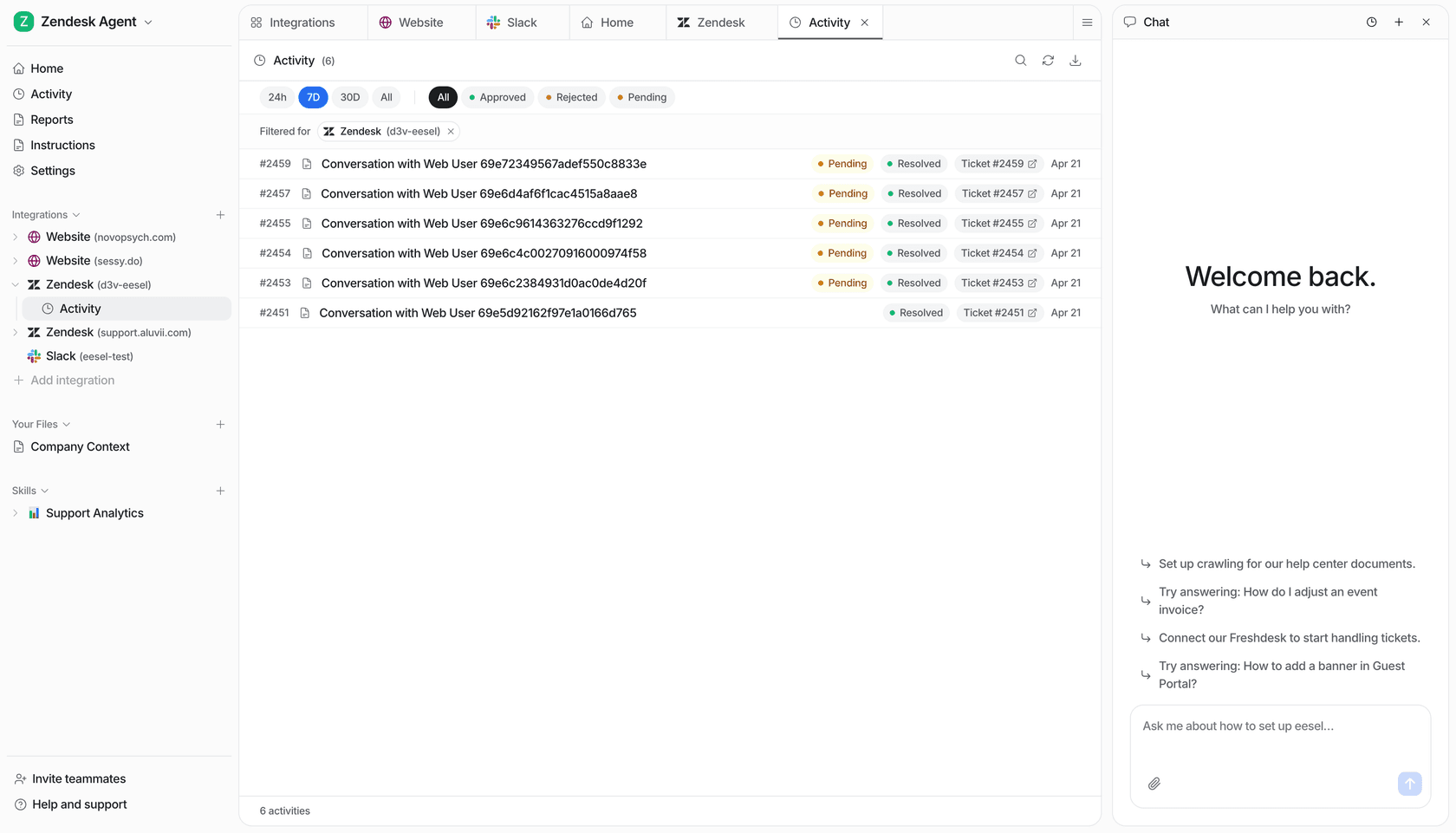
It's what IC Intracom uses to answer resellers from its product catalogue at any hour, and what Innr uses to prepare 190 Freshdesk tickets a month, warranty claims included, for a person to send. You pay per ticket, not per seat, starting at $299 a month, with a 7-day trial on 100 free credits. Try eesel on a week of your reseller tickets and see how many arrive complete.