
Why small businesses outgrow Zoho Desk
Let me be fair to Zoho first, because the reasons people choose it are real. It's one of the cheapest serious helpdesks on the market: a real free plan for 3 users, paid tiers from $7/agent/month, and a Reddit reputation as "almost everything that Zendesk does at like half the cost." Its automation engine (Blueprint, SLAs, assignment rules) is legitimately strong, and if you already run other Zoho apps, the suite integration is hard to beat.
So why do small teams leave? Two patterns show up over and over.
The first is the UI. Zoho Desk is dense. G2 has 112 reviews tagged "learning curve" and 68 tagged "complexity," and the sentiment is echoed on Reddit, where one user put it plainly: "I personally feel zohodesk is flooded with features and makes it difficult for me after using it." For a 3-person team, a platform built to scale to 450 departments is a lot of furniture to move around.
The second is the AI, and this is the one that matters most in 2026. Zoho's assistant, Zia, gets rough reviews from the people using it:
"Zoho may need to rebrand any forthcoming intelligence features. Zia is so poor that I'm hesitant to use any 'ai' that is branded as Zia."
Reddit user in r/Zoho, surfaced via checkthat.ai's review aggregation of r/Zoho threads
Even the gentler takes land in the same place. A user who actually tried Zia's ticket features wrote that "the summary for a ticket is ok but struggles when there is a lot of content." And the AI that does deflect tickets (Answer Bot, sentiment analysis, auto-tagging, field predictions) is gated to the Enterprise plan. So the SMB that represents Zoho's core market gets the basic AI, and the real stuff costs $40/agent/month.
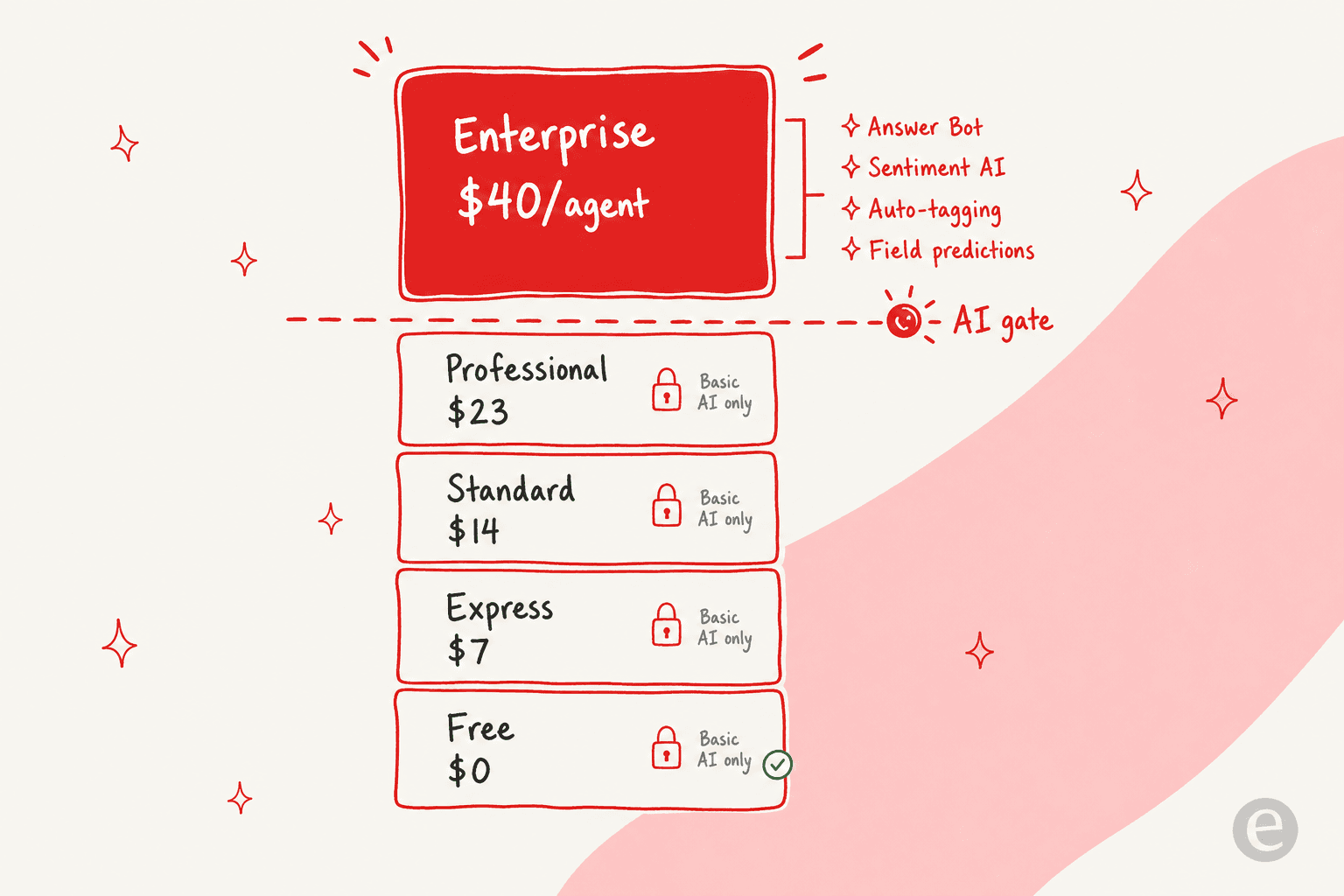
That gate is the real story. I've watched a confident-sounding bot quietly give wrong answers, which is why every rollout we run gets simulated against historical tickets before it goes live. The lesson that stuck: the AI layer is the whole game now, and if it's weak or paywalled, the rest of the helpdesk's price advantage stops mattering. That's the lens I used to rank everything below.
How I picked these
Quick on methodology, so you know what the verdicts are based on. I read each vendor's own pricing, docs, and product pages, pulled real user voice from Reddit, G2, and Capterra, and weighed five things a small team actually feels:
- Real total cost, including how AI is billed (this is where the surprises live).
- Time to value, because a 3-person team can't spend three weeks configuring.
- AI quality, specifically whether it learns from your past tickets, not just your help docs.
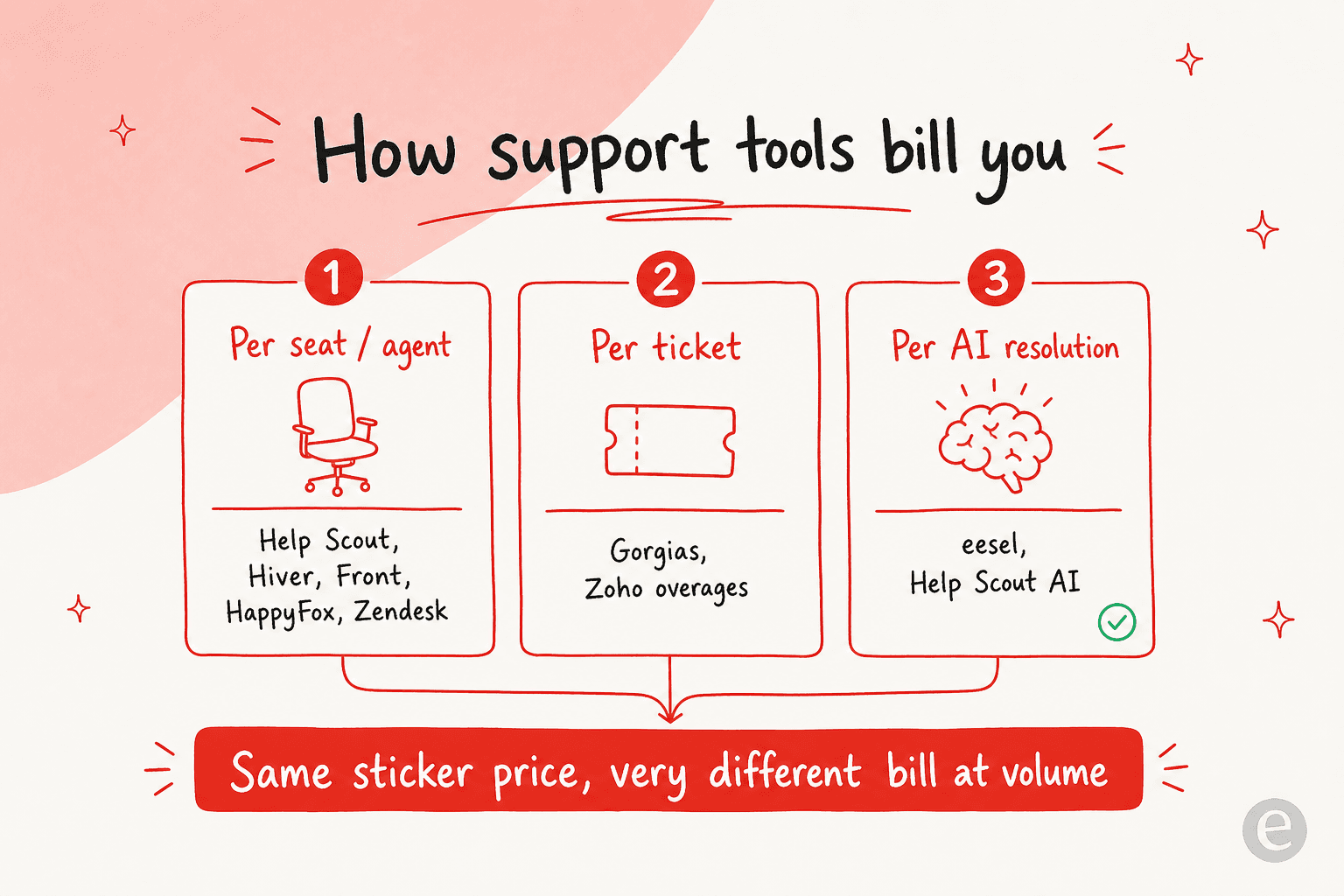
- The billing unit, since "per seat" vs "per ticket" vs "per resolution" changes the bill more than the sticker price does.
- A free or low-cost on-ramp.
A note on scope: I focused on the tools small businesses realistically evaluate against Zoho Desk. For deeper one-to-one matchups, we have full breakdowns like Zendesk vs Zoho Desk, Freshdesk vs Zoho Desk, and Gorgias vs Zoho Desk.
The 8 best Zoho Desk alternatives at a glance
| Tool | Best for | Starting paid price | How AI is billed | Free tier | Security |
|---|---|---|---|---|---|
| eesel AI | Adding AI to the helpdesk you already have | Usage-based, from $0.40/ticket | Per task, no per-seat fee | $50 free usage trial | EU residency, HIPAA/BAA (Enterprise) |
| Help Scout | Relationship-first small teams | $25/user/mo | $0.75 per AI resolution | Yes (up to 5 users) | Not published in this pass |
| Freshdesk | A free starting point that scales | $19/agent/mo | $49 per 100 sessions (after 500 free) | Free for 1-2 agents, 6 months | Not published in this pass |
| Hiver | Teams that live in Gmail | $25/user/mo | Bundled from Growth up | Yes (free forever) | SOC 2 Type II, ISO 27001, HIPAA |
| Gorgias | Shopify and ecommerce stores | $10/mo (50 tickets) | $0.90-$1.00 per resolution | No (paid only) | GDPR, CCPA, SSO |
| HappyFox | Value across support and IT | $21/agent/mo | $14-$29/agent/mo, or $0.02/task | No (demo-led) | SOC 2 Type II, HIPAA, GDPR |
| Front | Collaborative, multi-team ops | $25/seat/mo | Add-ons from $0.05/conversation | No (14-day trial) | Not published in this pass |
| Zendesk | Teams planning to scale up fast | $19/agent/mo | Per automated resolution (add-on) | No (trial only) | Trust Center (specifics not public) |
A quick reading note before the deep dives: the "starting price" column is the trap. The number that actually decides your bill is the AI billing unit in the next column, which is why I broke it out separately.
1. eesel AI: best for adding AI to the helpdesk you already have
Best for: small teams who don't want to rip out their helpdesk just to get AI that works.
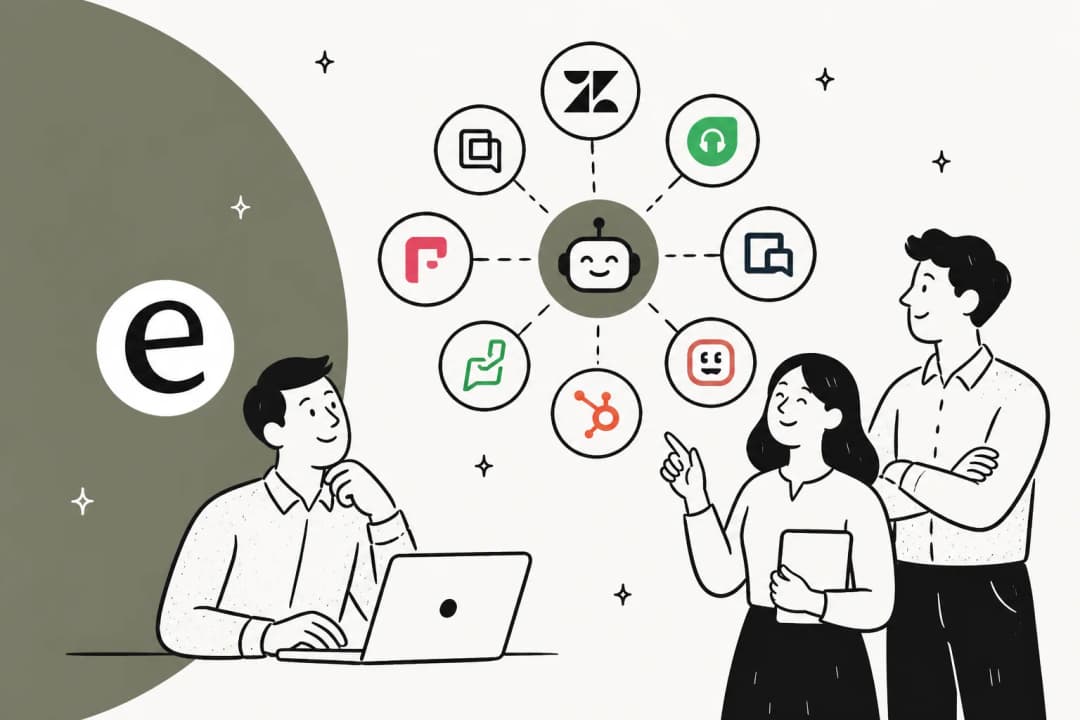
Here's the move most "Zoho Desk alternatives" lists skip: you might not need to switch at all. eesel AI is an AI layer that plugs into the helpdesk you already run, learns from your past tickets and help docs on day one, and starts drafting replies, triaging, and resolving tier-1 tickets. It connects to Zendesk, Freshdesk, Gorgias, Front, and 100+ other tools, so the "migration" is closer to an afternoon than a quarter.
This is the bit I'd flag if you've been burned by Zia: eesel trains on your solved tickets, not just your help-center articles, so it picks up the tone and the actual answers your team already gives. Before anything goes live, you run it in simulation mode against your ticket history to see exactly what it would have resolved and where it would have stumbled. That trust-and-control piece is the difference between an AI that demos well and one you'll actually let touch customers. As one CX lead we work with put it, you want an AI that "is only handling the tickets that it's confident to handle, and all the other ones, leave them alone."
| Plan | Price | Notes |
|---|---|---|
| Free trial | $50 in usage, no card | Test against real tickets |
| Pay-as-you-go | From $0.40 per ticket | No per-seat fee, no platform fee |
| Annual commit | 25% off above $300/mo | For steadier volume |
| Enterprise | $1,000/mo platform fee + usage | SSO, HIPAA, BAA, dedicated SE |
Pros: no migration; trains on past tickets; simulation before go-live; no per-seat pricing, so adding viewers is free.
Cons: it's an AI layer, not a full ticketing system, so you keep paying for your underlying helpdesk; the flat platform fee on Enterprise only makes sense at real volume.
Verdict: if your gripe with Zoho Desk is the AI and not the ticketing, eesel is the cheapest, fastest fix, because you skip the switch entirely. If you do want to leave the platform, keep reading.
2. Help Scout: best for relationship-first small teams
Best for: teams that want support to feel like a human reply, not a ticket number.
Help Scout is the anti-Zoho on UI. It's a clean, email-like shared inbox you can "learn in less than an hour," bundled with a knowledge base (Docs), an embeddable widget (Beacon), and live chat. It's used by 12,000+ companies and is squarely aimed at small businesses and growing support teams. Its AI Answers agent claims a ~73% resolution rate.
The catch is pricing, on two fronts. AI Answers is a usage add-on at $0.75 per resolution stacked on top of the seat price, which reviewers flag as a hidden cost at scale (1,000 resolutions a month is roughly +$750). And Help Scout torched a lot of goodwill in 2025 by switching from per-seat to per-interaction pricing, then reverting:
"HelpScout changed back to user-based pricing. Guess too many people cancelled including me... Helpscout lost all trust with this flip-flopping on pricing."
u/manu_8487, r/SaaS, Nov 2025

| Plan | Price (per user/mo, annual) | For |
|---|---|---|
| Free | $0 | Up to 5 users, 1 inbox |
| Standard | $25 | Growing teams |
| Plus | $45 | Higher volume, multi-channel |
| Pro | $75 | Scale and security (min 10 users) |
Pros: fastest tool here to learn; lovely writing experience; real free plan.
Cons: thin reporting and "lacks advanced features" is the top aggregated G2 con; AI billed separately per resolution.
Verdict: pick Help Scout if your support is high-touch and relationship-driven and you value a clean inbox over deep automation. If you're cost-sensitive at volume, price out the AI add-on carefully first, and see how it stacks up in our Help Scout alternatives guide.
3. Freshdesk: best for a free starting point that scales
Best for: bootstrapped teams that want a real product free before paying anything.
Freshdesk (from Freshworks) is the most direct like-for-like swap for Zoho Desk: a full-featured, AI-boosted helpdesk trusted by 74,000+ businesses, with a central agent workspace it calls the Command Center. Its standout for small teams is the free program, $0 for 1-2 agents for six months, which is a far softer landing than committing on day one. Its Freddy AI agent claims up to 80% resolution on the marketing pages.
On Reddit, Freshdesk usually comes up as the value pick: "Freshdesk might offer better bang for low volume without overkill features." The thing to watch is Freddy's billing, the Email AI Agent includes 500 free sessions, then runs $49 per 100 sessions, which climbs quickly for a busy inbox.
| Plan | Price (per agent/mo, annual) | For |
|---|---|---|
| Free | $0 (1-2 agents, 6 months) | Brand-new teams |
| Growth | $19 | Small growing teams |
| Pro | $55 | Multi-channel, automation |
| Enterprise | $89 | Larger, governance needs |
Pros: generous free program; strong ticketing and automation; G2 "Best Usability."
Cons: Freddy AI is consumption-priced and adds up; the broader Freshworks suite can feel sprawling, much like Zoho.
Verdict: the safest one-for-one switch if you want Zoho-grade features with a friendlier on-ramp. If Freddy's per-session pricing scares you, you can run eesel on Freshdesk instead and keep the ticketing. More options in our best Freshdesk alternatives piece.
4. Hiver: best for teams that live in Gmail
Best for: small teams already running on Google Workspace who don't want to leave their inbox.
Hiver turns Gmail (and Outlook) into a shared helpdesk, layering ticketing, SLAs, automation, analytics, and an AI suite right inside the inbox your team already uses. That "it just runs inside Gmail" pitch is the whole reason people pick it, near-zero learning curve, which is the exact opposite of the Zoho Desk complaint. It's trusted by 10,000+ teams and rates 4.6/5 on G2 from 1,283 reviews.
Crucially for anyone burned by Zoho's AI gate: Hiver bundles its AI (AI Agents plus AI Copilot) from the Growth plan up, with no separate per-resolution metering in its Gmail tiers. The honest caveat is that independent testing of Hiver's AI quality is thin, and the loudest complaint is per-seat cost climbing as you add users.
| Plan | Price (per user/mo, annual) | Notes |
|---|---|---|
| Free | $0 | Shared inbox, no AI |
| Growth | $25 | First tier with AI |
| Pro | $55 | Portal, SLAs, analytics, API |
| Elite | $85 | AI QA, SSO, HIPAA |
Pros: zero-friction adoption inside Gmail; AI bundled, not metered; strong security (SOC 2 Type II, ISO 27001, HIPAA) even on a small plan.
Cons: if you're not on Google Workspace, the whole value prop evaporates; 2-seat minimum; AI is less battle-tested than rivals'.
Verdict: if your team practically lives in Gmail, Hiver is the lowest-friction escape from Zoho Desk on this list. If you're not a Google shop, skip it.
5. Gorgias: best for Shopify and ecommerce stores
Best for: small online retailers whose support questions are really order questions.
If you sell online, a general helpdesk like Zoho Desk makes you bolt store data on the side. Gorgias flips that: it's built ecommerce-first, with native Shopify integration so orders, refunds, and subscriptions live right inside the ticket. It powers support for a claimed 40% of Shopify brands, and its AI Agent is pre-trained on 1B+ ecommerce conversations to handle returns, order edits, and product questions, not just FAQs.
The thing to model carefully is pricing, because Gorgias uses a ticket-based model (not per-seat), and the AI Agent is a usage add-on at $0.90-$1.00 per resolved conversation on top. For a small store that's mostly "where's my order," the math works. For lower volumes it can sting, and the sticker shock is real, one fashion brand we saw ran a dozen successful test chats, then opened two cancellation requests the moment it hit the billing page. Run the numbers before you commit.
| Plan | Price (monthly) | Tickets/mo |
|---|---|---|
| Starter | from $10 | 50 |
| Basic | from $50 | 300 |
| Pro | from $300 | 2,000 |
| Advanced | from $750 | 5,000 |
Pros: unbeatable Shopify integration; AI that can take real store actions; revenue attribution built in.
Cons: roughly 3x the cost of generic helpdesks at similar volume; only worth it once a big chunk of tickets need direct store actions.
Verdict: the clear pick for Shopify-first stores, and a poor one for everyone else. If you want the Shopify power without the per-resolution add-on, our best Gorgias alternatives guide covers layering eesel on top instead.
6. HappyFox: best for value across support and IT
Best for: small businesses that need one tool for both customer support and internal IT/HR.
HappyFox is the quiet value play. It's a broad suite spanning customer service, IT service management, and employee support, and reviewers love the price-to-features ratio, one Capterra reviewer reports doing "75-80% of the features" of Zendesk at about 10% of the cost. It carries a 4.6/5 on Capterra from 92 reviews and a Forrester study claiming 401% ROI.
It's also one of the few here with serious compliance out of the box (SOC 2 Type II, HIPAA, GDPR), which matters if you're in a regulated niche. The trade-offs reviewers flag: "the reporting is very challenging" and the knowledge base editor lags Zendesk's. There's also no free trial, it's demo-led, which is a small-team annoyance.
| Plan | Price (per agent/mo, annual) | Notes |
|---|---|---|
| Basic | $21 | Up to 5 agents |
| Team | $39 | Multi-brand, custom roles |
| Pro | $89 | Collision, SLA, 24/7 email |
| Enterprise PRO | Custom | Phone support, CSM |
Pros: excellent value; handles support + IT in one tool; strong certifications.
Cons: weak reporting and KB editor; demo-only (no self-serve trial); AI priced as a separate add-on ($14-$29/agent/mo).
Verdict: a smart pick if you want one affordable platform covering both customer and internal support. If reporting depth is a deal-breaker, look elsewhere.
7. Front: best for collaborative, multi-team operations
Best for: small teams where support, ops, and sales all touch the same conversations.
Front is a collaborative shared inbox built for complex customer operations that span departments, not just FAQ-style support. Its calling card is behind-the-scenes collaboration, internal comments and shared drafts on real customer emails, so as one customer put it, "nothing will get lost in Slack." It's trusted by 9,300+ companies and reports a 428% average ROI on its pricing page. Its AI (Front AI) claims to resolve up to 70% of requests.
The watch-out is the bill. The AI capabilities (Autopilot, Copilot, Smart QA, Smart CSAT) are add-ons on the lower tiers, and Enterprise runs $105/seat/month, which is steep for a small business. Front shines when collaboration is the actual problem, less so if you just need ticket deflection.
| Plan | Price (per seat/mo, annual) | Seat range |
|---|---|---|
| Starter | $25 | up to 10 |
| Professional | $65 | up to 50 |
| Enterprise | $105 | unlimited |
Pros: best-in-class collaboration; clean omnichannel; a real edge for cross-department work.
Cons: AI is mostly add-ons; gets expensive fast; overkill for simple support.
Verdict: choose Front if multiple teams share customer conversations and coordination is your pain. For pure support deflection, it's more tool than you need, see Help Scout vs Front if you're torn.
8. Zendesk: best for teams planning to scale up fast
Best for: small teams that expect to grow into a mid-market support org soon.
Zendesk is the heavyweight, and I'm including it because plenty of teams leave Zoho Desk specifically because they're scaling and want the platform everyone integrates with. It's an AI-first "Resolution Platform" with 22,000+ AI customers, a 1,800+ app marketplace, and self-improving AI agents (now Forethought-powered). If your roadmap is "we'll be 40 agents in two years," Zendesk is built for that journey.
The reason it's last on a small business list is cost and complexity. The entry Support Team plan ($19) has no AI; AI agents start at the $55 Suite Team tier, and the model layers seat price + per-resolution AI billing + $50/agent add-ons (Copilot, WEM, Contact Center). That's the classic surprise-bill setup, and it's a lot of platform for a 3-person team.
| Plan | Price (per agent/mo, annual) | Notes |
|---|---|---|
| Support Team | $19 | No AI |
| Suite Team | $55 | AI agents start here |
| Suite Professional | $115 | Most popular |
| Suite Enterprise | Custom | Sales-led |
Pros: the most mature ecosystem; deepest AI roadmap; scales effortlessly.
Cons: expensive and complex for small teams; layered billing; AI not in the entry plan.
Verdict: the right call only if you're a small team that's confident you'll scale fast. Otherwise it's a heavier (and pricier) version of the Zoho Desk complexity you're trying to escape. A common middle path is to keep a leaner helpdesk and add eesel for the AI, see best AI for Zoho Desk.
How to actually choose
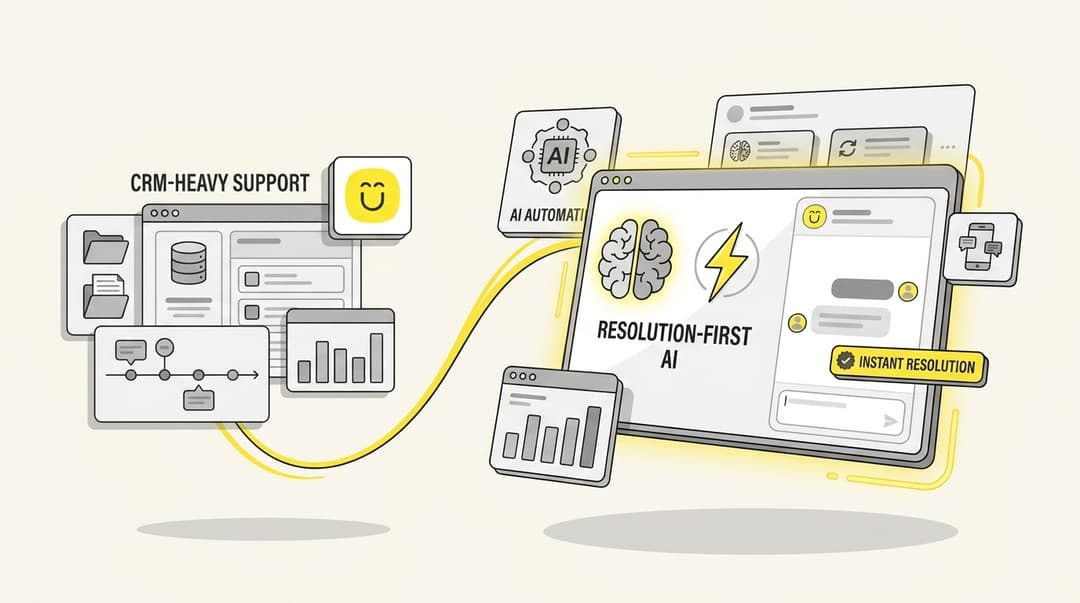
If your eyes glazed over somewhere around the fourth pricing table, here's the decision in one picture.
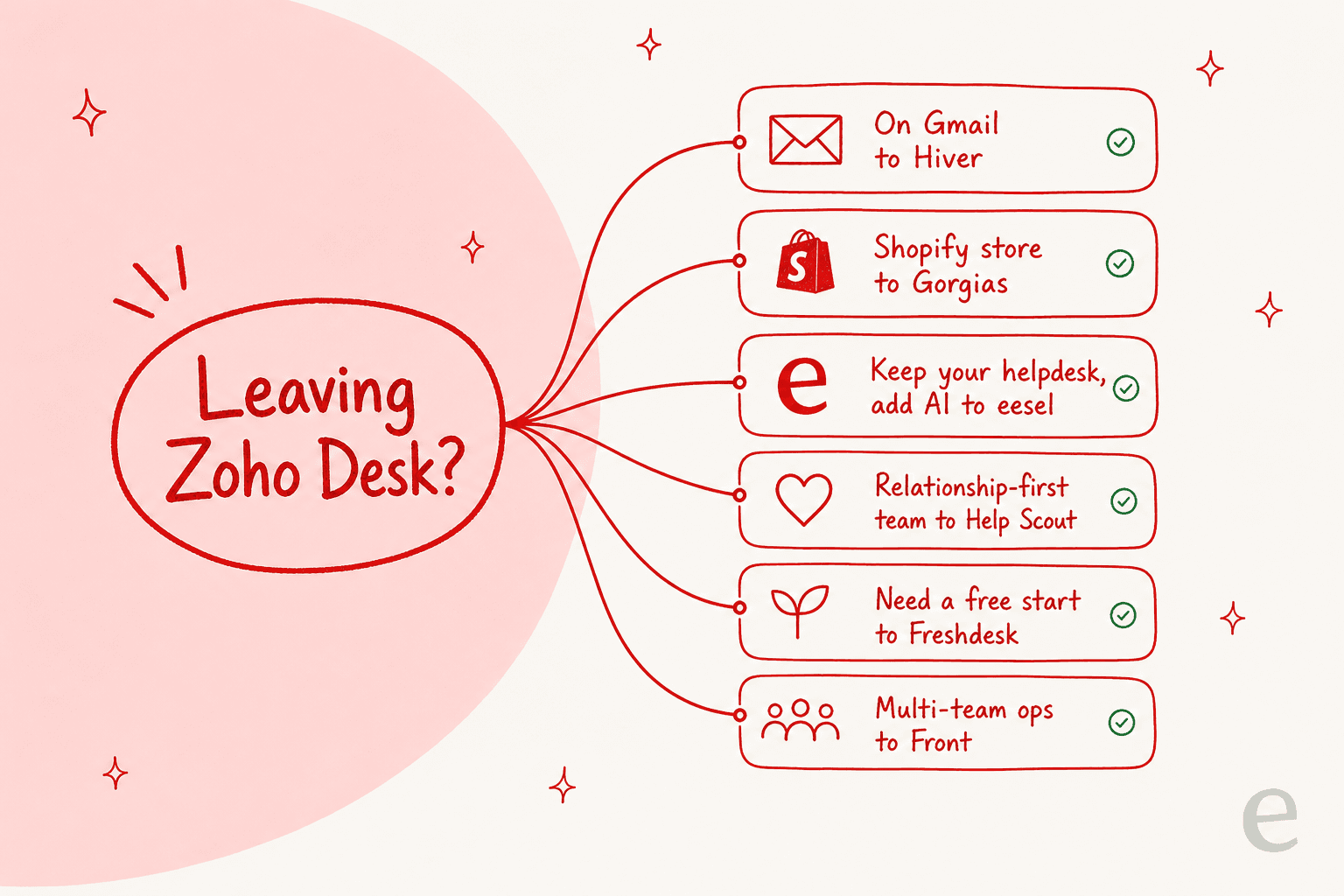
The honest meta-point: most of these are good tools, and switching helpdesks is painful, you re-train the team, migrate ticket history, rebuild automations, and risk a bad first month. So before you commit to a migration, ask the cheaper question: is the helpdesk actually broken, or is it just the AI?
For a lot of small teams leaving Zoho Desk, it's the AI. The ticketing is fine; Zia just isn't pulling its weight. In that case the build-vs-switch math usually favors staying put and layering AI on top. As one founder we work with framed the build-vs-buy version of this decision: "We could try to write our own LLM application but we didn't want to invest our time into that. We wanted something that we would not have to maintain." Switching helpdesks is a similar kind of effort you can often avoid.
A worked cost example
Say you're a 4-agent team doing ~1,500 tickets a month, and you want AI to handle the repetitive half.
- Zoho Desk Enterprise (to unlock the real AI): 4 × $40 = $160/mo, plus the AI agent token limits to manage.
- Help Scout Standard + AI Answers: 4 × $25 = $100, plus ~750 AI resolutions × $0.75 = $562, so ~$662/mo.
- Keep your current helpdesk + eesel: your existing seats, plus ~750 resolved tickets at usage-based pricing, with no per-seat AI fee. The AI cost scales with what it actually resolves, not with how many people log in.
The point isn't that one number always wins, it's that the billing unit decides the bill, and "cheap per seat" tools can become expensive AI tools the moment you switch the AI on. Model your own volume before you sign anything. Our guides on AI agent vs human agent cost and AI customer support cost savings go deeper on the math.
Try eesel
If the reason you're shopping for Zoho Desk alternatives is that Zia underwhelms, you may not need a new helpdesk at all. eesel AI works like a new hire that plugs into your existing setup in a few minutes, learns from your past tickets and help docs, and handles the repetitive tickets while routing anything it's unsure about to a human. You can simulate it on your real ticket history before it ever replies to a customer, so you see the resolution rate up front instead of hoping. One team, Gridwise, saw 73% of tier-1 requests resolved in the first month, with results showing up during a 7-day trial. It's free to try, no credit card, and there's no migration to dread.
Frequently Asked Questions
What is the best Zoho Desk alternative for a small business?
Is there a free Zoho Desk alternative?
How much does Zoho Desk cost for a small team?
Why do small businesses switch away from Zoho Desk?
Can I keep Zoho Desk and just add better AI instead of switching?


Article by
Kurnia Kharisma Agung Samiadjie
Kurnia is a software engineer and writer at eesel AI with two years of SEO experience, writing about AI tools, helpdesk software, and customer support. He pairs a developer's understanding of how these products are built with search-driven research into what actually ranks and resonates with the people searching for them.