

Wait, where did Groove go?
Let's clear this up first, because it changes everything about how you shop.
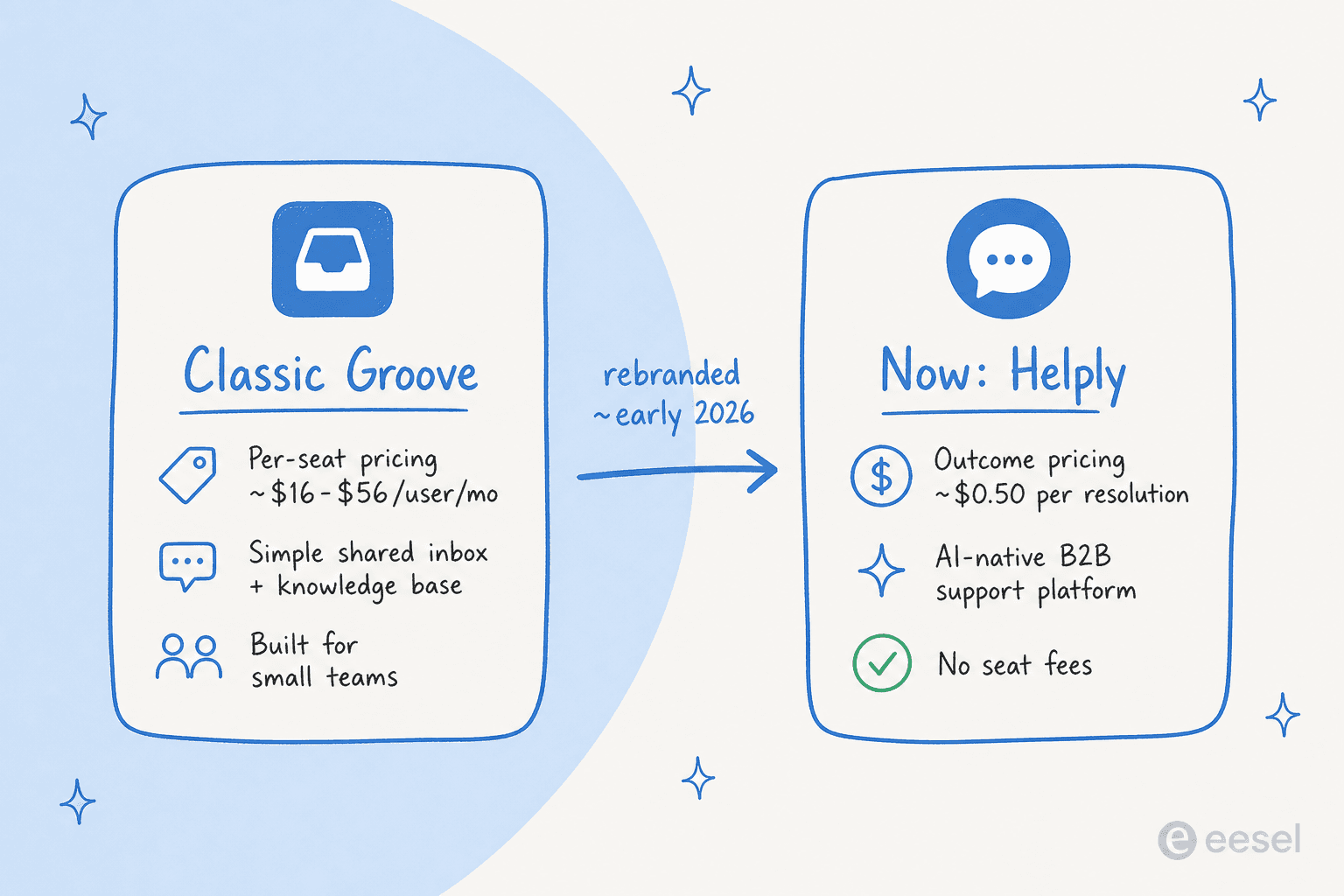
Groove was Alex Turnbull's bootstrapped SMB help desk, famously grown "from 0 → $5M ARR as a solo founder" and beloved as a simpler, cheaper alternative to Zendesk. Sometime around early 2026, it became Helply. The about page says it plainly, and Turnbull's launch post frames the new pitch as "65% of your support tickets resolved by AI in 90 days. Or you pay nothing." The Groove knowledge base now literally titles itself "Groove Knowledge Base - Helply".
The big change is the money. Classic Groove charged per seat; Helply charges per outcome. That's a clean break, and it matters: if you're a tiny team with low ticket volume and you just want a tidy shared inbox for a flat, predictable seat price, an outcome-priced AI platform is a different animal than what you were comparing.
To be fair to Helply, this isn't a shutdown, and the AI-native angle is a real bet on where support is heading. But "the help desk I was about to buy quietly turned into a different product with a different pricing model" is exactly the kind of surprise that sends people shopping. So let's shop.
What classic Groove was (and why people loved it)
Quick refresher, because the alternatives below only make sense against what Groove actually was.
Pulling its pricing page from the Wayback Machine (captured May 2024), classic Groove looked like this:
| Plan (classic Groove) | Price (per user/mo, annual) | The gist |
|---|---|---|
| Standard | $16 | 2 shared inboxes, 1 knowledge base, basic automation |
| Plus (most popular) | $36 | 5 inboxes, SLA, advanced automation, AI summarize/sentiment |
| Pro | $56 | 25 inboxes, enterprise security, dedicated account manager |
It was a shared inbox, a knowledge base, live chat, light automation, 40+ integrations, and mobile apps. Nothing exotic, priced fairly, "trusted by 118,000+ users since 2012." People genuinely liked it. On Capterra it sits at 4.5/5 across 87 reviews, and 4.6/5 from 195 reviews on G2, with ease of use and responsive support as the standout themes. One small-team user on Reddit summed up the appeal:
"I've been using Groove and it seems to cover most of the functionality you've mentioned. It's super easy to implement, and get up to speed. not a bad price too."

But two cracks ran through the Groove story for years, and they're worth knowing because they're the things you should pressure-test in any replacement. The first was billing trust. The single highest-ranking Reddit thread about Groove is a 2017 "Avoid GrooveHQ" post complaining about surprise price jumps and cancellation friction (it's old, so treat it as reputation rather than current behavior). The second was a quietly brutal bit of community sentiment:
"Groove is one of the companies that I and many others look up to, not for their product but for their content on their blog."
Loved for the marketing, respected-but-not-adored for the product, and now pivoted to something new. That's the backdrop. Here's where to go.
How we picked these alternatives
We anchored on what people actually wanted from Groove, then asked which tools deliver it today:
- A real shared inbox + knowledge base, not just a chat widget.
- Predictable, fair pricing (the thing Groove buyers were most twitchy about).
- A path to good AI without a second mortgage, because every vendor is now charging separately for it.
- Verifiable user sentiment, so we leaned on Reddit, G2, and Capterra over marketing pages.
One honest disclosure up front: we make eesel AI, an AI layer that plugs into most of the help desks below. We've tried to be straight about where each tool wins and where it doesn't, including ours. We've also left Intercom off the list deliberately; it's not a fit for the "simple Groove replacement" brief most readers are here for.
The best Groove alternatives at a glance
| Tool | Best for | Entry price | Pricing model | Free plan | Built-in AI agent | Rating |
|---|---|---|---|---|---|---|
| eesel AI | Adding AI to your existing help desk | $0.40/ticket | Usage, no seats | Trial ($50 credit) | Yes (core product) | - |
| Help Scout | The classic Groove feel | $25/user/mo | Per seat + usage AI | Yes (5 users) | AI Answers, $0.75/res | 4.4/5 |
| Freshdesk | Generous free tier + scaling | $19/agent/mo | Per agent + usage AI | Yes (1–2 agents) | Freddy, usage-based | 4.4/5 |
| Zendesk | Enterprise scale | $19/agent/mo | Per agent + per-resolution AI | No (14-day trial) | Yes, per resolution | 4.3/5 |
| Front | Cross-team collaboration | $25/seat/mo | Per seat + add-on AI | No (14-day trial) | Autopilot, $0.05/conv | 4.5/5 |
| Gorgias | Shopify / ecommerce | $10/mo | Per ticket volume | No (trial) | Yes, ~$0.90/res | 4.6/5 |
| Crisp | Tightest flat budget | $45/mo flat | Per workspace (flat) | Yes (2 seats) | AI credits | 4.5/5 |
| HubSpot Service Hub | Teams already on HubSpot CRM | $7/seat/mo | Per seat + credit AI | Yes (2 users) | Breeze, ~$0.45/res | 4.4/5 |
Ratings are blended G2/Capterra figures from each tool's section below. Not sure how to read the table? This is the cheat sheet:
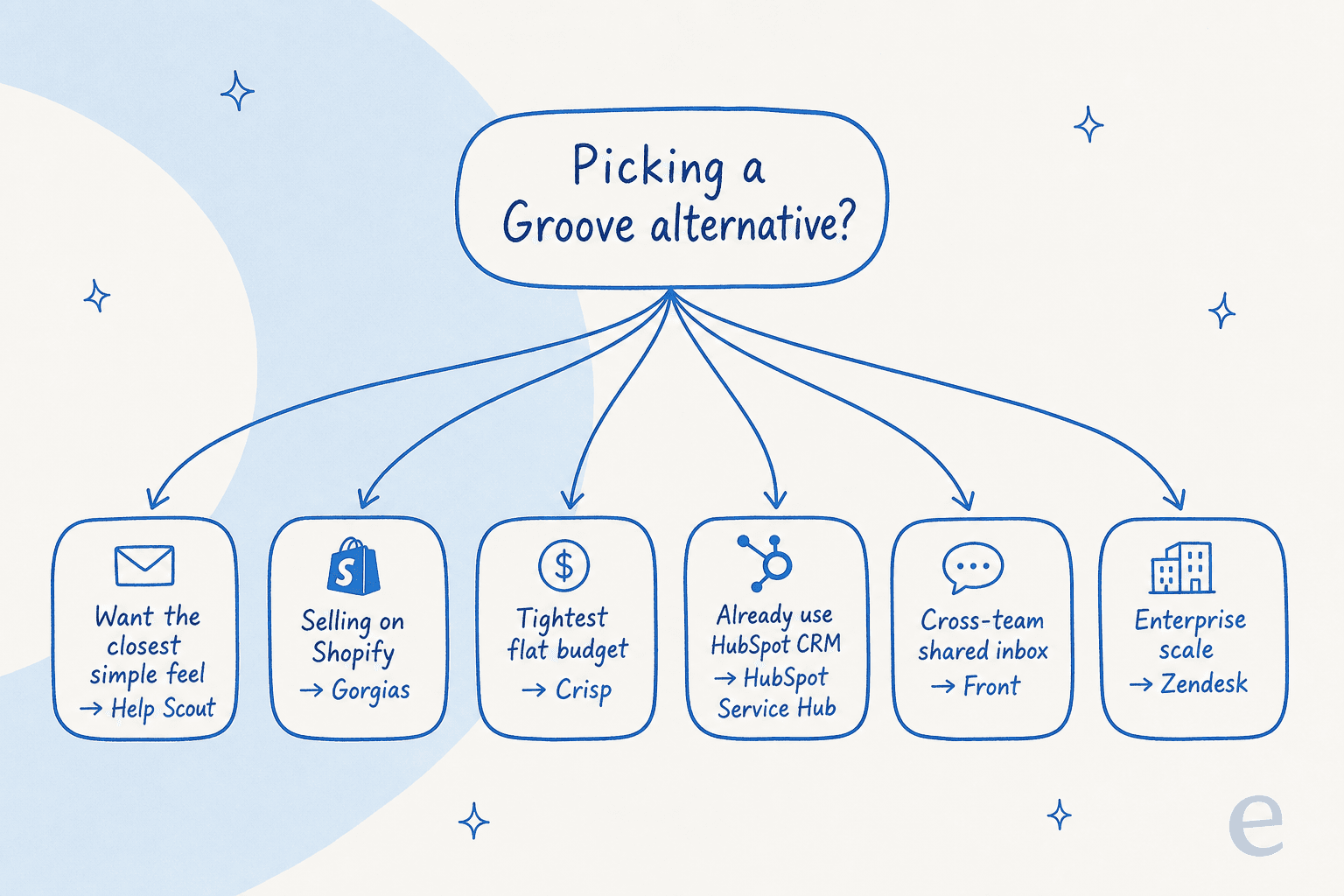
1. eesel AI
Best for: teams that want to pick the help desk they actually like, then bolt great AI on top of it.
Let's get the conflict of interest out of the way (we did above, but it bears repeating): this is our product. So here's the honest framing first. eesel AI is not a shared inbox you'd rip Groove out for. It doesn't replace Help Scout or Zendesk. It's the AI brain that sits on top of whichever help desk you choose, which is exactly the decision you're making right now.
Why does that matter for a Groove refugee? Because the trap most people fall into is shopping for the help desk with the best built-in bot. But the bots are uneven, the AI is usually a pricey add-on, and you're locking your whole workflow to one vendor's roadmap. The alternative is to choose your help desk on its merits and treat AI as a separate, swappable layer.
What it does
eesel connects to your help desk (Help Scout, Zendesk, Freshdesk, Front, Gorgias, HubSpot, and 100+ others), learns from your past tickets and help docs on day one, and then drafts replies, triages, escalates, and resolves tier-1 tickets. The part we'd point a nervous buyer to is simulation mode: it runs the AI against your past tickets so you can see exactly what it would have done, find the gaps, and only then turn it loose.
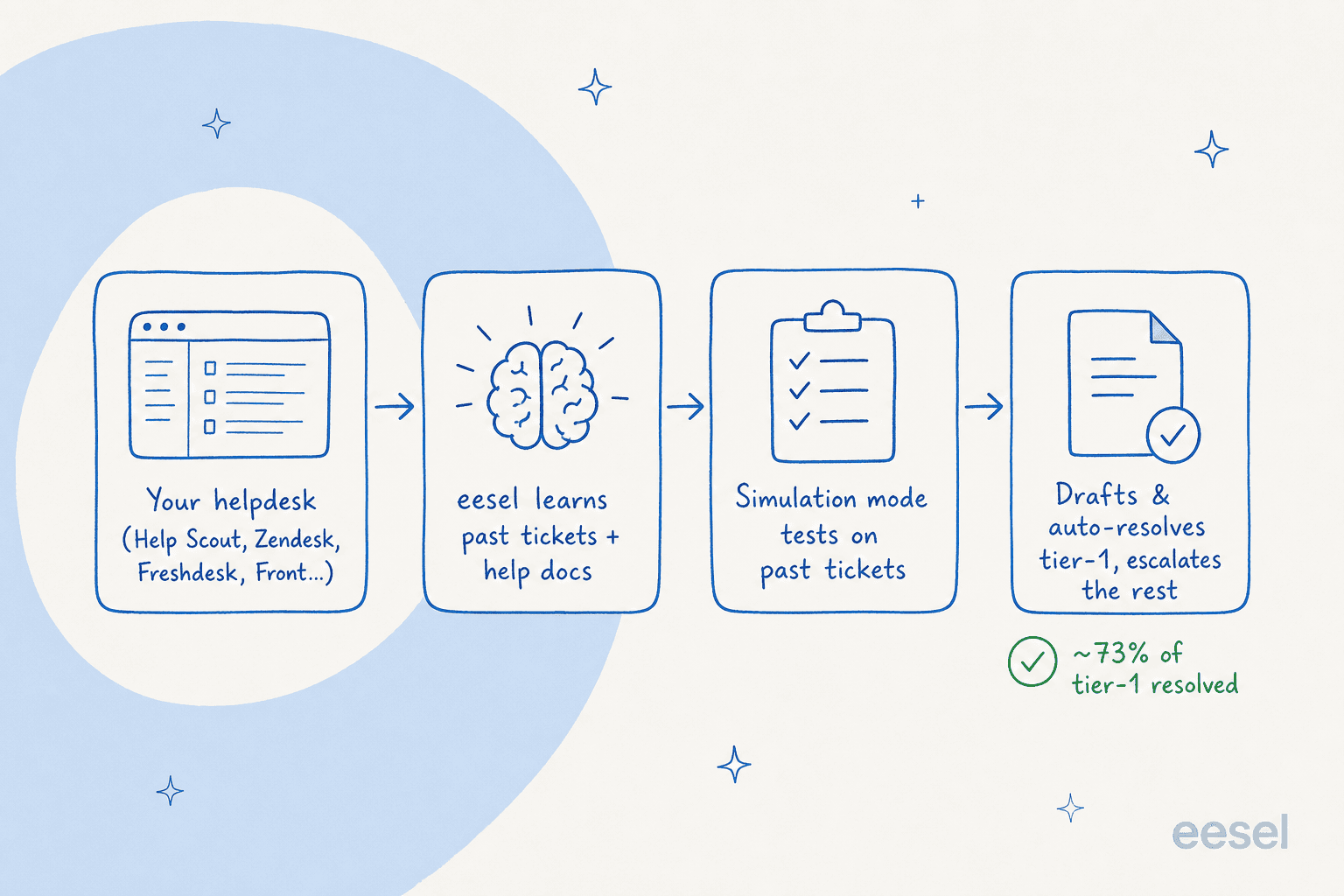
The proof points are concrete: Smava runs a fully automated Zendesk agent on 100,000+ German-language tickets a month, and Gridwise saw 73% of tier-1 requests resolved in the first month.
Pricing
| Plan | Price | Notes |
|---|---|---|
| Pay-as-you-go | From $0.40 per ticket | No per-seat fees, no platform fee, no minimum |
| Annual commit | 25% off | Commit to ≥$300/month for the year |
| Enterprise | $1,000/month + usage | SSO, HIPAA, BAA, dedicated support |
The free trial gives you $50 in usage with no card. Full details on the pricing page.
Pros: keeps you off the per-seat treadmill, works with the help desk you already chose, and the simulation step removes most of the "will the AI say something dumb" fear.
Cons: it's a layer, not a help desk, so you still need one of the tools below underneath it. If you want a single all-in-one box, that's a different shape of purchase.
Our take: if your real goal is "automate the boring tickets," don't let the help-desk shopping decide your AI for you. Pick the inbox that fits, add eesel, and keep both decisions independent. We obviously integrate with most tools on this list, so weigh that bias accordingly.
2. Help Scout
Best for: teams that loved old Groove and want the nearest thing to it.
If you're mourning classic Groove, Help Scout is the tool you'll feel most at home in. It's the same idea, a clean, email-like shared inbox, a knowledge base (Docs), and a help widget (Beacon), pitched squarely at "relationship-driven small businesses." In Reddit recommendation threads, Groove and Help Scout get named in the same breath constantly, and Help Scout usually wins the actual switch.
The thing people praise most is how fast it is to learn. Help Scout claims you can "learn the platform in less than an hour", and reviewers back that up: ease of use is the single most-repeated positive. It says 12,000+ companies use it, and its AI Answers agent resolves around 73% of interactions.
Pricing
| Plan | Price (per user/mo, annual) | For |
|---|---|---|
| Free | $0 | Up to 5 users, 1 inbox |
| Standard | $25 | Growing teams |
| Plus | $45 | Higher volume, multiple channels |
| Pro | $75 | Scale + security (min 10 users) |
| AI Answers | $0.75 / resolution | Usage-based add-on |
Pros: the gentlest learning curve here, a genuinely useful free plan, and a product philosophy that feels like Groove's. Cons: reviewers flag thinner reporting and advanced features, and the AI Answers add-on at $0.75 a resolution stacks on top of the seat price, which gets expensive at volume.
Our take: for most ex-Groove small teams, this is the default pick, and we'd start here unless you have a specific reason not to. Read our full Help Scout review or, if you outgrow it, the Help Scout alternatives roundup. If you want to compare it head-to-head, we've also written Help Scout vs Front.
3. Freshdesk
Best for: budget-conscious teams that want room to scale.
Freshdesk (from Freshworks) is the tool to beat if your top priority is "start cheap, grow later." It's a fuller ticketing platform than Groove ever was, trusted by 74,000+ businesses including Bridgestone and Klarna, and its 2026 story is a hard pivot to agentic AI it calls Freddy.
The real hook for small teams is the free tier: $0 for up to 2 agents, no credit card, with ticketing, a knowledge base, and basic reporting. That's a genuinely usable on-ramp, not a teaser.
Pricing
| Plan | Price (per agent/mo, annual) | The gist |
|---|---|---|
| Free | $0 | Up to 2 agents, core ticketing |
| Growth | $19 | Automation, collision detection |
| Pro | $55 | Multiple products, advanced automation |
| Enterprise | $89 | Skills routing, audit logs |
Freddy's Email AI Agent includes the first 500 sessions, then runs $49 per 100 sessions.
Pros: the most generous free plan here, a clear upgrade path, and a mature feature set. Cons: the usage-based Freddy AI can climb fast at volume, and the jump from "free" to a properly automated setup is bigger than the sticker price suggests.
Our take: the best free starting point on this list, and a safe bet if you expect to grow. If Freddy's pricing gives you pause, see our notes on Freshdesk AI reviews and the wider Freshdesk alternatives.
4. Zendesk
Best for: larger teams that have outgrown a simple shared inbox.
Zendesk is the enterprise end of the spectrum, the opposite of what Groove was, which is exactly why some scaling teams need it. It's an AI-first "Resolution Platform" with 22,000+ service teams, deep omnichannel, a 1,800+ app marketplace, and a 2025 Gartner Magic Quadrant Leader badge. Reliability and breadth are not the issue here.
The issue is the bill, and the community is loud about it. The headline complaint is cost creep as you grow:
"as we've grown from just a few users to a couple of dozen, our Zendesk bill has climbed to around $5,000 per month (not including add-ons)."
And the structure of the pricing draws particular ire:
"Even if you spend a million dollars a year, they will still nickel and dime the shit out of you because it's their model... Want automation? That costs more. Want their latest AI feature? Cost more."
Pricing
| Plan | Price (per agent/mo, annual) | The gist |
|---|---|---|
| Support Team | $19 | Ticketing essentials, no AI |
| Suite Team | $55 | Adds AI agents, omnichannel, messaging |
| Suite Professional | $115 | Most popular; skills routing, IVR |
| Suite Enterprise | Talk to sales | Governance, advanced AI |
Note the trap: the $19 entry price includes no AI, add-ons like Copilot run $50/agent/mo each, and AI agents are billed per "automated resolution" on top, a model users describe as unpredictable (and where, per community threads, an abandoned chat can still count as a "resolution"). For the full picture, see how Zendesk licensing works.
Pros: unmatched depth, maturity, and ecosystem; the ~92% 4-5 star share on G2 (across 6,964 reviews) shows people trust the core product. Cons: it's overkill and over-budget for the small team Groove served, and the stacked pricing is the #1 reason people leave.
Our take: the right call if you've genuinely outgrown a shared inbox and need omnichannel at scale, the wrong call if you just want a tidy inbox. If the AI bill is what worries you, you can run eesel's AI agent inside Zendesk on usage pricing instead. Our Zendesk review goes deeper.
5. Front
Best for: teams where support, sales, and ops all touch the same conversations.
Front takes the shared-inbox idea and pushes it toward collaboration. It blends email, ticketing, and an AI command center, and it's built for "complex customer operations" that span departments rather than pure FAQ support. It's trusted by 9,300+ companies.
The standout is the behind-the-scenes collaboration, internal comments and shared drafts right on a conversation, so nothing gets lost in a separate Slack thread. Branch's CTO reported a 40% productivity improvement after switching from Zendesk, and Front claims a 428% average ROI across customers.
Pricing
| Plan | Price (per seat/mo, annual) | Seat range |
|---|---|---|
| Starter | $25 | Up to 10 seats |
| Professional | $65 | Up to 50 seats |
| Enterprise | $105 | Unlimited |
AI is sold as add-ons: Autopilot from $0.05/conversation, Copilot at $20/seat/mo, bundled into Enterprise.
Pros: the best collaboration model here, polished UI, strong omnichannel. Cons: Starter is single-channel only, and the per-seat plus AI-add-on math gets pricey for a small support-only team that just wanted Groove.
Our take: worth it specifically when multiple teams share an inbox; overkill if it's just you and two support reps. See our Front review, or Front vs Hiver if you're weighing the collaborative-inbox category. You can also add AI to Front without paying for the bundled Enterprise tier.
6. Gorgias
Best for: Shopify and ecommerce brands.
If you sell online, Gorgias is the most relevant tool on this list. It's an ecommerce-first help desk with the deepest native Shopify integration anywhere, orders, refunds, and subscriptions live right in the ticket, and it claims to power customer conversations for 40% of Shopify brands.
The pitch isn't just deflection, it's revenue. The AI Agent is pre-trained on 1B+ ecommerce conversations and can recommend products and generate discounts, not just answer "where's my order." BareMinerals reported an 8.83x ROI on AI-driven sales.
Pricing
| Plan | Price (monthly) | Tickets/mo |
|---|---|---|
| Starter | from $10 | 50 |
| Basic | from $50 | 300 |
| Pro | from $300 | 2,000 |
| Advanced | from $750 | 5,000 |
Pricing is by ticket volume, not seats, and the AI Agent is a usage add-on at $0.90 per resolved conversation (each AI interaction also counts as a billable ticket).
Pros: unbeatable for Shopify, with AI that can actually take store actions. Cons: the community's recurring gripe is cost, roughly 3x Zendesk for similar ticket volumes, so it only pays off when a real chunk of tickets need Shopify actions.
Our take: if you're on Shopify, start here; if you're not, skip it. Our Gorgias AI review and Gorgias AI pricing breakdown have the full numbers, and Gorgias alternatives covers the rest.
7. Crisp
Best for: the tightest, most predictable budget.
Crisp is the answer to the single thing Groove buyers worried about most: surprise bills. Its defining feature is flat, per-workspace pricing, you pay one price no matter how many conversations you handle, with seats bundled in. It's an all-in-one messaging and support platform (chat widget, shared inbox, knowledge base, CRM) trusted by 10,000 companies.
Pricing
| Plan | Price (per month, flat) | Seats |
|---|---|---|
| Free | $0 | 2 |
| Mini | $45 | 4 |
| Essentials | $95 | 10 |
| Plus | $295 | 20+ |
Every paid tier includes unlimited conversations, and AI runs on bundled credits. See the full plan table.
Pros: genuinely cheap and predictable, chat-first, no per-seat anxiety. Cons: it leans more live-chat than ticketing, the AI credit model is a little opaque, and it's less of a "serious ticketing" tool than Freshdesk or Zendesk.
Our take: the budget winner, and a great fit for startups and chat-heavy small businesses. If you want the deeper dive, we've covered Crisp pricing and Crisp AI reviews.
8. HubSpot Service Hub
Best for: teams already living inside HubSpot.
HubSpot Service Hub only makes this list for one specific reader: the team already using HubSpot's CRM. If that's you, the appeal is obvious, support tickets share one customer record with your marketing and sales data, and the AI (Breeze) is grounded in that same CRM.
HubSpot says Breeze Customer Agent resolves 65% of conversations across 8,000+ customers, and as of April 2026 it's billed on outcomes (around $0.45 per resolution).
Pricing
| Plan | Price (per seat/mo, annual) | The gist |
|---|---|---|
| Free | $0 | Up to 2 users |
| Starter | $7 | Basic ticketing |
| Professional | $90 | Customer Agent, automation |
| Enterprise | $150 | Advanced governance |
Note the cliff: the Starter-to-Professional jump is steep, and Breeze runs on usage-based credits on top. HubSpot's loudest community complaint by far is cost, with long-tenured customers reporting bills roughly doubling.
Pros: unbeatable if you're already on HubSpot, with one unified customer view. Cons: expensive and overkill if you're not, and the credit-based AI billing causes real "bill shock" for some teams.
Our take: a clear yes for existing HubSpot shops, a clear no for everyone else. If you're on the fence, we wrote is HubSpot Service Hub AI worth it? and HubSpot Service Hub AI alternatives.
What it actually costs: a worked example
Sticker prices lie, because almost every tool now charges for the help desk and the AI separately. So let's price a realistic scenario: a 5-agent team handling 1,000 tickets a month, of which they want AI to resolve about 400.
- Help Scout Plus: 5 seats × $45 = $225/mo, plus 400 AI Answers × $0.75 = $300. Total ≈ $525/mo.
- Zendesk Suite Team: 5 seats × $55 = $275/mo, plus per-resolution AI billed on top of allowance (budget a few hundred more). Total $500+/mo and climbing.
- Crisp Plus: $295/mo flat, AI credits included up to a cap. Total ≈ $295/mo (cheapest if your volume fits).
- Pick-your-helpdesk + eesel: a $99/mo Help Scout-style base, plus ~400 tickets at eesel's usage pricing. The point isn't that it's always cheapest, it's that the AI cost is decoupled from per-seat fees and you keep the help desk you like.
Two lessons. First, the AI line item is now the part that moves your bill, not the seat price, so that's where to focus. Second, per-resolution and per-credit models are the ones that surprise people; flat (Crisp) or usage-with-simulation (eesel) are the most predictable. For the broader category, our guide to the best AI help desk software for 2026 and best help desk software for small businesses go wider.
Try eesel for the AI part
Here's the move we'd actually make in your shoes: pick the help desk from this list that fits your team and budget, then add eesel AI for the automation, instead of letting the bot decide your help desk.
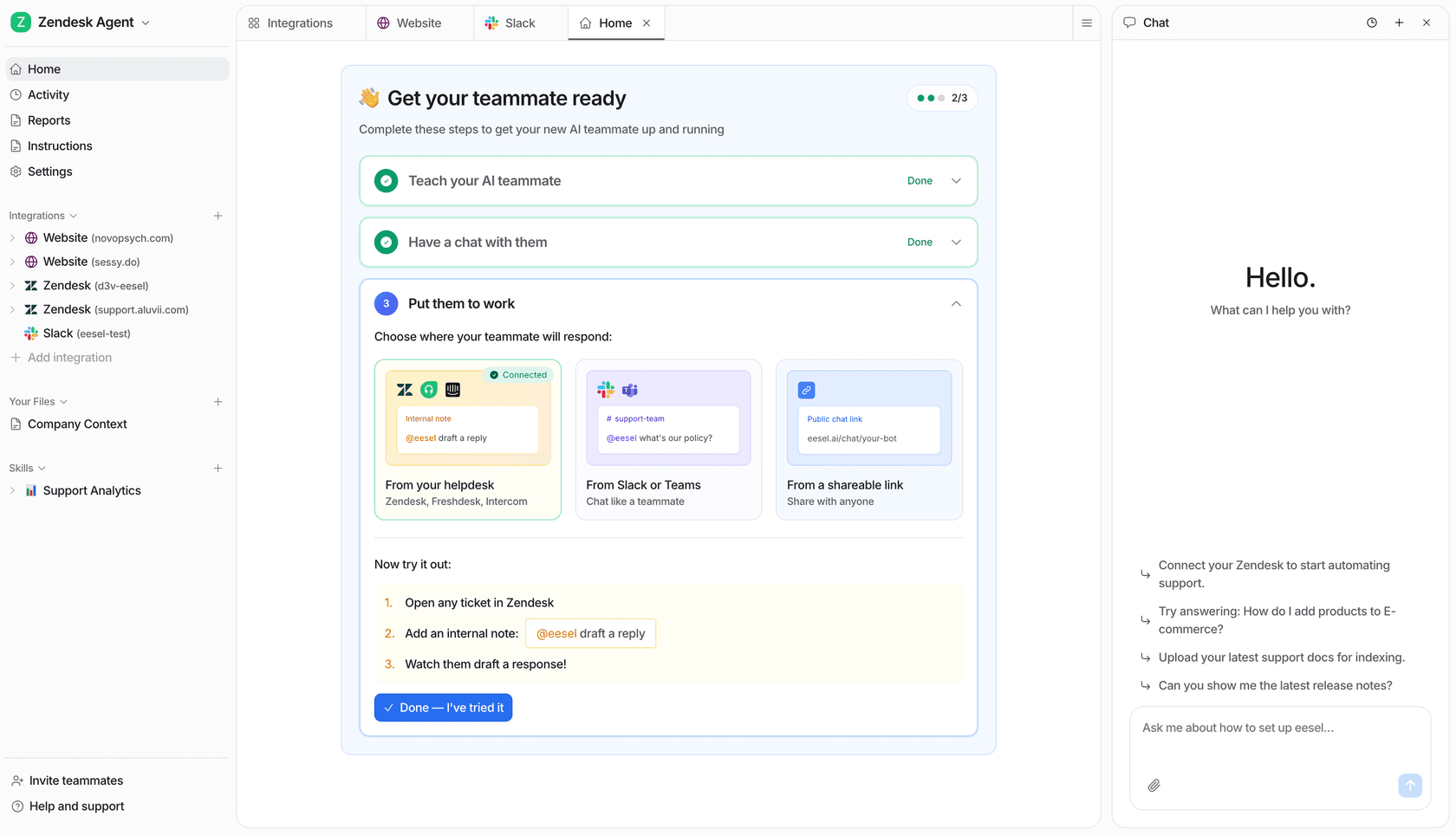
eesel connects to Help Scout, Zendesk, Freshdesk, Front, Gorgias, HubSpot, and 100+ tools, learns from your past tickets and help docs, and lets you run a full simulation on historical tickets before a single automated reply goes out. Pricing is usage-based with no per-seat fees, so it scales with your volume, not your headcount. You can start a free trial with $50 of usage and no credit card, point it at whichever inbox you just picked, and see how much of your tier-1 load it clears before you commit to anything.
Frequently Asked Questions
Is Groove still available, or is it now Helply?
What is the best Groove alternative for a small team?
How much do Groove alternatives cost?
Which Groove alternative is best for Shopify and ecommerce?
Can I add AI to a Groove alternative without switching everything?


Article by
Riellvriany Indriawan
Riell is a designer and writer at eesel AI with about two years of experience researching CX platforms, AI chatbots, and helpdesk software. She combines her design background with a sharp eye for how these tools actually look and feel in practice — making her comparisons unusually visual and user-focused.