


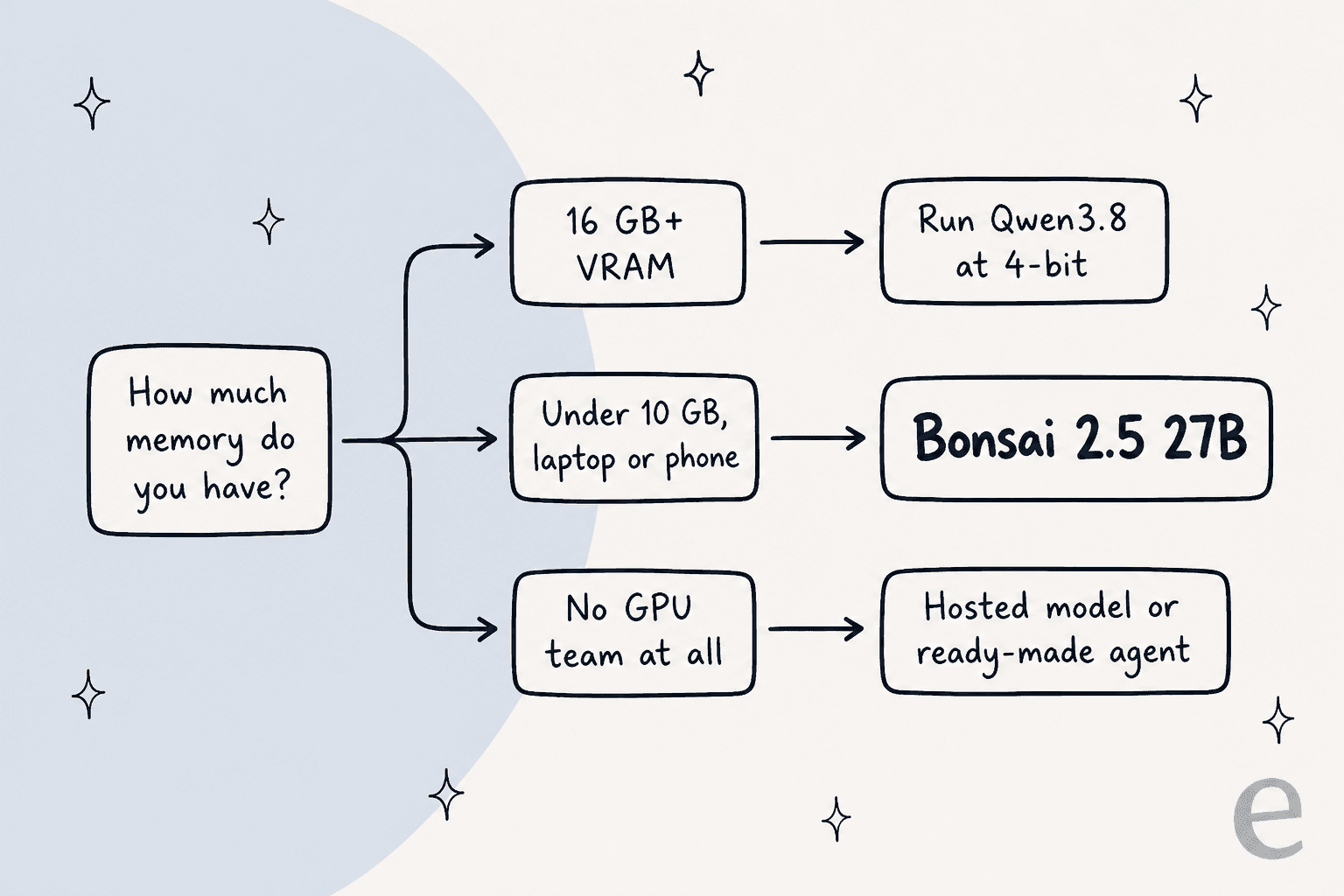
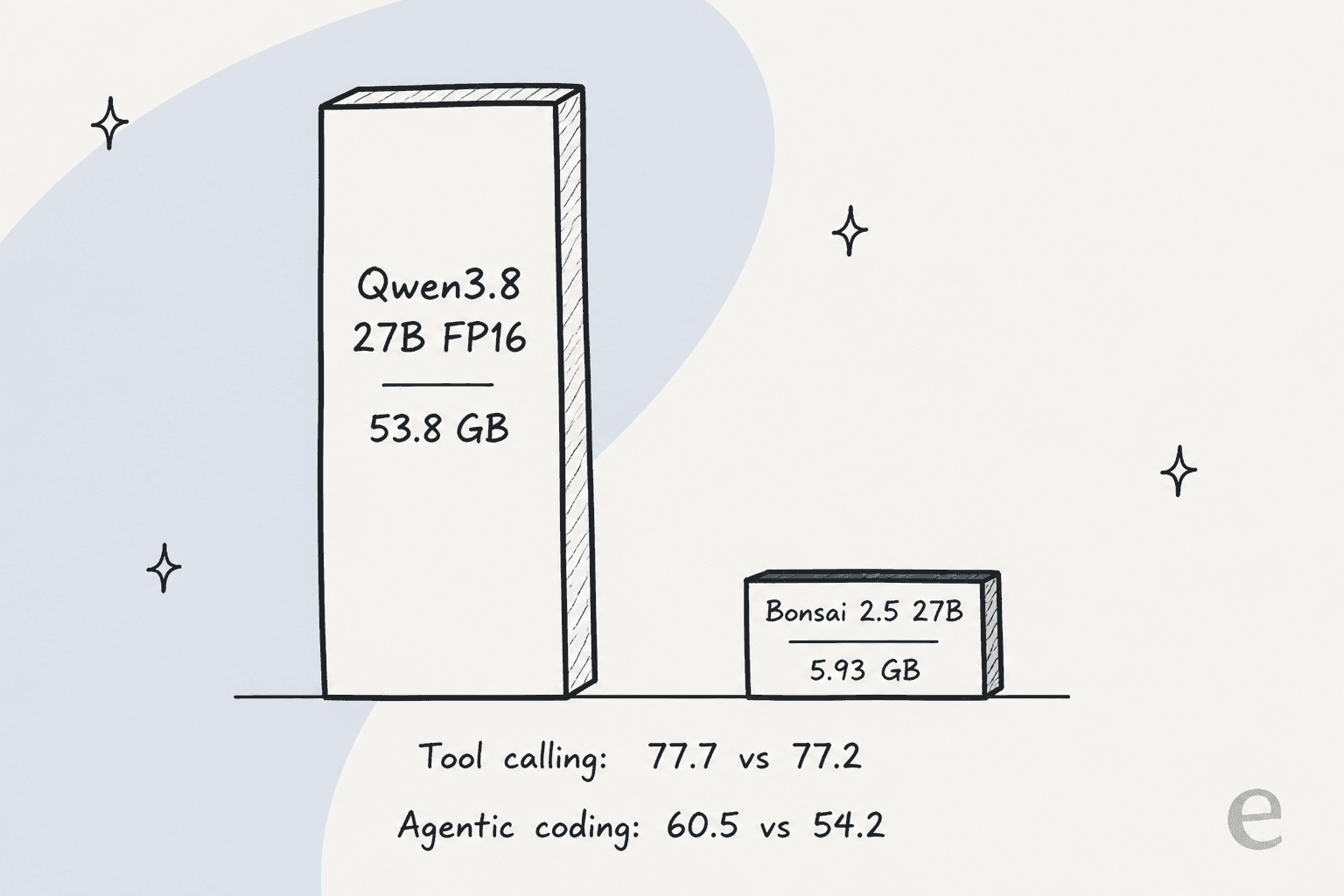
Ternary Bonsai 2.5 27B is PrismML's new free, open-weight model: Qwen3.8 27B squeezed into 5.93 GB instead of 53.8 GB, and it now matches the full model on tool calling (77.2 vs 77.7) while keeping 90% of its agentic coding score. That makes it the pick when an agent has to run on a laptop, a single consumer GPU or a phone, with private files that never leave the device. If you have 16 GB or more of VRAM, a 4-bit Qwen3.8 build is still the stronger choice.
For support teams, a strong local model is the start of an agent, not the agent. eesel is the ready-made helpdesk teammate. Through the eesel CLI, a coding agent can upload approved macros and help articles, then run test questions before anything reaches a customer.
What is Ternary Bonsai 2.5?
Ternary Bonsai 2.5 27B is a compressed version of Qwen3.8 27B from PrismML, a company that came out of Caltech research and is backed by Khosla Ventures, Cerberus and Google. PrismML released it on 24 November 2026 as an upgrade to Ternary Bonsai 2 27B, which shipped on 17 September.
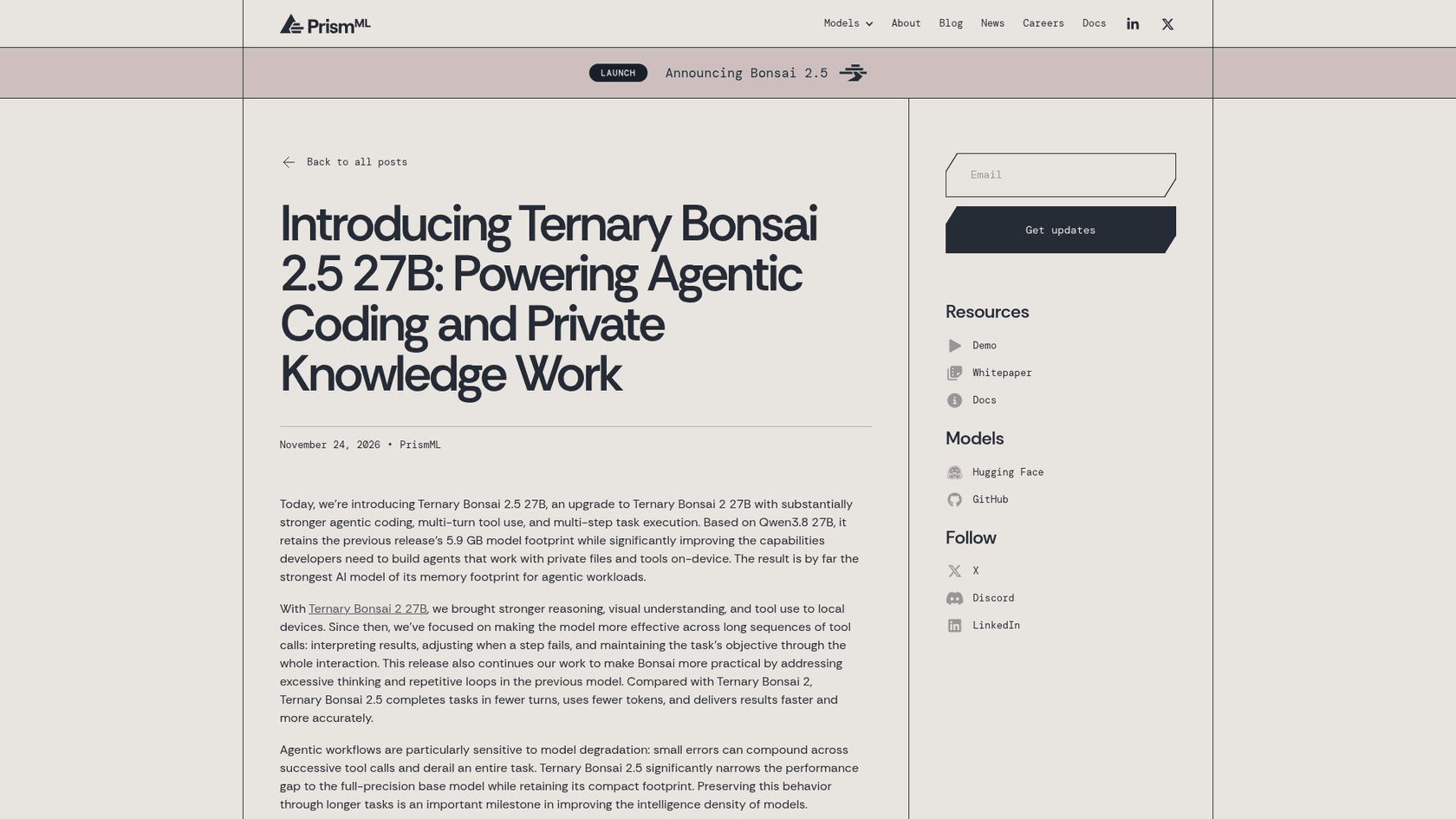
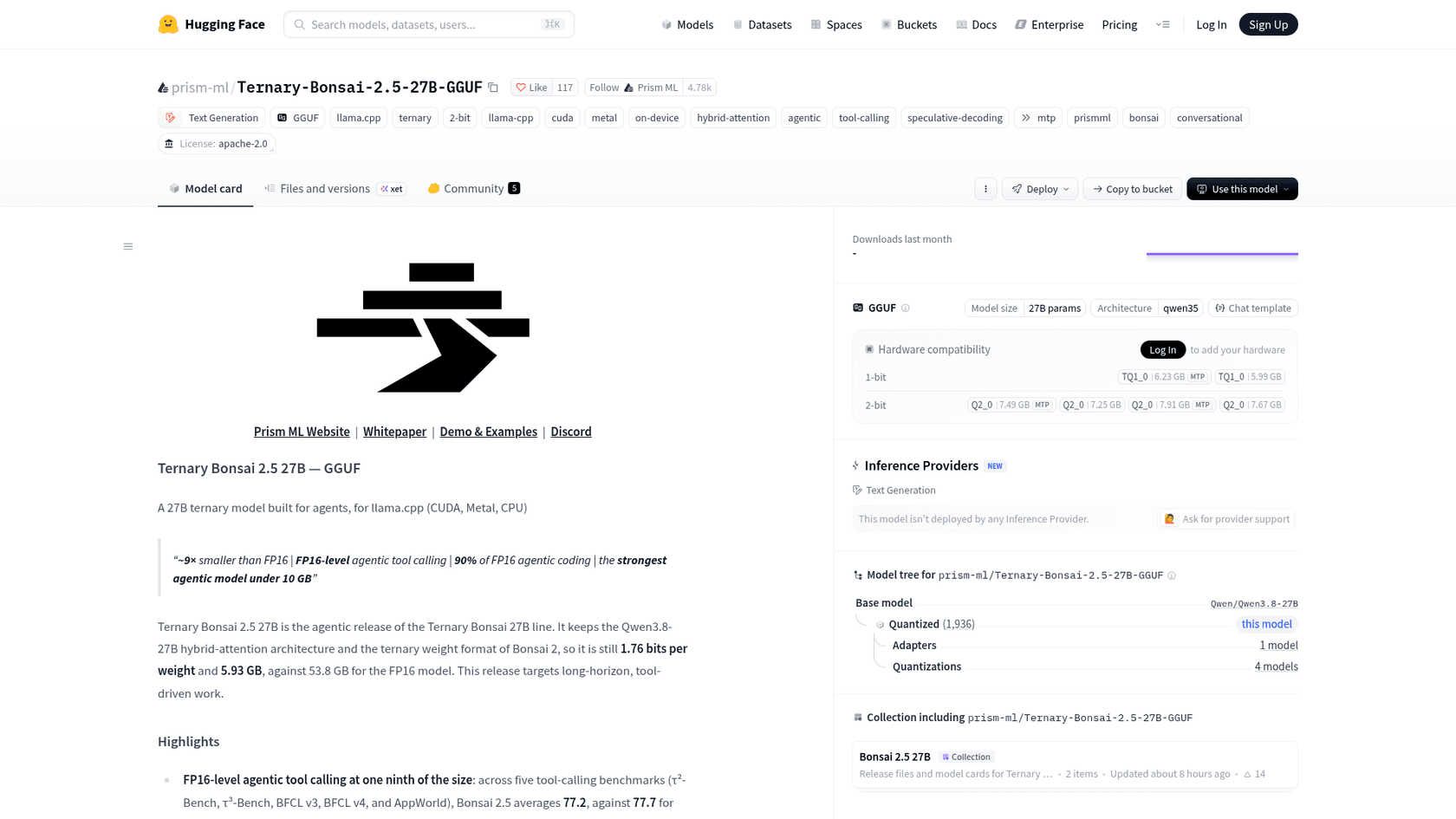
"Ternary" is the trick. In a normal model each weight is a 16-bit number. In Bonsai, every language-model weight is one of three values: -1, 0 or +1, with one shared scale number for each group of 128 weights. Per the Hugging Face model card, that works out to 1.76 bits per weight. The architecture is unchanged from Qwen3.8 27B, including its 262K-token context window and a vision tower for image input.
What changed from Bonsai 2 is the training focus. PrismML says it worked on long chains of tool calls: reading results, recovering when a step fails, and staying on task. It also went after the excessive thinking and repetitive loops that people complained about in Bonsai 2. eesel has spent years running AI agents on live support queues, and I've watched loops sink an otherwise capable model in production, so this is the right thing to fix.
Quick facts, all from PrismML's docs and model card:
| Item | Ternary Bonsai 2.5 27B |
|---|---|
| Maker | PrismML |
| Released | 24 November 2026 |
| Base model | Qwen3.8 27B (hybrid attention) |
| Parameters | 27.36B total |
| Smallest file | 5.93 GB (PTQ1_0), vs 53.8 GB at FP16 |
| Context | 262K tokens |
| Input | Text and images (vision file optional) |
| Reasoning modes | xhigh (default) or medium |
| Runtimes | llama.cpp (CUDA, Metal, CPU, SYCL), MLX |
| License | Apache 2.0 |
| Price | Free weights |
How good is Ternary Bonsai 2.5 compared with full Qwen3.8 27B?
Close, and on tool calling it is level. Across five tool-calling benchmarks, Bonsai 2.5 averages 77.2 against 77.7 for the full FP16 model, at about one ninth of the size. On agentic coding it averages 54.2 against 60.5, which is 90% of the full model.
These are PrismML's own numbers, from the model card and the whitepaper, run in thinking mode at xhigh effort. Here are the agentic rows:
| Benchmark | Qwen3.8 27B FP16 | Bonsai 2 27B | Bonsai 2.5 27B |
|---|---|---|---|
| SWE-bench Verified | 80.6 | 60.8 | 75.6 |
| Terminal-Bench 2.1 | 70.8 | 52.8 | 60.1 |
| DeepSWE | 30.1 | 0.0 | 27.0 |
| τ²-Bench | 80.6 | 80.2 | 82.0 |
| τ³-Bench | 72.8 | 69.1 | 73.9 |
| BFCL v4 | 70.8 | 64.4 | 67.2 |
| AppWorld | 93.2 | 51.2 | 90.5 |
PrismML also compares it with conventional low-bit builds of the same model. The only one with a higher coding average is GSQ-RCO IQ3_XXS at 10.1 GB, 1.7 times the size. On general capability (16 benchmarks across knowledge, math, coding, instruction following and vision) Bonsai 2.5 averages 82.1 against 84.3 for the full model.
For context on what these scores mean next to frontier models, my notes on Claude Opus 5, GPT-5.6 and Gemini 4 Neon cover the hosted end. Bonsai isn't trying to beat those. It's trying to be the best thing that fits in under 10 GB.
What changed between Bonsai 2 and Bonsai 2.5?
The agentic scores jumped, and the size didn't move. Bonsai 2 kept 63% of the full model's coding score and solved zero DeepSWE tasks. Bonsai 2.5 solves 27.0, and AppWorld (writing code against the APIs of nine everyday apps) climbs from 51.2 to 90.5.
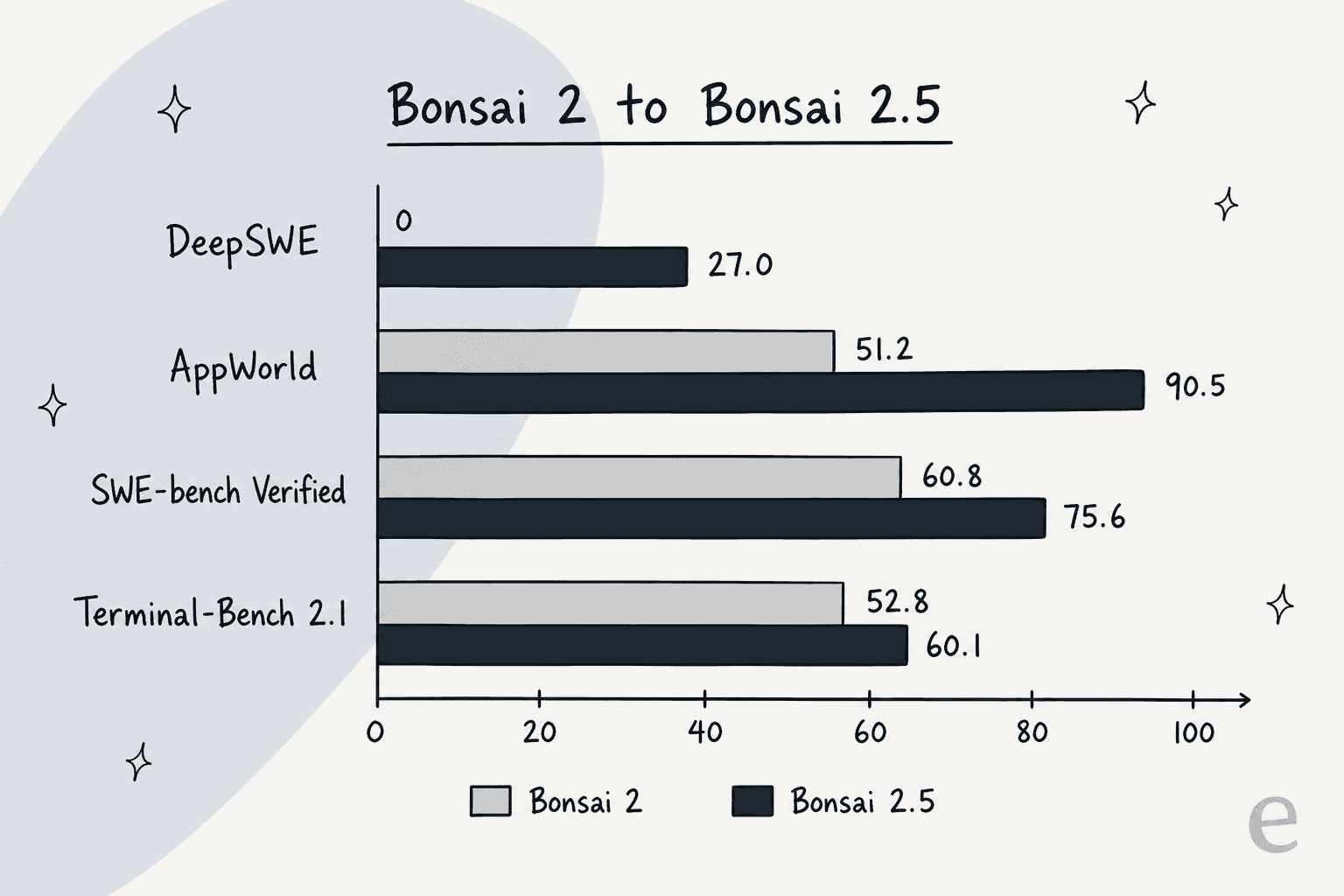
The AppWorld result is the one I'd pay attention to. PrismML says most of the gain comes from finishing whole scenarios: Bonsai 2.5 completes every task in a scenario 89.3% of the time. The model card also flags a trap with other low-bit builds: one 2.5-bit build scored 79.5 on τ²-Bench but only 46.5 on AppWorld, because in about one task in five it guessed every API call in one long script and marked the task done before seeing any output. Headline scores don't always predict that kind of failure, which is why I always benchmark an agent on the job it will actually do.
Early testers on Hacker News are seeing the "fewer loops" claim hold up on their own long tasks:
"The tps remains the same, but the overall task completion time has improved. Bonsai2 5 of 8, 358 steps, 107 min. Bonsai2.5 5 of 8, 296 (17% fewer), 76 min (29% less)."

Same pass rate, fewer steps, less time. That matches what PrismML claims, and it's an honest reading too: the pass rate didn't go up on that tester's eight tasks.
How fast is Ternary Bonsai 2.5, and what hardware does it need?
Fast for its class. On a single NVIDIA H100, PrismML reports 291 tokens per second with its draft head and about 3,200 tokens per second reading a 2,000-token prompt. On a consumer RTX 4090 it reaches 204 tokens per second. An Apple M5 Pro decodes at about 30 tokens per second through llama.cpp.
The "draft head" is the new piece. The MTP variants of the file include one extra layer that guesses the next few tokens, and the full model checks those guesses in one pass. PrismML measures a 1.5 to 1.8 times decode speedup on NVIDIA GPUs, with output that matches normal decoding.
Real-world numbers from people who installed it on launch day:
"running PrismML's Ternary Bonsai 2.5 27B on a single RTX 3060. 12GB VRAM. 262K context. ~74 tok/s decode, ~520 tok/s prefill. bonsai 2 did 26 tok/s at 262K on this card on day one."
"I'm seeing about 22-25 tokens/s on a Mac Mini M5 Pro 24G RAM... I can get up to 128k context in memory easily which makes it potentially useable for agentic coding."
There are three file packings, and picking the wrong one is the most likely way to have a bad first hour:
| File | Size | Runs on | Pick it when |
|---|---|---|---|
| PTQ1_0 | 5.93 GB | PrismML's llama.cpp fork | You're on NVIDIA; fastest decode on every NVIDIA GPU tested |
| PQ2_0 | ~7.2 GB | PrismML's llama.cpp fork | You're on Apple Metal; it's the format PrismML benchmarked there |
| Q2_0 | 7.67 GB | Stock llama.cpp b11556+ | You want upstream llama.cpp or an app that bundles it |
Two setup gotchas from the model card worth knowing before you start:
- Old llama.cpp builds fail silently. PrismML warns that stock builds older than b11556 load the Q2_0 file without any warning and produce garbage. Check
llama-cli --versionfirst. - Give it room to think. The model defaults to
xhighreasoning. A small output cap like 256 tokens ends mid-thought before any answer.loweffort isn't supported; usemediumfor shorter replies. Also pass--min-p 0, since llama.cpp defaults to 0.05.
How much does Ternary Bonsai 2.5 cost?
The model is free. PrismML publishes the weights under Apache 2.0, which allows commercial use, on Hugging Face. There's no PrismML subscription or per-token fee to run it on your own hardware. Hugging Face itself is free for downloads; see my Hugging Face pricing breakdown if you plan to host it there.
Hosted access isn't there yet. When I checked OpenRouter's model list on 25 November 2026, it carried two PrismML models and neither was Bonsai 2.5:
| Model on OpenRouter | Input per 1M tokens | Output per 1M tokens | Context |
|---|---|---|---|
| Ternary Bonsai 2 27B | $0.075 | $0.50 | 262K |
| Ternary Bonsai 2 9B | $0.08 | $0.13 | 262K |
| Ternary Bonsai 2.5 27B | Not listed | Not listed | n/a |
The Hugging Face model page also showed "This model isn't deployed by any Inference Provider" on launch day. So for now, the real cost is your hardware and your time. For teams that want custom work, PrismML says it post-trains Bonsai on domain data and tunes inference for target hardware, with pricing through its sales team.
Who should run Ternary Bonsai 2.5?
It comes down to memory. If you have the VRAM for a less-compressed Qwen3.8 build, use that. If you're under 10 GB, on a laptop, or shipping an app that runs on a phone, Bonsai 2.5 is the strongest agentic model PrismML could find at that size.
Hacker News commenters made the same point, bluntly:
"If you have the memory to run a less-quantized version of Qwen, you'll get better output doing that. This model is deliberately trying to crunch things down to a minimum size."
Where I'd reach for it:
- Private coding agents. A 262K context and 75.6 on SWE-bench Verified from a 6 GB file means a coding agent can work through a private repository on a developer laptop. Pair it with a harness like the ones in my agentic coding CLI roundup, or compare it against hosted options in my Claude Code and OpenAI Codex write-ups.
- On-device products. A document app that summarizes files locally, or a desktop assistant that never uploads anything. That's the "private knowledge work" PrismML is pitching.
- Cheap single-GPU serving. Around 300 tokens per second on one datacenter GPU is a lot of throughput per dollar of hardware.
Where I'd skip it: if you already run a hosted model like Claude Haiku 5.5 or DeepSeek V4 Flash happily, data residency isn't a blocker, and nobody on the team wants to manage GPUs. Also note the vibe from users of the previous version was mixed:
"I tried the V2 and it was unfortunately really bad. It ran but it got stuck in loops and the output was comparatively poor... Hopefully it works better now."
That's about Bonsai 2, not 2.5, and PrismML's fixes target exactly this. But it's a reason to test on your own tasks before trusting the benchmark table. Other small open models worth a look in the same weight class are Inkling 2 Mini, which several commenters compared it against, and the wider Qwen alternatives list.
Can Ternary Bonsai 2.5 power a customer support agent?
The model can do the hard part of the job, and that's new for something this small. τ²-Bench and τ³-Bench put an agent in front of a simulated customer over many turns of conversation and tool calls, and Bonsai 2.5 scores 82.0 and 73.9, above the full Qwen3.8 model on both. If you care about keeping customer data on your own machines, that's a real option now. I covered the compliance side in my HIPAA-compliant AI guide.
But a support agent is much more than a model that can call tools. The "we'll just build our own" plan comes up on eesel sales calls. One churned mid-market customer told the team that long term they would "just build our own, which is so possible now with AI." Bonsai 2.5 makes the model part cheaper. The rest of the list doesn't shrink:
- Knowledge retrieval. Syncing help center articles, macros and past tickets, and keeping them fresh. See my guide to training a support agent.
- Helpdesk actions. Tagging, drafting, routing and handing off inside Zendesk AI or another helpdesk, with permissions that stop it from issuing a refund it shouldn't.
- Handoff. Knowing when to pass a ticket to a person, per my AI agent handoff notes.
- Testing before launch. Running the agent against past tickets so you see the wrong answers before customers do. The hallucination guide covers why.
My build vs buy breakdown runs the full cost of that list, and my AI support agent cost guide puts numbers on the buy side.
Here's what the finished version looks like in practice. smava, a Berlin loan comparison platform, runs three eesel agents on one Zendesk shared by two brands: one categorizes every ticket, one drafts the reply from a library of 820 macros and help articles, and one per brand prepares the customer-ready answer, which eesel never sends itself. That handled 27,000 tickets in a month. SE Ranking gives each of its three products its own agent on Zendesk live chat, which answered 2,100 chats first in a month and hands refunds and Tier 2 questions to the team with the evidence attached. None of that is model work. It's the job around the model.
Try eesel for your support queue
Bonsai 2.5 is a great reason to experiment with local agents, and I'd encourage any developer to try it this week. If what you actually need is the agent answering tickets, eesel is an AI helpdesk teammate that joins your existing helpdesk, learns from your past tickets, macros and help center, and gets simulated on historical tickets before it replies to a customer. Plans are fixed credit bundles starting at $299 for 500 credits, per the eesel pricing page.
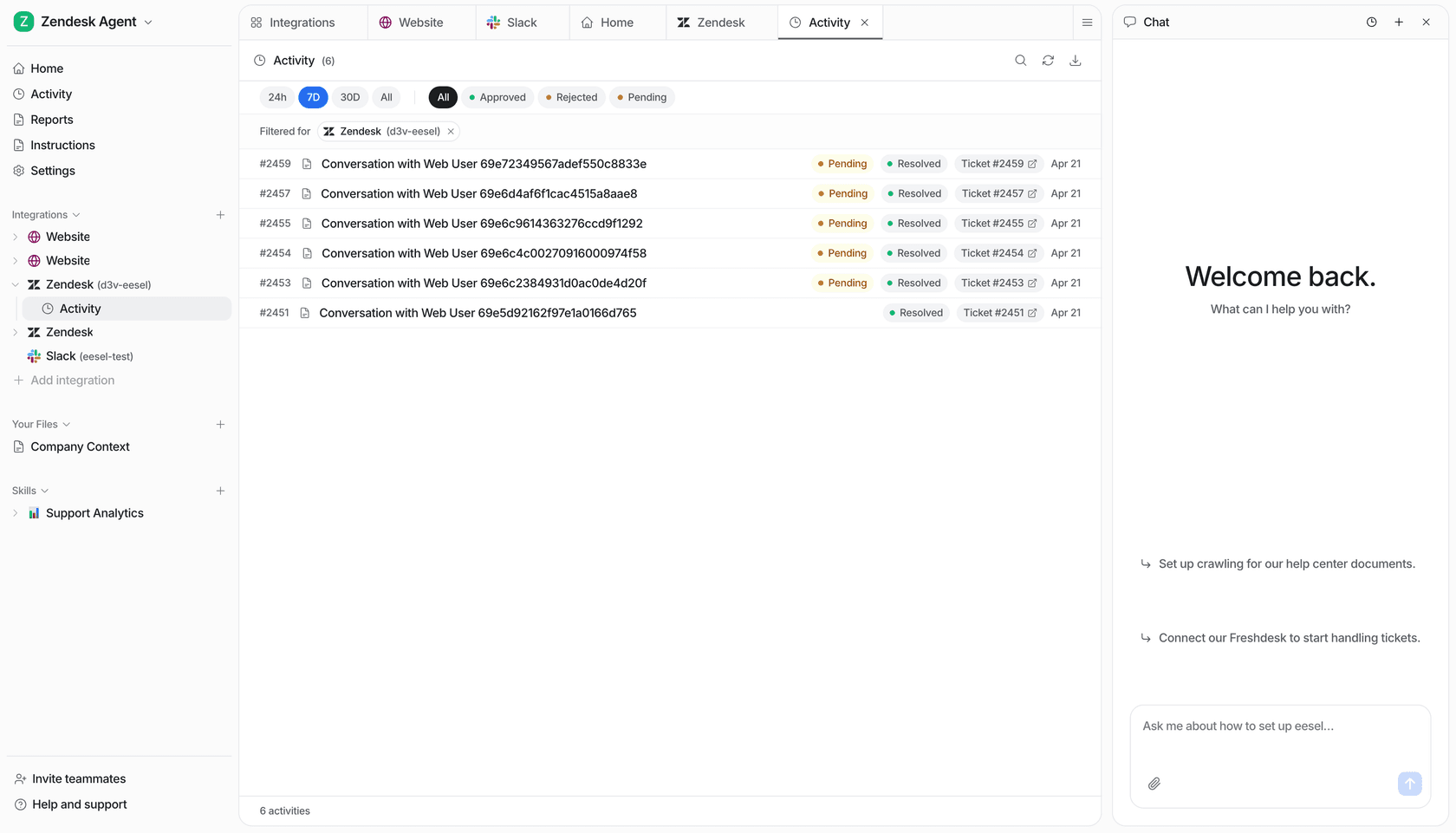
If your team already works through coding agents, the eesel CLI lets one upload approved knowledge, adjust the agent's instructions and ask it test questions from the terminal. Connecting the helpdesk itself still needs someone with admin access to approve it. Compare it with the other AI customer support agents first if you like, then try eesel free.