The 8 best OTRS alternatives in 2026

Kurnia Kharisma

Katelin Teen
Last edited October 14, 2026

Why teams are leaving OTRS in the first place
Let me be fair to OTRS first, because it earned its install base. It is a powerful, ITIL-aligned service management platform, and reviewers who stuck with it say so. On Capterra it holds a 4.4/5 across 96 reviews, with the praise landing squarely on flexibility:
"The best part about OTRS is it can be fully customizable, it is a flexible and scalable platform that can be personalized to meet the particular needs of a business."

So what changed? Three things push people out the door.
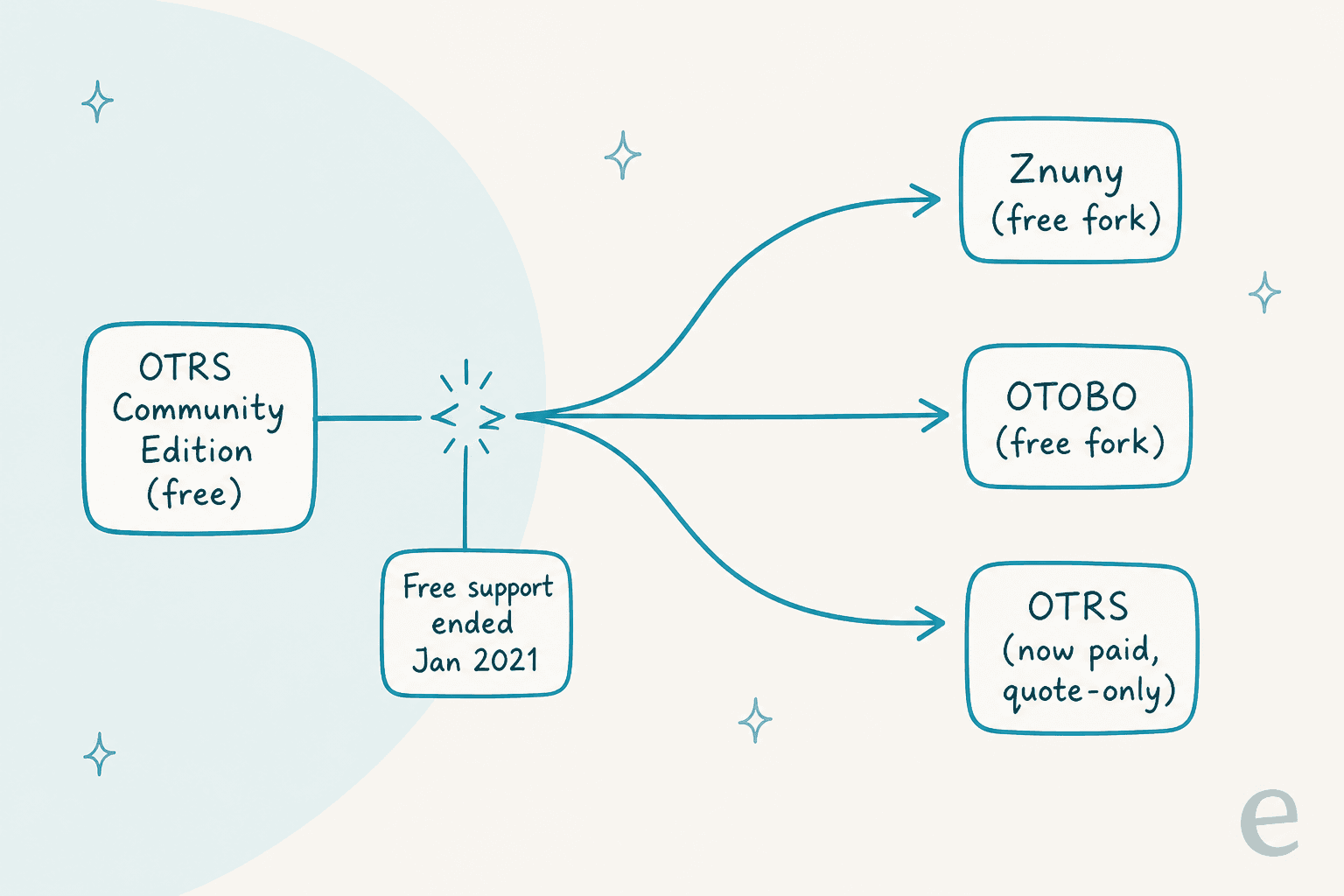
The free version is gone. This is the big one. On December 23, 2020, OTRS AG announced that support and security fixes for the ((OTRS)) Community Edition would stop on January 1, 2021, roughly eight days' notice, over the holidays. The last free release was version 6.0.x. The community read this as a shove toward the commercial product, and it responded by forking the code into two new projects, Znuny and OTOBO. If you are running "free OTRS" in 2026, you are almost certainly running one of those forks, not OTRS.
The pricing is a black box. OTRS today is sold directly from the vendor as a configure-and-quote product. The /pricing and /otrs-plans URLs both 404, and every call to action is "Get a quote." For a large regulated buyer that is normal. For a 10-person IT team it is a wall, and it is the exact friction that makes people go looking for a free ticketing system with a published price.
It is heavy to run. The recurring criticism, even from fans, is the learning curve and the dated user portal. One reviewer put the portal complaint plainly:
"The user portal was not user friendly at all, it created a lot of desafection with the users."
None of this makes OTRS a bad product. It makes it a specific product: enterprise, sales-led, and demanding to administer. If that is not you, here is where to look.
How I picked these OTRS alternatives
I did not want to hand you another list of ten interchangeable ticketing tools. So every pick here is here for a reason, judged on the things that actually matter when you are leaving OTRS:
- Deployment model. Open-source and self-hosted (like OTRS Community Edition was), or fully cloud. This is usually the first fork in the road.
- Migration path. Can you get your OTRS tickets out and into the new tool without a painful export-import project?
- Real, published pricing. After OTRS's quote-only model, a tool that just tells you the price is a feature.
- AI that does more than autocomplete. The whole reason to switch systems in 2026 is often to automate tier-1 tickets, so I looked at whether the AI actually resolves, or just assists.
- Fit. An IT service desk (ITSM) and a customer support desk are different jobs, and I have flagged which each tool is really built for.
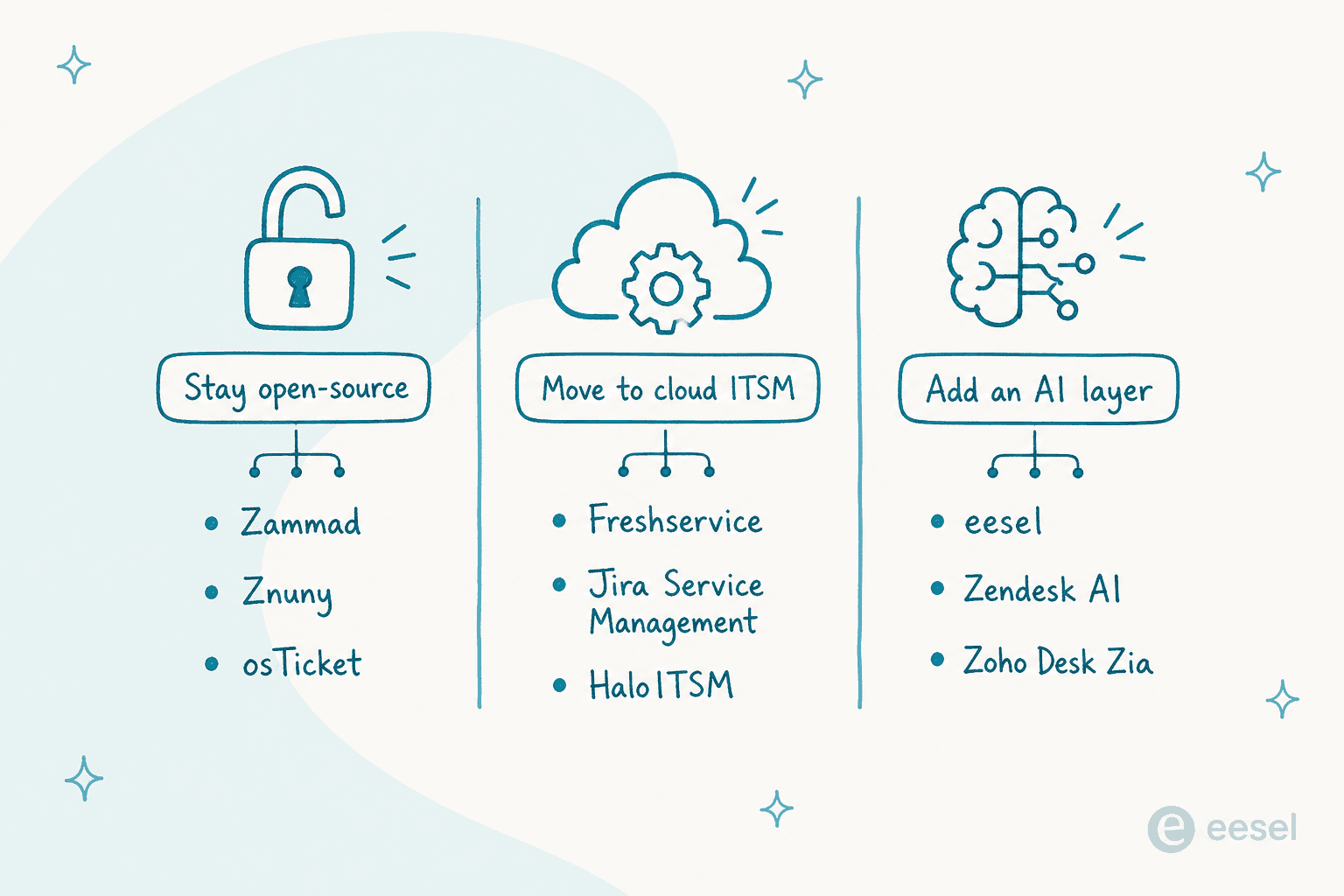
There are broadly three routes off OTRS, and it is worth deciding which one you are on before you compare individual tools.
OTRS alternatives at a glance
Here is the whole field in one table before I get into each one. Prices are the cheapest real entry point (self-hosted tools are free to run; you pay in hosting and time).
| Tool | Best for | Deployment | Starting price | Open source | Native AI | Standout |
|---|---|---|---|---|---|---|
| Zammad | Migrating off OTRS, staying open-source | Self-hosted or cloud | Free self-hosted; hosted from €7/agent/mo | Yes | Ticket summary, writing assist, rule-fired agents | Built-in OTRS importer |
| Znuny | Keeping an existing OTRS setup alive | Self-hosted | Free (GPL-3.0) | Yes | Znuny-LLM, bring-your-own model | Direct OTRS Community Edition continuation |
| osTicket | Small teams that want free, no-frills ticketing | Self-hosted or cloud | Free self-hosted; cloud from $12/agent/mo | Yes | None | Rock-solid free workhorse |
| Freshservice | IT teams wanting cloud ITSM with AI | Cloud | $19/agent/mo | No | Freddy AI (add-on) | Full ITSM in a clean UI |
| Jira Service Management | Teams already living in Jira | Cloud | Free (3 agents); Standard $25/agent | No | Virtual agent + Rovo (Premium+) | Deep dev-and-ops integration |
| Zoho Desk | Cost-conscious teams in the Zoho stack | Cloud | Free (3 agents); paid from $7/agent/mo | No | Zia (Answer Bot from Standard) | Lowest published price |
| Zendesk | Scaling customer-support teams | Cloud | $19/agent/mo | No | AI agents, $1.50–$2.00 per resolution | Biggest app ecosystem |
| HaloITSM | Enterprises wanting all-inclusive ITSM | Cloud or on-premise | £69/agent/mo | No | Halo AI (included) | Every feature in one price |
One thing the table can not show: eesel AI is not a like-for-like ticketing swap. It is an AI teammate that plugs into most of the tools above, so I have given it its own section rather than a row that pretends it is a ticket database. More on that shortly.
Which OTRS alternative fits you?
If you would rather not read all eight write-ups, this walks you to a shortlist in about three clicks.
1. Zammad: the cleanest way off OTRS
Best for: teams leaving OTRS who want to stay open-source without the OTRS baggage.
If there is a natural successor to OTRS, Zammad is it. It is a modern, open-source helpdesk built in Germany, and it goes after OTRS refugees deliberately, right down to a dedicated "alternative to OTRS" page and a built-in Zammad Migrator that imports straight from OTRS (and Freshdesk and Zendesk). That importer is the single biggest reason it tops this list: the scariest part of leaving OTRS is getting your history out, and Zammad hands you a named path.
Reviewers who made the jump keep saying the same thing:
"Modern and Easy to use! ... Love the look and the interface. [Switched from OTRS because] OTRS is no longer supporting the Community Edition."
What it does well: clean multichannel ticketing (email, chat, Telegram, WhatsApp, SMS), a real knowledge base, strong security for a helpdesk (SAML SSO, plus first-party S/MIME and PGP email encryption), and full auditability, which is why it turns up in banks. Its AI is a light "Smart Assist" set: ticket summaries, a writing assistant, and rule-fired AI Agents.
Where it falls short: reporting is thin. Zammad delegates deep analytics to Grafana and Kibana over Elasticsearch rather than shipping a first-party report builder, and reviewers note custom reports take real effort. The AI is assist-grade, not an autonomous resolver, and it is metered separately at €0.03 per AI call on top of your seat price.
Pricing: self-hosted Zammad is free and open-source; you only pay for optional support contracts (from €2,999/year). Hosted plans run €7/€16/€25 per agent per month (Starter, Professional, Plus) on annual billing, in German ISO 27001 data centres.
My take: if you are self-hosting today and want to keep self-hosting, Zammad is the first tool to trial. The migrator alone can save you a week of work. Just go in knowing reporting is its weak spot, and that its AI will draft and summarise rather than close tickets on its own.
2. Znuny: keep your OTRS setup, minus the vendor
Best for: existing OTRS Community Edition users who want to keep exactly what they have, patched and supported.
Znuny is the most literal answer to "what happened to free OTRS." It is a direct continuation of the ((OTRS)) Community Edition 6.0.30, picked up by a German-Swiss team the moment OTRS AG walked away. The GitHub repo says it outright: Znuny is a continuation of the ((OTRS)) Community Edition that reached end of life in December 2020. If your team knows OTRS admin inside out, Znuny keeps every muscle memory intact.
What it does well: it is the same lineage, so your OTRS configuration, workflows, and knowledge translate over with minimal relearning. It is GPL-3.0 and free forever, patched on a visible cadence (paired LTS and feature lines, with real CVE fixes), and it carries over 2,000 configuration options. Its AI, Znuny-LLM, is unusually honest and flexible: it is bring-your-own-model, working with Ollama, OpenAI, Azure, or any OpenAI-compatible endpoint, so no data has to leave your environment.
Where it falls short: it inherits OTRS's DNA, which means it inherits OTRS's learning curve and its older interface. This is a tool for teams that liked OTRS's power and only disliked its price and the vendor's exit. It is not the pick if your complaint about OTRS was that it felt dated.
Pricing: free, full stop. Optional paid support and hosting are sold separately through znuny.com.
My take: Znuny is the low-drama option for a shop that is happy with OTRS the software and just needs a maintained, free home for it. If you are going to keep running this class of system anyway, Znuny is a safer base than an unsupported Community Edition install.
3. osTicket: the free ticketing workhorse
Best for: small teams and internal IT desks that want dependable free ticketing and nothing they will not use.
osTicket has been quietly running support queues for well over a decade. It is a free, self-hosted PHP application that does the core job, ticket intake, routing, SLAs, canned responses, a customer portal, very well and asks nothing in return. On Capterra it sits at 4.3/5 across 76 reviews, and the sentiment is consistent: reliable and free, with a dated look.
"One downside of osTicket is that the user interface can feel somewhat outdated compared to newer help desk platforms."
What it does well: custom fields and forms per help topic, ticket filters for rule-based routing, agent collision avoidance, SLA plans, and a straightforward customer portal. For a lean team that wants a free ticketing system and owns its own server, it is hard to beat on cost.
Where it falls short: be honest with yourself about what is missing. osTicket's own feature page describes no AI, no machine learning, no chat or messaging channels, no native Slack or Teams integration, and no mobile app, and its product screenshots have not been refreshed since January 2021. The routing is deterministic if-this-then-that rules, not content-aware. It is email-and-web-form ticketing, done well, and no more.
Pricing: the self-hosted core is free to download. The cloud-hosted version now runs under the SupportSystem brand at $12/$16/$24 per agent per month, and one gotcha there: SAML single sign-on is Premium-only, so an SSO mandate doubles your per-seat cost.
My take: osTicket is the right call when the brief is "we need reliable tickets, we have no budget, and we can host it ourselves." If you need automation or omnichannel, it will feel a generation behind, and that is where a modern helpdesk or an AI ticketing system earns its keep.
4. Freshservice: cloud ITSM with the AI built in
Best for: IT teams that used OTRS for ITSM and want the same discipline in a hosted tool.
If you ran OTRS as an IT service desk, Freshservice is the most natural cloud landing spot. It covers the full ITIL set, incident, problem, change, release, plus asset and operations management, in a UI that is far friendlier than OTRS's. Its Freddy AI layer splits into a deflection agent, an agent-side copilot, and proactive insights, and Freshworks cites up to 66% ticket deflection with self-service.
What it does well: clean, approachable ITSM that a mixed team can actually administer, strong asset management, and enterprise search across the internal knowledge base plus SharePoint, Google Drive, and Confluence. It is a common pick in our ITSM for small business research for exactly that reason.
Where it falls short: the AI is largely an add-on, and it can disappoint if you expect magic. Freddy Copilot is $29/agent/month on top of your plan, and one large team on Reddit reported the deflection agent actually slowed them down at first:
"Added Freddy AI 5 months ago and our tier-1 MTTR went up."

That is not a reason to avoid Freshservice; it is a reason to test any AI against your own tickets before trusting it, which is a theme I will come back to.
Pricing: Starter, Growth, and Pro run $19 / $49 / $99 per agent per month, billed annually, plus a custom Enterprise tier that bundles a Freddy AI Agent session allowance. Freddy Copilot is a $29/agent/month add-on.
My take: Freshservice is the safe, well-rounded ITSM upgrade from OTRS. Budget for the AI add-ons rather than assuming they are included, and pilot the deflection agent before you flip it on for everyone.
5. Jira Service Management: for teams already in Jira
Best for: engineering-adjacent teams whose developers already live in Jira.
If your OTRS instance mostly served an IT team that works alongside developers, Jira Service Management is worth a serious look, because the link between a service ticket and a dev issue is native rather than bolted on. It is deeply configurable, which is both its superpower and its tax. We have a fuller rundown in our Jira Service Management alternatives piece.
What it does well: tight integration with the Atlassian universe, powerful automation, and flexible workflows. There is a real free tier for up to 3 agents, which OTRS never offered.
Where it falls short: two things. First, the complexity is real; reviewers describe it as heavy and admin-intensive. Second, the billing surprises people. The headline "$20 per agent" is a blended rate at 75 seats; a team of 10 actually pays the $25/agent list rate, and seats can get auto-assigned:
"User management is tricky. I found that users were automatically assigned as users to JIRA Service Management. I didn't realize what was happening until I received the invoice for additional users."
The AI adds another wrinkle: the virtual service agent only exists on Premium and up, and it ships two overlapping AI systems (the older Virtual Agent and newer Rovo) that even admins find confusing. If you want AI here, our best AI for Jira Service Management guide covers the layers.
Pricing: Free for 3 agents; Standard lists at $25/agent/month for small teams, Premium at $57.30; Enterprise is quote-only. The virtual agent bundles 1,000 assisted conversations on Premium, with overage from $0.30 each. Full breakdown in our Jira Service Management pricing guide.
My take: pick it if you are already an Atlassian shop; the integration payoff is real. If you are not, the configuration overhead is a lot to take on right after escaping OTRS's own complexity.
6. Zoho Desk: the budget pick
Best for: cost-conscious teams that want a published price and maybe already use Zoho.
After OTRS's quote-only wall, Zoho Desk feels refreshingly transparent: the prices are right there, and they are low. It leans customer support rather than pure ITSM, but for a team that used OTRS as a general helpdesk, it is a comfortable, affordable home, especially if you already touch other Zoho apps. 125,000+ companies run support on it.
What it does well: a real knowledge base from the Standard tier, multi-brand help centres, a community forum, and Zia AI that can turn past tickets into help articles and auto-translate content across 50+ languages. For the price, the feature depth is strong, and our best AI for Zoho Desk piece digs into the AI specifics.
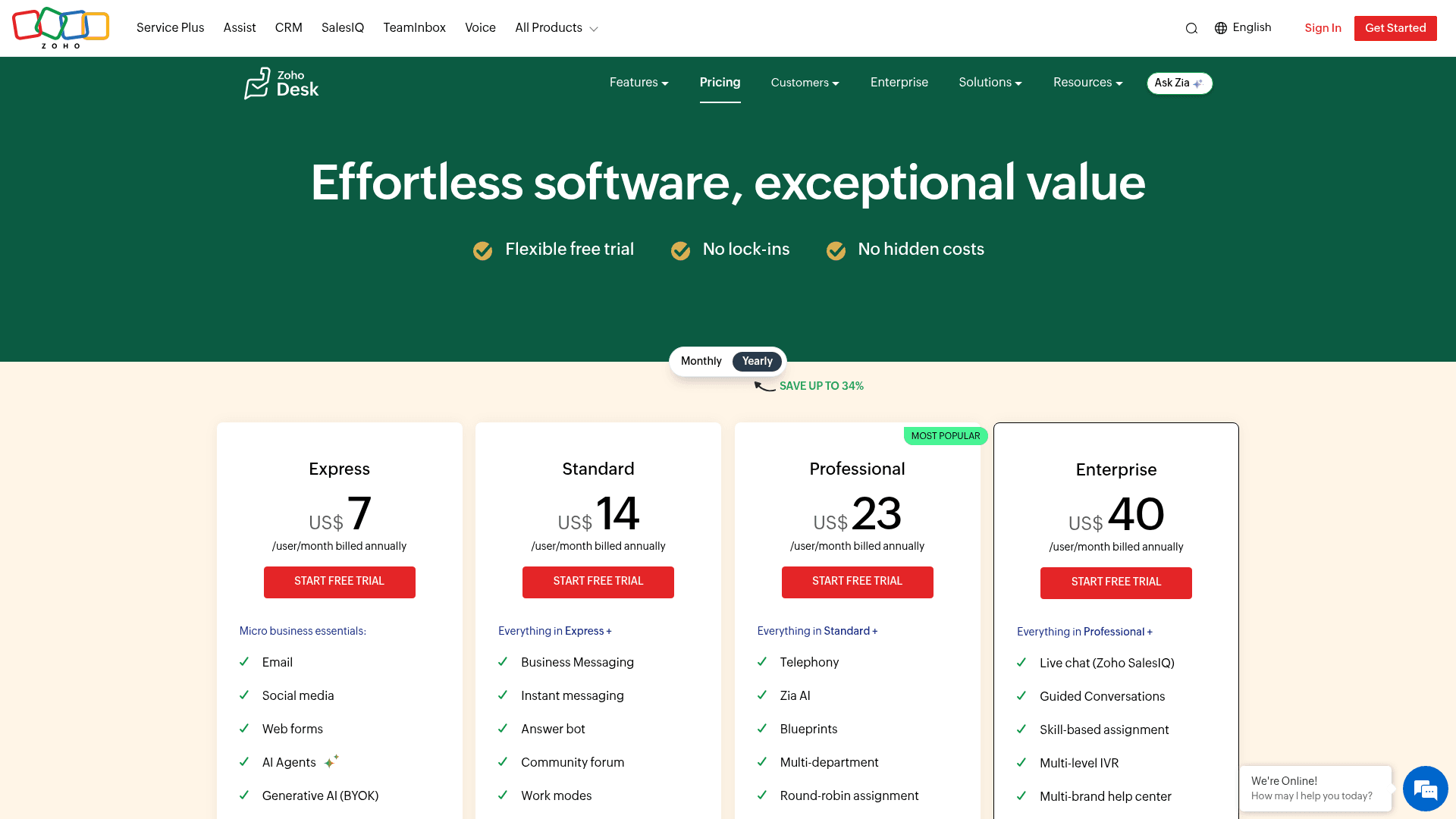
Where it falls short: the most advanced AI is gated to the top tier. Zia's Answer Bot, the piece that actually answers customers from your knowledge base, starts on Standard, but the Answer Bot inside the ASAP widget and chatbots in Instant Messaging are Enterprise-only at $40/user/month, and generative AI on lower tiers requires you to bring your own OpenAI API key. So the cheap entry price and the useful AI are not the same plan.
Pricing: Free for 3 users, then Express $7, Standard $14, Professional $23, and Enterprise $40 per user per month (billed annually). The knowledge base starts at Standard.
My take: Zoho Desk is the value play. If budget is the reason you are leaving OTRS and you want customer-support features more than heavy ITSM, it is the easiest yes. Just price the tier that has the AI you actually want, not the $7 headline.
7. Zendesk: the scale option
Best for: customer-support teams that expect to scale and want the largest ecosystem.
If OTRS was serving external customers rather than an internal IT team, Zendesk is the market-leading place to land. It is polished, endlessly extensible, and has by far the biggest app marketplace. Its AI agents can resolve tickets end to end, and it publishes real deflection numbers from named customers like Tesco and Squarespace.
What it does well: a mature omnichannel platform, a huge integrations catalogue, and a genuine knowledge base that its generative AI can build from your ticket history. It is the default comparison point for a reason, and we cover it in depth in our Zendesk platform guide.
Where it falls short: cost, and the shape of that cost. The Suite plans start at $55/agent/month and climb to $115 for Professional, and the AI is billed separately on top, at $1.50 to $2.00 per automated resolution. That per-resolution model can get unpredictable at volume, which is exactly the kind of pricing our Zendesk AI agents guide exists to demystify. For a small team, Zendesk is a big step up in spend from a self-hosted OTRS.
Pricing: Support Team $19, Suite Team $55, Suite Professional $115 per agent per month (annual). AI resolutions are $1.50 (committed) or $2.00 (pay-as-you-go) each, on top.
My take: Zendesk is the right answer when you are a growing support org that needs the ecosystem and can fund it. If you are a lean team chasing the free-OTRS feeling, it will feel expensive, and the per-resolution AI billing is something to model carefully before you commit.
8. HaloITSM: all-inclusive enterprise ITSM
Best for: enterprises that want deep, ITIL-aligned ITSM without the per-feature upsell games.
HaloITSM is the closest match to OTRS's enterprise ambitions, and it fixes the two things enterprises hate about big suites: tiered feature-gating and opaque pricing. Everything, every module, every integration, and AI as standard, comes in one per-agent price. It is a UK vendor named a Gartner Challenger for ITSM, and it runs the McLaren F1 team's service platform. On G2 it holds a strong 4.8/5.
What it does well: the full ITIL set (incident, change, problem, CMDB, service catalogue), 1,000+ out-of-box reports, no-code configurability, and Halo AI (virtual agents and AI suggestions) included rather than sold as an add-on. For a regulated enterprise leaving OTRS, it is comparable in depth.
Where it falls short: power comes with a learning curve. Reviewers praise the flexibility but flag a steep ramp and thin documentation, and some advanced reports need SQL. It is compared most often to Freshservice, with the trade being "more configurable, harder to learn."
Pricing: £69 per agent per month, all-inclusive, cloud or on-premise, with a 30-day free trial and no credit card. Not the cheapest per seat, but there are no surprise upsells.
My take: HaloITSM is the enterprise-for-enterprise swap. If you loved OTRS's depth and only hated the quote-only pricing and admin friction, Halo gives you comparable cloud ITSM breadth with one honest number on the invoice.
The option most OTRS lists miss: add AI instead of switching everything
Here is the reframe I promised. When I talk to teams leaving OTRS, the migration is almost never what they actually want. What they want is for the boring, repetitive tickets to stop landing on a human. Swapping ticketing systems is just the path they assume they have to take to get there.
Often, they do not. This is where eesel AI fits, and it is a different shape from everything above. eesel is not a ticketing database you migrate into. It is an AI support teammate that plugs into the helpdesk you already have (or the one you pick from this list), learns from your past tickets and help centre, and starts drafting and resolving replies. Think of it as hiring a new agent that already knows your product on day one, rather than buying a new filing cabinet.
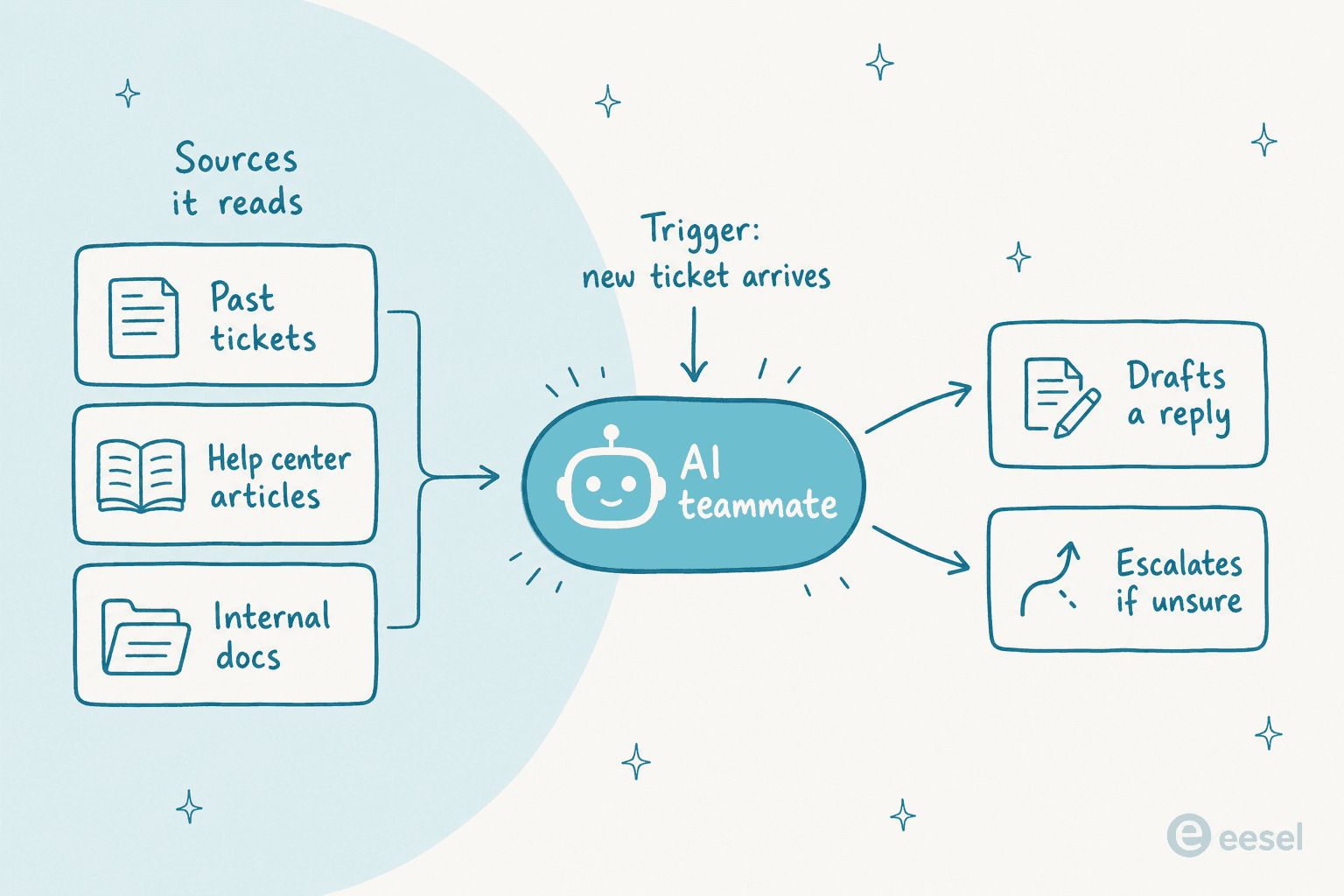
The difference that actually matters is the one the Freshservice reviewer above ran into: most native helpdesk AI is a fixed chatbot you turn on and hope for the best. We have spent years watching confident-sounding bots quietly give wrong answers, which is why eesel makes you simulate a rollout against your own historical tickets first, so you see the resolution rate and the exact replies before a single customer is affected. And because it learns from your solved tickets, not just your help centre, it sounds like your team, not a generic FAQ.
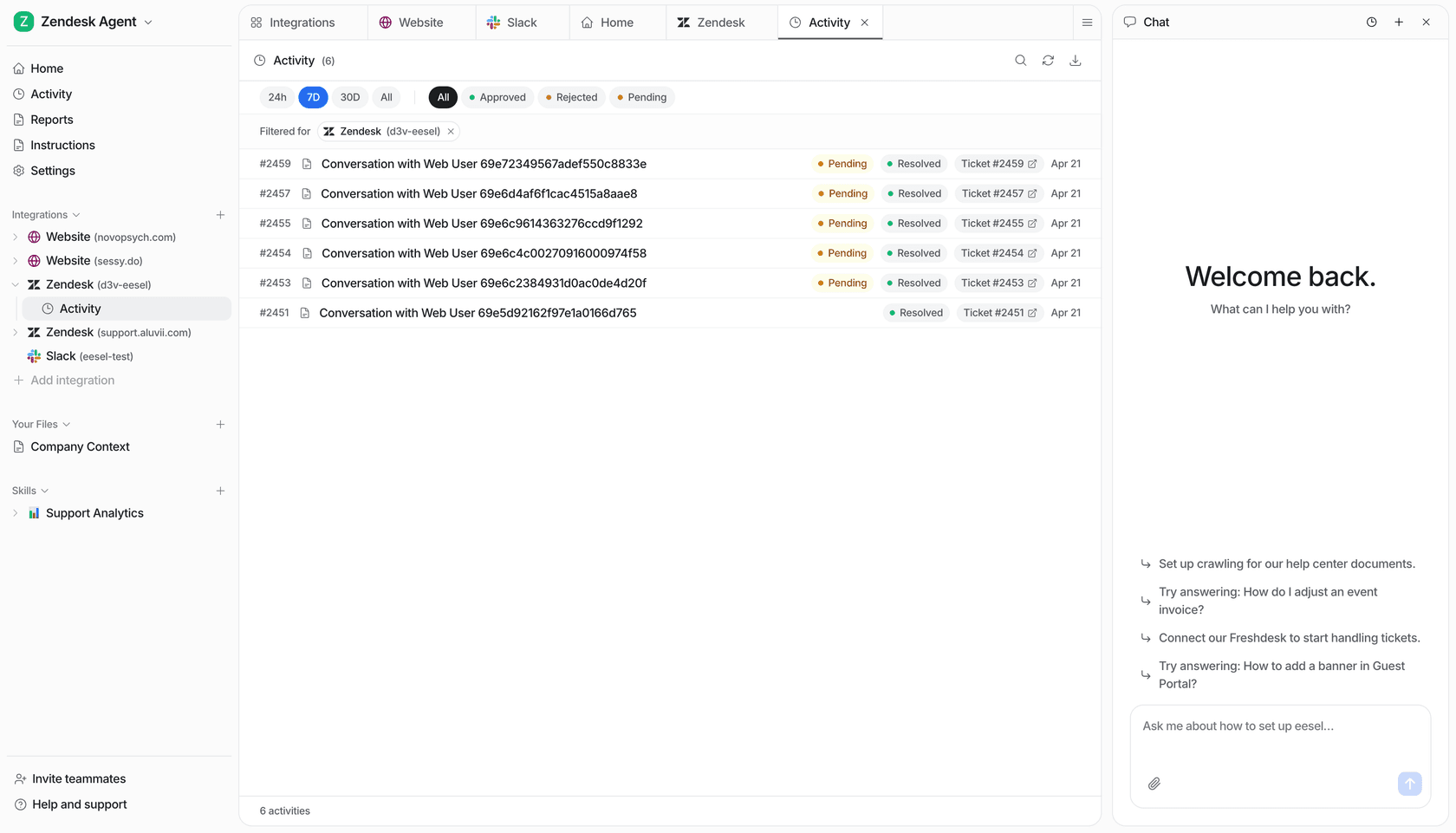
The results are real and named: Gridwise resolved 73% of its tier-1 tickets in the first month, and Smava runs over 100,000 tickets a month fully automated in German. Setup is measured in minutes, not the months an OTRS-class rollout takes.
So before you commit to a full ticketing migration, it is worth asking: is my problem the helpdesk, or is it the volume of repetitive tickets? If it is the second one, you can often solve it on top of whatever you land on, or even on top of what you already have.
Try eesel AI on top of your helpdesk
If your real reason for leaving OTRS is that you want AI to actually handle tickets, eesel AI is the fastest way there. It connects to helpdesks like Zendesk, Freshservice, Zoho Desk, and more, learns from your existing tickets and docs, and drafts or fully resolves replies, with confidence-based escalation so it hands off anything it is unsure about instead of guessing. You can simulate it on your own past tickets to see the resolution rate before it goes live, and pricing is transparent and per-ticket, not per-resolution.

Most teams are live within 30 minutes, there is no sales call required, and it is free to try. If you have been putting off the OTRS migration because it feels enormous, this is the low-risk first step: keep your tickets where they are, and let the AI take the repetitive load off your team today.
Frequently Asked Questions
What happened to the free version of OTRS?
What is the best open-source alternative to OTRS?
How much does OTRS cost in 2026?
/pricing and /otrs-plans pages now 404, and the "How to Buy" flow is a configure-and-quote model across Starter, Advanced, and Pro packages. Every button says "Get a quote," which is a real barrier for smaller teams compared to self-serve helpdesks. If you want predictable numbers, look at a free ticketing system or a published-price tool instead.