The 8 best TheLoops alternatives in 2026

Kurnia Kharisma Agung Samiadjie

Katelin Teen
Last edited September 28, 2026

Why people look for a TheLoops alternative
I have spent the last three-plus years putting AI agents on live support queues, and the pattern with tools in this category is always the same. The demo is genuinely impressive, the data depth is real, and then the practical questions start: what does it cost, how long until it is live, and what happens when a feature quietly changes.
TheLoops is a good product with a real point of view. It grades 100% of tickets instead of the 3-10% a manual QA program usually samples, and its escalation prediction reads sentiment across dozens of signals. Its own customers back this up. One support ops lead on G2 put it plainly:
"We benefit from the highly customizable reporting, which allows us to answer in-the-moment questions with accuracy and ease. The AI-features like escalation prediction, Impact Score, and Sentiment Score are valuable tools for our support leaders to understand and prioritize our backlog."

So why shop around? A few reasons come up again and again, and they are the honest ones, not a hatchet job.
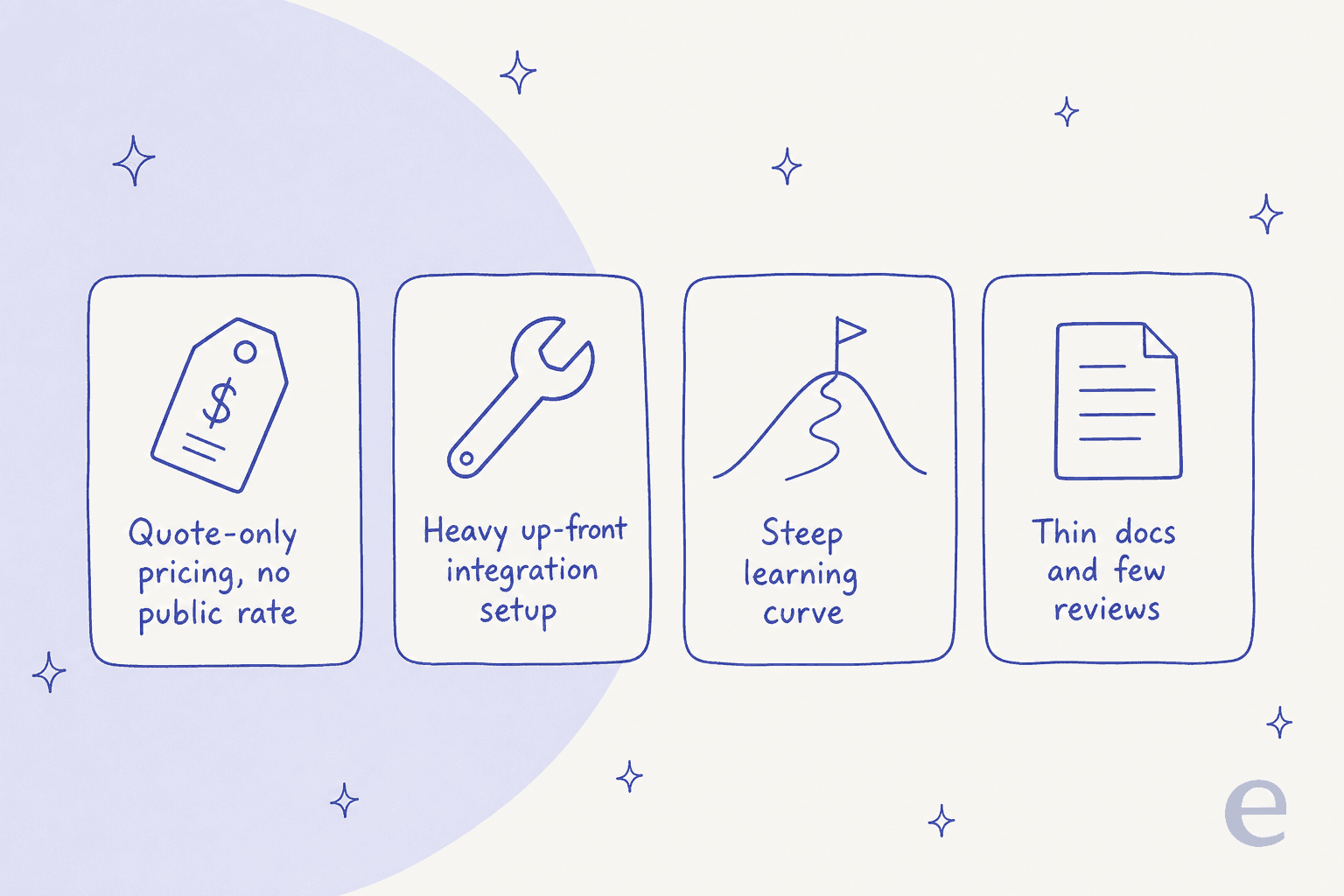
First, the price is a mystery. Every path on the TheLoops site is a "Get a demo" button; there is no public rate, no billing unit, no free trial. Second, setup is heavy. It is a data platform, so the value only shows up after you have wired in your helpdesk, your warehouse, and your other tools across its roughly 60 connectors. Third, there is a learning curve. The same reviewers who love the depth admit it. As one wrote on G2, the platform "can be a bit daunting to learn since it is so powerful." And fourth, the review footprint is thin, at 4.6 out of 5 across just nine reviews, which is not much to go on for a purchase this size.
None of that makes TheLoops a bad tool. It makes it a specific tool, and the right alternative depends on which of its jobs you actually care about.
First, what TheLoops actually is (so you pick the right kind of alternative)
This is the step most roundups skip, and it is the one that saves you a wasted month. TheLoops does not answer your customers. It sits on top of the tools that do and adds three things: automated QA on every conversation, prediction (escalation risk, CSAT, sentiment), and an agent-assist copilot. Its newer AutoPilot module does handle some self-service, but the core of the product is intelligence, not front-line resolution.
That means "TheLoops alternatives" actually splits into three different shopping lists, and mixing them up is how teams end up with the wrong tool.
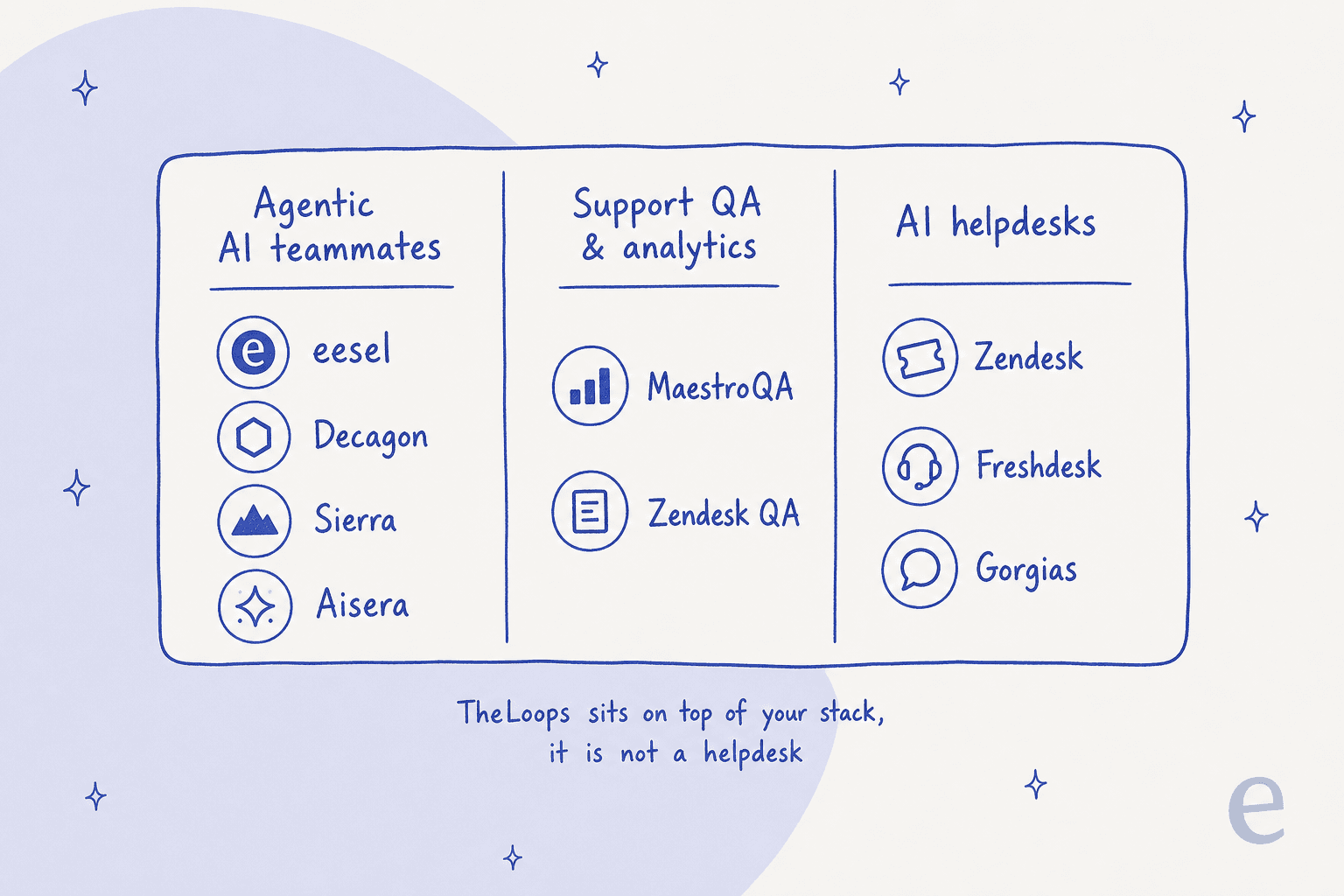
- Agentic AI teammates actually resolve tickets on their own: eesel, Decagon, Sierra, and Aisera. This is where you look if you want deflection, not just dashboards.
- Support QA and analytics grade and analyze conversations, which is TheLoops' flagship job: MaestroQA and Zendesk QA.
- AI helpdesks are the underlying platform with AI bolted on: Zendesk, Freshdesk, and Gorgias.
I have put all eight below with real pricing and an honest verdict. If you only read one section, read the one that matches your actual job.
The 8 best TheLoops alternatives at a glance
| Tool | Best for | Category | Billing unit | Starting price | Free option | Built-in QA |
|---|---|---|---|---|---|---|
| eesel AI | Resolving tickets with a self-serve start | Agentic AI teammate | Per ticket / chat handled | Free, then $299/mo | 100 free credits | Simulation + reporting |
| Decagon | Enterprise agentic deployments | Agentic AI teammate | Per conversation or resolution | Quote only | No | Watchtower QA |
| Sierra | Large consumer brands, voice + chat | Agentic AI teammate | Per outcome | Quote only | No | Insights |
| Aisera | Cross-functional IT + HR + CX | Agentic AI platform | Quote only | Quote only | No | Analytics suite |
| Zendesk | Teams that want the helpdesk and QA in one | AI helpdesk + QA | Per automated resolution | $19/agent/mo | 14-day trial | Zendesk QA add-on |
| MaestroQA | Pure conversation QA and analytics | Support QA | Quote only | Quote only | No | Yes (core product) |
| Freshdesk | Budget-friendly AI helpdesk | AI helpdesk | Per AI session | Free, then $19/agent/mo | Free plan | Add-on |
| Gorgias | Ecommerce and Shopify support | AI helpdesk | Per resolution | $10/mo | 7-day trial | Basic reporting |
Prices checked September 2026. Quote-only means the vendor publishes no rate and routes you to sales.
1. eesel AI
Best for: teams that want an AI teammate to actually resolve tickets, and want to see it work on their own data before paying a cent.
Full disclosure: this is my team's product, so read the verdict with that in mind. But it earns its spot here because it sits in the gap TheLoops leaves open. TheLoops tells you which tickets are risky; eesel goes one step further and drafts or sends the reply. It is an AI teammate platform, and the AI helpdesk teammate is the one that competes here: it plugs into your existing helpdesk, learns from your past tickets, macros, and help center on day one, and handles real conversations.
The differentiator that matters against this whole category is the simulation. Before eesel replies to a single customer, it replays hundreds of your past tickets and scores its answers against what your team actually sent, so you see the accuracy and the gaps up front. This is the exact fear that keeps teams from trusting an AI agent, and it is why we built simulation first. As one CX lead we work with put it, the goal is "an AI who is only handling the tickets that it's confident to handle, and all the other ones, leave them alone."
Features
- Autonomous AI helpdesk agent that drafts or auto-sends replies, with a draft mode for the nervous first weeks.
- Simulation over your real ticket history before go-live, so accuracy is a number you check, not a promise.
- Over 1,000 point-and-click integrations across Zendesk, Freshdesk, Gorgias, Salesforce, Slack, Confluence, and more.
- An eesel CLI and MCP server, so a person, a script, or a coding agent like Claude Code or Cursor can operate the same teammate from a terminal. Every command prints JSON, and setup or lookup commands are free; only actual chat work is billed.
- Handles replies in the language the customer writes in. Smava runs a fully automated Zendesk agent handling 100,000+ tickets a month in German.
Pros
- The only tool on this list you can fully try before buying, with no card and no sales call.
- Pricing is public and predictable, billed per conversation handled rather than per seat.
- Live in about 30 minutes on an existing helpdesk, with no rip-and-replace.
Cons
- It is a resolution and automation tool, not a dedicated conversation-QA analytics suite. If deep manual scorecard workflows are your only need, a QA specialist like MaestroQA fits better.
- Newer and smaller than the enterprise incumbents, with a G2 footprint of 4.6 across 18 reviews.
Pricing
Genuinely transparent, which is rare in this category. A free tier gives you 100 credits with no card, then teammate plans run from $299 a month for 500 credits, scaling up to $1,899 for 5,000. One credit equals one ticket or chat handled, and every plan includes unlimited agents and seats. Optional overage is $0.80 per extra credit.
Verdict: If your real goal is deflection and you are tired of demo-gated pricing, eesel is the most direct answer to what TheLoops does not do. Start free, run a simulation, and you will know inside an afternoon whether it works on your tickets.
2. Decagon
Best for: large enterprises deploying a fully autonomous agent across chat, voice, and email, with the budget and team to match.
Decagon is one of the most credible AI-native agent platforms, built around AOPs (Agent Operating Procedures), which are natural-language workflows rather than a decision-tree builder. On top of that sit Duet (which generates and refines those procedures from real conversations) and Watchtower, its always-on QA, which is the piece that most directly overlaps TheLoops. The customer numbers are strong: Duolingo reports an 80% deflection rate and Curology a 65% cost reduction.
One Duolingo operations lead captured the switching story better than any spec sheet:
"With the previous vendor, at least half my week was dedicated to maintaining their system. With Decagon, it's been a night-and-day difference."
Ian Riggins, Senior Operations Manager, Duolingo (decagon.ai)
Features
- AOPs for authoring agent logic in plain language.
- Duet and Watchtower for building, testing, and continuously QA-ing agents.
- Browser Actions, so the agent can act in web systems that have no API.
Pros
- A genuinely autonomous agent, not an assist layer, with real enterprise deflection numbers.
- Publishes its billing meters openly and even argues against outcome pricing, which is refreshingly candid.
Cons
- No self-serve trial and no public rate, so evaluation runs entirely through sales.
- Docs sit behind a sign-in wall, so you cannot check how it works before a demo.
Pricing
Quote-only. Uniquely, Decagon publishes the meters even without a rate: you can choose per-conversation or per-resolution billing, and it steers most customers to per-conversation to avoid arguments over what counts as a "resolution." No dollar figure appears anywhere on its site, so budget on a real quote, not a rumor.
Verdict: A top pick if you are an enterprise buying a serious autonomous agent and QA in one, and price discovery through sales is fine. Overkill, and likely over budget, for a small or mid-size team.
3. Sierra
Best for: large consumer brands that want a polished, voice-first agent and a long-term partner rather than a self-serve tool.
Sierra is the other enterprise heavyweight, founded by Bret Taylor and Clay Bavor and built for consumer-facing brands running support across voice, chat, email, and WhatsApp. It offers both a no-code Agent Studio and an agents-as-code Agent SDK, plus Ghostwriter, which builds an agent from a prose description. The scale is not in doubt; Taylor announced the company had raised money at a heady valuation:
"Sierra is raising $950 million from new and existing investors, led by Tiger Global and GV, at a valuation of over $15 billion."
Features
- Two build paths (no-code Studio and code-first SDK) with Agent Traces for real-time observability.
- Voice as a first-class channel with dedicated PCI-certified infrastructure for payment data.
- Insights for reporting, experimentation, and monitoring.
Pros
- Serious voice and multichannel depth, in 58-plus languages.
- Enterprise-grade security and a partner model built for big rollouts.
Cons
- Outcome pricing is negotiated per contract, so there is no universal definition of a billable "outcome" to compare against.
- Fully sales-led, with no pricing, integrations, or security pages public, and docs behind a login.
Pricing
Quote-only, on an outcome-based model: you pay when the agent achieves an agreed outcome, most often a resolved conversation. Sierra admits the real bill is usually blended with consumption-style work where outcomes are hard to attribute. No rate is published anywhere.
Verdict: A strong choice for a large brand that wants voice, scale, and a hands-on partner. If you want to move fast or self-serve, its enterprise sales motion will feel slow.
4. Aisera
Best for: organizations that want one agentic platform spanning IT, HR, and customer service, not just support.
Aisera is the broadest platform here. Rather than CX only, it runs autonomous agents across IT, HR, finance, and customer service, with a Universal Agent orchestrating domain-specific ones. It was acquired by Automation Anywhere in November 2025, so it is increasingly bundled into that agentic-automation stack. It is also heavily funded, having raised roughly $171M and hit a $1.6B valuation, with customers like Adobe, Cisco, and Workday.
Features
- Universal Agent plus Domain Agents (IT, HR, Finance, CX) and narrow Task Agents.
- Aisera Unify orchestration built on open standards (A2A, MCP), with a BYO-LLM gateway.
- The TRAPS governance framework, plus SOC 2, ISO 27001, and HIPAA compliance.
Pros
- True cross-functional reach if you want IT and HR service automation alongside CX.
- Deep enterprise governance and a large model-agnostic architecture.
Cons
- Breadth is a tradeoff. If you only need customer support, a CX-focused tool is simpler to run. See how it stacks up in our Aisera reviews.
- Quote-only, and the recent acquisition adds some roadmap uncertainty.
Pricing
Quote-only with no public rate. For the closest thing to a breakdown, our Aisera pricing guide collects what is knowable, and its competitors page covers adjacent options.
Verdict: The right call if you are buying an enterprise-wide service platform, not just support software. If your problem is purely the support queue, it is more platform than you need.
5. Zendesk (with Zendesk QA)
Best for: teams that would rather have the helpdesk, the AI, and the QA under one roof instead of a separate intelligence layer.
Here is the reframe worth considering: a big reason TheLoops exists is to add intelligence to a helpdesk that lacked it. But Zendesk has since built much of that natively. Its AI agents resolve tickets across messaging, email, and voice, and Zendesk QA (the former Klaus, which it acquired) grades 100% of conversations, which is TheLoops' core job. Getting both from your existing platform can beat bolting on a third tool. It is worth reading up on Zendesk's AI capabilities before deciding.
Features
- AI agents for messaging, email, and voice, with a natural-language agent builder.
- Zendesk QA for automated grading across the full conversation volume.
- A deep app marketplace and mature reporting.
Pros
- One vendor for helpdesk, AI, and QA, which simplifies procurement and data flow.
- Genuinely transparent per-agent pricing on its core plans.
Cons
- QA is a paid add-on, not included in the base plans.
- Automated resolutions are metered on top of seats, so heavy AI use adds up. Our guide to Zendesk AI agents walks through the real costs.
Pricing
Per agent, per month: Support Team at $19, Suite Team at $55, and Suite Professional at $115 (annual). Automated resolutions are included in small amounts (5 to 10 per agent per month) and then billed as usage, at a published rate of around $1.50 to $2.00 each. Zendesk QA is a separate add-on.
Verdict: The pragmatic pick if you are already on Zendesk or want everything in one platform. Less appealing if you specifically want a best-of-breed intelligence layer that spans multiple non-Zendesk tools, which is exactly TheLoops' pitch.
6. MaestroQA
Best for: teams whose actual need is conversation QA and analytics, TheLoops' flagship job, without the agentic extras.
If you strip TheLoops down to its most-loved feature, Auto QA, MaestroQA is the specialist that does exactly that. It started as a contact-center QA tool and has grown into a "conversation data platform" that ingests calls, chats, emails, and bots, then analyzes 100% of them with AI instead of the manual 2-8% sample. Named customers include Etsy, DraftKings, and Stitch Fix. Oura summed up the appeal on MaestroQA's use-case page: "We're now evaluating 100% of interactions, not just the 8% that get a CSAT response."
Features
- AutoQA that grades every interaction against your scorecards.
- Coaching workflows that turn QA findings into agent development.
- Voice-of-Customer analytics and reverse-ETL into your data warehouse.
Pros
- A true best-of-breed QA tool, deeper on grading and coaching than a generalist.
- Strong compliance posture (SOC 2, HIPAA, PCI) and a mature scorecard toolkit.
Cons
- It analyzes conversations; it does not resolve them. This is analytics, not deflection.
- Pricing is demo-only, a recurring complaint in its own community reviews.
Pricing
Quote-only. There is no published plan, seat price, or billing unit; the pricing page is a lead-capture form. Budget on a real quote.
Verdict: The cleanest swap if QA was the only reason you looked at TheLoops. If you also wanted prediction and agent assist, you will feel the narrower scope.
7. Freshdesk
Best for: budget-conscious teams that want an AI-capable helpdesk they can actually start on today.
Freshdesk is the value play in the AI-helpdesk group. Its Freddy AI Agent handles customer-facing resolutions and Freddy Copilot assists human agents, all on a platform that starts at a genuinely low price and even offers a free plan. It will not match a dedicated intelligence platform for depth of analytics, but for a smaller team that wants front-line AI without an enterprise contract, it is a sensible landing spot. We cover the options in our best AI for Freshdesk roundup.
Features
- Freddy AI Agent for automated customer resolutions on email and chat.
- Freddy Copilot ($29 per agent) for agent-side assist.
- A solid core helpdesk with knowledge base, routing, and reporting.
Pros
- A free plan for 1-2 agents and low per-agent pricing.
- The first 500 Freddy AI sessions are free on Pro and Enterprise plans.
Cons
- AI analytics are lighter than a dedicated platform's, and deeper insights sit on higher tiers.
- Session-based AI billing needs watching. Our Freshdesk automation guide explains where costs creep in.
Pricing
Standalone Freshdesk runs Free ($0 for up to 2 agents), Growth ($19), Pro ($55), and Enterprise ($89) per agent per month, billed annually. Freddy AI Agent is billed per session (a 72-hour interaction window), with the first 500 sessions free on Pro and above, then $49 per 100 sessions.
Verdict: Best value here if you want a real helpdesk with AI on a budget. Not the tool if you came to TheLoops specifically for advanced prediction and QA.
8. Gorgias
Best for: ecommerce and Shopify stores that want AI support wired into order data.
If your support is ecommerce, Gorgias is the specialist. Its AI Agent handles pre- and post-sales questions, returns, refunds, and order edits, with deep Shopify context right inside the ticket. That focus is exactly why merchants pick it, as one long-time operator explained on Reddit:
"If a meaningful chunk is WISMO, address changes, cancels, refunds, exchanges, Gorgias usually feels worth it because the agent can do the work inside the ticket with Shopify context right there."

Features
- AI Agent that resolves ecommerce tickets and takes order actions.
- Native Shopify, Klaviyo, and Recharge integrations.
- Omnichannel support across email, chat, and social DMs.
Pros
- Purpose-built for ecommerce, with order actions inside the ticket.
- Transparent, conversation-based pricing that scales with volume, not headcount.
Cons
- Outside ecommerce, its specialization is wasted. See the best AI for Gorgias if you want to extend it.
- Costs can climb as ticket volume grows, even for simple, repetitive queries, a point the same Reddit thread raised.
Pricing
Plans run Starter ($10/mo, 50 tickets), Basic ($50, 300), Pro ($300, 2,000), and Advanced ($750, 5,000), with unlimited seats. The AI Agent is a usage add-on billed per resolved conversation, at $0.90 on annual plans and $1.00 monthly, with overage listed at $1.50 each.
Verdict: The clear pick for a Shopify store. For non-ecommerce support, it is the wrong specialist.
What these actually cost, and why it is hard to compare
The single most frustrating thing about this category is that the tools do not bill the same way, so a sticker price tells you almost nothing. Here is what each one actually charges for.
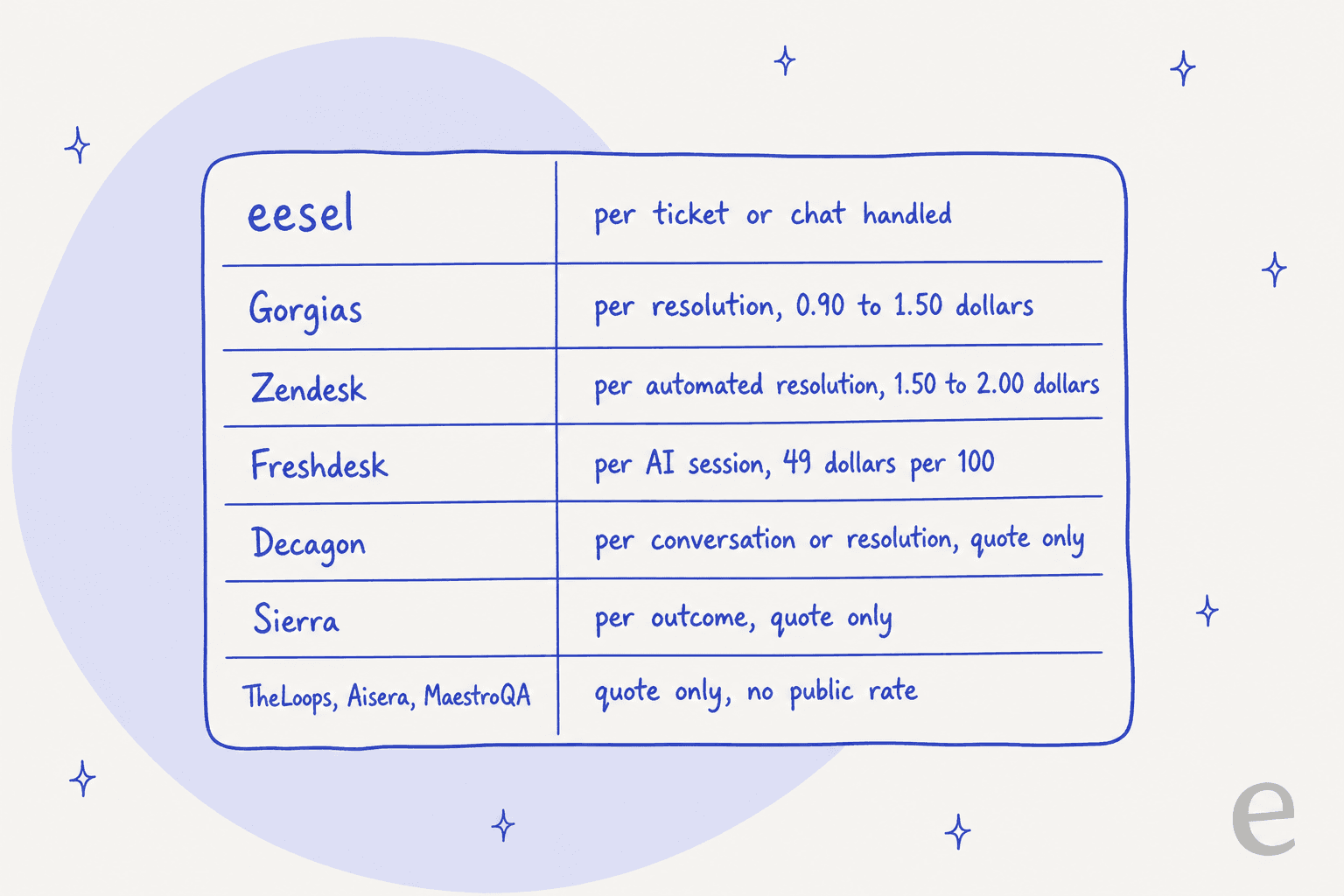
The split is stark. Five of the nine tools here, including TheLoops itself, are quote-only, which means real budgeting starts with a sales call. The rest each define a different billable unit: eesel charges per ticket or chat handled, Gorgias and Zendesk charge per resolution, and Freshdesk charges per AI session. Those units are not interchangeable. A "resolution" is only billed when the AI fully closes a case, while a "handled" ticket counts whether or not it resolved, and a "session" can bundle many replies inside a time window.
The practical takeaway: if predictable, checkable pricing matters to you, that alone narrows the field fast. It is worth walking through a real cost comparison with your own ticket volume before committing, because the cheapest sticker is rarely the cheapest bill.
How to choose the right TheLoops alternative
Skip the feature grids for a second and answer one question: what job are you hiring for?
- You want to resolve more tickets automatically. Look at the agentic teammates. eesel if you want to start free and simulate first, Decagon or Sierra if you are a large enterprise with the budget for a sales-led rollout.
- You only want conversation QA and analytics. That is MaestroQA or Zendesk QA. TheLoops' Auto QA was the draw, and these do it as their whole job.
- You want the helpdesk itself, with AI included. Zendesk for the all-in-one, Freshdesk for value, Gorgias for ecommerce.
- You want IT and HR service automation too, not just CX. Aisera is the cross-functional platform.
And whatever you shortlist, insist on trying it against your own data. The tools that let you do that without a sales call, mainly eesel and Freshdesk, give you a real answer in an afternoon. The rest ask you to trust the demo.
Try eesel
If what pulled you toward TheLoops was the promise of AI that understands your support, but what pushed you away was quote-only pricing and a long setup, eesel is worth 30 minutes of your time. It plugs into your existing helpdesk, learns from your past tickets and help center on day one, and lets you simulate its accuracy on your real ticket history before it ever replies to a customer.
Unlike most of this list, you can start for free with 100 credits and no card, see exactly what it costs, and be live the same day. It is the closest thing here to "TheLoops, but you can actually try it and read the price tag."
Frequently Asked Questions
What is the best TheLoops alternative?
It depends on the job you are hiring for. If you want an AI that actually replies to and resolves tickets, eesel's AI helpdesk teammate is the closest fit and the only one here you can start for free. If you only want conversation grading and QA, MaestroQA is the specialist. TheLoops itself is an intelligence layer, so the right alternative maps to whether you want automation, analytics, or a full helpdesk.
How much does TheLoops cost compared to the alternatives?
TheLoops is quote-only with no public rate, which is one of the main reasons buyers shop around. Among the alternatives, eesel publishes plans from a free tier up, Zendesk and Freshdesk list per-agent prices, and Decagon, Sierra, and Aisera are also quote-only. See the cost breakdown for how the units differ.
Is TheLoops a helpdesk?
No. TheLoops (now IFS Loops) is an AI intelligence and agentic layer that sits on top of your existing stack like Zendesk or Salesforce. If you actually need the helpdesk itself, look at Zendesk, Freshdesk, or Gorgias rather than a pure analytics layer.
Which TheLoops alternative is best for support QA?
MaestroQA and Zendesk QA (formerly Klaus) are the two dedicated QA platforms here, both built to grade 100% of conversations rather than a manual sample. TheLoops' Auto QA competes directly with them, so if QA is your only need, a specialist is usually a cleaner fit than a broad intelligence platform.
Can I try a TheLoops alternative for free?
Most of this category is demo-gated, but a few are not. eesel gives you 100 free credits with no card, and Freshdesk has a free plan for small teams. Decagon, Sierra, Aisera, and MaestroQA are all sales-led with no self-serve trial, which is worth factoring into how fast you can actually evaluate them.


Article by
Kurnia Kharisma Agung Samiadjie
Kurnia is a software engineer and writer at eesel AI with two years of SEO experience, writing about AI tools, helpdesk software, and customer support. He pairs a developer's understanding of how these products are built with search-driven research into what actually ranks and resonates with the people searching for them.