


Gemini 3.5 Pro isn't live yet, and that matters
Let's clear this up first, because half the pages ranking for "Gemini 3.5 Pro pricing" quietly skip it.
The Gemini 3.5 family has launched, just not the Pro member. Gemini 3.5 Flash is live and stable, and so is Gemini 3.5 Live Translate. But the Pro tier is still a version behind. On the DeepMind Gemini lineup, the Pro card shows a "3.5 Pro coming soon" badge sitting over a model that still reads "Gemini 3.1 Pro." There is no gemini-3.5-pro model ID in the API docs, and no 3.5 Pro row on the pricing page.
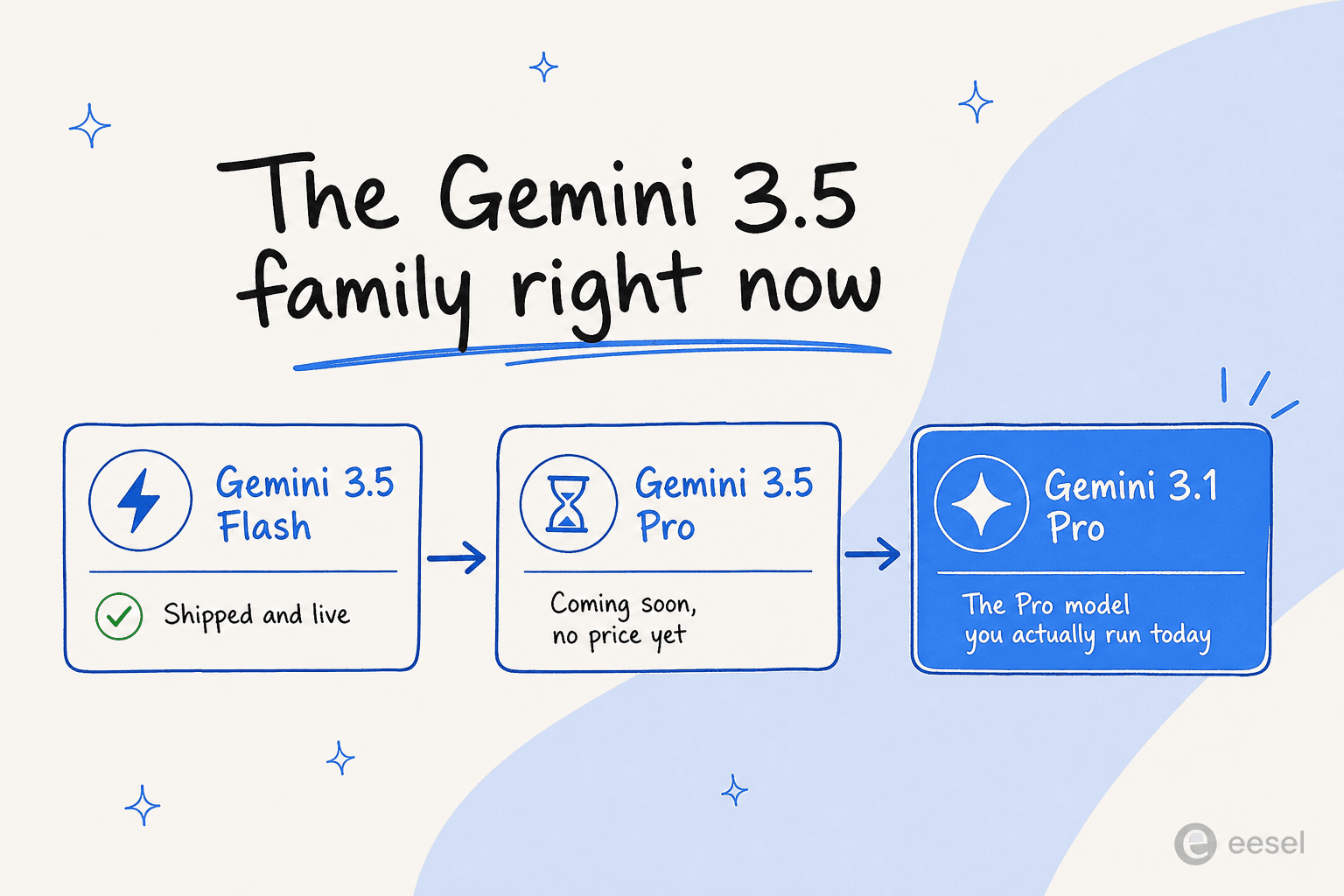
Why the wait? Google has publicly said 3.5 Pro is taking longer because it's working on the model's capabilities, especially coding. On Hacker News, the delay is the loudest thread in the room:
"Near the end of 2025, Google was on top - best LLM (Gemini 3 Pro), best video model (Veo 3.1), and best image model (Nano Banana). They seemed unstoppable. And then, they stopped."

The practical takeaway: if a page hands you an exact Gemini 3.5 Pro price or a benchmark table, it's a guess. The only numbers worth budgeting against today are the live Gemini 3.1 Pro rates, so that's what I'll use, and I'll flag clearly where 3.5 Pro is expected to land.
The current Pro price: Gemini 3.1 Pro API rates
Here's the model you'd actually be paying for today if you build on the Pro tier. Gemini 3.1 Pro is the only family member with context-length tiering: prompts up to 200k tokens are cheaper than prompts above it. Each model also publishes four service tiers, so the "Pro price" depends on how you call it.
| Tier | Input ≤200k | Input >200k | Output ≤200k | Output >200k | Cached input | Cache storage |
|---|---|---|---|---|---|---|
| Standard | $2.00 | $4.00 | $12.00 | $18.00 | $0.20 / $0.40 | $4.50 /1M/hr |
| Batch | $1.00 | $2.00 | $6.00 | $9.00 | $0.20 / $0.40 | $4.50 /1M/hr |
| Flex | $1.00 | $2.00 | $6.00 | $9.00 | $0.20 / $0.40 | $4.50 /1M/hr |
| Priority | $3.60 | $7.20 | $21.60 | $32.40 | $0.36 / $0.72 | $8.10 /1M/hr |
All figures are per 1M tokens, USD, from the Gemini 3.1 Pro Preview section of Google's pricing page. There's no free tier for Pro, which is worth noting: the free API tier only covers Flash and Flash-Lite.
A few things that trip people up:
- Output includes thinking. Gemini 3.1 Pro is a reasoning model, so the tokens it "thinks" with are billed at the output rate. On a hard prompt, thinking can dwarf the visible answer, which is why output is 6x the input price.
- Batch and Flex halve your bill if you can tolerate delay. Batch runs asynchronously; Flex is for lower-priority traffic. Both drop Standard's $2/$12 to $1/$6.
- Priority costs 80% more for guaranteed low latency. If you're serving live users, you're probably here, not on Standard.
For the cheaper end of the family, Gemini 3.5 Flash runs $1.50 input / $9.00 output on Standard, and Gemini 3.1 Flash-Lite is the budget option at $0.25 input / $1.50 output. If you want the whole grid across every model, our Gemini pricing guide keeps the full table current.
What Gemini 3.5 Pro pricing will probably look like
Google hasn't published it, so I won't invent it. But the pattern across recent Pro releases has been steady: context-tiered pricing in the same neighborhood as the prior Pro model, with the new model replacing the old at a similar or slightly higher rate. If 3.5 Pro follows that, expect something close to the current $2 to $4 input and $12 to $18 output band, possibly with a bump for a stronger reasoning tier. Anyone quoting a precise 3.5 Pro number right now is reading tea leaves.
Gemini consumer pricing: the Google AI plans
If you're not building on the API and just want Gemini in the app, Gmail, and Docs, you're on a Google One AI plan. Google renamed these after I/O 2026, so ignore older write-ups quoting "$7.99 AI Premium." Here are the live numbers from one.google.com:
| Plan | Price | Storage | What you get |
|---|---|---|---|
| Free | $0 | 15 GB | Gemini 3.5 Flash, limited 3.1 Pro, image gen, Deep Research |
| Google AI Plus | $4.99/mo | 400 GB | Higher limits, Gemini 3.1 Pro, YouTube Premium Lite |
| Google AI Pro | $19.99/mo | 5 TB | 4x higher limits, $10/mo Cloud credits, Jules, Antigravity |
| Google AI Ultra (5x) | $99.99/mo | 20 TB | 5x usage vs Pro, Deep Think, $40/mo Cloud credits |
| Google AI Ultra (20x) | $199.99/mo | Highest | 20x usage, highest limits everywhere, $100/mo Cloud credits |
The thing to notice: paying more mostly buys you more usage of the same Pro model, not a smarter one. AI Plus and AI Ultra both run Gemini 3.1 Pro; Ultra just lets you hit it far more often and unlocks Deep Think reasoning. If you're a single user who occasionally bumps into limits, AI Pro at $19.99 is the sweet spot. If you're a team trying to cost out real work, the consumer plans aren't your answer, and I'll get to why.
For how these plans compare to the rest of the market, we've done the head-to-heads: Gemini vs Perplexity, ChatGPT vs Gemini, and a wider set of Gemini alternatives.
Rolling Gemini out across a company is priced differently again. If your team runs on Google Workspace, the Workspace pricing tiers are the ones to read, and our Gemini 3 pricing guide covers the generation-level numbers.
The API math that actually decides your bill
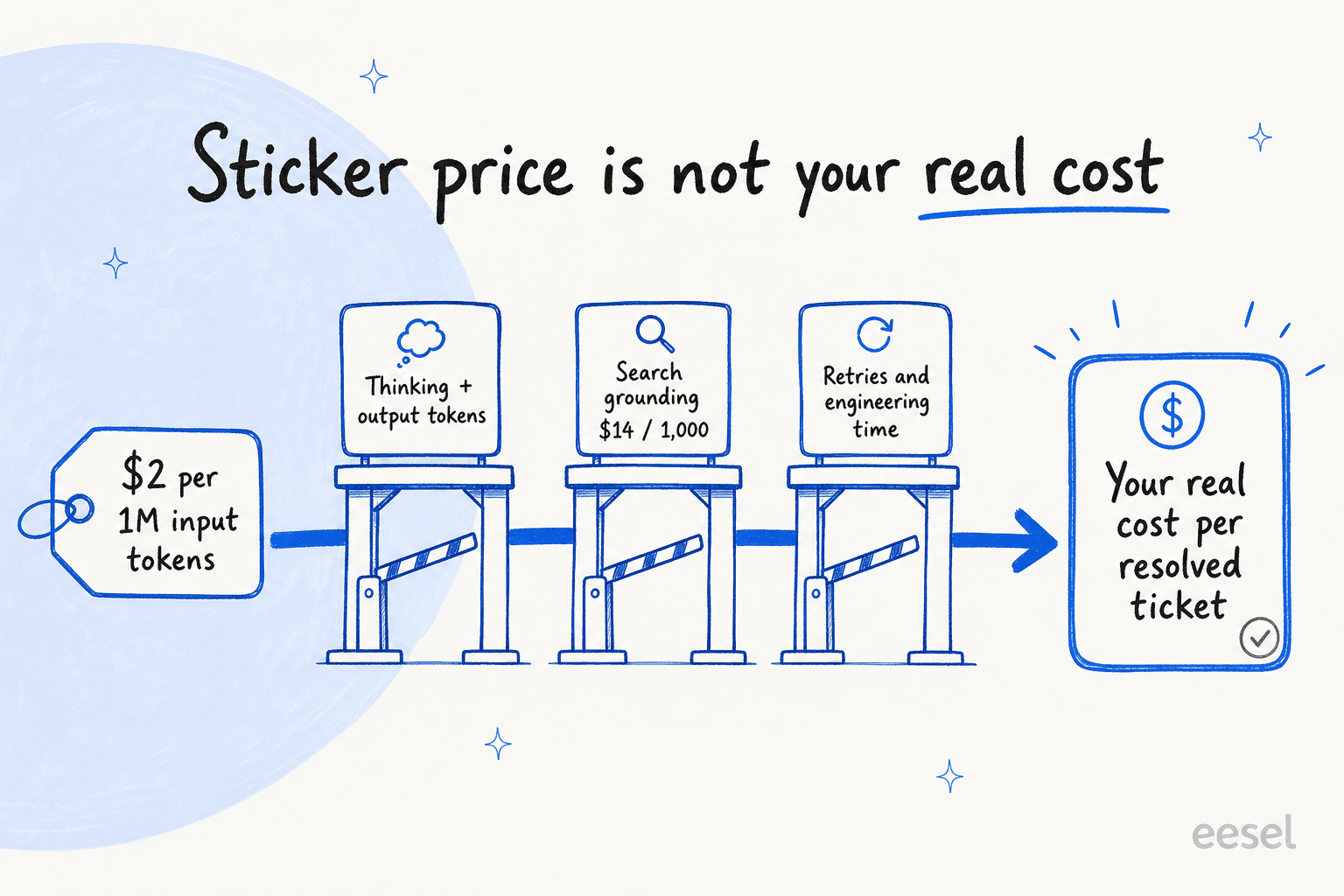
This is the part most pricing posts skip, and it's the part that matters. A $2 / 1M input tokens sticker feels cheap. Then you deploy, and the bill is nothing like your estimate. Here's where the gap comes from.
Plug your own numbers in. This estimator uses the live Gemini 3.1 Pro Standard rates (the current Pro tier) so you can see how token volume turns into a monthly bill:
Run the defaults and a support-sized workload (10,000 conversations, ~6k input and ~1.5k output tokens each) lands around $440/month in tokens and grounding. That already ignores the expensive parts:
- Thinking tokens are unpredictable. You don't control how long the model reasons, and every one is billed at output rates.
- Grounding adds up fast. Search grounding is free for the first 5,000 prompts a month across the Gemini 3 family, then $14 per 1,000 queries. One search per ticket at scale is a real line item.
- Retries and failed tool calls. This is the one that stings. On Hacker News, agentic Gemini use gets specific complaints:
"Its not just subpar, its not even sub-sub-par. It goes into loops and never completes a task 8 times out of 10 that i've used it."
Every loop is billed. The sticker price assumes one clean pass; production rarely gives you one.
How Gemini 3.1 Pro performs (since you're paying for it)
Price only means something next to capability. Gemini 3.1 Pro is genuinely strong on the numbers Google publishes, and the community backs a lot of it up for non-coding work.
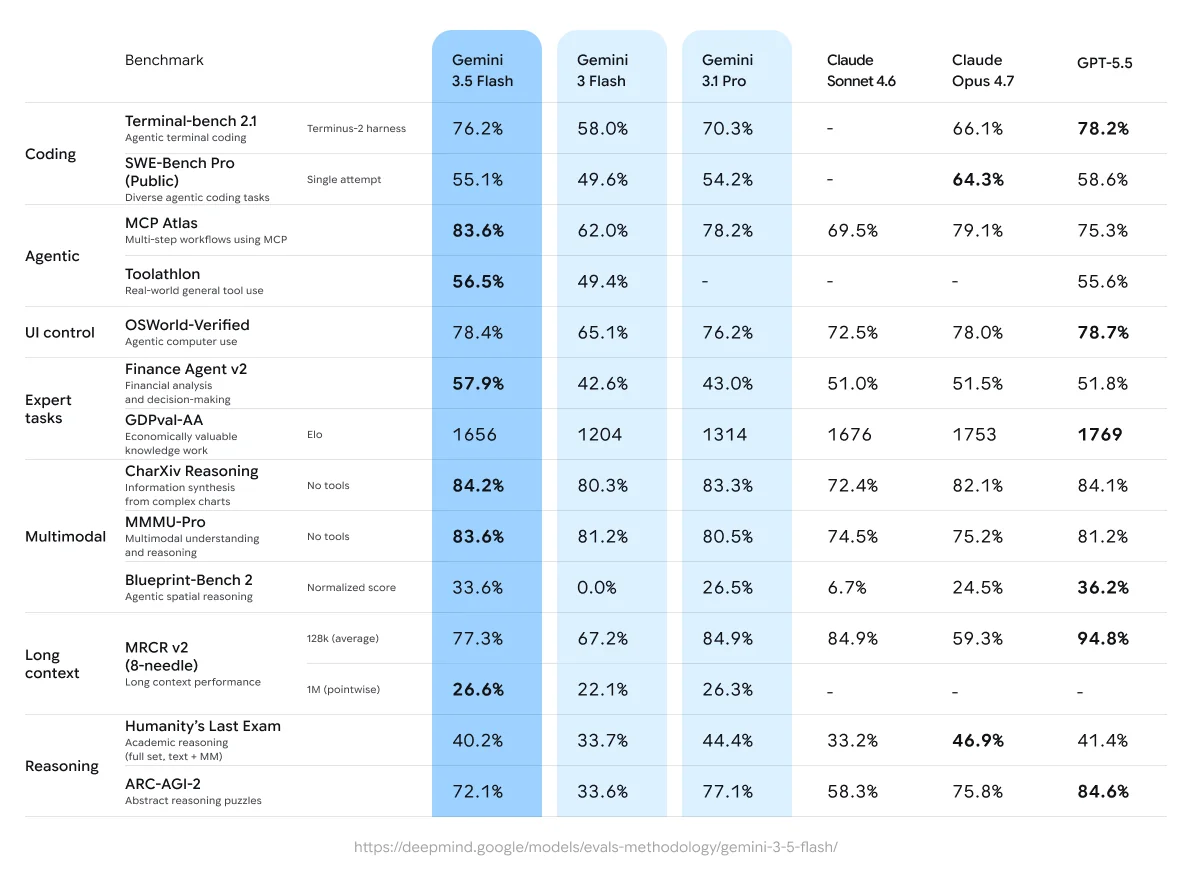
On Google's own evals, Gemini 3.1 Pro (Thinking High) leads on GPQA Diamond (94.3%), Humanity's Last Exam (44.4%), ARC-AGI-2 (77.1%), LiveCodeBench Pro (2887 Elo), and BrowseComp (85.9%). It trades the top spot on SWE-Bench Verified, landing 80.6% against Claude Opus 4.6's 80.8%. That's a strong flagship by any read, and the delayed 3.5 Pro is meant to push it further.
The lived experience is more mixed, and honest. Users rate Gemini highly for fast, factual chat:
"In my experience Gemini 3.0 pro is noticeably better than chatgpt 5.2 for non-coding tasks. The latter gives me blatantly wrong information all the time, the former very rarely."
But the recurring knock, and the reason the 3.5 Pro rebuild is taking so long, is reliability under load:
"You get burned by the hallucinations Gemini casually spews out on a daily basis. You develop a habit of fact checking every single answer."
That gap between benchmark and behavior is exactly why raw model choice is the wrong first question for a support team. For fuller side-by-sides, see our Gemini 3 Pro vs Claude Opus 4.6 and Gemini vs Mistral comparisons.
Which Gemini price actually applies to you
Three different buyers land on this page, and they need three different answers.
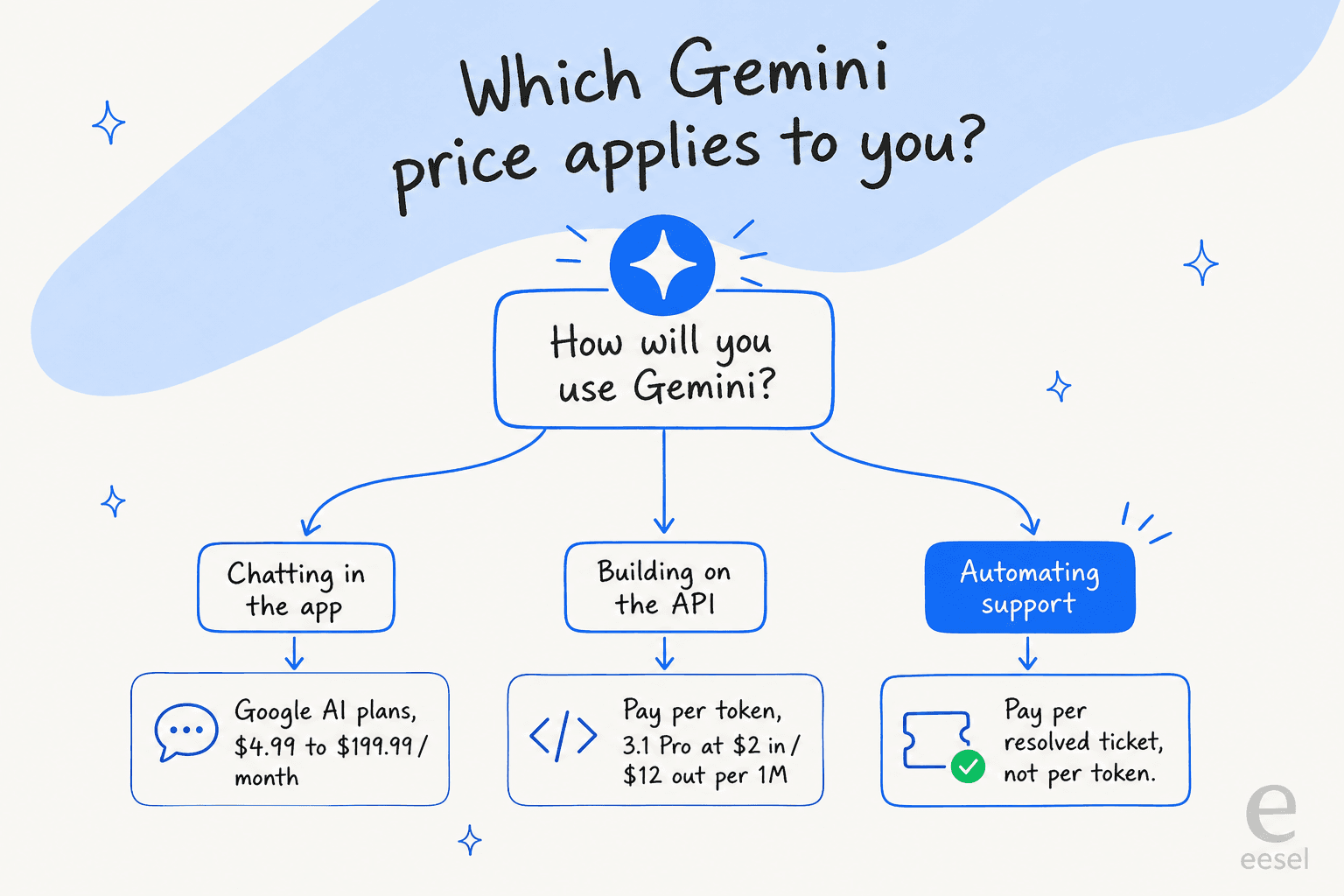
- You just want to chat. Pick a Google AI plan. Free is fine for occasional use; AI Pro at $19.99 covers most power users; Ultra is for heavy daily usage.
- You're building a product on the model. You're on per-token API pricing, and the estimator above is your friend. Budget for thinking tokens and grounding, not just the input rate.
- You want it to run customer support. This is where per-token pricing quietly becomes a bad fit, and it's the one I'd push back on hardest. A purpose-built AI customer service tool or AI helpdesk chatbot is a better shape for this than raw tokens.
Here's the problem. When you buy raw model tokens for support, you build everything on top: the retrieval pipeline, the guardrails, the escalation logic, the monitoring, the retry handling. Your bill scales with token volume, which means a busy support month is also an expensive, unpredictable one. That's the opposite of what a support budget wants. We've written up the true cost comparison if you want the full picture, and the metrics that actually matter for judging whether it's working.
Try eesel AI for support instead of pricing tokens
If you landed here because you're evaluating Gemini to power customer support, the token math is the wrong spreadsheet. I've spent the last few years building AI agents that sit on live support queues, and the lesson that keeps repeating is this: the model is the cheap part, and the pipeline around it is where the real cost and risk live.
eesel AI takes a different shape. It runs on frontier models (the same tier as Gemini Pro), but you don't pay per token or per seat, you pay one fixed monthly price sized to ticket volume (1 credit per ticket or chat, from $299/month for 500 credits), so the bill stays predictable instead of tracking usage you can't control. It plugs into your existing helpdesk and trains on your past tickets and knowledge base in minutes, and, because we've watched confident bots give wrong answers, every rollout gets simulated against your historical tickets first so you see the resolution rate before it ever touches a customer.
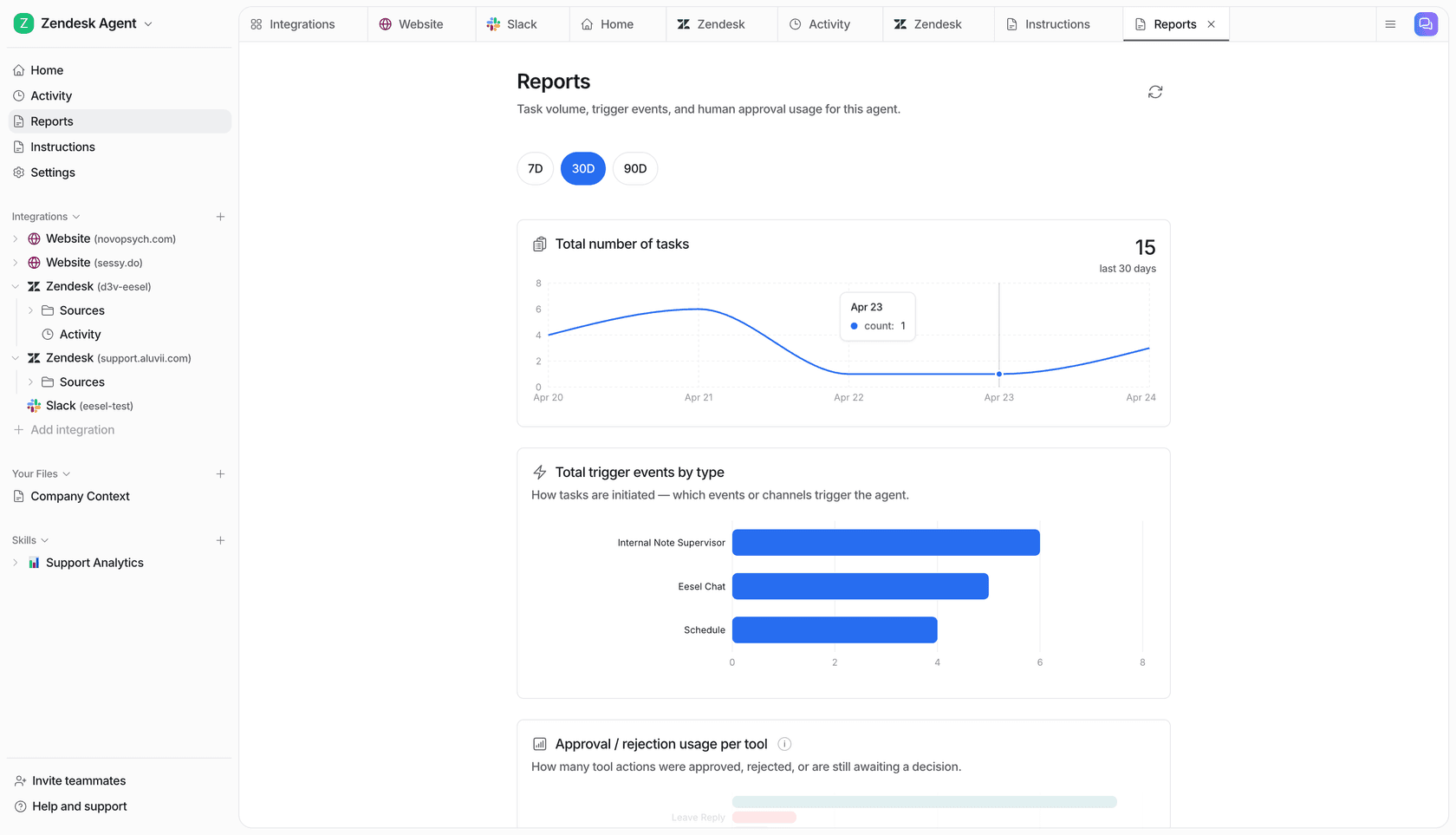
That's the difference between pricing a model and pricing a result. You can try eesel free and see the pricing in units you actually budget in (100 free credits, no card), or dig into what these agents look like in practice.