

Pick Decagon if your engineers want to own the agent's logic and you can sign an enterprise contract with no published price; pick Ada if you need the widest set of messaging channels and a listed starting price ($30,000 a year on its Salesforce AppExchange listing). Both bill mostly per conversation, so you pay for chats the AI escalates as well as the ones it resolves. The bigger news is ownership: Dialpad and Ada announced on 4 November 2026 that they are combining, so buying Ada now means buying into a combined Dialpad roadmap. If neither contract fits your volume, eesel works inside the helpdesk you already run, from $299 a month. An AI coding agent can also set eesel up through the eesel CLI, bringing in its macros and help articles and asking test questions before go-live, though connecting the helpdesk still needs an admin's approval.
Decagon or Ada: which fits your team?
Pick what matters most to you. Each answer comes from the vendors' own pages, linked further down.
Pick the priority that would decide it for your team to see which one fits.
How do Decagon and Ada compare at a glance?
Decagon and Ada sell the same thing: an AI agent that resolves customer conversations for large support teams. The table puts the facts each vendor publishes side by side.
| Decagon | Ada | |
|---|---|---|
| How you build the agent | Agent Operating Procedures in natural language, Git-based versioning | Playbooks and Coaching on the Reasoning Engine |
| Channels listed | Voice, chat, email | Voice, email, chat, Messenger, WhatsApp, SMS, Instagram, in-app, custom |
| Pricing model | Per conversation or per resolution | Per conversation, per resolution for some enterprises |
| Published price | None | $30,000 per company per year on AppExchange |
| Free trial | None listed | 14 days on AppExchange |
| Testing | Experiments (A/B), simulations, Watchtower QA | Coaching |
| Security listed | SOC 2 Type II, HIPAA, ISO 27001:2022, PCI DSS 4.0.1, GDPR, CCPA | SOC 2 Type 2, HIPAA, PCI, GDPR |
| G2 rating (20 Nov 2026) | 4.4 from 162 reviews | 4.6 from 183 reviews |
| Ownership | Independent | Combining with Dialpad (announced 4 Nov 2026) |
What is Decagon?
Decagon is an AI agent platform for enterprise customer service, built around what it calls Agent Operating Procedures (AOPs). An AOP is a set of instructions written the way you would brief a new hire, which Decagon describes as combining "the flexibility of natural language with the reliability of code". Decagon says CX teams can write them, and that "technical teams can version with Git-based tracking and retain full ownership of code."
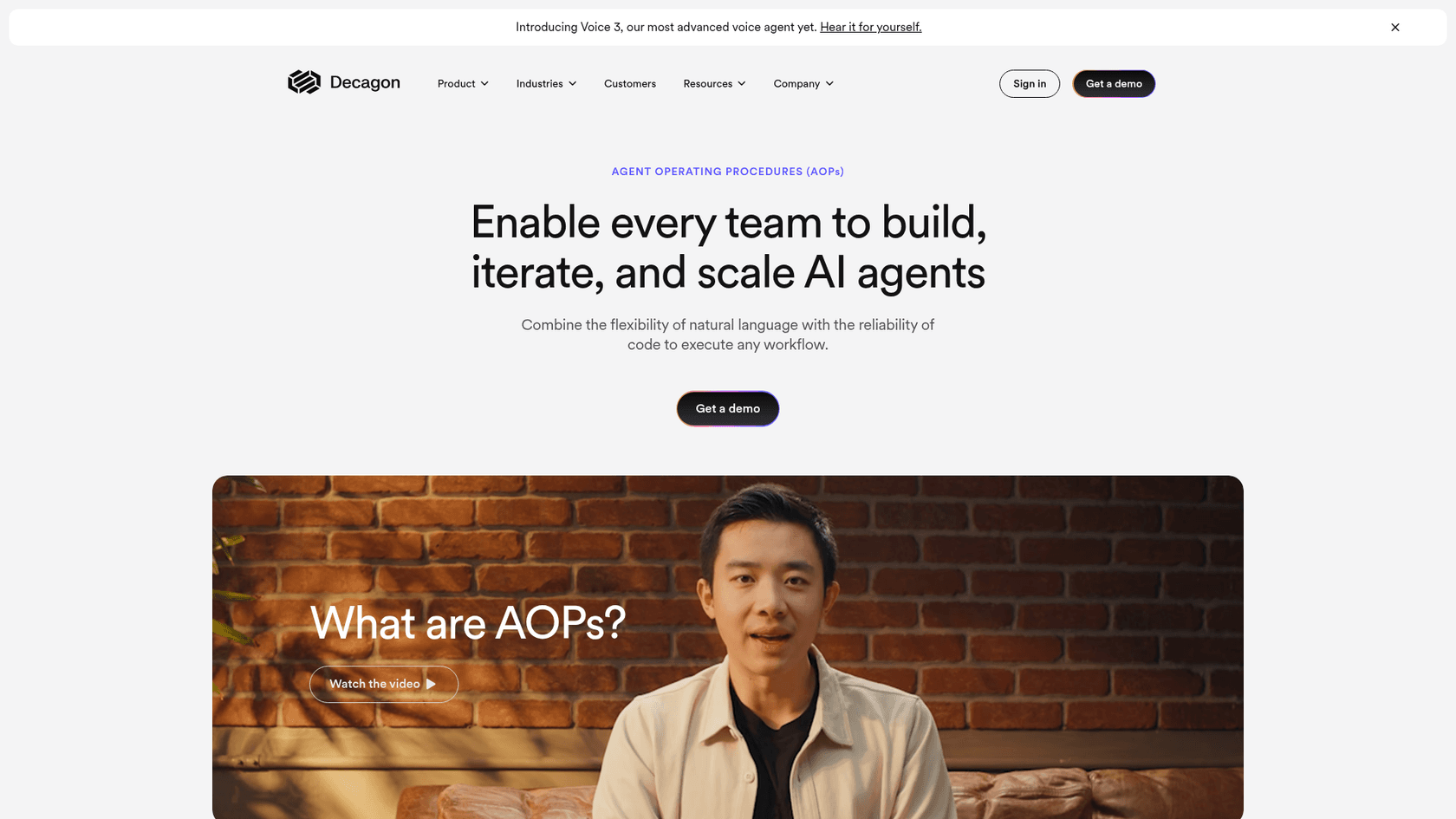
Around the AOPs sits a testing and monitoring layer that is the most complete part of the product: live A/B tests (Experiments), large-scale simulations (Testing & QA), always-on QA (Watchtower) and reasoning traces that show why the agent did what it did, with runtime and latency numbers. Decagon has kept shipping into voice too: Decagon Voice 3 is its newest voice agent, and Missions, launched on 12 November 2026, takes on long-running work.
Reviewers like the AOPs. One wrote:
"This feature allows us to define rules and resolution flows directly in natural language, in a clear and flexible way."

The same reviewers are clear that the plain-language part is the easy half. Hooking AOPs up to refunds, account changes and your CRM is where the time goes:
"Quality closely tracks the effort you put into grounding and workflow design. If your knowledge base is thin, you can end up with confident but wrong answers."
My take: Decagon is the pick for a large support org with engineers who want the agent's logic in version control and a testing suite to prove changes before they ship. Skip it if nobody on your side can own the integrations. The Decagon review goes further.
What is Ada?
Ada is an AI customer service platform for enterprises. In the merger announcement, Ada says it has "deployed more than 500 AI agents in production across voice, messaging, email, and social channels in more than 130 languages." Its platform has three parts: the Reasoning Engine, which it calls "a unified intelligence layer that powers AI agents across all channels"; Playbooks, which "let your AI agent follow multi-step SOPs using real-time data"; and Coaching, where feedback on past conversations "is automatically applied to future interactions."
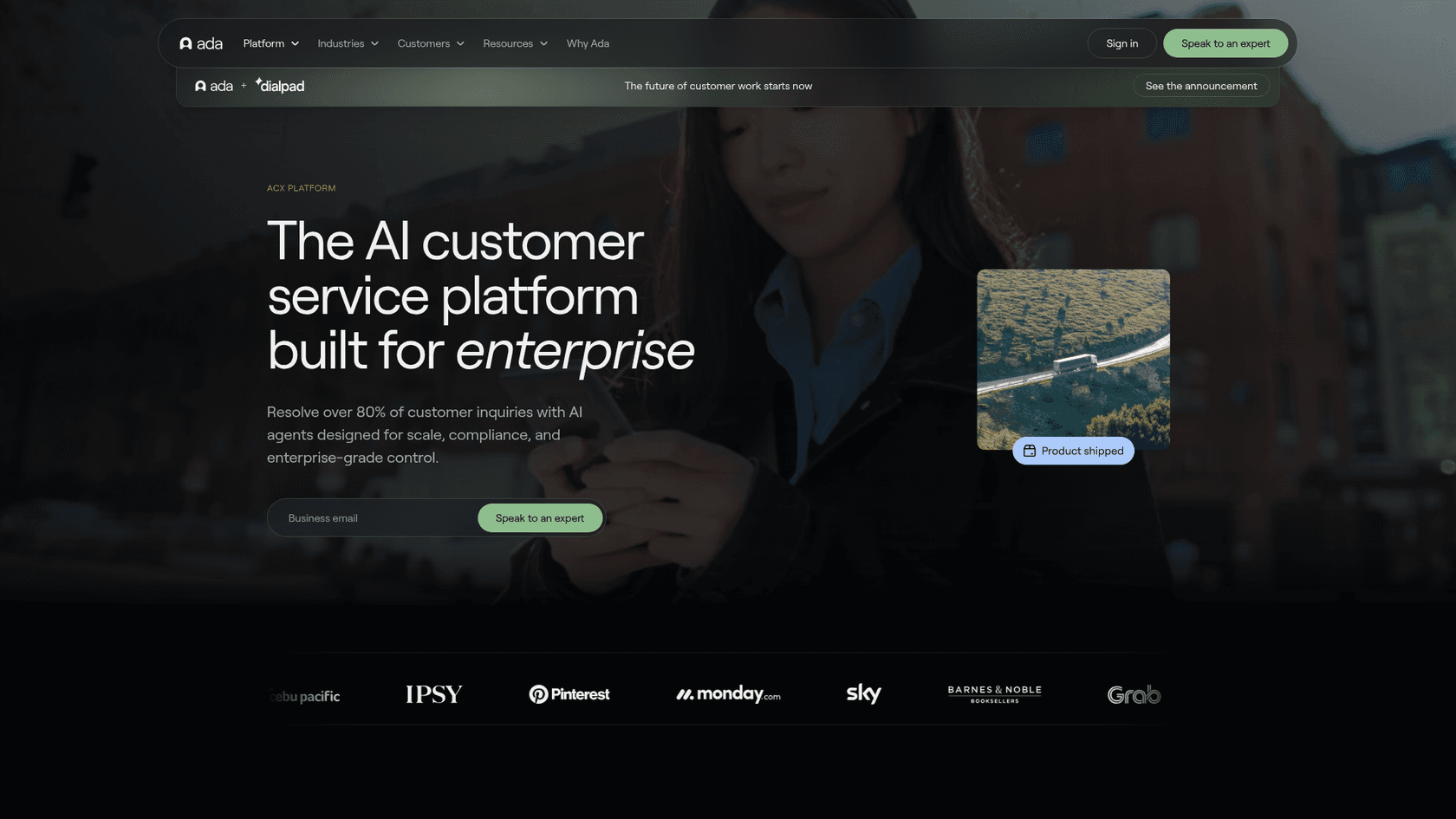
The channel list is Ada's clearest edge. It names voice, email, chat, Messenger, WhatsApp, SMS, Instagram, in-app and custom channels, so a team with heavy omnichannel support has fewer gaps to fill. Its integrations page lists Zendesk, Salesforce, Kustomer, Gladly, Gorgias, Help Scout, ServiceNow, Genesys, NICE, Twilio and Amazon Connect.
Ada's G2 reviews praise the onboarding team and how flexible Playbooks are:
"The combination of playbooks and tools lets us use a multibranch playbook for several customer journeys, collecting and validating information along the way and ensuring a positive outcome for the customer."
The complaints are about reporting across many bots and about price:
"When I have 10+ bots, I have to copy and paste the metrics for each one unless I use Ada CLI."
My take: Ada is the pick for an enterprise that serves customers on many messaging channels and wants an onboarding team to hold its hand. Skip it if the Dialpad combination makes you nervous about where the product goes next. The Ada review has the full picture.
How do Decagon AOPs and Ada Playbooks differ?
Both are plain-language procedures that tell the agent how to handle one kind of request, so the gap is smaller than the marketing suggests. The real difference is who each one is built for: Decagon gives engineers version control and a test bench, while Ada gives CX admins a coaching loop.
- Decagon AOPs compile into validated workflows, are versioned in Git, and are tested with simulations and A/B experiments before they go live. That suits a team that treats the agent like software.
- Ada Playbooks follow multi-step SOPs with live data, and Coaching turns feedback on real conversations into better future replies. That suits a team that improves the agent by reviewing transcripts.
Either way, the agent is only as good as the knowledge and backend actions behind it. If your help center is thin, fix that first; the guide on training AI on past tickets shows what to feed it.
What do Decagon and Ada cost?
Neither Decagon nor Ada publishes a per-conversation rate, and both default to charging per conversation. Here is what each says in its own words.
Decagon's Director of Product laid out its two models in a post on pricing AI agents: per-conversation is "a fixed rate for every incoming conversation, with flexible pricing for higher volumes", and per-resolution is "a higher fixed rate for each fully resolved conversation, with no charge for escalations." The same post says "the vast majority of our customers choose per-conversation pricing."
Ada's platform page says "you pay for every conversation your AI agent has with end users", and that it offers "a resolution-based pricing model for enterprises with specific needs, but most customers choose conversation-based pricing." Its Salesforce AppExchange listing is the only public number either vendor gives: $30,000 per company per year, a 14-day free trial, and discounts for nonprofits.
What per-conversation pricing means in practice: you pay for every conversation the AI touches, including the ones it hands to a person. So your resolution rate decides what each resolved ticket really costs you. At a 50% resolution rate, every resolved conversation carries the cost of an escalated one too. The breakdown of cost per resolution shows the maths, and the AI customer service cost guide compares the pricing models.
Reviewers on both sides flag the price. A Decagon reviewer called it "very enterprise-level oriented, making it difficult to adopt in teams or projects with tight initial budgets", and an Ada reviewer wrote:
"Pricing could be more competitive for the services provided."
The Decagon pricing guide goes deeper on Decagon's side.
What does the Ada and Dialpad deal change?
On 4 November 2026, Dialpad and Ada announced they are combining. The deal was expected to close on or about 12 November 2026; as of 20 November 2026 neither company had announced that it closed. Dialpad's Craig Walker is to lead the combined company as CEO, with Ada's CEO Mike Murchison as Chief AI Officer.
For a buyer today, three things follow from the announcement itself:
- Your contract doesn't change yet. "Current Dialpad and Ada customers will continue with their current contracts, pricing, account teams, and support channels, and existing integrations will continue operating as configured."
- Voice gets more attention. Ada's own announcement page promises "faster, more reliable voice" through Dialpad's network. If phone is a big channel for you, that is good news. The Dialpad pricing guide covers the other half of the new company.
- The roadmap is now shared. Ada says its "platform will remain open to your business systems and applications" while it will "increasingly offer more of our own applications." If you run a contact center platform other than Dialpad, ask how that plays out before you sign a multi-year deal.
Decagon has no comparable change in ownership, which counts for something on a multi-year contract.
Which should you choose, Decagon or Ada?
Choose Decagon if you have engineers to own the agent and want the strongest testing tools; choose Ada if you need many messaging channels and are comfortable with the Dialpad roadmap. Both are enterprise purchases: Ada's demo form starts its volume options at "less than 50K" tickets a year, and reviewers of both describe implementation as a project, not a weekend.
If you are a mid-size team, or you just want to see an AI agent working on your own tickets before you sign anything, neither one is built for you. The list of Ada alternatives covers more options, and Decagon vs Sierra covers the other big name in this category.
Try eesel next to Decagon or Ada
If what you want is an AI agent resolving tickets in the helpdesk you already run, without a procurement cycle, try eesel next to whichever enterprise demo you are booked into. eesel is an AI teammate that joins your existing queue in Zendesk, Freshdesk, Gorgias and other helpdesks, learns from your past tickets, and is tested against them before it replies to anyone. What it may do depends on who is asking: it can act on its own for your support lead, ask first for a verified customer, and never touch billing for an anonymous visitor.
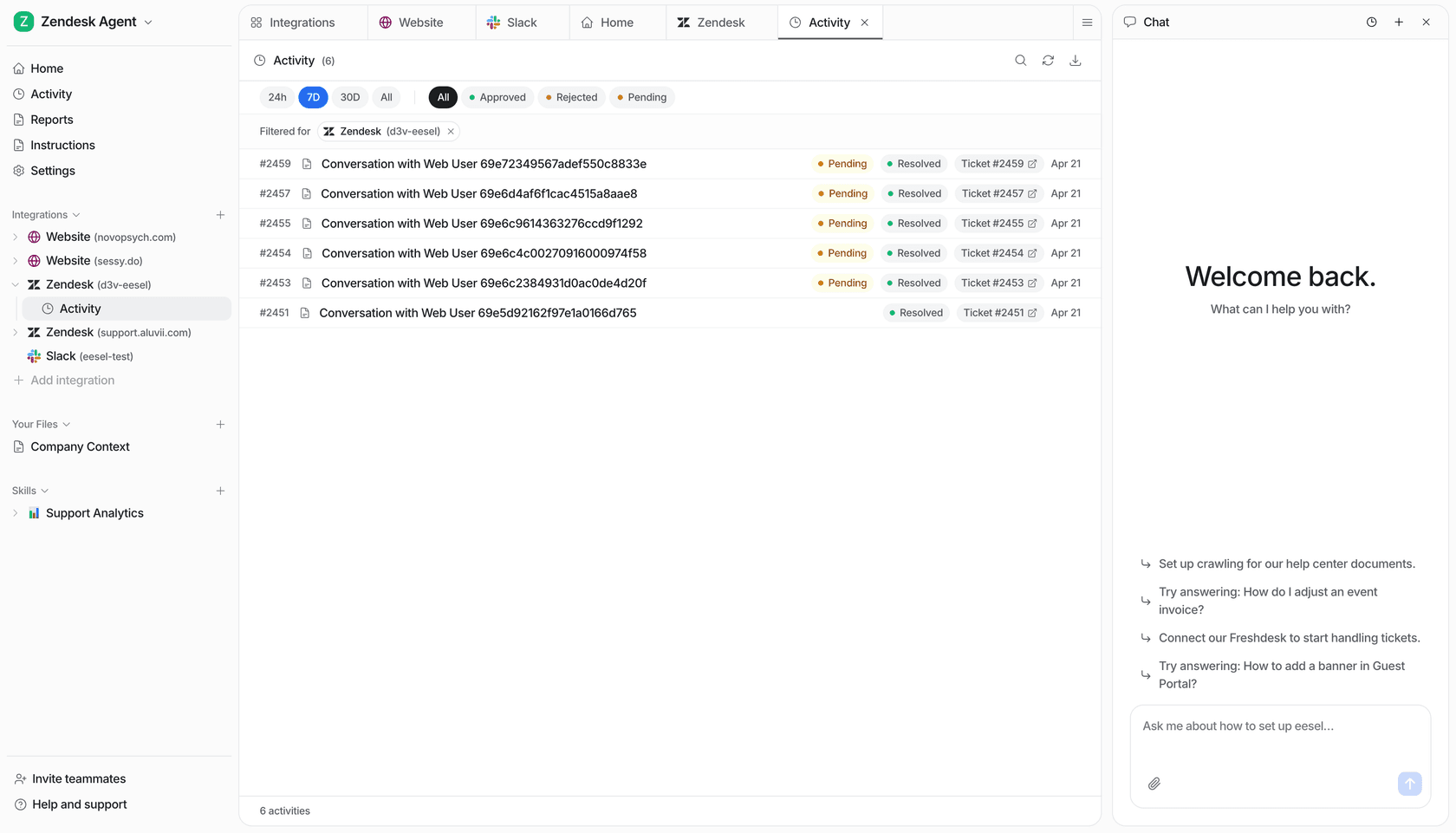
It runs at enterprise volume too. smava, a German loan comparison site, runs three eesel agents on one Zendesk: in a month they handled about 27,000 tickets, categorised about 14,600 and prepared about 15,300 draft replies from 820 macros and help center articles.
Pricing is on the page: a ticket or chat is 1 credit however long it runs, and plans start at $299 a month for 500 credits, with a 7-day free trial and no card. Try eesel on your own tickets this week and compare it with what the enterprise demos show you.