

Wonderful (at wonderful.ai, not the creative tool at usewonderful.com) is an enterprise "AI OS" that runs autonomous AI agents across voice, chat, email, and documents for large, regulated companies like banks, telcos, and utilities. It sells three things together: the platform, on-the-ground deployment teams in every market, and a strategy partnership with McKinsey. It started with customer support because that is the hardest, highest-volume place to prove AI works.
The numbers are eye-watering. Wonderful went from a $34M seed in July 2025 to a $550M Series C at a $5B valuation in September 2026, with Salesforce joining the round. Pricing, though, is quote-only: the only public figure is an AWS Marketplace listing for a 12-month contract at $2,500,000, and even that says "reach out for a private offer."
My verdict after digging through their product, docs, and customer cases: Wonderful is seriously impressive if you are a Fortune 500 with a CEO-level AI mandate and a multi-year transformation budget. It is a poor fit if you just want an AI agent live on your helpdesk this month, because there is no self-serve path, no free trial, and no published price. For that job, a layer like eesel that plugs into your existing helpdesk in minutes is a very different proposition. One more thing worth knowing: as a 2025-founded company selling top-down, Wonderful has almost zero independent user reviews yet, so this review leans on primary sources.
What Wonderful actually is
The first thing to get straight is that Wonderful is not a helpdesk chatbot. The homepage headline is "Applied AI for the enterprise," and the product is framed as "the unified operating layer for the AI-native enterprise" - an AI OS rather than a point tool. It is aimed squarely at large organizations "deep in regulated, mission-critical industries": banking, telecommunications, healthcare, retail, utilities, and insurance. That is a world away from the AI chatbot most teams shop for.
I spend my days on a support queue, so my instinct is to ask "which helpdesk does it plug into?" With Wonderful, that is the wrong question. Their whole pitch, laid out in a founder essay called "AI Doesn't Care About Your Org Chart," is that most companies deploy AI against the wrong unit. As CEO Bar Winkler puts it, "Enterprises are organized into functions. Work is not." A delayed-shipment question looks like support, but resolving it touches logistics, inventory, and fulfillment. So Wonderful sells an AI layer that runs across whole workflows instead of bolting an agent onto each department.
That shapes everything else. The buyer is explicitly the CEO, not a support manager. The platform includes pieces you would expect from cloud infrastructure, not a chatbot builder: permissions, guardrails, evals, an orchestrator, a CLI, and an AI Gateway to govern all enterprise AI from one place. It is a bold, coherent thesis, and it is the reason a Wonderful deal looks nothing like buying customer service software.
The funding story everyone is reacting to
Half the reason Wonderful is on your radar is the raise. The trajectory is rare enough to be worth laying out in order.
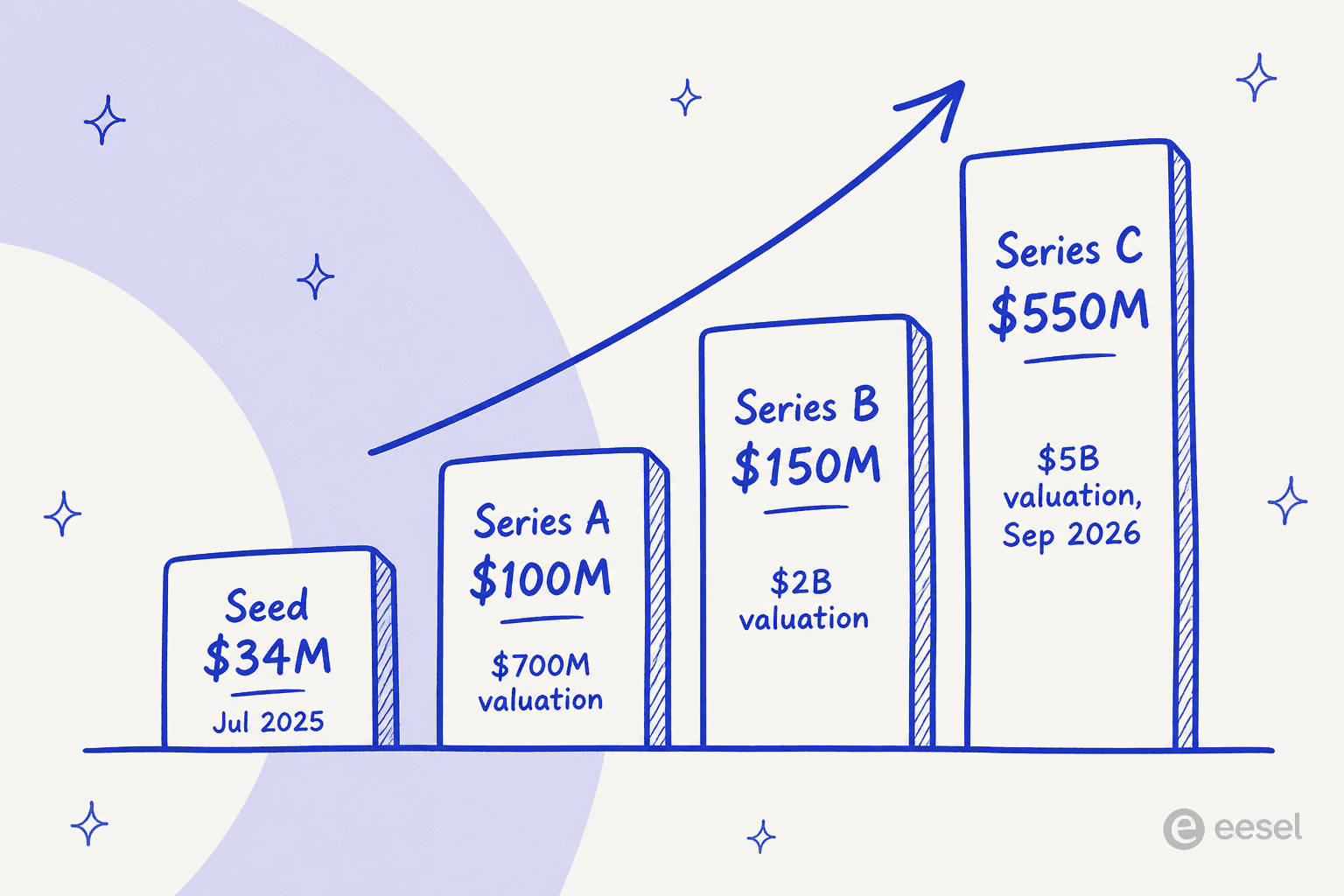
A $34M seed landed in July 2025. By November 2025 the company had raised another $100M at a $700M valuation, led by Index Ventures, when Reuters reported it was on track for roughly $10M in ARR. Wonderful's own LinkedIn then announced a $150M Series B at a $2B valuation in March 2026. And in September 2026 came the $550M Series C at a $5B valuation, led by Insight Partners with Salesforce participating.
That is a jump from $700M to $5B in about ten months.
Alongside the money, Wonderful now reports 650 employees across 35+ markets and a McKinsey partnership to sell transformation "from strategy to scale." Whatever you make of the product, that is a serious war chest and a serious go-to-market motion. It is also a useful signal about who they are chasing: enterprises where a single deal can justify eight figures a year. If you are weighing that against a build vs buy decision, the calculus is very different at this scale.
What the agents actually do
Under the OS framing, the agents themselves are the part a support leader will recognize, closer to an AI copilot than a scripted bot. Wonderful's line is that its agents "engage customers, assist employees, and execute work" across "voice, chat, email, documents, and any other channel the work comes through." Voice was their launch modality, and it is still the sharpest part of the story. If you are mapping the space, our roundup of AI voice companies is a useful companion here.
The most interesting capability is what they call computer use. Instead of waiting on API work to connect a decades-old system, Wonderful agents log into a legacy platform inside a managed virtual machine, read the screen, fill in fields, and move through multi-step workflows the way a new hire would. They name Oracle, Epic, and SAP as examples, and every action is observable, auditable, and pausable for human review.
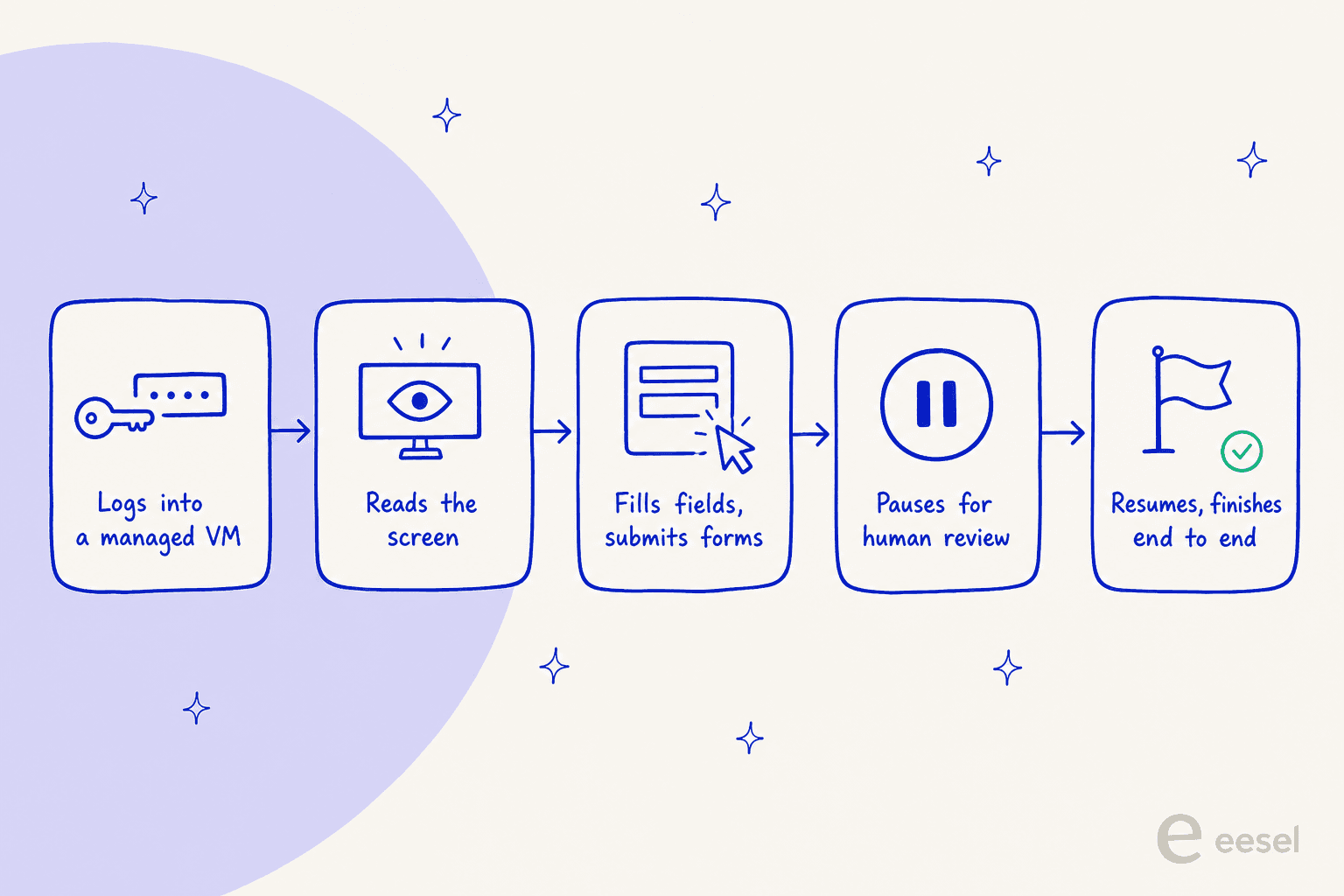
For anyone who has fought a months-long integration project, that is a real unlock. It is also where Wonderful separates itself from a normal AI agent: a scripted bot follows a fixed path, while these agents "read the screen, understand what they're looking at, and decide what to do next." The lifecycle tooling around it is mature too, with versioning, A/B testing, reusable skills, and an A2A protocol for handing work between agents. It is the kind of setup you would expect from teams thinking hard about AI customer service workflows, not a weekend chatbot wrapper.
Deployment: teams on the ground, not software off a shelf
Here is the part that most changes the buying decision. Wonderful is adamant, in its deployment pitch, that "you can't buy workflow AI off a shelf and install it." So they send people. Forward-deployed engineers and deployment strategists physically embed with your team, build the integrations and edge-case logic, get one use case into production, then hand it over and move to the next.
They claim 40+ local teams and offer four deployment models, including fully air-gapped on-premise and bring-your-own-cloud where your data never leaves the org. That is a different world from the self-serve support automation platforms most teams evaluate. For a bank with a compliance team that says data cannot touch a third-party cloud, that flexibility is a genuine differentiator, and it is not something most AI customer service companies can match.
The flip side is honesty about what this means for you. A forward-deployed model is a services engagement. It is powerful, and it is also the reason there is no "sign up and try it" button. You are buying a partner, a timeline, and a change-management project, not a subscription. That distinction sits at the heart of any AI vs human support math you run. That is the right call for a national telco and the wrong one for a 20-person support team, and it is worth being clear-eyed about which you are before the first sales call.
Wonderful in the wild
The proof points are strong where they exist. The flagship is Telefónica's Movistar in Colombia, where Wonderful built a billing agent across voice and WhatsApp. Telefónica said it had evaluated over 20 providers first. Wonderful reports going from kickoff to production in three weeks and hitting a 91.5% containment rate on eligible interactions, a strong first-contact resolution result, with average handling time cut in half.
Other named deployments include Banco Caja Social running collections across 2.5 million clients, OTE, Petrol Ofisi, and PPC Energie. Built on Google Cloud with Gemini and Vertex AI, Wonderful says a banking client shipped a promotional agent in four days that previously took weeks. The Google Cloud case study also cites customer service costs cut by up to 70%, the kind of number our own guide to how much AI can save tries to pin down honestly.
These are real, specific, checkable results, and they are the best evidence in Wonderful's favor. The one caveat I would flag: they are all vendor-published case studies. That is normal for a company this young, but it is not the same as a market full of independent operators reporting their own numbers, which brings me to the next point.
What users actually say (the honest version)
I always go looking for real user voice, and here I have to be straight with you: there almost isn't any yet. Wonderful's G2 profile shows zero reviews. There is no Capterra or Trustpilot listing, no Reddit thread about the vendor, and no Hacker News discussion. For a company that just raised $550M, that is striking, and it is a direct consequence of the model: it sells top-down to a handful of giant accounts, so there is no self-serve crowd leaving reviews.
The only public sentiment lives on LinkedIn, and it is entirely funding-cycle promotion from the company and its investors, not customers:
"We've raised $150M Series B at a $2B valuation. Over the past few months, the momentum has been real: live in 30+ countries, working with..."

None of this means Wonderful is bad. It means the evidence base is investor and vendor claims plus a few flagship cases, not the broad track record you can find for companies using AI that have been at it longer. If you are the kind of buyer who wants twenty peers to compare notes with before signing, you will not find them here yet. That is a real consideration for a purchase this size, and it is the sort of thing I would want said plainly in any customer service AI review.
Security and compliance
Credit where due: for regulated buyers, Wonderful has done the homework. The platform page lists SOC 2 Type II, ISO 27001:2022, GDPR, PCI DSS, and EU AI Act alignment, independently verified annually. On data protection, it advertises zero data retention with AI providers, automatic PII redaction, and AES-256 encryption, plus third-party pen testing twice a year.
The AI Gateway is the control layer that ties this together: it inspects outgoing requests and redacts sensitive data before it reaches any model, enforces access policies per team, and keeps full audit logs of every session. Combined with the air-gapped on-prem option, this is a compliance story built for a bank's risk committee, and it is more complete than what many AI helpdesk tools or free customer service options offer out of the box.
Wonderful AI pricing
This is the shortest section because there is so little to report: Wonderful publishes no pricing. The /pricing page returns a 404, and the only CTAs anywhere are "Get in touch." The single public dollar figure lives on the AWS Marketplace, and it comes with heavy caveats.
| Item | What Wonderful discloses |
|---|---|
| Public rate card | None. /pricing returns a 404; all deals are contact-sales |
| Only public figure | AWS Marketplace: a 12-month enterprise contract listed at $2,500,000 |
| Nature of that figure | "Reach out for a private offer" - a contract anchor, not a fixed transacted price |
| Billing model | Committed annual contract in undefined "units," not pay-as-you-go metering |
| Billable unit | Not disclosed publicly |
| Free tier / trial | None |
| Self-serve / starter plan | None; enterprise-only |
| Deployment models | Multi-tenant, single-tenant, BYOC, and fully on-premise |
To be fair, quote-only pricing is standard for enterprise software sold to banks, and the real number is whatever a private offer lands at. It does make the AI agent vs human cost comparison harder to run up front, though. But if you are comparing this to a tool with a published price, the difference matters. A hidden price means a procurement cycle, a legal review, and no way to model your cost before you are deep in a sales process. That opacity is fine for a buyer with a dedicated procurement team, and a genuine barrier for everyone else. If total-cost-of-ownership is your concern, our breakdown of AI customer support cost savings walks through the units to watch.
Who Wonderful AI is for (and who it isn't)
After all of it, the review nets out to a clean split. Wonderful and a normal AI support agent, or even a suite play like Agentforce, are not really competing for the same buyer.
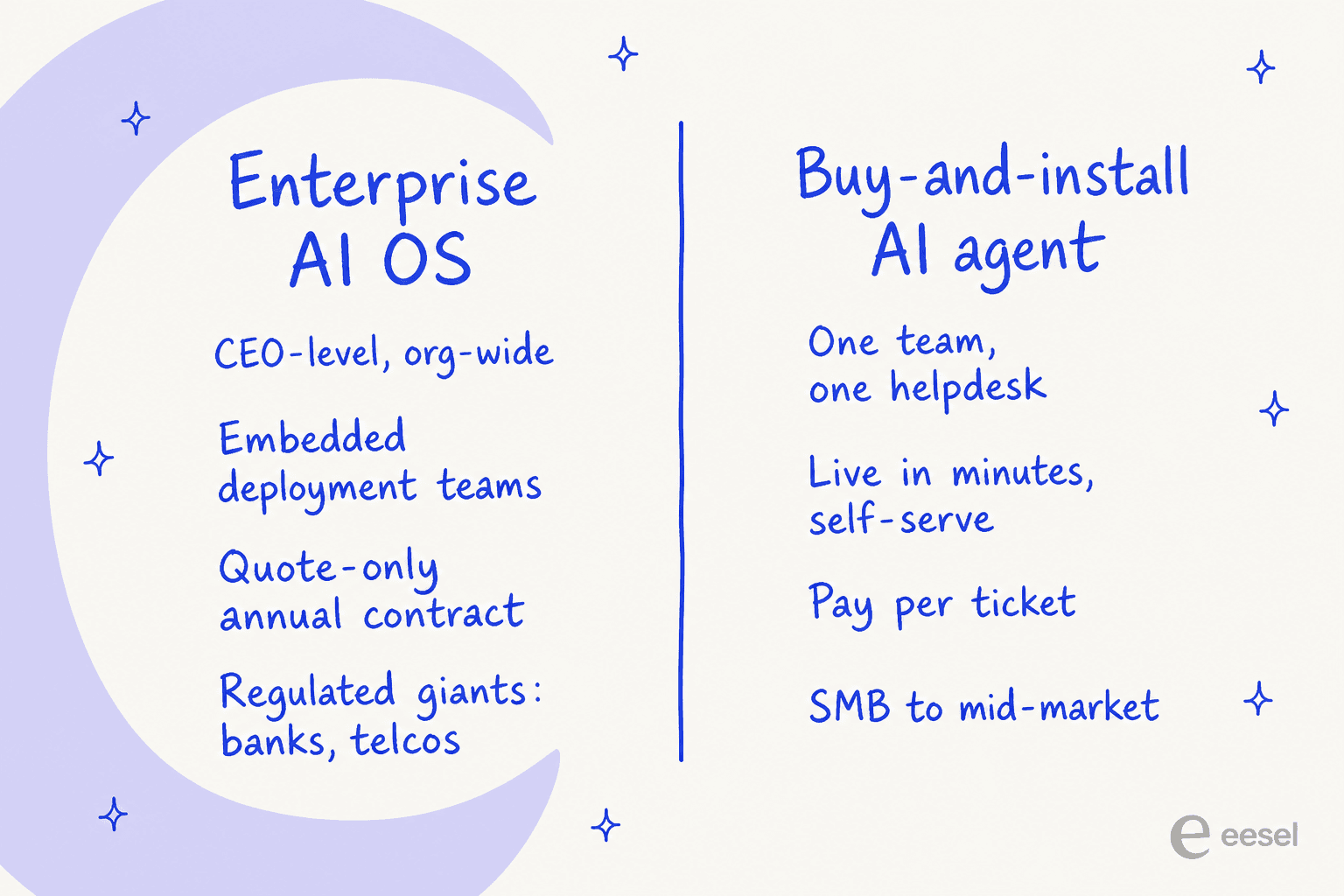
Pick Wonderful if you are a large, regulated enterprise, the mandate comes from the top, you need voice agents in many languages, you have legacy systems with no clean APIs, and you can commit to a multi-year, embedded-team engagement with a seven-figure budget. In that world, the deployment model and the compliance depth are exactly what you are paying for.
Skip it if you are a support or CX team that wants an AI agent for customer service working on your existing helpdesk in days, you want to see the price before you talk to sales, and you would rather start small and expand from the best AI customer support tools you can actually trial. That is not a knock on Wonderful. It is just a different shelf, and reaching for the enterprise OS when you need a helpdesk teammate is like hiring a construction firm to hang a picture. For most teams reading a review like this, the second column is where you actually live.
Try eesel for AI on your helpdesk
If you landed here because you want AI answering tickets, not a company-wide transformation program, that is exactly the gap eesel fills. eesel is an AI support teammate that joins the helpdesk you already run (Zendesk, Freshdesk, Gorgias, Help Scout, and more), trains on your past tickets and help center, and drafts or sends replies inside the tools your team lives in. It works whether that is a Zendesk AI setup or Gorgias for ecommerce. There are no forward-deployed engineers to schedule and no procurement cycle to survive.

The two differences that matter most for the buyer Wonderful leaves out: you can simulate the agent against your historical tickets before it ever touches a customer, so you see how it would have handled real conversations first; and the pricing is public and fixed monthly rather than a private seven-figure contract, which makes 24/7 support something a small team can actually switch on. One customer, Global Pay, put the payoff simply:
"With eesel, we can find specific answers to questions extremely fast. We have seen up to 80% time savings."
Alex Capurro, Chief Innovation Officer, Global Pay
And if you do care about programmatic control, eesel ships a public CLI plus MCP support, so a person, a script, or a coding agent like Claude Code can drive the same teammate and workspace from a terminal. It is free to start, self-serve, and goes live in minutes. That is the honest alternative when a Wonderful AI review leaves you wanting something you can actually try today.