Why ecommerce support is its own problem
General customer service advice mostly misses ecommerce, because an online store's inbox doesn't look like a SaaS inbox. It's the same handful of questions, over and over: where is my order, can I return this, change my address, cancel my subscription. One operator I sat in with, running 500-plus tickets a day across roughly 70 countries, described the volume as almost entirely refunds, unsubscribes, and order tracking. That repetition is exactly what makes ecommerce such a good fit for AI: the tickets that drown your team are also the easiest ones for an agent to learn.
But ecommerce has two traps general support doesn't. First, answering isn't enough. "Your order shipped" is useless if the AI can't actually pull the tracking number from Shopify. The good ecommerce agents take order-tracking actions and refund actions, not just FAQ deflection. Second, your volume is wildly seasonal. A tool that feels cheap in March can get scary in late November, which is the part most comparison posts skip.
I'll come back to that pricing trap, because it's the one that's quietly cost teams the most. First, the shortlist.
The best AI for ecommerce customer service at a glance
Here's how the seven tools I'd actually consider stack up. I've focused on the columns a store owner cares about: the billing unit, whether the AI touches live Shopify data, channel coverage, and whether you can try it without a sales call.
| Tool | Best for | AI pricing model | Starting price | Native Shopify actions | Channels | Free trial |
|---|---|---|---|---|---|---|
| eesel AI | Layering AI on your existing helpdesk | Per ticket, flat | $0.40 / ticket, no seat fee | Via Shopify + helpdesk | Helpdesk, chat, Slack, email | $50 free, no card |
| Gorgias | Shopify-native stores | Per resolution | From $10/mo + $0.90/resolution | Yes, deep | Email, chat, SMS, social | 7 days |
| Richpanel | Going fully autonomous | Per conversation | $500/mo + $0.25/convo | Yes | Email, chat, social, voice | 30-day guarantee |
| Re:amaze | Small multi-channel teams | Per resolution | $29/seat/mo + $0.85/res | Order data in-thread | Email, chat, SMS, social, voice | 14 days |
| Tidio | Small stores, live chat first | Per Lyro convo | From $24.17/mo, $0.50/convo | Growth+ actions | Chat, email, social | 7 days |
| Gladly | Premium, high-LTV brands | Per resolution | $1.50/resolution (Shopify app) | Yes | Chat, voice, email, SMS, social | 30 days |
| Zendesk | Large, scaling operations | Per automated resolution | $55/agent/mo + AI usage | Via app | All channels | 14 days |
A note on what's not here: I've left some well-known general-purpose support bots out on purpose. This list is about tools that actually understand a store, not every chatbot that can sit on a website.
1. eesel AI
Best for: stores that already have a helpdesk and want to add AI without switching tools or signing a per-seat contract.

I'll be upfront that this is the tool I work on, so take the praise with the appropriate pinch of salt and judge it on the specifics. The reason eesel leads my list isn't loyalty, it's the starting point: most stores don't want to abandon the helpdesk they've already trained their team on. eesel AI is an AI teammate that plugs into the helpdesk you've got, whether that's Zendesk, Freshdesk, Gorgias, or Help Scout, plus Shopify and WooCommerce, and starts learning from your past tickets and help docs on day one.
The part that matters for ecommerce specifically: it learns from your solved tickets, not just your help center, so it picks up how your team actually phrases a refund decline or a shipping delay. It connects to Shopify to handle order-status and return questions, supports 80-plus languages out of the box, and uses confidence-based routing so it only auto-replies when it's sure and escalates the rest to a human.
The feature I'd actually flag as the differentiator is simulation. Before it touches a live customer, you run the agent against thousands of your past tickets to see exactly what it would have said and what your resolution rate looks like by topic. It's the difference between hoping the AI is good and knowing.
Pros
- Works on top of your current helpdesk, so no migration and a setup measured in minutes.
- Flat $0.40-per-ticket pricing with no per-seat fee and no charge for tickets humans handle.
- Simulation mode lets you test on historical tickets before going live.
Cons
- It's an AI layer, not a full helpdesk, so you do need an existing support tool (or Shopify, or email) underneath.
- SOC 2 is listed as in progress rather than certified, which can matter for larger procurement teams. The Enterprise tier covers HIPAA and BAAs.
- No native live-chat widget of its own in the way a Tidio offers, since it's designed to power the channels you already run.
Pricing: Free until you've used $50, no card required. After that it's usage-based from $0.40 per ticket, with no platform or seat fee. A store doing 1,000 automated tickets a month pays around $400. Annual commitments get 25% off.
Verdict: If your store already runs a helpdesk and you want AI live this week with a bill that doesn't punish you for a good month, this is where I'd start. Stores that want one all-in-one platform with a built-in chat widget should look at Gorgias or Tidio below.
2. Gorgias
Best for: Shopify and BigCommerce stores that want AI built natively into the inbox, taking real order actions.
Gorgias is the helpdesk built for ecommerce, full stop. It claims to power 40% of Shopify brands and serve over 17,000 stores, and the native Shopify integration is the reason. Orders, customers, and store data live inside the ticket view with no syncing, so its AI Agent can cancel an order, generate a discount, or process a return right inside the conversation.
The AI Agent is pre-trained on over 1 billion ecommerce conversations, which is a genuine head start on the WISMO-and-returns grind. It also leans hard into revenue: Gorgias frames support as a sales channel, and brands like BareMinerals report an 8.83x ROI on AI-driven sales. One Obvi exec captured the peak-season appeal nicely:
"At 6pm on the second day of Black Friday week, our CX agent said: 'I'll see you tomorrow. We're at inbox zero.'"
Obvi, via Gorgias
Pros
- The deepest native Shopify actions of anything here.
- AI pre-trained on a huge ecommerce corpus, so less cold-start pain.
- Strong revenue and upsell tooling baked in.
Cons
- Pricing is the consistent complaint, running roughly 3x a general helpdesk for similar ticket volumes, and each AI resolution also counts as a billable ticket.
- The per-resolution AI add-on ($0.90 to $1.00 each) stacks on top of your plan's ticket cost.
- It's a full platform, so adopting it means moving onto Gorgias, not adding AI to what you have.
Pricing: Plans from $10/mo (Starter, 50 tickets) up to $750/mo (Advanced, 5,000 tickets), with the AI Agent as a usage add-on at $0.90 per resolved conversation on annual billing. A trial user in one case I saw ran 12 successful test chats, loved the answers, then hit the billing page and immediately tried to cancel, which tells you to model the cost carefully before you commit.
Verdict: If you're a Shopify-first brand and you want AI that does things in your store rather than just answering, Gorgias is the most complete option. Just price out your busy months first. If you'd rather keep your current setup, layering eesel onto Gorgias gets you the AI without the platform fee.
3. Richpanel
Best for: stores ready to go fully AI-first, with a guarantee attached.
Richpanel made a hard pivot to AI-first, and its homepage now reads "hire an AI support team." The framing is employees, not software: Frontline AI resolves tickets, Copilot AI assists humans, and a QA AI layer reviews 100% of replies before they send, which is its answer to the hallucination worry. The headline pitch is a 50% autonomous resolution guarantee in 30 days, or your money back.
The numbers it cites are concrete: roughly $0.30 per AI-handled conversation, an 8-second first reply, and 4.7/5 CSAT on AI-resolved tickets. Jones Road Beauty reportedly went from 18 agents to 10 while revenue grew, with zero Black Friday backlog. For order-heavy stores, the QA-review layer is the most interesting idea here, because it's the thing that lets a team trust full automation.
Pros
- A 30-day money-back guarantee on hitting 50% autonomous resolution is a rare commitment.
- QA AI reviews every reply, a real check against bad AI answers.
- SOC 2 Type II, HIPAA, and GDPR coverage included on both tiers.
Cons
- The $500/mo base is a real floor; this isn't for a side-hustle store.
- It's another full-platform switch rather than an add-on.
- Community review data is thin, so most proof is still vendor-reported.
Pricing: $500/mo base plus $0.25 per conversation and $100 per human seat. A sample bill of 2 AI agents and 3 human seats lands around $800/mo. ROI breakeven is roughly 3 agents or 2,000 conversations a month.
Verdict: If you've decided AI should carry the bulk of your support and you want a vendor willing to guarantee it, Richpanel is the boldest bet on the list. Smaller stores will find the floor too high and should look at Tidio or eesel.
4. Re:amaze
Best for: small-to-mid teams that want live chat, helpdesk, and AI in one tidy package without a steep bill.
Re:amaze (owned by GoDaddy since 2021) is the quiet, practical option. It bundles email, live chat, social, SMS, and even VoIP into one shared inbox, with order data surfacing inside conversations. Things other tools charge extra for, like proactive Cues, a real-time Live Dashboard of who's browsing, and co-browsing, ship as first-party features.
Its AI Agent is still in beta, so this isn't the most advanced automation on the list. But for a designer-founder type who, as one Re:amaze customer put it, is "not a customer service expert," the simplicity is the selling point. Built Bar reported boosting support speed 5-6x, and Printful scaled from 1 to 30 operators on the same tool.
Pros
- Genuinely affordable, with a $59 flat Starter plan for unlimited seats at low volume.
- Live chat, proactive messaging, and order context all built in.
- Easy enough for a non-support team to run.
Cons
- The AI Agent is newer and less proven than Gorgias' or Richpanel's.
- AI resolutions are capped per user per plan, then $0.85 each over.
- Less depth on advanced ticket routing and analytics than the enterprise tools.
Pricing: Starter at $59 flat/mo (500 conversations, unlimited seats), or per-seat plans from $29/seat/mo. AI overage is $0.85 per resolution across all plans. 14-day free trial, no card.
Verdict: A solid, no-drama pick for a small store that wants everything in one inbox and cares more about value than cutting-edge AI. If automation is your main goal, the AI-led tools above will resolve more out of the box.
5. Tidio
Best for: small and mid-market stores that lead with live chat and want a proven AI agent attached.
Tidio pairs a polished live-chat widget with Lyro, its AI agent, which (notably) runs on Anthropic's Claude rather than ChatGPT. Tidio claims Lyro hits a 67% average resolution rate, which it bills as the highest in the market, and backs it with a money-back guarantee if you fall below 50%. It's trusted by over 300,000 businesses and rates 4.8/5 on the Shopify App Store across 1,300-plus reviews.
For a store that gets a lot of pre-sale chat ("is this in stock," "what size"), Tidio's combination of proactive Flows and Lyro is a good fit, and the native Shopify actions on the Growth plan handle order tracking and cart recovery. Users consistently praise how it stays grounded in your own data rather than making things up.
Pros
- Lyro is capable and easy to install without engineers.
- Strong, Shopify-native chat experience with proactive automation.
- Free plan and a money-back resolution guarantee lower the risk.
Cons
- The pricing stacks three meters: billable conversations, Lyro conversations, and Flows visitors, which gets hard to predict.
- The jump from Growth to the Plus plan ($749/mo) is steep.
- Lower tiers are email-support only.
Pricing: Free plan (50 Lyro conversations lifetime), Starter from $24.17/mo, Growth from $49.17/mo, with Lyro billed around $0.50 per conversation. Standalone Lyro starts at $32.50/mo if you want to add it to an existing helpdesk.
Verdict: For a smaller store where live chat is the front door, Tidio is one of the easiest ways to get a capable AI agent live. Watch the layered pricing as you scale, and look at the flatter options if conversation volume is large.
6. Gladly
Best for: premium, high-LTV brands where every conversation is a relationship, not a ticket.
Gladly takes the opposite stance to deflection bots. Its model is "people, not tickets": one lifelong conversation per customer instead of disconnected threads, with a 360-degree profile so customers never repeat themselves. It's openly aimed at DTC and retail brands, with a customer roster that includes TUMI, UGG, Crate & Barrel, and Nordstrom. Its Sidekick AI agent resolves end to end and takes real actions across chat, voice, email, SMS, and social.
The proof points are strong (a 4.7/5 from over 1,100 G2 reviews, a claimed 76% of conversations resolved by AI), and reviewers love the unified customer view. But the two consistent gripes are worth knowing: price, flagged repeatedly as expensive, and reporting, the single most-cited complaint, which several users describe as fragmented and reliant on manual exports.
Pros
- The unified, lifelong customer profile is a real differentiator for premium brands.
- True omnichannel, including strong voice support.
- High review scores and real DTC scale behind it.
Cons
- Consistently flagged as expensive, with a per-seat or flat-rate model that's less flexible for small stores.
- Reporting is the top user complaint.
- Full platform pricing is sales-gated; only the Shopify app rates are public.
Pricing: The core platform is contact-sales only. The public Shopify App Store plan runs pay-as-you-go at $1.50 per AI resolution, $0.25 per AI assist, and $120/mo per seat, with a free 30-day, 100-interaction trial.
Verdict: If you're a premium brand where customer lifetime value justifies a richer (and pricier) tool, Gladly's relationship-first model is compelling. Budget-conscious or smaller stores will feel the cost, and the reporting gap is a real consideration.
7. Zendesk
Best for: large or fast-scaling operations that need an enterprise platform with AI on top.
Zendesk is the incumbent, and at scale it's a serious platform: 22,000-plus service teams, a Leader spot in the 2025 Gartner Magic Quadrant, and a marketplace of 1,800-plus apps. Its "Resolution Platform" now folds in Forethought for self-improving AI agents, and it claims up to 80% automation. For a big store with complex routing, voice, and workforce management needs, the breadth is hard to match.
The honest caveat is one I hear constantly from ecommerce teams evaluating it. More than one operator I've sat with described native Zendesk AI as "inadequate and overpriced" for what they needed, and the layered pricing is easy to underestimate. The entry price most people quote ($19/agent) includes no AI at all.
Pros
- Deep, mature platform with strong AI agent capabilities and a huge app marketplace.
- Handles voice, QA, and workforce management at enterprise scale.
- Self-improving agents via the Forethought acquisition.
Cons
- Layered pricing: a seat fee, plus per-resolution AI billing, plus $50/agent add-ons for Copilot, voice, and WEM.
- Several ecommerce teams I've talked to found the native AI underwhelming for the cost.
- Heavier to configure than a Shopify-native tool, and AI first appears only on the $55 Suite tier.
Pricing: Support Team from $19/agent/mo (no AI), Suite Team from $55/agent/mo (AI agents included), Suite Professional $115/agent/mo. AI agents bill separately per automated resolution on top. Enterprise is sales-gated.
Verdict: For a large operation that already lives in Zendesk or needs its enterprise breadth, it's a safe, capable choice. But many stores get better ecommerce results and clearer pricing by adding a focused AI layer, like eesel on top of Zendesk, rather than paying for Zendesk's native AI stack.
The pricing trap nobody warns you about
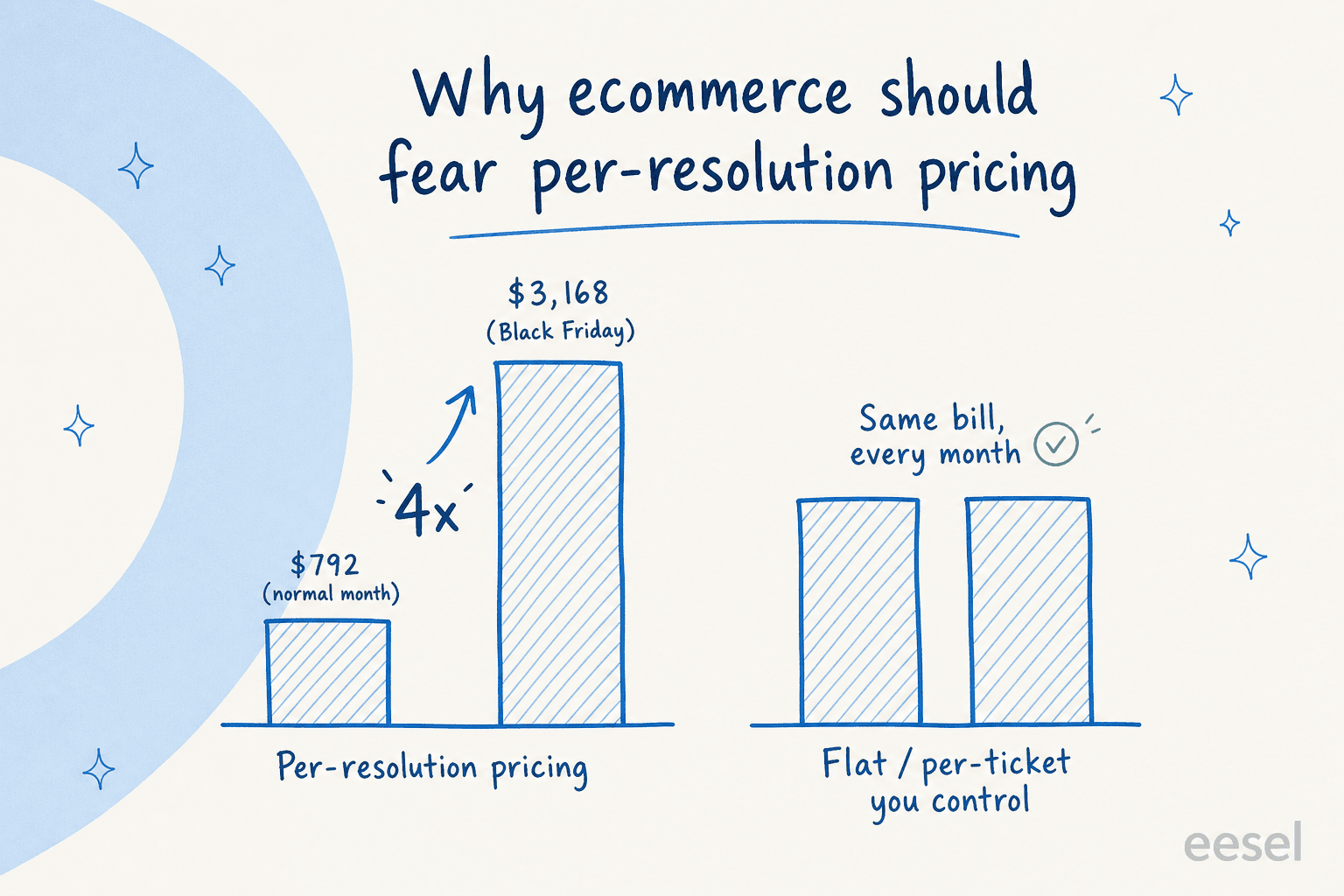
Here's the part I promised to come back to, because it's the single biggest mistake I see stores make. Most ecommerce AI bills per resolved conversation, and that model quietly punishes you for being busy.
Run the math on a store doing 1,000 tickets a month at an 80% resolution rate on a roughly $0.99-per-resolution plan, and you're around $792 a month. That feels fine in a normal month. Then Black Friday hits and volume quadruples to 4,000 tickets: same 80% resolution, and you're now looking at over $3,168 for that month. Per-resolution pricing scales up exactly when your margins are tightest, and it also means a better AI (one that resolves more) costs you more.
It's worth asking any vendor two questions: does your "resolution rate" count auto-closed spam (in one real ecommerce inbox I analyzed, 22% of the volume was spam), and what does my bill look like in November, not March? A flatter, per-ticket model, like eesel's $0.40 per ticket, keeps your busiest month proportional instead of explosive. That's not a knock on per-resolution pricing for every store, but it's the variable that's blindsided the most teams I've watched.
How to actually pick
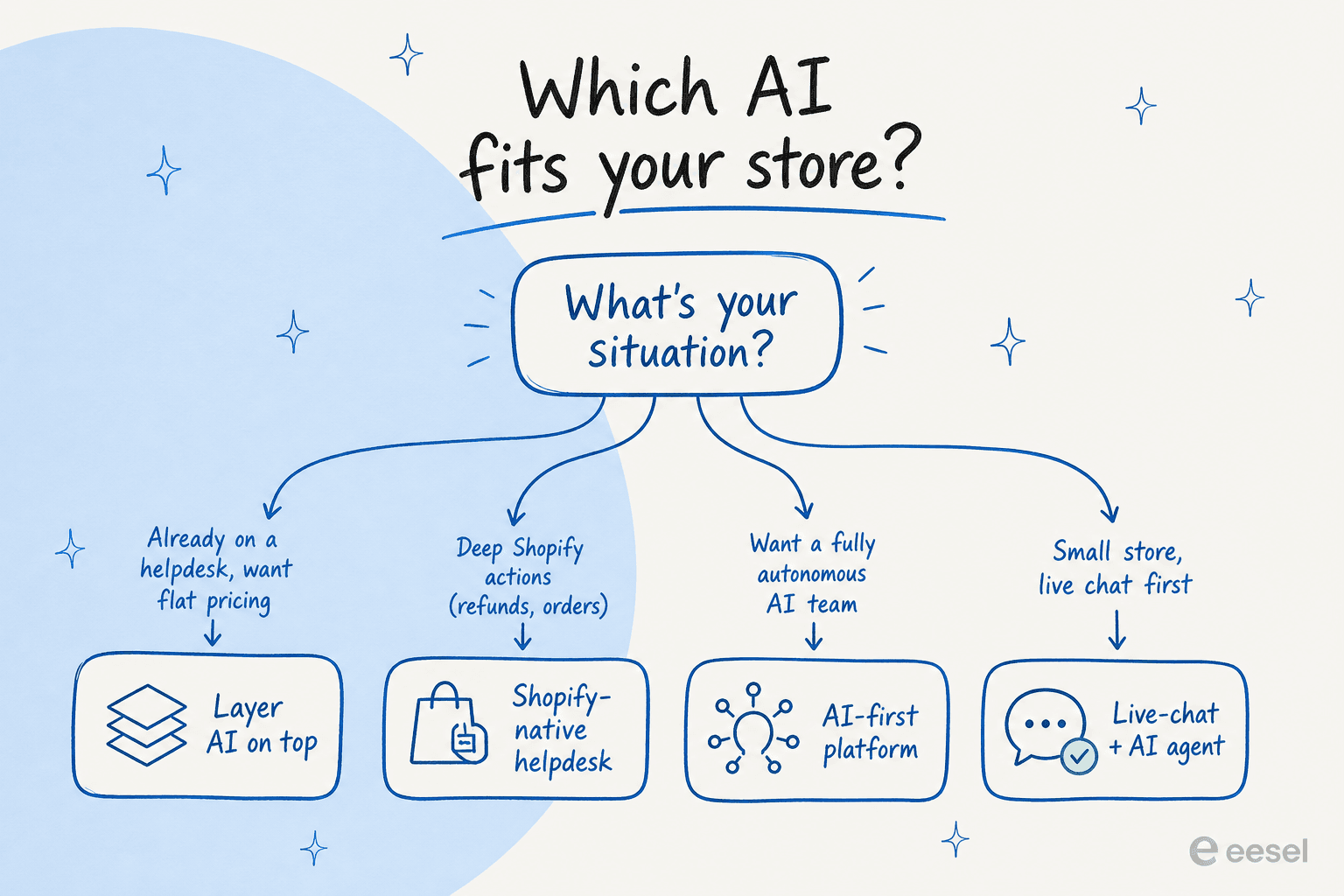
After all that, here's the short version of how I'd choose:
- You already have a helpdesk and want AI fast, with predictable cost: layer on eesel AI and keep your stack.
- You're Shopify-first and want AI taking order actions inside the inbox: Gorgias, with the pricing modelled for peak.
- You want to go fully autonomous with a guarantee: Richpanel.
- You're a small store that wants one simple inbox: Re:amaze, or Tidio if live chat is your front door.
- You're a premium brand optimizing for lifetime value: Gladly.
- You're enterprise scale and live in your platform already: Zendesk.
Whatever you pick, the one non-negotiable is this: don't let an AI answer live customers until you've seen how it performs on your own past tickets. The tools that let you simulate before launch and only auto-reply when confident are the ones that won't embarrass you in front of a customer.
Try eesel for your store's support
If you're already running a helpdesk and the idea of switching platforms just to get AI sounds exhausting, that's exactly the gap eesel AI fills. It plugs into Shopify and whatever support tool you use, learns from your past tickets and help docs in minutes, and starts drafting and resolving the WISMO-and-returns grind, only auto-replying when it's confident. You can run it against your real ticket history first to see your resolution rate by topic before a single customer sees it, and the flat per-ticket pricing means Black Friday won't blow up your bill. It's free to try, no card needed.
Frequently Asked Questions
What is the best AI for ecommerce customer service?
How much does AI for ecommerce customer service cost?
Can AI handle Shopify order tracking and refunds?
Will an AI support agent give wrong answers to my customers?
Do I need to switch helpdesks to add AI to my store?


Article by
Riellvriany Indriawan
Riell is a designer and writer at eesel AI with about two years of experience researching CX platforms, AI chatbots, and helpdesk software. She combines her design background with a sharp eye for how these tools actually look and feel in practice — making her comparisons unusually visual and user-focused.