

ValiOpt prices its AI support on resolutions, with a published indicative range of $0.50 to $0.90 per resolution. There are no public plan tiers, no seat pricing, and no monthly platform fee listed. The billable unit is a resolution: you pay when ValiOpt actually solves an issue, not per message. Every deployment is quoted per customer, because the price bundles a done-for-you service (workflow discovery, custom integrations, launch support, ongoing tuning), not just software.
The catch is that there is no self-serve path and no free trial. The Shopify app is free to install, but you cannot see a firm number without talking to their team, and the $0.50 to $0.90 band is explicitly labelled indicative. For a workflow-heavy DTC brand that wants someone else to build and run the automation, that managed model can be worth it. For a team that wants to see the price, try it today, and configure it themselves, a self-serve tool with transparent pricing (like eesel AI, from $299/month for 500 credits) is the faster, more predictable route.
What ValiOpt is, and why the pricing looks the way it does
I have spent the last few years putting AI on live support queues, and the one pattern that never changes is that the pricing page tells you what the company actually is. I hear it on sales calls constantly: one CX lead at a US ecommerce brand told us they had "kicked the tires" on their helpdesk's native AI and found it "largely inadequate and overpriced," which is exactly why they were shopping around. So when a vendor prices per resolution and hides the number behind a quote, that is a signal, not a red flag, and it is worth reading correctly.
ValiOpt is a bespoke AI customer support automation service aimed at ecommerce and DTC teams. Its own headline is "Less admin console. More operational partnership," and that line is the whole pricing model in six words. Instead of handing your team an AI dashboard to configure, ValiOpt's team studies your support operation, builds the workflows, wires up the integrations, and keeps tuning after launch. The Shopify app launched on September 1, 2025 and currently shows 0 reviews on the Shopify App Store, so this is a genuinely new, lesser-known vendor rather than an established one.
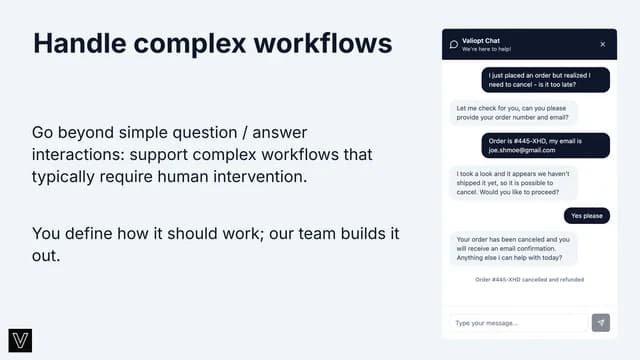
The product itself is squarely an AI customer support agent: it can run inside an existing helpdesk like Gorgias or Zendesk, or as a branded website chat widget, and it takes real actions (like order status and returns) rather than just answering FAQs. Because the price includes people (their team doing the setup and tuning), it is scoped per customer instead of published as a flat rate. That is the reason a ValiOpt quote and a self-serve helpdesk AI subscription are hard to compare on a single number, and the rest of this post is about doing exactly that.
The one published number: $0.50 to $0.90 per resolution
Here is the headline you came for. ValiOpt's pricing page leads with "Resolution-based pricing" and shows an indicative range of $0.50 to $0.90 per resolution. In ValiOpt's own words, you "pay for the support work Valiopt resolves, with pricing shaped by your ticket volume, workflows, integrations, and the level of ongoing support needed to make automation perform well."
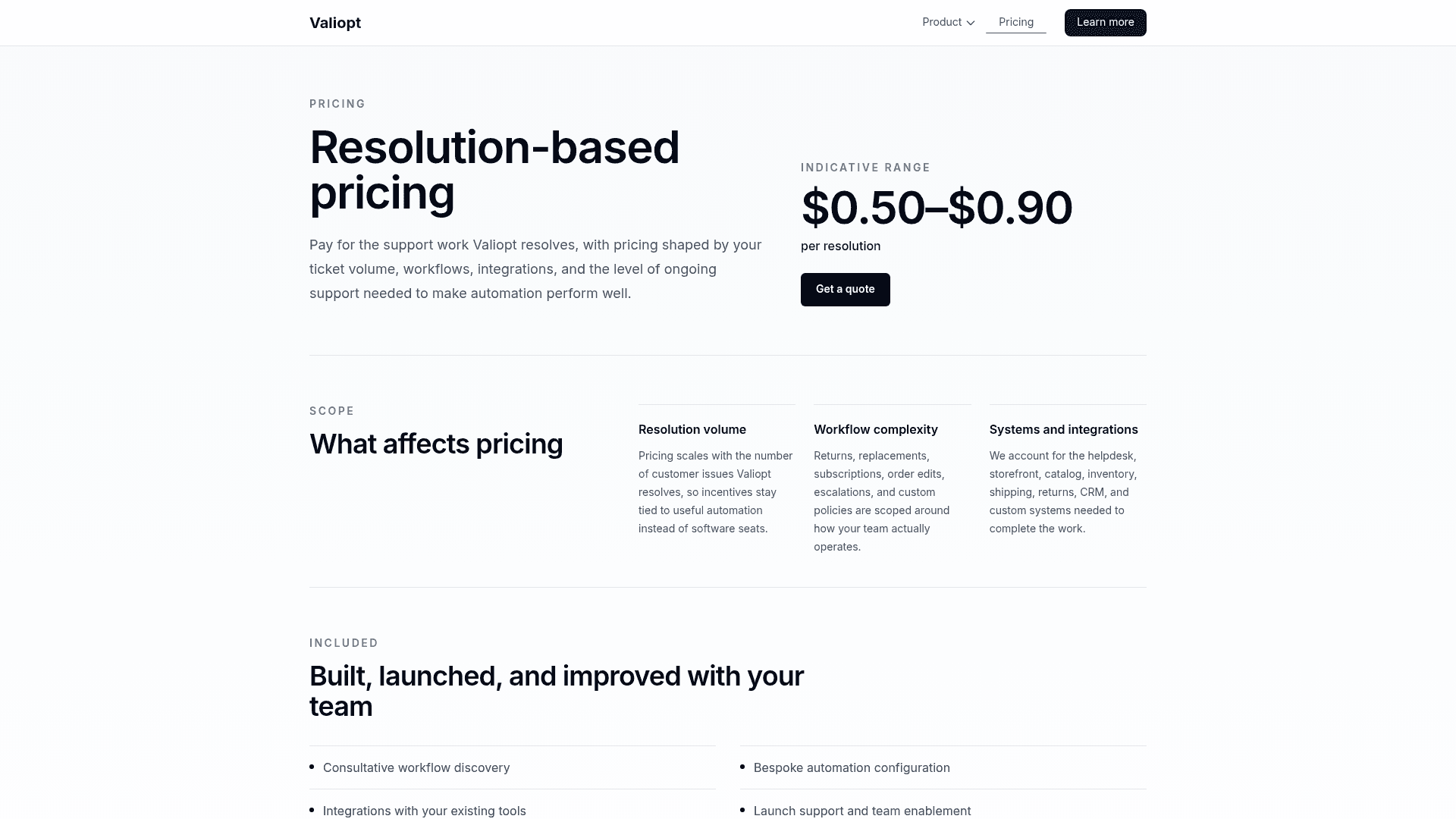
Three things about that number matter more than the number itself:
- It is labelled indicative, not fixed. The $0.50 to $0.90 band is a guide. The only calls to action on the page are "Get a quote" and "Talk through pricing," so your real rate lands somewhere in (or around) that range after a scoping conversation.
- There are no named tiers. No Starter, no Pro, no Enterprise. No per-seat cost. No published monthly platform fee. This is unusual for a support tool and tells you the pricing is built around your operation, not a feature matrix.
- The unit is a resolution. You are billed when ValiOpt resolves an issue, not for every inbound message. That is a genuinely customer-friendly unit, and it is worth understanding precisely, which is the next section.
On the Shopify listing, the same model shows up as "Free to install. Additional charges may apply," with all charges billed in USD. So installing the app costs nothing; the resolutions cost the per-resolution rate.
Resolution, conversation, ticket: the unit changes everything
The most expensive mistake in AI support buying is comparing two tools on their sticker price when they bill on different units. A "resolution" is not a "conversation" is not a "ticket handled," and the gap between them is where your budget actually lives.
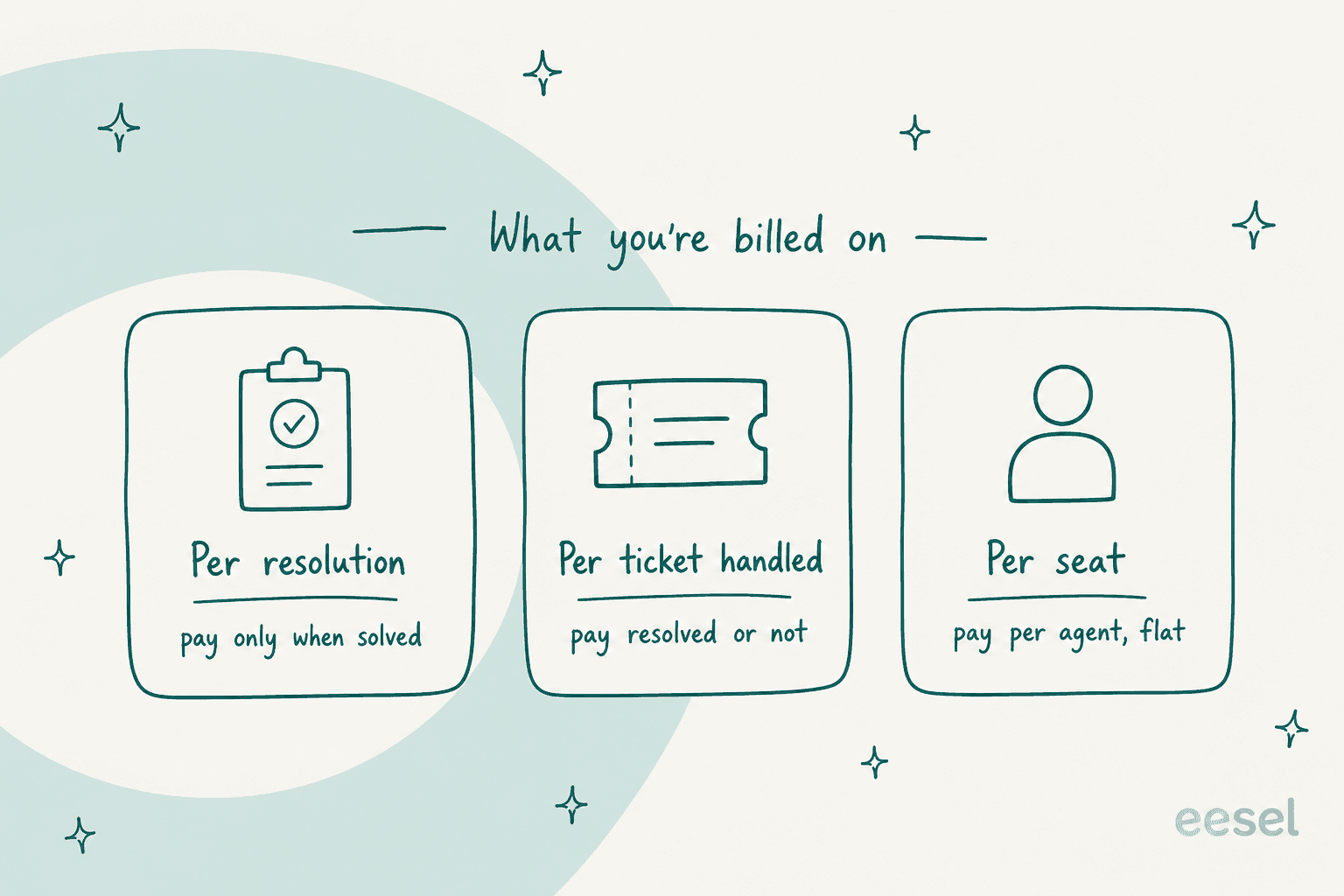
ValiOpt bills per resolution: you pay only when an issue is actually solved. If the AI picks up a ticket, tries, and hands it to a human unresolved, you are not charged for that one. That is the friendliest end of the spectrum for a buyer, because your cost is tied directly to outcomes.
Compare that to two other common models:
- Credits per ticket handled (how eesel AI works): you pay one fixed monthly price for a batch of credits, and 1 credit covers a ticket or chat whether or not the AI fully resolves it. The upside is a fixed, fully transparent price you can see before you sign up; the tradeoff is that credits are also used on some tickets the AI could not close.
- Per resolution but higher (how some Gorgias AI pricing works): outcome-based like ValiOpt, but often at a higher per-resolution rate once you are past the included allotment.
Neither model is universally cheaper. At list prices, a per-resolution quote of $0.50 to $0.90 can land below a fixed monthly plan at some volumes, so eesel's case is a predictable bill with everything included rather than the lowest sticker. If your resolution rate is low and you only want to pay for wins, a per-resolution model protects you from paying for misses. The honest answer is that you cannot rank them without your own numbers, which is why there is a calculator further down.
What moves a ValiOpt quote up or down
Since the price is scoped rather than fixed, it helps to know which levers push it. ValiOpt names three explicitly on its pricing page.
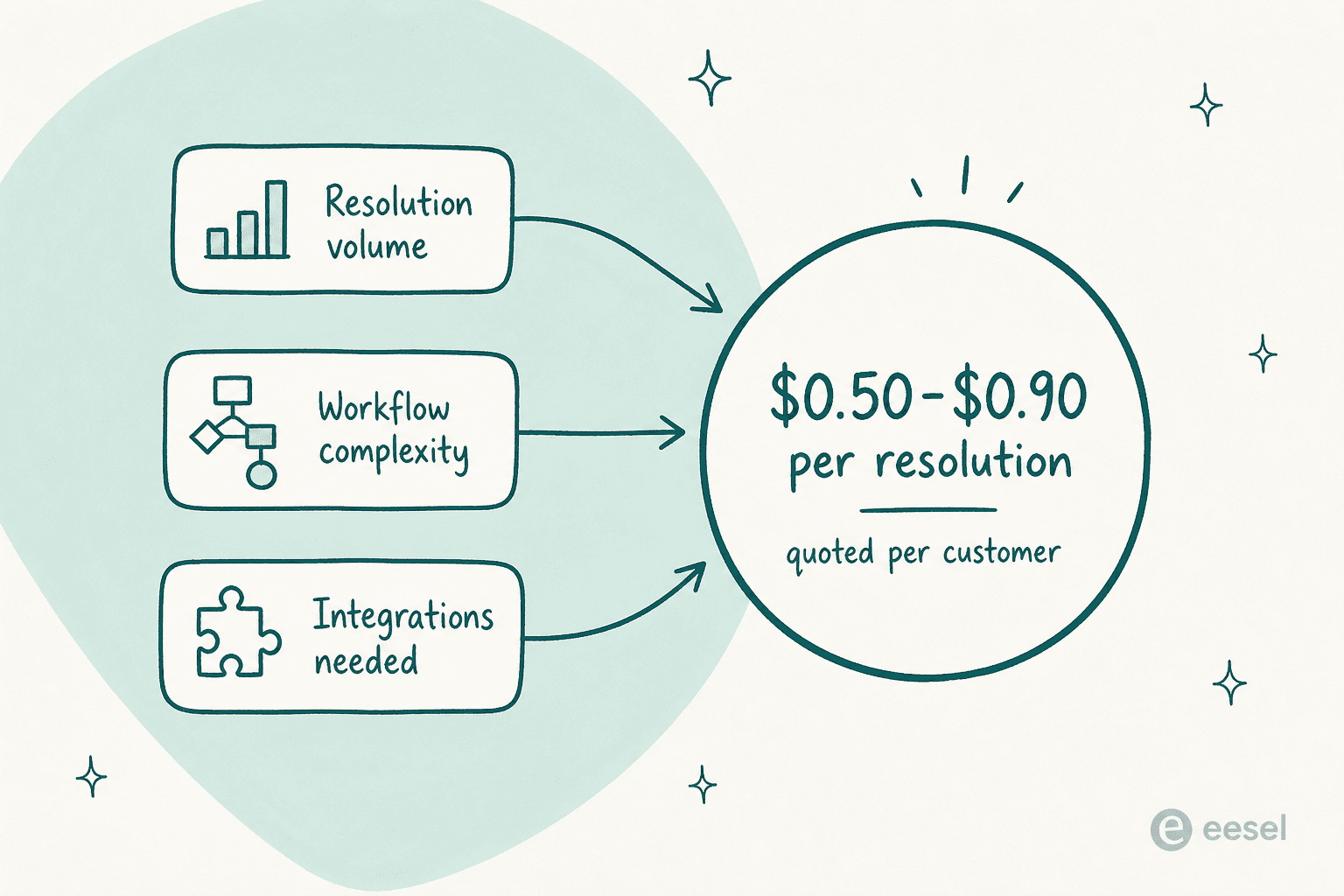
- Resolution volume. Pricing scales with the number of issues ValiOpt resolves. ValiOpt frames this as keeping "incentives tied to useful automation instead of software seats," which is a fair way to put it: you are not paying for empty seats during a slow month.
- Workflow complexity. Returns, exchanges, subscriptions, order edits, escalations, and custom policies are scoped around how your team actually operates. A store with a simple returns policy and a store with a multi-condition warranty flow are not the same build, and the quote reflects that. If most of your volume is order-management work, the complexity (and the cost) sits in those action workflows.
- Systems and integrations. The helpdesk, storefront, catalog, inventory, shipping, returns, and CRM tools ValiOpt has to connect to complete the work. ValiOpt lists around 60 named integrations and says it will build custom ones "for most tools, at no additional cost to you," which is a real point in its favour.
The takeaway for budgeting: a ValiOpt quote is closer to a services engagement than a SaaS subscription. That is not a criticism, it is just a different shape of cost, and it means the number you get is specific to your store rather than a list price you could look up.
What the price actually buys you
This is where ValiOpt's model earns its keep, and it is the part a bare per-resolution number hides. Every ValiOpt quote bundles the managed-service work, not just access to software.
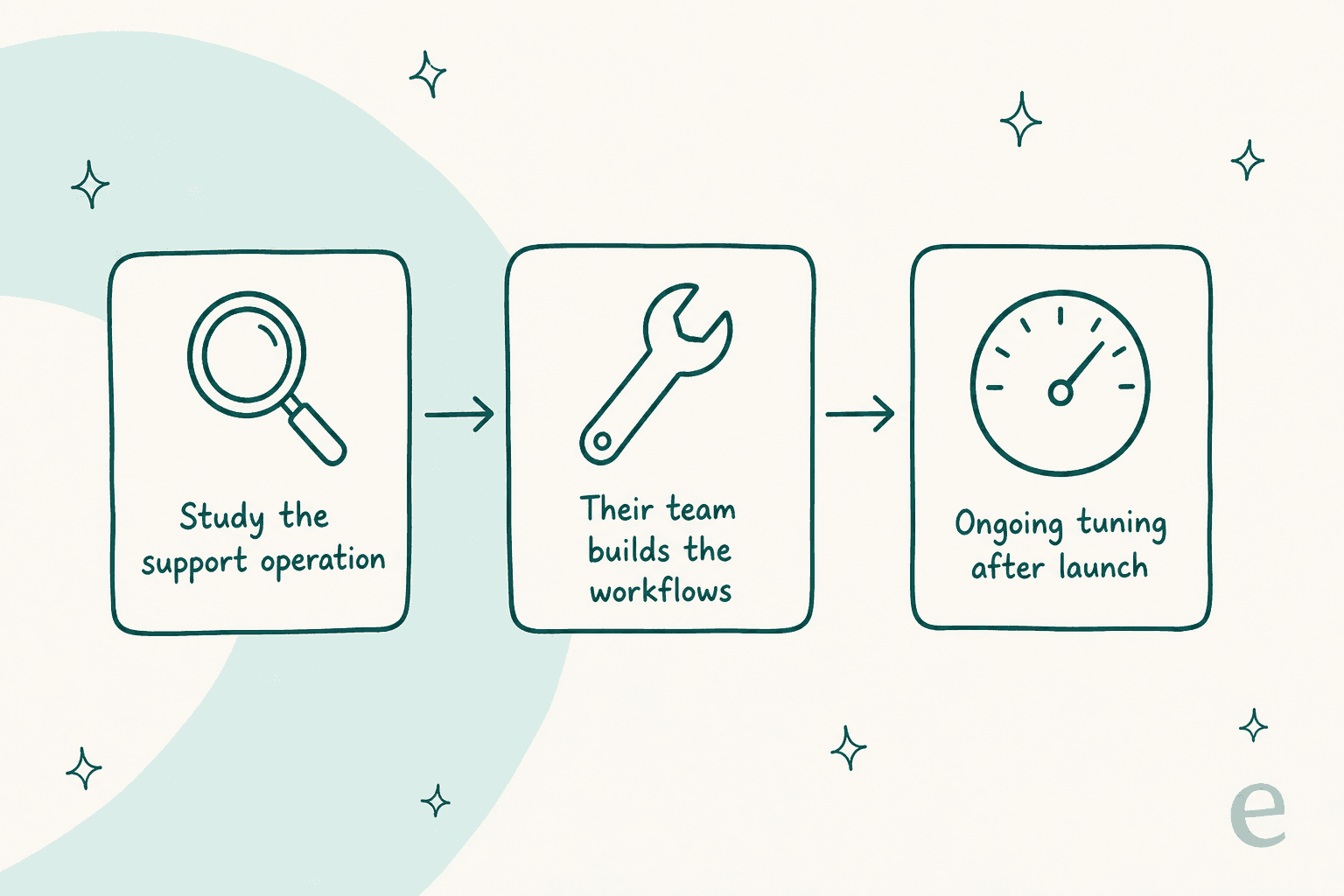
From the pricing page, every deployment includes consultative workflow discovery, bespoke automation configuration, integrations with your existing tools, launch support and team enablement, dedicated monitoring, performance SLAs, A/B testing, and ongoing tuning as your policies and ticket drivers change. The Shopify listing adds free migration from existing software and managed onboarding.
Put plainly: with ValiOpt, a person on their team builds and maintains your automation. With most self-serve tools, that person is you (or someone on your team). Neither is wrong. If you do not have the bandwidth to own an AI config, paying for the managed layer is rational. If you do want to own it, you are paying for labour you would rather not buy, and a self-serve ecommerce helpdesk tool will be cheaper and faster. This is the classic build-versus-buy tradeoff, just with a third "have someone build it for you" option in the middle.
One capability worth calling out, because it shows the depth here: ValiOpt's warranty claims automation can analyse customer-submitted photos for visible damage, check the original order, and route to a replacement or a human approval based on your warranty rules. That is a real workflow, not a chatbot answering "where is my order," and it is the kind of thing the managed model exists to build.
The free tier and trial situation
Short version: there isn't one, at least not in the way self-serve tools mean it.
- No free usage tier. ValiOpt does not publish an "X free resolutions per month" allowance.
- No self-serve free trial. There is no "start free, add a card later" path on the marketing site. Every CTA routes to a conversation.
- The Shopify app is free to install. You can add the app at no cost, but resolutions are billed once it goes to work. Install-free is not the same as try-free.
For comparison, this is the biggest practical difference between ValiOpt and a self-serve alternative. Many AI customer support tools and customer service AI platforms let you connect your helpdesk, run the AI against your own past tickets, and see how it performs before you pay anything. ValiOpt's model is "talk to us, we'll scope it, we'll build it," which is slower to start but comes with humans doing the work.
Estimate what you would actually pay
Because everything here depends on your own volume and resolution rate, a sticker price is close to useless on its own. Plug in your numbers and see the two models side by side. The point is not to declare a winner, it is to show how the unit you are billed on changes the total.
Notice the pattern: at a 55% resolution rate and a $0.70 quote, the two models land close together. Push the resolution rate up and the per-resolution bill grows toward the fixed plan; push it down and per-resolution protects you. That is the real decision, and it is invisible if you only stare at "$0.50 to $0.90" versus a monthly price.
Where ValiOpt fits, and where it doesn't
Let me be fair to it, because the managed model is genuinely a good fit for some teams and a poor one for others.
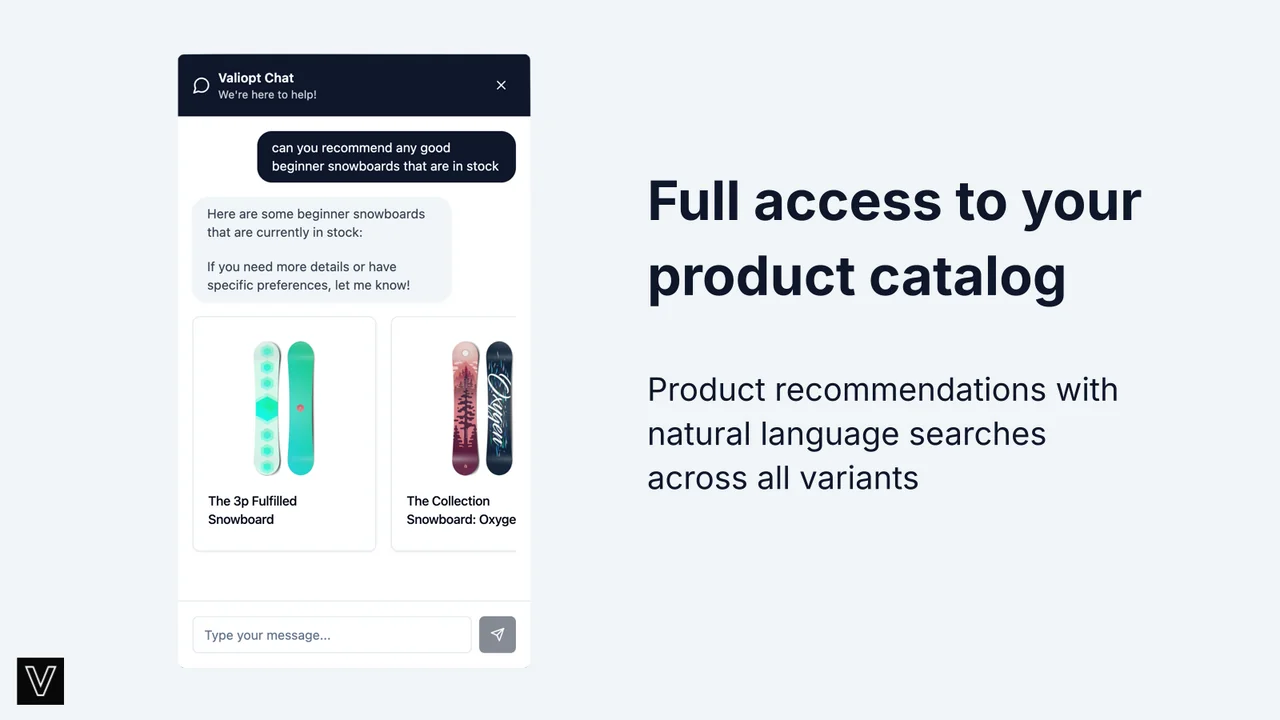
ValiOpt is a strong fit if you run a workflow-heavy ecommerce operation (returns, warranties, subscriptions, order edits), you do not have the internal bandwidth to build and maintain AI workflows yourself, and you would rather pay for outcomes than seats. The done-for-you build, the product-catalog-aware recommendations, and the warranty-photo analysis are real, and having their team own the tuning is worth money if your team is stretched.
ValiOpt is a weaker fit if you want to see the price before you commit, you want to try the tool today without a sales call, or you would rather own and tweak the config yourself. The quote-only model and the missing free trial add friction, and as a brand-new vendor with no public reviews yet, there is not much third-party track record to lean on. For a smaller store especially, a self-serve Shopify chatbot or one of the flat-rate AI chatbot platforms tends to be cheaper and quicker to stand up than a scoped AI agent engagement.
None of that is a knock on ValiOpt. It is a different product shape: a managed partnership priced on outcomes, versus a self-serve tool priced on a public rate. The right pick is genuinely about how you want to buy, not just what you want to pay.
Try eesel AI
If your reason for looking at ValiOpt is "I want AI to actually resolve ecommerce tickets, not just answer FAQs," but the quote-only, no-trial part gives you pause, eesel AI is the self-serve version of that idea. It plugs into the helpdesk you already run (Gorgias, Zendesk, Freshdesk, Help Scout) and into Shopify order data, and it handles tickets and chats on a fixed, public monthly plan from $299 for 500 credits (1 credit per ticket or chat), with no platform fee and no per-seat cost. You can read the full model on the pricing page.

The part that answers ValiOpt's "no free trial" gap directly: eesel lets you connect your helpdesk and run a simulation against your own past tickets before you pay, so you see how it would have answered real conversations instead of trusting a scoping call. There are 100 free credits to start with no credit card, it is live in minutes rather than after a build cycle, and where you do want a hand, that help is available without it being the only way in. If you are weighing ecommerce options, our guides to Gorgias alternatives and the best AI for Shopify support are a good next read.