Storebird AI pricing 2026: Essential, Pro, and Scale plans explained

eesel Team
Last edited October 14, 2026

I have spent the last three-plus years putting AI agents on live e-commerce support queues, and the moment I watch most closely is not the demo. It is the second a store owner opens the billing page. One brand I worked with, a US swimwear shop running on Gorgias, ran twelve clean test chats, loved every answer, then opened two cancellation requests the instant it saw how it would be billed. Pricing is where AI support tools win or lose the trial, which is exactly why a breakdown like this one matters before you connect anything.
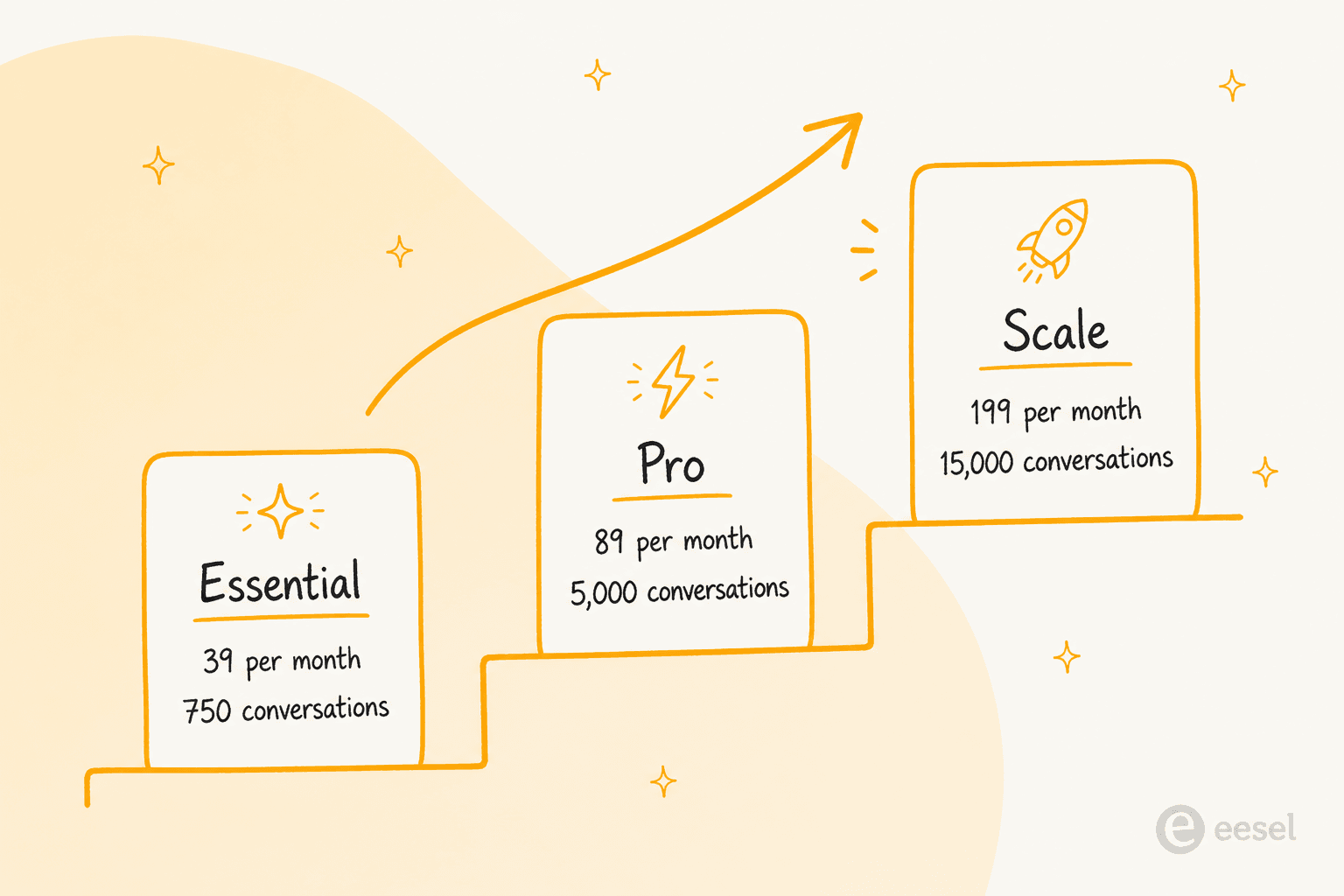
Storebird is a WooCommerce-only AI chatbot, and its pricing is refreshingly simple: three flat monthly tiers, $39 Essential, $89 Pro, and $199 Scale (the same numbers in euros), each capped by monthly conversations rather than billed per message. The whole pitch is that a flat fee never spikes on Black Friday.
The catches are worth knowing up front: there is no permanent free tier (only Pro gets a 14-day trial), the AI is included but the conversation caps are real (750 / 5,000 / 15,000), and it only works on WooCommerce. Below I break down every plan, where the extra costs hide, and how the flat model stacks up against per-resolution AI agents.
Storebird pricing at a glance
Storebird keeps the top line easy to read. Three plans, one monthly price each, billed in dollars or euros at the same number. Here is the full picture, with the buyer-relevant dimensions in one place rather than the marketing three-card view.
| Plan | Price / month | Best for | Conversations / mo | Knowledge pages | Stores included | Free trial |
|---|---|---|---|---|---|---|
| Essential | $39 / €39 | 10-30 orders/day | 750 | 100 | 1 | 14-day money-back |
| Pro | $89 / €89 | 30-100 orders/day | 5,000 | Unlimited | 1 | 14-day free trial |
| Scale | $199 / €199 | 100+ orders/day or agencies | 15,000 | Unlimited | 3 | Contact sales |
A Monthly / Yearly toggle sits on the pricing page; the figures above are the month-to-month rate, and Storebird does not publish the exact annual discount on the static page, so ask before you assume it. Every plan carries a 14-day money-back guarantee, and the plugin itself is free to install so you can run it in admin-only test mode before paying.
The full feature-by-tier breakdown
The three-card summary hides where the real gates are. Most of the things a growing store actually wants, the email channel, lead capture, advanced carrier tracking, custom brand voice, live behind Pro. Here is the honest tier map.
| Feature | Essential | Pro | Scale |
|---|---|---|---|
| Price / month | $39 | $89 | $199 |
| Conversations / month | 750 | 5,000 | 15,000 |
| Knowledge pages | 100 | Unlimited | Unlimited |
| Product search | Yes | Yes | Yes |
| Basic order tracking | Yes | Yes | Yes |
| Advanced tracking (1,500+ carriers) | No | Yes | Yes |
| Human handoff | Yes | Yes | Yes |
| Lead capture | No | Yes | Yes |
| Email channel (AI drafts, you approve) | No | Yes | Yes |
| Custom brand voice | No | Yes | Yes |
| Priority support | No | Yes | Yes |
| Add extra stores | €29/mo each | €29/mo each | €29/mo each |
| API access | No | No | Yes |
| Dedicated support manager | No | No | Yes |
| Custom integrations | No | No | Yes |
The takeaway: Essential is a genuine entry plan, not a crippled one. It answers product and order questions and hands off to a human. But the features that turn a chat widget into a real customer support layer, email drafting with live order data, lead capture, brand voice, mostly start at Pro.
What each plan actually gets you
Essential ($39/month)
Built for stores doing 10-30 orders a day. You get the core WooCommerce AI chatbot: product search against your live catalog, basic order tracking, human handoff, and up to 100 knowledge pages for your policies and FAQs. The order-tracking chatbot piece alone can absorb a big slice of "where is my order?" volume, which on most stores is 30-50% of tickets. What you do not get here is the email channel or lead capture. Note too that Essential has no free trial, only the 14-day money-back guarantee, so testing it live means paying first and claiming a refund if it disappoints.
Pro ($89/month)
This is the plan Storebird marks "Most Popular," and for a store doing 30-100 orders a day it is the honest starting point. The jump from 750 to 5,000 conversations a month is the headline, but the features it opens up matter more: unlimited knowledge pages, advanced tracking across 1,500+ carriers, lead capture, custom brand voice, priority support, and the email channel where the AI drafts replies with live WooCommerce order data for you to approve. Pro is also the only plan with a real 14-day free trial, no credit card.
Scale ($199/month)
Aimed at stores past 100 orders a day and at agencies. You get 15,000 conversations, three stores included, API access, a dedicated support manager, and custom integrations. If you run several WooCommerce shops, this is the tier that makes the multi-store math work, though each store beyond the included three is another €29/month. Scale is quote-adjacent: the button says "Contact Sales" rather than self-serve checkout.
The pricing model: flat cap, not per message
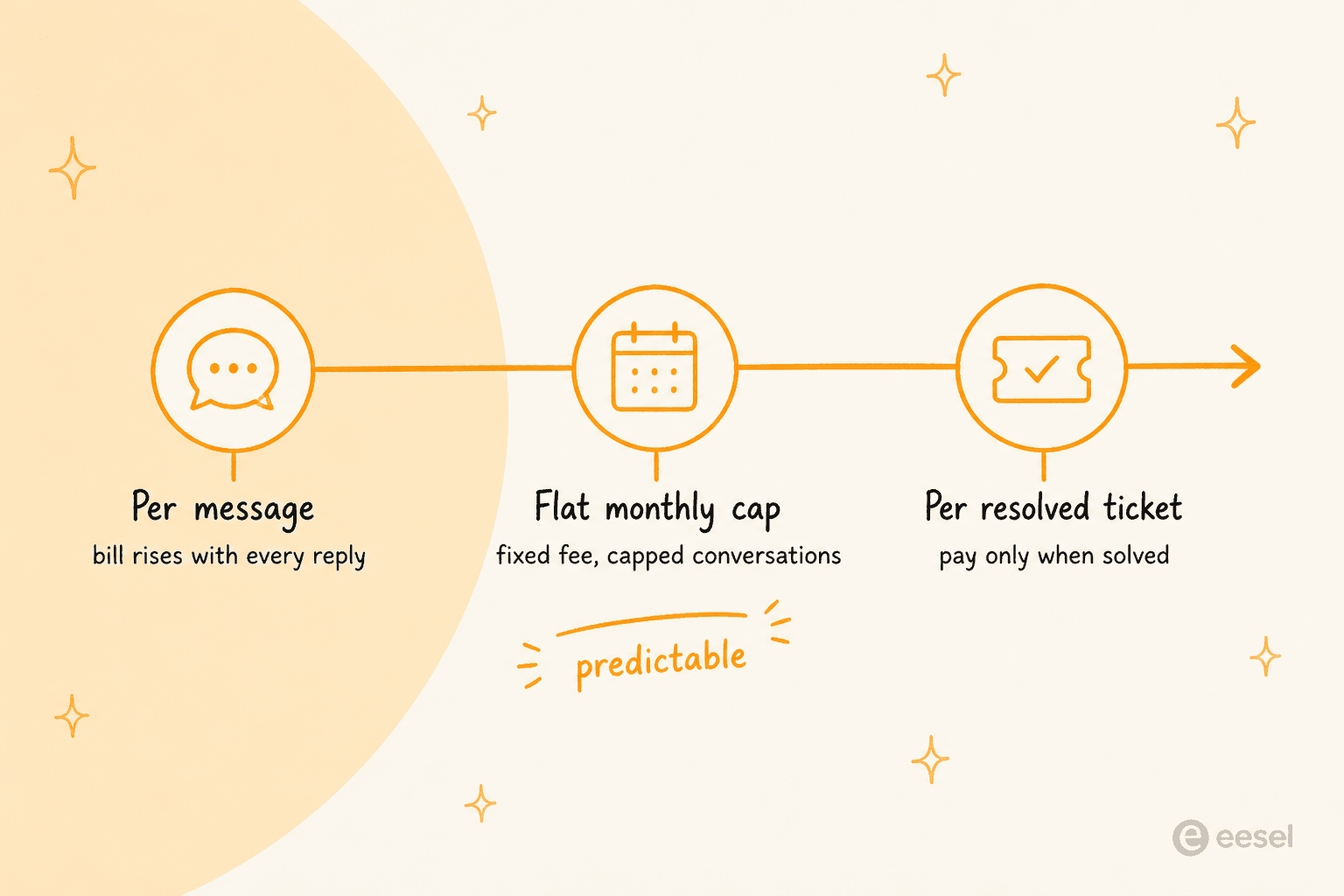
Storebird's core pricing argument is worth taking seriously, because it is a real problem. Many AI chatbot tools bill per message or per reply, which means your bill climbs exactly when traffic spikes, so a good Black Friday becomes a surprise invoice. Storebird charges a flat monthly fee tied to a conversation cap, so a busy month never blows up the bill, it just runs down your allowance faster.
That is a genuine advantage over per-message billing, and it is the same complaint I hear constantly on sales calls: a high-volume store on a per-interaction model watches the meter with dread. One ops lead at a payouts fintech told me a 3,000-interaction cap would be exhausted in a day and a half at their volume. Flat pricing removes that anxiety.
The tradeoff is the cap itself. A flat fee with a 5,000-conversation ceiling is predictable right up until you cross it, and then the behavior at the ceiling is what determines whether "predictable" holds. Storebird's public page does not spell out what happens at the limit, so that is the one question I would pin down before signing.
There is a third model worth knowing about, because it sits between the two: per-resolution billing, where you pay only when the AI actually solves something. That is how tools like Gorgias AI Agent bill. eesel's own AI helpdesk agent sits closer to a flat plan: a fixed monthly price sized to ticket volume. None of the three is automatically "cheapest," they just fail in different places: per-message punishes volume, flat-cap punishes overage, per-resolution rewards deflection.
Which Storebird plan fits your store?
The plan you want is set almost entirely by your monthly conversation volume, which tracks roughly with your daily order count. Use this to land on the right tier before you start a trial.
Radio widgets like this are a small thing, but they save the reader the mental arithmetic of matching order volume to a cap, which is the single most confusing part of any chatbot pricing page.
Where the costs hide
Flat pricing is honest at the headline level, but three things are worth reading before you budget.
- No free tier. The plugin installs free and runs in admin-only test mode, but shoppers never see it until you pay. Only Pro has a 14-day trial; Essential and Scale do not. Compare that to the free plans in my best AI chatbot for e-commerce list, where several tools keep a permanent free tier.
- Extra stores add up. Every store beyond your included allowance is €29/month. On Essential and Pro that is your second store; on Scale it is your fourth. For an agency, five shops on Scale is $199 plus €58, not $199 flat.
- The conversation cap is the real meter. 750, 5,000, and 15,000 sound generous, but a single shopper conversation can span many back-and-forth messages, and a store with a chatty widget burns through allowance faster than an order count suggests. Track it the way you would track any chatbot metric.
None of these are hidden in a dishonest way, Storebird's page is clearer than most, but they are the difference between the sticker price and the real monthly bill.
Storebird pricing versus the alternatives
Storebird is new, it launched in February 2026, and it is deliberately narrow: WooCommerce only, no Shopify, no Facebook Messenger or Instagram channels, no permanent free tier. Its edge is real, though: it reads your WooCommerce catalog, variations, stock, and orders through the native data model instead of scraping your pages, which is more than most generic live chat widgets do. To Storebird's credit, its own comparison content is honest about where cheaper or bigger tools win.
A few reference points on price:
- Tidio with Lyro AI starts around $29/month, but the AI is a separate add-on ($39-$289/month), so a realistic "Tidio + AI" bill lands closer to $68-$348. Storebird bundles the AI. See my Tidio AI reviews for the fuller picture.
- Crisp is a broader inbox with AI bolted on; check the Crisp AI breakdown if a multichannel inbox matters more than deep WooCommerce sync.
- Gorgias is the e-commerce helpdesk standard, and it lists WooCommerce among its supported stores on every plan, but its native order-actions integration is documented most fully for Shopify, so confirm what the AI Agent can read from a WooCommerce store. Weigh it against the best Gorgias alternatives.
Where eesel fits (and where it doesn't)
Here is the honest line, and Storebird's own blog actually draws it too: if you run a WooCommerce store as a standalone shop with no separate helpdesk, a native storefront widget like Storebird is the tidy fit. If your store already runs support through a real AI helpdesk, like Gorgias, Zendesk, or Freshdesk, that is where eesel lives.

eesel is an AI support teammate that joins the queue you already have. It trains on your past tickets, help center, and store knowledge, and it can draft replies for your team or answer customers directly, across the helpdesk rather than only in a storefront bubble. Two differences matter for a pricing comparison. First, eesel lets you simulate the agent on your real past tickets before it replies to a single customer, so you see the resolution rate before you pay, no refund-request moment required. Second, eesel uses one fixed monthly price sized to volume, from $299/month for 500 credits, where 1 credit covers one ticket or chat however long it runs, and there is a free plan with 100 credits. On the Scale-style end, where Storebird gates API access, eesel exposes a full CLI and API so scripts and coding agents can drive the same teammate from a terminal.
That is not a knock on Storebird. The two tools sit at different layers: Storebird plugs into the WooCommerce storefront, eesel plugs into the helpdesk. If you have no helpdesk, Storebird's flat pricing is easy to reason about. If you do, eesel's approach meets your support where it already is.
The verdict on Storebird pricing
For what it is, Storebird's pricing is clean and fair. The flat model does protect you from the per-message spike that plagues other bots, the entry plan is a real product rather than a teaser, and $39 to $199 is a reasonable range for a WooCommerce-native AI chatbot. The honest caveats: budget for the conversation cap, not just the sticker; the no-free-tier stance means you either trial Pro or pay-then-refund; and it only helps you if you are on WooCommerce.
If that describes your store, it is worth the 14-day Pro trial. If your support already lives in a helpdesk, price a volume-based AI teammate against it before you decide, because "flat" and "cheap" are not the same thing once you cross the cap.
Frequently asked questions
How much does Storebird cost?
Storebird pricing has three flat monthly tiers: Essential at $39/€39, Pro at $89/€89, and Scale at $199/€199. Each plan is capped by monthly conversations (750, 5,000, and 15,000), not billed per message or per resolution. See how a flat model compares in the chatbot cost guide.
Is there a free plan for Storebird?
No. Storebird has no permanent free tier. The plugin is free to install and you can test it in admin-only mode, but going live needs a paid plan. Only the Pro plan carries a 14-day free trial; every plan has a 14-day money-back guarantee. If a free tier matters, the best AI chatbot for e-commerce roundup lists tools that keep one.
What is Storebird's pricing for a small WooCommerce store?
The Essential plan at $39/month is aimed at stores doing 10-30 orders a day, with 750 conversations a month and up to 100 knowledge pages. If your volume is lower than that, weigh it against a cheaper native option from the small-business helpdesk list.
What happens when I hit my Storebird conversation limit?
Storebird addresses the limit in its own FAQ, but the exact overage behavior (block, upgrade prompt, or extra charge) is not spelled out on the public pricing page, so confirm it with sales before you commit. This is the number to watch on any capped plan, the same way you would track a per-resolution meter in Gorgias AI Agent pricing.
Does Storebird pricing include AI, or is it an add-on?
AI is included on every Storebird plan, with no separate OpenAI API key to buy. That is different from tools like Tidio, where the Lyro AI is a paid add-on on top of the base plan; see the Tidio AI pricing breakdown for that math.
Can Storebird run more than one store on one plan?
Only the Scale plan ($199/month) includes multiple stores, three of them. On any plan, extra stores are €29/month each. Agencies running several WooCommerce shops should price that in. For a broader look at multi-store support tooling, see the best e-commerce helpdesk guide.
Is Storebird pricing good value versus a helpdesk AI agent?
It depends on where your support lives. Storebird prices a storefront chatbot for WooCommerce catalogs. If your store already runs on a helpdesk, an AI helpdesk agent that layers onto that queue can be a better fit, and it bills differently, a fixed monthly price by ticket volume (1 credit per ticket or chat) rather than a conversation cap.
Does Storebird work on Shopify or only WooCommerce?
Storebird is WooCommerce-only by design. It has no Shopify or BigCommerce version. Shopify stores should look at the best Shopify chatbot apps and Shopify AI pricing guides instead.