

What developer onboarding really is (and where it breaks)
Developer onboarding is the whole arc from a new engineer's first login to the day they ship confidently on their own. Access and a working local environment, then the mental map of the codebase and its conventions, then a first pull request, then ownership of something real.
Most teams have the mechanical parts covered. HR provisions the accounts, IT hands over the laptop, and there's usually a README somewhere. Where it breaks is the middle: the tacit knowledge that never made it into a doc, or made it into a doc three reorgs ago and is now quietly wrong.
That's the gap a new developer falls into around day three. The onboarding page says "run make dev," but make dev fails on Apple silicon, and the fix lives in a Slack thread from eight months ago that nobody thought to write down. So they ask. And they ask again. Onboarding stops being a process and becomes a series of interruptions, which is exactly the thing a good internal helpdesk or internal search system is supposed to prevent.
The hidden cost: your senior engineers become the onboarding help desk
Here's the part that doesn't show up on any onboarding checklist. When a new hire can't find an answer, the cost isn't their idle time, it's your best engineer's focus.
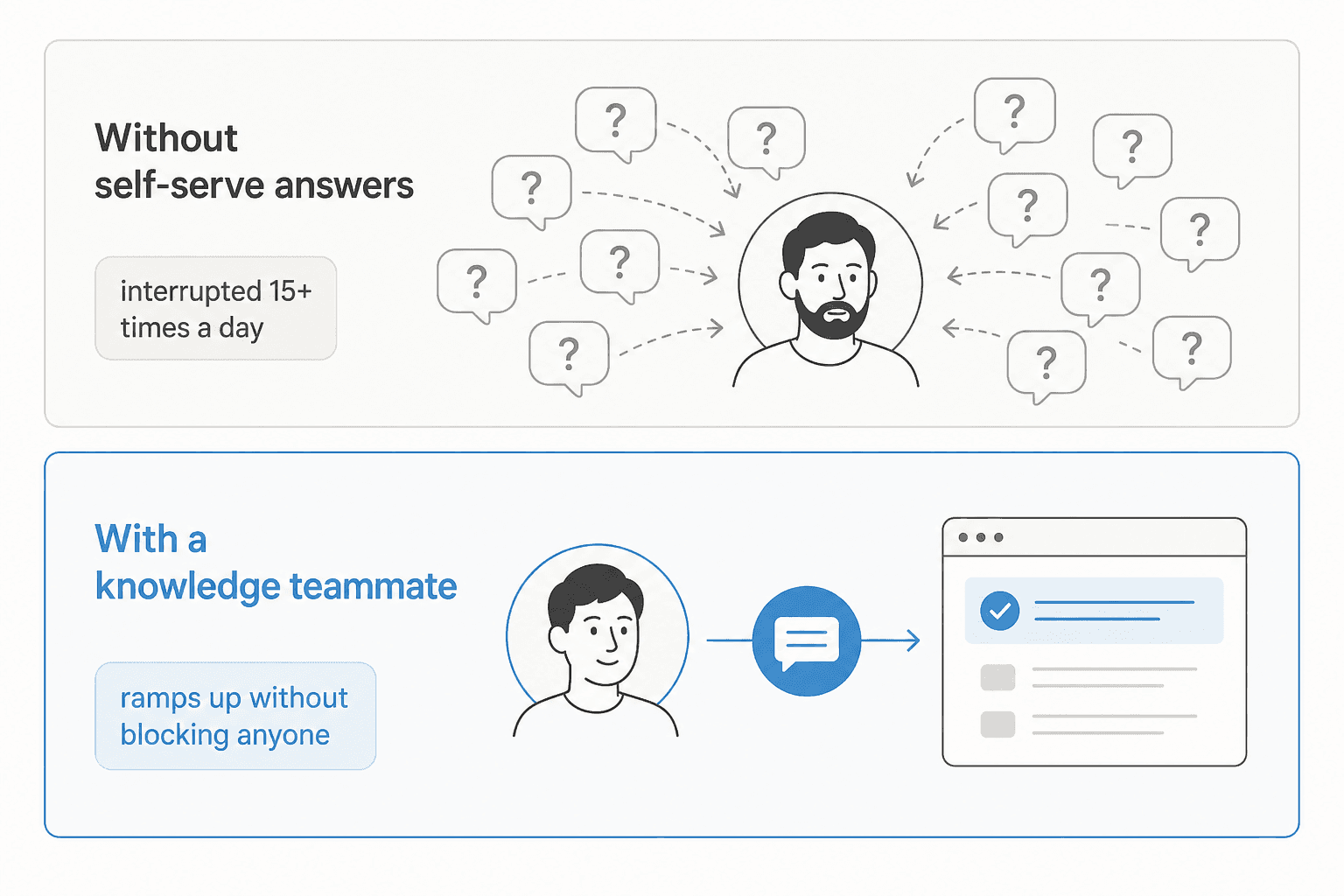
A senior developer pulled out of deep work to explain the staging deploy for the third time loses far more than the five minutes the answer takes. Context-switching is the tax, and it compounds when two or three new people join in the same month. The senior engineer becomes an unofficial help desk, morale on both sides dips, and the very person you hired to move fast is now the bottleneck.
This is why treating onboarding as a support problem, not just an HR checklist, pays off. The questions new developers ask are overwhelmingly repetitive and already answered somewhere, which makes them a near-perfect fit for the kind of AI internal support that resolves tier-1 questions automatically. It's the same shape as employee support and IT service desk work, just pointed at engineering.
A developer onboarding checklist that survives contact with reality
Before any tooling, you need the written path. A checklist forces the tacit stuff into the open, and it's the thing your AI layer will later be trained on. Here's the shape I'd use, mapped to milestones rather than vague "week one" buckets.
Pre-boarding (before day one). Trigger access requests the moment the offer is signed, not the morning they start. Nothing kills momentum like a new hire who can't log in until Thursday. Route these through an internal ticketing system so nothing gets lost between HR, IT, and the team lead.
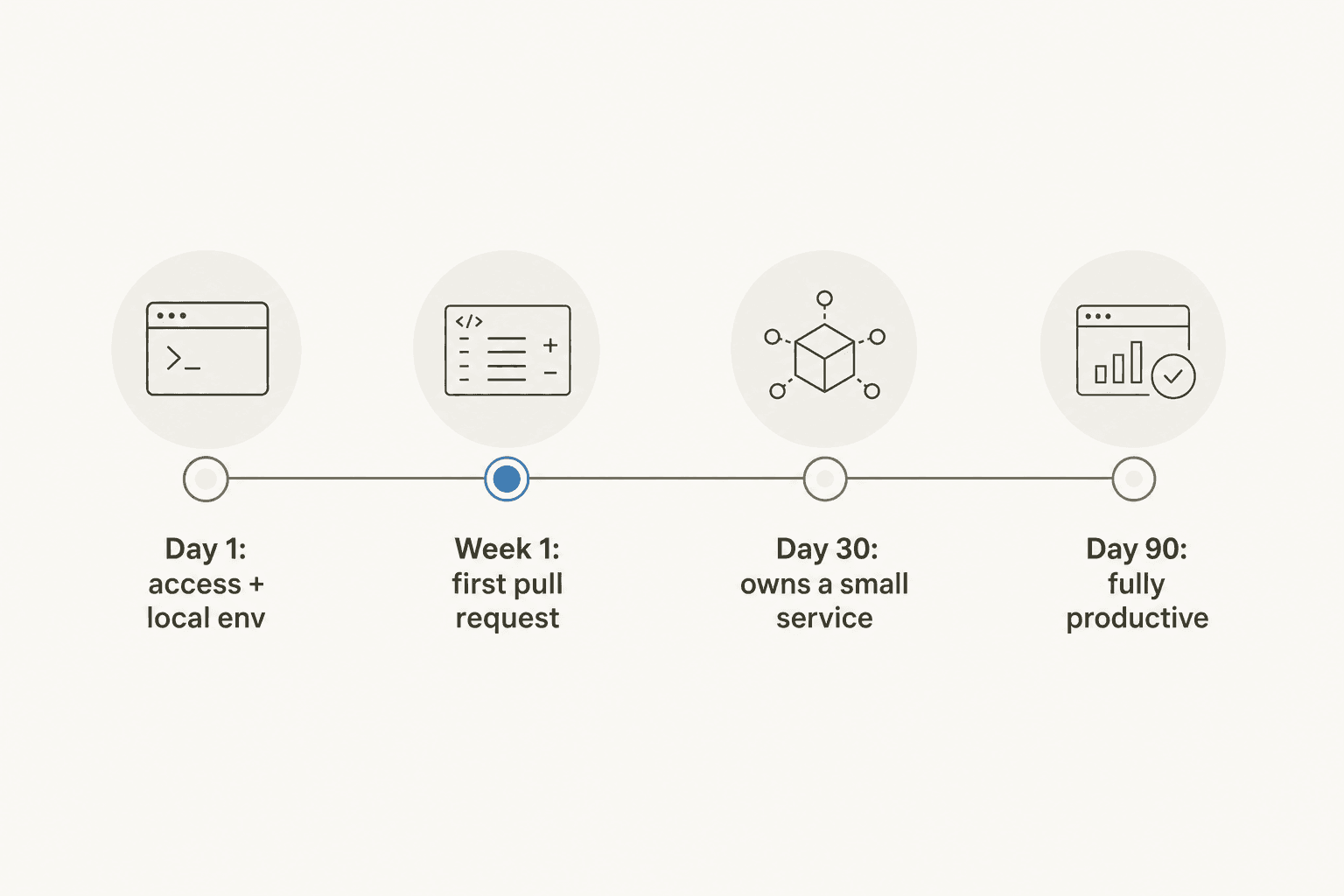
Day 1: access and a working local environment. The single measurable goal for day one is a codebase that builds and runs locally. Everything else is secondary. If your environment setup takes longer than a morning, that's a documentation bug worth fixing before the next hire.
Week 1: the first pull request. Give them a real but small, safe change to ship. A typo in a log line, a missing test, a doc fix. The point is to walk the whole pipeline end to end: branch, PR, review, CI, merge, deploy. Shipping on day four does more for confidence than a week of reading.
Day 30: owning a small service or area. By the first month, a new engineer should own something, even if it's small. Ownership is where passive reading turns into real understanding.
Day 90: fully productive. The finish line is when they're contributing at the level you hired for and, ideally, onboarding the next person. If you're consistently missing day 90, the answer usually isn't the person, it's how long it takes them to get unblocked.
The milestones are the easy part. Keeping the docs behind them current is the hard part, which is where most onboarding programs quietly rot. A checklist that points at a stale wiki is worse than no checklist, because it teaches new hires not to trust the docs.
Where AI fits: turn your docs into a teammate new hires can ask
Here's the reframe. You almost certainly don't have a knowledge problem, you have a retrieval problem. The answer to "why does the local build fail on Apple silicon" exists. It's in a Slack thread, a Jira comment, a Confluence page, someone's head. It's just not findable at the speed a blocked developer needs it.
An AI knowledge layer closes that gap by reading everything you've already written and answering in plain language, with a link to the source.
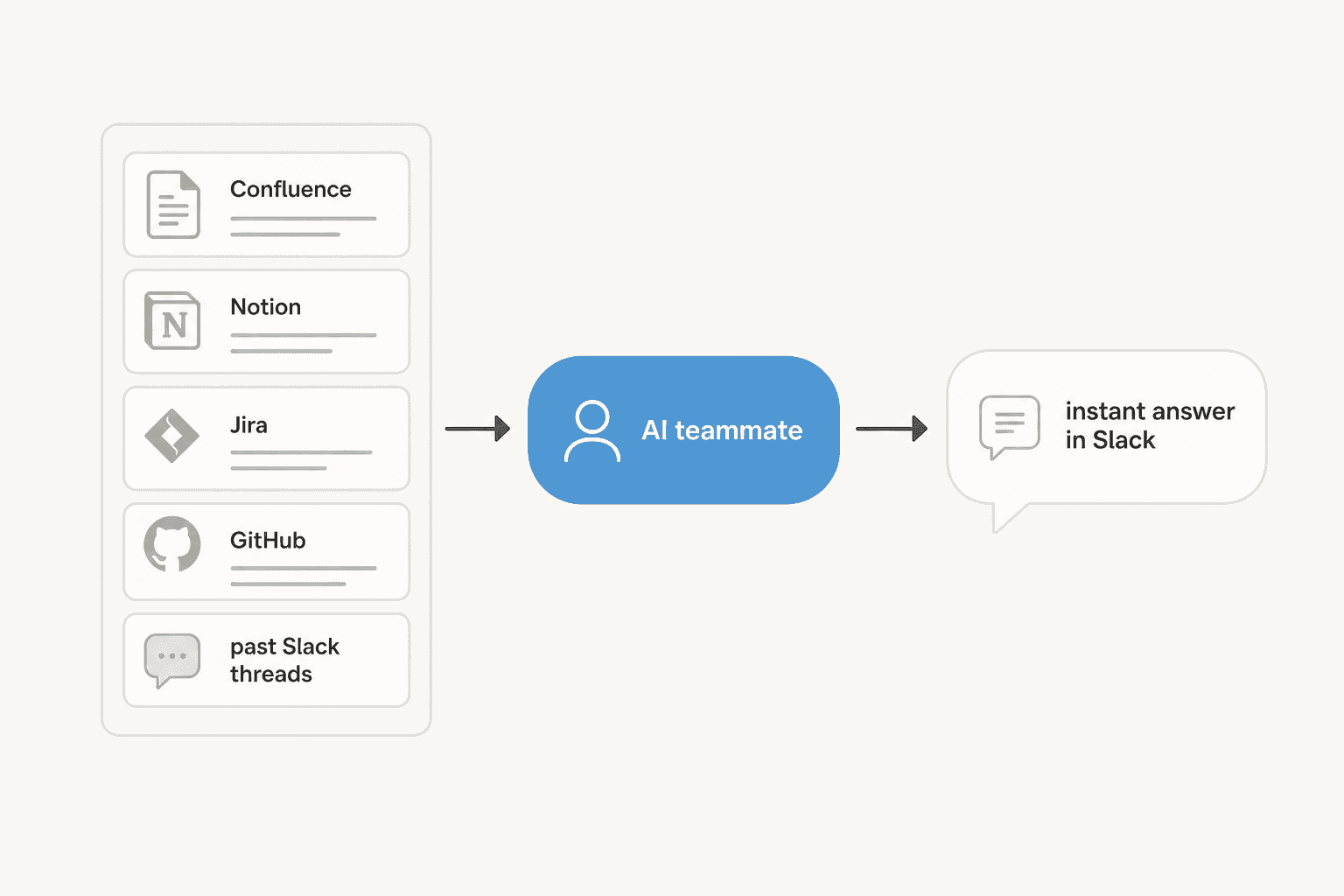
Connect your Confluence and Notion, your Jira tickets, your GitHub repos and READMEs, and crucially the historical Slack threads where most tacit knowledge actually lives. The AI retrieves the right answer and posts it back in the channel the new hire is already in. No new portal, no context switch.
This is what the Global Pay team put in front of their Confluence, and they were direct about the result:
"In a business where transactions need to be processed as quickly as possible, every second counts. With eesel, we can find specific answers to questions extremely fast. We can onboard new employees very quickly and have seen up to 80% time savings."
Alex Capurro, Chief Innovation Officer, Global Pay
It's the difference between a wiki (a place you go to search) and a teammate (something you ask). One team we worked with at Yellowdig put it more bluntly:
"Recently, a new customer success hire joked that our eesel AI bot was their best friend during onboarding and interviewing."
Jon Miron, Director of Support & Operations, Yellowdig
That's the bar. When the new person's first instinct is to ask the bot instead of interrupting a teammate, your senior engineers get their focus back and onboarding stops depending on who happens to be online.
Setting it up without a three-month project
The fear I hear most is that this is a quarter-long integration effort. It isn't, and the reason it isn't is that the docs already exist, you're just pointing something at them. Here's the sequence I'd run.
1. Connect your sources. Point the AI at your existing knowledge: help docs, Confluence, Notion, Jira, past tickets, and Slack history. With 100+ integrations this is mostly clicking connect, not writing glue code. The Confluence and Slack path is the common starting point for engineering teams.
2. Simulate before you trust it. This is the step that separates a useful assistant from a confident liar. Run the AI against real historical questions and read what it would have answered, so you catch gaps before a new hire does. We built simulation mode after watching too many bots sound sure while being wrong; grounding answers in your docs and testing them first is the whole game with AI accuracy.
3. Deploy where the questions already happen. Put the assistant in Slack, not behind another login. A new developer asks in #eng-help and gets a cited answer inline.
4. Let it improve from corrections. When a senior engineer corrects an answer, the AI learns from the edit, and the docs gap gets flagged so you can auto-draft the missing article. Onboarding docs stop rotting because the tool that answers questions also tells you what's missing.
That "connect, simulate, deploy" loop is the same one teams use to automate onboarding across Jira and Confluence for non-engineers too. viaStore did exactly this to connect knowledge for their internal teams.
Common developer onboarding mistakes
A few patterns I'd actively avoid, because they're the ones that quietly extend ramp-up time:
- Documentation as a one-time event. A wiki written the week someone joins and never touched again is worse than useless. Treat docs as living, and use a tool that surfaces the gaps automatically rather than waiting for someone to notice.
- No first-week win. If a new hire's first PR doesn't land until week three, you've taught them that shipping here is slow and scary. Engineer an early, safe win.
- Onboarding by shoulder-tap. Relying on senior engineers to be the answer key doesn't scale past one or two hires and burns out your most valuable people. This is precisely the tier-1 support load AI is good at absorbing.
- A firehose day one. Forty browser tabs of docs on the first morning is not onboarding, it's an anxiety generator. Milestones exist so the reading arrives when it's relevant.
- Buying a tool before writing the checklist. AI over garbage docs is just faster garbage. The written path comes first; the AI makes it reachable.
Get those right and developer onboarding shifts from a drain on your senior team to something closer to self-serve, which is the only version that scales as you hire.
Try eesel for developer onboarding
If your new engineers spend their first weeks hunting for answers that already exist, that's the exact problem eesel AI was built for. It connects to your Confluence, Notion, Jira, GitHub, and Slack, learns from your real history, and answers new hires' questions in the tools they already work in, with a link to the source every time.
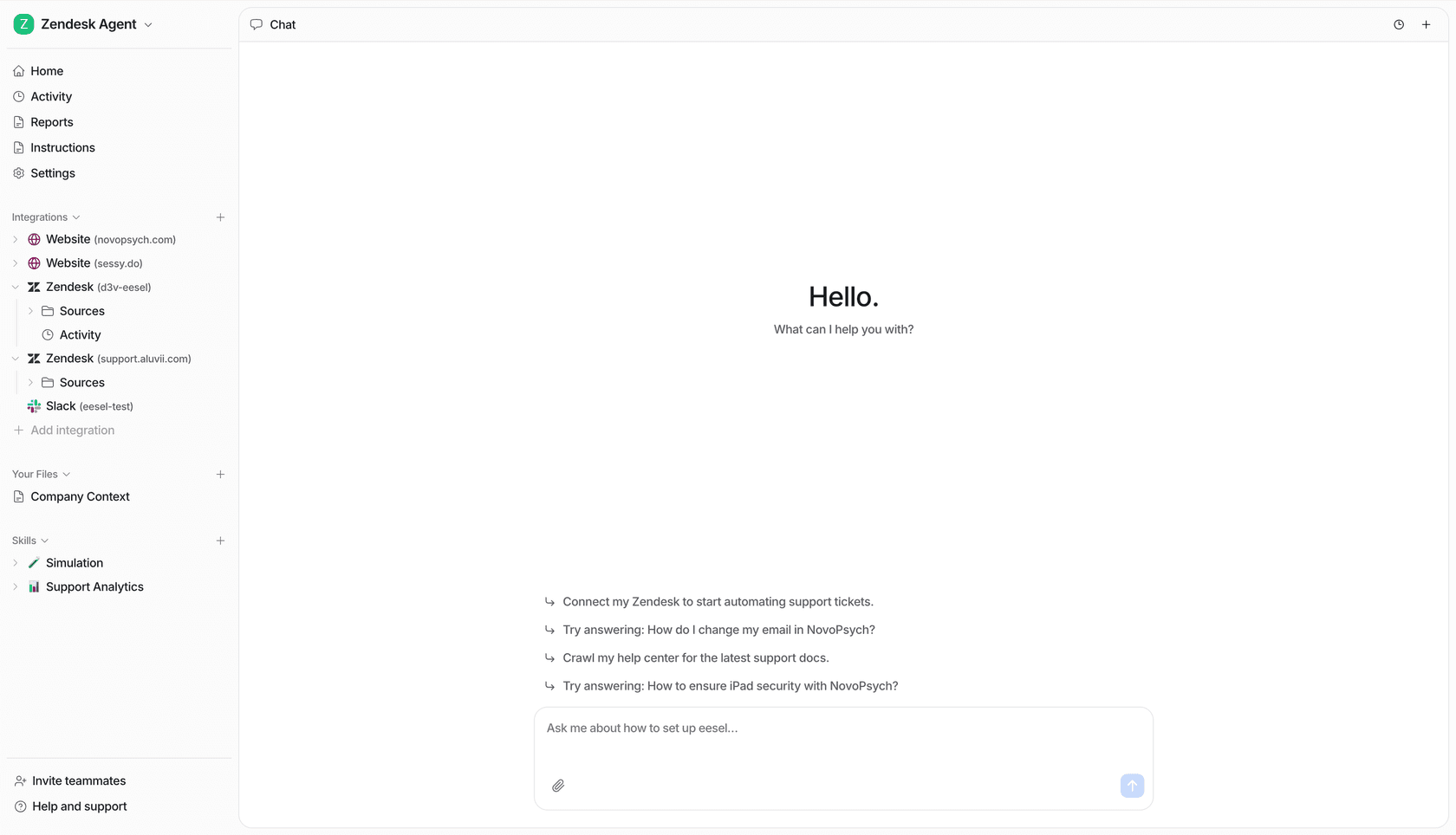
The differentiator that matters here: you can simulate it against past questions before it answers a single real one, so you know exactly how accurate it is on day one instead of hoping. Pricing is one fixed monthly price with no per-seat fees, so it costs the same whether one new hire uses it or your whole team does. You can try eesel free with 100 credits and point it at your own docs to see what it would answer.