

What makes travel support different from any other queue
Before the list, it's worth being honest about why a generic support bot often falls over in travel.
First, the spikes are brutal and they're not your fault. A volcano, a hurricane, an IT outage or a fare-sale flash can 10x your queue in an hour. A team sized for normal days drowns, and seasonal hiring is slow and expensive. AI doesn't get overwhelmed at 2am during a weather event, which is the whole point.
Second, the intent is unusually repetitive but the actions are real. A huge share of travel tickets are "where is my booking," "can I change my flight," "what's your cancellation policy," and "I need a refund." Those look simple, but a good answer needs the actual booking record, the fare rules, and sometimes the authority to make a change. A bot that can only recite a help-center article isn't enough; it has to actually do the thing.
Third, it's multilingual by default. A hotel chain or an online travel agency serves guests from everywhere, often in the middle of the night, and hiring fluent native speakers for every timezone is unrealistic. Multilingual support is one of the cleanest wins AI offers travel teams, and most of the tools below handle 50 or more languages.
Here's the shape of what a good travel support AI actually does with a request, regardless of which vendor you pick:
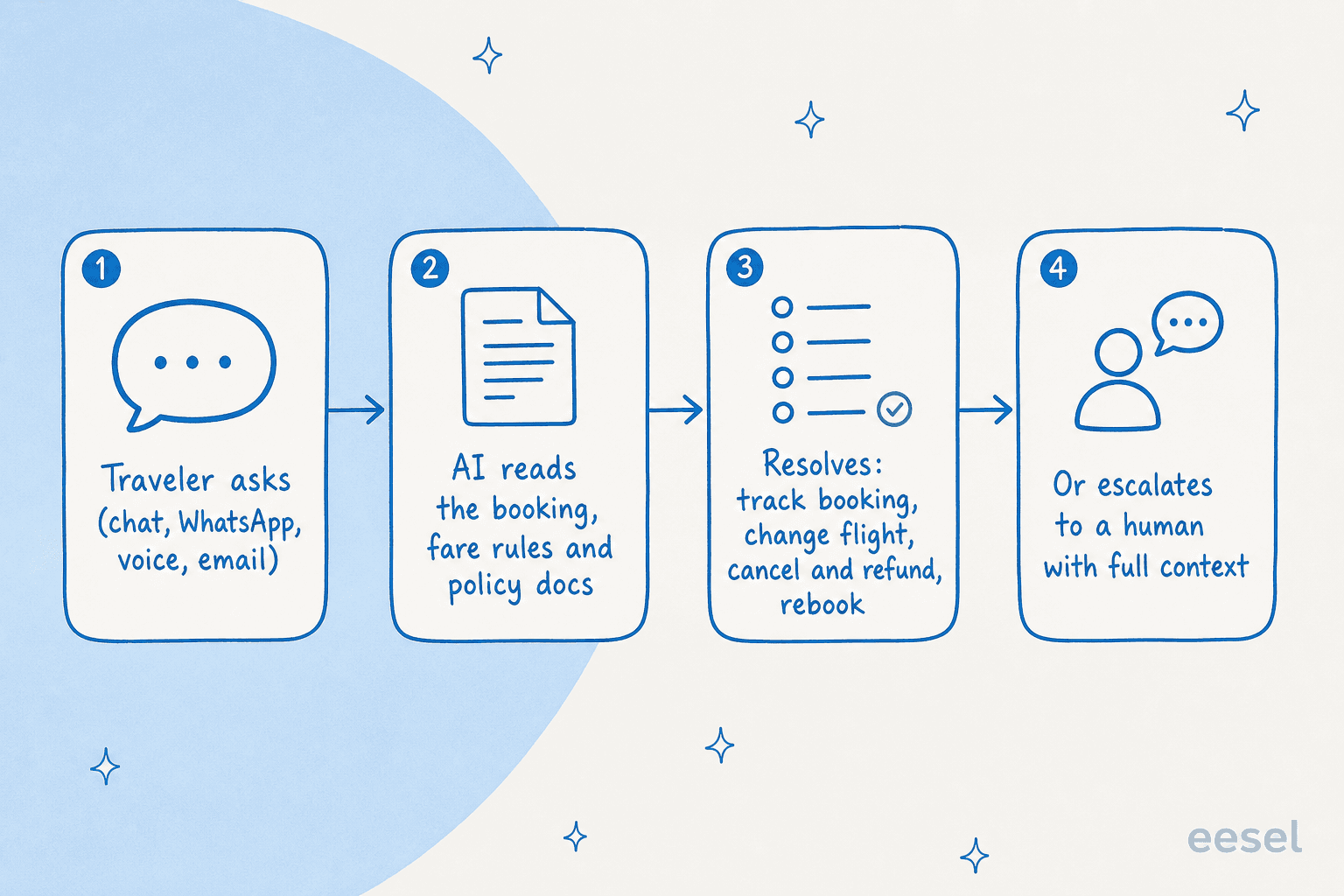
The key phrase in that flow is "reads the booking." The tools that genuinely move the needle are the ones that connect to your systems and take action, not the ones that just deflect to an FAQ. For more on that distinction, our piece on AI for live chat deflection digs into why deflection alone is a vanity metric.
How I picked these tools
I leaned on a few criteria that matter specifically for travel, not generic support:
- Can it take real actions? Looking up a booking, changing a flight, processing a refund, not just answering questions.
- How does it bill? Per ticket, per resolution, per minute, or per outcome. This is the single biggest cost lever.
- Voice or chat first? Airlines and hotels are phone-heavy; OTAs and DTC travel brands lean chat and messaging.
- Languages and channels. WhatsApp matters enormously in travel, especially outside North America.
- Setup reality. How long until it's live, and can you test it safely before customers see it.
I also stuck to two kinds of evidence: each vendor's own pricing and docs, and real user voice from places like Reddit and G2. Now the list.
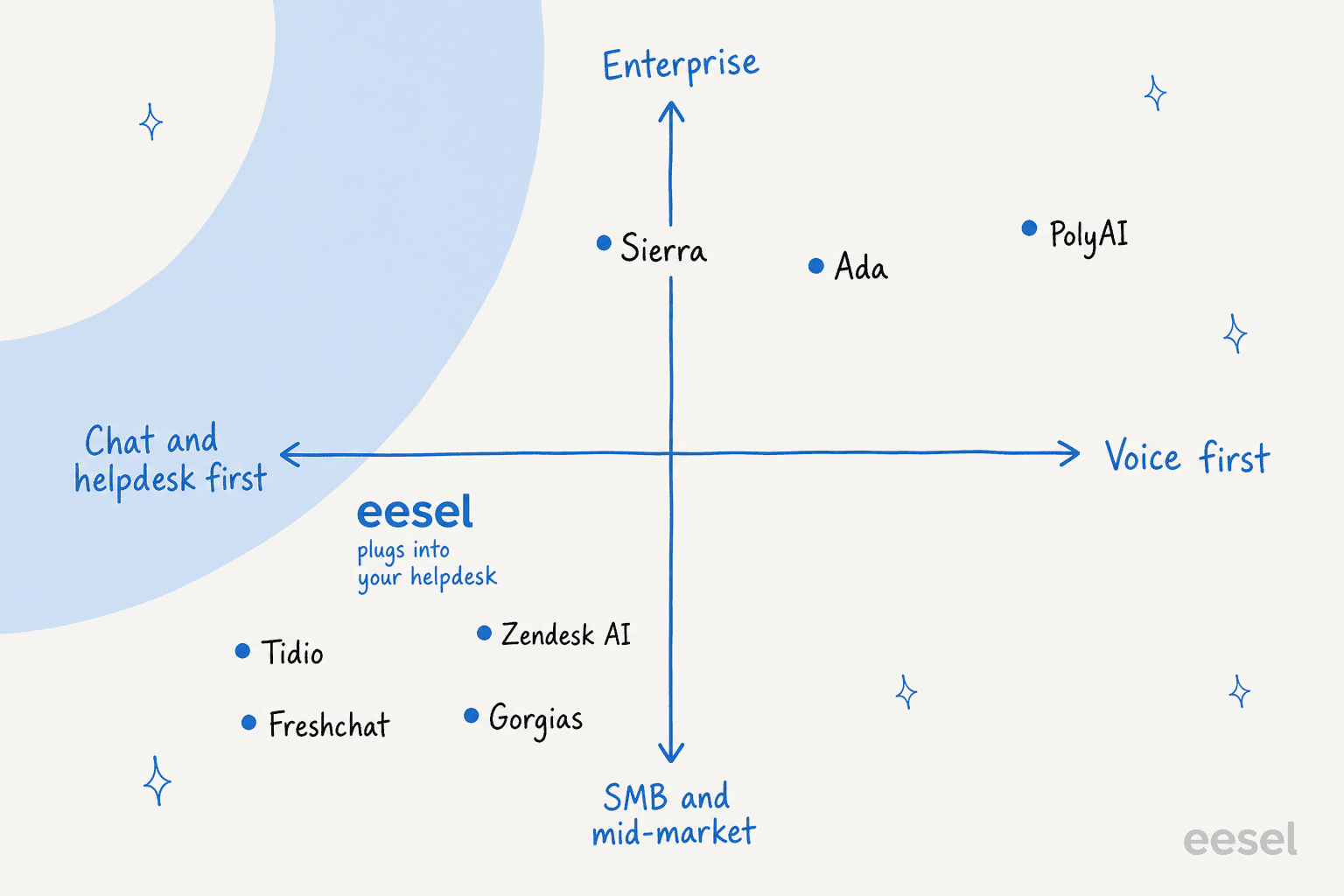
The best AI for travel support at a glance
| Tool | Best for | AI billing model | Entry point | Voice agents | Plugs into your existing helpdesk |
|---|---|---|---|---|---|
| eesel AI | AI on the helpdesk you already run | Per ticket (~$0.40), no seat fee | $50 free credit, no card | Via your helpdesk | Yes, native |
| Ada | Large airlines and OTAs at scale | Custom (volume-based) | 300k+ conversations/yr floor | Yes | Sits on top |
| PolyAI | Phone and voice support | Per voice minute | Demo only | Voice-only specialist | Telephony layer |
| Sierra | Premium brands paying for outcomes | Outcomes-based | Sales only | Yes | AI-first platform |
| Gorgias | Shopify travel stores and DTC | ~$0.90 per resolution + seats | From $10/mo | Add-on | It is the helpdesk |
| Zendesk AI | Teams already on Zendesk | ~$1.20-1.50 per resolution + seats | $19/agent/mo (no AI) | Yes (add-on) | It is the helpdesk |
| Freshchat | Budget multichannel and WhatsApp | $49 per 100 AI sessions | Free up to 10 agents | Freshcaller add-on | It is the helpdesk |
| Tidio | Small agencies and tour operators | ~$0.50 per Lyro conversation | Free tier | No | Lyro bolts onto others |
A quick note on reading that table: "plugs into your existing helpdesk" is the line that decides whether adopting AI means a migration or a Tuesday afternoon. Now let's get into each one.
1. eesel AI: best for putting AI on the helpdesk you already run
Full disclosure, this is my team's product, so take the framing with the appropriate pinch of salt. I've put it first because the most common situation I see in travel isn't "we have no helpdesk," it's "we already run Zendesk or Freshdesk and we don't want to rip it out to get AI." That's the gap eesel AI is built for.
Instead of being a separate platform you migrate to, it's an AI layer that sits inside your existing stack and learns from your past tickets, help docs and macros on day one. For a travel team, that means years of "where's my booking" and refund threads become training data immediately, rather than something you have to hand-write into a flow builder.
Features that matter for travel
- It plugs into your helpdesk natively. Zendesk, Freshdesk, Gorgias, Front, HubSpot and more, plus over 100 integrations across Slack, Confluence, Shopify and email.
- Simulation mode. Before it answers a single live guest, you run it against thousands of your real historical tickets to see exactly what it would have said and what your resolution rate would be. In an industry where a wrong cancellation answer costs real money, this is the feature I'd refuse to launch without.
- Multilingual out of the box. It answers in 80+ languages, trained on your own multilingual history, which suits international travel brands with overnight demand.
- Confidence-based escalation. Low-confidence questions get drafted for a human instead of guessed at, which is how you keep an AI agent from hallucinating a refund policy that doesn't exist.
"eesel resolved 73% of tier-1 requests in the first month" with results showing during a 7-day trial. eesel AI customer Gridwise
Pricing
eesel uses usage-based pricing: roughly $0.40 per ticket it handles, with no per-seat fees, no platform fee on the standard plans, and no minimum. You start with $50 of free credit and no credit card. An annual commit of $300/month or more knocks 25% off, and there's a $1,000/month Enterprise tier that adds dedicated support, SSO and HIPAA.
| Plan | What you pay |
|---|---|
| Free trial | $50 credit, no card |
| Pay-as-you-go | ~$0.40 per ticket, no seats |
| Annual commit | 25% off at $300/mo+ |
| Enterprise | $1,000/mo platform fee + usage |
Pros and cons
- Pros: no migration, fast time-to-value, the simulation safety net, transparent per-ticket pricing that doesn't punish you for adding agents.
- Cons: it's an AI layer, not a full helpdesk, so you still need an underlying platform like Zendesk or Freshdesk. And it isn't a dedicated voice product, so phone-first call centers should pair it with a voice tool.
Verdict: if you already have a helpdesk and want AI on your tickets next week instead of next quarter, this is the lowest-friction option in the list. Smaller and mid-market travel teams get the most out of it; pure phone-support operations should look at PolyAI alongside it.
2. Ada: best for large airlines and OTAs at scale
Ada is the enterprise heavyweight here, and it has the travel logos to back it up. Cebu Pacific and Malaysia Airlines are both named customers, and Ada has a dedicated travel landing page, which tells you where it's focused. It's a Toronto company that has raised around $190M, hitting a $1.2B valuation back in its 2021 Series C.
The important architectural point: Ada is a standalone AI platform that sits on top of your helpdesk (Zendesk, Salesforce, Freshworks), rather than an AI feature inside one. Its Reasoning Engine orchestrates across multiple LLMs, and it ships omnichannel including voice, WhatsApp, SMS and Instagram.
Features
- Multi-LLM Reasoning Engine with safeguards, rather than betting on one model.
- Omnichannel including voice, which matters when an airline's customers are split across phone, app and social.
- Playbooks for multi-step processes (the "first verify the booking, then check the fare class, then offer rebooking" kind of logic).
- Heavy compliance, including the AI-specific AIUC-1 certification and zero data retention with LLM providers.
For Cebu Pacific, Ada reports a 34%+ higher automated resolution rate than their previous chatbot, with sub-one-minute wait times, per its Cebu Pacific case study. That's the kind of number that justifies an enterprise contract.
Pricing
There's no public pricing, and this is the catch for most readers: Ada's own pricing page states it's a great fit for companies with at least 300,000 annual customer service conversations. That's a deliberate enterprise gate. If you're under that, Ada won't be the right fit and you'll be steered elsewhere anyway.
Pros and cons
- Pros: genuinely built for airline-scale volume, strong voice, deep compliance, proven travel customers.
- Cons: enterprise-only, no public pricing, no self-serve trial, and it's a separate platform contract rather than a toggle inside your existing helpdesk.
Verdict: if you're a major airline or a large OTA with hundreds of thousands of conversations a year, Ada belongs on your shortlist. If you're a mid-market brand or a small agency, you've already aged out of its target market. Smaller teams that want the same "AI on top of the helpdesk" idea without the enterprise floor should look at eesel.
3. PolyAI: best for phone and voice support
A lot of travel support still happens on the phone, especially for hotels, resorts and disrupted-travel situations where people want a human voice. PolyAI is the specialist here. It builds enterprise voice AI agents that answer calls end to end and sound startlingly human, powered by its proprietary Raven model trained on over 1 billion enterprise conversations.
The hospitality fit is real. Its named customers include Golden Nugget (a hotel-casino brand) and the restaurant group Fogo de Chão, whose CMO says on PolyAI's site the agent is "on track to add just over $7M" in incremental revenue. That's voice AI not just deflecting calls but booking tables and capturing revenue.
Features
- Full-stack voice agents, not voice bolted onto a chatbot. PolyAI says plainly it's "not voice bolted onto chat."
- Multilingual voice, including deployments like Croatian for a bank's contact center, so guests get answers in their own language.
- Enterprise reliability, with a 99.9% uptime SLA on phone lines and 24/7 monitoring.
- Compliance by default, with SOC 2, HIPAA, GDPR and PCI DSS standard.
Users "consistently praise the human-like voice and ease of integration," highlighting effective automation of client calls. PolyAI reviews on G2
Pricing
PolyAI is enterprise and quote-based, with the billable unit stated plainly: ongoing use is priced on a per-minute basis, bundling maintenance and 24/7 support. There's no public number and no self-serve signup, just a demo request.
Pros and cons
- Pros: the best voice experience in this list, strong hospitality track record, genuinely multilingual phone support.
- Cons: voice-only focus, enterprise pricing, per-minute billing that needs forecasting, and no chat helpdesk of its own.
Verdict: if phone is the bulk of your support, like a hotel group or an airline call center, PolyAI is the voice specialist worth a demo. If you're chat and email first, the per-minute model won't be your main event, and you'd pair it with a helpdesk-native tool for the rest.
4. Sierra: best for premium brands paying for outcomes
Sierra is the buzziest name on this list, co-founded by Bret Taylor (former co-CEO of Salesforce, now chair of OpenAI's board) and Clay Bavor, an 18-year Google veteran. It has raised aggressively, with a reported Series D of around $350M at a roughly $10B valuation in late 2025. Its travel and mobility customers include CLEAR, Deliveroo and Rivian.
Sierra's pitch is that the agent is the product. It's AI-first, not a helpdesk with AI bolted on, and it leans hard into autonomous, omnichannel agents that span chat, voice, SMS, WhatsApp and even ChatGPT.
Features
- Outcomes-based pricing, the headline differentiator (more on that below).
- Ghostwriter, an agent that builds agents from your SOPs, transcripts or plain-English goals, which collapses the usual multi-week setup.
- Omnichannel including voice and ChatGPT, so one agent covers every surface.
- Serious compliance, including ISO 42001 (the AI management standard), SOC 2, HIPAA and GDPR.
Pricing
Sierra champions outcomes-based pricing: "ensure you only pay for the value Sierra delivers." There's no rate card and no self-serve. In theory it shifts risk onto Sierra; in practice it means a custom enterprise contract negotiated per use case, so you'll want clarity on exactly what counts as a billable "outcome" before signing.
Pros and cons
- Pros: top-tier founders and funding, genuinely autonomous agents, fast setup via Ghostwriter, outcomes pricing that aligns incentives.
- Cons: enterprise-only, opaque pricing, and "outcome" definitions you'll need to pin down carefully. Overkill for a small travel agency.
Verdict: for a premium, well-resourced travel brand that wants a flagship autonomous agent and likes the idea of paying for results, Sierra is compelling. For everyone else, it's more platform (and more sales process) than the job needs.
5. Gorgias: best for Shopify travel stores and DTC brands
Not all travel is airlines. A huge slice is commerce: luggage and travel-gear brands, tour and experience bookings, travel subscriptions, and DTC stores selling everything from packing cubes to airport lounge passes. If that's you and you're on Shopify, Gorgias is built for exactly this. It powers support for 40% of Shopify brands and pulls order data straight into the ticket.
Its AI Agent is pre-trained on over a billion ecommerce conversations and can handle the commerce side of travel support: order status, changes, refunds and product questions, with actions that actually touch the store.
Features
- Deep Shopify integration, with orders, refunds and cancellations inside the ticket. Also supports BigCommerce, Magento and WooCommerce.
- Omnichannel inbox across email, chat, Instagram, TikTok, WhatsApp, plus SMS and voice as add-ons.
- AI Agent and automation for FAQs, returns and order edits, with conversational, non-pushy upsell.
"If a meaningful chunk is WISMO, address changes, cancels, refunds, exchanges, Gorgias usually feels worth it because the agent can do the work inside the ticket." u/cavalry18 on r/CRM
Pricing
Gorgias uses ticket-based plans, not per seat:
| Plan | Monthly | Tickets/mo |
|---|---|---|
| Starter | from $10 | 50 |
| Basic | from $50 | 300 |
| Pro | from $300 | 2,000 |
| Advanced | from $750 | 5,000 |
The AI Agent is a usage add-on at $0.90 per resolved conversation on annual plans ($1.00 monthly), and each AI interaction also counts as a billable ticket. The common community caution is that costs climb fast at volume.
Pros and cons
- Pros: unbeatable Shopify integration, commerce actions baked in, strong automation during peak season.
- Cons: it's ecommerce-shaped, not travel-shaped, so it's a poor fit for airline or flight-change support. Pricing stacks up at scale, and it's a full helpdesk you'd migrate to.
Verdict: for a Shopify-based travel commerce brand, Gorgias is a top pick. For booking-and-itinerary support, it's the wrong shape. If you like Gorgias but already use a different helpdesk, our Gorgias alternatives roundup is worth a read.
6. Zendesk AI: best for teams already on Zendesk
If your travel team already lives in Zendesk, the path of least resistance is its own AI. Zendesk has rebuilt around what it calls the Resolution Platform, folding in its Forethought acquisition for self-improving agents. Travel-adjacent logos like Airbnb, Uber, OpenTable and Grubhub use it, and it claims up to 80% automation across 22,000+ AI customers.
Features
- AI agents and Copilot across messaging, email, voice and the knowledge base.
- Automatic QA scoring across 100% of human and AI interactions, useful for regulated or high-value travel.
- Workforce management for forecasting, which matters when travel demand is seasonal.
- A marketplace of 1,800+ apps and integrations.
Pricing
Seat-based, with AI billed separately on top:
| Plan | Per agent/mo |
|---|---|
| Support Team | $19 (no AI) |
| Suite Team | $55 |
| Suite Professional | $115 |
| Suite Enterprise | Custom |
The catch is the per-resolution AI billing, which users report lands around $1.20 to $1.50 per automated resolution, plus $50/agent add-ons for Copilot. That layered model is the most common complaint:
"From what I can see in regards to this new 'Automated Resolution' pricing model, we'll be paying about $1.50 to $1.20 per resolution. And what Zendesk counts as a resolution can be subjective." u/caledragonpunch on r/Zendesk
That "subjective" point is worth pausing on for travel, where an abandoned chat during a stressful cancellation could still get counted as a resolution you paid for. It's one reason teams look at Zendesk AI alternatives, including running eesel on top of Zendesk so the AI learns from solved tickets instead.
Pros and cons
- Pros: if you're already on Zendesk, it's one toggle away, mature, omnichannel, with strong QA and WFM.
- Cons: the stacked seat-plus-resolution-plus-add-on pricing is hard to forecast, and "what counts as a resolution" frustrates users.
Verdict: the convenient default for existing Zendesk shops. Just model the AR costs carefully before you commit, and know that a per-ticket layer like eesel can sit on the same Zendesk instance with more predictable billing.
7. Freshchat: best for budget multichannel and WhatsApp
Freshchat, Freshworks' messaging product with Freddy AI on top, is the value pick, and it has genuine travel credentials: MakeMyTrip and Travix are both named customers. For travel brands in markets where WhatsApp is the default channel, Freshchat's omnichannel reach (WhatsApp, Instagram, LINE, SMS and more) is a real draw.
Features
- Omnichannel messaging including WhatsApp, Instagram, LINE and Google Business Messages.
- Freddy AI Agent for autonomous self-service, plus Freddy Copilot for human agents.
- A real free tier, unusual among the brand-name suites.
- Freshcaller voice as an add-on if you need phone.
Pricing
| Plan | Per agent/mo (annual) |
|---|---|
| Free | $0 (up to 10 agents) |
| Growth | $19 |
| Pro | $49 |
| Enterprise | $79 |
Freddy AI is a separate add-on: 500 free agent sessions, then $49 per 100 sessions (roughly $100 per 1,000), where a session is all interactions in a 24-hour window. Freddy Copilot is $29/agent/month on Pro and up.
Pros and cons
- Pros: real free tier, low entry price, strong WhatsApp and messaging coverage, proven travel customers.
- Cons: Freddy AI is metered per session on top of seats, social channels aren't on the free plan, and there's persistent upsell pressure toward the heavier Freshdesk Omni suite.
Verdict: a strong budget-conscious pick for messaging-heavy and WhatsApp-first travel support. If you want the same affordability but on a helpdesk you already run, or you find Freddy's session billing fiddly, eesel's per-ticket model is the alternative to weigh.
8. Tidio: best for small agencies and tour operators
For a small travel agency, a boutique tour operator or a B&B, Tidio is the easiest on-ramp. Its Lyro AI agent is powered by Anthropic's Claude, claims a 67% average resolution rate, and is designed to install in minutes without engineering help. Tidio serves 300,000+ businesses, and one hospitality customer, Gecko Hospitality, reports automating 90% of repetitive tasks.
Features
- Lyro AI agent grounded only in your own content, which users praise for staying on-script and not hallucinating.
- Live chat and ticketing in one inbox, plus visual no-code Flows for proactive automations.
- Shopify actions like order tracking and cart recovery on Growth and up.
- A money-back guarantee if resolution drops below 50% (Premium tier).
Pricing
| Plan | Price (annual) | Billable convos |
|---|---|---|
| Free | $0 | 50 |
| Starter | $24.17/mo | 100 |
| Growth | from $49.17/mo | from 250 |
| Plus | from $749/mo | Custom |
| Lyro (standalone) | from $32.50/mo | 50 AI convos |
The effective Lyro cost works out to roughly $0.50 per AI conversation (calculator-derived, not a printed rate). Notably, standalone Lyro can bolt onto Zendesk or Salesforce, so you don't have to switch helpdesks to use it.
Pros and cons
- Pros: real free tier, cheap entry, fast setup, Claude-powered AI with good guardrails, hospitality proof point.
- Cons: the free tier is thin (50 conversations), pricing gets complex at scale with the jump to $749/mo Plus, and lower tiers are email-support only.
Verdict: the friendliest starting point for small travel businesses. Larger operations will outgrow the volume caps quickly, at which point a per-ticket model like eesel scales more predictably.
What a travel support AI actually costs
Here's the part that trips up most buyers. These tools don't just have different prices, they count your bill in fundamentally different ways:
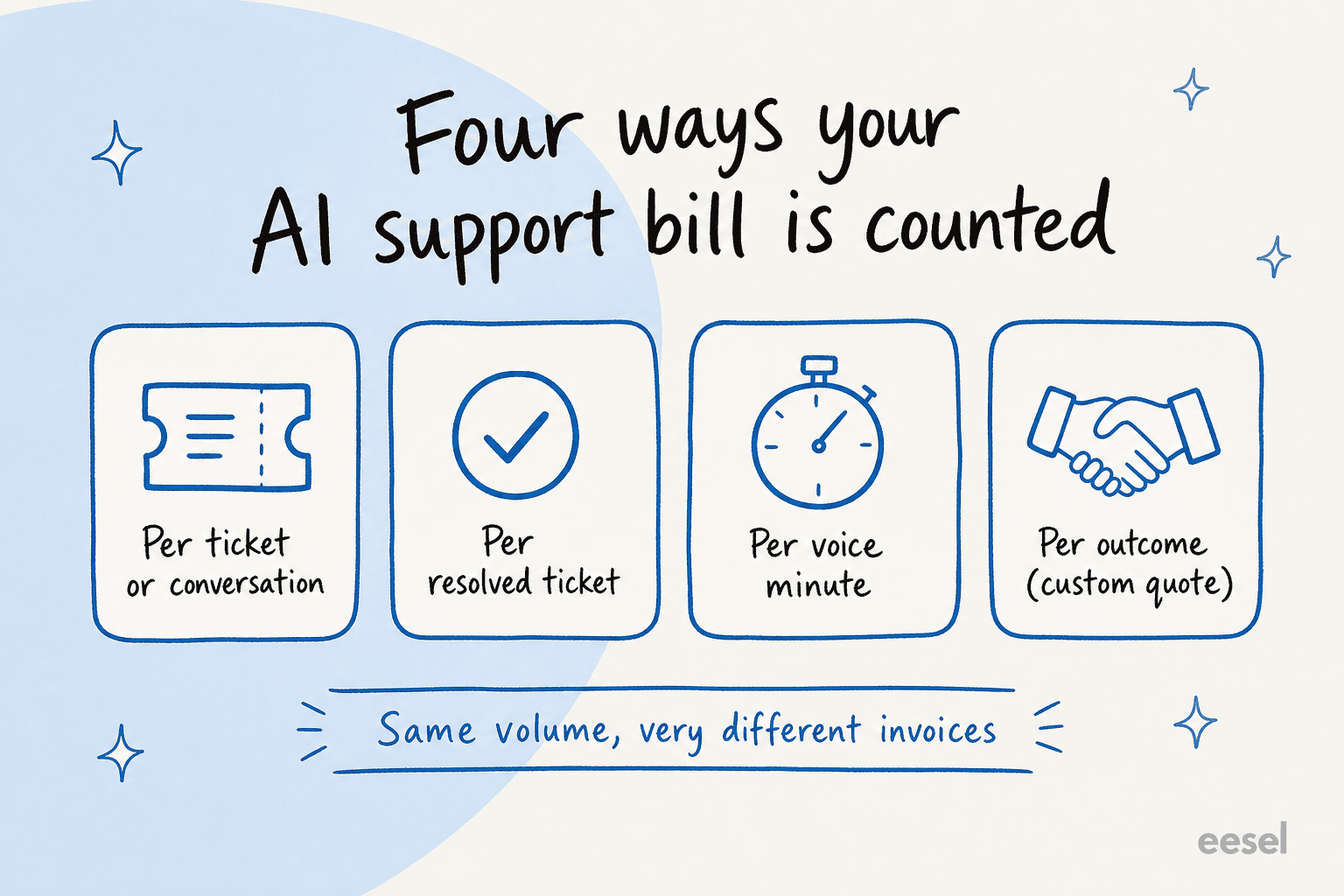
Say you're a mid-sized OTA handling 10,000 AI-resolved conversations a month. Roughly:
- Per-ticket (eesel): around $4,000, with no seat fees on top, and lookups don't count.
- Per-resolution (Zendesk, Gorgias): at $0.90 to $1.50 each, that's $9,000 to $15,000 in AI charges plus your agent seats. And you may be paying for "resolutions" where the customer abandoned the chat.
- Per-minute (PolyAI): entirely depends on call length, which is why voice is forecasted separately.
- Per-outcome (Sierra, Ada): a custom number you negotiate, with the definition of "outcome" doing a lot of heavy lifting.
The billing unit, not the sticker price, is what determines your real cost. A per-resolution model looks cheap until your volume spikes during a travel-disruption event, which is exactly when you most need the AI. For a deeper look, our guide on AI customer support cost savings and the AI versus human agent cost breakdown both go further.
Which one should you pick?
The honest answer is that it depends on your shape: airline, hotel, OTA, Shopify store, or small agency. Pick the description that fits you best below to see where I'd point you.
What best describes your travel business?
Try eesel for your travel support

If you already run a helpdesk and just want AI handling the flood of "where's my booking" and "I need to change my trip" tickets, eesel AI is the lowest-risk way to start. It plugs into Zendesk, Freshdesk, Gorgias or Front, learns from your real travel tickets, answers in 80+ languages for overnight demand, and lets you simulate it on your own history before a single guest sees it. Pricing is a flat per-ticket rate with no per-seat fees, so a holiday volume spike doesn't blow up your invoice.
You can try eesel free with $50 of credit and no credit card, and see your projected resolution rate in a simulation before you commit.
Frequently Asked Questions
What is the best AI for travel customer support?
How much does AI for travel support cost?
Can AI handle multilingual travel support?
Can AI answer phone calls for airlines and hotels?
What should a small travel agency look for in an AI support tool?


Article by
Kurnia Kharisma Agung Samiadjie
Kurnia is a software engineer and writer at eesel AI with two years of SEO experience, writing about AI tools, helpdesk software, and customer support. He pairs a developer's understanding of how these products are built with search-driven research into what actually ranks and resonates with the people searching for them.