

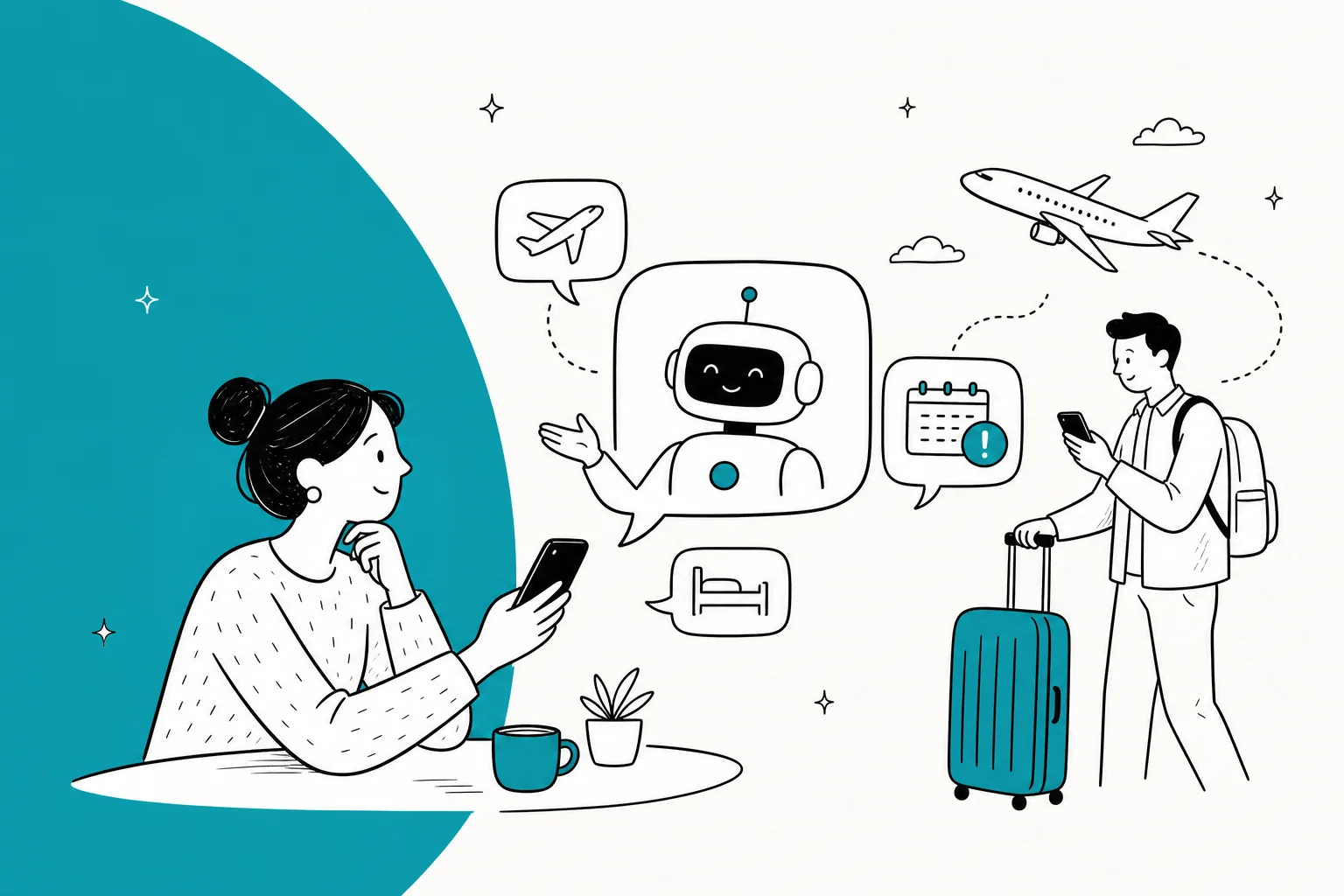
What an AI chatbot for travel actually is
Let's clear up the biggest confusion first, because "chatbot" covers two very different things.
The old kind is a rule-based bot: a decision tree with buttons, the thing that popped up on a travel site in 2019 and shut down the moment you asked something off-script. It felt like a database, and it caused most of the AI chatbot problems travelers complain about.
The new kind is a conversational AI agent. It reads a traveler's free-form question, understands intent, and pulls the answer from a knowledge base and your booking system rather than a fixed menu. Ask it "my flight got moved, can I still make my connection?" and, if it's connected properly, it reads your actual itinerary instead of a generic answer an external model would hallucinate.
The practical difference for you: the rule-based bot deflects a handful of exact-match FAQs and irritates everyone else, while a well-built AI agent handles the long tail of how travelers actually phrase things, and can take an action at the end instead of just answering. That second part, doing something rather than reciting something, is the line that matters, and it's what separates AI in customer service from a glorified FAQ. In travel it's the whole game.
Where an AI chatbot helps across the trip
The clearest way to think about this isn't a feature list, it's the traveler's timeline. An AI chatbot can carry weight at every stage.
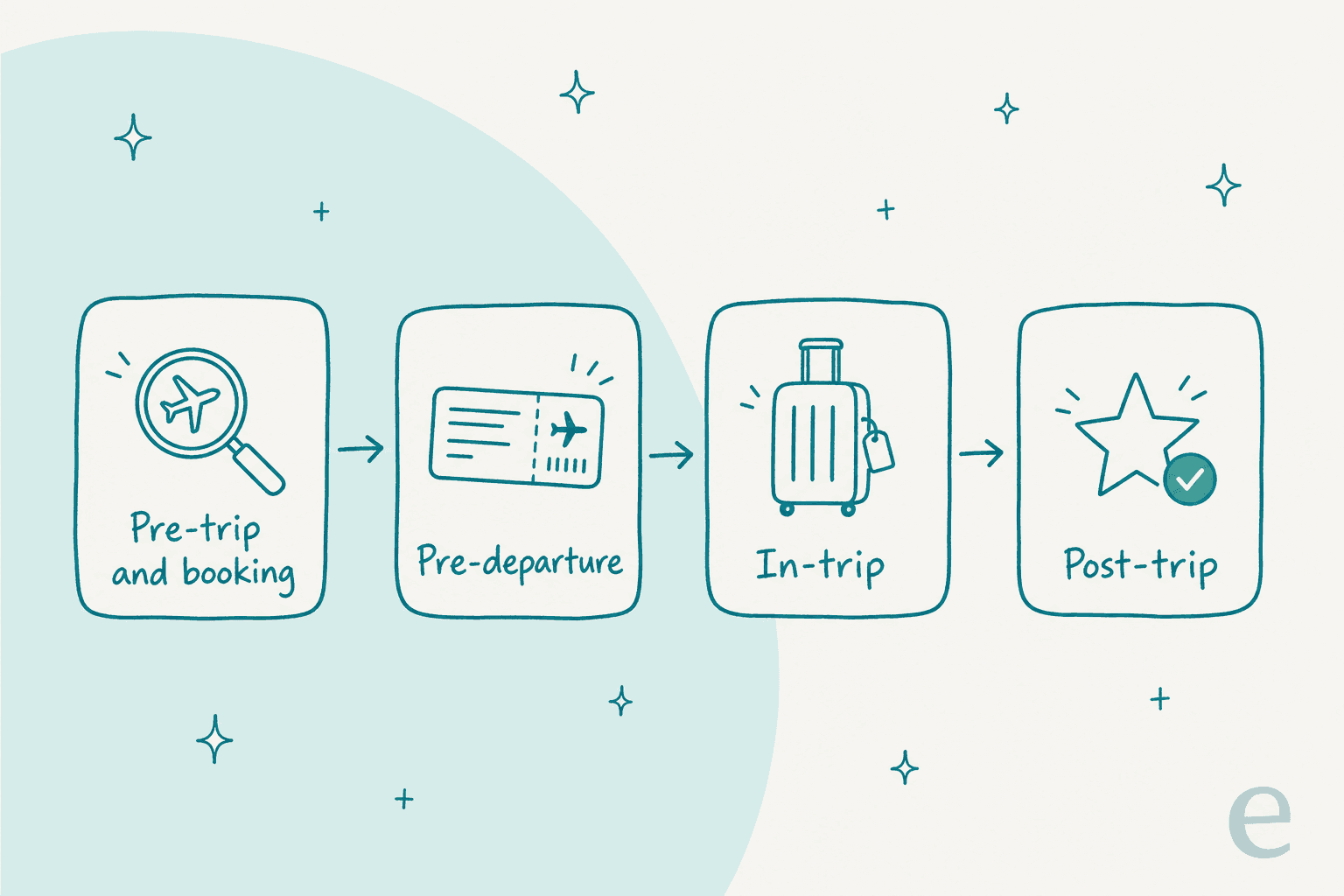
- Pre-trip and booking. It answers fare, route, baggage, and policy questions on your site 24/7 and can help complete a booking. This matters more every year: IATA's 2024 survey found 71% of passengers book online or via a mobile app, and only 16% prefer a human for booking, so travelers already expect a digital assistant to carry the conversation.
- Pre-departure. It fields the "when does check-in open / can I change my seat / what's my baggage allowance" wave, handles pre-check-in forms, and can surface the right add-on at the right moment.
- In-trip. The hard part and the point of the whole thing: delays, gate changes, missed connections, rebooking, and "where's my bag." Booking.com and Expedia both lean into this. Expedia's Romie assistant is built to watch the weather and last-minute disruptions and have alternatives ready.
- Post-trip. Personalized follow-ups at scale, feedback while the trip is fresh, refund and eCredit status, and a nudge for reviews. Delta's app assistant, Delta Concierge, does bag tracking and eCredit lookup in this slot.
Two use cases move money, not just minutes. Multilingual support lets one team answer travelers in whatever language they message in, and it's a genuine strength here: Alaska's AI search runs in 90+ languages, and eSky, a flight OTA across 50+ markets, runs an English knowledge base with real-time translation. And revenue automation surfaces upgrades and ancillaries at the right moment instead of a static banner nobody clicks.
How an AI travel chatbot actually works under the hood
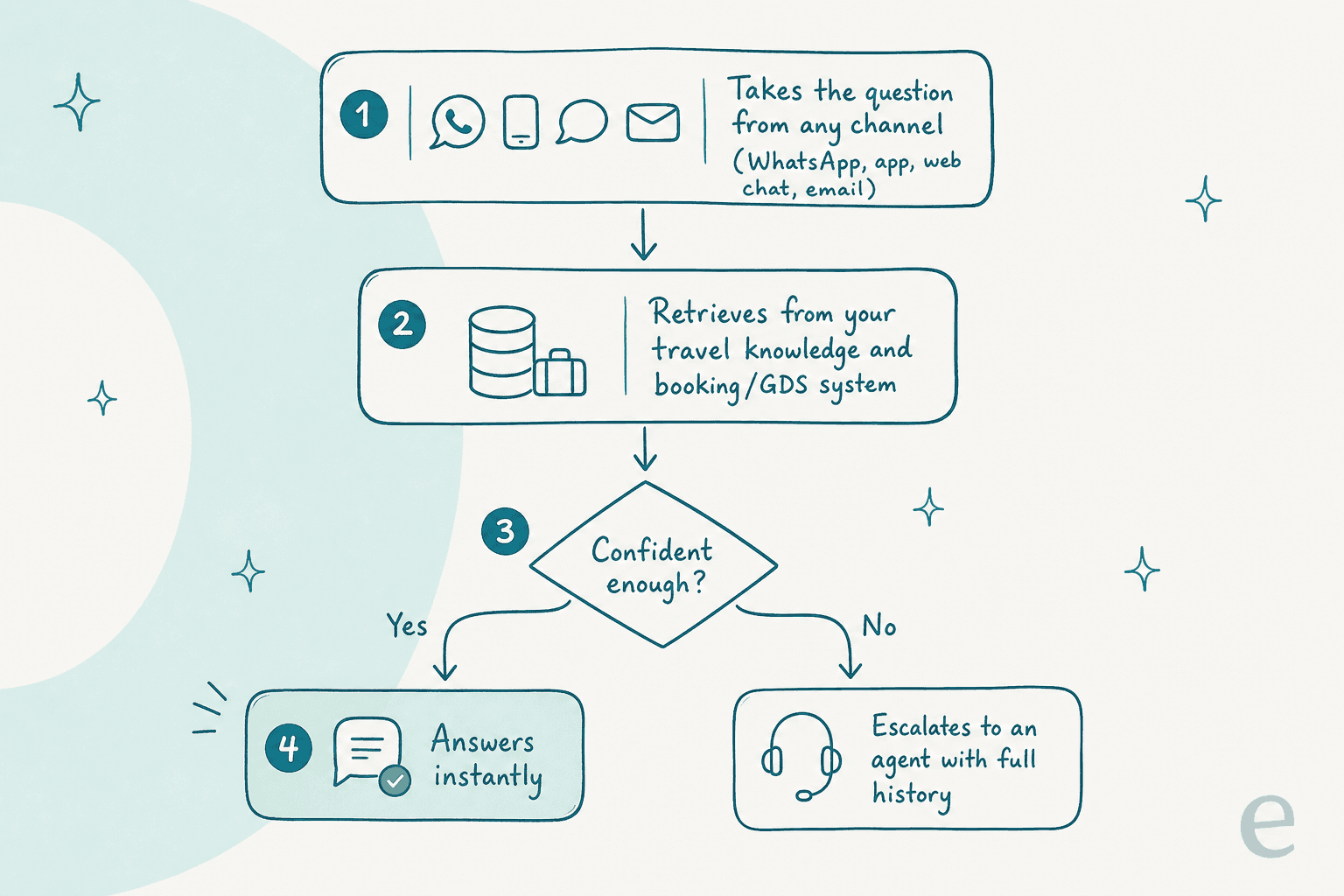
Skip the "magic AI" framing, because the mechanism is what tells you whether a tool will actually work for you. As someone who wires these integrations for a living, I'd say a solid travel chatbot does four things in sequence.
- It takes the question from wherever the traveler is, whether that's WhatsApp, SMS, web chat, the app, or email. Travelers mid-trip won't switch channels to reach you.
- It retrieves the answer from your own sources: your editable travel knowledge (fare rules, baggage, policies) and, crucially, your booking engine, GDS, or PNR data for live itineraries and availability. This retrieval step, done with RAG, is what keeps it accurate. Alaska's assistant is grounded on the airline's own APIs, which is what keeps its answers real rather than invented.
- It checks whether it's confident. A good agent knows when it doesn't know, which is the difference between answering correctly and guessing.
- It answers or escalates. Confident answers go out instantly. Everything else routes to a human, or drops a draft as a copilot suggestion, ideally with the full conversation attached so a stressed traveler doesn't have to repeat the whole saga. Cebu Pacific's agent hands off into Salesforce for exactly this.
That fourth step is where cheap tools cut corners, and it's the single thing I'd stress-test hardest. It's also the thing I've watched go wrong: we've run AI on live support queues for years, and a confident-sounding bot that guesses a fare rule is worse than no bot. This is exactly why one of our own customers, a DTC supplements lead handling ~7,000 tickets, put the trust bar this way:
"The AI will never be able to answer 100% of the questions, but if it tries and just answers 'sorry I don't know this,' I cannot go and check all my 7,000 tickets to see if the AI actually made a good answer, then the point is a little bit gone. I need an AI who is only handling the tickets that it's confident to handle and all the other ones, leave them alone."
a DTC supplements CX lead, eesel customer call
What travelers and operators actually say
The sentiment online isn't "AI good" or "AI bad." It's more specific and more useful than that, and travel is where people feel it hardest, because a broken bot meets you at your worst moment: stranded, at 1am, in the wrong time zone.
The single loudest complaint isn't wrong answers. It's broken escalation, an AI built as a wall that blocks travelers from a human. One operator put the airline version of this bluntly:
"The only thing that's worse then talking to a chatbot. Is talking to a human with absolutely no power to change anything. Most Airlines do this, customer support is only allowed to repeat info from the site, or ask to fill in a form. In that case just put a bot or GPT instead of humans suffering abuse from frustrated customers."

And the harder line, the one that should scare any team shipping a bot as its only support channel:
"If the only 'customer support' a company offers is to talk to a chatbot, I think of that as the exact same thing as not having customer support at all, even if the chatbot can be talked into letting me talk to a human."
That wall-versus-filter distinction is the whole game:
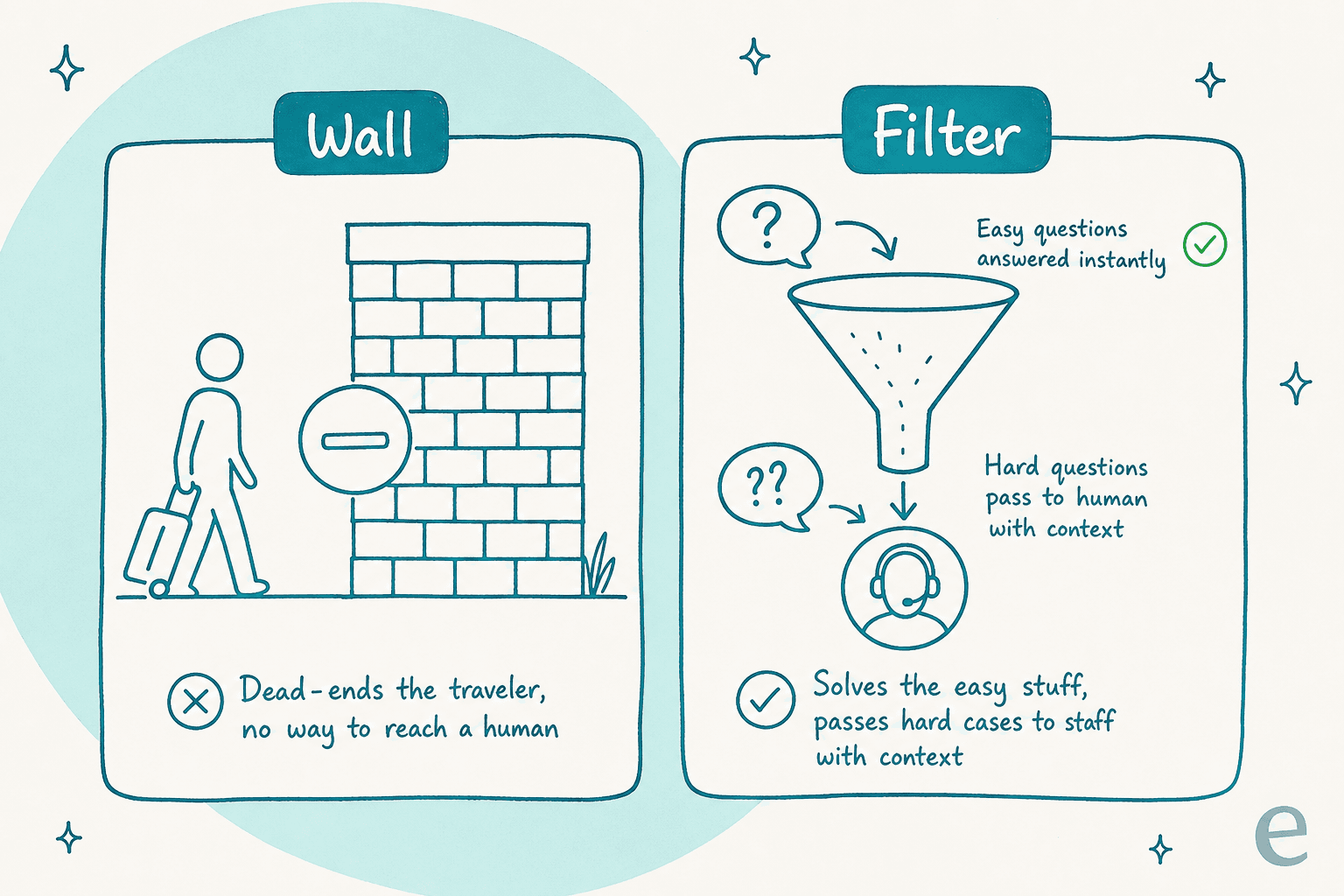
The balanced operator view lands in the same place: AI versus human support isn't the fight, AI earns its keep as a filter, not a replacement.
"…that can be useful, just to filter out the usual noise, and buy your real support staff more time to work on the cases where they're really needed…"
That's the target: let the bot clear the repetitive tier-1 volume so your humans have room for the missed-connection-at-midnight cases that actually need judgment.
The hard parts nobody puts on the sales deck
I've spent enough time putting AI on live support queues to know the demo is the easy part. Here's what actually decides whether this works in travel.
Hallucination on fare and refund policy. The highest-stakes risk is a bot inventing a refund rule, a baggage fee, or a change policy that doesn't exist. Travel has the landmark case: Air Canada's chatbot promised a bereavement-fare refund it shouldn't have, and a tribunal held the airline to it. The fix is grounding the bot in editable, company-controlled knowledge plus a hard rule to escalate instead of guess. Our own take on hallucination prevention is the same: ground it, gate it, test it.
Booking-system and GDS integration friction. This is travel's biggest practical blocker, and it's the one I see teams underestimate. "Integration" on a vendor's site rarely means your GDS, PNR format, or booking engine. A bot that can't read a real itinerary can only answer FAQs, never rebook, which is the exact moment travelers need it. The vendors that work invest here: Cebu Pacific wired its agent into Salesforce and its knowledge base. Demand the demo run on your exact system or get a written connector plan before you sign.
The disruption-day surge. A travel bot's real exam is irregular operations. eSky notes that during irregular flight operations, contact volumes can spike dramatically within minutes. A tool that looks great in a calm demo can fall over when a storm grounds a hub and thousands of travelers hit it at once, so ask how it behaves under load.
The deflection number with no denominator. Vendors love a headline automation rate. Ada's own guide is honest about the trap: containment averages ~72% but automated resolution averages ~52%, and "the bot didn't escalate" is not "the traveler got helped." Ask what counted as resolved, whether repeat messages were double-counted, and how many answers staff had to correct later. Our explainer on deflection rate walks through why first-contact resolution is the number that actually matters.
Travel-native platform or an AI layer on your helpdesk?
This is the fork most teams hit. Both are valid; the right answer depends on your stack. Walk it:
What to look for when you pick one
Boil the noise down to a short buyer's checklist:
| What to check | Why it matters | Green flag |
|---|---|---|
| Grounding | Stops invented fares and refund rules | Answers come from your editable knowledge, not the open web |
| Escalation | The #1 traveler complaint | Clean handoff to a human with full conversation history |
| Booking / GDS connection | Turns answers into rebookings | Reads your itineraries and PNRs in the demo, not a generic one |
| Disruption load | The real exam is a bad-weather day | Holds up when volume spikes within minutes |
| Channels | Travelers message mid-trip | WhatsApp, SMS, web, app, email in one place |
| Testing before launch | Catches bad answers before travelers do | Simulate on your real past messages first |
| Billing unit | Where the cost surprises hide | Clear per-resolution or per-ticket pricing, no per-seat trap |
If you're weighing the broader build, our guides on reducing ticket volume, no-code support agents, and implementing AI go a level deeper.
For the numbers, customer service KPIs and AI customer service metrics cover what to track.
On the setup side, knowledge management keeps answers grounded, and ticket triage explains the mechanics behind the deflection number. It's also worth seeing companies using AI chatbots before you commit.
Try eesel for traveler support
If you already run traveler support through a helpdesk, you probably don't need a whole new travel platform, you need an AI agent that sits on top of the stack you have. That's the gap eesel fills.

eesel plugs into email, WhatsApp, Zendesk, Freshdesk and 100+ other tools, learns from your existing help docs and past tickets, and drafts or fully handles traveler messages while escalating the truly hard ones with full context, the filter, not the wall. Because I work on the integration side, the part I'd point any travel team to first is the simulation mode: you run it on your real past traveler messages before it touches a live conversation, so you see the resolution rate and catch a bad fare answer before a traveler does. It bills per ticket, not per seat, so a holiday spike or a disruption day doesn't mean buying a rack of licenses.
The data side is SOC 2 handled. Try eesel free, or book a demo to see it on your own data.