

Wonderful AI is a genuinely impressive enterprise "AI OS": voice-first agents for banks, telcos, and insurers, sold from the top down with embedded engineering teams and a McKinsey partnership. It is also quote-only, with no free trial, and its one public price is a $2.5M/year Enterprise contract listed on AWS Marketplace. That is the right tool for a Fortune 500 CEO's transformation program, and the wrong tool for almost everyone else.
If you want the same "AI answers customer conversations" outcome without the multi-month, CEO-level sales cycle, here are the eight alternatives I'd actually shortlist:
- eesel AI - best if you want to skip the sales cycle entirely. Self-serve, from $299/month for 500 credits (1 credit per ticket or chat), live in minutes on your existing helpdesk.
- Sierra - best for consumer brands wanting an outcome-priced flagship agent, backed by Bret Taylor.
- Decagon - best if you want the pricing meter spelled out before you talk to sales.
- Parloa - best voice-first pick for contact centers replacing an IVR.
- Ada - best for very high-volume enterprises standardizing on one AI layer.
- Netomi - best for Fortune 500 CX in high-stakes, regulated verticals.
- Cresta - best for blended human-plus-AI contact centers.
- Aisera - best if you want IT, HR, and CX automation on one platform.
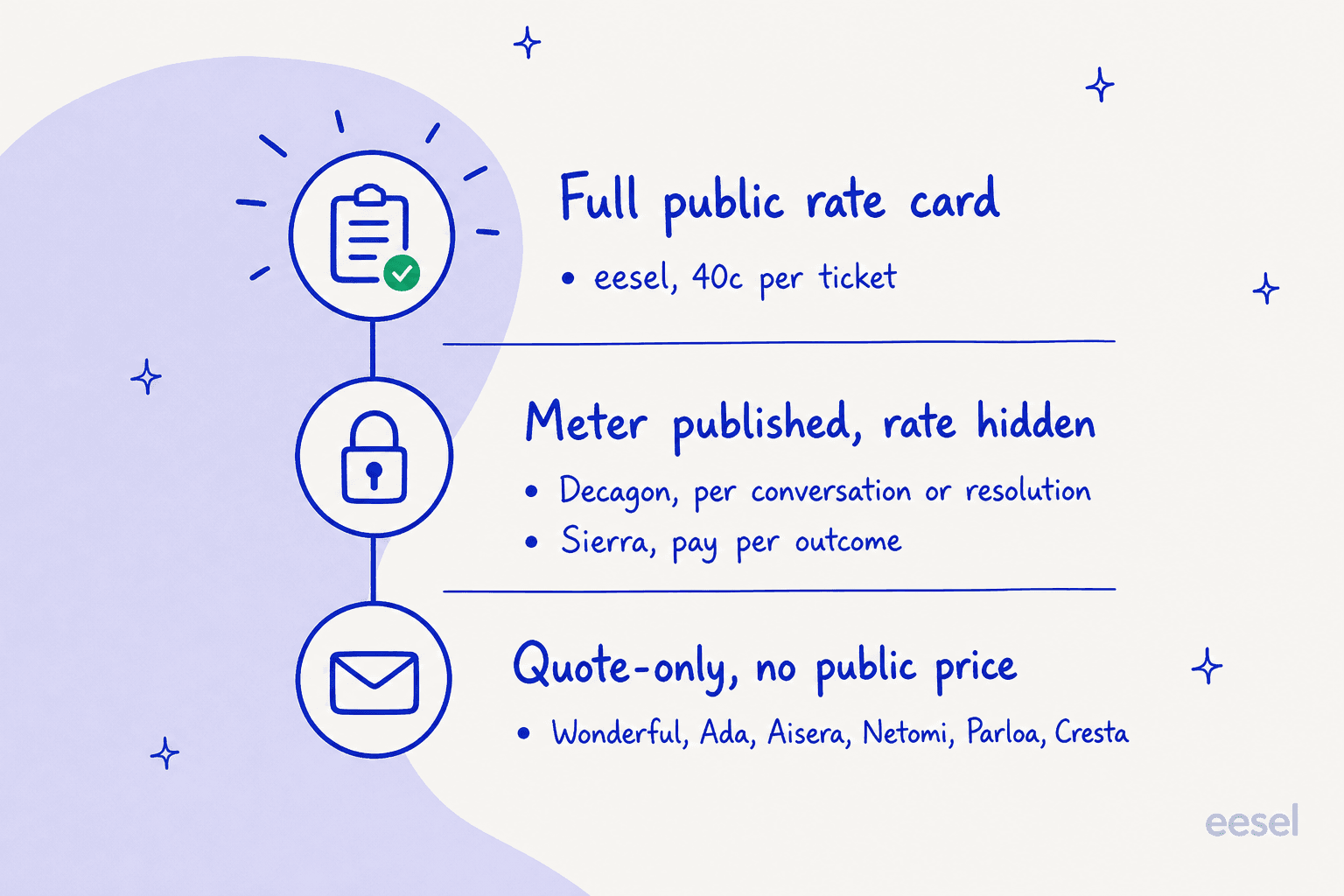
The single biggest dividing line is how you buy: a handful of these publish real pricing you can act on today, and the rest make you request a quote. That distinction alone will narrow your list fast.
Why teams start looking past Wonderful AI
I've spent the last few years watching teams try to put AI on live support queues, and the same pattern keeps repeating: someone senior gets excited by an enterprise demo, then the org discovers what "enterprise" actually means for pricing and timeline. On one sales call, a CX lead at a US healthcare platform told us he'd already kicked the tires on his helpdesk's native AI and found it "largely inadequate and overpriced", and he wanted something he could move on fast. That gap, between a slick top-down pitch and a team that just needs to resolve tickets next week, is exactly where the search for alternatives begins.
First, the fair part. Wonderful is a serious company. It came out of stealth in 2025, raised a $100M Series A at a $700M valuation led by Index Ventures, then announced a $150M Series B at a $2B valuation barely a year in. Its agents run on Google Cloud with Gemini and Vertex AI, it claims 80%+ resolution rates, and its flagship Telefónica deployment is cited at a 91.5% containment rate. It even pairs the software with on-the-ground local teams and a partnership with McKinsey's QuantumBlack. If you are a regulated giant that needs air-gapped, locally-tuned voice agents in twelve dialects, this is a real answer.
Here is why people still look elsewhere:
- No public pricing. Wonderful's pricing page 404s, and the only dollar figure anywhere is the AWS Marketplace listing: a $2,500,000 Enterprise contract for 12 months, arranged by private offer. The billable "unit" is not defined publicly.
- No way to try it. There is no free tier, no trial, no self-serve signup. Every path is "Get in touch."
- It is a top-down buy. The model is embedded engineering teams and a long deployment, not a tool your support manager configures on a Tuesday.
- It is voice-and-enterprise-first. If your primary channel is a text helpdesk (tickets, email, chat), a lot of Wonderful's value is aimed somewhere else.
None of that makes Wonderful bad. It makes it a specific shape of product for a specific buyer. The eight alternatives below cover the rest of the market, from "I want to try it this afternoon" to "I'm consolidating IT, HR, and CX for a 20,000-person company."
How I picked these alternatives
I stuck to tools that actually compete for the same job Wonderful does: autonomous AI agents resolving customer conversations across chat, email, and (for most) voice. For each one I read the vendor's own docs and pricing, checked what real users say where a public footprint exists, and paid attention to the two dimensions that decide most shortlists:
- How you buy. Can you see a price and start, or do you have to book a demo and wait for a quote?
- Who the buyer is. A support manager configuring a tool, versus a CIO signing a transformation contract.
Here is the whole field at a glance.
| Tool | Best for | Pricing model | Voice channel | Deployment | Free trial |
|---|---|---|---|---|---|
| eesel AI | Skipping the sales cycle | Public: from $299/mo (500 credits) | Text helpdesk focus | Self-serve, minutes | Yes (100 free credits) |
| Sierra | Outcome-priced flagship agent | Quote-only, per outcome | Yes | Vendor-led, weeks | No |
| Decagon | Knowing the meter up front | Quote-only, per conversation or resolution | Yes | Vendor-led | No |
| Parloa | Voice-first contact centers | Quote-only | Yes (voice-first) | Vendor-led, ~4 weeks | No |
| Ada | Very high-volume enterprise | Quote-only, 300k+ conversations | Yes | Vendor-led | No |
| Netomi | Regulated Fortune 500 CX | Quote-only | Yes | Vendor-led | No |
| Cresta | Blended human + AI centers | Quote-only (~$150k/yr on AWS) | Yes | Vendor-led | No |
| Aisera | IT + HR + CX on one platform | Quote-only | Yes | Vendor-led | No |
Notice the pricing column. It is the fastest way to sort this list, so it is worth encoding on its own.
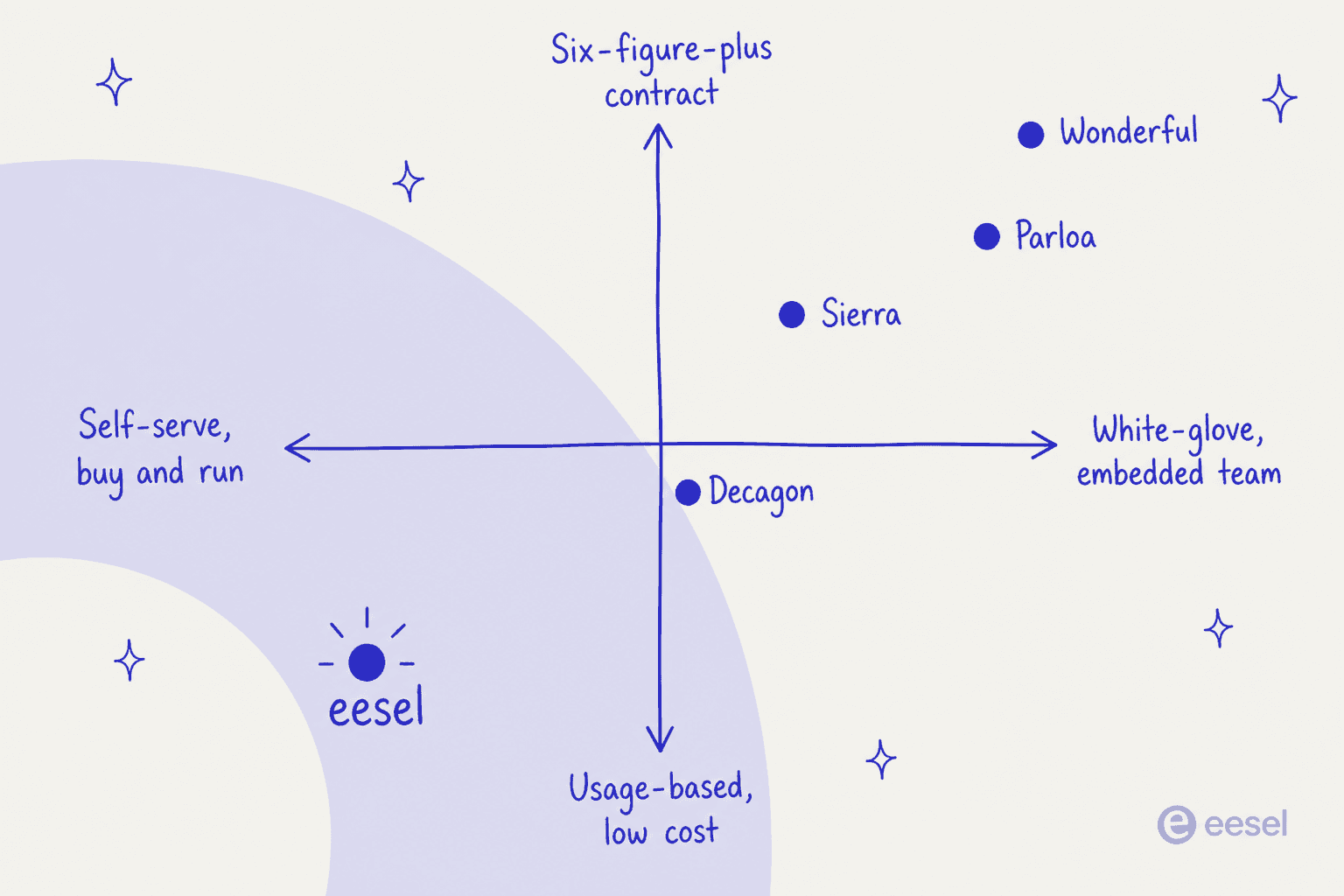
And here is roughly where each one sits on the two axes that matter, from self-serve-and-cheap to embedded-team-and-expensive.
1. eesel AI
Best for: teams that want to buy and run an AI support agent without an enterprise sales cycle.
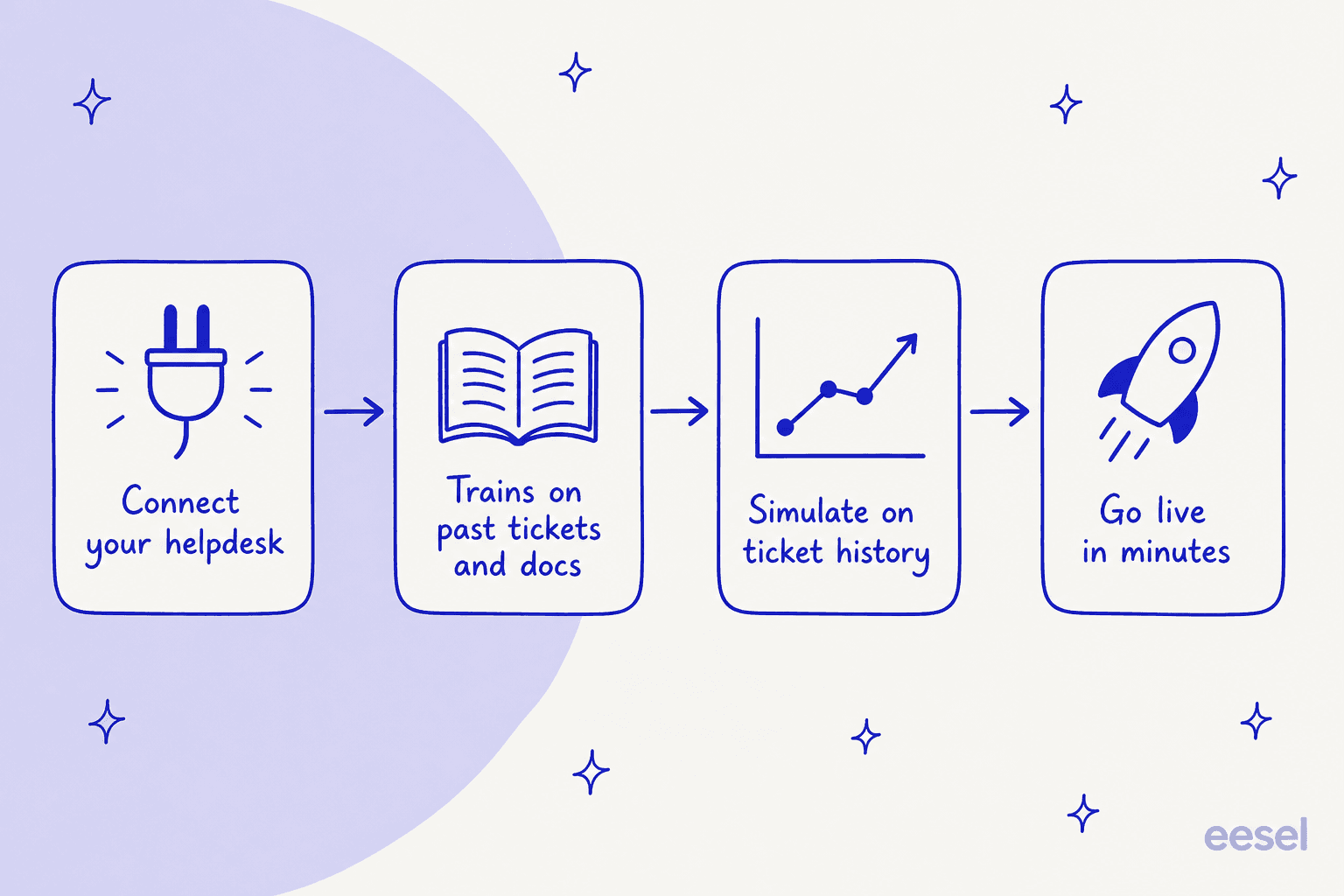
I work on eesel AI, so treat this as the insider view, not a neutral one, and hold me to the specifics. eesel is the deliberate opposite of the Wonderful model. Instead of an "AI OS" you install with an embedded team, it is an AI helpdesk teammate you hire in minutes. It joins the queue you already run in Zendesk, Freshdesk, Gorgias, or Help Scout, learns from your past tickets and help center, and starts drafting or auto-sending replies.
The thing Wonderful buyers usually can't get, that eesel leans on hardest, is a real dry run. You can simulate the agent on your own ticket history before it answers a single live customer, so you see the actual resolution rate and cost on your own data first. That habit exists because we've watched confident-sounding bots quietly give wrong answers, and simulating against real past tickets is the only way to catch it before your customers do.
Pros:
- Genuinely self-serve. Start free with 100 credits and no credit card, no sales call required.
- Fully public pricing: one fixed monthly price from $299 for 500 credits (1 credit per ticket or chat), with no platform fee and no per-seat fees.
- Simulation on historical tickets before go-live, so the risk is measured, not hoped for.
- Works with 1,000+ integrations and sits on top of your existing helpdesk instead of replacing it.
Cons:
- Not a voice-first phone-IVR platform. eesel focuses on the text helpdesk (tickets, email, chat), so if voice is your primary channel, a voice-native tool below fits better.
- Not built for the air-gapped, on-prem, locally-embedded-team scenario Wonderful specializes in.
- The self-serve model means you own the configuration, which some very large teams would rather hand to a services organization.
Verdict: if you're a support team that can't stomach a quote-only, six-figure commitment just to find out whether AI works on your queue, this is the pick. It's the one tool here you can see the price of and start today. It stops being the answer at the exact point Wonderful starts being one: multilingual voice at national scale with an on-site delivery team.
2. Sierra
Best for: consumer brands that want a premium, outcome-priced flagship agent and can run a vendor-led build.
Sierra is the closest peer to Wonderful in ambition and pedigree. Founded by Bret Taylor and Clay Bavor, it sells an enterprise conversational-AI platform across voice, chat, email, and WhatsApp, and says 40% of the Fortune 50 partner with it. Taylor has said the company raised $950 million at a valuation over $15 billion, which tells you the tier it plays in.
Its defining commercial idea is outcome-based pricing: you "pay only when the software achieves specific, valuable outcomes," most often a resolved conversation. It's an attractive story, though Sierra is candid that what counts as an outcome is negotiated per contract, and that the real bill blends in consumption-style work where outcomes don't map cleanly. Not everyone loves the model. As one commenter put it on the Hacker News thread about the raise:
"So we're supposed to believe that removing humans from customer support will lead to better outcomes? ... Yeah... that won't last."

Pros:
- Serious platform with strong authoring tools (Agent Studio, an Agent SDK, and scenario simulations) and a deep compliance list.
- Outcome pricing aligns cost with results, at least in theory.
- First-class voice with dedicated PCI-certified infrastructure.
Cons:
- No public pricing at all;
/pricingis a hard 404, and the docs are behind an evaluation login. - No self-serve or free trial; the only path is a "Learn more" form, and expect a Sierra team on the build.
- Simulation is scenario-based, not a replay of your own historical tickets, so pre-launch confidence rests on scenarios you write.
Verdict: if you're a large consumer brand and the outcome-pricing pitch resonates, Sierra belongs on your shortlist right next to Wonderful. If you're a mid-market team, the Hacker News read that it's a "for pricing, let's go play C-level golf" kind of company is not far off.
3. Decagon
Best for: teams that want the pricing meter spelled out before they ever get on a call.
Decagon is one of the strongest AI-native CX platforms out there, unifying chat, voice, and email around natural-language Agent Operating Procedures rather than a decision-tree builder. Its customer numbers are loud: 80% deflection at Duolingo, plus named results from Oura, Rippling, and ClassPass. And its testing story is genuinely good, with an integrated simulation suite that auto-generates test cases before you deploy.
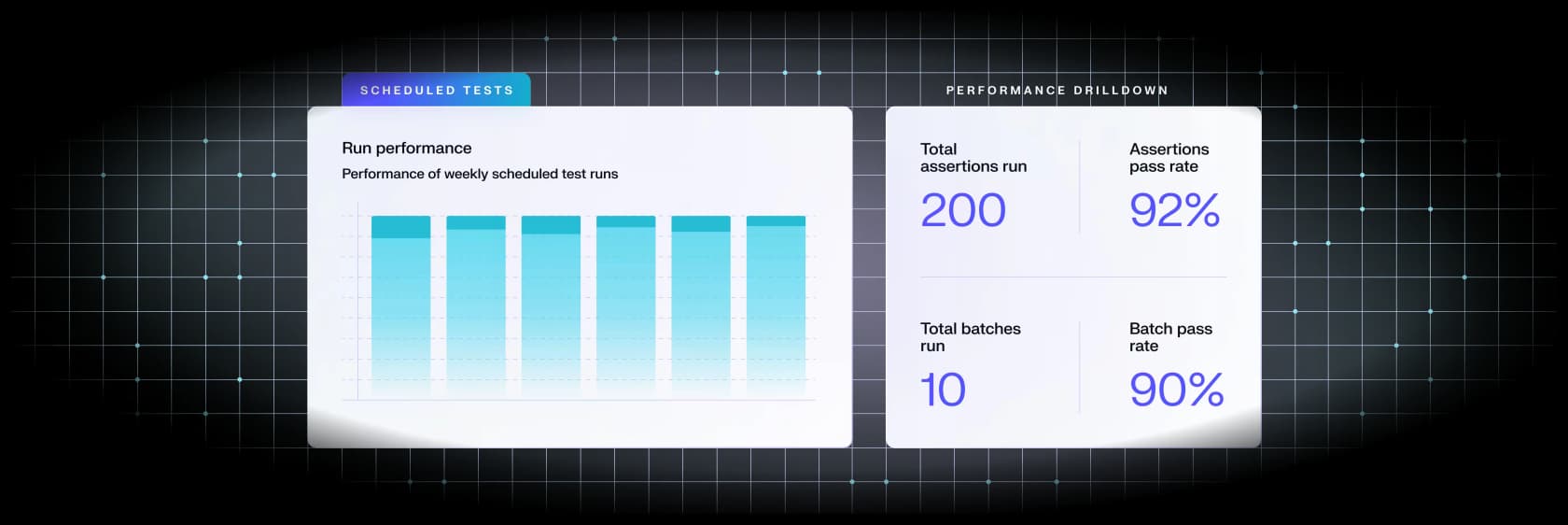
What I like most about Decagon, and what earns it this slot, is that it's unusually honest about pricing. It's still quote-only, but it publishes the two meters it bills on, per conversation or per resolution, and even argues against the outcome meter in its own words: "You never want to be in a situation where you're arguing over what a 'resolution' is." That candor is rare and worth rewarding.
Pros:
- Publishes its billing model (per conversation or per resolution), even if not the rate.
- Excellent pre-launch testing and QA, plus always-on monitoring via Watchtower.
- Names real helpdesk integrations (Zendesk, Salesforce, Kustomer) and supports MCP.
Cons:
- No published rate, no pricing page, and docs sit behind a sign-in wall.
- No self-serve or free trial; every CTA is "Get a demo."
- Engineering stays in the loop for guardrails and integrations by design, so it's not a CX-team-only motion.
Verdict: if you're comparing enterprise AI agents and want the least opaque of the quote-only bunch, Decagon is my pick. Its 4.7/5 across 25 G2 reviews is small-N but positive. If you want the meter and the rate in public, though, you're back to eesel. For a deeper look, I've written a full Decagon alternatives roundup.
4. Parloa
Best for: voice-first contact centers replacing an IVR at national scale.
If Wonderful's voice-first, regulated-industry angle is what you actually need, Parloa is the most direct alternative on this list. The German-founded, now New-York-based company sells an AI Agent Management Platform built around a lifecycle (design, test, scale, monitor) for voice agents, and it's grown fast: a $350M Series D at a $3B valuation in January 2026, and $50M in ARR on 150% net revenue retention. Its agents speak 130+ languages across 70+ countries, with customers like Allianz, Booking.com, and IKEA.
The proof points are concrete: BER Airport's "Berry" agent hit a 65% cost reduction with zero wait times, and Württembergische Versicherung went live in four weeks. Parloa is explicit that it's for high-volume regional operations, not "point bots."
Pros:
- Voice-first and genuinely enterprise-grade, with a strong lifecycle-governance story for regulated industries.
- Real, sourced customer outcomes and a fast-growing reference list.
- Deployments as quick as four weeks are documented, which is fast for this tier.
Cons:
- Quote-only;
/pricing404s and there's no self-serve entry. - Near-zero independent review footprint, since it's enterprise-sold.
- Overkill if your primary channel is a text helpdesk rather than the phone.
Verdict: for a contact-center leader ripping out an IVR, Parloa is arguably a better-fit alternative to Wonderful than most of this list, because it's aimed at the same voice-heavy, regulated buyer. For a support team living in tickets and chat, it's more platform than you need.
5. Ada
Best for: very high-volume enterprises standardizing customer service on a single AI layer.
Ada is a Toronto-based, enterprise-tier AI customer service platform that brands its category as Agentic Customer Experience. It sits on top of your helpdesk as a standalone AI layer, powered by a multi-LLM Reasoning Engine, and it's one of the better-funded independents at roughly $190M raised, last valued at $1.2B. Customers skew large-consumer: Monday.com, IPSY, Cebu Pacific, Grab.
The honest catch is the entry bar. Ada's own pricing page states it flat out: "We are a great fit for companies with at least 300,000 annual customer service conversations." That's a deliberate enterprise gate, and it tells you exactly who Ada is and isn't for.
Pros:
- Mature, standalone AI platform with strong multilingual and omnichannel coverage, including a growing voice product.
- Leads on AI-specific compliance (AIUC-1) and zero data retention with LLM providers.
- Playbooks for multi-step SOPs and a Coaching loop that applies reviewer notes automatically.
Cons:
- Enterprise-only by stated qualification: a 300k annual conversation floor, no public pricing, no free trial.
- It's the AI layer only, so you still need a helpdesk underneath it.
- No self-serve signup, so time-to-value depends on a sales-led onboarding.
Verdict: if you're a large consumer platform with serious volume, Ada is a credible Wonderful alternative that leaves ticketing to your existing stack. If you're under that 300k floor, it simply won't quote you, which makes the decision easy. I've compared it in more depth in my Ada alternatives and Ada review pieces.
6. Netomi
Best for: regulated Fortune 500 CX in high-stakes verticals like airlines and finance.
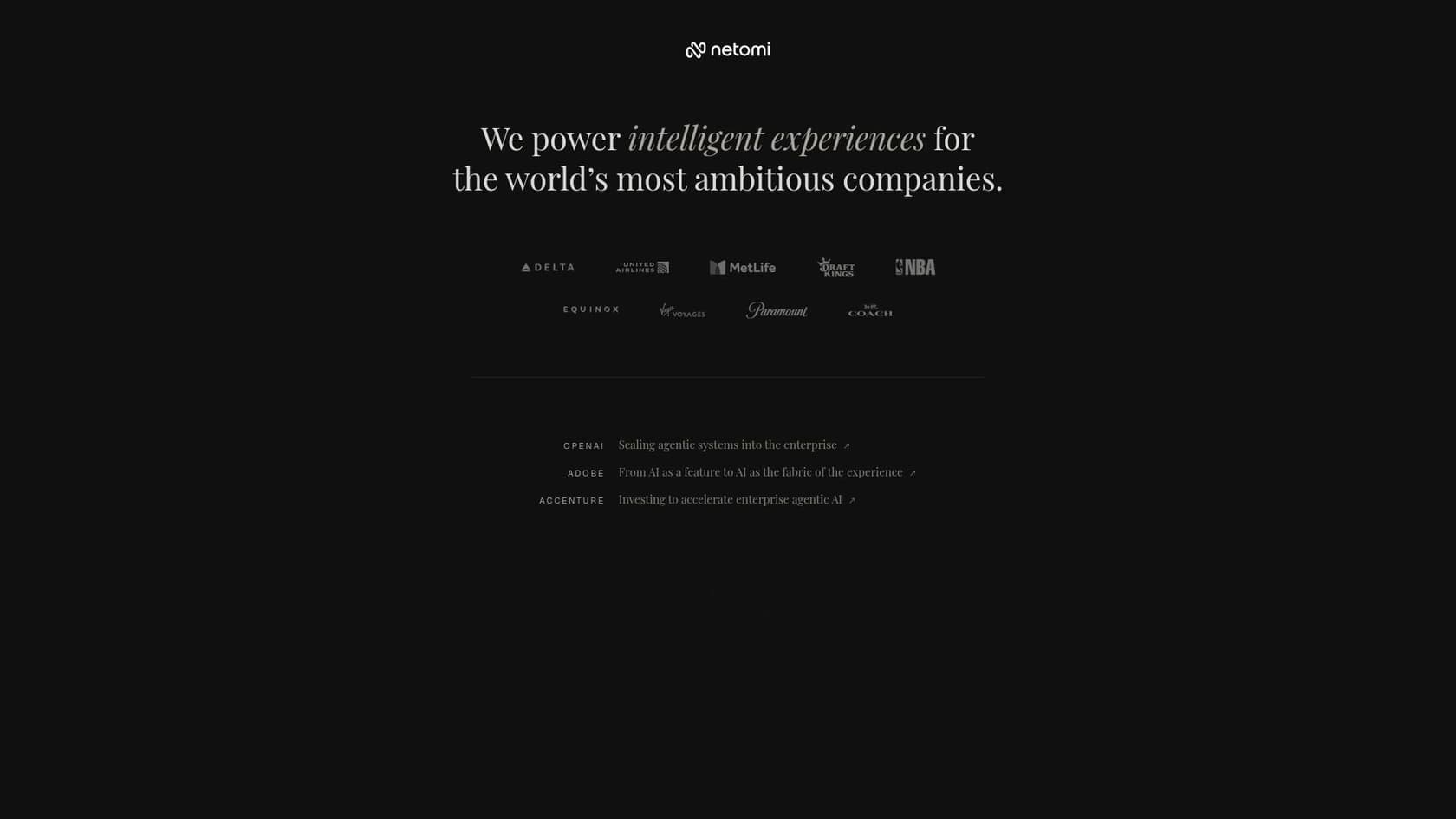
Netomi pitches itself as "the only agentic AI platform built for what comes after the pilot," and its logo wall backs the enterprise claim: Delta, United, MetLife, ESPN+, and the NBA, among others. It raised $110M with Accenture and Adobe as strategic backers, runs omnichannel (voice, chat, email, SMS, social), and carries a deep compliance stack (SOC 2 Type II, ISO 27001, HIPAA, GDPR, PCI DSS).
It also scores well where users do review it, at 4.8/5 across 16 G2 reviews, with the standout praise going to its hands-on customer-success team. That same dependence is the recurring criticism, too: reviewers flag that quality swings with which CSM you get, and that reporting and analytics are the weak spot.
Pros:
- Production-grade autonomous agents with strong governance guardrails that run before every action.
- Real Fortune 500 references in exactly the regulated verticals Wonderful targets.
- Both an Autopilot autonomous mode and a human-in-the-loop Co-Pilot.
Cons:
- Quote-only and enterprise-only; both
/pricingand/plans404, and there's no trial. - Reporting and analytics are the most common complaint across reviews.
- Experience leans heavily on the assigned CSM, so it varies with your account team.
Verdict: Netomi is a legitimate head-to-head alternative to Wonderful for a regulated enterprise that wants a managed, autonomous CX agent and values a strong services relationship. Just go in knowing the analytics gap and the CSM dependency. My Netomi alternatives post digs into the trade-offs.
7. Cresta
Best for: blended contact centers that want AI agents and live human coaching on one platform.
Cresta is a contact-center AI platform that spans both AI-led and human-led conversations: virtual AI Agents, real-time Agent Assist for human reps, and Conversation Intelligence for analytics and coaching. It was co-founded at Stanford by Sebastian Thrun, has raised $273M+, and was named a Leader in the Forrester Wave for Conversation Intelligence. Customers include United Airlines, Marriott, and CVS.
Cresta is the one vendor here with a public dollar figure beyond a marketplace anchor: its AWS Marketplace listing shows a $150,000/year contract for up to 125,000 chat sessions or 100,000 voice calls, with overages at $1.20 per extra chat and $1.50 per extra call. That won't be everyone's final number, but it's more than most of this list will show you.
Pros:
- Covers automation and human agent-assist together, which suits centers that aren't going fully autonomous overnight.
- Real-time coaching that reviewers say lifts mid-tier reps without waiting for post-call QA.
- A rare public price point via AWS Marketplace to anchor your budget.
Cons:
- Still quote-gated on the main site, with a heavy configuration effort ("almost an AI linguist," per one reviewer).
- Some users say the knowledge-assist model can misread caller intent and transcription is inconsistent.
- Firmly a large-contact-center product, not a self-serve helpdesk tool.
Verdict: if your reality is a big voice-and-chat center with a lot of human agents you still want to keep and coach, Cresta is a smarter buy than a pure-automation platform. If you're trying to deflect tickets in a text helpdesk, it's aimed elsewhere. See my Cresta review and Cresta pricing breakdowns for detail.
8. Aisera
Best for: enterprises consolidating IT, HR, and customer service automation onto one platform.
Aisera is the outlier that broadens the frame. Where Wonderful and most of this list are customer-facing, Aisera is a cross-functional AI agent platform that spans IT, HR, finance, and customer service from day one, orchestrating "Domain Agents" under a Universal Agent. It's heavily funded (roughly $171M raised, last valued at $1.6B) with Fortune 500 references like Adobe, Cisco, and Nokia, and in November 2025 it was acquired by Automation Anywhere.
The published outcomes lean internal-service: LifeScan auto-resolves 65% of support requests for $2.2M in savings, and NJ Transit reports a 60% agent productivity lift. That breadth is the whole point, and also the caveat, since a customer-service-only team rarely needs the HR and IT layers.
Pros:
- One platform for IT, HR, and CX, with an open-standards orchestration layer (A2A, MCP) and a BYO-LLM gateway.
- Deep enterprise compliance and analyst recognition in ITSM and conversational AI.
- Strong fit if you're a big org trying to avoid buying three separate AI tools.
Cons:
- Quote-only; both
/pricingand/demo404, with no trial or per-seat rate. - For a CX-only buyer of 50 to 500 seats, it's usually too heavy a purchase.
- Post-acquisition, its go-to-market is increasingly bundled into Automation Anywhere's platform, so the buying motion is shifting.
Verdict: if your problem is "we need AI across the whole company, not just support," Aisera is a stronger frame than Wonderful. If your problem is strictly customer service, it's more platform than the job needs. I've dug into the numbers in my Aisera pricing and Aisera reviews posts.
So which Wonderful AI alternative should you pick?
Strip away the funding headlines and it comes down to two honest questions.
If you're a regulated enterprise that genuinely needs voice at national scale, with an embedded-team deployment and a budget to match, you're choosing between Wonderful, Parloa, Netomi, and Sierra. That's a real, serious project, and any of them can do it.
If you're everyone else, which is most teams, the enterprise framing is a trap. You don't need an "AI OS" and a McKinsey engagement to deflect refund and order-status tickets. You need an AI agent you can try on your own data, price honestly, and get live this week. On that job, the quote-only vendors are working against you, and the tool you can actually start with wins.
Try eesel AI
If Wonderful's pitch sounded right but the price and timeline didn't, eesel AI is the version you can act on today. It's an AI support teammate that plugs into the helpdesk you already run, trains on your past tickets and help center, and lets you simulate on real ticket history before it ever answers a customer, so you see the resolution rate and the cost up front instead of after a six-figure commitment.
And the price is just there: from $299/month for 500 credits (1 credit per ticket or chat), no platform fee, no per-seat fees, with 100 free credits to start and no credit card required. You can be running a real, measured pilot before most of the vendors on this list would return your demo request. Try eesel free, or book a demo if you'd rather see it on your own tickets first.