
The short answer on TheLoops pricing
I spend a lot of my week mapping what buyers actually type into search, and "theloops pricing" is a query with a frustrating answer: TheLoops publishes no pricing at all.
I checked the obvious places. The theloops.io/pricing URL resolves, but it serves the generic marketing homepage, no plans, no prices, no billing unit. The /plans page is effectively empty. Web searches for a per-agent cost surface nothing from the vendor, and every third-party aggregator (Vendr, G2, and the rest) says the same thing: custom quotes only.
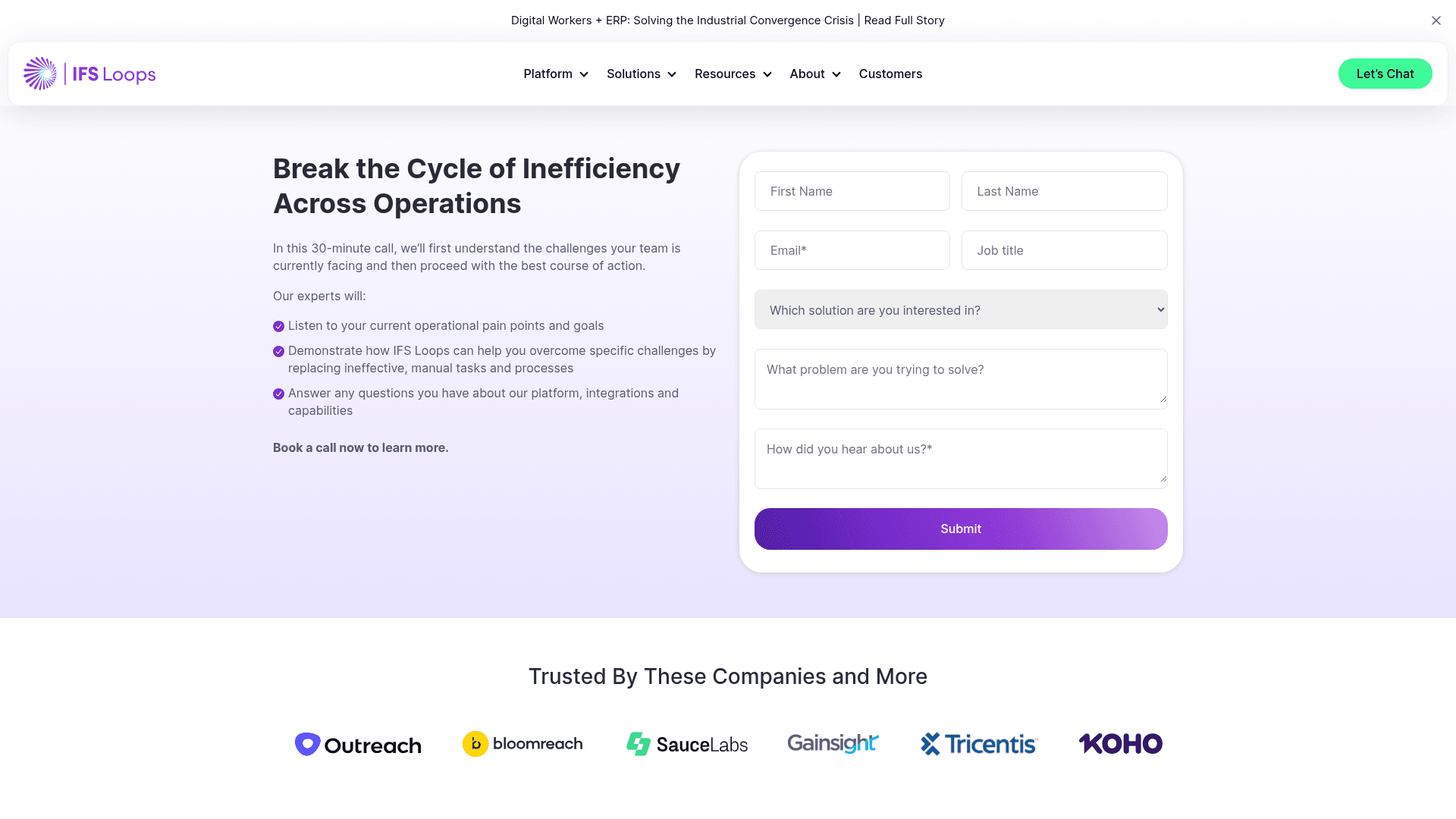
That screenshot is the whole story. Every CTA on the site, "Get a Demo," "Request a Demo," "Let's Chat," lands you on this demo form, a 30-minute call where "our experts will listen to your current operational pain points." There is no plan selector and no signup. If you came looking for a number, the site's answer is a calendar invite.
What TheLoops pricing actually looks like
Here is everything TheLoops publicly commits to, which is to say, not much.
| What you'd want to know | What TheLoops publishes |
|---|---|
| Public plans / tiers | None |
| Billing unit (per agent / resolution / seat) | Not disclosed |
| Starting price | Not published |
| Free trial | None (demo request only) |
| Free tier | None |
| Contract term | Annual enterprise deal (implied) |
This is not unusual for a true enterprise platform, and I want to be fair about that. TheLoops is an AI support-operations layer that sits on top of your whole stack, not a $20-a-seat app you swipe a card for. Products in that category almost always negotiate per deal.
But for anyone trying to build a business case, quote-only pricing is real friction. You cannot model cost without booking a call, and you cannot line TheLoops up cleanly against a tool that just tells you the number. That matters more now that so many AI customer service tools do publish rates.
Why there's no public number (the IFS shift)
The single most important fact for anyone pricing TheLoops in 2026: it is no longer an independent startup.
TheLoops was founded around 2020 by Somya Kapoor (ex-SAP, ex-ServiceNow) and CTO Ravi Bulusu, and raised an $8.75M seed led by Dell Technologies Capital in 2021. Then, in June 2025, IFS acquired the company and folded it into an "Industrial AI workforce" strategy. The product now shows up as IFS Loops across the site, and its G2 profile was renamed to match.
Practically, that pushes pricing in one direction: further into enterprise sales. IFS Loops now markets three angles, AI for CX, Industrial Agentic AI, and an embeddable OEM engine, aimed at SaaS, manufacturing, telecom, energy, and aerospace. Support is now one vertical inside a much bigger enterprise play, and that usually means longer rollouts and a roadmap steered by more than support. A vendor selling into that motion has little reason to post a price list, because the deal is scoped case by case anyway.
What actually moves a TheLoops quote
Since there is no list price, the useful question is: what will the number depend on? Based on how TheLoops is built and how enterprise support platforms price, four things do most of the work.
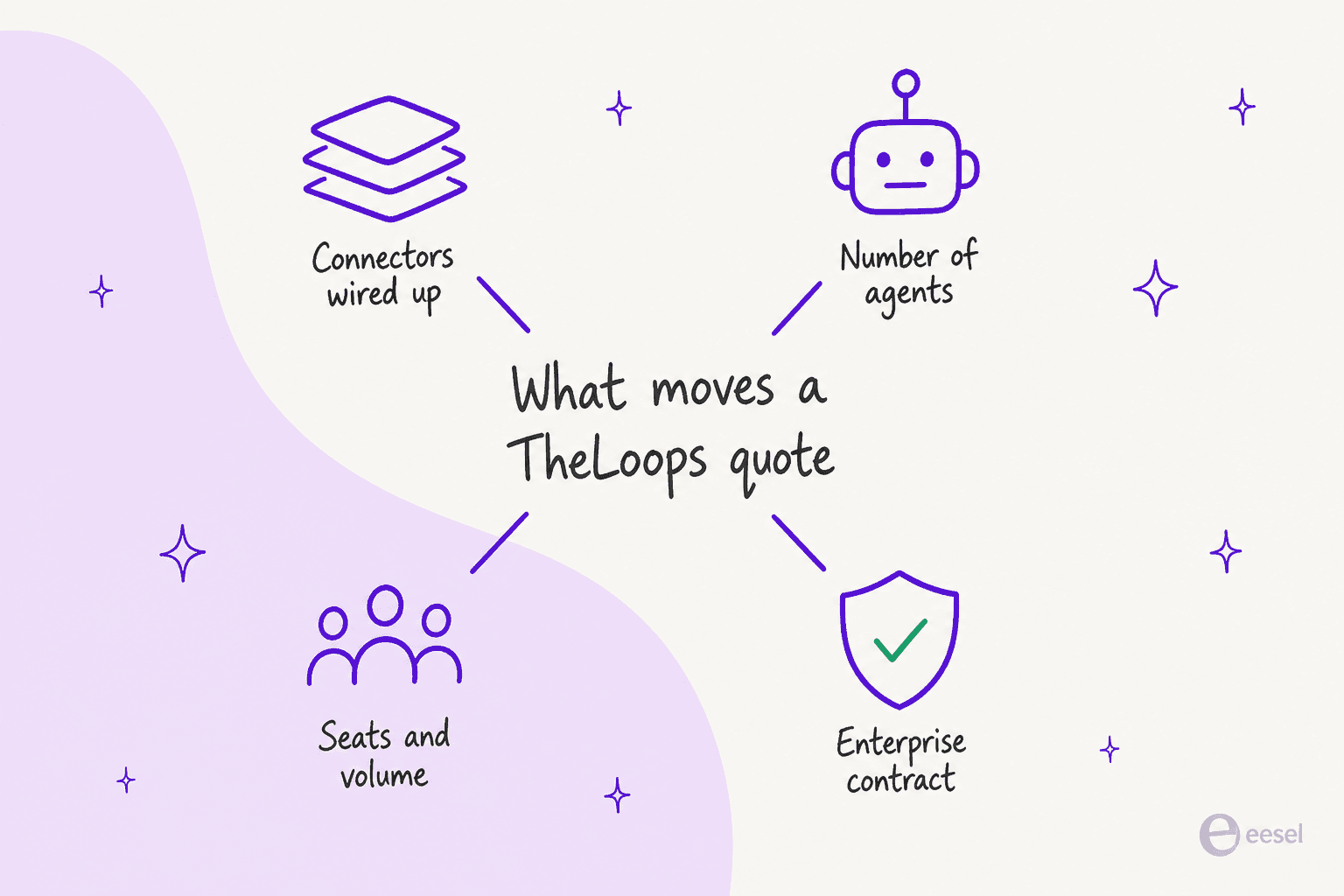
- Connectors wired up. TheLoops lists roughly 60 no-code connectors and its whole value is pulling signal from many systems at once. The more of your stack you wire in (Zendesk, Salesforce, Jira, Snowflake, and so on), the bigger the deployment and, usually, the quote.
- Number of agents. TheLoops markets a catalog it calls 100+ AI agents, or "Digital Workers," spanning Case Resolution, Auto QA, Coaching, Predictive Escalation, and more. How many you actually deploy shapes scope.
- Seats and volume. Enterprise support deals almost always factor in team size and ticket volume, even when the headline unit is a platform fee.
- Enterprise contract and security. TheLoops holds SOC 2 Type 2, GDPR, and HIPAA compliance. Data residency, security review, and contract length all feed into an enterprise number.
None of these have public dollar figures attached, but knowing the levers lets you sanity-check whatever the sales team quotes, and it tells you where a "40% discount" like the one Vendr describes might actually come from.
The one external data point
To be precise about what is actually known: the only third-party pricing signal comes from Vendr, a marketplace that tracks real SaaS deals.
Vendr lists TheLoops as a custom-quote vendor and notes one anonymized buyer (a 201 to 1,000 employee company) who negotiated about a 40% discount on a single-year contract by signing near TheLoops' end of quarter and leaning on a proof-of-concept. That is directional at best. It gives no list price and no billing unit, and it is a negotiation story rather than a published rate. I would treat it as a hint that there is room to negotiate, nothing more.
Should TheLoops' pricing model work for you?
Quote-only pricing is not automatically bad, it just fits some buyers and frustrates others. Here is a quick way to tell which one you are before you spend a week in a sales cycle.
TheLoops pricing vs a self-serve alternative
I have spent years putting AI on live support queues, and the split I keep seeing is not "expensive vs cheap," it is "you can see the number vs you cannot." That difference decides how fast a team can even start.
eesel sits on the transparent side. It is an AI helpdesk teammate you hire like a new support hire: it plugs into Zendesk, Freshdesk, Salesforce, and more in minutes, learns from your past tickets and help center on day one, and drafts or auto-answers with a clean handoff when it is unsure.
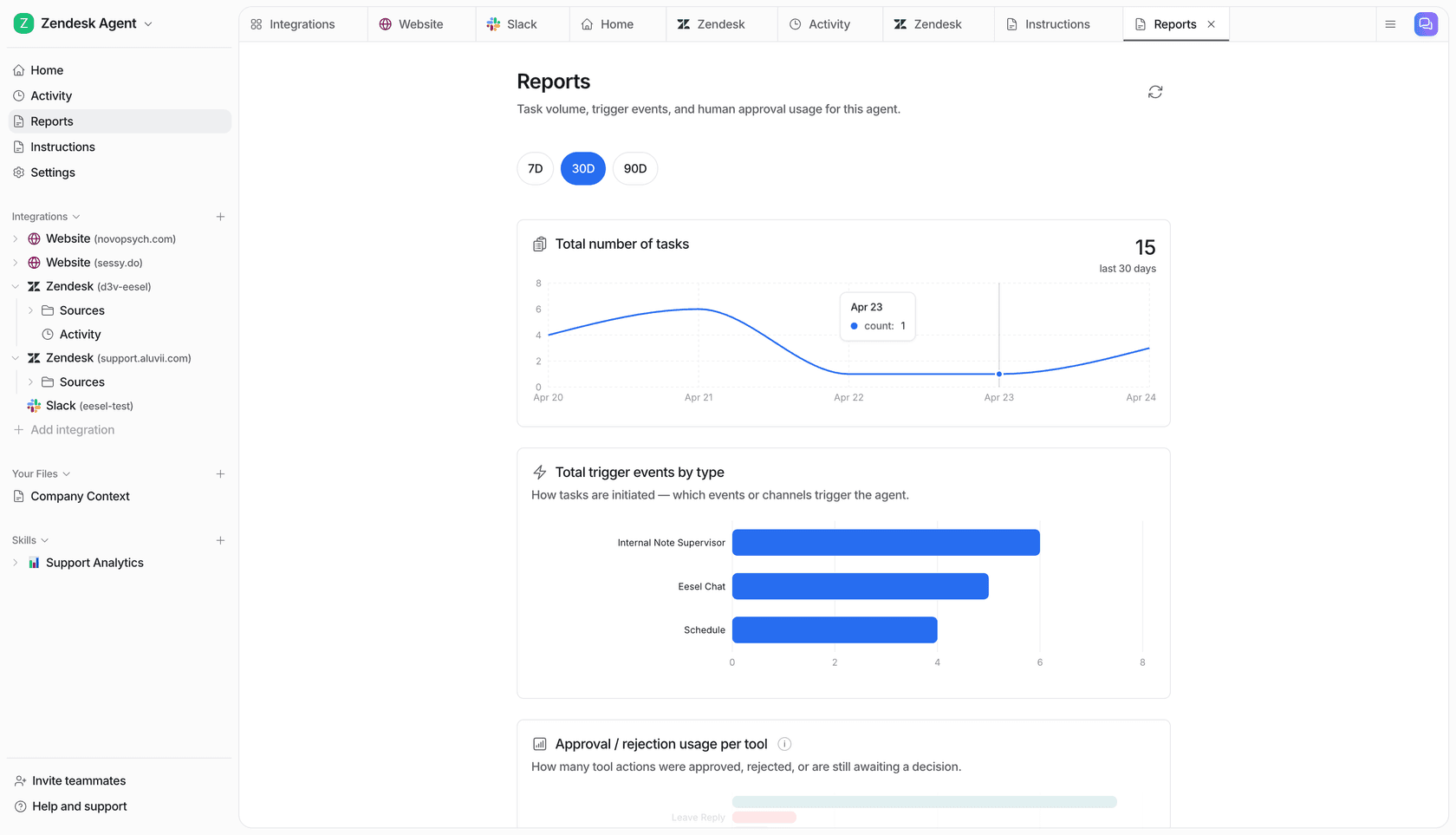
The two differences that matter for a pricing comparison:
- The price is public. eesel publishes its pricing openly, starting free with 100 credits and moving to fixed monthly credit plans where a ticket or chat is one credit. No demo required to see the number.
- You can test before you pay. The part I care about most, having watched confident bots quietly give wrong answers, is that eesel simulates every rollout against your own historical tickets first, so you see accuracy before a single customer does. That is the build-versus-buy risk taken off the table.
To be clear, these are different jobs. TheLoops is a deep analytics and QA layer for large, multi-system operations. eesel is an AI agent that resolves tickets. If your goal is the second one, you should not have to sit through a sales call to learn the price.
Who TheLoops pricing makes sense for
After all that, my read is straightforward.
Quote-only pricing is worth the friction if you are a large enterprise with a complex, multi-system support operation and a team to run it. If your data is spread across a helpdesk, a CRM, a product analytics tool, and a warehouse, and you want QA at 100% coverage plus predictive analytics on top, few tools go as deep, and you are buying that depth through procurement anyway.
It is a weaker fit if you are a small or mid-size team that needs public pricing to build a case, if you want to switch something on and see value this week, or if what you actually want is an AI agent that resolves tickets rather than a scoring and prediction layer. Those buyers will spend more time in TheLoops' sales cycle than the tool is worth to them, and they have transparent options like ServiceNow alternatives and modern AI helpdesk tools to compare against.
Try eesel
If you read this whole post because you wanted a number and not a calendar invite, that gap is exactly what eesel closes for the AI support job.
eesel is an AI helpdesk teammate that plugs into Zendesk, Freshdesk, Salesforce, and more in minutes, learns from your past tickets on day one, and simulates on your history so you see accuracy before customers do. Pricing is public and starts free, no demo required to see the cost. If your goal is resolved tickets with a number you can plan around, start there.
Frequently Asked Questions
How much does TheLoops cost?
TheLoops does not publish pricing. There is no public plan list, no per-agent or per-resolution rate, and no free trial, so the only way to get a number is a sales demo. If you want transparent numbers up front, eesel's pricing is public and starts free.
Does TheLoops have a free trial or free plan?
No. TheLoops pricing offers no free trial and no free tier. Every button on the site points to a demo request, not a signup. For a tool you can switch on for free, most modern AI helpdesk tools now include a free plan or trial.
What is TheLoops' billing unit, per agent or per resolution?
It is not disclosed publicly. TheLoops pricing is negotiated per deal as an annual enterprise contract, and the vendor does not state whether it bills per seat, per resolution, or as a platform fee. Compare that with usage-based tools where a resolved ticket maps to a clear unit.
Is TheLoops the same as IFS Loops for pricing?
Yes. IFS acquired TheLoops in June 2025, and the product now trades as IFS Loops. That shift pushes pricing further toward enterprise sales motions and longer contracts, not toward a public plan page.
How can I estimate my TheLoops pricing before the demo?
Scope the four things that move an enterprise quote: how many connectors you need wired up, how many AI agents you will run, your seat count and ticket volume, and your security requirements. That gives you a range to sanity-check the number against, and it maps to the same drivers behind most AI customer service software.
What are the best TheLoops alternatives with public pricing?
For a self-serve AI agent that resolves tickets with pricing you can see, look at the best AI support agents. For QA and analytics with clearer costs, most modern support automation platforms now publish rates.
Does TheLoops pricing include Zendesk and Salesforce?
TheLoops connects to Zendesk, Salesforce, Jira, Slack, and warehouses like Snowflake, but the number of connectors you turn on is part of what shapes the quote, so more integrations usually means a higher deal.


Article by
Kurnia Kharisma Agung Samiadjie
Kurnia is a software engineer and writer at eesel AI with two years of SEO experience, writing about AI tools, helpdesk software, and customer support. He pairs a developer's understanding of how these products are built with search-driven research into what actually ranks and resonates with the people searching for them.