26 social media response examples for customer service teams

Riellvriany Indriawan

Katelin Teen
Last edited July 6, 2026

What makes a social media response actually work
I work the support queue every day, and social is its own animal. It's one of the trickier corners of AI in customer service precisely because it's public. An email sits in a private inbox. A tweet sits in front of everyone the customer knows, plus every prospect who's mid-research on you. So the response is doing two jobs at once: solving one person's problem and showing a silent audience how you treat people.
After enough of these, the good ones all rhyme. They hit four beats in order.
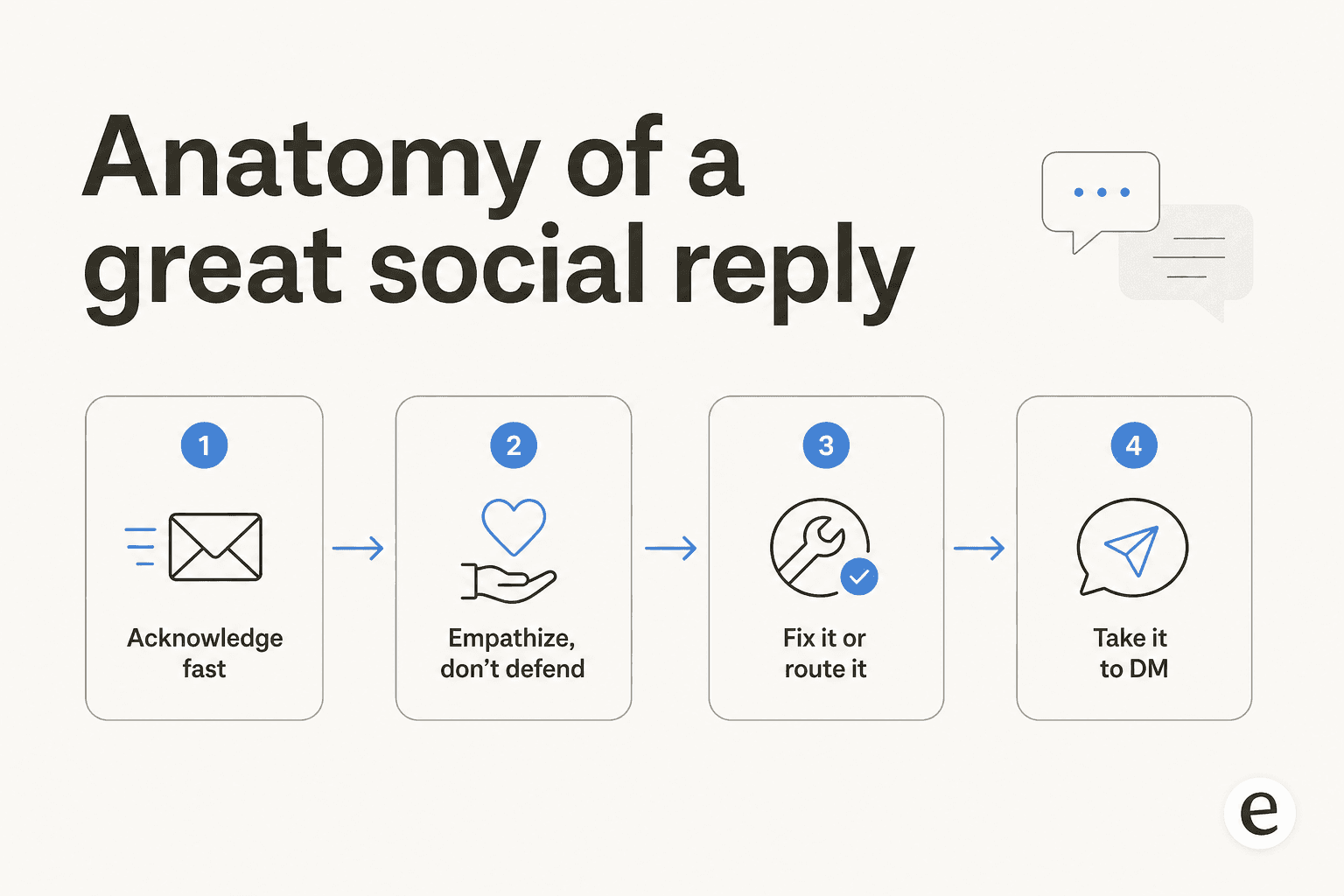
- Acknowledge fast. Speed is most of the battle on social. A reply in ten minutes that just says "on it" beats a perfect essay three hours later.
- Empathize, don't defend. The instinct to explain why it's not your fault reads as cold to the audience, even when you're right. Name the feeling first.
- Fix it or route it. Say what happens next, concretely. "I'll check your order now" beats "we apologize for the inconvenience."
- Take it to DM. The moment you need an order number, email, or anything personal, move it private. More on that next.
The tells of a bad response are just as consistent: the wall of corporate boilerplate, the "please DM us your details" with zero warmth, and the defensive "actually, our policy states." If you want a catalogue of how wrong this goes, our roundup of bad customer service stories is a useful before picture.
Public reply or private DM?
This is the decision people get wrong most often, so it's worth its own map. The rule I use: reply in public first so the audience sees you showed up, then move the private stuff to a DM.
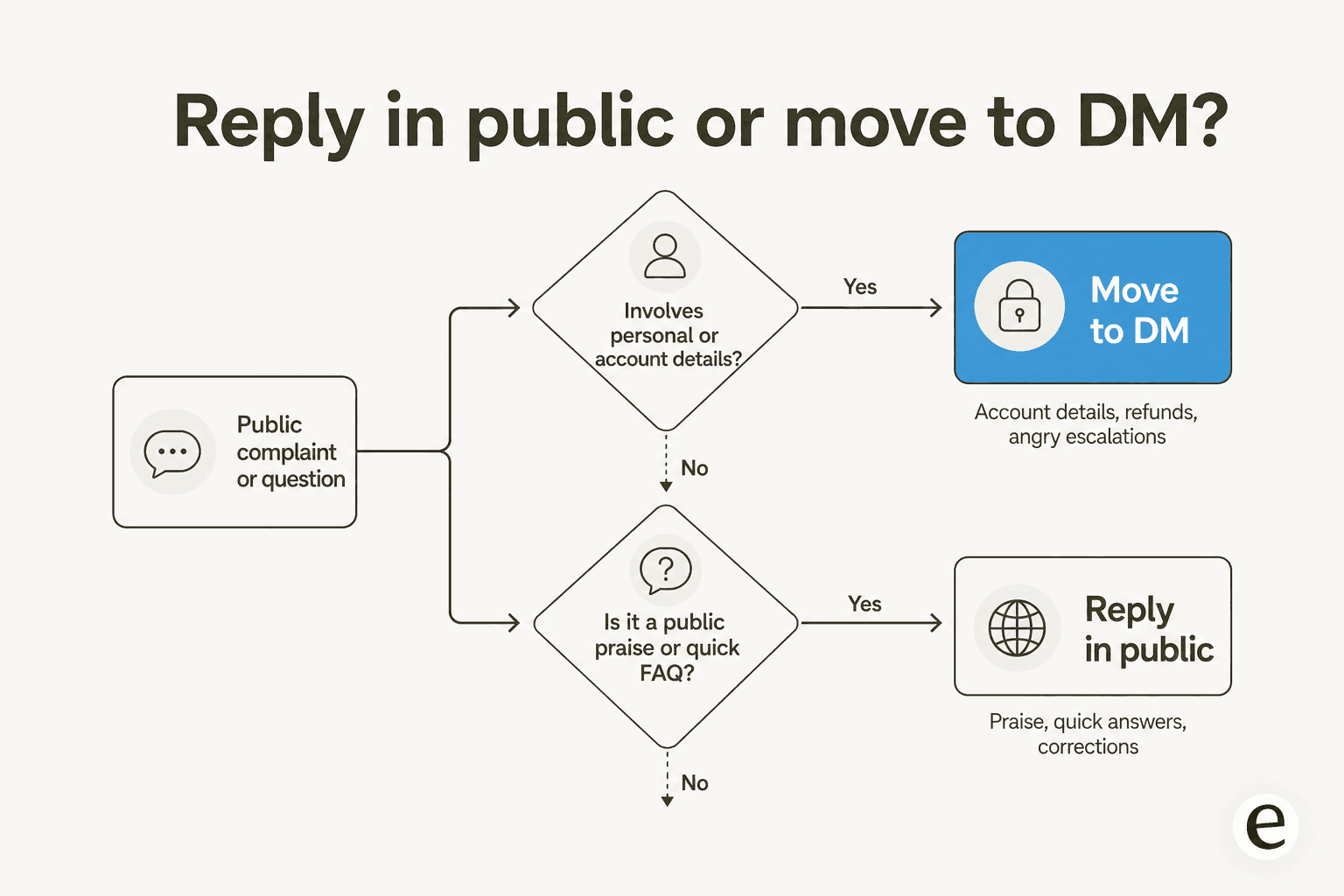
Stay public for praise, quick factual questions, gentle corrections of misinformation, and the first acknowledgement of a complaint. The audience needs to see those.
Move to DM the instant it involves account details, refunds, personal data, or a back-and-forth that's heating up. Nothing good happens when a refund negotiation plays out in a public thread. A clean handoff to a private channel is the same muscle as a good chat escalation flow, just on a different surface.
26 social media response examples by scenario
Here's the meat. Treat these as starting points, not scripts. Swap in the real name, the real order number, the real fix. The fastest way to sound like a bot is to paste one of these verbatim and forget to make it about the actual person.
Angry customer, public complaint
- "That's not the experience we want you to have, and I'm sorry. I've just sent you a DM so we can dig into your account and make it right."
- "You're right to be frustrated by this, [name]. I don't want to guess at what happened in public, so I've messaged you directly to pull up the details."
- "Really sorry for the mess here. Give me your order number in a DM and I'll personally chase this down today."
The pattern: own it in the first clause, no "if you were inconvenienced" hedging, then a concrete next step. If you want a deeper playbook on the de-escalation itself, our customer service problem solving guide goes past the templates.
Product not working or a bug
- "Ugh, that shouldn't happen. Can you DM me a screenshot and the browser you're on? I'll get it in front of our team right away."
- "Thanks for flagging this, that's a real bug and not you doing anything wrong. We're looking into it now, and I'll come back to you here the moment it's fixed."
- "Confirmed on our side, we can reproduce it. A fix is going out shortly. I'll update this thread when it's live so you're not left guessing."
Naming that it's a real bug, not user error, defuses a surprising amount of tension.
Refund or billing request
- "Totally fair ask. Refunds involve your account details, so I've moved us to DMs to sort it without posting anything private."
- "I can help with that. I've sent you a message so we can verify the account and get the refund started today."
Never negotiate money in public. Always the same move: acknowledge, then DM. A good customer service chatbot handles the same handoff on your website widget too.
Shipping delay
- "I hear you, waiting past the estimate is frustrating. Send me your order number in a DM and I'll get you a real status, not a canned tracking link."
- "Sorry about the delay, [name]. I've messaged you to check exactly where your package is right now."
Positive feedback or praise
- "This made our whole day, thank you. So glad it's working for you."
- "Love to hear it! If you ever want a feature you don't see, my DMs are open, we actually read them."
Don't let praise sit there with a bare like. A warm reply to a happy customer is free marketing, and the audience clocks it. This is a good habit to bake into your broader customer service standards.
Responding to a negative review
- "Thank you for the honest review, [name]. The [specific issue] you mentioned is on us, and here's what we're changing because of it: [change]. I'd like to make the original problem right too, so I've reached out directly."
- "We read every review, and this one stung because you're right. I've messaged you to fix the immediate issue, and I've passed the bigger point to the team that owns it."
The move that builds trust with future readers is naming the specific thing and the specific change, not a generic "we value your feedback."
Pricing or plan question
- "Great question. The short version: [plan] covers [x]. I've DMed you a couple of specifics for your use case so I don't clutter the thread."
- "Happy to break it down. For a team your size, [plan] is usually the fit. Want me to send the details over DM?"
Feature request
- "Honestly, a good idea. I've logged it with the product team and tagged your handle so they can follow up if they build it."
- "We don't have that yet, and I won't pretend otherwise, but you're not the first to ask. Adding your voice to the request now."
Honesty about what you don't have builds more credibility than a vague "great suggestion, we'll consider it."
Outage or incident
- "We're aware of the issue affecting [feature] and the team is on it right now. Status updates here: [status page]. I'll post again the moment it's resolved."
- "Confirmed outage, and I'm sorry for the disruption. No ETA yet, but I'd rather tell you that than guess. Watch this thread for the all-clear."
During an incident, one honest holding reply beats silence by a mile. Silence is what turns an outage into a reputation problem.
Troll, spam, or off-topic
- "Not much I can help with here, but if there's a real issue underneath this, my DMs are open."
- (Often the right move is no reply at all, plus a quiet hide or block. Don't feed a thread that only wants a reaction.)
Follow-up after you've resolved it
- "Circling back, your issue should be sorted now. Can you confirm it's working on your end? Want to make sure before I close this out."
- "All fixed on our side. Thanks for your patience through it, and sorry again for the hassle."
The follow-up is the step everyone skips, and it's the one that turns a fixed ticket into a customer who tells people you're good. It's also where clean tracking earns its keep, closing the loop is easier when tickets are tagged and classified properly.
Moving a public thread to DM
- "Sending you a DM now so we can share details safely, keep an eye on your messages."
- "Replied in your inbox, [name], let's finish this where I can pull up your account."
That's the core 26 across the situations that actually recur. The rest of your library is variations on these, tuned to your voice. If you'd rather see a fuller set organized as reusable templates, our customer service chatbot examples post has more you can lift.
The nuance changes by platform
The four beats are constant. The register isn't. A response that lands on X reads as flippant on LinkedIn.
| Platform | Expected speed | Tone | Public vs DM habit | Watch out for |
|---|---|---|---|---|
| X / Twitter | Very fast (minutes to an hour) | Punchy, human, low formality | Reply publicly, DM quickly | Threads go viral; one bad reply travels |
| Fast (within an hour) | Warm, a touch more formal | Public comment, then Messenger | Reviews and recommendations are permanent | |
| Moderate | Friendly, visual, emoji-ok | Comments public, serious stuff to DM | Comments get buried; check story replies | |
| Slower is acceptable | Professional, no slang | Comment publicly, DM for specifics | B2B buyers are watching; keep it credible |
A few platform-specific notes worth internalizing:
- X rewards speed and personality more than any other channel, and punishes canned copy hardest. It's also where a complaint can pick up momentum fastest, so the fast public acknowledgement matters most here.
- Facebook recommendations and reviews stick around and rank, so a thoughtful reply to a negative one is doing long-term reputation work, not just handling one person.
- Instagram conversations often start in DMs and story replies, which are easy to miss without the right tooling. If DMs are a real volume for you, an AI for social media setup that watches every surface is worth it, and it overlaps with the AI social media marketing tools your marketing team already runs.
- LinkedIn is where B2B prospects lurk. Keep it substantive, drop the emoji, and treat every reply as something a buyer might screenshot.
Common mistakes I still see teams make
- Going quiet on the hard ones. The complaint you don't want to answer is the one the audience is watching. Silence reads as guilt.
- Copy-pasting the same apology. If your last five replies are identical, people notice, and it signals nobody's actually home.
- Arguing in public. You will not win a public back-and-forth, even when you're right. Move it to DM.
- The soulless "please DM us." Every complaint ends in a DM, sure, but "DM us your details" with no acknowledgement is the coldest possible version. Warm it up.
- No follow-up. Fixing the issue and never confirming it leaves the customer, and the audience, unsure it's resolved.
- Inconsistent voice across the team. Five agents, five personalities, is a brand problem. Consistency is a tooling problem more than a talent one, which is the whole point of the next section. Tracking the right customer service KPIs is how you catch this drift early, and it's a core part of good customer service management.
How to scale on-brand social responses with AI
Everything above is easy to do once. The trouble starts at volume. When you're fielding hundreds of mentions, DMs, comments, and story replies across four platforms, the bottleneck isn't knowing what to write, it's writing it fast enough, consistently enough, without burning out the two people covering the whole thing. This is the gap that AI for customer service is actually good at closing, and it's why AI customer service software has moved from nice-to-have to standard on busy teams.
This is where I'd reach for AI, and specifically for AI that drafts rather than one that fires blindly. I've watched a confident-sounding bot quietly give wrong answers in public, which is the worst place for it to happen, so the setup that actually works keeps a human in the loop until you trust it.
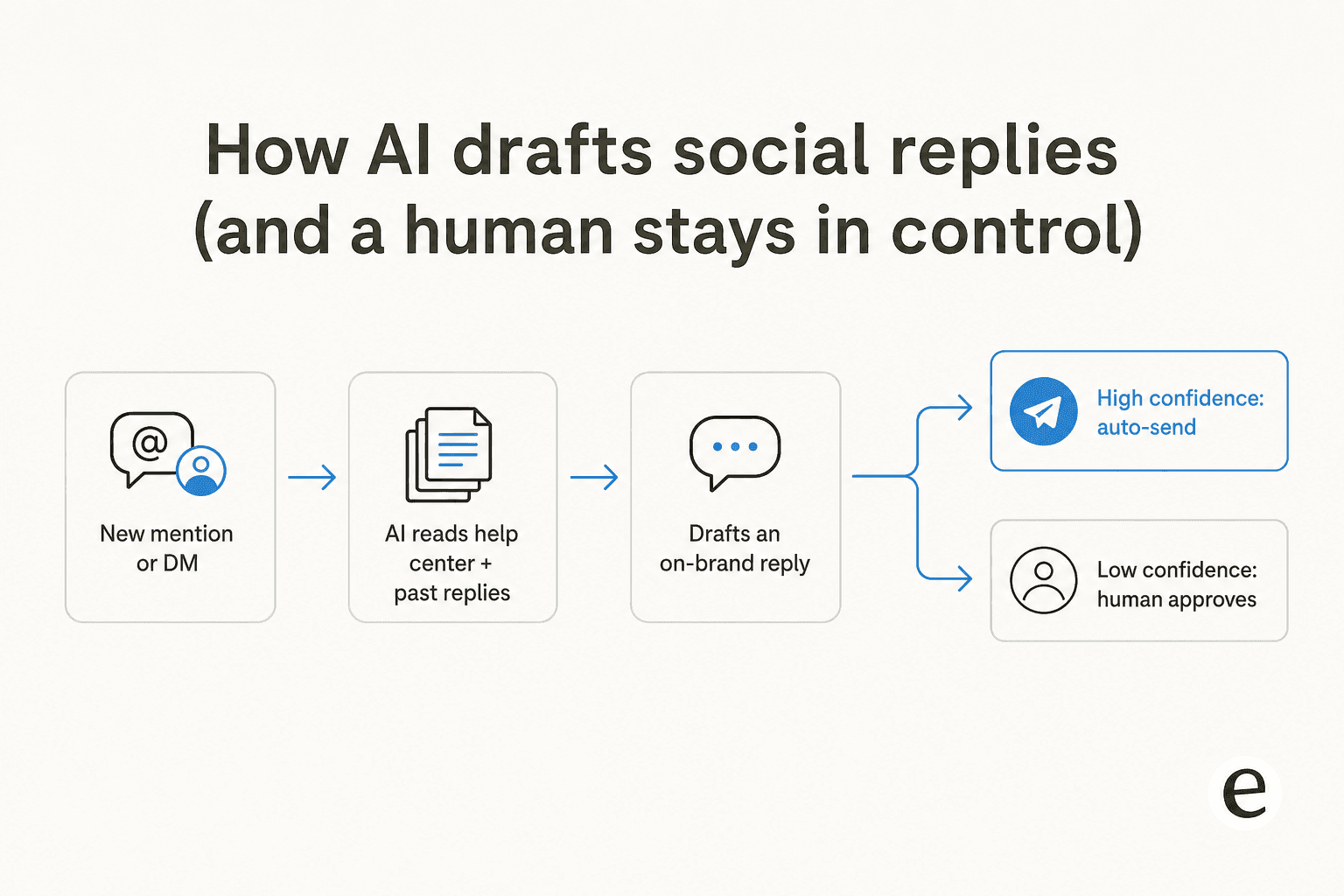
The pattern is: a new mention or DM comes in, the AI reads your help center and your past replies, drafts an on-brand response, and then routes it based on confidence. Getting that routing right leans on solid AI ticket classification under the hood. High-confidence, routine stuff (shipping status, a known FAQ) can auto-send. Anything ambiguous or emotional gets drafted and dropped in front of a human to approve or edit before it goes out. That's the difference between an AI customer service chatbot that helps and one that embarrasses you.
Two things make or break this:
- Train it on your own material, not a generic model. An AI trained on your past tickets and help docs sounds like you. One running on a blank prompt sounds like every other bot. This is also what stops the canned-voice problem, since it's mirroring replies your team actually wrote. Plenty of companies using AI chatbots for customer service get this backwards and ship a generic voice.
- Roll out gradually with confidence-based routing. Start with everything drafted for human review. Watch it. As it earns trust on specific topics, hand those over. One CX lead I spoke with, running a DTC supplements brand, put the bar perfectly:
"The AI will never be able to answer 100% of the questions. I need an AI who is only handling the tickets that it's confident to handle, and all the other ones, leave them alone."
That's exactly the right instinct, and it's why confidence-based escalation beats an all-or-nothing switch.
The results, when it's set up this way, are real. Gridwise saw eesel resolve 73% of tier-1 requests in the first month, with clear signals during a 7-day trial. Sentiment tracking on top of that means you can also flag the angry ones for a human automatically, which pairs neatly with AI sentiment analysis on incoming messages.
Try eesel for social and support responses
If you're drowning in social mentions and support tickets, eesel is built for exactly this. It plugs into your existing helpdesk and channels, learns from your past replies and help center on day one, and drafts on-brand responses that a human can approve, or that auto-send once you trust them on a given topic.

The part I'd actually sell you on is the safety net. You can simulate the AI against your past tickets before it ever touches a live conversation, so you see coverage and catch gaps first instead of finding out in public. The same engine backs your AI live chat and broader customer service automation, so social isn't a bolt-on. It's free to try, no credit card, and you can point it at a single channel to start. For the wider picture on picking a tool, our rundown of the best customer service AI puts it in context.
Frequently Asked Questions
Should you reply to complaints in public or in a private message?


Article by
Riellvriany Indriawan
Riell is a designer and writer at eesel AI with about two years of experience researching CX platforms, AI chatbots, and helpdesk software. She combines her design background with a sharp eye for how these tools actually look and feel in practice — making her comparisons unusually visual and user-focused.