
Let’s face it: customers today expect answers right away, no matter the time of day. Your team is human, though, and they’re probably already stretched thin. This gap between what customers want and what your team can realistically provide is a tough spot to be in. It's a balancing act that's hard to get right.
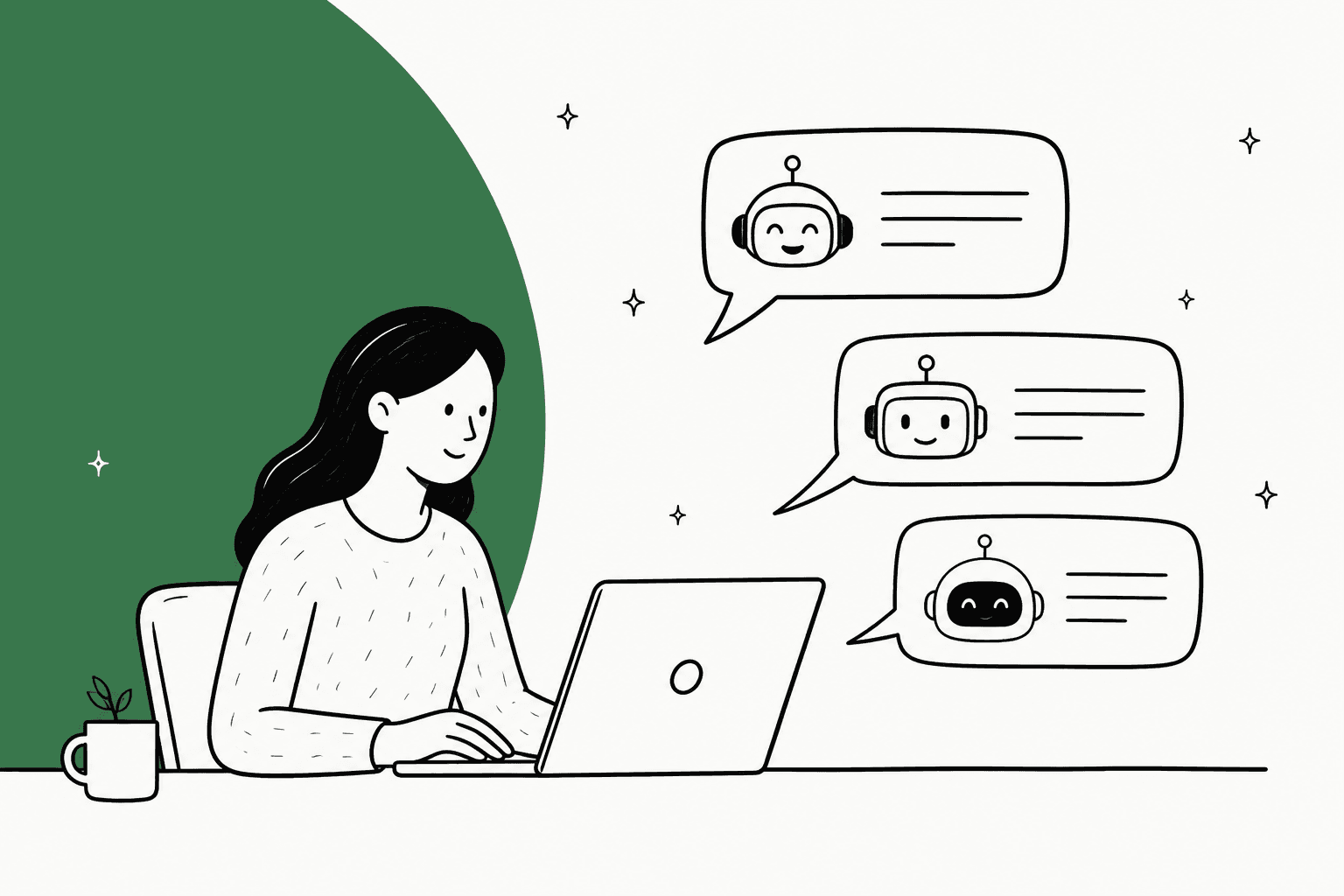
This is where an AI chatbot can make a difference. It’s not about replacing your team, but about providing a capable AI teammate. A chatbot can bridge that gap by handling routine questions, freeing up human agents to focus on complex problems that need a human touch.
This article will skip generic advice and show what effective AI looks like in the real world. We're going to break down 7 customer service chatbot examples that are boosting sales and handling complex support questions.
What are modern customer service chatbots?
A modern customer service chatbot is an AI-powered assistant that can understand what a customer is saying, respond intelligently, and actually do things based on their request. It’s very different from the rule-based bots of the past.
Older, rule-based chatbots were essentially interactive FAQs. They followed a rigid script, and if a question was phrased differently, they would often respond with, "Sorry, I don't understand." This could create more work for both the customer and the support team.
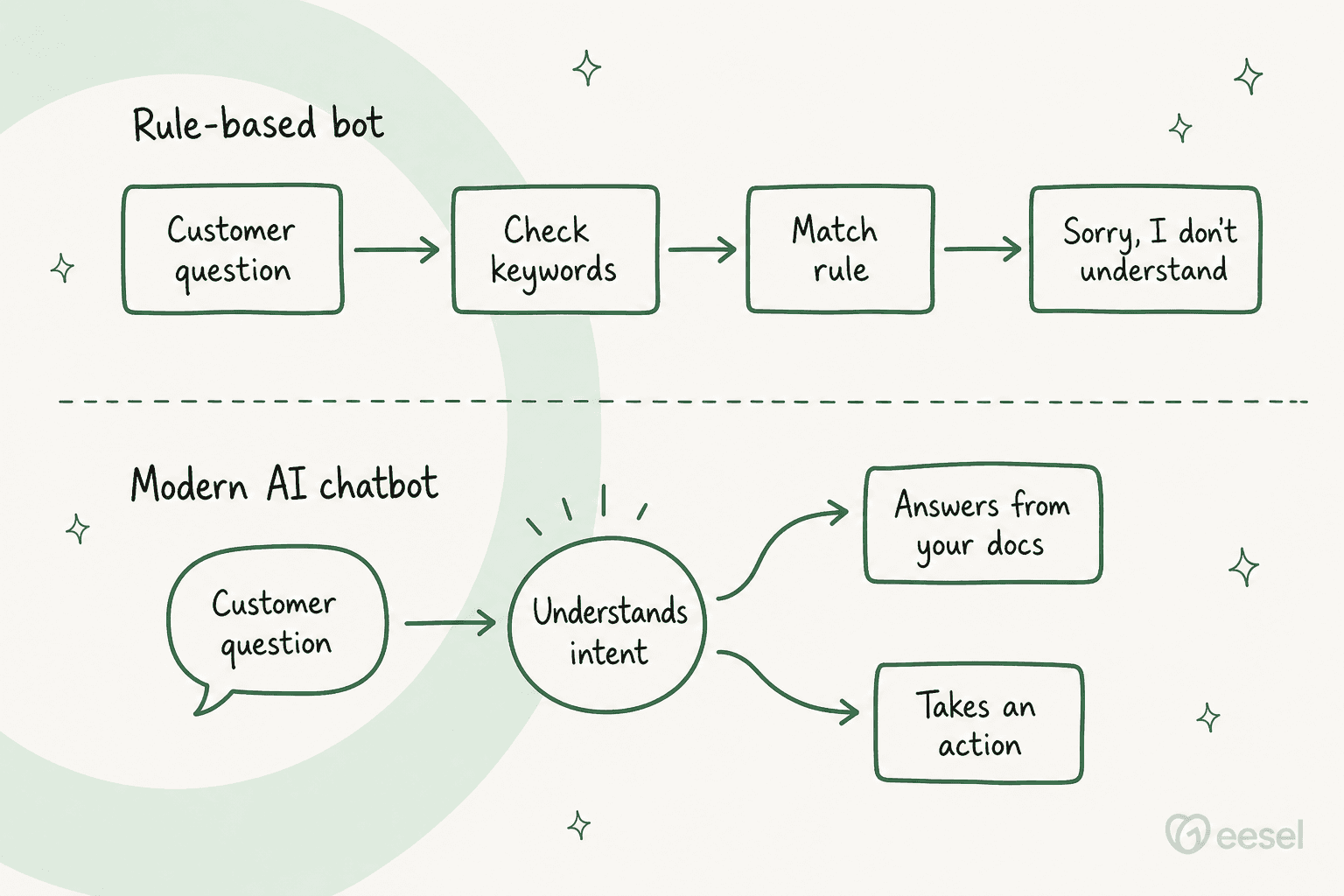
Today's AI chatbots use Natural Language Processing (NLP) to get the context and intent behind a question. They aren't just matching keywords. The most effective ones are well-integrated into a company's tools. They can pull information from multiple places at once, like Google Docs or Confluence, connect to other apps for real-time info, and perform tasks that solve the customer's problem.
How we chose the best chatbot examples
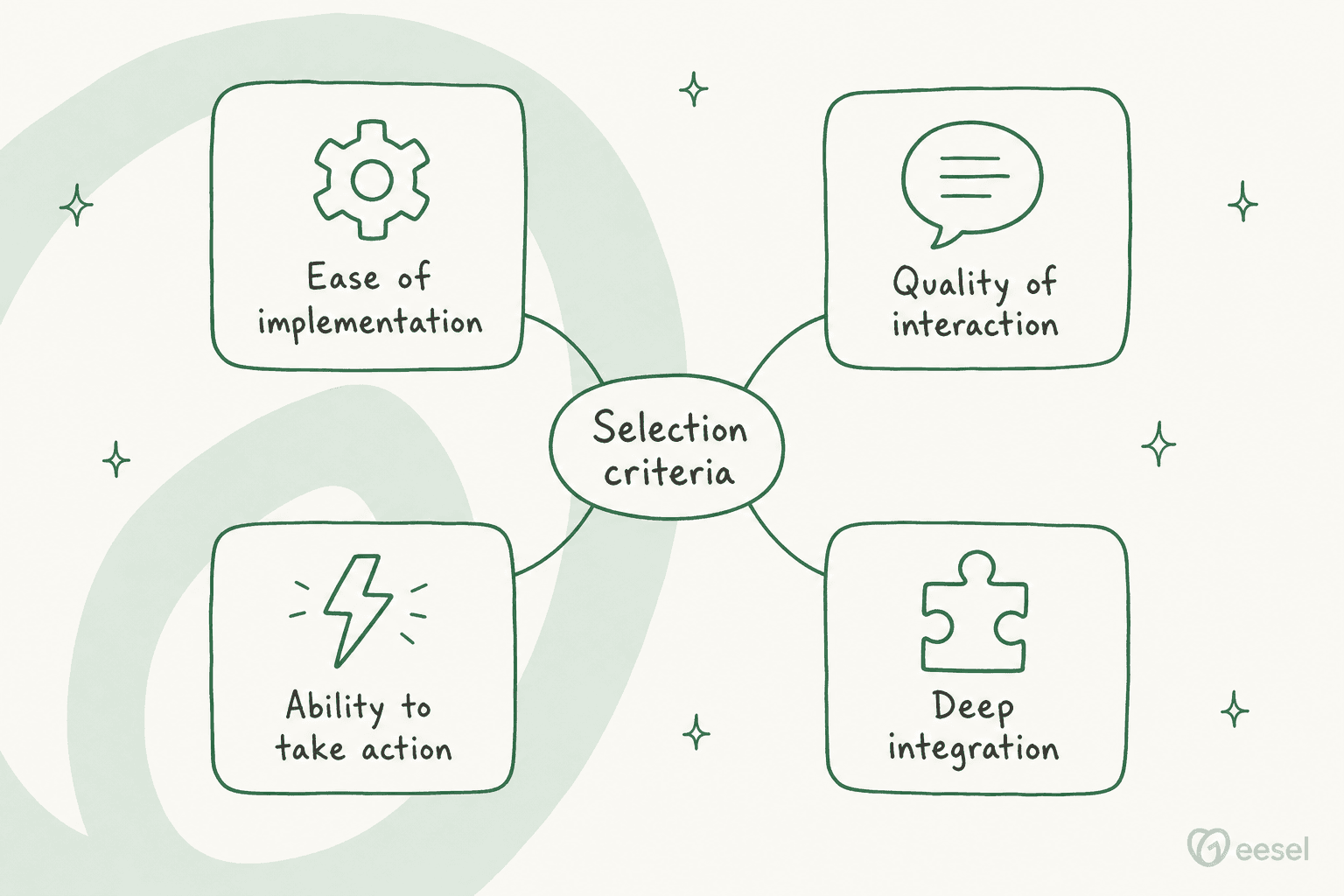
To make this list genuinely useful, we didn't just pick the flashiest bots. We looked for chatbots that deliver real, measurable results and are powered by tech that’s accessible to more than just Fortune 500 companies. Here’s what we focused on:
-
Ease of Implementation: How quickly can a team get this thing up and running? We looked for examples powered by platforms that don't require a massive, months-long IT project to see value.
-
Quality of Interaction: Does the conversation feel helpful and natural, or is it a robotic dead end? The user experience was a huge factor for us.
-
Ability to Take Action: Can the chatbot do more than just spit out information? We prioritized examples that can look up orders, process returns, or make personalized recommendations.
-
Deep Integration: How well does the bot play with the rest of the business? The best examples work seamlessly with a company’s help desk, e-commerce platform, or internal knowledge base.
A quick comparison of the top customer service chatbot examples
| Brand Example | Key Feature Highlight | Primary Use Case | Best For |
|---|---|---|---|
| eesel AI | Plug-and-play AI teammate | E-commerce sales & support | Teams wanting a self-serve AI that learns from existing data and rolls out safely. |
| Klarna | High-volume, multilingual query resolution | Fintech & payments support | Businesses needing to provide accurate, 24/7 answers at a massive scale. |
| H&M | Personalized shopping quiz | Guided selling & product discovery | E-commerce brands looking to make online shopping more interactive and personal. |
| Amtrak's Julie | Voice and text automation | Travel booking & information | Companies with high call volumes for multi-step transactional queries. |
| Domino's Dom | Omnichannel ordering with regional accents | Effortless, high-frequency sales | Brands wanting to meet customers on their favorite messaging apps (Messenger, Alexa). |
| Bank of America's Erica | Proactive financial guidance | 24/7 banking support | Financial institutions aiming to provide secure, personalized, and value-added support. |
| Casper's Insomnobot | Conversational brand building | Top-of-funnel engagement | Brands that want to build an emotional connection and community beyond direct sales. |
7 best customer service chatbot examples in 2026
Here are seven real-world examples that show just how powerful and versatile a modern AI chatbot can be.
1. eesel AI
eesel AI is designed to be an AI teammate that you invite to your existing tools. Its AI Chatbot for ecommerce is an example of this, integrating directly with platforms like Shopify to become a 24/7 sales and support assistant. It learns from your product catalog to make recommendations and connects to your help desk to handle common support queries like "Where's my order?".

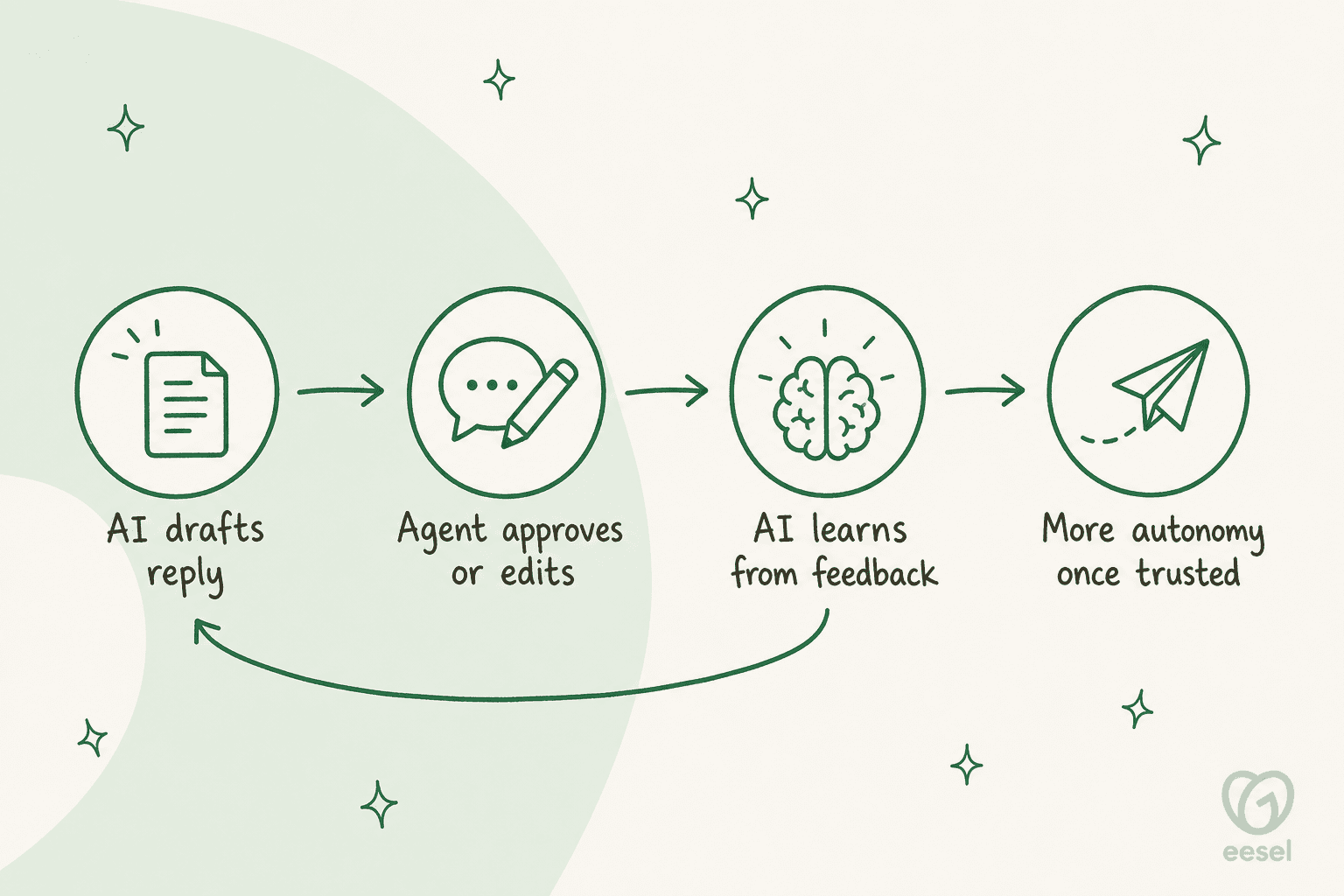
Why it's a great example: It combines automated sales and support into one experience. It offers a self-serve, plug-and-play setup. You can connect it to your help desk and knowledge sources, where it starts learning. Plus, its human-in-the-loop design allows for a controlled rollout. You can start by having it draft replies for your team to approve, and give it more autonomy once you've seen it in action and trust how it performs.
Key facts:
-
Fast Onboarding: Learns from your past tickets, help center articles, and entire Shopify catalog with one-click integrations.
-
Takes Action: It can do more than just talk. It can look up order statuses, process returns, and create tickets directly in your help desk.
-
Safe Rollout: You can simulate its performance on your past tickets before it ever talks to a customer; it scores each answer and suggests fixes.
-
Proven Results: One customer, Gridwise, resolved 73% of its tier-1 support tickets with eesel AI in the first month.
2. Klarna
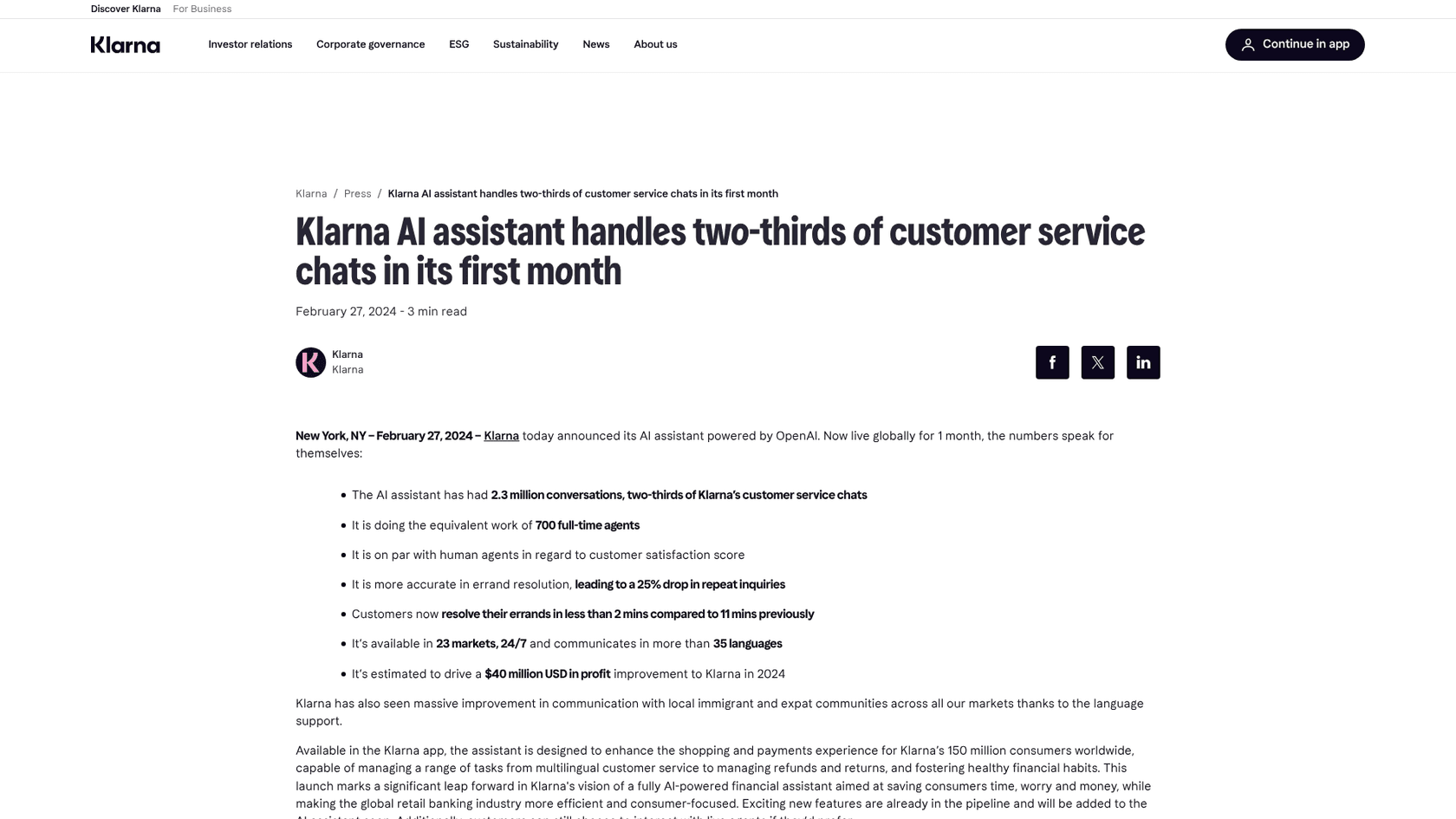
Klarna's OpenAI-powered assistant is an example of an AI trained to handle complex and regulated topics with high accuracy. At launch, it handled millions of conversations, which freed up its human agents to focus on the most sensitive and critical customer issues.
Why it's a great example: This shows that AI chatbots can be trusted with much more than just basic questions. In its first month, the assistant handled 2.3 million conversations, which was two-thirds of all their customer service chats.
Key facts:
-
Massive Efficiency: The AI does the work of 700 full-time agents and is expected to contribute to a $40 million profit improvement.
-
Faster Resolutions: Per Klarna's February 2024 release, customer issues were resolved in less than two minutes, down from 11 minutes. Klarna also reported a 25% drop in repeat inquiries and customer satisfaction on par with human agents.
-
Global & Multilingual: At launch, the assistant was available 24/7 in 23 different markets and could communicate in over 35 languages.
-
A Hybrid Approach: Initially, Klarna went with a pure AI-first model but found that customers still needed an escape hatch to a human. They've since adjusted their strategy to ensure customers can "always speak to a real person" when needed, creating a much better-balanced experience.
Amazon's is the only one I've had good experiences with. When processing a return, it prompted me for the necessary information, then seamlessly escalated me to a human customer service agent to complete the process. I wish there was an up-front way for chatbot interfaces to indicate whether or not they include an option to reach a human agent. I'm so annoyed with the dead-end FAQ bots that I often don't even bother trying chat.

3. H&M
For a brand like H&M, with a massive and constantly changing inventory, helping customers find the right product is a big challenge. Their chatbot, launched on the Kik messenger app, acts like a personal stylist. It starts by asking users a few questions about their fashion preferences and then puts together personalized outfit recommendations.
Why it's a great example: This is an example of using conversational AI to make online shopping feel more engaging and personal. Instead of forcing customers to scroll through endless product pages, H&M provides a guided shopping experience that's interactive and fun. This not only improves the customer experience but also helps boost conversion rates.
4. Amtrak's Julie
Amtrak was getting swamped with calls about train schedules, fares, and bookings. Their solution was "Julie," a virtual assistant that works over both voice and text to guide travelers through the entire booking process. Amtrak's Ask Julie page says the chat uses both live agents and an automated chatbot.
Why it's a great example: Julie shows how a chatbot can automate a complicated, multi-step process from start to finish. The return on investment and customer satisfaction improvements have been significant.
Key facts:
-
High Volume: Julie answers around 5 million questions every year and handles an average of 50,000 calls per day.
-
Significant Savings: By taking care of routine questions, the chatbot saved Amtrak over $1 million in customer service costs.
-
Business Growth: After implementing Julie, Amtrak saw a 25% increase in bookings and a 50% jump in user engagement with their self-service tools.
5. Domino's Dom
Domino's wanted to make ordering a pizza as easy as sending a text. Their ordering assistant, "Dom," is available everywhere their customers are, including Facebook Messenger, Amazon Alexa, Google Assistant, and even SMS.
Why it's a great example: This is all about meeting your customers where they are. By building an omnichannel presence, Domino's removed all the friction from the ordering process. But they didn't stop there; they also focused on making the interaction feel more human.
Key facts:
-
Omnichannel Ordering: Customers can reorder their favorite pizza or track their delivery status from whatever app or smart device they prefer to use.
-
Hyper-Personalized Voice: The voice AI uses region-specific accents to sound more natural and relatable to customers across the U.S.
-
Wide Adoption: The text-to-voice feature is now used for about 80% of all phone orders in North America.
6. Bank of America's Erica
"Erica" is Bank of America's AI assistant, and it lives right inside their mobile app. It helps customers with everyday banking tasks like checking balances, paying bills, and transferring money. But it also goes a step further by providing proactive insights into their spending habits.
Why it's a great example: Erica shows that a chatbot can provide secure, personalized, and helpful financial support on a massive scale. It moves beyond simple transactions to offer real, value-added guidance.
Key facts:
-
Massive Scale: Since it launched in 2018, Erica has handled over 3 billion client interactions with nearly 50 million users, and was averaging more than 58 million interactions a month as of August 2025.
-
Proactive Insights: Erica sends out personalized alerts, like notifications about recurring charge increases or weekly spending summaries.
-
High Accuracy: Bank of America says more than 98% of users find the information they need, which has cut down on call center volume. It's worth noting that while Erica uses NLP, it's not based on generative AI or large language models.
7. Casper's Insomnobot
Casper, the mattress company, had a unique marketing problem: how do you connect with potential customers when they aren't actively shopping for a new bed? Their solution was the Insomnobot3000, a chatbot built specifically for people who are up late and can't sleep.
Why it's a great example: This is an example of a chatbot used for brand building. The bot doesn't try to sell you anything. Instead, it offers friendly, casual conversation via SMS to "make 3 a.m. a little less lonely." It shows that AI can be used to create an emotional connection with an audience, building brand loyalty long before someone is ready to buy.
3 things to consider when reviewing customer service chatbot examples
Before you implement a chatbot, here are three important things to consider to ensure you choose a valuable tool.
1. Onboarding shouldn't be a 3-month IT project
Some AI tools can have a long, complicated setup that requires developers and weeks of configuration. This can delay the return on investment.
Decent list, but the real catch with a lot of these big platforms is the pricing model or the ecosystem lock-in. You either get hit with unpredictable per-resolution fees which can skyrocket, or you're forced to migrate your entire support stack just to use their AI. It's a huge hidden cost/effort that these lists don't always cover.
Look for a plug-and-play solution. Many platforms today are designed to learn from your existing data sources, like your help desk, past tickets, and internal docs, automatically.
For example, a platform like eesel AI is designed to be invited to your help desk just like a new hire. It starts learning your business context in minutes, not months, so you can see value right away.
2. You need a safe way to roll it out
A common concern for support leaders is the risk of an AI providing wrong or off-brand answers. The go-live process should be controlled.
It is helpful to prioritize platforms that offer a gradual, controlled rollout. One way to do this is with a human-in-the-loop model. The AI starts by drafting replies for agents to approve, edit, or reject. This process trains the AI on real-world feedback without putting your customer experience at risk.
Also, look for a tool that has a simulation mode. Tools like eesel AI let you test your AI's performance on hundreds of your actual past tickets. It scores each answer and suggests fixes before it ever interacts with a live customer.
3. It needs to do more than just talk
Answering questions is only part of the job. An effective chatbot is one that can take action.
This means it needs to be deeply integrated with your other business tools. Can it look up an order status in Shopify? Can it process a refund for a customer? Can it tag and route a ticket in Zendesk?
This ability to perform tasks elevates a chatbot from an informational tool into an AI teammate that saves your team a ton of time and resolves customer issues from start to finish.
Seeing these examples is one thing, but understanding how they're built can provide even more clarity. For a hands-on look at how a modern, no-code chatbot comes to life, the video below walks through the process of building a functional customer support agent in just a few minutes.
Your best agent doesn't have to be human
As these customer service chatbot examples show, the technology has evolved significantly. Modern solutions can act like fully integrated AI teammates. They learn your business, work right alongside your human agents, and can handle tasks across both sales and support.
They can be straightforward to set up, offer controlled rollouts, and can impact your bottom line. The question is no longer if a business should use an AI chatbot, but which one is the right fit for their team.
If you're looking for an AI teammate you can invite to your help desk today, try eesel AI for free. You can simulate its performance on your own past tickets and see its potential in just a few minutes.
Frequently asked questions
What makes the Customer service chatbot examples in this list so effective?
They're effective because they go beyond just answering questions. They are deeply integrated with business tools (like Shopify or a help desk), can take real action (like booking a ticket or processing a return), and offer a natural, helpful user experience. They solve problems from start to finish.
How can I determine which of these Customer service chatbot examples is right for my e-commerce business?
For e-commerce, look at examples like eesel AI and H&M. The key is to find a solution that integrates directly with your platform (e.g., Shopify), can learn from your product catalog to make recommendations, and handles common support queries like "Where's my order?" automatically.
Are the technologies behind these Customer service chatbot examples affordable for small businesses?
Yes, many modern platforms are designed for accessibility. Instead of requiring a large IT project, solutions like eesel AI are "plug-and-play." They can be set up quickly and learn from your existing data, making them an accessible way to get started with AI.
What is the most important takeaway from these Customer service chatbot examples when it comes to implementation?
The most important takeaway is to roll out your chatbot safely. Look for a platform that offers a human-in-the-loop model, where the AI first drafts replies for your team to approve. This, combined with a simulation mode to test performance beforehand, ensures you can launch with confidence.
Do all good Customer service chatbot examples need to be able to take action, or can they just provide information?
While informational bots can be useful (like Casper's Insomnobot for brand building), the most valuable examples are those that can take action. The ability to look up an order, process a request, or route a ticket is what turns a chatbot from a simple FAQ into a true AI teammate that saves your team significant time.
How do the best Customer service chatbot examples balance AI automation with the need for a human agent?
The best examples use a hybrid approach. They automate routine and repetitive queries but always provide a clear and easy way for a customer to speak with a human agent if needed. As Klarna learned, this balance is key to a good customer experience. The AI acts as the first line of defense, not a wall.


Article by
Kira
Kira is a writer at eesel AI with a Computer Science background and over a year of hands-on experience evaluating AI-powered customer service tools. She focuses on breaking down how helpdesk platforms and AI agents actually work so that support teams can make better buying decisions.