


How to read this list
Every image model is a bundle of trade-offs, so I scored these on the axes that actually decide a purchase: raw quality, how well they render text inside the image, whether they can edit an existing image cleanly, whether the weights are open, and what they cost. Here is roughly where they land.
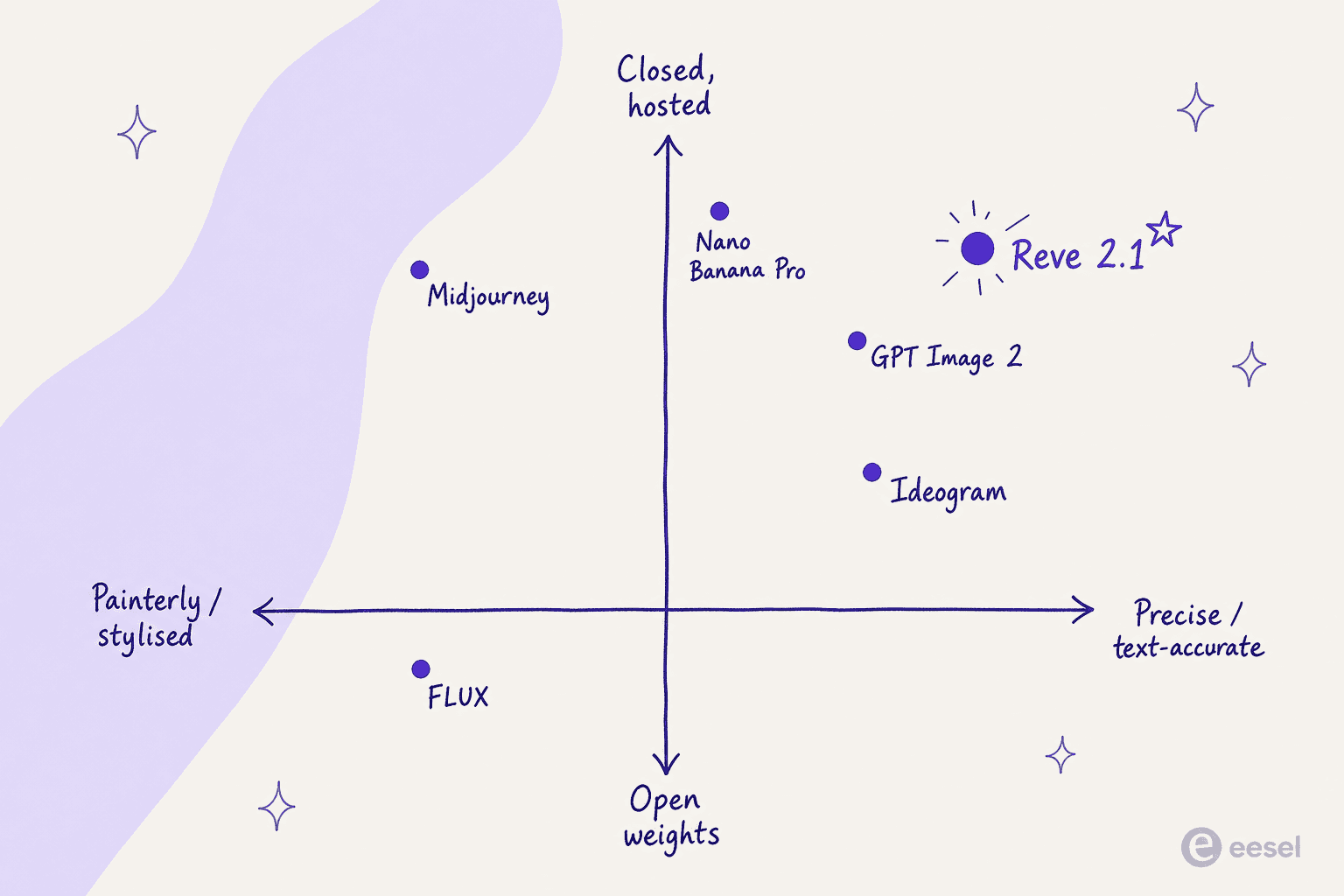
The summary table has the full breakdown before we get into each one.
| Model | Best for | Native 4K | Text rendering | Post-gen editing | Open weights | Free tier | Paid from |
|---|---|---|---|---|---|---|---|
| Reve 2.1 | Marketing + text | Yes | Excellent | Layout-based | No | Yes | $7.99/mo |
| GPT Image 2 | Top all-round quality | Upscaled | Excellent | Conversational | No | Limited | Usage-based |
| Nano Banana Pro | Free + editing | Up to 4K | Very good | Conversational | No | Yes | In Gemini plans |
| Midjourney | Painterly art | Upscaled | Weak | Region + vary | No | No | ~$10/mo |
| Ideogram | Text + typography | No | Excellent | Magic Fill | No | Yes | ~$8/mo |
| FLUX | Open weights / self-host | Varies | Good | Inpainting | Yes | Via hosts | Per-image API |
| Recraft | Brand + vector | Yes | Very good | Vector edit | No | Yes | ~$12/mo |
| Leonardo AI | Game + production assets | Upscaled | Fair | Canvas + control | No | Yes | ~$12/mo |
Prices are approximate consumer entry points; check each vendor's pricing page for current numbers.
1. GPT Image 2 — the model that beats Reve
If you want an alternative because you want better, this is the one to try first. On the same Text-to-Image Arena where Reve 2.1 sits at #2, GPT Image 2 is the model directly above it. OpenAI's generator matches Reve on the two things Reve is proudest of, prompt adherence and readable in-image text, and it does it inside the ChatGPT interface most people already have open.
Where it beats Reve: it is the current #1 on that leaderboard, and its conversational editing ("make the sky darker, keep the logo") feels natural if you already live in ChatGPT. Our GPT Image 2 comparison digs into the head-to-head.
Pricing: available in ChatGPT's paid tiers and usage-based through the API. There is a lighter, cheaper GPT Image 1 mini for high-volume, cost-sensitive jobs.
The catch: you do not get Reve's inspectable, layout-as-code model, so editing is conversational rather than surgical. And native resolution is lower than Reve's true 4K unless you upscale.
2. Nano Banana Pro — the best free rival
Google's image model, nicknamed Nano Banana, is the closest thing to Reve you can use without paying. The step-up version, Nano Banana Pro, is the one to reach for: it is genuinely strong at editing and at following detailed prompts, and it is built into the Gemini app where a huge number of people already have access.
Where it beats Reve: price and reach. A capable model, free, inside a tool you may already use, with conversational editing that rivals Reve's layout edits for everyday work. The Nano Banana Pro review covers how far the free tier actually goes.
Pricing: free in the Gemini app, with higher limits inside Google's paid AI plans.
The catch: it does not expose Reve's addressable layout, so you cannot pop a single element open and re-prompt only that region. If you want other Google-adjacent options, our Nano Banana alternatives list goes wider.
3. Midjourney — still the king of painterly style
Reve wins on obedience and typography; Midjourney wins on vibe. For illustrative, cinematic, painterly output where you care more about mood than about a precise brief, Midjourney's aesthetic still edges out almost everything else, which is why it keeps its audience despite being harder to steer.
Where it beats Reve: raw artistic quality and a distinctive look. If your work is concept art, editorial illustration, or moodboards, this is the pick.
Pricing: Midjourney pricing starts at roughly $10/month, with no free tier. The Midjourney reviews breakdown covers who it actually suits.
The catch: weak in-image text, less literal prompt-following, and no equivalent to Reve's element-level editing. If Midjourney's constraints bug you, our Midjourney alternatives post is a dedicated deep dive.
4. Ideogram — the text specialist
Before Reve made typography its headline feature, Ideogram was the model people used specifically to get readable words into an image. It is still excellent at it. If your only reason to consider Reve was text rendering on posters, logos, and signage, Ideogram is the most direct swap and it has a usable free tier.
Where it beats Reve: a free entry point and a laser focus on legible text, plus a "Magic Fill" editing tool for targeted changes.
Pricing: free tier available, with Ideogram pricing paid plans from around $8/month.
The catch: it does not do native 4K, and it is narrower than Reve as a general-purpose generator. For adjacent typography-strong tools, see our Ideogram alternatives roundup.
5. FLUX — the open-weights option
Every model above is closed and hosted, exactly like Reve. FLUX, from Black Forest Labs, is the one that is not. Its weights are open, so you can self-host it, fine-tune it on your own data, or run it through providers like Replicate and fal without being locked to a single vendor's UI or content policy.
Where it beats Reve: control. Open weights mean no platform lock-in, no per-image gatekeeping, and the freedom to build it into your own product. It is the answer to Reve's biggest structural limitation, which is that it is proprietary and hosted-only.
Pricing: free if you self-host on your own hardware; otherwise pay-per-image through API hosts.
The catch: you trade polish and convenience for control. Output is strong but not quite Reve-tier on the hardest prompts, and you own the infrastructure and prompt-engineering work yourself.
6. Recraft — the brand and vector tool
Reve is aimed squarely at marketing visuals, and so is Recraft, but from a designer's angle. Recraft can output true vector (SVG) graphics, holds a consistent brand style across a set of assets, and is built for teams producing icons, illustrations, and on-brand collateral at volume.
Where it beats Reve: vector output and brand-style consistency. If you need editable SVGs or a locked house style across dozens of assets, Reve's raster-first, layout-based approach does not compete here.
Pricing: free tier available; Recraft pricing paid plans start around $12/month.
The catch: it is more of a design workflow tool than a state-of-the-art photorealism model, so for cinematic or product-photography realism Reve and GPT Image 2 are stronger.
7. Leonardo AI — for production and game assets
Leonardo AI earns its place for anyone building assets at scale, especially in games and product design. It layers fine-grained control (reference images, pose and depth control, trained style models) on top of solid image quality, which is exactly what a production pipeline needs and what Reve does not really offer yet.
Where it beats Reve: control and repeatability. Custom-trained style models and control tools make it easy to generate hundreds of on-style assets, which matters more than a single perfect image in a real workflow.
Pricing: free daily credits, with Leonardo AI pricing paid plans from around $12/month.
The catch: the interface has a learning curve, and out-of-the-box aesthetic polish trails Midjourney and Reve. It rewards the time you put into it.
Which one should you actually pick?
The trap with a list like this is treating it as a ranking, when it is really a set of jobs. Pick the priority that matches your work and let it choose the tool.
Notice how few of these actually replace Reve outright. For most marketing and text-heavy work, Reve 2.1 is already near the top, so the honest recommendation is often to stay put and only reach for an alternative when you hit one of Reve's real walls: it is closed, hosted-only, premium-only for editing, and its content policy is locked even for paying users.
"Haven't tested yet but the improved text rendering and prompt understanding sound like game-changers for complex designs."
That reaction to Reve's text rendering is exactly why Ideogram and GPT Image 2 are the two names that come up most often when people go looking for a swap: they are the only other models that reliably get words right.
The deeper pattern worth stealing
I spend most of my time building AI that people have to trust before it does anything real, and the reason I find Reve interesting is not the pictures. It is the architecture: Reve makes the model's plan visible and editable instead of hiding it in a black box. You can inspect the layout before it renders and correct one piece without re-rolling everything.
That is not an image-generation trick. It is just good AI design, and it is the same instinct behind trustworthy AI in every other domain. A system that only hands you a final answer is hard to correct; a system that shows its plan first is one you can actually steer. Whichever image model you land on, that is the property worth valuing.
Try eesel
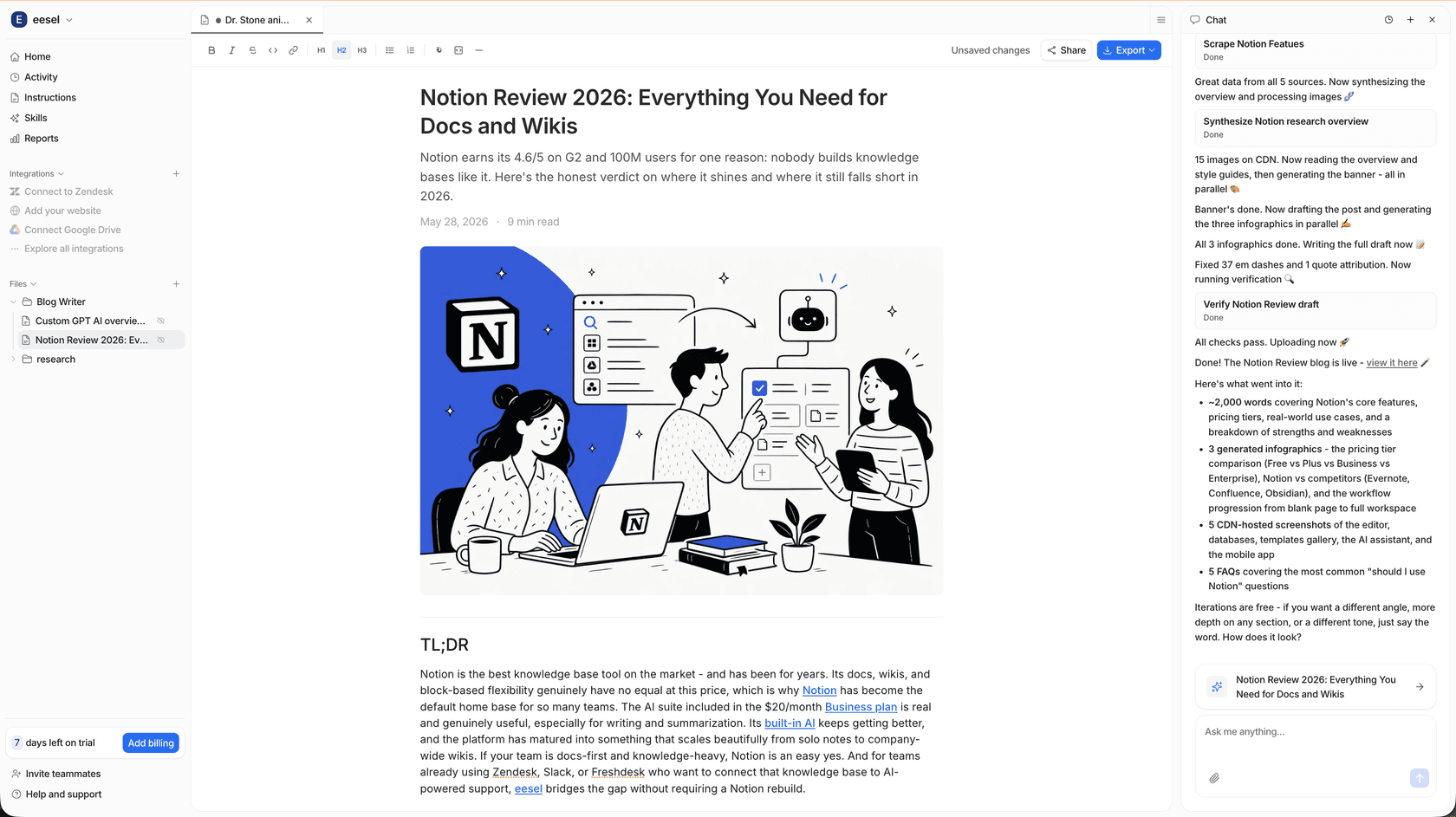
Here is the honest redirect I promised. Every tool above generates pictures. If the AI problem you are really trying to solve is written work, support replies, help-center articles, blog drafts, then an image model is the wrong category entirely, and eesel AI is built for exactly that.
Our AI blog writer drafts long-form, researched content (this comparison included), and our AI helpdesk agent resolves support tickets. It runs on the same principle that makes Reve good: it never asks you to trust a black box. Before an agent replies to a single real customer, you can simulate it on past tickets to see exactly what it would have said, find the gaps, and fix them. It is the antidote to AI that hallucinates, and it is why customers like Gridwise saw 73% of tier-1 requests resolved in the first month.
Pricing is one fixed monthly price on the Teammate plan, from $299/month for 500 credits (1 credit per ticket or chat), with no per-seat fees, and you can try eesel free with 100 credits, no card. It plugs into your help desk in a few minutes and already knows your docs. If images are what you need, though, start with GPT Image 2 or Reve itself, they are still the two to beat.