


What Ideogram is and why pricing gets complicated
Ideogram is a text-to-image AI launched in August 2023 by ex-Google Brain researchers - Mohammad Norouzi (CEO), William Chan, Chitwan Saharia, and Jonathan Ho. Based in Toronto, the company has raised $96.5M - $16.5M seed from a16z and $80M Series A in February 2024.
What makes Ideogram pricing genuinely tricky to compare isn't the headline monthly cost. It's the credit system underneath it. Every generation costs a different number of credits depending on which model you choose and which quality setting you use. You can burn through a $15/month plan in a day if you're generating with Ideogram 4.0 Quality, or stretch it to thousands of images if you're happy with the 2a Turbo model.
This guide breaks all of that down - every plan, every credit rate, the API pricing table, and worked examples for three different types of users.
Ideogram pricing plans in 2026
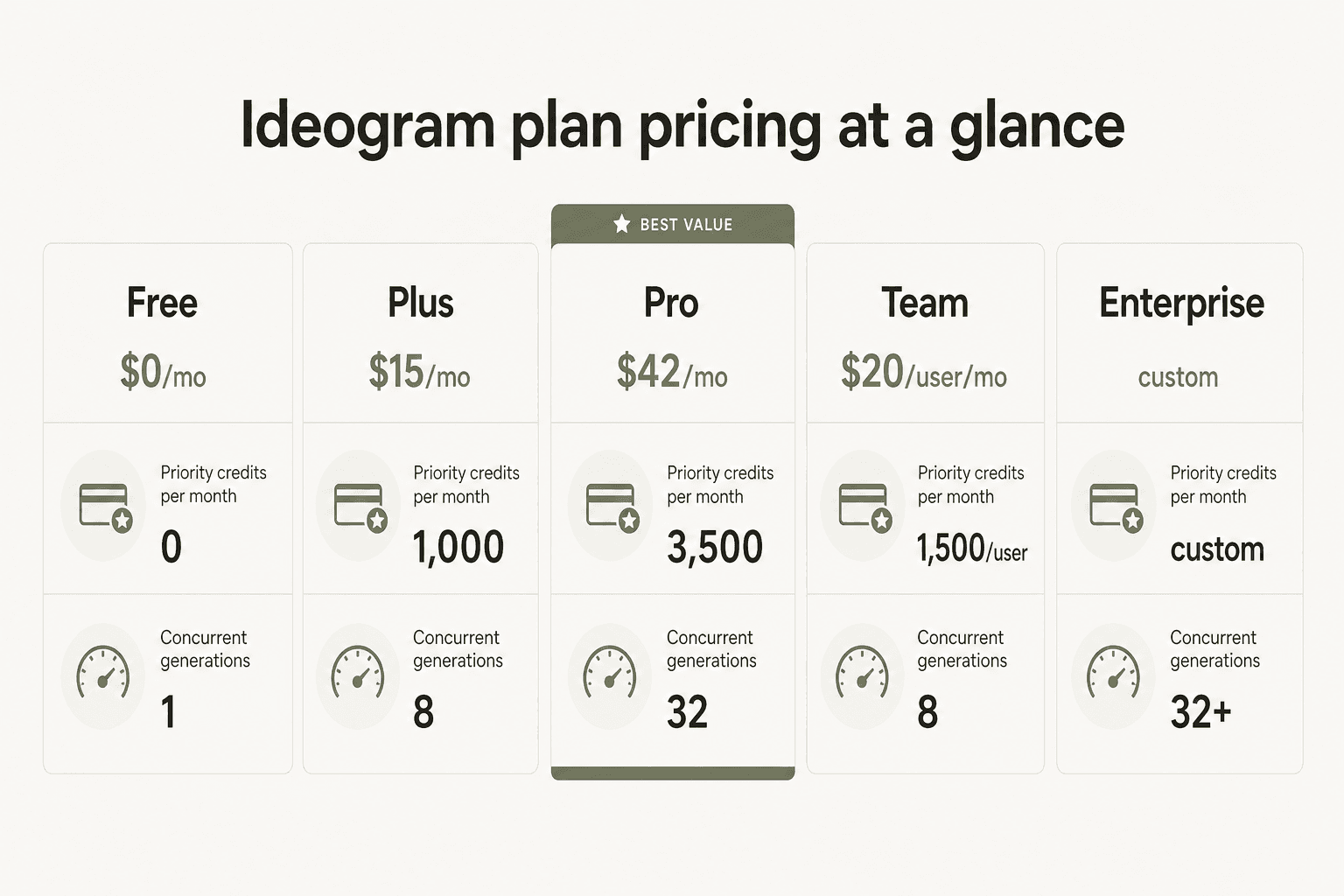
Here's the full picture of what Ideogram charges:
| Plan | Monthly billing | Annual billing | Priority credits | Concurrent generations |
|---|---|---|---|---|
| Free | $0 | $0 | 10 slow credits/week | 1 |
| Plus | ~$20/mo | $15/mo | 1,000/month | 8 |
| Pro | ~$60/mo | $42/mo | 3,500/month | 32 |
| Team | ~$30/user/mo | $20/user/mo | 1,500/user/month | 8 |
| Enterprise | Custom | Custom | Custom | Custom |
Annual billing saves 25% on Plus and 30% on Pro - worth locking in if you know you'll use it consistently.
A few plan-specific details worth knowing:
- Free: All generated images are public and visible in Ideogram's explore feed. You can't delete them. The slow queue wait time fluctuates with platform load - often several minutes per generation.
- Plus: Gets you private image generation, image deletion, quality export (uncompressed PNG), and 8 concurrent generations. Top-up credits cost $4 for 150 priority credits.
- Pro: Adds batch generation (upload a spreadsheet of prompts) and 32 concurrent generations. Top-up credits cost $4 for 250 priority credits - a better rate than Plus.
- Team: Everything in Plus, plus central billing and early access to collaboration features. Structured for teams of two or more.
- Enterprise: Custom models trained on your visual data, volume API discounts, and priority support. Requires contact with sales.
Payment is Stripe only - Mastercard, Visa, American Express. No PayPal or digital wallets. Prices exclude tax; tax is calculated at checkout based on billing address.
How Ideogram credits actually work
This is where most pricing comparisons break down, because "1,000 priority credits" doesn't mean "1,000 images." It means different things depending on which model and quality setting you choose.
| Model | Rendering | Credits | Images per 1,000 credits |
|---|---|---|---|
| 4.0 | Turbo | 2 per image | 500 images |
| 4.0 | Default (Balanced) | 4 per image | 250 images |
| 4.0 | Quality | 6 per image | 167 images |
| 3.0 | Turbo | 2 per 4 images (0.5 each) | 2,000 images |
| 3.0 | Default | 4 per 4 images (1 each) | 1,000 images |
| 3.0 | Quality | 6 per 4 images (1.5 each) | 667 images |
| 2a | Turbo | 0.5 per 4 images (0.125 each) | 8,000 images |
| 2a | Default | 1 per 4 images (0.25 each) | 4,000 images |
| Upscale 1.0 | Default | 1 per image | 1,000 upscales |
So on the Plus plan at $15/month: if you generate exclusively with Ideogram 2a Turbo, you get about 8,000 images. If you use Ideogram 4.0 Quality for everything, you get 167. Most people land somewhere in between - 250-1,000 images per month is a realistic range for Plus plan users working primarily with 4.0 and 3.0 models.
One more thing: Magic Fill (the inpainting tool) only works with 2.0 and 3.0 models, not 4.0. If you're editing images, you're spending 3.0 credits, not 4.0 credits.
Two types of credits
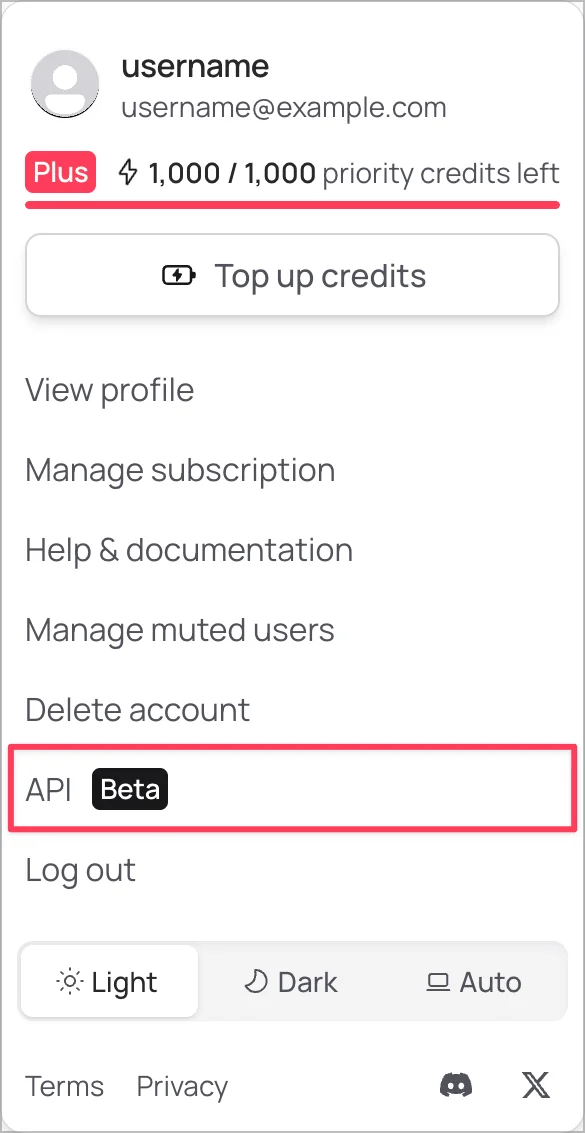
Priority credits come with your plan and expire at the end of each billing cycle. They skip the queue and generate much faster. Once they're gone, you're on the slow queue until the cycle resets (or you top up).
Slow credits are unlimited on Plus and Pro plans, but they come with a catch covered in the next section. Free users get 10 slow credits per week.
Top-up credits are purchased separately, carry over month to month (unlike subscription credits), and are available to any paid plan.
The hidden cost most reviews skip
Here's the thing nobody puts in the headline: unused priority credits expire every billing cycle. Zero rollover.
As one reviewer on pxz.ai put it:
"If you bought a Plus plan at $20/month, got 1,000 Priority credits, used 600, and went on a two-week trip - those 400 credits are gone. Reddit users have flagged this directly, with one r/AIArt commenter noting it's 'designed for agencies, not for normal people who have irregular schedules.'"
That's a real structural issue. If your creative work is seasonal or irregular - you sprint for a project and then go quiet - you're effectively paying for credits you'll never use on the down months.
The slow queue situation is worth knowing too. In January 2025, Ideogram extended slow queue wait times from a 2-minute cap to up to 20 minutes per generation - without announcing the change. This hit annual subscribers particularly hard. One user on Reddit put it bluntly:
"Ideogram has made negative changes without previous announcement before (lowering free users' credits from 25 per day to 20 per day to 10 per day to 10 per week) but this time, things are more severe. This time, the target is paid users... and there was no announcement about these changes at all."
The practical implication: "unlimited slow credits" on Plus and Pro doesn't mean infinite free generation. It means you can generate as many images as you want at a 20-minute pace. For someone doing batch creative work, that's essentially unusable - 3 images per hour.
The free tier has been through its own evolution. In January 2025, the daily limit dropped from 10 credits/day to 10 credits per week - a 7x reduction. The community was not happy. One commenter: "ideoSCAM 😏" - harsh, but it captures the frustration of watching a generous free tier progressively tighten.
Ideogram API pricing
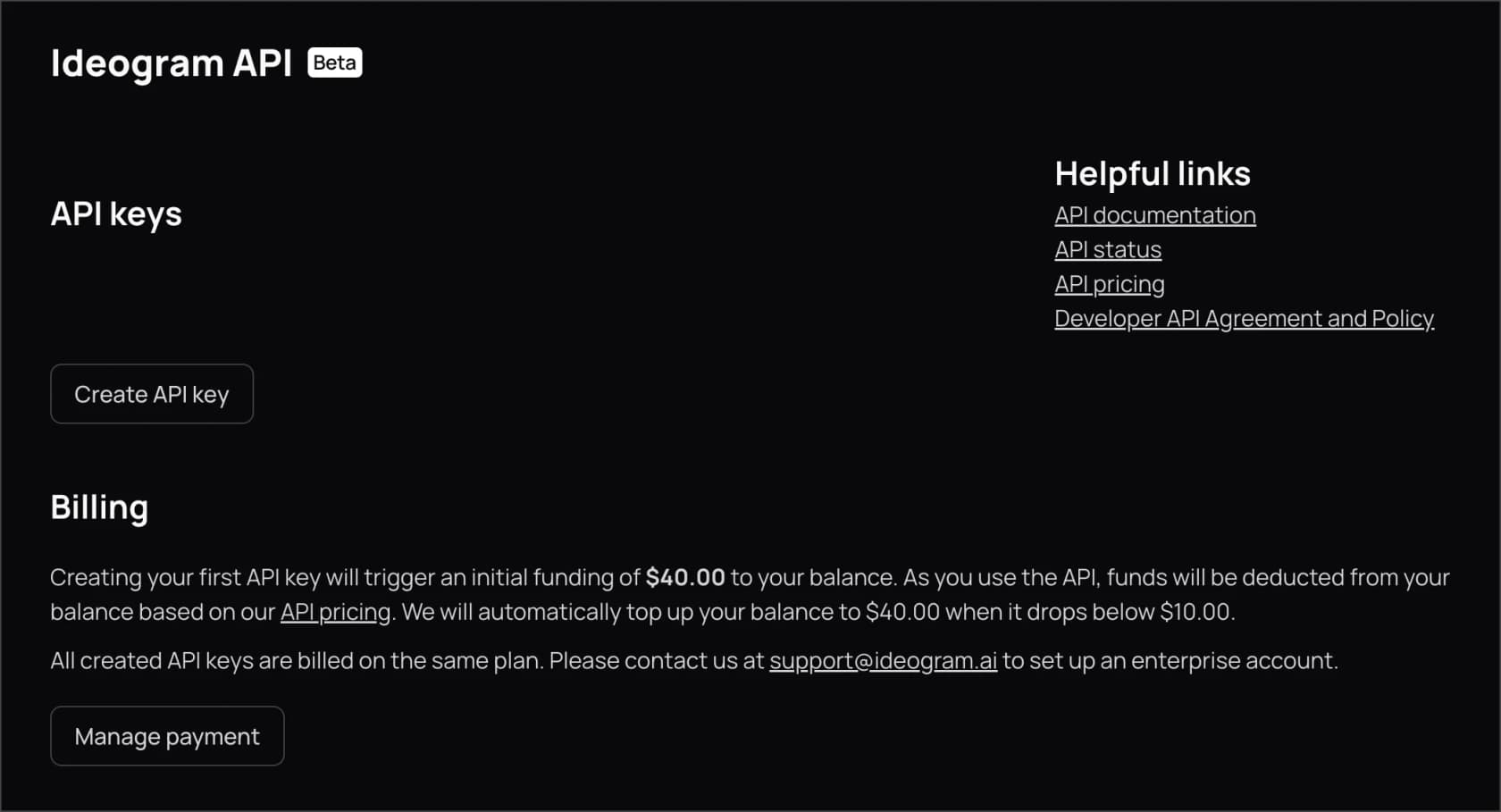
The API is priced separately from subscriptions - you access it via developer.ideogram.ai with its own credit balance. You don't need a subscription to use the API; you just add a payment method via Stripe.
The billing setup works like this: adding a payment method triggers an initial $40 top-up to your API credit balance. Going forward, the system auto-tops up to $40 whenever your balance drops below $10. You can customize this threshold.
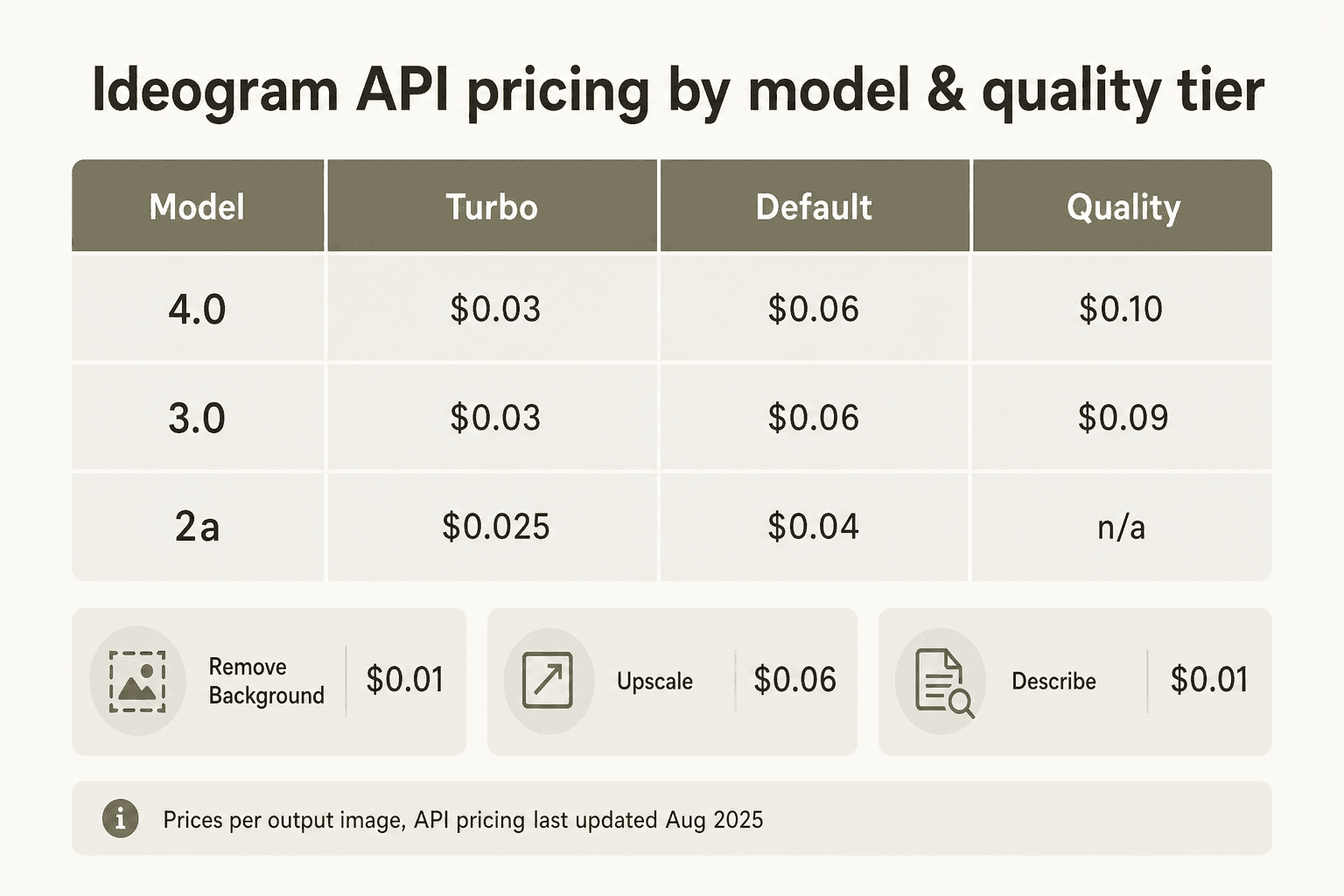
Here's the full API pricing table (last revised August 2025):
Generation, remix, edit, reframe, replace background
| Model | Price per image |
|---|---|
| 4.0 Turbo | $0.03 |
| 4.0 Default | $0.06 |
| 4.0 Quality | $0.10 |
| 3.0 Flash | $0.03 |
| 3.0 Turbo | $0.03 |
| 3.0 Default | $0.06 |
| 3.0 Quality | $0.09 |
| 3.0 Turbo + Character Reference | $0.10 |
| 3.0 Default + Character Reference | $0.15 |
| 3.0 Quality + Character Reference | $0.20 |
| 2.0 Turbo | $0.05 |
| 2.0 Default | $0.08 |
| 2a Turbo | $0.025 |
| 2a Default | $0.04 |
| 1.0 Turbo | $0.02 |
| 1.0 Default | $0.06 |
Utility endpoints
| Endpoint | Per-input fee |
|---|---|
| Remove background | $0.01 |
| Upscale (up to 2x) | $0.06 |
| Describe (image to text) | $0.01 |
Custom model training
Self-serve custom model training costs $40 per training run. Once trained, generation via custom models runs at $0.06–0.18 per image depending on quality tier. Custom models require a minimum of 1 million images/month - this is an enterprise-scale feature.
The default rate limit is 10 in-flight concurrent requests. For higher volume, contact partnership@ideogram.ai for enterprise API agreements.
What Ideogram actually costs you: three worked examples
Casual hobbyist (50 images/month)
The free tier covers you - barely. At 10 slow credits/week (40/month), using Ideogram 3.0 Default (1 credit per image) you get roughly 40 images/month through the slow queue. If you want Ideogram 4.0 Balanced quality (4 credits/image), you're down to 10 images/month.
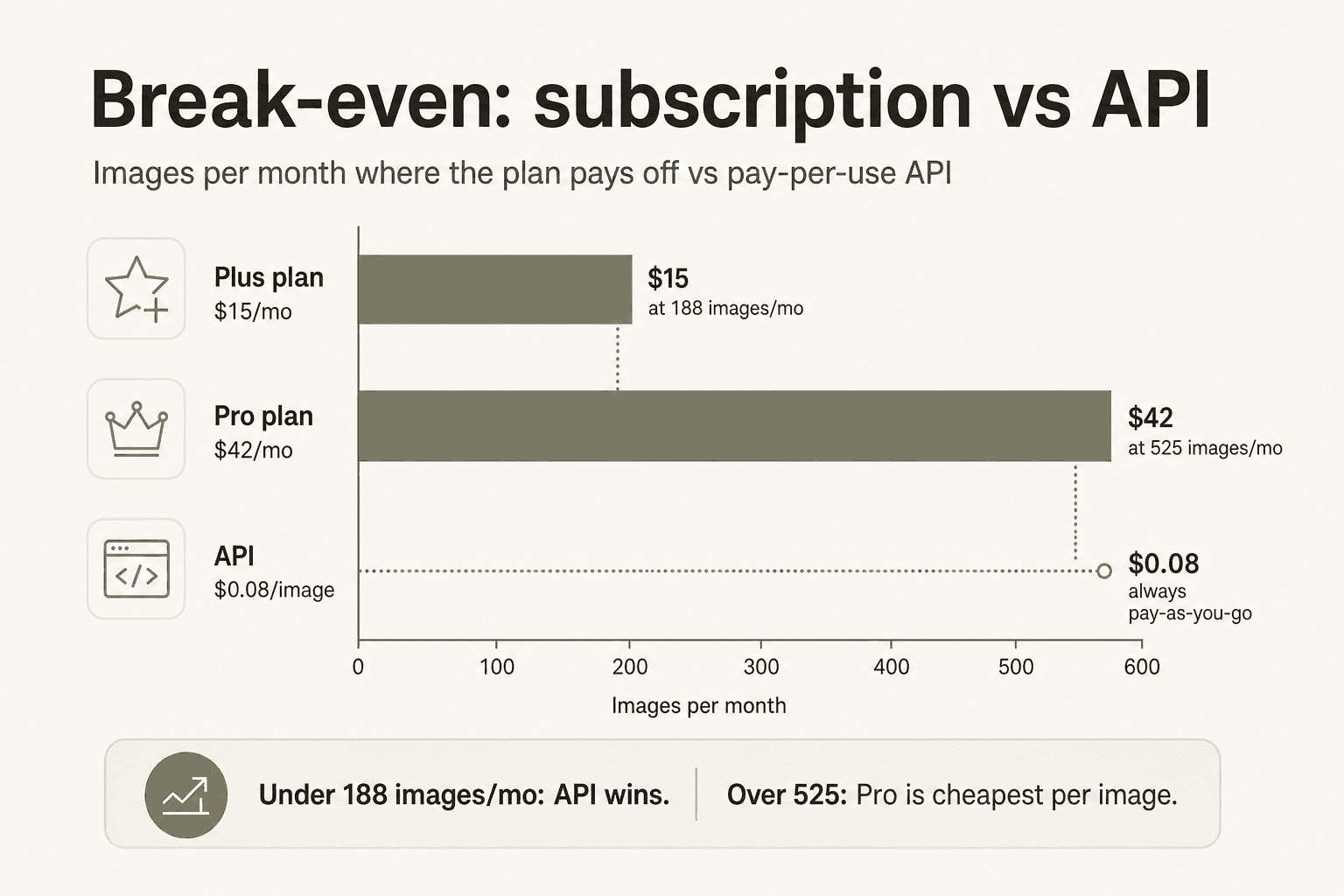
The smarter move at this volume: use the API. At $0.03/image (Ideogram 4.0 Turbo), 50 images costs you $1.50. No subscription required, better model access, and you're not paying a monthly fee for credits you might not fully use.
Regular content creator (250 images/month, needs private)
This is where Plus earns its keep. Free images on Ideogram are public - your prompts and outputs appear in the explore feed. If you're creating branded content, client work, or anything you don't want shared, you need Plus.
At $15/month (annual), Plus gives you 1,000 priority credits. Using Ideogram 3.0 Default (1 credit per image), that's 1,000 images - 4x more than you need, with credits left over for experimentation. Using 4.0 Balanced (4 credits per image), it's 250 images, right at your target.
Compare to the API at $0.06/image: 250 images = $15. Identical cost, but the subscription also gets you 8 concurrent generations, priority queue, and quality PNG export. At 250 images/month, Plus is the obvious call.
Professional agency or developer (1,000+ images/month)
At this scale, the API starts competing with Pro. Pro at $42/month gives you 3,500 priority credits - at 3.0 Default (1 credit per image), that's 3,500 images. At 4.0 Balanced, 875 images.
API at $0.06/image: 1,000 images = $60/month. API at $0.03/image (4.0 Turbo): $30/month.
The break-even isn't just about raw image count - it's about the features the subscription unlocks. Pro includes batch generation (upload a CSV of prompts and run them overnight), 32 concurrent generations, and the largest queue allocation. For teams doing product mockups, catalog images, or social media content at scale, those operational advantages often justify the subscription over pure API.
Ideogram vs. competitors: how the pricing stacks up
Ideogram's headline strength - text rendering inside images - is genuinely hard to find elsewhere at this price. One benchmark from a reviewer who tested 3,000+ images over six months: Ideogram achieves approximately 90% accuracy in text rendering, compared to Midjourney's 30% success rate with short phrases.
Here's how the main competitors stack up on price:
| Tool | Cheapest paid plan | Priority generations | Text rendering |
|---|---|---|---|
| Ideogram Plus | $15/mo (annual) | 1,000 credits (250-1,000 images) | ~90% accuracy |
| Midjourney Standard | $30/mo (annual) | Unlimited fast (~4,000 images) | ~30% accuracy |
| Leonardo AI Pro | $12/mo | 8,500 tokens | Moderate |
| GPT Image 1 (API) | Pay-per-use | $0.040-0.080/image | Good |
| Freepik AI | $9/mo | 100 generated images | Moderate |
| Recraft AI | $25/mo | Unlimited | Good (designer-focused) |
| Canva Magic Studio | Included with Pro ($15/mo) | 500 credits | Basic |
The comparison that matters most: Ideogram vs. Midjourney. Ideogram Plus costs half what Midjourney Standard does. The trade-off is that Midjourney's Standard plan gives genuinely unlimited fast generations (a much higher ceiling), while Ideogram Plus caps you at 1,000 priority credits.
If you generate 250-500 images/month and text rendering matters - logos, posters, social graphics, print-on-demand - Ideogram is the clear value winner. A Texture Queen blogger who switched from Midjourney put it plainly:
"The pricing was a major reason for my switch from Midjourney. At $60 per month, Midjourney was simply too expensive for my use. At the time it also sucked at generating text. Ideogram not only provides a more budget-friendly option for every subscription tier, but also excels at creating images with embedded text."
For pure photorealism and image quality without a text requirement, Midjourney holds the edge. They're solving different problems.
What Ideogram can do with text is genuinely impressive. These were generated through the subscription plan:


Looking beyond images? Ideogram 4.0 also supports character reference - keeping a specific character consistent across multiple generations - which is useful for brand mascots, product characters, and campaign work. Character reference adds $0.05-0.11 to the API cost per image, but subscription users get unlimited character consistency included.

Who should pay for what
Here's the honest breakdown:
| User type | Best option | Why |
|---|---|---|
| Occasional hobbyist | Free tier | 10 credits/week is enough for casual exploration |
| Light variable user | API (pay-per-use) | Pay $0.03-0.06/image only when you need it |
| Regular creator (150-300 images/mo) | Plus ($15/mo annual) | Private images, priority queue, cost-effective at this volume |
| Heavy creator (500-1,000 images/mo) | Pro ($42/mo annual) | Batch generation, 32 concurrent, better credit-to-image ratio |
| Team of 2+ | Team ($20/user/mo) | Central billing, shared administration |
| Developer / high-volume business | API + Enterprise | Volume discounts, custom models, no concurrent limit |
One practical note on the free tier: if you're evaluating whether Ideogram is right for you, start there. The full feature set (styles, remix, character reference, magic fill) is available on free - you're just limited to 10 slow credits per week and public images. That's enough to get a real sense of the quality before committing to a paid plan.
And if you want to test the API without a full subscription setup, Replicate hosts Ideogram models for roughly the same per-image rate without requiring you to wire up your own API billing.
If you're looking at what else is in this space, our roundup of Ideogram alternatives covers 10 tools with comparable pricing and features - and our Ideogram review goes deeper on quality benchmarks.
Try eesel for your content workflow
If you're using Ideogram to generate visuals for blog posts, marketing campaigns, or brand content, the written side of that work can run on autopilot too. eesel is an AI teammate that researches, drafts, and publishes long-form content - sitting inside the tools your team already uses. You can try it free (no card required) at eesel.ai.
Frequently Asked Questions
Is Ideogram free to use?
How much does Ideogram cost per image?
Do Ideogram credits expire?
Is Ideogram Plus worth it?
How does Ideogram compare to Midjourney pricing?


Article by
Rama Adi
Rama is a software engineer at eesel AI with two years of experience writing about B2B SaaS, AI tools, and customer support technology. Based in Bali, Indonesia, he brings a developer's perspective to product comparisons — cutting through marketing copy to what the integrations and APIs actually do.