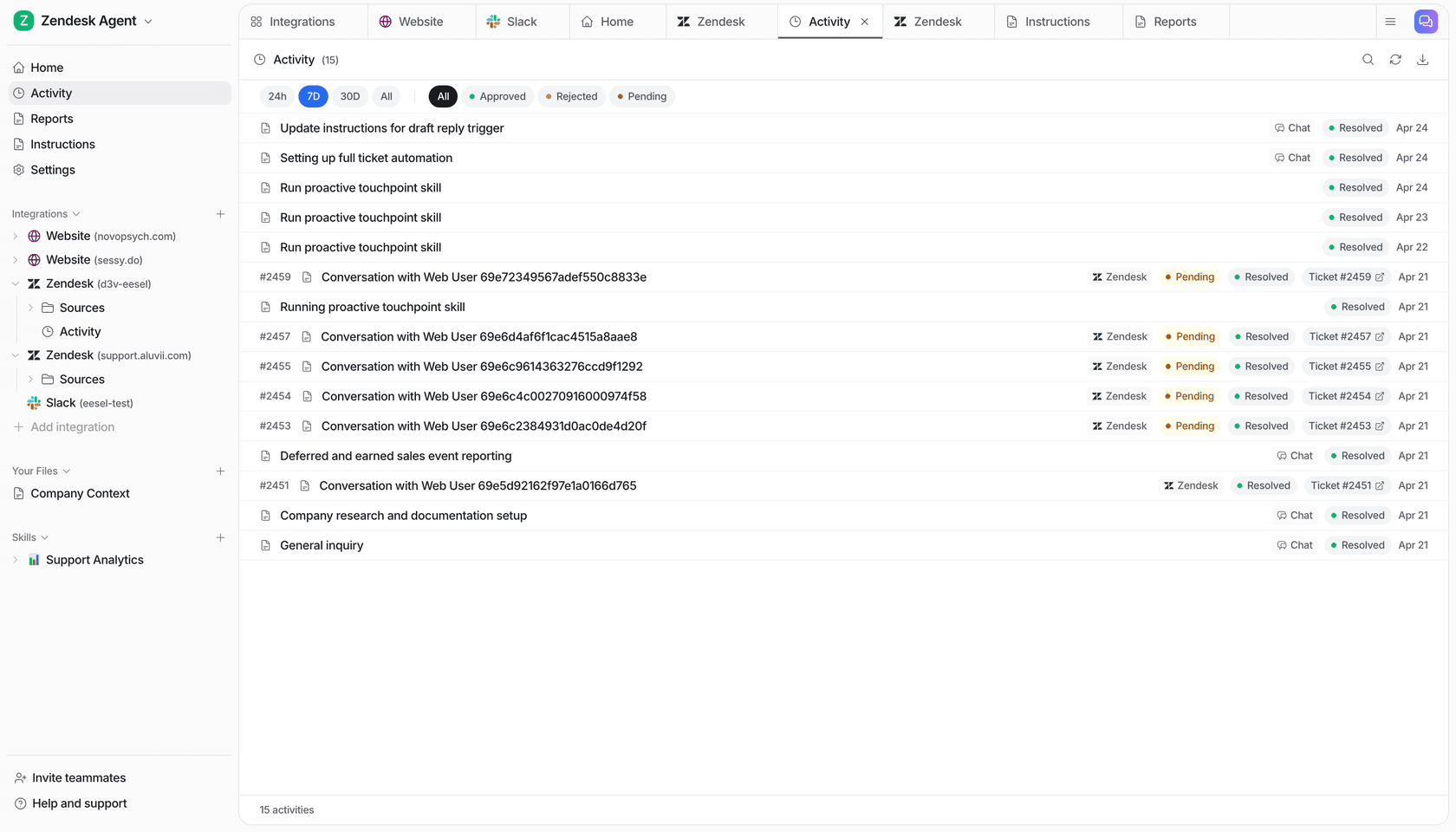


There is no ChatGPT app or official extension for Magento. What exists depends on which job you mean. To get your products found in ChatGPT, Adobe says Adobe Commerce supports OpenAI's Agentic Commerce Protocol, while Magento Open Source stores apply to OpenAI to share a product feed (only Shopify and Etsy catalogs are integrated automatically). For help running the store, ChatGPT is a fine writing and analysis partner, one person at a time. For answering your shoppers, a ChatGPT subscription is off the table, so it's the OpenAI API and a build of your own, Adobe's Brand Concierge, or an AI that already knows Magento.
That last option is eesel. It looks up orders, payments, tracking and stock live in your Magento 2 store, answers shoppers in your storefront chat, and answers your staff in Slack. And what it may do depends on who is asking: your ops lead can have an order held or cancelled with a yes, a customer with their order number and email gets their own order, and an anonymous visitor gets stock and public policy answers only. If you live in the terminal, Codex or Claude Code can run the setup with the eesel CLI, though creating the integration in Magento Admin stays a human step.
Three things "ChatGPT for Magento" can mean
When a Magento merchant says "we want ChatGPT for the store", they mean one of three things. They get very different answers, so here's the map first.
| The job | Official route today | Who it works for | What it costs |
|---|---|---|---|
| Get your products found in ChatGPT | ACP support in Adobe Commerce; an application or Business Hub feed for other stores | Shoppers using ChatGPT in the U.S. | No fees on purchases that start in ChatGPT, per OpenAI |
| Help running the store | A ChatGPT plan for each person | One person at a keyboard | Plus is $20 a month; Business is $25 per user monthly |
| Answer your shoppers and staff | No ChatGPT route; the OpenAI API, Adobe Brand Concierge, or a store-aware AI teammate | Customers on your site, your team in Slack | API tokens plus a build, or a product |
eesel has spent years letting an AI act inside teams' own tools, and the thing that decides whether it works is never the model. It's what the AI may do on its own, what it asks a person about first, and what it must never hand a stranger who types an order number into your chat.
How do you get Magento products into ChatGPT?
Through a product feed, and the path depends on your edition. OpenAI's merchant page says shopping in ChatGPT is built on the Agentic Commerce Protocol (ACP), which today "supports product discovery and more accurate, personalized recommendations through shared product data." Purchases happen on your own site, with "no fees for purchases made on your site or app."
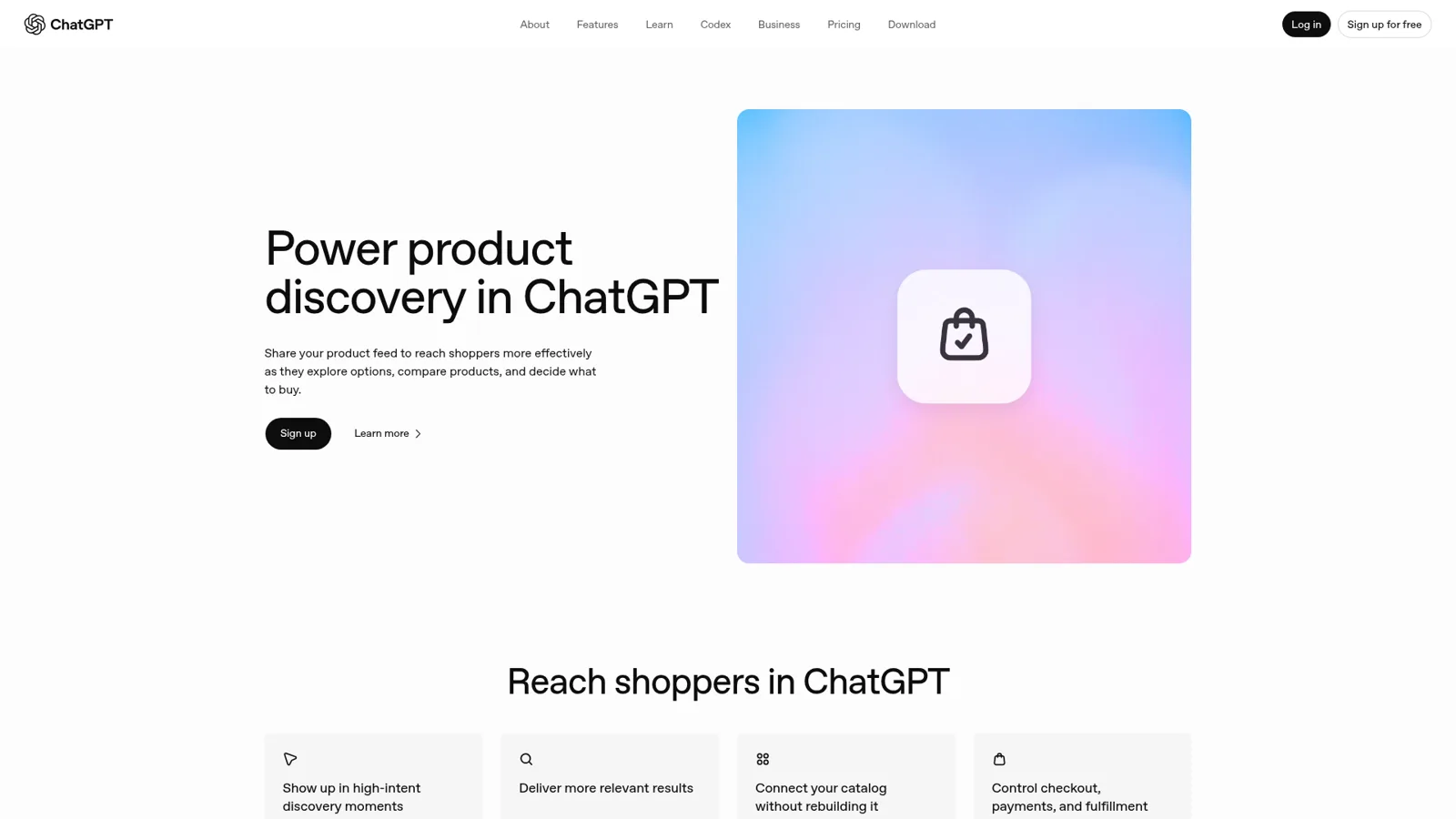
The catch for Magento is the next line: "If you sell through Shopify or Etsy, your catalog is already integrated, and no additional setup or application is required." Everyone else applies with a feed that meets OpenAI's spec and joins a waitlist, and "Shopping is currently live for ChatGPT users in the U.S." OpenAI also opened Businesses in ChatGPT on November 10, 2026, where a verified business can add "self-service product feeds with pricing and availability" in Business Hub, and eligible U.S. ecommerce businesses can publish a Business Agent that answers questions inside ChatGPT. Shopify merchants get a three-step connect; anyone else claims the business by hand. My ChatGPT Business Hub post walks through it.
On Adobe's side, the AI-driven commerce page says "Adobe Commerce supports both the Unified Commerce Protocol (UCP) from Google and Agentic Commerce Protocol (ACP) from OpenAI", and lists LLM-ready product pages and automatic channel feeds. Adobe announced the commitment in a February 2026 post. That's Adobe Commerce, the paid edition. If you run Magento Open Source, the OpenAI application and Business Hub feed are your route.
My Agentic Commerce Protocol explainer covers the protocol itself, and ChatGPT Instant Checkout covers why in-chat checkout was wound back.
Is it worth chasing? Probably, for discovery. Just keep expectations level. One engineer at a point-of-sale company put the buying side well:
"I work for a POS company and was asked about the ACP (Agentic Commerce Protocol) and I told my boss we should skip it for now because of this exact reason."

His reason was that shoppers want to see the price and compare before buying, which is why discovery in ChatGPT and checkout on your own site is the shape OpenAI settled on.
Using ChatGPT to run your Magento store
This is where ChatGPT earns its keep for a single person. Product descriptions for a new range, meta titles in bulk, a pricing analysis from an export, a Magento error message explained in plain English, a first draft of your returns policy. ChatGPT Plus is $20 a month, and ChatGPT Business is $25 per user per month (or $20 billed annually) with a two-seat minimum.
My ChatGPT for ecommerce post covers the store-owner side, and bulk content generation covers doing it at catalog scale.
ChatGPT has real team controls too. On Business, the apps anyone can use depend on what's enabled in the workspace, and OpenAI's workspace agents set write actions for apps to "Always ask" by default. Those controls follow the person using ChatGPT or are set once per agent. What ChatGPT doesn't have is a Magento connection out of the box, so everything about your actual orders and stock still arrives by copy and paste.
Adobe has more of its own AI here than most merchants realise, mostly on Adobe Commerce rather than Open Source:
- Semantic search. Live Search's semantic search matches shoppers to products by meaning rather than literal keywords.
- Brand Concierge. Adobe's conversational shopping guide, which per Adobe uses "catalog content and real-time pricing and inventory from the Adobe Commerce catalog".
- Commerce MCP server. A server that, in Adobe's words, exposes tools agents can use to "search your product catalog, retrieve real-time pricing and inventory, manage cart contents, and complete checkout", for developers building their own assistants.
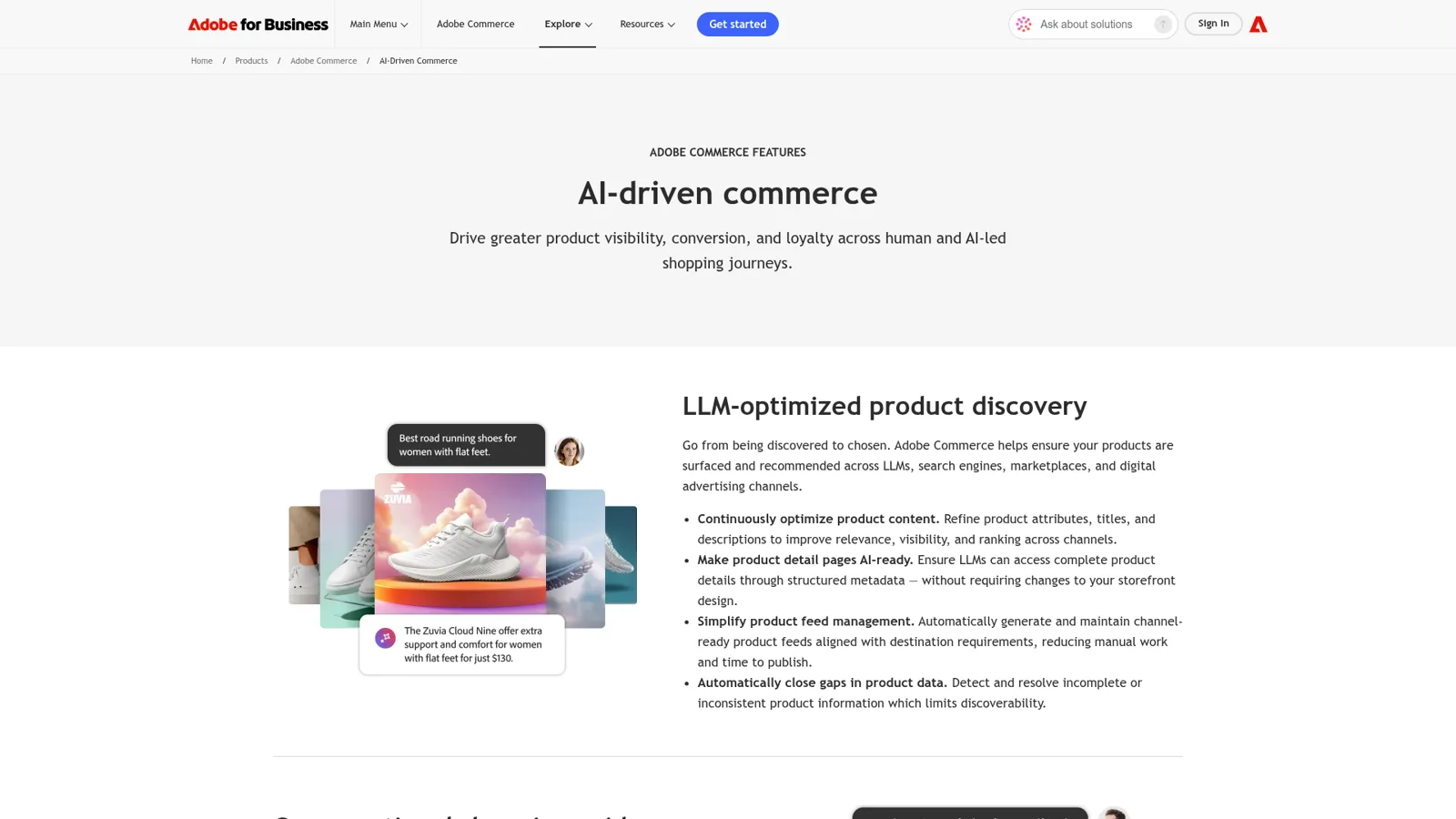
If you're on Adobe Commerce with a development partner, those are worth a look. The Magento AI guide and my Adobe Commerce pricing breakdown go further.
Can ChatGPT answer your Magento customers?
Not as a ChatGPT subscription. OpenAI's plan limits page lists "using ChatGPT to power third-party services" among the uses that aren't allowed, so a ChatGPT seat is a staff tool. A storefront bot means building on the OpenAI API. The model is cheap: on OpenAI's API pricing, GPT-6.2 Sol is $2 per million input tokens and $10 per million output, and GPT-6 Luna is $0.10 and $0.50.
The hard part is getting your store into the conversation. The most honest description of that problem I found is from a Magento developer on OpenAI's own forum, who tried to give ChatGPT the whole catalog at once:
"I am trying to use ChatGPT as the chatbot for my Magento 2 website, and I want to pass product data to it. To do this, I collected all the products and stored them in a JSON file, which I then read to embed the data in the
systemRoleContentof the system role. However, the issue I am facing is that the JSON file is quite large."
The request came back with a rate-limit error: 501,140 tokens requested against a limit of 30,000. The fix is product search the model can call, then order lookups by number and email, tracking, stock per SKU, a handoff to a person, and rules about who may see what. That's a real project. My Magento AI chatbot and AI chat widget for Magento guides cover the build.
Who should your Magento AI answer to?
This is the question a ChatGPT build makes you answer yourself, and it's the one I'd start with. A Magento store has at least three kinds of people asking the same AI for things.
- Your staff. The ops lead in Slack who wants yesterday's pending orders listed, or order 000184 held while someone checks a fraud flag.
- A customer. Someone who gives their order number and the email it was placed under, and wants to know where it is.
- An anonymous visitor. Someone browsing who asks if the linen shirt comes in medium, or who types in a stranger's order number to see what comes back.
eesel's answer is permissions that follow who is talking. Every action is On, Ask first or Off, per agent and per action, and you can set it in a sentence ("look orders up on your own, but ask me before you cancel anything"), per the actions and approvals docs. Ask first shows the exact action with Approve and Deny, and if the request came from Slack the card lands in that Slack thread. Only editors can approve, and on On, eesel's safety check can still hold a risky call. Actions tagged Team only run only when your team asks. On top of that, you set what eesel does for your team, specific named people, a verified customer and an anonymous visitor.
In Magento terms, using the actions on eesel's Magento docs:
| Who's asking | What eesel does | What waits for a yes | What never happens |
|---|---|---|---|
| Ops lead in Slack | Lists orders by day and status, looks up any order, payment, tracking and stock | Cancel Order or Hold Order, if you set them to Ask first | Anything beyond the API access you granted the Magento integration |
| Customer with order number and email | Finds their order, shipment and tracking link, checks stock on a SKU | An address change or a return you route to a person | List Orders, which is Team only and never runs on a customer's chat |
| Anonymous visitor | Product search, variants, stock and price, policies from your site | Nothing account-specific is offered | Order details, customer records, internal docs |
Compare that with the other routes:
| ChatGPT seat | Your own OpenAI API bot | eesel in Magento | |
|---|---|---|---|
| Works for | The person typing | Whoever you build it for | Your store: shoppers and staff |
| Reaches your live Magento data | Only what you paste | What you build | Orders, payments, tracking, stock, customers |
| What decides what it may do | Your workspace's app and agent settings | Your code | On, Ask first or Off per action, plus who is asking |
| Works with nobody at a keyboard | Workspace agents can run on a schedule | Yes, once built | Yes, from a storefront chat, a helpdesk ticket, a Slack mention or a schedule |
| Cost | $20 to $25 per user a month | Tokens plus hosting and engineering | From $299 a month, 7-day free trial |
How eesel works in Magento
You create an integration once in Magento Admin (System, then Extensions, then Integrations), ask eesel's dashboard chat to connect Magento, and paste the four values Magento gives you into a secure form that never puts them in the chat. From then on, per eesel's Magento docs, it reads orders, payments, shipments, tracking and stock live, at the moment someone asks.
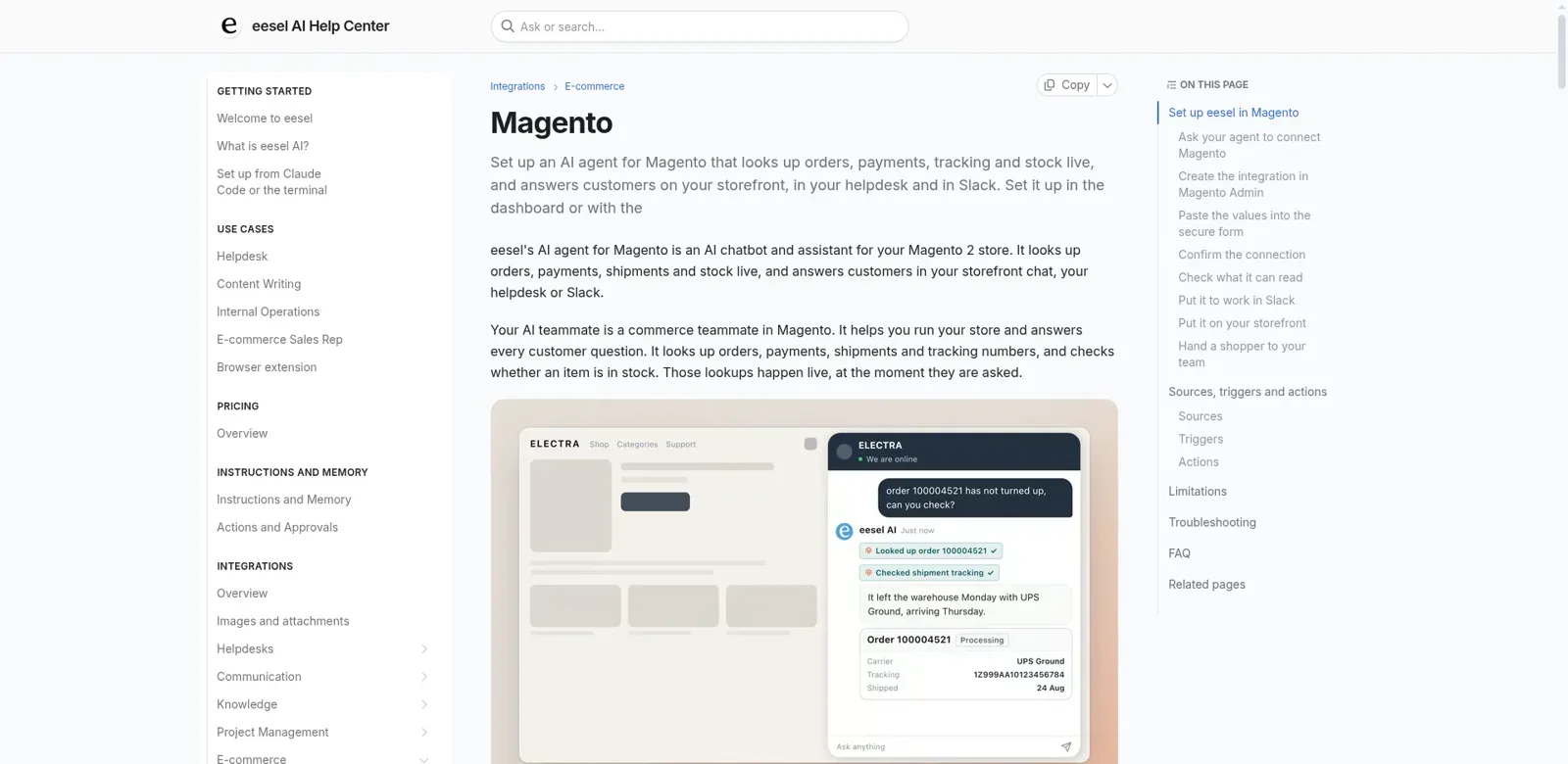
What it does once connected:
- On the storefront. The chat bubble answers stock and product questions from the live store, shows products as cards, and on Magento's Luma theme lets a shopper add to cart from the chat. Magento's RequireJS needs its own snippet, which the docs provide.
- In your helpdesk. It handles tickets in Zendesk, Gorgias or Freshdesk with the order already looked up. My Gorgias for Magento guide covers that pairing.
- In Slack. Staff mention it and get the customer, items, status, payment, tracking and stock back in the thread.
- In the store. It can cancel an order that hasn't shipped, hold and release orders, send order notices, correct a saved customer address, and start a return on Adobe Commerce.
- As a sales rep. The e-commerce sales rep setup recommends products, checks variants and hands a shopper to a person with a ticket when they ask.
It's proactive too. Automations start work from a schedule, an event in a connected app or a webhook, so a morning list of orders stuck in pending can land in Slack before anyone asks. It learns from your docs, past tickets and Slack history, and corrections stick through memory.
Two customer stories show the pattern, both on Shopify stores. IC Intracom runs two brands with one website-chat agent each, answering from 2,100 product records. STIL Classics has eesel look up the order first (230 orders in a month) and leave a draft for a person to send. For brands that want the whole thing done for them, eesel's Managed Support runs your support team for $5,000 a month flat as a founding-partner offer.
Keep ChatGPT, add a teammate
My recommendation for most Magento teams is both. Keep ChatGPT for copy, analysis and the odd Magento error message. Give the shared work (the storefront chat, the order questions in Slack, the 7am pending-orders check) to a teammate that's connected to the store and follows rules about who's asking. eesel's apps for ChatGPT are being listed in ChatGPT's app directory, and Codex can already set eesel up through the CLI. If you're comparing the two more broadly, see eesel vs ChatGPT.
The same split holds on social channels. My Claude for Instagram post makes the case for DMs, where Meta's rules add their own twist.
Try eesel as your Magento teammate
If you searched for ChatGPT for Magento because shoppers are waiting on answers and your team keeps pasting order numbers into a chat window, eesel connects to the store once and answers both groups, with permissions that change with who's asking. It's a free 7-day trial with 100 credits and no card, then plans from $299 a month on the pricing page, with unlimited agents and seats. More on the store side is on the AI ecommerce agent page.