
What a call center actually is
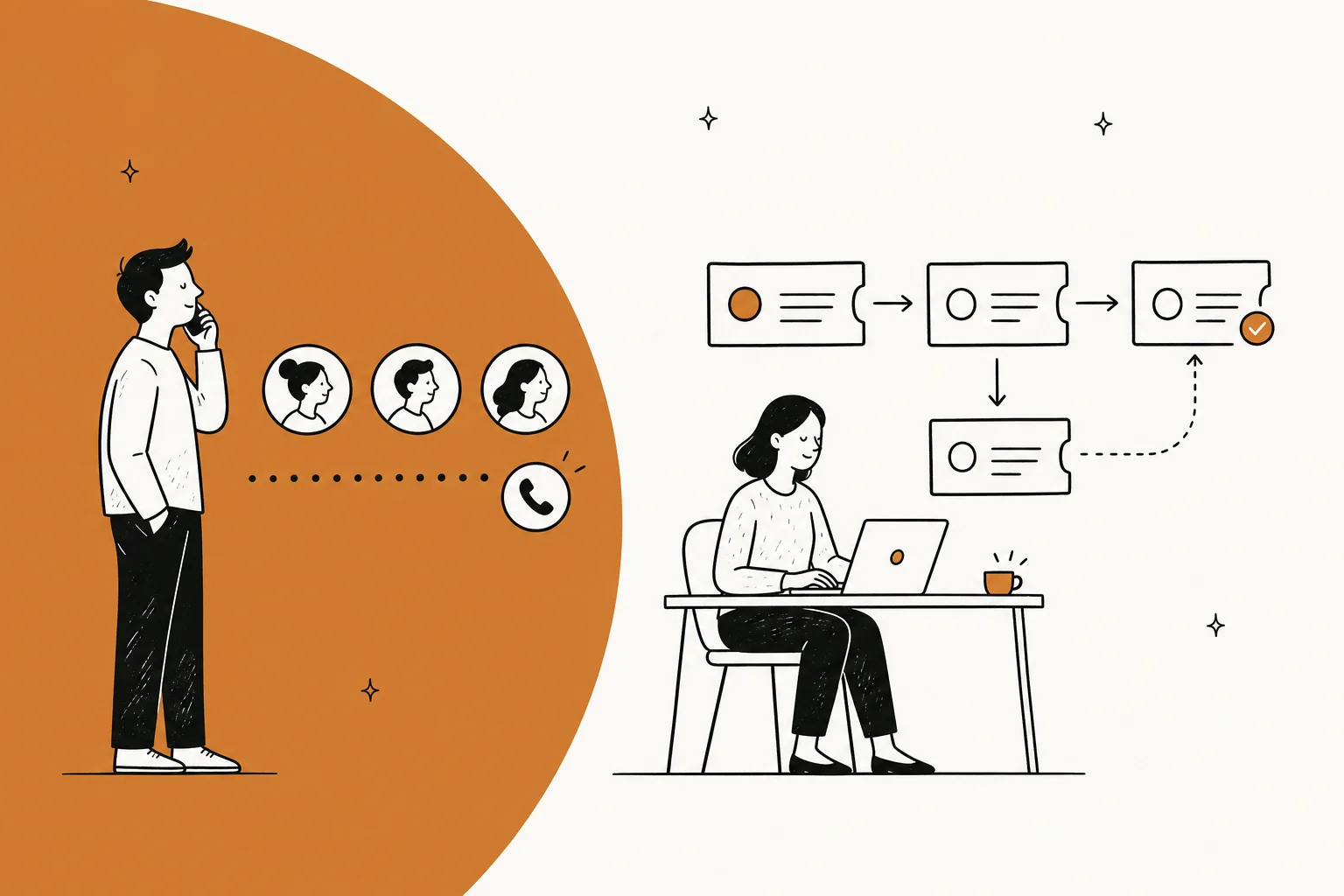
A call center is a voice-first, high-volume operation built around placing and receiving phone calls. Genesys's glossary defines it plainly as "a location or center where calls are placed or received, in high volume, for sales, marketing, customer service, telemarketing, technical support, or other specialized business activities." Zendesk narrows that to the support use case: a team of specialists fielding phone calls from customers with questions, split into two flavors depending on whether the goal is customer satisfaction (support) or "boosting sales, increasing lead generation, and acquiring new customers" (outbound).
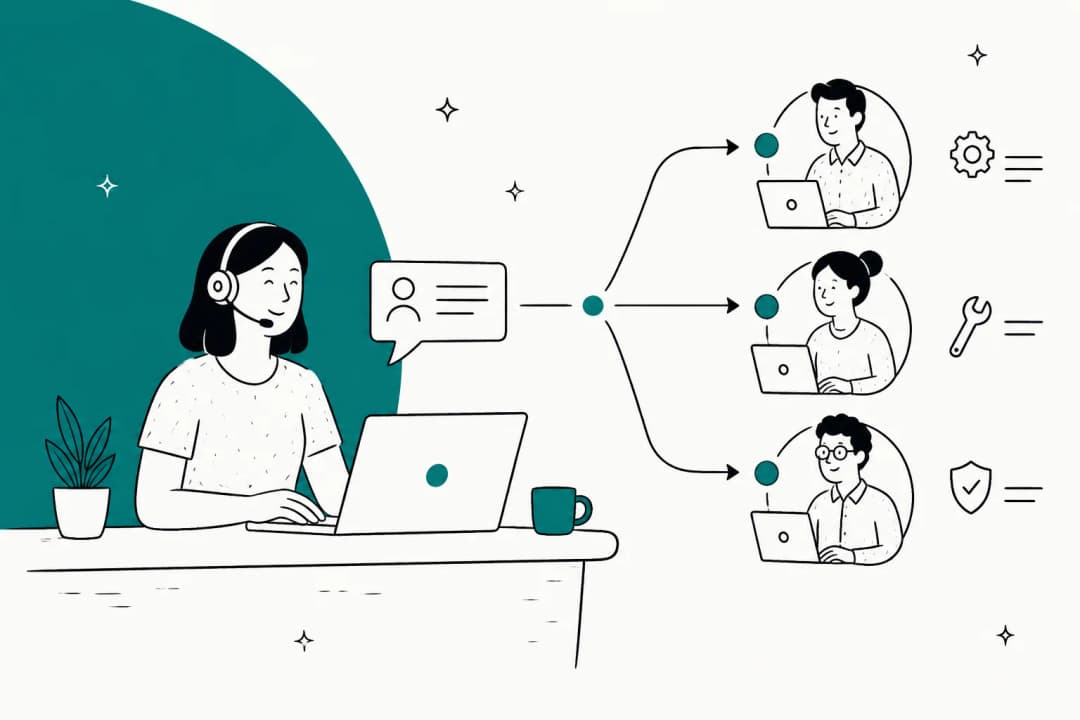
The model is reactive by design. Someone calls in, an agent answers, and the interaction resolves in that single live session, structurally different from a ticket that can sit, get reassigned, and close days later. The technology stack reflects that: an ACD (Automatic Call Distributor) routes the call, an IVR ("press 1 for billing") triages the caller before a human picks up, a PBX manages the underlying telephony switch, and dialers handle outbound campaigns. Once a team adds chat and email on top of that voice stack, vendors usually start calling it a contact center instead, and first contact resolution becomes the metric that matters most for whether a caller actually got helped.
What a call center is measured on is telephony-specific:
| Metric | What it measures | Source definition |
|---|---|---|
| AHT (Average Handle Time) | Total time an agent spends per call, including hold and after-call work, divided by call count | Five9 |
| Occupancy | % of logged-in time an agent is actively on a call vs. waiting for one | Genesys Glossary |
| Service level | % of calls answered inside a target window (e.g. 80% within 30 seconds) | Genesys Glossary |
None of these three measure whether the caller's actual problem got solved. They measure how efficiently the queue moved, which is the whole point of the model, and also its blind spot.
What a service desk actually is
A service desk's definition traces straight back to ITIL, the IT service management framework. Atlassian quotes it verbatim: a service desk is "the single point of contact between the service provider and the users," managing incidents and service requests and handling all communication with users. ITSM.tools puts it more plainly: a centralized point of contact, often called the single point of contact (SPOC), that supports employees or customers with their IT-related issues, requests, and inquiries.
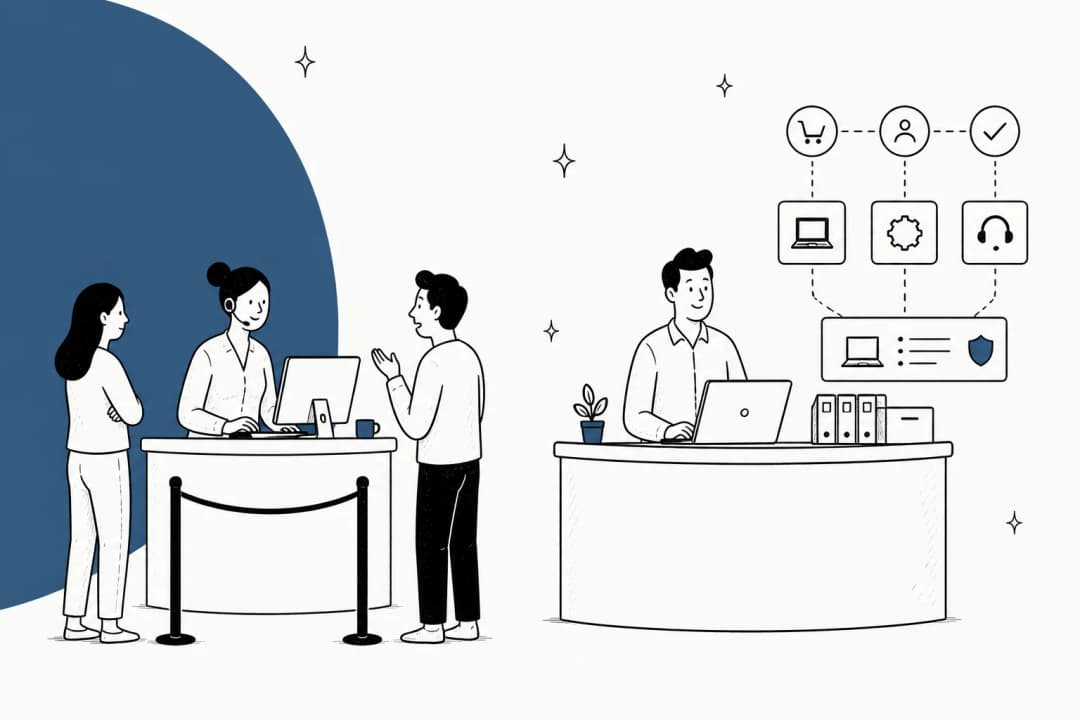
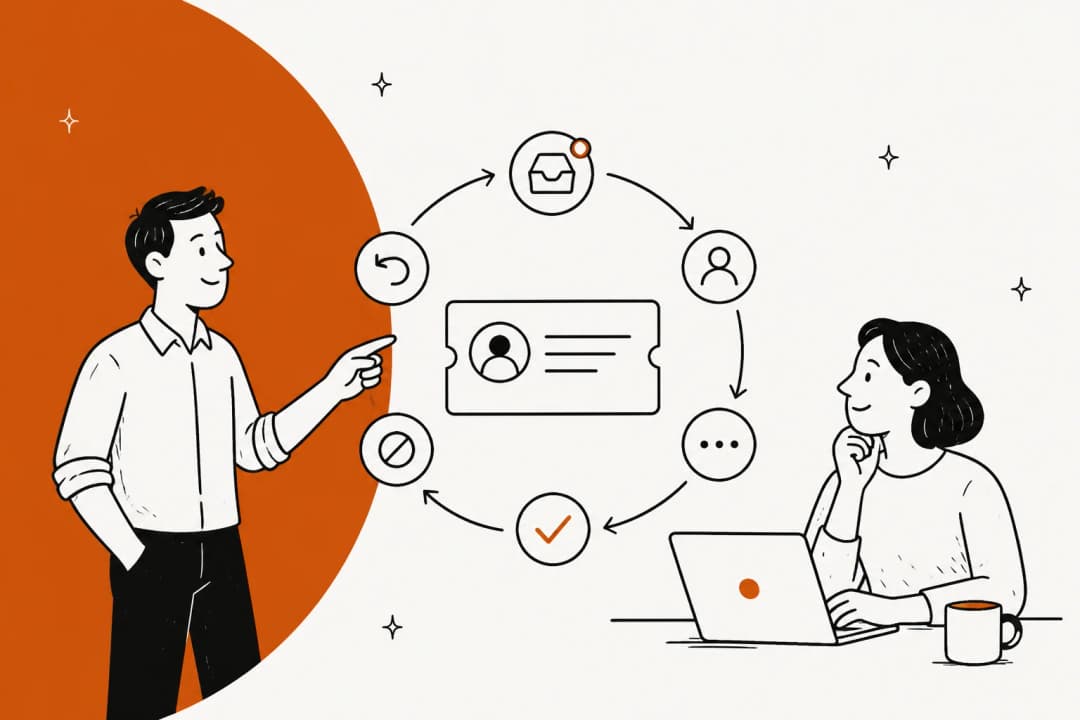
Where a call center's unit of work is a phone call, a service desk's unit of work is a ticket that persists across channels and time, tied into four ITIL practice areas:
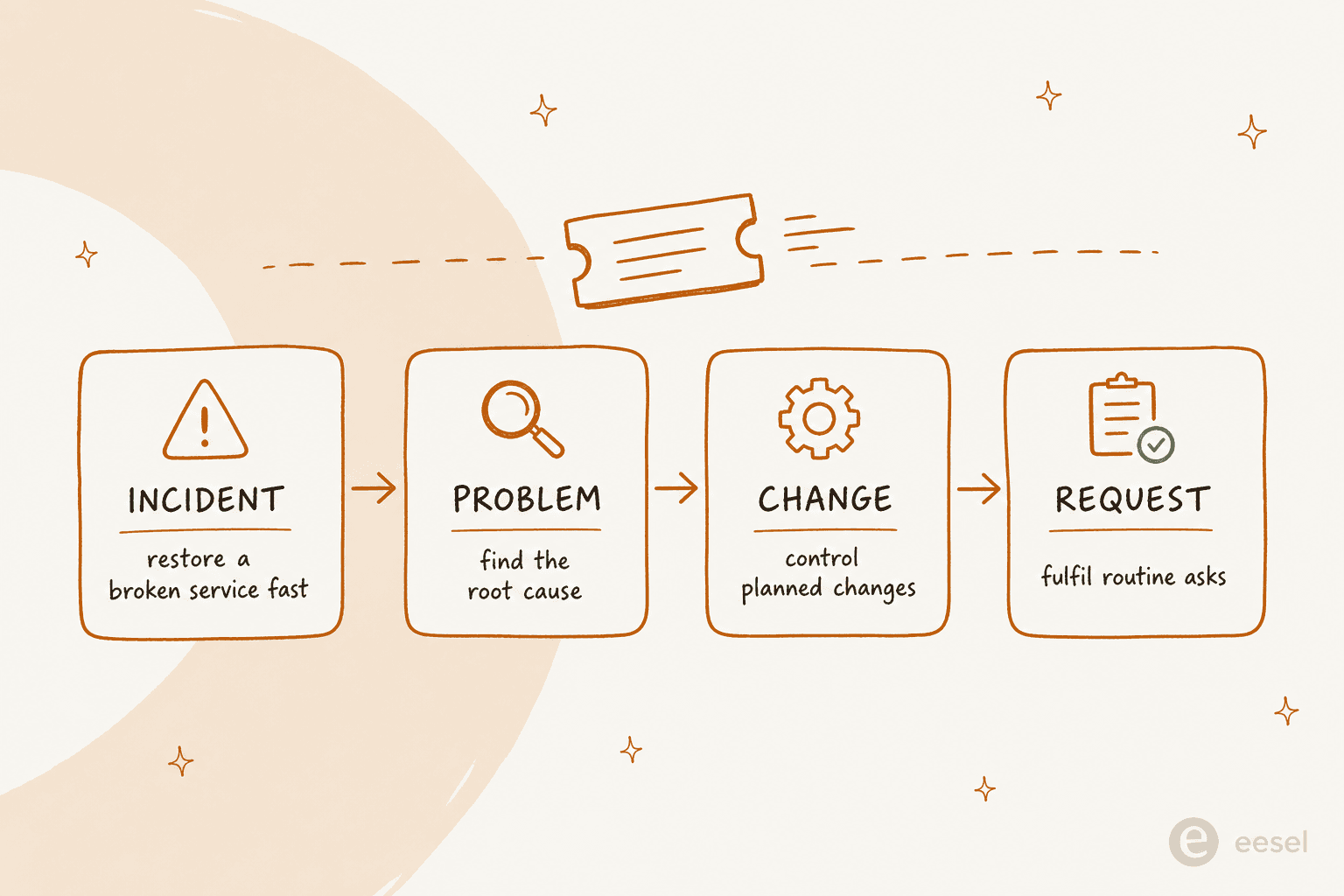
- Incident management - restoring a broken service fast, the classic break-fix.
- Problem management - finding and eliminating the root cause behind recurring incidents.
- Change management - controlling how changes to systems get requested, assessed, and rolled out.
- Request management - fulfilling routine asks (new laptop, software access, a password reset) that aren't technically broken.
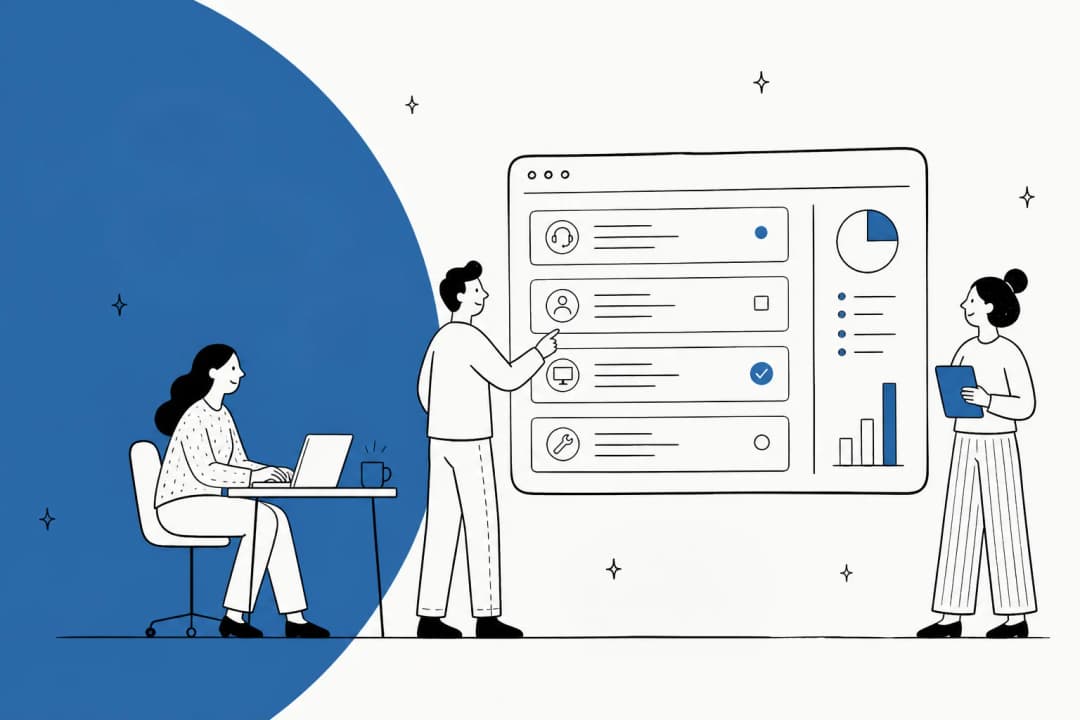
Crucially, service desk isn't an IT-only word anymore. ServiceNow's Enterprise Service Management generalizes the exact same "single point of contact + ticket + workflow" pattern to HR (onboarding, benefits), facilities (desk moves, badges, maintenance), and legal (NDAs, contract review) - all routed through what ServiceNow calls an "enterprise service desk." IT just happened to popularize the pattern first. HR service desks in particular run the identical ticket-and-workflow engine as their IT counterpart, just pointed at a different queue of requests, and even an internal channel like Microsoft Teams now gets treated as just another intake point into that same queue.
Whichever practice area a ticket falls into, most of it still gets triaged the same way a call center triages a queue of callers: a ticket-triage layer decides urgency and routing before anyone specialized picks it up, and a ticket-summarization step is often what makes handoffs between tiers fast instead of a scroll-fest through history.
Where the two models actually differ
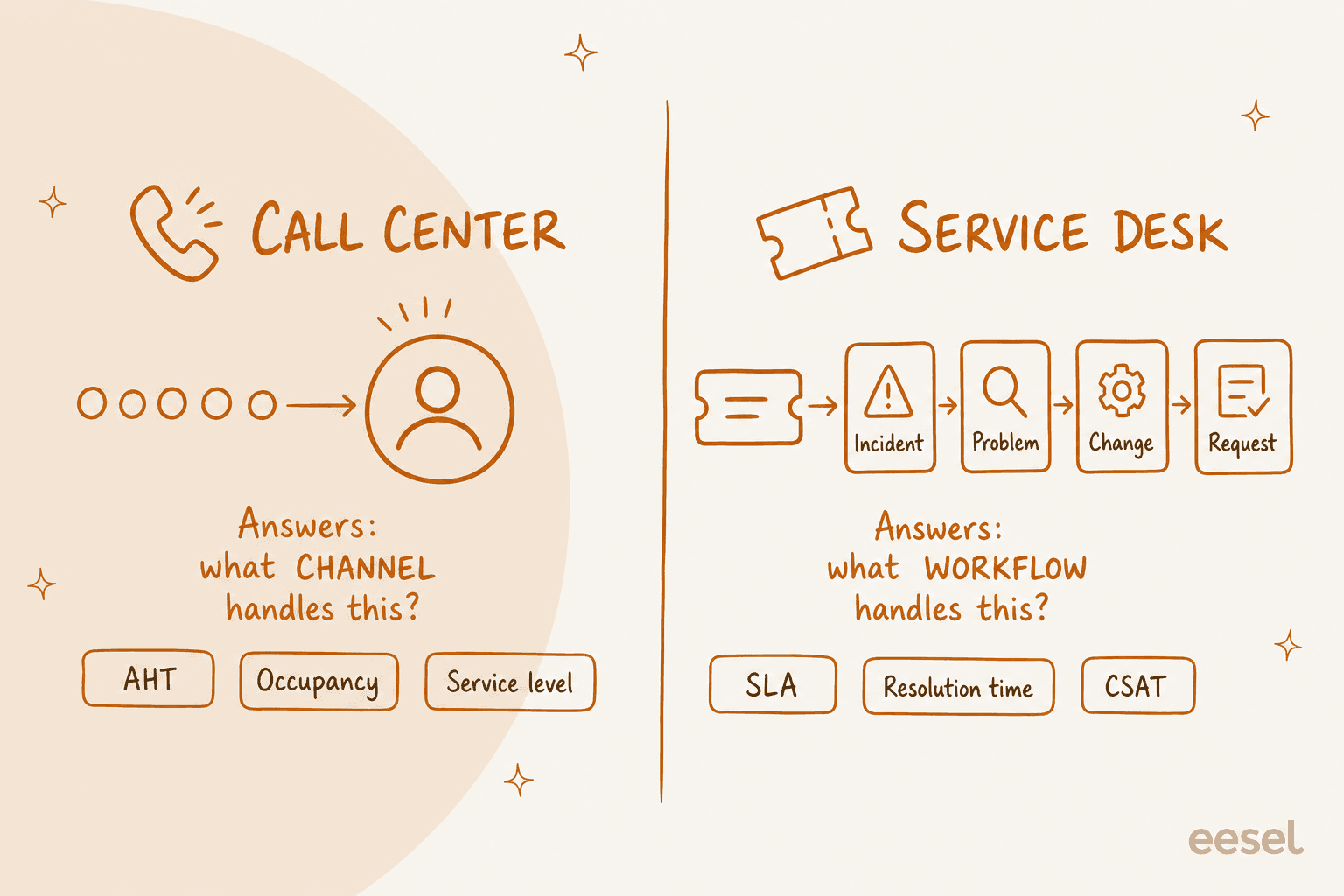
The structural difference is that a call center's clock starts when the phone rings and stops when the agent hangs up. A service desk's clock can run for days across multiple people and stages (triage → assignment → investigation → resolution → closure), which is why its metrics track a process, not a single conversation.
| Call center | Service desk | |
|---|---|---|
| Unit of work | The call | The ticket / case |
| Channel | Voice-first by heritage | Multi-channel by design (email, portal, chat, phone) |
| What flows through it | Inbound support calls, sales, telemarketing, appointment setting - mostly external | Incidents, problems, changes, requests - often internal (IT, HR, facilities) |
| Tooling | ACD, IVR, PBX, outbound dialers | Ticketing/ITSM platform with workflow engine, CMDB, knowledge base |
| Metrics | AHT, occupancy, service level | SLA compliance, resolution time, CSAT |
| Design intent | Live, synchronous traffic | Asynchronous, stateful work |
This is also why the two get confused constantly. Vendor shorthand tends to collapse into a tactical/strategic split: a help desk or call center is tactical - reactive, break-fix - while a service desk is strategic, spanning problem management and integrated business process. A call center can absolutely sit in front of a service desk (calls come in, get logged as tickets, get worked through the same incident workflow), which is exactly where the two models blur in practice.
Which one do you actually need? {#which-one-do-you-actually-need}
Where the lines blur in 2026
The two models have been converging from both directions for a few years, and by 2026 the boundary is genuinely fuzzy at the vendor level.
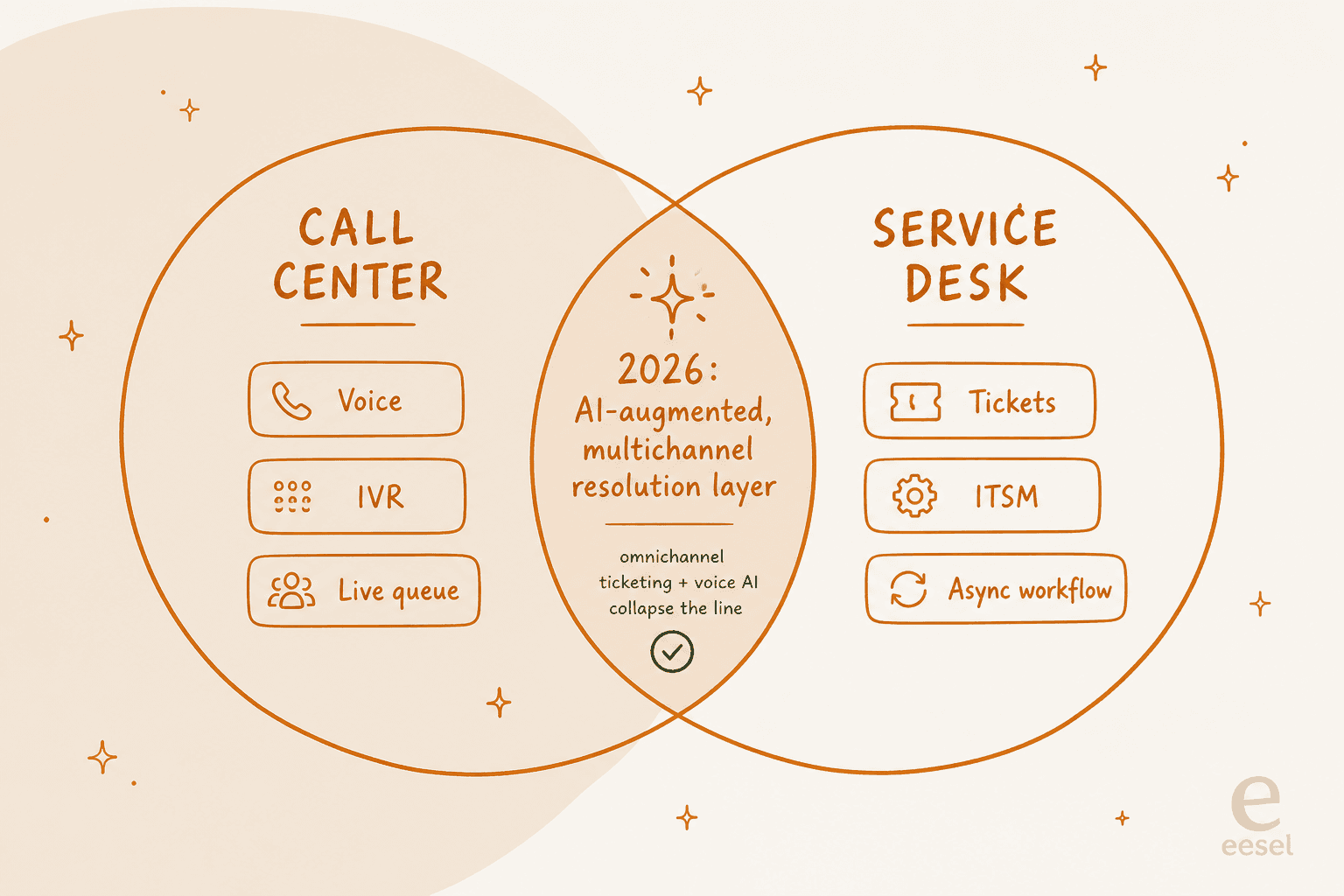
Contact centers now do omnichannel ticketing by default. Freshdesk Omni is a direct example of Freshworks' own positioning: it brings "chat, voice, email, and social support into a unified agent workspace" so that "every message becomes a ticket" regardless of which channel it arrived on. A call is no longer just a call, it's a ticket that happened to start on the phone. The same convergence runs the other way: ITSM platforms increasingly bundle live chat and telephony as just another intake channel into the same ticket queue, rather than treating phone support as a bolted-on afterthought.
On the pure ITSM side, that shift is why buyers now compare Freshservice pricing against Jira Service Management pricing on the same shortlist as a phone-first helpdesk, not a separate category.
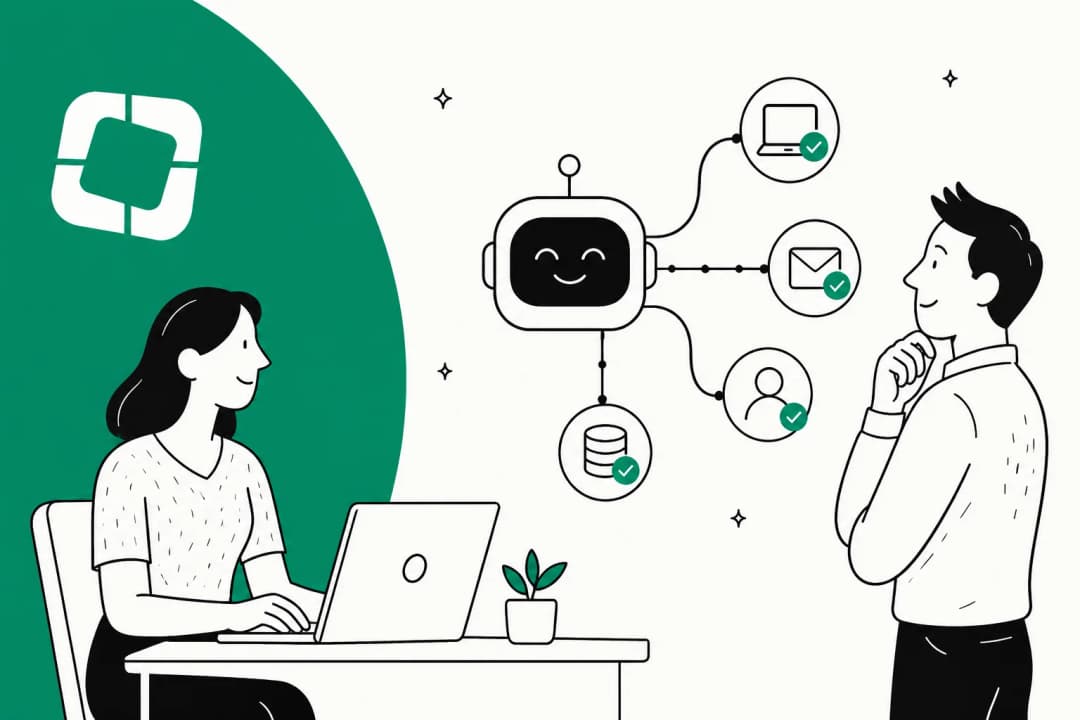
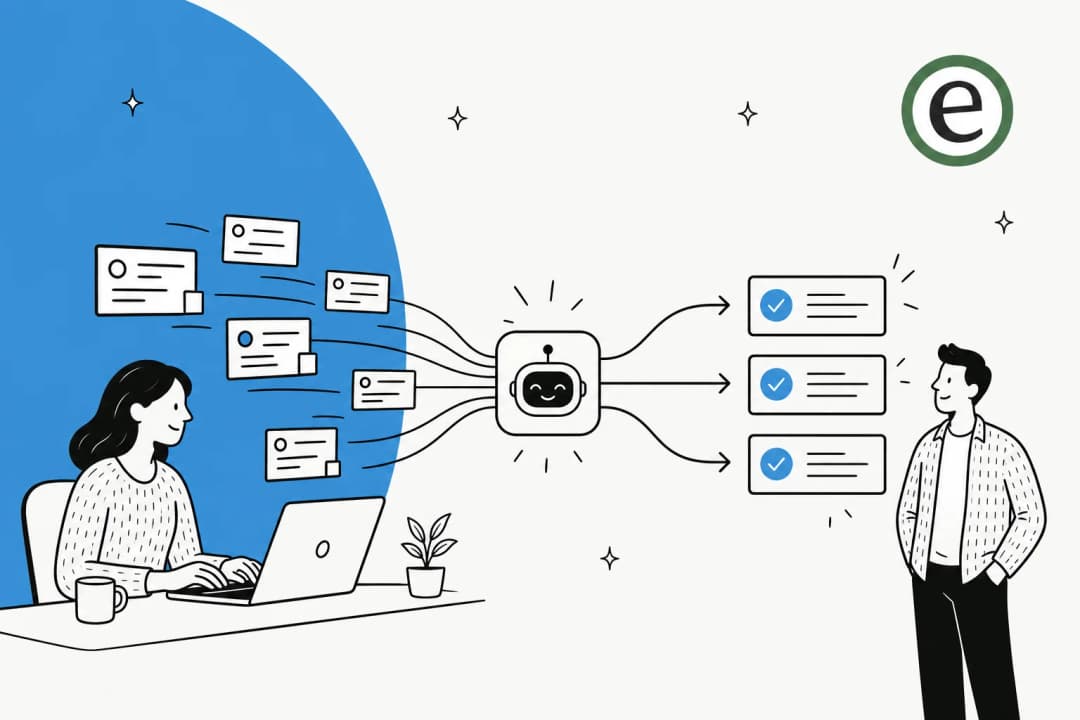
The bigger force collapsing the distinction is AI sitting in front of both. Once an agent is the thing answering the phone, resolving the chat, and triaging the ticket, the operational difference between "a call center that also has tickets" and "a service desk that also takes calls" mostly disappears. Vendors have noticed too - new CCaaS/ITSM product lines are explicitly marketed as one platform spanning both jobs, not sold as either a "call center product" or a "service desk product" the way they were a decade ago. Ticket automation and better resolution-rate tracking are usually the first two things a team asks for once it accepts it's running a hybrid, followed closely by a cleaner escalation path for whatever the AI can't close on its own.
What practitioners actually say
Support practitioners write about this exact confusion in public, and the framing lines up with the vendor glossaries almost word for word.
"Service Desk vs Call Center: What's the difference?"

Negron draws the line on function rather than industry: a service desk "tracks tickets, enables resolution workflows, and supports internal users," while a call center "handles real-time communications - calls, chats, IVRs - with customers or staff." His conclusion is the same one most practitioners land on: not either/or, a combination.
"Just answering phones and passing messages along, or even doing the basic support (e.g. password resets, rebooting systems, etc.), is no longer enough."
Roark's account is the tactical-to-strategic shift lived firsthand: the earliest help desks were essentially phone-answering, message-relay operations, structurally identical to a call center. The "service desk" label got attached the moment the job stopped being "answer the phone" and started being "own the resolution."
Even the naming itself is a running joke inside the industry. Jordan Johnson's own post on the subject is titled "The Helpdesk, HELLdesk, Service Desk, support desk and many other names I can't repeat," which is itself evidence that nobody on the ground experiences a clean taxonomy, just a pile of overlapping labels applied inconsistently by whichever manager set the team up.
How I actually see this play out on a real support queue
I work the support queue at eesel every day, and the channel-vs-workflow split shows up constantly, just not in the words vendors use for it. A ticket comes in from a customer who called first, gave up on hold, and then emailed. By the time it lands in front of an agent, nobody cares whether it "started" as a call center problem or a service desk problem, they care whether it's a ticket that's tracked, owned, and moving toward resolution. That's the service desk model winning by default, even on teams that would call themselves a "support team" and never use the word.
The clearest evidence I've seen that this convergence is real, not theoretical, is InDebted, a fintech/debt-resolution company running a genuine ITIL-style internal service desk on Jira Service Management, backed by Confluence and Slack. Their Head of IT, Jason Loyola, put an AI agent in front of it as the literal first responder: "We use it to be the first responder to our Helpdesk tickets in Jira. It essentially acts just like an agent would." That's a textbook service desk, the exact ITIL practice areas above, with an AI layer doing the triage a human tier-1 agent used to do, and it's the same pattern whether the queue in question is voice, chat, or a Jira ticket.

Try eesel
If your team is stuck straddling both models, an AI helpdesk agent is often the fastest way to stop caring which one you technically run. eesel connects to Zendesk, Freshdesk, and Jira Service Management at once, alongside 100+ other tools, and it learns from your past tickets and docs on day one rather than starting from a blank slate.
Smava runs a fully automated Zendesk agent across 100,000+ tickets a month, and Design.com handles 50,000+ tickets a month on Freshdesk with a multi-agent setup, proof that the same AI layer scales whether the queue in front of it looks like a call center's or a service desk's. The underlying resolution layer doesn't care which label your team uses.
You can try eesel free with 100 credits, no card required, and see which model your own ticket data actually looks like.
Frequently Asked Questions
What is the difference between a call center and a service desk?
A call center is built around a channel: the phone. It routes and queues live calls with ACD, IVR, and PBX infrastructure, and it's measured on queue metrics like AHT and occupancy. A service desk is built around a workflow: the ticket. It's rooted in ITIL and tracks incidents, problems, changes, and requests through to resolution, measured on SLA and CSAT. One is a channel model, the other is a lifecycle model.
Is a help desk the same thing as a service desk?
Not quite. Vendors like Atlassian frame a help desk as tactical: it exists to close the immediate ticket fast. A service desk is strategic: it covers the same tickets plus problem, change, and request management, with an eye on the underlying process, not just the individual case. In practice a lot of teams use the words interchangeably, which is exactly where the confusion starts.
Do I need a call center or a service desk?
It depends on who's asking. If you're IT, HR, facilities, or another internal-ops function fielding employee requests, you want a service desk (or the Enterprise Service Management pattern). If you're customer-facing and the phone is your primary contact method, you want a call center. Most SaaS, e-commerce, and B2B support teams in 2026 actually run a hybrid that's absorbed both.
Can a service desk handle phone calls?
Yes, and increasingly it's expected to. ITIL's own definition of a service desk doesn't specify a channel at all, it just says the desk handles "communication with the users." Modern ITSM platforms bundle live chat and telephony as just another intake channel into the same ticket queue, right alongside email and self-service.
What metrics does a call center actually track?
The three load-bearing ones are Average Handle Time (how long an agent spends per call), occupancy (the percentage of logged-in time an agent is actively on a call), and service level (the percentage of calls answered inside a target window, like 80% in 30 seconds). All three measure queue and staffing efficiency, not whether the underlying problem actually got fixed.
What does ITIL mean by 'service desk'?
ITIL defines a service desk as "the single point of contact between the service provider and the users," responsible for managing incidents and service requests and handling all communication with users. It's the framework that gave the ticket-and-workflow model its name, and it's why an ITSM platform looks structurally different from call-routing software even when both sit in front of the same support queue.
How is AI changing the call center vs. service desk split?
It's collapsing it. Once an AI agent is the thing answering the phone, resolving the chat, and triaging the ticket, the operational difference between a call center with tickets bolted on and a service desk that also takes calls mostly disappears. Both become the same thing: an AI-augmented, multichannel resolution layer sitting in front of whatever's left for a human to handle.


Article by
Riellvriany Indriawan
Riell is a designer and writer at eesel AI with about two years of experience researching CX platforms, AI chatbots, and helpdesk software. She combines her design background with a sharp eye for how these tools actually look and feel in practice — making her comparisons unusually visual and user-focused.