The 8 best ValiOpt alternatives for ecommerce support in 2026

eesel Team
Last edited October 14, 2026

ValiOpt is a done-for-you AI support service for ecommerce brands. Its team builds and runs the automation for you, and it bills $0.50 to $0.90 per resolution on a quote-only basis with no self-serve free trial. That model suits teams who want to hand the whole thing off, but it is a hard tool to try before you commit, and as a brand-new vendor (its Shopify app launched in September 2025 with zero reviews) there is not much of a track record to lean on yet.
If you want to keep control, see the price before you sign, or just add AI to the helpdesk you already run, there are better fits. My pick is eesel, an AI teammate that layers onto your existing helpdesk from $299/month for 500 credits (1 credit per ticket or chat) and lets you simulate on real past tickets before it answers a single customer. Gorgias and Richpanel are the strongest ecommerce-native platforms if you are open to switching, Freshdesk and Help Scout are the best value on the budget end, and Storebird is the one to look at if you are on WooCommerce.
The one thing to get straight before you compare prices: these tools do not bill for the same thing. A resolution, a conversation, a ticket, and a seat are four different units, so a lower sticker rate is not automatically cheaper.
Why look for a ValiOpt alternative
Let me be fair to ValiOpt first, because the pitch is genuinely appealing. Most AI support tools hand you an admin console and expect your team to become AI configurators. ValiOpt does the opposite: "Less admin console. More operational partnership." Their team studies your ticket drivers, builds the workflows, wires the integrations, and keeps tuning after launch. For a lean ecommerce team with nobody spare to own an AI project, that is a real value proposition, and the warranty-claims and returns automation is the kind of deep, action-taking workflow a lot of chatbots never reach.
So why shop around? A few concrete reasons come up again and again when I talk to ecommerce teams weighing this kind of tool.
- You cannot see the price until you talk to sales. ValiOpt publishes an indicative $0.50 to $0.90 per resolution on its pricing page, but there are no tiers, no calculator, and every deployment is quoted around your volume, workflows, and integrations. For a budget-conscious DTC brand, "get a quote" is friction.
- There is no real free trial. The Shopify app is free to install, but you pay per resolution from the first solve. There is no "try it on a sandbox" or "first 100 resolutions free" path, so you are committing before you have watched it handle your tickets.
- It is very new. The Shopify listing went live in September 2025 and still shows zero reviews as of writing. New is not bad, but for a system that will answer your customers, most teams want more of a track record.
- Done-for-you means less day-to-day control. When another team owns your workflows, small changes ("stop offering that refund on final-sale items") route through them instead of a setting you flip yourself. That is the trade you make for the hands-off convenience.
- Resolution billing is not always the cheapest unit. Paying only when the AI solves something sounds efficient, but the per-resolution rate carries the managed service inside it, and it is a different unit from the per-ticket or per-seat pricing most alternatives use.
That last point is the one worth slowing down on, because it is where most comparisons go wrong.
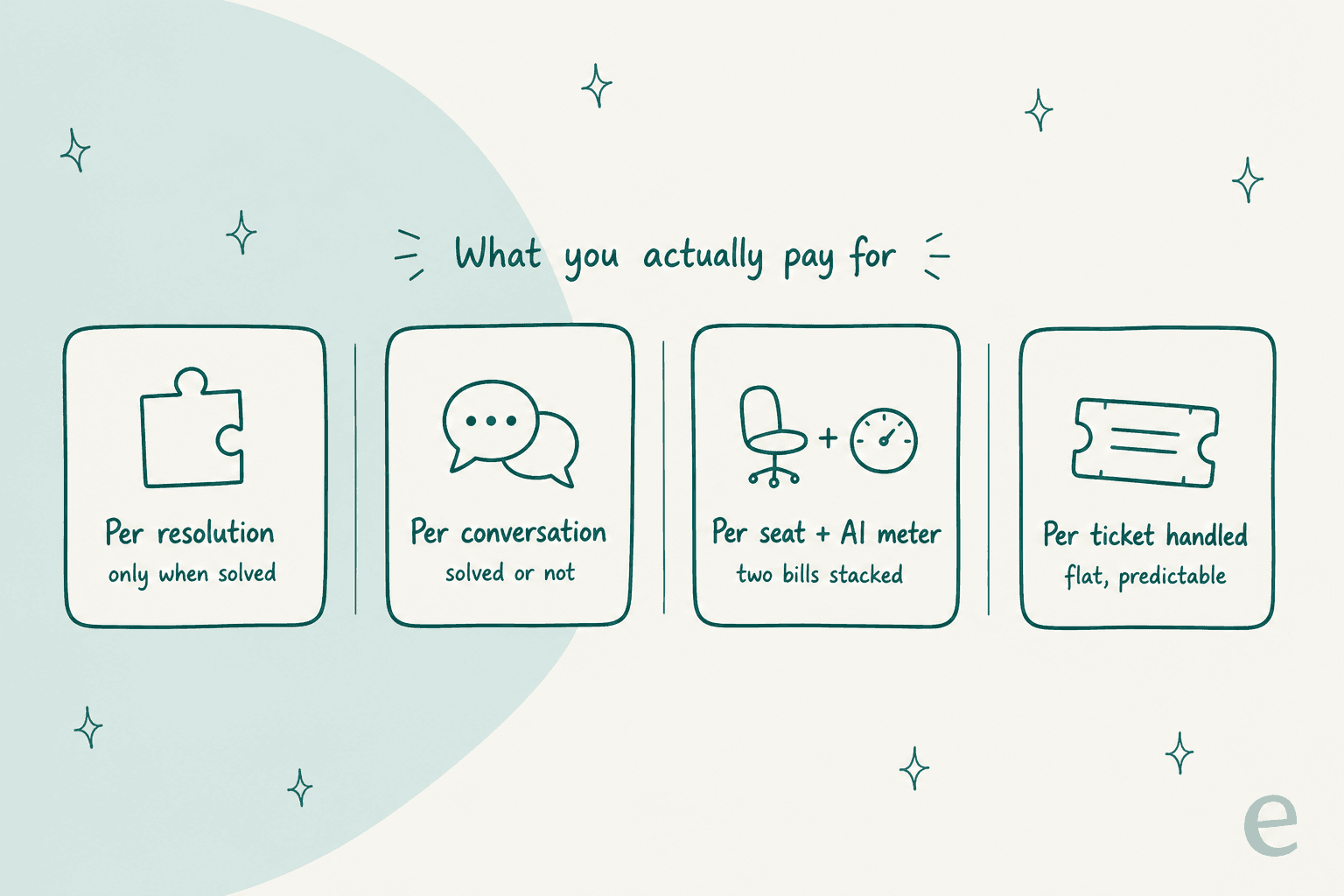
Here is the trap. ValiOpt bills per resolution (you pay when it solves something). Richpanel bills per AI conversation (solved or not). Zendesk and Gorgias stack a seat fee and a per-resolution AI meter. eesel charges a fixed monthly price for credits, one per ticket or chat handled. A "$0.20" and a "$0.90" are not comparable numbers when one covers a wider set of events than the other, so the only honest way to compare is to model your own volume against each unit. There is a calculator further down to do exactly that.
How I picked these alternatives
I run support tickets every day, so I weighted this list toward the things that actually bite once a tool is live, not the feature grid.
- Ecommerce depth: can it look up orders, start returns, and take real actions, or does it just answer FAQs?
- Pricing transparency: is the rate public, and is the billable unit one you can predict?
- Time to value: can you try it, and how long until it is answering tickets?
- Switch vs layer: does it replace your helpdesk, or add AI on top of the one you already have?
- Track record: are there real users and real numbers behind it?
Every tool below is a real product I could research against its own docs, pricing, and user reviews, not a name pulled off an SEO list. Here is the quick comparison, then the detail on each.
ValiOpt alternatives at a glance
| Tool | Best for | Pricing model | Billable unit | Free option | Switch or layer |
|---|---|---|---|---|---|
| eesel | Adding AI to your current helpdesk | From $299/mo for 500 credits, fixed monthly price | 1 credit per ticket or chat | 100 free credits, no card | Layer |
| Gorgias | Shopify-first support teams | Plan fee + AI meter | Automated interaction ($0.85 to $1.00) | 7-day trial | Switch |
| Richpanel | All-in-one ecommerce helpdesk + AI | Seats + AI usage, one bill | AI conversation (~$0.20) + $99/seat | Demo, 30-day guarantee | Switch |
| Re:amaze | Small ecommerce teams on a budget | Per seat + AI meter | $29-69/seat + $0.85/resolution | 14-day trial | Switch |
| Help Scout | Simple, human-first inboxes | Per seat + AI add-on | $25-75/seat + $0.75/resolution | Free (5 users) | Switch |
| Storebird | WooCommerce stores | Flat monthly, capped by volume | Conversations/mo ($39-199) | 14-day trial (Pro) | Switch |
| Zendesk | Larger, multi-channel operations | Seat + AI meter | $1.50-2.00 per resolution + seat | 14-day trial | Switch |
| Freshdesk | Budget teams wanting a free trial program | Seat + AI sessions | Session ($49/100) + seat | 6-month free program (2 agents) | Switch |
1. eesel
Best for: teams who want AI answering tickets this week without ripping out the helpdesk they already run.
I work on eesel, so treat this as the insider view rather than a neutral one, but the reason it leads this list is structural, not loyal. Where ValiOpt is a service that runs your support for you, eesel is an AI teammate you hire and control yourself. It joins the helpdesk you already have (Zendesk, Freshdesk, Gorgias, Help Scout, Shopify, and 1000+ others), trains on your past tickets and help center, and starts drafting or sending replies inside your existing queue.
The part that matters most for a support lead is the simulation step. Before eesel answers a live customer, you run it against your historical tickets and see exactly how it would have responded and what it would have resolved. We built that after watching too many confident-sounding bots quietly give wrong answers on day one. It is the opposite of the "flip the switch and hope" feeling you get with a tool you cannot try first.
Because a person can drive it, scripts can automate it, and coding agents like Claude Code or Cursor can too, eesel also ships a proper CLI, MCP server, and webhooks. If your team lives in the terminal or wants to wire support automation into other systems, you are not stuck clicking through a dashboard.
Pros
- Layers onto your existing helpdesk in minutes instead of a migration project.
- A fixed monthly credit plan from $299 for 500 credits (1 credit per ticket or chat), so the bill is predictable.
- Simulate on real past tickets before go-live.
- Free to start, no credit card, no sales call.
Cons
- It is an AI layer, not a full helpdesk, so you still need the underlying tool (that is the point, but worth saying).
- HIPAA support is Enterprise-only, so regulated-data teams need the higher tier.
- Newer to the pure ecommerce crowd than Gorgias or Richpanel, even though the Shopify and order-lookup pieces are all there.
Pricing: one fixed monthly price, from $299 for 500 credits, with 1 credit per ticket or chat whether the AI resolves it or hands it to a human. You can start free with 100 free credits.
Verdict: if the reason you are looking at ValiOpt is "I want AI on my support without a big project," eesel is the more direct answer, because you keep your helpdesk, keep control, and get to watch it work on your own tickets before you trust it. Global Pay's Chief Innovation Officer put the payoff simply:
With eesel, we can find specific answers to questions extremely fast. We have seen up to 80% time savings.
Alex Capurro, Chief Innovation Officer, Global Pay, via eesel
2. Gorgias
Best for: Shopify-first brands that want an ecommerce helpdesk and AI agent built around order actions.
Gorgias is the default ecommerce helpdesk for a reason. Its Shopify integration pulls order data, refunds, and cancellations right into the ticket, and its AI Agent can take those actions end-to-end. If your queue is mostly WISMO, address changes, and returns, this is the tool most operators reach for. Support teams on Reddit back that up:
If a meaningful chunk is WISMO, address changes, cancels, refunds, exchanges, Gorgias usually feels worth it because the agent can do the work inside the ticket with Shopify context right there.
u/cavalry18, r/CRM

The catch is the billing and a hard platform gate. Gorgias repriced in 2026 to $40, $90, $550, and $1,430 per month across four tiers, each with a bundled AI allowance. The rate is $1.00 per automated interaction on Starter, $0.90 on Basic and Pro, and $0.85 on Advanced, and the plans include 30 to 530 interactions. And a fully-automated ticket is billed twice on newer accounts, the ticket fee plus the automation fee. Crucially, the AI Agent requires Shopify and is not supported on BigCommerce, Magento, or WooCommerce, even though the helpdesk itself is.
Pros
- Deepest Shopify order-action integration in the category.
- AI Agent resolves order-related tickets end-to-end.
- Strong social and DM handling for IG/FB-heavy brands.
Cons
- AI Agent is Shopify-only, a real dealbreaker for WooCommerce or Magento stores.
- Costs climb quickly as volume grows, a common complaint from smaller teams.
- The double-billing on fully-automated tickets surprises people.
Pricing: $40 to $1,430/month by tier, plus $0.85 to $1.00 per automated interaction. 7-day trial, no free tier.
Verdict: the strongest ValiOpt alternative if you are on Shopify and want to own the helpdesk yourself, but check the volume math before you commit, and skip it entirely if you are not on Shopify. Read the full Gorgias review if it is your frontrunner.
3. Richpanel
Best for: ecommerce teams that want the helpdesk and the AI on one bill, with a results guarantee.
Richpanel pitches itself directly at Gorgias and Zendesk with a hard cost promise: cut tickets 50% and reduce support cost 30%, or your money back, even on an annual contract. It combines a helpdesk and AI agents in one platform, and its whole billing argument is "no double-meter" (you never pay per resolution on top of seats). The AI runs about $0.20 per handled conversation on its pricing page, billed on actual token use, plus $99 per human seat. A sample bill on their page lands at $299/month for 1,000 AI conversations and one seat.
That per-conversation rate is the lowest headline number on this list, but remember it is a different unit: a conversation is billed whether or not it resolves. Still, for a Shopify brand that wants an AI-first helpdesk and a guarantee to hedge the risk, Richpanel is a serious ValiOpt alternative, and unlike ValiOpt the pricing is fully public.
Pros
- Lowest published AI usage rate (~$0.20 per conversation).
- Money-back guarantee on automation results in the first 30 days.
- One combined bill, done-for-you migration from Gorgias, Zendesk, and Help Scout.
Cons
- $99/seat adds up for larger human teams.
- The pricing page is now a calculator with a "book a demo" CTA, so no self-serve checkout.
- It is a full switch, not an AI layer on your current tool.
Pricing: ~$0.20 per AI conversation + $99/seat/month, annual saves 17%. Demo-led with a 30-day money-back guarantee.
Verdict: the best "AI-native helpdesk" alternative if you are willing to switch platforms, and the transparency plus guarantee make it a lower-risk bet than a quote-only service.
4. Re:amaze
Best for: small ecommerce teams that want an affordable multi-channel inbox with AI bundled in.
Re:amaze is the value pick. It is a long-standing multi-channel helpdesk (email, chat, social, SMS) that ecommerce teams like for being simple and cheap. Re:amaze's plans run $29 (Basic), $49 (Pro), and $69 (Plus) per member per month, or a flat $59 Starter plan with unlimited members capped at 500 responded conversations a month. Its AI Agent is bundled but still labelled beta, billed per resolution at $0.85 overage, with 5, 10, or 20 included resolutions per user per month.
Watch that last detail: the AI allowance scales with seat count, not ticket volume, so a small team with a big queue burns through the included resolutions fast and starts paying the $0.85 rate. For a store with steady, modest volume, though, Re:amaze is one of the most economical ways to get a real helpdesk plus some AI without a quote-only contract.
Pros
- Cheapest per-seat entry point on this list.
- Multi-channel inbox with a flat-rate volume plan option.
- AI Agent bundled, no separate platform to buy.
Cons
- AI Agent is still in beta.
- Included AI resolutions scale by seats, not volume, so small teams hit overages.
- Less deep on Shopify order-actions than Gorgias or Richpanel.
Pricing: $29 to $69 per member/month (or $59 flat Starter), AI at $0.85 per resolution over the included allowance. 14-day trial.
Verdict: a smart budget ValiOpt alternative for smaller teams, as long as you model the per-seat AI allowance against your actual queue. See how it stacks up in our Re:amaze review.
5. Help Scout
Best for: teams who want a clean, human-first inbox with AI as an optional add-on.
Help Scout is the most human-feeling helpdesk in this group, and that is the point of it. It is a beautifully simple shared inbox and knowledge base, priced per seat, with Standard, Plus, and Pro tiers at $25, $45, and $75 per user per month on annual billing, plus a genuine free plan for up to five users. Its AI Answers feature is a separate usage-based add-on at $0.75 per resolution, so you only pay for AI where you actually use it.
Help Scout is less ecommerce-specialized than Gorgias or Richpanel (fewer native order-action workflows), but for a brand whose support is more conversational than transactional, its simplicity and the free tier make it one of the easiest ValiOpt alternatives to start with. And if you like the inbox but want stronger AI on top, this is exactly the kind of helpdesk eesel is designed to layer onto.
Pros
- Genuinely free tier for up to five users.
- Clean, fast, well-liked interface.
- AI Answers billed only on resolutions you use.
Cons
- Fewer native ecommerce/order-action workflows.
- AI is an add-on rather than the core of the product.
- Per-seat pricing scales with headcount, not automation.
Pricing: Free (5 users), then $25 to $75 per user/month annual, plus AI Answers at $0.75/resolution, with a 16% annual saving. Full detail in our Help Scout pricing guide.
Verdict: the best pick if you value a simple, human inbox over deep ecommerce automation, and the free plan makes it painless to try. Full breakdown in our Help Scout review.
6. Storebird
Best for: WooCommerce stores that want a flat-fee AI chatbot without per-message surprises.
If you are on WooCommerce, most of this list quietly excludes you (Gorgias's AI is Shopify-only), which is where Storebird comes in. It is a WooCommerce-native AI chatbot that syncs your catalog, variations, stock, and orders directly through the data model rather than scraping your site. Storebird's plans are refreshingly flat: $39 (Essential), $89 (Pro), $199 (Scale) per month, with each tier capped by conversations per month (750 / 5,000 / 15,000) rather than metered per message. Its whole pitch is "flat beats per-message spikes on Black Friday."
There is no permanent free tier (a 14-day money-back window, plus a free trial on the Pro plan), and it is WooCommerce-only, no Shopify, BigCommerce, or social channels. But for a WooCommerce store that wants predictable costs, the flat model is genuinely easier to reason about than a per-resolution quote.
Pros
- Native WooCommerce catalog, stock, and order sync.
- Flat monthly pricing, capped by conversations rather than metered.
- Free WordPress plugin as the front end.
Cons
- WooCommerce-only, no Shopify or other platforms.
- Conversation caps per tier, with overage behavior not fully published.
- Very new, so a limited track record.
Pricing: $39 / $89 / $199 per month by conversation cap. 14-day money-back, free trial on Pro.
Verdict: the clear ValiOpt alternative for WooCommerce merchants who want a predictable flat fee. If you already run a full helpdesk, eesel can layer AI onto your WooCommerce support instead.
7. Zendesk
Best for: larger, multi-channel operations that need enterprise scale and reporting.
Zendesk is the enterprise-grade option: the most mature platform here, with the deepest reporting, routing, and channel coverage. Seats run $19, $55, and $115 per agent per month on annual billing across its licensing tiers (Support Team, Suite Team, and Suite Professional), and it now publishes its AI rate clearly: $1.50 per automated resolution on a committed plan, $2.00 pay-as-you-go, with 5 to 10 resolutions included per agent.
The honest caveat is that Zendesk's baseline AI underwhelms teams that expect autonomy out of the box. As one user put it bluntly on Reddit, the Copilot's quality depends heavily on a clean knowledge base:
The Co-Pilot stuff is decent, but we found its effectiveness really depends on having a perfectly curated Zendesk knowledge base, which... ours isn't, lol.
u/ToastBix, r/Zendesk
That is actually a strong argument for the layer approach: rather than switch to (or double down on) Zendesk's native AI, teams often get better results pointing a dedicated AI teammate at Zendesk and training it on past tickets. Our Zendesk AI review goes deeper on where the native tools stop.
Pros
- Most mature reporting, routing, and multi-channel coverage.
- AI resolution rate is now clearly published.
- Huge app marketplace and integration ecosystem.
Cons
- Native AI quality is gated by knowledge-base hygiene.
- The $1.50-2.00 per-resolution AI meter stacks on top of seat fees.
- Overkill and pricey for a small ecommerce team.
Pricing: $19 to $115 per agent/month annual, plus $1.50-2.00 per automated resolution and add-ons like Copilot at $50/agent. 14-day trial.
Verdict: the right ValiOpt alternative only if you need enterprise scale, and even then, pairing it with a dedicated AI layer usually beats its native automation. Compare the full picture with the best AI for Zendesk.
8. Freshdesk
Best for: budget-conscious teams that want a six-month free program and a familiar helpdesk.
Freshdesk rounds out the list as the value-and-familiarity pick. It runs a free program for up to two agents for six months, then Growth at $19, Pro at $55, and Enterprise at $89 per agent per month on annual billing. Its Freddy AI Agent is billed by session: the first 500 sessions are free once per account on Growth, Pro and Enterprise, then $49 per 100 sessions, where a session is a unique end-user interaction (for email, a 72-hour window from the first message).
Freshdesk is not ecommerce-specialized the way Gorgias is, but it is a solid, affordable general-purpose helpdesk, and the six-month free program makes it the easiest no-commitment starting point on this list. As with Zendesk, if Freddy's native automation falls short, eesel can layer onto Freshdesk and train on your ticket history instead.
Pros
- Six-month free program for up to two agents.
- Low entry price at $19/agent for Growth.
- Freddy AI Agent gives 500 free sessions once per account on Growth, Pro and Enterprise.
Cons
- Session-based AI billing (the 72-hour email window) takes some modeling.
- Less ecommerce-native than Gorgias or Richpanel.
- Advanced AI features gate behind higher tiers.
Pricing: Free program (2 agents, 6 months), then $19 to $89 per agent/month annual, plus Freddy AI at $49 per 100 sessions after the first 500. See the Freshdesk AI pricing breakdown.
Verdict: the best ValiOpt alternative for teams who want to start free and keep costs low, especially if your support is general-purpose rather than deeply ecommerce.
Switch or layer: the decision that actually matters
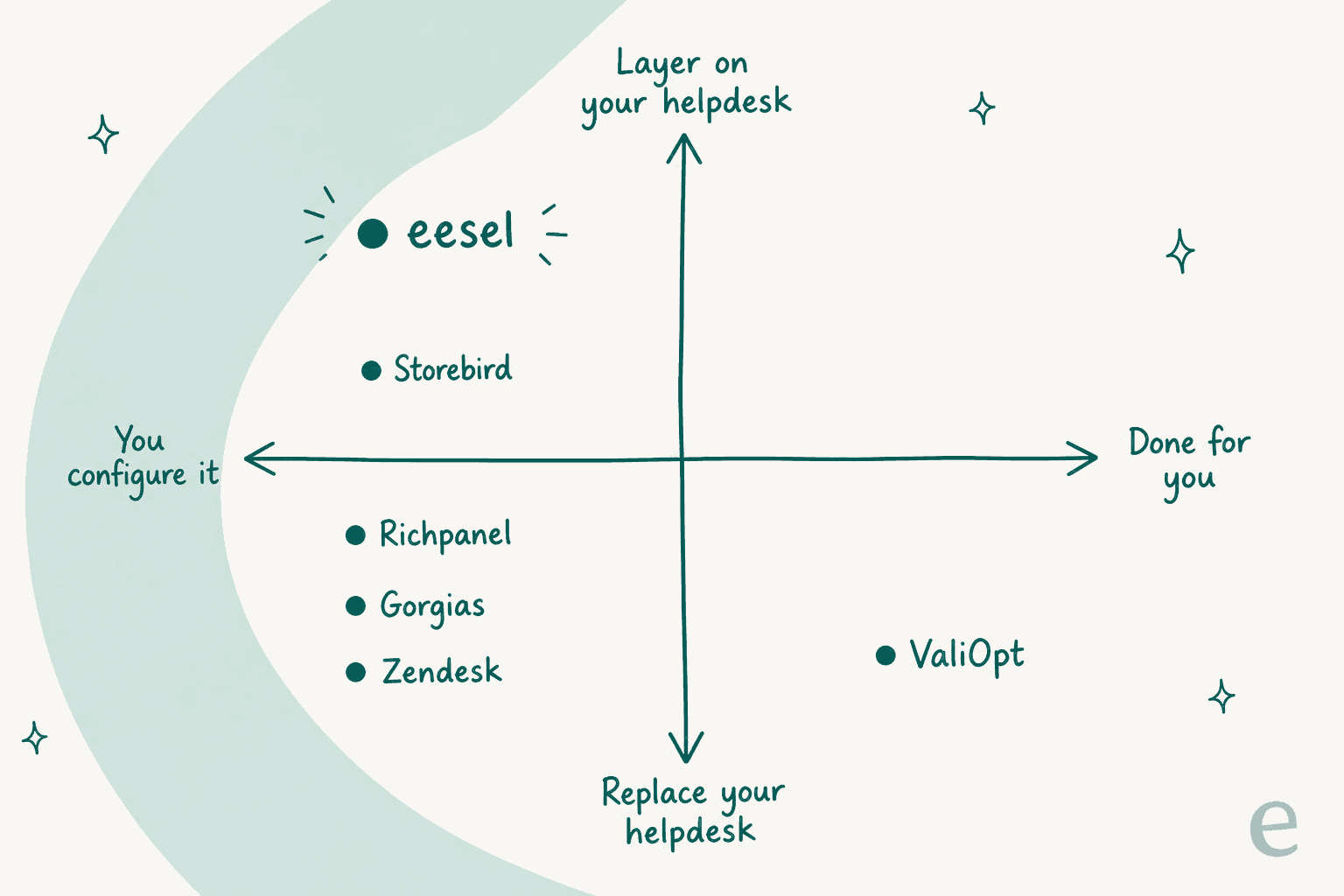
Notice the pattern in that table. Six of these tools are helpdesks you would switch to, ValiOpt is a service that runs support for you, and eesel is the one that adds AI onto whatever you already have. That switch-versus-layer choice matters more than any single price, because a platform migration is weeks of data moving and team retraining, while layering AI on top is a job you can finish this week.
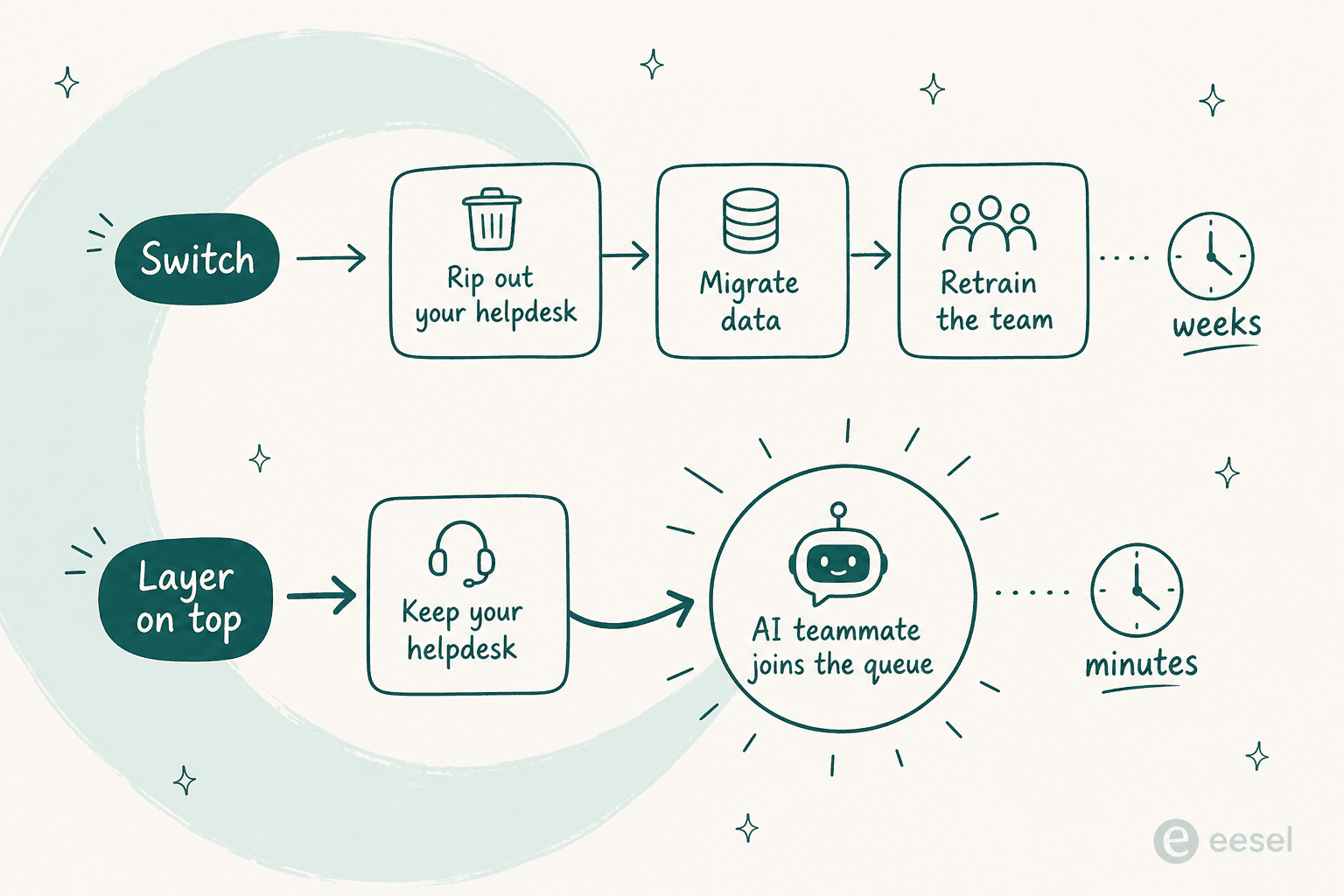
The reason this is worth pausing on: most teams do not actually want a new helpdesk. They like the one they have, their agents know it, and the pain they are trying to fix is "too many repetitive tickets," not "our inbox is broken." For those teams, ripping out the platform to get AI is solving the wrong problem. Pointing an AI teammate at the existing helpdesk, training it on past tickets, and simulating before go-live gets the automation without the disruption.
Here is where each tool sits on the two axes that decide this, how much you configure yourself versus how much is done for you, and whether you replace the helpdesk or layer onto it.
Model your real cost before you decide
Because these tools bill on four different units, the only way to compare them fairly is against your own volume. Plug in the number of tickets or resolutions you handle a month and see how the models diverge. (Rates are indicative list prices; a resolution, a conversation, and a ticket are different units, so read this as a directional model, not a quote.)
The takeaway is not "eesel is always cheapest," it is that the cheapest sticker rate rarely wins once you account for what each unit actually covers and whether a seat fee stacks on top. A fixed monthly credit plan is easy to forecast; a quote-only per-resolution service is not, until you have signed.
Try eesel
If your reason for looking at ValiOpt was "I want AI handling my ecommerce tickets without running a whole project," eesel is the most direct way there. It is an AI teammate that joins the helpdesk you already run, trains on your past tickets and help center, and can look up orders and take actions inside your existing queue, no migration required.

The differentiator against a done-for-you service is control plus proof: you simulate it on your own historical tickets first, so you know its resolution quality before a single customer sees it, and the pricing is a fixed, published monthly plan from $299 for 500 credits that you can predict from day one. You can try eesel free, no credit card and no sales call, and have it answering tickets in minutes.