The 9 best Umnico alternatives in 2026

Kurnia Kharisma

Katelin Teen
Last edited October 12, 2026

Why people look for Umnico alternatives
Let me start with the fair part, because Umnico gets a few real things right. It is genuinely good at one hard problem: connecting personal WhatsApp and Telegram accounts (not just the official API) alongside 25+ other channels in one window, which reviewers say is hard to find anywhere else. One head of sales on G2 credits it with a real result:
"Umnico platform is the only one of its kind that allows you to connect personal Whatsapp/Telegram in addition to chatbots and add all necessary social networks... Right after the introduction of the platform, the conversion rate increased by at least 20%"

It is also cheap to start and quick to set up. Teams report onboarding in a few days with no training, and there is a genuinely usable free setup. So why do people leave? A few reasons come up again and again once you get past the marketing page.
The pricing gets fiddly. Umnico doesn't sell tiers. You build your own plan by adding integrations à la carte, and the price is the sum of everything you switch on. Website live chat, Instagram, Facebook Messenger, telephony, and most CRM connectors are free, which is great. But the paid channels stack up: the WhatsApp Business API is $29.25/month, Avito is $22.75, VK is $16.25, and every extra operator seat after the first is another $29.25/month. For one person that is nothing. For a team of ten running WhatsApp plus a couple of paid channels, you are quietly assembling a real bill, and buyers notice.
"The price becomes a little bit higher when you have multiple users and need to add instant messengers... Your mobile app need improvement because it comes with very limited options."
The WhatsApp connection can be shaky. This is the most consistent technical complaint across surfaces. G2's own review summary flags "occasional issues with integration stability, particularly with WhatsApp," and a small-business owner hunting for a WhatsApp CRM put it plainly:
"I gave Umnico a try. I do really appreciate that it uses the whatsapp business but it seems really glitchy and problematic."

The AI is early. Umnico has a visual chatbot builder and some AI features, but users describe it as immature: "AI chat-bot is still early stages and takes time to set-up and use," per a Capterra reviewer. If AI resolution is the reason you are shopping, that gap is the whole story.
A few practical gaps and friction points. There is no SMS channel (Capterra's feature analysis calls this out, and 57% of category buyers rate SMS as important), no Google Analytics integration, and the mobile app is Russian-only even though the web app is in English. There is also at least one sharp, unincentivized billing complaint on G2 about being charged after trying to cancel, which the vendor publicly disputed and offered to make right. Worth knowing before you commit a card.
One more thing worth naming honestly: the review base is small (22 on G2, 6 on Capterra of which 5 are vendor-incentivized, 7 on Trustpilot), and Umnico is built primarily for the Russia/CIS market. If you are a Western support team, some of its best channels (VK, Avito, Auto.ru, OK) are ones you will never touch, and you are paying for a product optimized for a different region.
If any of that is why you are here, the good news is the alternatives are strong, and they split cleanly by what you actually want the tool to do.
How I picked these Umnico alternatives
I have spent the last few years building and running AI on live support queues at eesel, so my bias is toward tools that make a real dent in the actual work, not just tools that look good in a demo. I looked at each option on five things:
- Channel coverage - can it actually replace your Umnico inbox across WhatsApp, Instagram, Telegram, and the rest?
- AI that does real work - does it resolve or draft, or is it a keyword chatbot for customer service with a fresh coat of paint?
- Pricing you can predict - what does a real team actually pay, and is the billable unit sane?
- Setup and control - how fast does it go live, and can you test it before it talks to customers?
- Who it is genuinely for - because "best" depends entirely on whether you are a solo seller, a D2C brand, or a support team.
Here is the whole field at a glance before we get into each one.
| Tool | Best for | Starting price | Billable unit | Native AI | Free option |
|---|---|---|---|---|---|
| eesel AI | AI support inside your helpdesk | 100 free credits, then from $299/mo | Monthly credit plan (1 credit per ticket or chat) | AI agent + copilot | 100 free credits |
| respond.io | High-volume WhatsApp sales | $79/mo | Monthly active contacts | AI Agents (Growth+) | 7-day trial |
| telecrm | WhatsApp and phone sales teams | $19/user/mo (annual) | Per user + ChatSync add-on | WhatsApp workflows; AI not specified | Not specified |
| Trengo | European AI-first inbox | €299/mo | Per conversation | HelpMate AI (all plans) | Trial |
| SleekFlow | B2C marketing + support | Paid (region-tiered) | Monthly active contacts | AgentFlow AI | Trial |
| DelightChat | Shopify / WhatsApp D2C | $29/mo | Tickets + contacts | AI add-on | 14-day trial |
| Tidio | Small ecommerce live chat | Free / $24.17/mo | Billable conversations | Lyro AI ($0.50/conv) | Free plan |
| Chatwoot | Open source, self-hosted | Free / $19/agent/mo | Per agent | Captain AI (paid) | Community Edition |
| Freshchat | Freshworks ecosystem | Free / $19/agent/mo | Per agent | Freddy AI | Free plan |
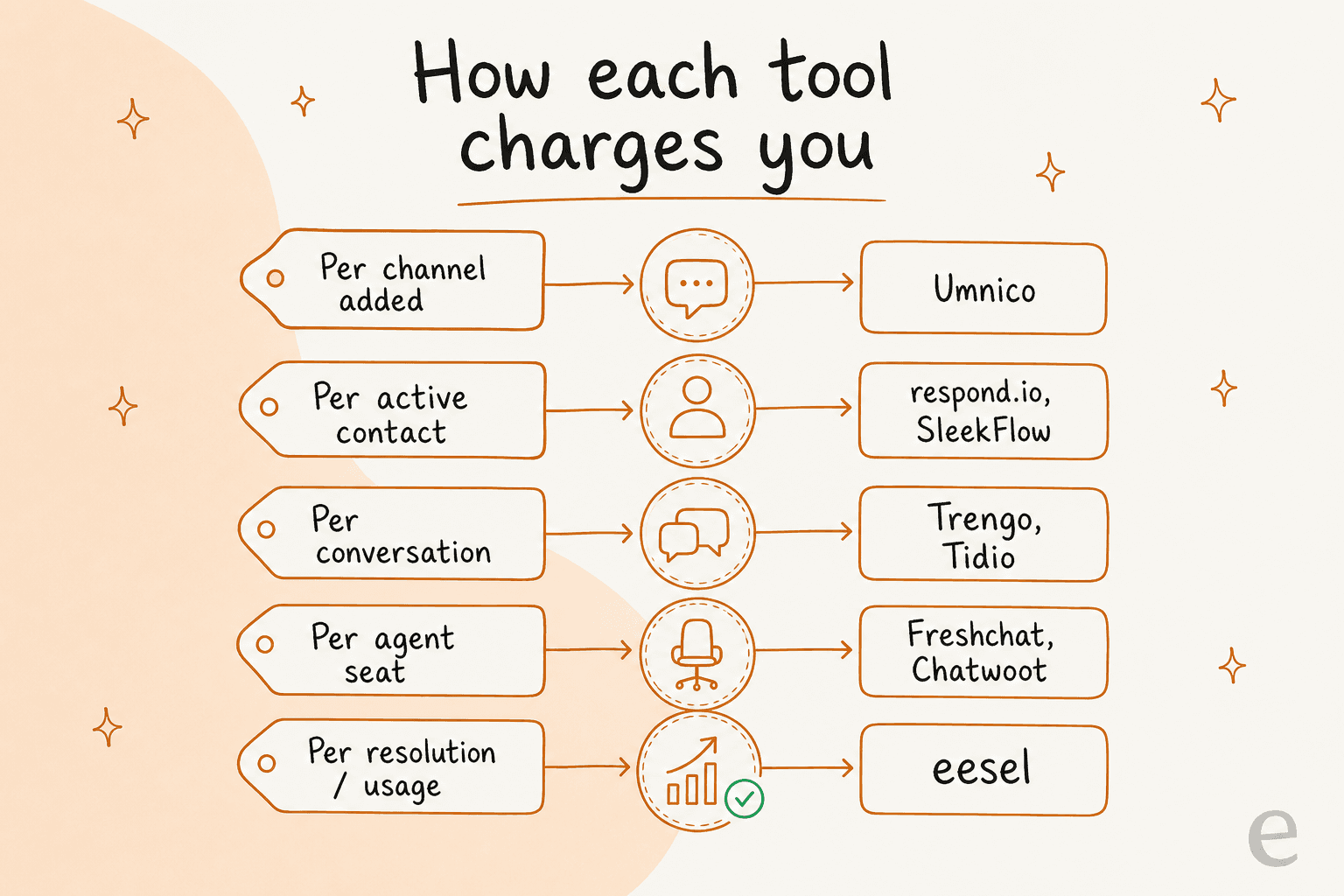
The single biggest difference between these tools isn't features, it is how they charge you. Umnico charges per channel; the alternatives split into per-contact, per-conversation, per-seat, and per-resolution camps, and that choice changes your bill more than any feature list.
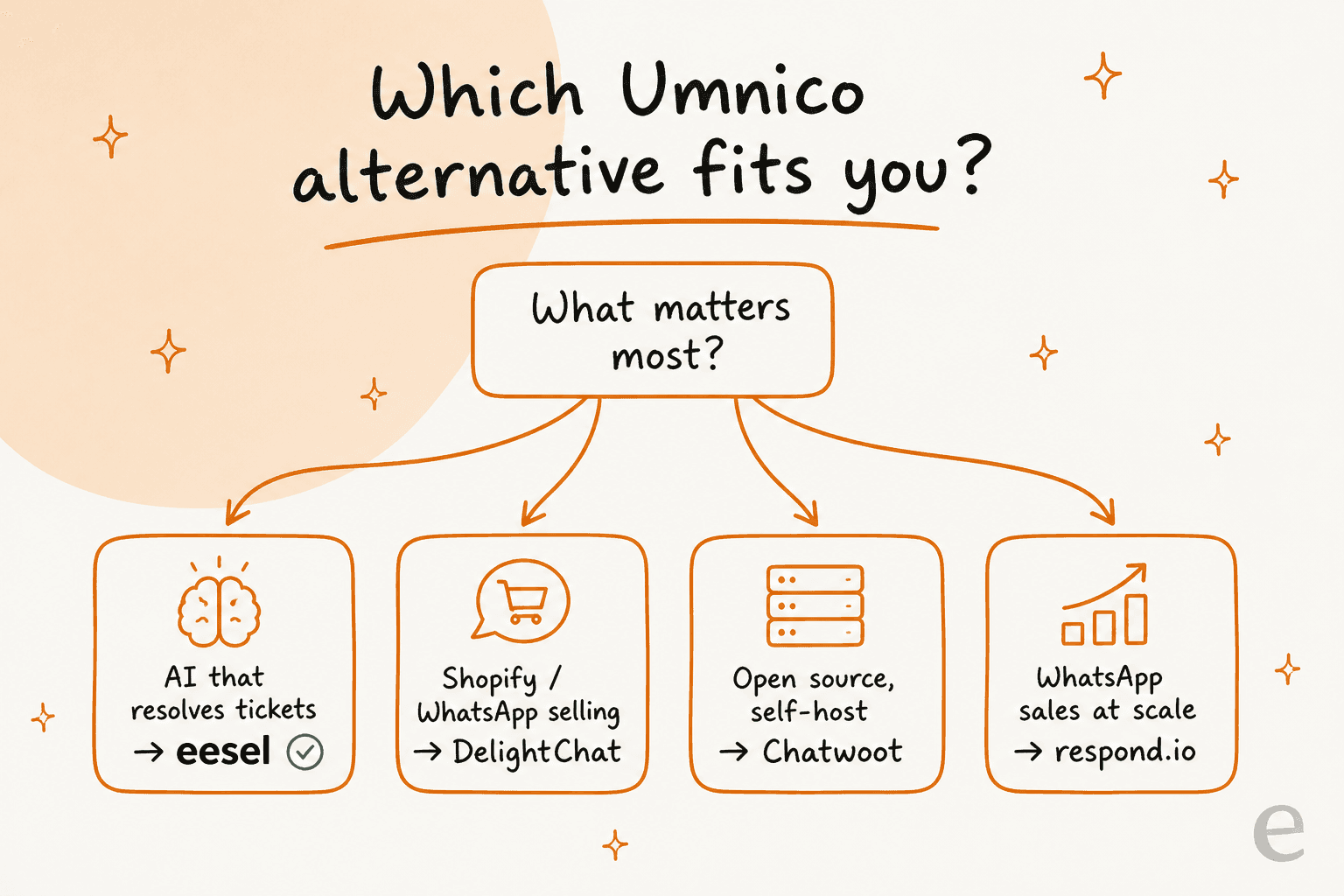
And if you just want a quick pointer to the right tool for your situation, this is the shortcut.
The 9 best Umnico alternatives in 2026
1. eesel AI - best for AI that resolves tickets inside your existing helpdesk
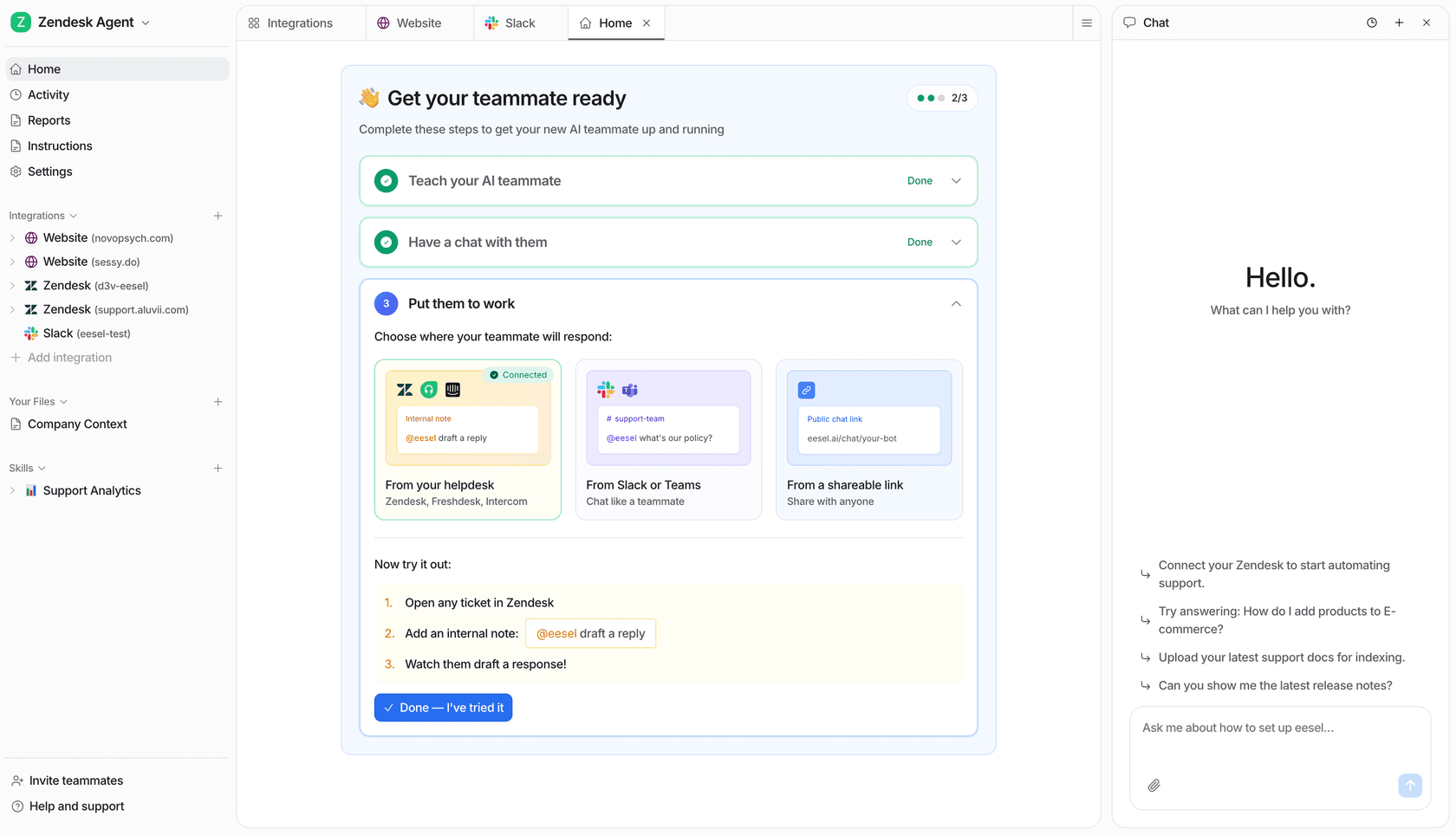
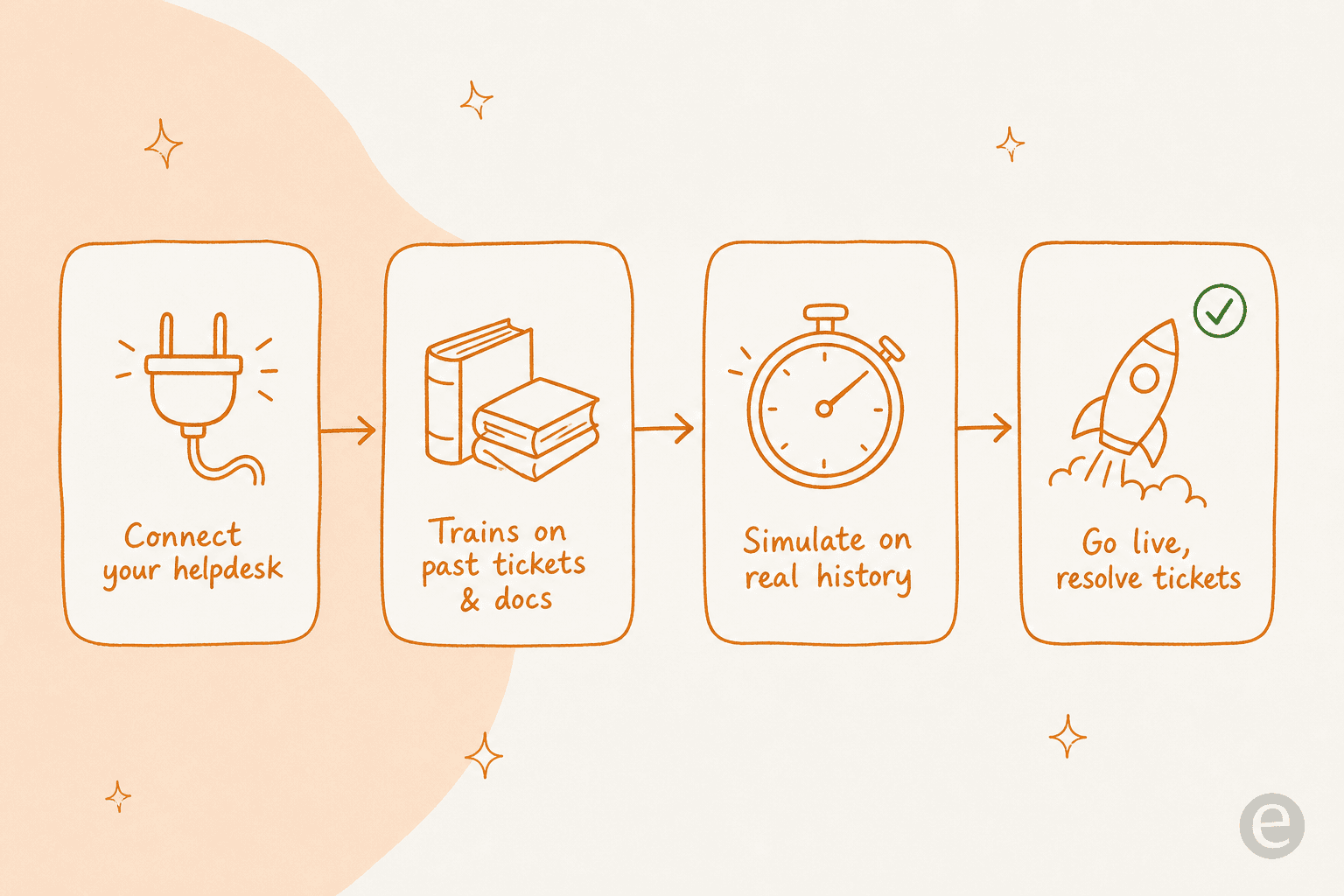
Most tools on this list are inboxes: they give your humans a nicer place to answer messages. eesel AI takes a different swing. It is an AI teammate that plugs into the helpdesk you already run (Zendesk, Freshdesk, Gorgias, Help Scout) or your shared inbox, trains on your past tickets and docs, and starts drafting or fully resolving tickets on its own. If your reason for leaving Umnico is "the AI is too basic," this is the direct answer.
The reason I put it first for support teams isn't loyalty, it is the control model. Every rollout I have seen go badly started the same way: someone flipped an AI live with no idea how it would behave. eesel lets you simulate the agent on your real historical tickets before it touches a live conversation, so you can see the actual resolution rate and read the actual replies it would have sent. That is the difference between hoping and knowing.
Features: an AI agent for customer service that resolves tickets end to end, an AI copilot that drafts replies for human review, training on past tickets and help center content, a chat widget for your site, order lookups (like a Shopify order #), and a shared inbox plus 1000+ integrations. There is even an AI blog writer teammate under the same account if you do content.
Pros: it works with your current stack instead of replacing it; the simulation mode is genuinely rare; a fixed monthly price with no per-seat fee means you are not punished for adding agents; and it is self-serve, so you can start without a sales call.
Cons: it is an AI layer and a helpdesk assistant, not a full multichannel sales CRM with a Kanban pipeline like Umnico's. If what you want is a place for reps to manually work personal WhatsApp chats, a dedicated inbox below will suit you better. It also leans toward teams that already have a helpdesk or a real ticket history to learn from.
Pricing: one fixed monthly price. Plans start at $299/month for 500 credits, where 1 credit is one ticket or chat however long it runs, with no platform fee and no per-seat charge. A worked example: a team handling 500 AI tickets a month pays $299; at 1,000 it is $499. You can start free with 100 free credits, no card required, and only tickets the AI actually works on count (route 200 of your 1,000 monthly tickets to it and you use 200 credits). Add-ons like priority support and SSO are available when you need them.
Our take: if you are a support team and the reason you outgrew Umnico is that you want AI to actually close tickets, eesel is the pick. Choose it when you already run a helpdesk and want automation without a migration; skip it if what you really need is a manual multichannel sales inbox rather than support automation.
2. respond.io - best for high-volume WhatsApp sales teams
respond.io is the closest spiritual match to Umnico's "sell over messaging" pitch, just further up-market. It is a WhatsApp-first omnichannel platform and an official WhatsApp Business Solution Provider, with a team inbox unifying WhatsApp, TikTok, Instagram, Messenger, voice, and email, plus native lead management and AI for social media that qualifies leads and routes chats.
Features: unified messaging inbox, native CRM/lead fields, broadcasts, a visual workflow builder, and AI Agents for real-time qualification and routing.
Pros: built for revenue-critical, high-volume messaging; AI usage is included at no extra cost on Growth and above (subject to fair use); and billing by monthly active contacts rather than seats means large teams aren't taxed per head.
Cons: AI Agents are gated to Growth and up, so the $79 Starter is really an inbox plus basic AI assist. If your contact volume spikes seasonally, overage (billed at $12 per 100 extra contacts on Growth) can surprise you.
Pricing: billed on monthly active contacts (MACs). At 1,000 MACs and monthly billing, Starter is $79/mo (5 users), Growth is $159/mo (10 users, adds AI Agents and workflows), and Advanced is $279/mo. There is a 7-day trial, no card needed.
Our take: pick respond.io if you are a sales-led team doing serious WhatsApp volume and you want lead management baked in. It is a sales machine first; if your job is support deflection rather than closing deals, an AI-support tool will serve you better.
3. telecrm - best for sales teams that sell over WhatsApp and calls
telecrm is a sales CRM built around the way a lot of Indian teams actually work: leads come in, reps call them, follow up on WhatsApp, and move them through a pipeline. Instead of treating WhatsApp as another support channel, it connects messaging with lead ownership, calling, follow-ups and sales tracking. If what you are looking for is a proper WhatsApp CRM rather than another shared inbox, that distinction matters.
Features: WhatsApp lead capture and chat sync, official WhatsApp API support, lead assignment, sales pipelines, calling and call recording, automated follow-ups, workflow automation, and reporting across leads and team activity.
Pros: particularly well suited to Indian sales teams that rely heavily on both calls and WhatsApp; conversations can sit alongside each lead's call and follow-up history rather than living in a separate inbox; and the CRM side is much deeper than you get from a messaging-only tool.
Cons: telecrm is primarily a sales CRM, not a customer-support helpdesk. If your main goal is ticket resolution, knowledge-base automation, or managing support queues, something like eesel or Freshchat is a better fit. It is also most compelling for teams whose sales process genuinely revolves around calling and WhatsApp.
Pricing: Core CRM starts at $19 per user/month when billed annually, with quarterly billing available at $29 per user/month. WhatsApp ChatSync is available as an add-on.
Our take: choose telecrm if your team sells primarily through WhatsApp and phone calls and you want those conversations connected to lead assignment, follow-ups and pipeline management. If you mainly need an omnichannel support inbox, look elsewhere on this list.
4. Trengo - best for a European team wanting one AI-first inbox
Trengo is an AI-first omnichannel inbox that unites WhatsApp, email, live chat, Instagram, Facebook, and voice into one workspace where humans and AI handle queries together. It leans on WhatsApp and an ecommerce angle (cart recovery, driving sales) and is popular with European teams, with pricing quoted in EUR by default.
Features: shared team inbox, an AI agent called HelpMate that suggests and sends responses, AI Journeys for multi-step automation (in beta), AI reporting, and the usual automation rules.
Pros: HelpMate AI is included on every plan rather than gated to a top tier; the move to conversation-based pricing in 2024 means you aren't paying per seat; and it is a mature, well-rounded inbox.
Cons: the entry price is high (€299/mo) for a small team, and AI usage carries a per-conversation surcharge on top of the plan, so the "AI included" line has an asterisk. AI Journeys is still beta, so packaging may shift.
Pricing: conversation-based, with each plan bundling users and a conversation allowance. Boost is €299/mo annually (10 users, 500 conversations/mo), Pro is €499/mo (20 users, 1,500/mo), and Enterprise is custom. Extra conversations run €15 to €18 per 100.
Our take: a solid choice for a mid-size European team that wants AI in the inbox from day one and bills in euros. Just budget for the per-conversation AI surcharge, and know the floor price rules out very small teams.
5. SleekFlow - best for B2C brands running marketing plus support
SleekFlow is an omnichannel conversational platform built on the WhatsApp Business API and extended across Instagram, TikTok, Telegram, email, and voice, with a shared inbox, built-in CRM, a Flow Builder, and broadcast campaigns. Its AI layer, AgentFlow, is pitched as an "AI GTM workforce" that qualifies leads and books appointments, so like Umnico it is a revenue tool first and a support tool second.
Features: shared inbox, contact CRM, Flow Builder automation, broadcast campaigns, and AgentFlow role-scoped AI agents.
Pros: strong on the marketing-plus-messaging combo B2C brands want; genuinely broad channel coverage; and a clever pricing quirk where a yearly plan with unlimited AI costs the same as a monthly plan without it, so committing annually effectively makes the AI free.
Cons: the pricing is the most opaque here. SleekFlow bills on monthly active contacts but doesn't publish the overage rate, the per-seat add-on price, or the AI credit count anywhere on the page, and WhatsApp adds Meta's per-message and per-number hosting fees on top. You will need a conversation with sales to know your real number.
Pricing: plan subscription (Pro / Premium / Enterprise, each with an AI variant) billed on monthly active contacts, priced differently across four geographic tiers and nine currencies. Published numbers vary by region; expect to confirm your exact rate with sales.
Our take: a good fit for B2C brands that want marketing campaigns and support in one messaging tool. Go in knowing the total cost of ownership takes a quote to pin down, especially once WhatsApp's own fees stack on.
6. DelightChat - best for Shopify and D2C brands on WhatsApp
DelightChat is an omnichannel support inbox plus WhatsApp marketing suite built specifically for ecommerce and D2C brands, with a deep Shopify integration at its center. It claims 1000+ D2C brands and is especially strong in the India/D2C world. If your Umnico use case is really "run my Shopify store's WhatsApp support and marketing," this is the specialist.
Features: shared support inbox across WhatsApp, Instagram, email, and more; WhatsApp broadcast marketing; deep Shopify order data in-thread; a free green-tick WhatsApp API application; and an AI Assistant that drafts and rewrites replies.
Pros: purpose-built for Shopify ecommerce, so the order context is right there; transparent, published pricing; and no markup on WhatsApp conversation fees.
Cons: it is not a general-purpose helpdesk, and it is not designed for non-ecommerce use. The AI Assistant is a paid add-on (10K free tokens/mo, then $2 per 100K tokens) rather than a resolve-it-for-you agent, so it drafts and polishes rather than closing tickets autonomously.
Pricing: Startup is $29/mo (500 tickets, 2,500 marketing contacts, 5 members), Scale is $99/mo (2,000 tickets, 20 members), and Growth is $299/mo (6,000 tickets, 50 members) - all plus WhatsApp's own per-conversation fees. There is a 14-day free trial, no card.
Our take: the clear pick for a Shopify or D2C brand doing support and marketing over WhatsApp, and a strong option among live chat tools for ecommerce. Look elsewhere if you are not an ecommerce brand or you need AI that resolves rather than drafts.
7. Tidio - best for small ecommerce sites that want live chat plus simple AI
Tidio bundles live chat, ticketing, no-code chatbot Flows, and an AI agent called Lyro into one tool aimed at SMBs and ecommerce. It positions itself as something you can add without migrating off your current stack, and it names customers like Under Armour and The Body Shop.
Features: live chat widget, ticketing, Flows automation, multichannel messaging, and the Lyro AI agent for knowledge-based answers with human handoff.
Pros: a real free plan to start, an easy setup, and Lyro can be added to any helpdesk standalone. Good for a small site that mostly needs website chat.
Cons: channel coverage skews toward website live chat rather than the deep WhatsApp/personal-messenger stack Umnico gives you, and the metering has three separate dials (billable conversations, Lyro conversations, Flows visitors) that can be confusing. Lyro at $0.50 per conversation adds up if volume is high.
Pricing: Free is $0 (50 conversations), Starter is $24.17/mo (100 conversations), Growth starts at $49.17/mo (from 250), and Plus starts at $749/mo. Lyro AI is $0.50 per conversation with 50 free, sold as a standalone add-on too. Annual billing, 7-day trial.
Our take: a friendly, affordable entry point for a small ecommerce site whose main need is website chat plus a light AI agent. If your world is really WhatsApp and Telegram sales, a messaging-first tool fits better.
8. Chatwoot - best if you want open source and want to self-host
Chatwoot is the open-source option: an omnichannel support desk with an AI assistant (Captain) and a knowledge base, used by 15,000+ businesses, rated 4.5+ on G2, with 34k GitHub stars and SOC 2 Type II. If part of why you are leaving Umnico is data control or wanting to own the stack, this is the one to look at. I have written more on Chatwoot alternatives if you want the wider field.
Features: omnichannel inbox, Captain AI assistant, knowledge base, and a self-hostable open-source Community Edition.
Pros: free forever if you self-host the Community Edition; full data ownership; and an active, credible open-source project behind it.
Cons: the free build has no AI at all (Captain starts at the paid tier), and self-hosting means you own the maintenance. Roles and permissions, SLAs, and SSO are all paid unlocks. This is engineering effort you are trading for the license savings.
Pricing: cloud plans are per agent; self-hosted has a free Community Edition, then Premium at $19/agent/mo and Enterprise at $99/agent/mo (annual). Captain AI and SSO/SLA features sit in the paid tiers. 15-day trial on cloud.
Our take: the right call if you have the engineering appetite to self-host and want an open-source inbox you fully control. If you want AI resolution out of the box without hosting anything, a managed tool will get you there faster.
9. Freshchat - best if you are already in the Freshworks ecosystem
Freshchat is Freshworks' live chat and messaging product, the conversational front end of the broader Freshdesk Omni suite. Freshworks says it is trusted by 74,000+ businesses, and it is the natural pick if you already run Freshdesk or want a big-vendor platform with a full ticketing suite behind the chat.
Features: website and mobile chat, social and messaging channels (WhatsApp, Messenger, Instagram, SMS, LINE, more), team inbox, Freddy AI Agent (chatbot), and Freddy Copilot (agent assist).
Pros: a real free plan for up to 10 agents; the deep Freshworks ecosystem if you want ticketing, KB, and voice in one place; and broad channel coverage on paid tiers. There is a full Freshchat pricing breakdown if you want the details.
Cons: the free tier is website chat and email only, so every social channel starts at the $19/agent Growth plan. Freddy AI is a per-session add-on ($49 per 100 sessions after 500 free), and per-agent pricing means costs climb with headcount, the opposite of Umnico's per-channel model.
Pricing: Free is $0 (up to 10 agents, chat + email), Growth is $19/agent/mo (adds social channels), Pro is $49/agent/mo, and Enterprise is $79/agent/mo. Freddy AI Agent is roughly $0.49 per session. 14-day trial.
Our take: the sensible choice if you are already a Freshworks shop or want one big vendor for chat plus a full helpdesk. If you are not, the per-agent-plus-per-session pricing can outrun a fixed-price AI plan as you grow.
Try eesel for AI support that plugs into what you already run
If you came to this list because Umnico's chatbot felt too basic, that is exactly the gap eesel AI fills. Instead of asking you to move your whole team into a new inbox, eesel drops an AI support teammate into the helpdesk you already use, trains it on your past tickets and help center, and lets you simulate it on real history before it ever replies to a customer, so you see the resolution rate up front rather than crossing your fingers.
The pricing is the other half of the pitch: one fixed monthly price from $299 for 500 credits, with no per-seat fees, which is the opposite of watching a per-channel or per-agent bill creep upward. You can try it free with 100 free credits, no credit card and no sales call. If your goal is AI that resolves customer service tickets rather than just another place to read them, it is worth ten minutes.