
What SaaS technical support actually is
I work the support queue every day, so let me be blunt about the difference that trips people up. Customer service answers "where is my order"; SaaS technical support answers "why is your webhook returning a 500 when I POST to it." One needs empathy and a refund button. The other needs someone who can read a stack trace.
SaaS technical support is the function that helps people use a cloud software product when they hit friction: a login they can't recover, a setting that won't save, an integration that silently stopped syncing, an API call that errors, or a full-blown outage. It sits at the intersection of customer-facing help and the actual engineering of the product, which is what makes it its own discipline rather than a subset of a generic help desk.
The stakes are also different. In SaaS, support is retention. A customer who can't get their integration working during the trial doesn't complain, they just don't convert. A paying account that files three unanswered technical tickets in a month is a churn risk, not a satisfaction score. So the quality of your technical support shows up directly in the numbers the business actually watches.
The tiers of SaaS technical support
Almost every SaaS team, from a two-person startup to an enterprise, ends up organising technical support into tiers. The labels vary, but the shape is consistent: cheap, fast, self-serve help at the bottom, expensive human expertise at the top, and a goal of resolving each ticket at the lowest tier that can actually solve it.
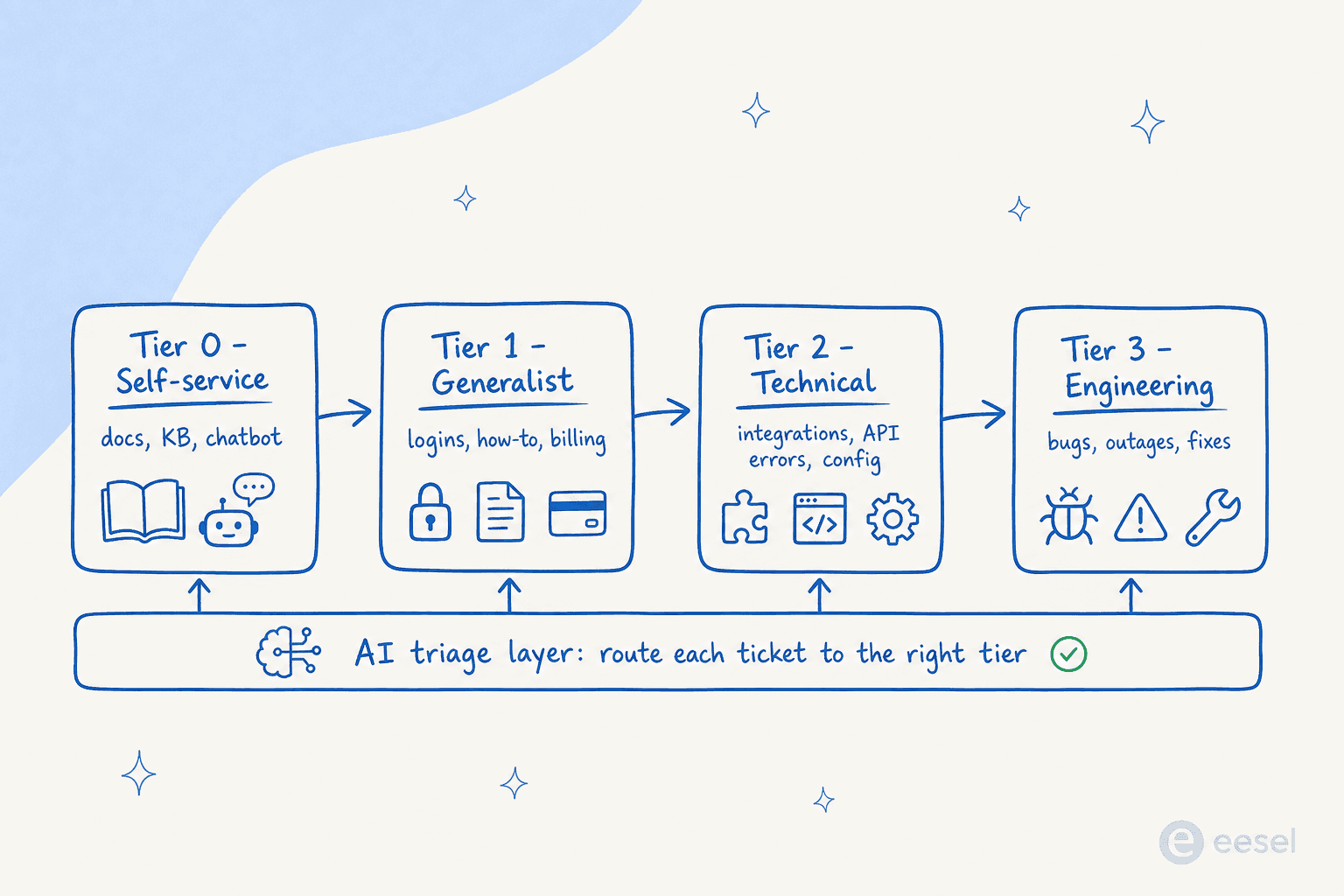
- Tier 0, self-service. Your help center, docs, and any chatbot. The customer solves it themselves, and it costs you nothing per ticket. This is where a good knowledge base earns its keep.
- Tier 1, generalists. The front line: password and login issues, "how do I do X", basic billing and account questions. High volume, mostly repetitive, and the layer most ripe for ticket automation.
- Tier 2, technical specialists. Integration debugging, API errors, configuration edge cases, data issues. These need product depth and often some back-and-forth to reproduce.
- Tier 3, engineering. Genuine bugs, outages, and anything that needs a code change. Expensive, slow, and where you want as little volume landing as possible.
The old failure mode is a ticket landing at the wrong tier: a tier-1 agent sitting on an API bug for two days before it gets escalated, or an engineer pulled off a sprint to answer a question that was in the docs all along. The single biggest lever in SaaS technical support is getting each ticket to the right tier fast. That used to be a manual triage job. It isn't anymore.
Why SaaS technical support is hard
If it were easy, you would just hire cheerful people and hand them a script. It isn't, for three reasons.
The knowledge is deep and it moves. Answering technical tickets well means knowing how the product actually behaves, including the undocumented quirks. And SaaS ships constantly, so last month's correct answer can be this month's wrong one. Keeping knowledge organised and current is a permanent job, not a one-off.
Your best knowledge lives in people's heads. The senior agent who knows exactly why that Salesforce sync fails on leap years is also the one most likely to leave. I saw this play out with one team we worked with: a French public-sector IT services firm running roughly 3,000 tickets a month of complex ERP troubleshooting on Freshdesk was about to lose two senior agents in the same year, and their whole reason for looking at AI was to capture that tribal knowledge before it walked out the door. That is a real, specific fear, and it is everywhere in SaaS support.
Volume and complexity pull in opposite directions. You want to answer fast, but technical tickets resist speed, they need reproduction, logs, sometimes a call. Meanwhile the repetitive tier-1 stuff floods the same queue and buries the hard tickets. Small teams feel this most acutely. As a director of support at a fast-growing EdTech startup on Zendesk put it in an eesel case study:
"As a fast-growing startup with a small team, our customers far outnumber our employees. It's crucial that we have robust self-service solutions as well as tools to supercharge the efficiency of our client-facing teams."
Jon Miron, Yellowdig (case study)
That tension, too much volume, too little specialist time, is exactly the gap AI is good at closing.
Where AI actually helps (and where it doesn't)
Here is the part people get wrong. The pitch "AI answers all your support tickets" is a fantasy that will burn you, because a confident-sounding bot giving a wrong technical answer is worse than no answer at all. We learned that the hard way over years of running AI on live support queues, which is why every rollout we do now gets simulated against a customer's historical tickets first, before it ever talks to a real person.
The realistic and useful version is narrower: let AI own the repetitive layer it can be confident about, and route everything else to a human with context. The mechanism that makes this safe is confidence-based routing.
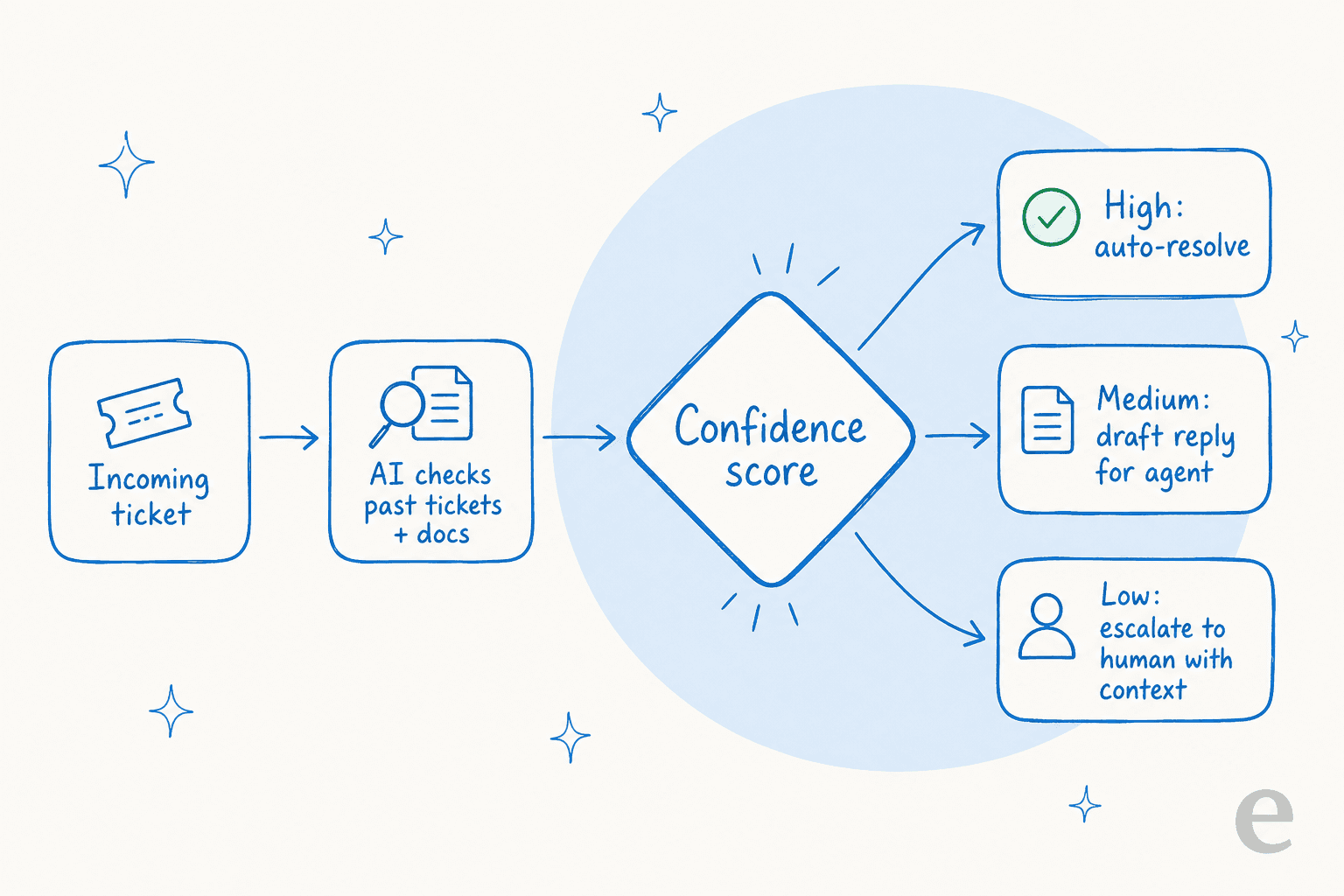
A ticket comes in. The AI agent checks what it knows from past tickets and your docs, then scores how confident it is:
- High confidence (a known login fix, a documented how-to): it resolves the ticket outright.
- Medium confidence: it drafts a reply for a human agent to review and send, which is the copilot pattern.
- Low confidence (a novel bug, an angry enterprise account, anything it hasn't seen): it escalates to the right person, with a summary and the relevant history attached so the human doesn't start from scratch.
This is the design that separates useful AI support from the chatbots everyone hates. The buyer instinct is exactly right. As one DTC supplements CX lead described the requirement: they wanted an AI handling only the tickets it was confident to handle, and to leave all the others alone. That is not a limitation to apologise for, it is the correct default for technical support triage.
Where AI does not belong: making judgment calls on a production incident, deciding whether to issue a large refund, or inventing an answer to a question no one has ever documented. Draw that line clearly and the rest gets a lot easier.
What good looks like
When the repetitive layer is actually handled, the numbers move in ways the business notices. These are real results from eesel deployments, not projections.
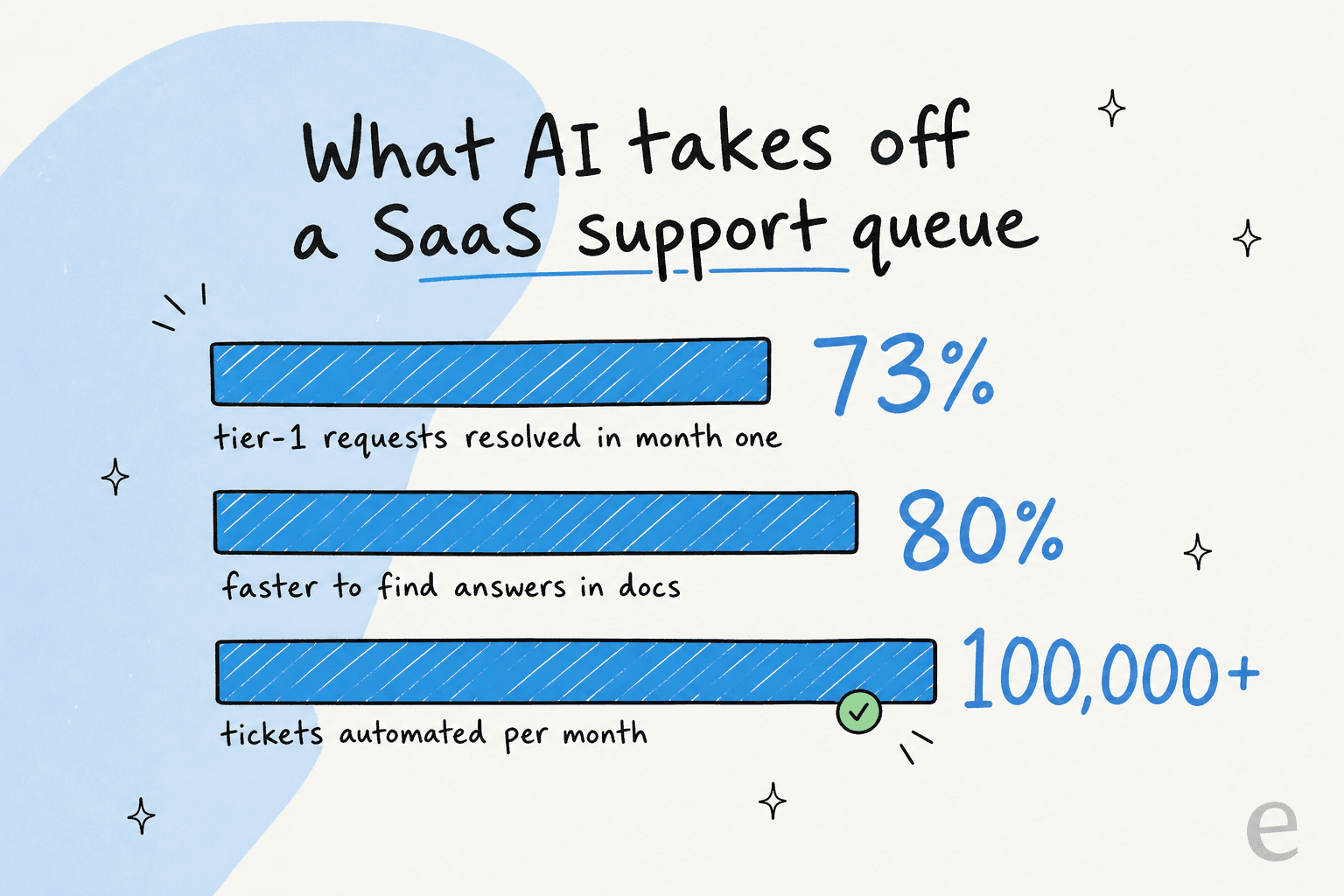
Gridwise, a gig-economy driver-analytics app on Zendesk, resolved 73% of tier-1 requests in the first month, with results showing up during a 7-day trial. An internal IT helpdesk at InDebted, running on Jira Service Management, reached 15% ticket deflection on the way to a 55% target. And at the top end, one lender runs a fully automated Zendesk agent processing over 100,000 German-language tickets a month. The through-line isn't "AI replaced the team", it's that the team stopped drowning in tier-1 and got their time back for the tier-2 and tier-3 work that actually needs them.
The other quiet win is speed to an answer inside the team. Global Payments reported up to 80% time savings just on finding the right answer across their documentation, which is the tribal-knowledge problem solved from the other direction.
How to level up your SaaS technical support
If you want to move your own queue in this direction, here is the order I would do it in.
- Fix tier 0 first. Before automating anything, make sure your docs and help center actually answer the top 20 recurring questions. An AI agent trained on thin docs gives thin answers. A solid knowledge management foundation is the prerequisite, not an afterthought.
- Train AI on your real history, not just your docs. The magic isn't the model, it's the data. An agent that learns from your resolved tickets picks up the actual phrasing and fixes your team uses, not just the sanitised help-center version. This is what turns years of ticket history into usable knowledge on day one.
- Simulate before you go live. Run the agent against your past tickets to see, ticket by ticket, what it would have answered and where it would have been wrong. Fix the gaps, re-run, and only then let it touch a live customer. Skipping this step is how you end up with the confident-wrong-answer problem.
- Start supervised, then grant autonomy. Let it draft for humans first. Once you can see it is reliably right on a category, say password resets, flip that category to fully automatic and keep the rest supervised. Autonomy is earned per ticket type, not switched on all at once.
- Measure by tier. Don't celebrate a blended resolution rate. Track how much tier-1 you cleared and, more importantly, how much faster your specialists now resolve the hard stuff. That is where the real ROI lives.
The metrics that matter
You can't improve what you don't watch, but the usual dashboard of first response time and CSAT hides as much as it shows. Weight your support metrics by tier:
| Metric | What it tells you | Watch out for |
|---|---|---|
| Deflection rate | How much never reaches a human | A high number that hides frustrated customers who gave up |
| Tier-1 resolution rate | How well the repetitive layer is handled | Counting escalations as "resolutions" |
| First response time | Speed of acknowledgement | Fast auto-replies that don't actually help |
| Time to resolution by tier | The real health of the queue | A good average masking slow tier-2/3 |
| CSAT on technical tickets | Whether the answers were actually right | Averaging it in with easy tier-1 wins |
| Escalation accuracy | Whether tickets land at the right tier first time | Ping-ponging between tiers |
The pattern to aim for: tier-1 numbers get fast and cheap, and your human time visibly shifts up the stack toward the tickets that need judgment. A reporting view that breaks results out by tier is what makes this legible instead of a single flattering average.
Try eesel for SaaS technical support
If your technical queue is buried under repetitive tier-1 tickets while the hard bugs wait, this is precisely what eesel AI is built for. It plugs into the helpdesk you already run, whether that's Zendesk, Freshdesk, Jira Service Management, HubSpot, or Front, learns from your past tickets and docs, and starts drafting and resolving the tier-0 and tier-1 layer with confidence-based routing keeping it on what it actually knows.

The differentiator I would point to is the simulation mode: you run it against your real historical tickets and see exactly how it would have performed, by theme, before it ever answers a live customer. That is how you get the 73%-in-month-one results without the confident-wrong-answer risk. Pricing is usage-based at $0.40 per ticket with no per-seat fees, and there is a free trial with $50 of usage, so you can point it at your own queue and judge it on your own tickets. Try eesel.
Frequently Asked Questions
What is SaaS technical support?
How is SaaS technical support different from customer service?
Can AI handle SaaS technical support tickets?
How do you structure a SaaS technical support team?
What metrics matter most for SaaS technical support?


Article by
Riellvriany Indriawan
Riell is a designer and writer at eesel AI with about two years of experience researching CX platforms, AI chatbots, and helpdesk software. She combines her design background with a sharp eye for how these tools actually look and feel in practice — making her comparisons unusually visual and user-focused.