


What Marblism actually costs
Here is the short version, because the pricing page buries it under three glossy cards. Marblism is a single product. The only thing the "plans" change is how long you commit up front, which changes the effective monthly rate.
| Billing cadence | Effective price | What you pay | Roughly per year |
|---|---|---|---|
| Yearly | $24/mo | billed once, ~$288 upfront | ~$288 |
| Quarterly | $33/mo | ~$99 every three months | ~$396 |
| Monthly | $44/mo | billed each month | ~$528 |
Every cadence includes the exact same thing: access to all AI employees, unlimited chat, unlimited team members, unlimited businesses, 100+ languages, 24/7 support, and the shared 50 hours of AI work a month. So the "which plan" question is really just "how much am I willing to pre-pay for a discount." Commit to a year and you save about 45% a month versus paying month to month. Commit to nothing and you pay the $44 rate.
One thing worth flagging before you go hunting: the "$39/mo unlimited tasks" figure that shows up in a lot of older Reddit threads is stale. Marblism moved to the metered, 50-hour model, so treat any "unlimited" pitch from a year ago as out of date. The current floor is $24/mo on the annual plan.
I build the metering side of AI products for a living, so the first thing I do with any tool that leads with a flat monthly price is go looking for the meter hiding underneath it. Marblism has one, and it matters more than the $24.
The number that decides your bill: 50 shared hours
The sticker price gets you in the door. The 50 hours of AI work is what you are really buying, and it is one pool shared across the whole team, not 50 hours each.
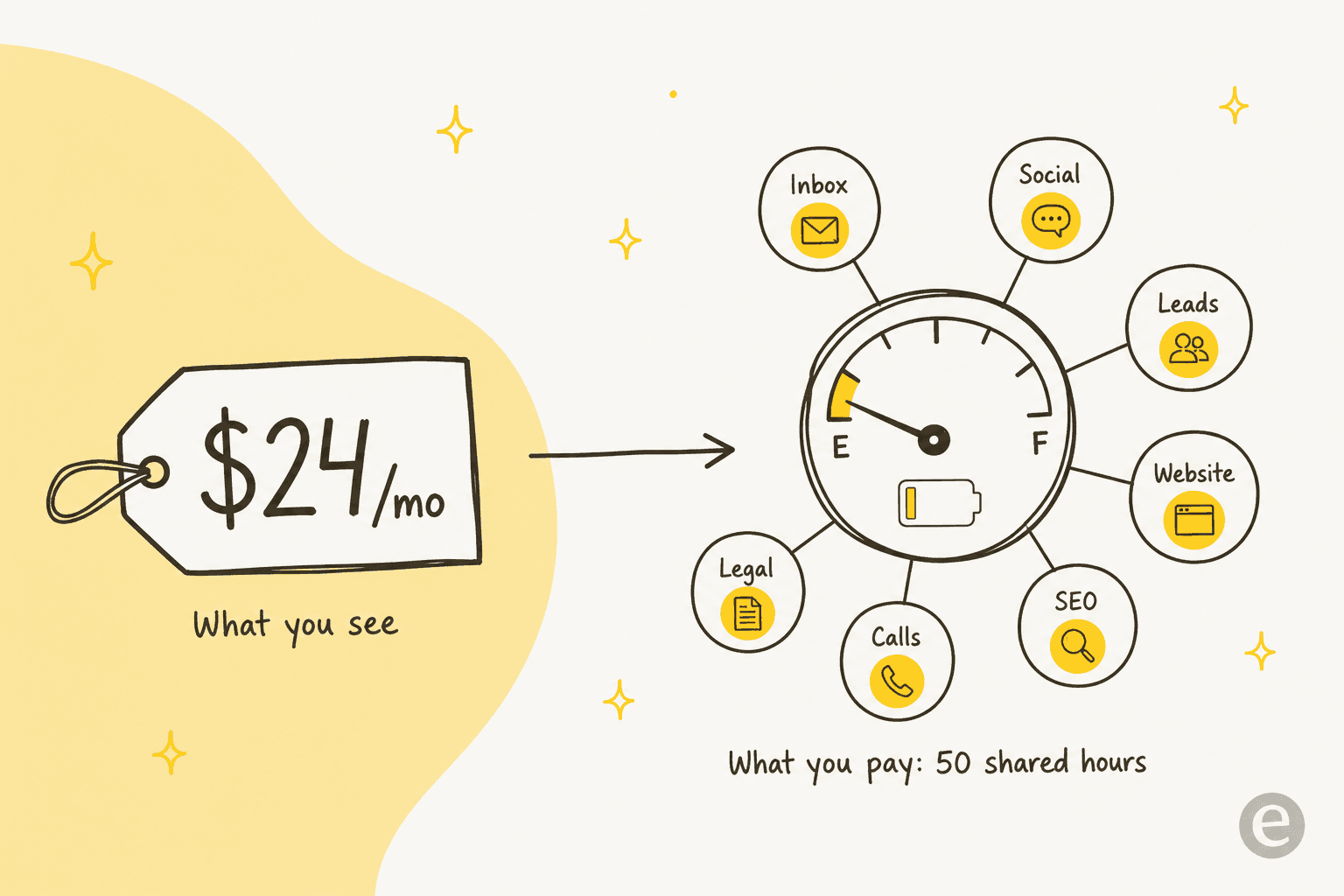
Here is the mechanic, straight from Marblism's own help center: "Every plan starts with 50 monthly hours of AI work that reset each month. Hours are only consumed by advanced AI actions. Chat and quick tasks don't use them. When you run out, you can purchase flexible top-ups at any time."
So the pool drains only when an employee does real work. That is a fair model on paper, and it is genuinely more honest than a fake "unlimited" claim. The problem is the two words doing the heavy lifting: shared and top-ups.
Shared means the same 50 hours feed your inbox assistant, your social manager, your lead-gen agent, your blog writer, and your phone receptionist. Run one of them hard and there is less left for the rest. Breadth is the whole pitch, and it is also the ceiling.
What burns your 50 hours, and what is free
This is the part that decides whether 50 hours is plenty or gone by the 12th. The split is clean once you see it.
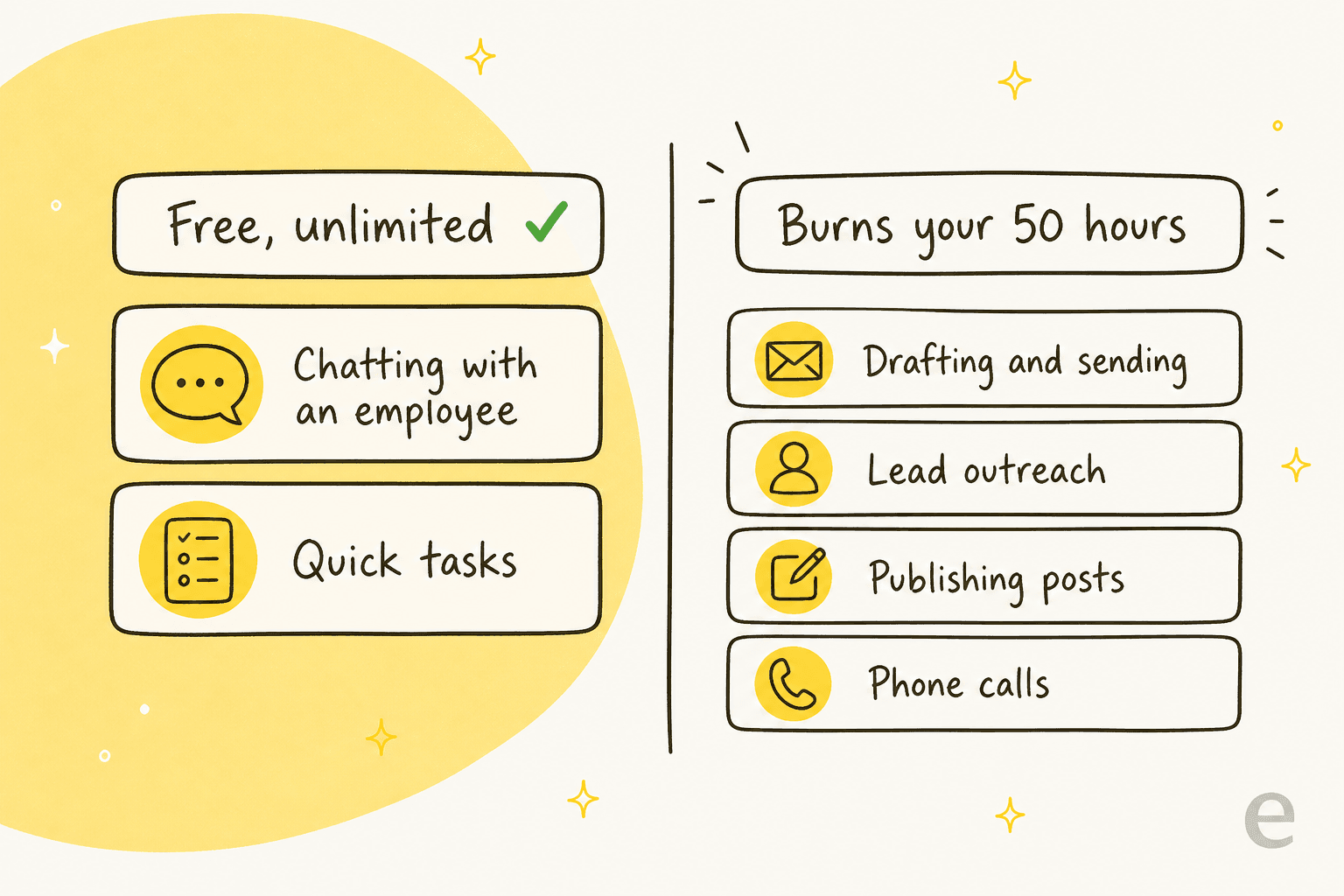
Talking to an employee costs nothing. You can chat with Eva or Penny all day and never touch the meter. What costs hours is the output: the actual drafting, the outreach sequence going out, the blog post publishing, the phone call getting placed. In other words, the moment an employee stops assisting and starts acting, the clock runs.
That is the right thing to meter, honestly. But it means the "unlimited chat" headline is a little generous, because chat is the cheap part. The work is the expensive part, and the work is capped at 50 hours a month unless you top up.
The top-up gap nobody prices
Here is the real hole in Marblism pricing, and it is worth pausing on before you buy.
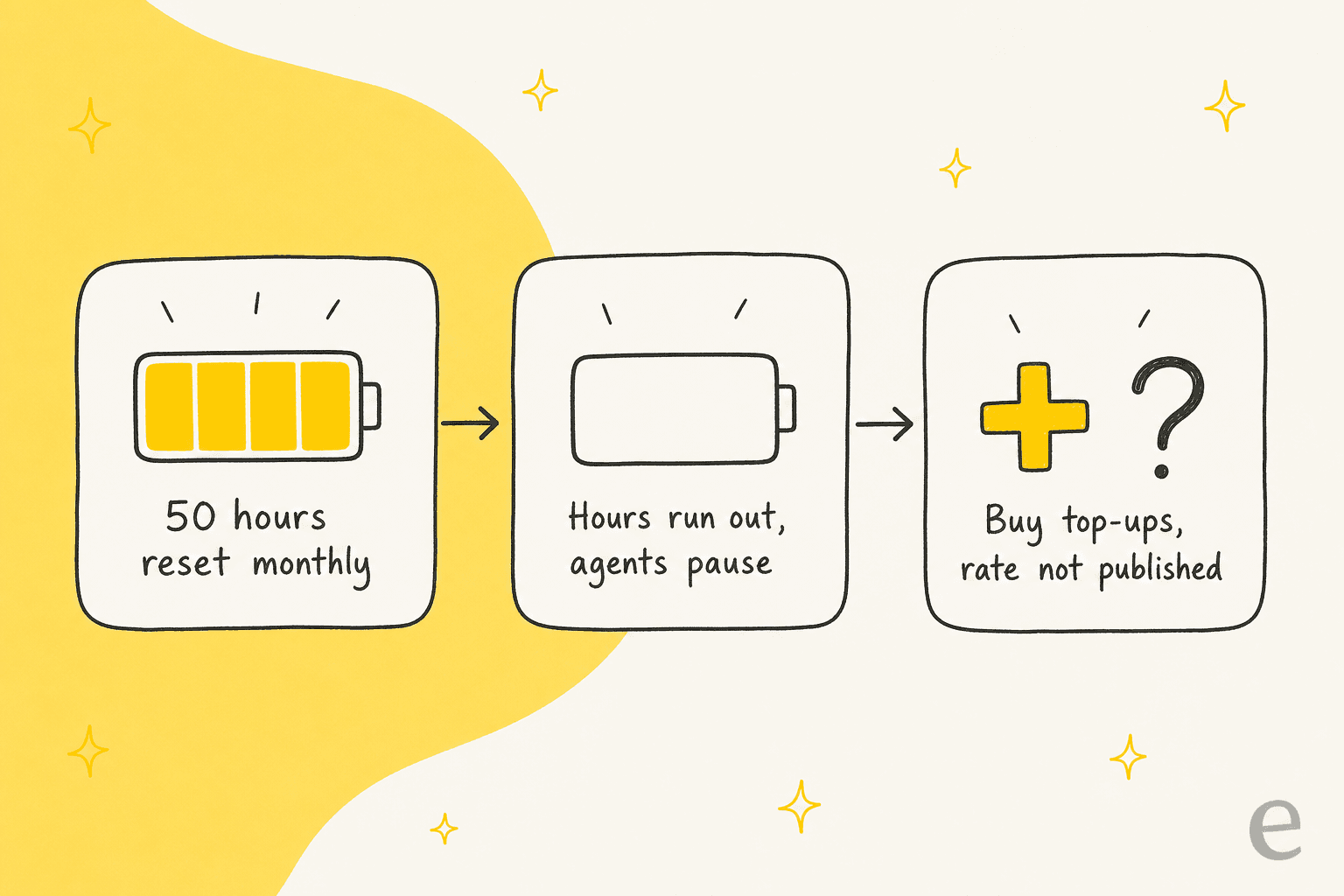
When the 50 hours are gone, the agents pause. To keep them working you buy "flexible top-ups." But Marblism does not publish a top-up rate anywhere on the pricing page. So the honest answer to "what will Marblism cost me?" is: $24 to $44 a month, plus an unknown amount the moment your team does more than 50 hours of real work.
For a light user that ceiling never bites. For anyone running two or three of the employees seriously, it is the number you cannot budget, and it is exactly the situation a couple of reviewers describe. One 4-star Trustpilot reviewer said they "did need to upgrade to the higher pricing plans almost immediately" once they were running more than one business. That is cost creep you cannot see coming from the pricing page.
If you are the kind of buyer who wants to know the total cost of ownership before you sign, this is the thing to email their support about first. A unit you can actually count, like eesel's 1 credit per ticket or chat on plans from $299/month, is a different animal precisely because there is no invisible second meter.
What you get for the money: the AI employee roster
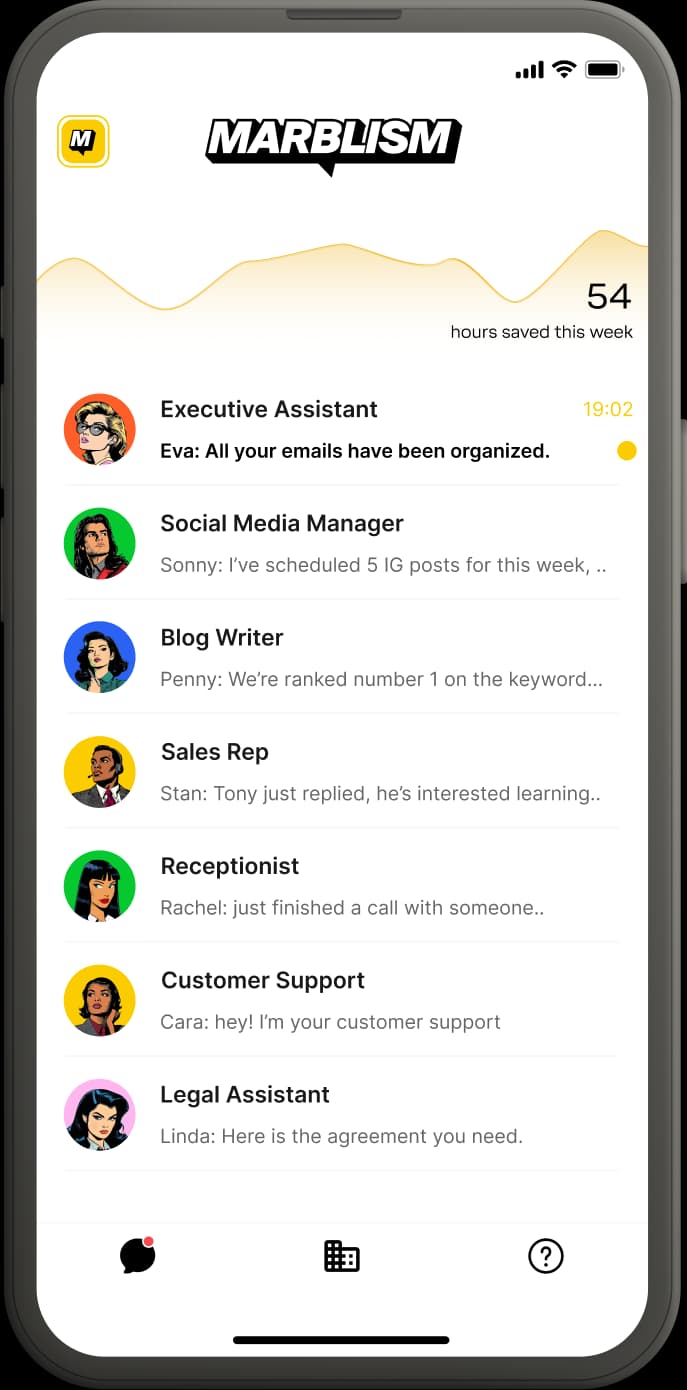
For your flat fee you get the whole team, not a subset. Marblism's FAQ markets "6 AI employees," but the homepage actually shows seven named agent cards (the count quietly leaves out the website builder). Here is the real roster.
| Employee | Role | What it does |
|---|---|---|
| Eva | Executive assistant | Sorts your inbox, drafts replies, takes meeting notes |
| Sonny | Social media manager | Content calendar, auto-posting, images and carousels |
| Stan | Lead generation | 700M+ lead database, email outreach, LinkedIn automation |
| Walter | Website builder | Builds and updates your site |
| Penny | SEO expert | Auto-publishes articles, keyword research, site audits |
| Rachel | Receptionist | Answers the phone, books appointments, transfers calls |
| Linda | Legal assistant | Reviews contracts and legal documents |
The named-persona framing is the part people genuinely like. You are not configuring a workflow, you are "hiring" Eva or Sonny, and Marblism leans hard into that with an AI-to-AI collaboration feature where the employees hand work to each other. It is a friendly on-ramp to the AI employee idea, and for a first-time buyer that clarity is worth something.
The trade is depth. Seven roles sharing one 50-hour pool means no single role gets the focus a purpose-built tool gives it. Stan's lead database is broad, but a dedicated lead generation tool goes further; Penny writes blog posts, but it is not a research-grade AI blog writer; and support is folded into the inbox and phone employees rather than a real helpdesk agent that connects to Zendesk or learns from your own ticket history. Breadth over depth is the whole design, and whether that is a good deal depends entirely on what you need.
Work out your real yearly cost
Before you pick a cadence, it helps to see the commitment in dollars rather than a per-month rate, because the cheap-looking $24 is the one you pay all at once. Pick an option below.
The pattern is the classic annual-plan trade. The yearly plan is the cheapest by a wide margin, but you hand over the full ~$288 on day one and you are committed. The monthly plan costs the most per month but risks nothing beyond the next 30 days. Given the billing complaints below, if you are not sure yet, the monthly plan is the safer way to test before you pre-pay a year.
Is Marblism worth it? What real users say
Let me be fair, because Marblism does real things well and the reviews back that up. It holds a 4.8/5 on Trustpilot across roughly 1,069 reviews, with 85% at five stars, and it claims 40,000+ businesses. For a solo founder drowning in unread email and a social account that has not been touched in weeks, hiring a seven-person AI team for less than a streaming bundle is a genuinely appealing pitch, and the social-media output in particular gets real praise. One organic user summed up the value verdict:
"I'm finding it useful enough that I rolled the first month's discounted rate and paid full fare for the second month. It's good but it's not perfect... For me, so far, it's been worth it."

The consistent negative, though, is money. Billing and refunds are the single most repeated complaint, and they show up on both review platforms. The sharpest version:
"It's a scam DO NOT SIGN UP NOT WORTH IT... They use credits which go away in like 2-4 days!! The refused to respond within the 7 day money back guarantee, when I requested to cancel and get a refund and then continued to charge me..."

The lone organic G2 review is the same shape: a 1-star dispute where the reviewer says they were charged with no confirmation screen and their refund inside the 7-day window was rejected as a "renewal." Marblism disputes these claims in its public replies, and with 85% of Trustpilot reviews at five stars this is clearly a friction point rather than the whole story. But when the recurring negative is specifically about charges and refunds, it is worth knowing before you hand over a card, especially since there is no free tier to test first.
A couple of practical notes from those threads: buyers routinely hunt for a "70% off first month" discount code before signing up, and the code field appears at checkout. And the checkout charges without a confirmation step, so read the screen carefully.
The bigger question: depth vs breadth
Zoom out and the real decision is not which Marblism cadence to pick. It is whether a broad bundle is the right shape at all.
I have spent the last three-plus years working on AI that sits on live support queues, and the pattern that repeats is simple: a tool that does seven jobs at once rarely does the one job you actually care about to a standard you can ship. Marblism is a great way to start doing a little of everything. The moment one job becomes the job, your support queue, your blog, your outbound, a meter split seven ways starts to feel thin, and you want a teammate that goes deep on that one thing instead.
That is the trade to weigh. If you want the widest cheap bundle, Marblism is a reasonable buy and I said so. If you want depth in a single function, it is worth looking at the AI teammates and AI employee tools built for that. The best AI agent examples tend to own one job properly rather than dabble in seven. I compared the field in full in my Marblism alternatives roundup.
Try eesel
If the job that actually keeps you up at night is support tickets piling up or a blog that never gets written, this is where I would point you instead of a bundle.
eesel AI sells AI teammates you hire for a defined job, not a generalist that dabbles in seven. The current roster is an AI helpdesk agent and an AI blog writer, and each goes deep in a way a shared hour pool cannot. The helpdesk teammate learns from your actual solved tickets, your help center, and your macros, and it lives inside Zendesk, Freshdesk, or Slack rather than a separate dashboard, so it acts on tickets instead of just drafting for you.

Two things make the pricing story different. First, it is one fixed monthly price and countable, from $299 for 500 credits with 1 credit per ticket or chat and no invisible second meter, and there is a genuine free start of 100 credits. Blog posts are $4 each. Second, because we have watched confident bots quietly give wrong answers, every rollout can be simulated against your historical tickets first, so you see the resolution rate before it touches a live customer. In production, Gridwise resolved 73% of tier-1 tickets in the first month.
Want to see it run on your own queue before you decide? You can start free and watch it work.