
How CoSupport AI pricing works
CoSupport doesn't sell flat Starter/Pro/Enterprise tiers like most AI customer service software. Instead it lets you pick the shape of your bill: pay a flat monthly fee, pay per resolved ticket, or pay per reply. Your total is then that subscription plus a one-time setup fee, and both are quoted after a demo.
| Billing model | What you pay for | Entry price | The catch |
|---|---|---|---|
| Server-based | A flat monthly fee for unlimited AI responses | from $99/mo | "From" is the floor; the real number is quoted |
| Resolution-based | Only the tickets the AI actually resolves (unsolved are free) | from $0.19 / resolution | Volume-discounted, so $0.19 is the best-case rate |
| Response-based | Each AI-generated reply | from $0.04 / response | One ticket can take several replies |
| Setup fee | One-time onboarding + integration build | Not published | Depends on your integrations; quote only |
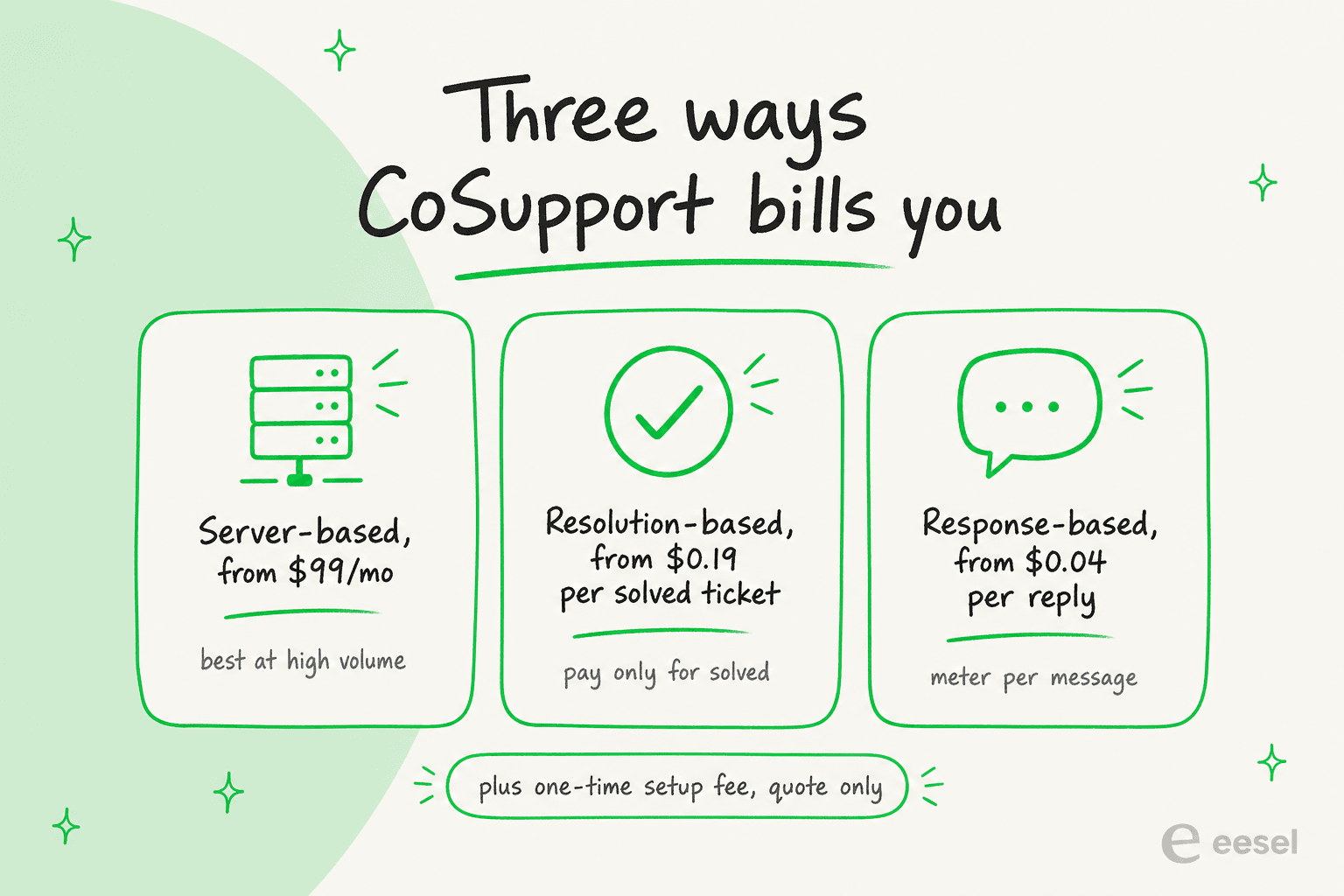
One honest wrinkle before you go further: CoSupport's own site isn't fully consistent on the per-unit numbers. The live pricing page and its review-site profiles cite $0.19 per resolution and $0.04 per response, while one older product page still cites $0.59 per ticket and $0.10 per reply. I'd treat the pricing-page figures as current and confirm every number in writing on your quote.
What each billing model actually costs you
The trap with usage-based AI support agent pricing is that the billable unit is never as simple as it sounds. Here's what each one really means before you pick one.
- Server-based (flat). You pay one monthly fee and the AI answers as much as it wants. Predictable, and it's usually the cheapest per-ticket once you're past a few thousand tickets a month. The downside: "from $99" is a floor for the smallest setups, and your real number scales with usage in ways CoSupport only reveals on a quote.
- Resolution-based. You're billed only for tickets the AI actually resolves, unsolved ones are free. Genuinely fair, and great at low volume. But the $0.19 floor is volume-discounted, so a smaller team pays more per resolution, and you have to trust CoSupport's definition of what counts as "resolved."
- Response-based. You pay per AI-generated reply. This is the one to watch: a single ticket often takes three or four replies back and forth, so $0.04 a reply can quietly multiply. It rewards short, one-shot answers and punishes the messy multi-turn tickets that are exactly where you want the AI helping.
To see which model is cheapest at your volume, plug your own numbers in below. It uses CoSupport's published floor rates, so read it as a directional best case rather than a quote.
What jumps out when you play with it: at any real ticket volume, the per-unit models add up fast, and the flat server-based plan often looks cheapest on paper. That's the trade most teams miss when a $0.19 rate sounds tiny on a sales call.
The costs the $99 headline doesn't show
If you only budget for the monthly subscription, you'll under-quote CoSupport to your finance team. There are three layers to the real cost, and only one of them is on the pricing page.
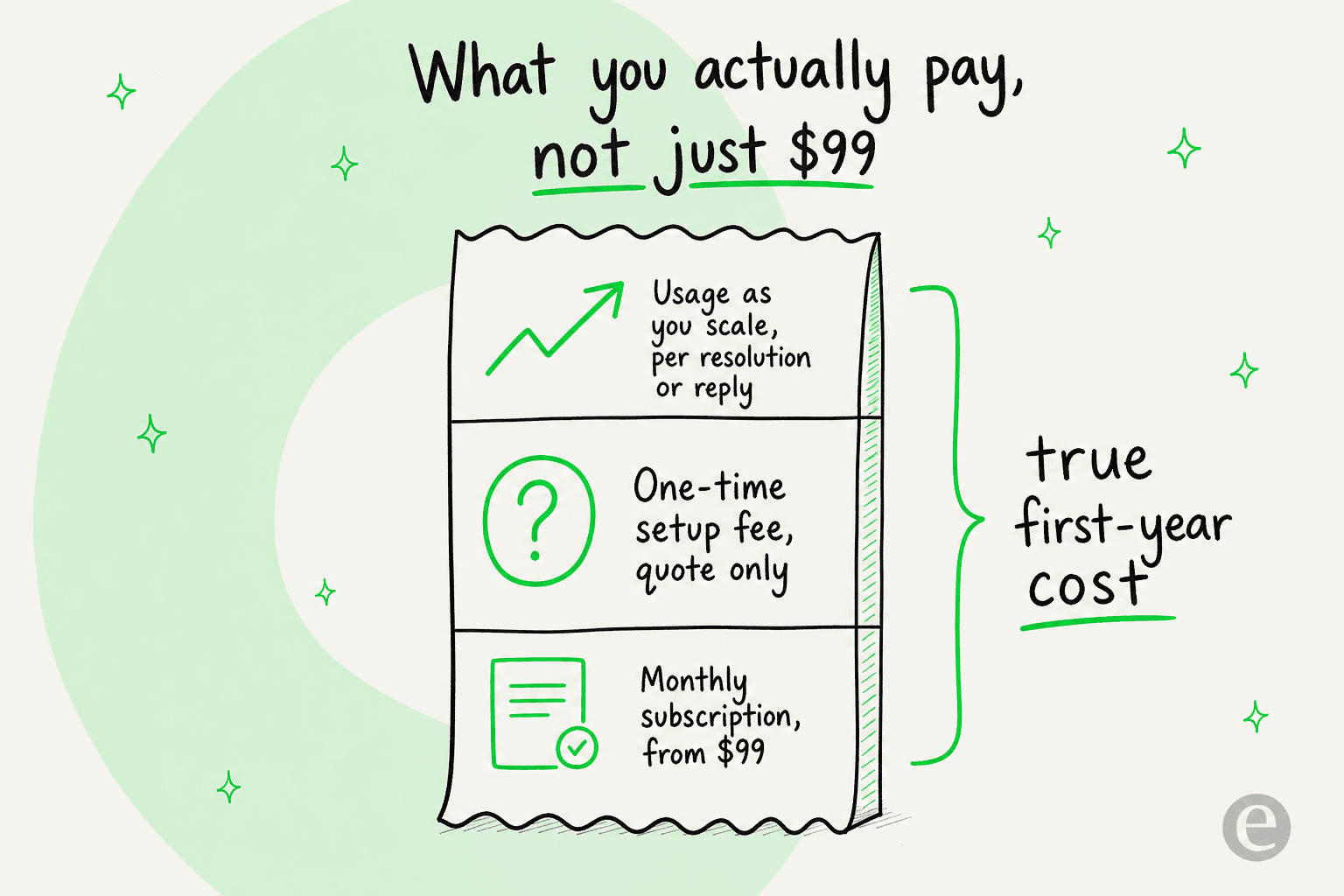
The big one is the setup fee. CoSupport confirms there's a one-time onboarding charge covering the integration build and initial model training, and it isn't published, you get it on your quote. That matters because setup is also the thing reviewers complain about most: the most-tagged G2 complaint is difficult, time-consuming setup. So you're paying for an onboarding that's also a multi-week project, which is a real total-cost-of-ownership consideration, not just a line item. If fast time-to-value matters, weigh that against a tool you can stand up yourself.
The second is scale. "From $99/mo" is anchored to the smallest server-based setup. As your ticket volume grows, so does the quote, and because it's all negotiated, you won't find your real number without going through sales. The third is the integration surface: CoSupport connects to Zendesk, Freshdesk, Zoho, Salesforce, Shopify, Stripe, Slack, and Microsoft Teams, but the more of those you wire up, the heavier (and pricier) the onboarding build.
Worked examples: what a real team pays
Abstract rates are hard to reason about, so here are two realistic shapes. Both leave out the setup fee, since it's unquoted, but remember it sits on top of every figure here.
- Small team, ~800 tickets/month, AI resolves 60%. Resolution-based lands around $91/month at the floor rate (800 × 0.6 × $0.19), basically neck-and-neck with the $99 flat plan, and response-based at three replies a ticket runs about $96. At this size the models are close, so the deciding factor is really the setup fee and how predictable you want the bill, not the per-unit rate.
- Mid-market team, ~6,000 tickets/month, AI resolves 75%. Now the gap opens up. Resolution-based is roughly $855/month (6,000 × 0.75 × $0.19), response-based at three replies is about $720, while the flat server plan, even after CoSupport's quote bumps it above $99, is usually the cheapest per ticket at this volume. This is the classic crossover: usage-based looks cheap until you actually have volume.
The takeaway isn't "CoSupport is expensive", it's that the cheapest model flips depending on your volume and resolution rate, and you can't know which one wins without modelling it (use the estimator above) and getting the setup fee in writing.
What users say about CoSupport AI pricing
The reassuring part: once teams have a quote, several reviewers describe the pricing as easy to reason about. The friction is almost entirely at the shopping stage, when the numbers are still gated. CoSupport rates 4.9/5 on G2 across 13 reviews and 5.0 on Capterra across 10, a strong score on an admittedly small, vendor-managed sample.
On value, the sentiment is genuinely positive once the model is dialed in:
"AI solutions are typically considered time-consuming and expensive. With CoSupport AI we learnt that AI tools implementation can be easy… Our most significant result of using CoSupport AI is that we cut the response time in half. 50% reduction number was achieved within days."
Verified G2 reviewer, Small-Business, G2

The named customer results back up the value case: a dental SaaS resolving ~74% of tickets and another team automating ~80%. For a guided, vendor-built rollout, those are believable, and they're the return that has to justify the setup fee.
The hidden cost of per-unit pricing
Here's the part I care about most, because it's not on any pricing page. Per-resolution and per-message billing quietly creates anxiety. When every reply has a price tag, teams start second-guessing whether to let the AI handle a ticket at all, which is the exact opposite of what you bought it for.
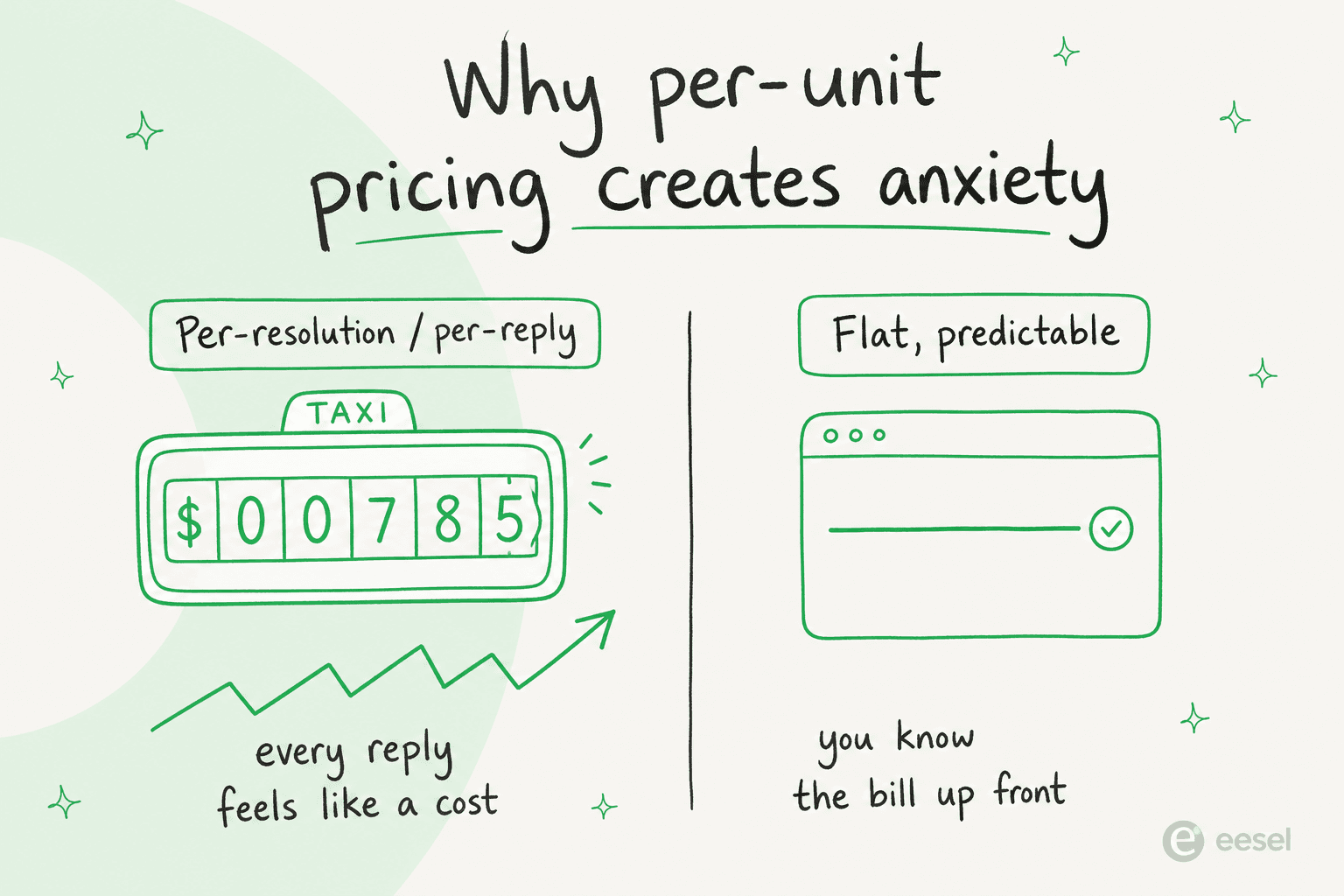
I've watched teams hesitate to expand automation because the bill scaled with every interaction, even when the AI was doing great work. It's a real enough problem that eesel deliberately moved away from charging per resolution when it set eesel's pricing, so a busy month never turns into a surprise invoice. The broader logic is worth reading in this guide to AI support cost savings: the cheapest tool on a per-unit sticker isn't always the cheapest tool to actually run, especially once you factor in setup and the behaviour the pricing model encourages.
So before you sign, the questions I'd take into the CoSupport demo are simple: what's the setup fee in writing, which billing model is cheapest at my real volume, and can I simulate this on my own tickets before I commit? If a vendor can't answer the first two without three more calls, that opacity is itself part of the cost.
Try eesel for AI support pricing you can see up front
If CoSupport's quote-gated, usage-based motion sounds heavier than you want, eesel AI is built on the opposite default. It's an AI support agent that plugs into the helpdesk you already run (Zendesk, Freshdesk, Gorgias, Help Scout, Slack and more), trains itself on your past tickets and docs, and you set it up yourself in minutes, no demo required to see a price.
The piece I'd point a careful buyer to: pricing is transparent and predictable with no per-resolution meter, and you can run a simulation on thousands of your historical tickets before going live to see your real resolution rate first. It's the "know the cost and test the reality before you commit" approach this whole post keeps coming back to. You can try eesel free.

Frequently Asked Questions
How much does CoSupport AI cost?
CoSupport AI pricing starts at $99/month for the server-based plan, with resolution-based ($0.19+ per solved ticket) and response-based ($0.04+ per reply) models as alternatives, plus a one-time setup fee. Every real number is quote-gated behind a demo, so the published figures are floors rather than what most teams pay. For how to budget AI support more broadly, see this guide to AI support cost savings.
What is CoSupport AI's pricing for small teams?
Small teams usually land on either the server-based plan (from $99/month, flat) or the resolution-based model (from $0.19 per solved ticket). At low volume the per-unit models can look cheap but the per-unit rate is higher than the published floor, and the setup fee hits everyone. If you want a price you can predict, compare it against a self-serve AI support workflow you configure yourself.
Does CoSupport AI charge a setup fee?
Yes. On top of the monthly subscription, CoSupport AI charges a one-time onboarding and integration fee that depends on your integrations and isn't published, you get it on a quote. It's the single most overlooked line item in CoSupport AI pricing, so ask for it in writing before you compare against an AI customer service company with no setup cost.
Is CoSupport AI's resolution-based pricing cheaper than flat pricing?
It depends on volume. Resolution-based billing (from $0.19 per solved ticket) only charges for tickets the AI actually resolves, so it's attractive at low volume, but at a few thousand tickets a month the flat server-based plan often wins. Use the estimator in this post, then read up on tier-1 deflection to see which tickets the AI should even touch.
Does CoSupport AI have a free trial?
CoSupport AI offers a free trial and a no-cost pilot, but you request a demo to start one rather than signing up self-serve. If you'd rather test pricing on your own data immediately, tools like eesel AI let you self-serve and simulate against past tickets before you commit to a plan.


Article by
Kurnia Kharisma Agung Samiadjie
Kurnia is a software engineer and writer at eesel AI with two years of SEO experience, writing about AI tools, helpdesk software, and customer support. He pairs a developer's understanding of how these products are built with search-driven research into what actually ranks and resonates with the people searching for them.