


Why "AI vs human" is the wrong fight
I've spent the last couple of years doing SEO, which means I've watched this debate go from "AI content is garbage" to "AI content is everywhere" in about eighteen months. Both takes miss the point.
Here's what I've actually seen building and watching content teams run AI: the writers who lost their jobs weren't replaced by AI. They were replaced by other writers who used AI and shipped ten times the work. And the AI-only operations that flooded the internet with auto-generated blogs mostly didn't rank, because they skipped the one thing AI can't do on its own.
So the useful question isn't "which is better." It's "which is better at what," and then "how do I combine them so I'm not paying a human to do robot work or trusting a robot to do human work." Let's settle the first two, then build the workflow.
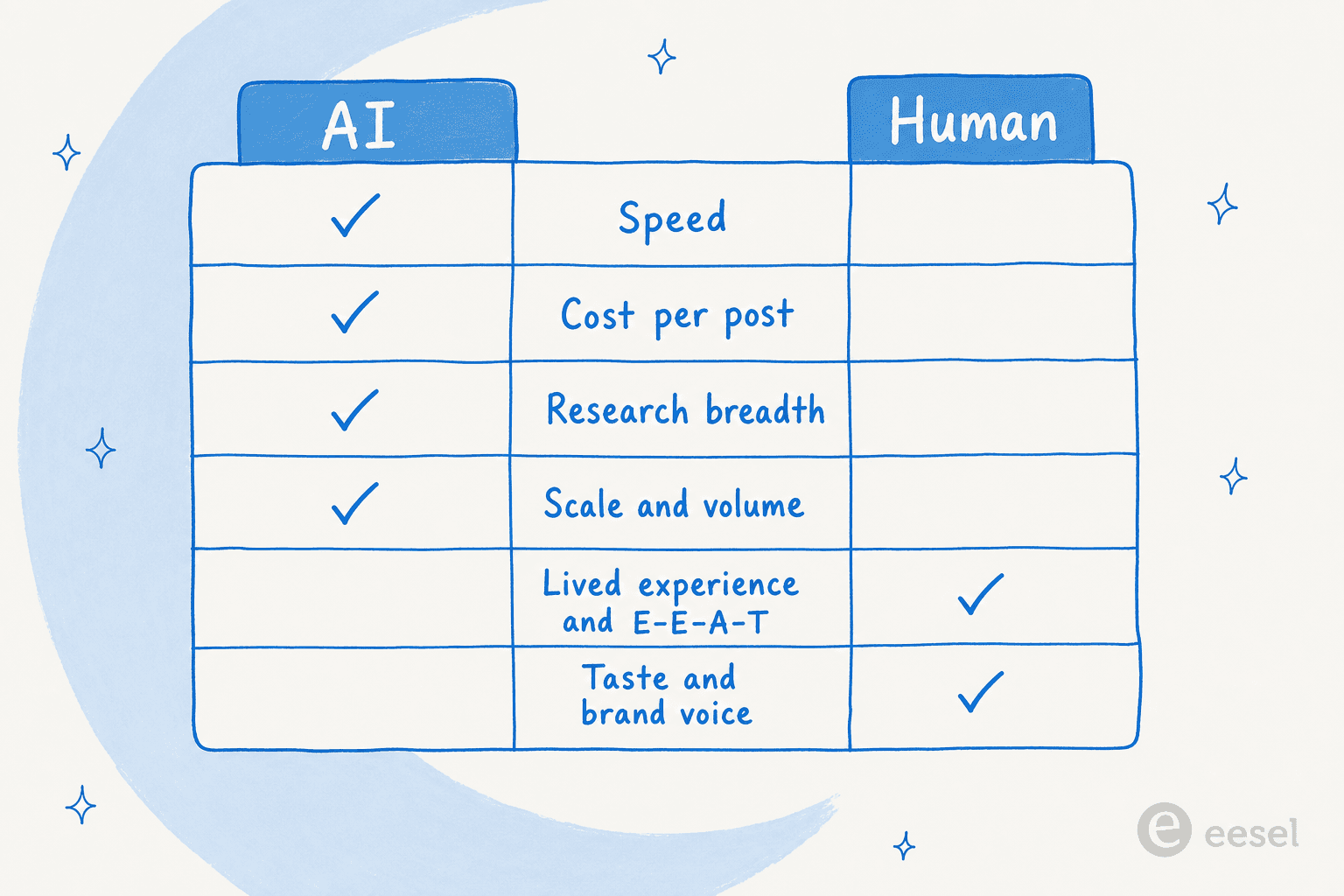
Where AI wins
Speed and volume, by a mile
This is the one that isn't close. A human writer producing a researched, 2,000-word B2B post is doing well to turn around a handful a week. An AI-assisted pipeline produces a comparable first draft in minutes.
The numbers are lopsided once you see them side by side. One content team I've watched run our blog writer scaled to 360+ posts a month, around twelve a day, off a keyword-to-publish pipeline with batch review, on a single small team. A German baby-textile brand ran the same skill about fifteen times across keywords to get 2,000-to-2,900-word SEO posts, each in roughly twelve to twenty minutes. No human team writes at that production speed.
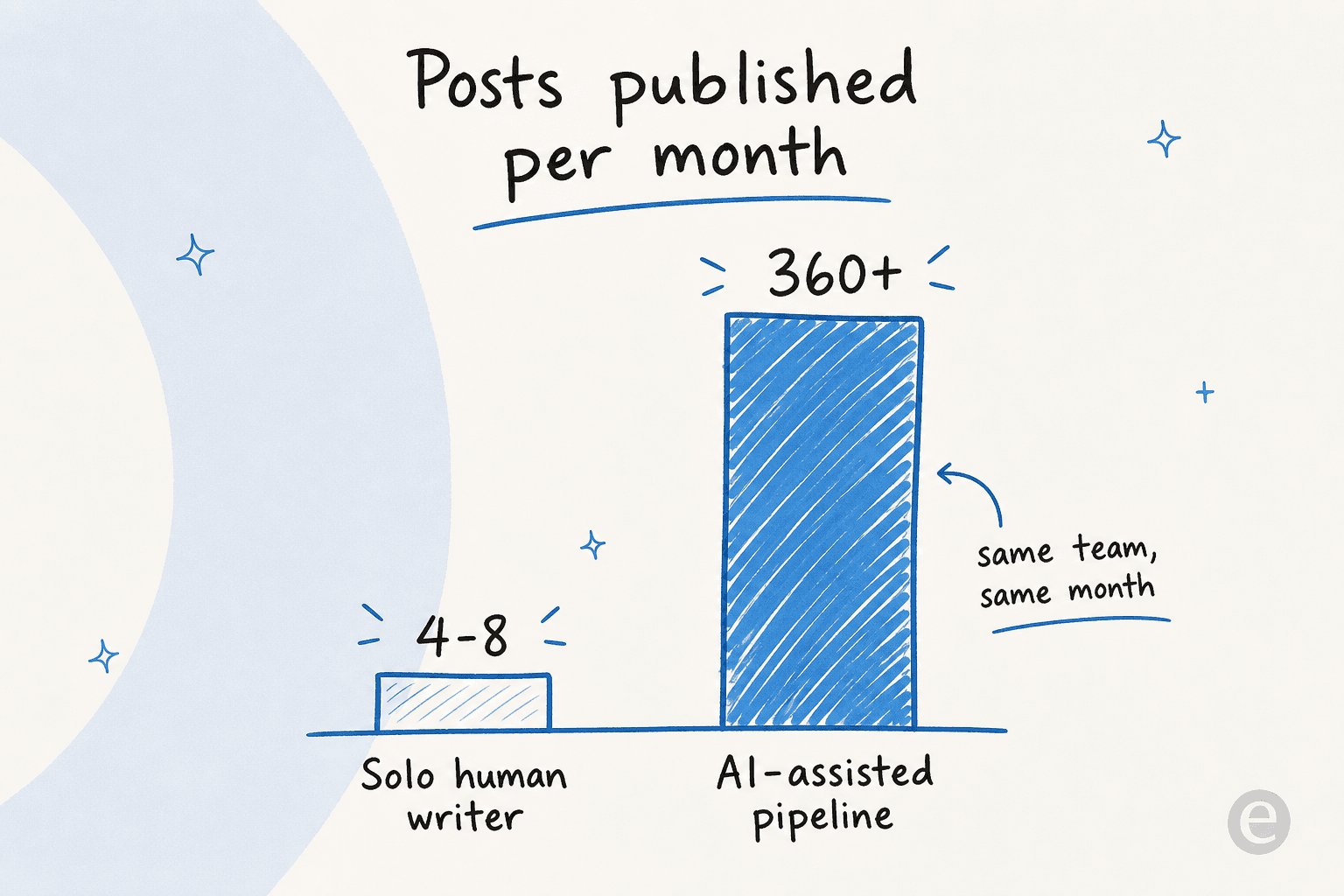
If your bottleneck is "we have 400 long-tail keywords and one writer," that's an AI problem, and tools built for scaling content are how you clear it. No amount of caffeine fixes a throughput gap that large.
Cost per post
The economics follow the speed. A freelance B2B post runs a few hundred dollars and lands in a few days; an agency retainer is more. An AI draft costs a few dollars and lands while you're still reading the brief. With eesel, a full blog draft is a $4 task on usage-based pricing, with the first two generations free.
That doesn't mean your content budget drops to nothing. It means the money moves. You stop paying for first drafts and start paying for editing and strategy, which is exactly where human time is worth more. The full math is in our AI blog writer cost comparison, but the headline is simple: the cheap part of writing got nearly free, and the expensive part stayed expensive.
Research breadth
People underrate this one. A good AI writer doesn't just generate text, it reads, fast and wide. The version we built reads Reddit threads, industry reports, and primary sources, and cites every claim inline rather than asserting things into the void.
A human can absolutely out-research AI on any single source by going deep. But breadth at speed, pulling forty sources into one outline before lunch, is where machines pull ahead. This is also why the old fear that AI content is automatically shallow is dated: shallow AI content comes from shallow prompts, not from the model. Give it real research and sources to work from and the floor rises a lot.
Where humans win
Lived experience and E-E-A-T
Google's quality framework leans hard on the extra E in E-E-A-T: experience. Has the author actually done the thing? AI hasn't. It has never onboarded a confused customer, blown a deadline, or had a launch flop. It can summarize a thousand posts about a topic, but it can't tell you the one war story that makes a reader trust the whole piece.
This is the single biggest reason pure-AI content underperforms. It reads competent and says nothing only the author would know. Closing that gap is the entire premise of writing E-E-A-T-compliant content, and it's a human job. The fix is small and it's huge: a real number, a real screenshot, a real "here's what bit us." A human adds those in five minutes; AI can't add them at all.
Taste and brand voice
AI gets you 90% of the way to your voice. Our blog writer claims a 94% voice match from day one, and that tracks with what I've seen. But the last 10% (knowing the joke that's a touch too much, the claim that's technically true but off-brand, the analogy that'll land with your exact audience) is taste, and taste is human.
You can train a lot of this. Brand voice training narrows the gap, and the model gets better with every edit you make. But someone still has to have the taste to judge the output, and that someone is you.
Accountability
Worth saying plainly: a model can't be responsible for a published claim. When a post says something wrong, a person has to own it, catch it, and fix it. That's not a knock on AI, it's just the job. Anything in a regulated space (health, finance, legal) needs a human signing off, full stop. It's also why blanket AI detectors miss the point: the question was never "did a machine touch this," it's "did a human stand behind it."
The head-to-head, in one table
| Dimension | AI | Human | Who wins |
|---|---|---|---|
| First-draft speed | Minutes | Hours to days | AI |
| Cost per post | A few dollars | Hundreds-plus | AI |
| Research breadth at speed | Dozens of sources, fast | Deep but slow | AI |
| Monthly volume | Hundreds | A handful | AI |
| Lived experience | None | Real | Human |
| Brand-voice nuance | ~90% there | The last 10% | Human |
| Original data and stories | Can't invent them | Brings them | Human |
| Accountability for claims | None | Owns it | Human |
| Consistency across 100 posts | Effortless | Drifts | AI |
| Knowing what not to say | Weak | Strong | Human |
Read down that table and the conclusion writes itself: you don't want AI or human blogging, you want each doing the rows it wins. Which is the whole point of the next section.
The hybrid workflow that actually works
Every content team I've seen get real results lands on roughly the same loop. It's not complicated, and once you see it you can't unsee how much of the old process was a human doing robot work.
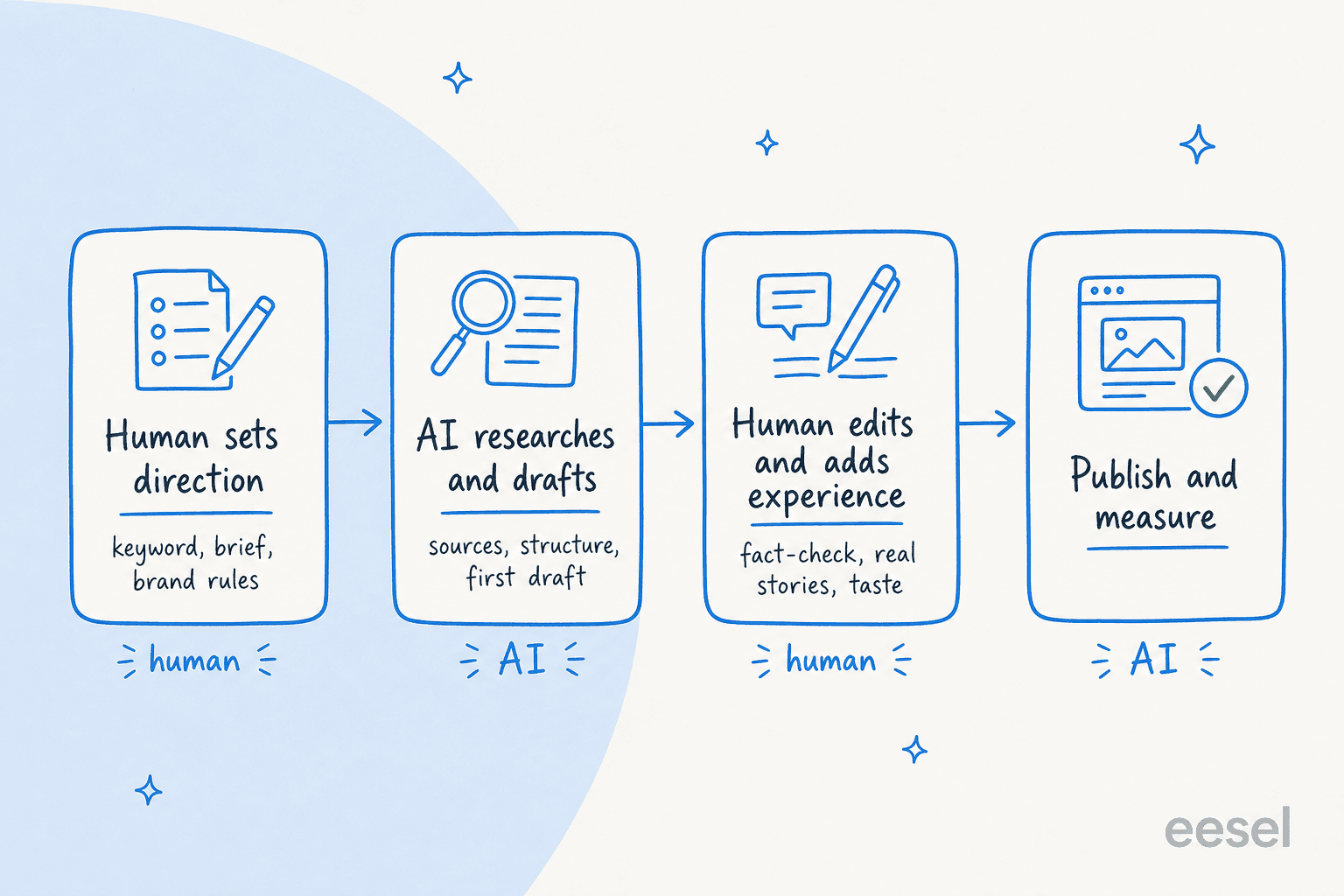
1. The human sets direction. Keyword, angle, audience, and the rules of the house. The strongest version of this I've watched was a wellness retailer who anointed one great post as the "North Star" and told the AI to match it on every future run, structure, reading level, research depth and all. Define the target once and you stop re-explaining it every post. This is also where you set brand-safety rules, like the marketer who banned a competitor-owned review site from ever appearing in her content.
2. AI researches and drafts. This is the legwork: pull the sources, build the structure, write the first pass, generate the images, draft the meta description. The thing AI is great at, done in the time it takes to get coffee. A good AI blog writing workflow front-loads all of this so the human never stares at a blank page.
3. The human edits and adds experience. This is where the post earns its keep. Fact-check the claims, cut the generic lines, and inject the things only you have: the real number, the customer story, the contrarian take. This editing process is the highest-leverage 30 minutes in the whole pipeline, and it's exactly the work that separates content that ranks from content that gets buried.
4. Publish and measure. Ship it, watch what ranks, feed the winners back in as the new North Star. The loop compounds: every edit teaches the AI your taste, so step 3 shrinks over time.
The trap to avoid is treating step 2 as the whole process. Skipping the human edit is how you get the AI posts that don't rank, the ones that read fine and convert nobody. The hybrid isn't "AI plus a quick proofread," it's "AI does the volume, human does the value."
For a deeper version of this for teams running it across clients, the workflow for agencies covers the batch-review side, and our roundup of the best AI blog writers covers which tools fit which step.
Common mistakes when you combine them
A few traps I see over and over, mostly from teams that got the speed but not the value:
- Publishing the first draft. The draft is the cheap part. Shipping it unedited throws away the human edge and lands you a generic post. If you only do one thing from this article, edit harder.
- Prompting thin and blaming the model. "Write a blog about X" gets you a Wikipedia summary. Feed it real sources and a real brief and the output changes completely, which is the difference between an AI blog generator and a research assistant.
- Treating the CMS as an afterthought. I've watched perfect drafts die on the way into a restrictive CMS that wouldn't take the formatting, metadata, or FAQ schema. Sort out CMS integration before you scale, not after.
- Forgetting internal links. Sparse pages don't rank. Whether a human or AI writes the body, the post needs internal linking baked in.
- Outsourcing judgment. You can outsource the draft. You can't outsource the decision about whether it's true and on-brand. That's also why outsourcing blog writing wholesale to either a content mill or a raw model tends to disappoint for the same reason.
If you want to pressure-test your own setup, our AI blog writer pros and cons and the broader AI vs traditional SEO piece are good companions to this one.
Try eesel for the hybrid workflow
If the workflow above sounds right but you don't want to wire it together yourself, that's basically what we built eesel's AI blog writer to be. It's not a prompt box, it's a teammate: it finds topics worth writing, does the real research, drafts in your voice with every claim cited, and hands you something to edit rather than a blank page. You stay in the seat that matters (direction and editing), and it takes the legwork.
What makes it fit the hybrid model specifically: it learns your taste from every edit, it writes in 80+ languages while matching your voice in each, and it ships with free SEO tools for the keyword-and-metadata side of the job. You set the North Star once; it does the volume; you do the value. The first two posts are free, no credit card, so you can run one real post through the loop before deciding. Start with the AI blog writer.
Frequently asked questions
Is AI blog writing better than human writing?
Does Google penalize AI-written blog posts?
How much does AI blog writing cost vs hiring a writer?
Can AI write blog posts that actually rank for SEO?
Will AI replace human blog writers?
How do I keep AI blog posts from sounding generic?
What is the best way to scale blog content with AI?


Article by
Kurnia Kharisma Agung Samiadjie
Kurnia is a software engineer and writer at eesel AI with two years of SEO experience, writing about AI tools, helpdesk software, and customer support. He pairs a developer's understanding of how these products are built with search-driven research into what actually ranks and resonates with the people searching for them.