

If you’re in content marketing, you know the feeling. The pressure to consistently publish great, SEO-friendly articles is relentless. It can feel like a marathon with no finish line, eating up time and resources that many teams just don’t have. It’s tough to keep up.
But what if you could put most of that workflow on autopilot? That's the idea behind an AI automated blog platform. These aren't just clever writing assistants; they are complete systems built to handle everything from finding keywords to hitting "publish." This guide will walk you through what these tools are, the key features to look for, some of the major players, and how to pick one that actually fits your goals.
What is an AI automated blog?
Simply put, an AI automated blog is a system that uses artificial intelligence to run your entire content creation process. Imagine having a content strategist, writer, and SEO specialist all working together, 24/7. It starts by finding keywords and brainstorming topics, then writes and optimizes the article, and sometimes even publishes it straight to your website.
This is a big step up from just using a basic AI writer like ChatGPT. While those tools are handy for getting words on a page from a prompt, they're only one small part of the whole content puzzle. An automation platform is designed for the complete workflow, from start to finish. It’s built to help businesses grow their content marketing, establish themselves as experts on a topic, and bring in organic traffic, all without having to massively increase their headcount or budget. The real aim isn’t just to write more articles, but to build a smart, self-running content engine.
Key components of an AI automated blog
Before you start comparing tools, it helps to know what separates a genuinely useful platform from a gimmick. The best systems don't just have a list of features; they weave them together into a smooth process.
A good starting point for any content strategy is automated research and planning. The smartest platforms don't wait for you to feed them a topic. They analyze search results, sniff out keywords with high potential and low competition, and suggest topics your audience will actually care about. Some can even sketch out a content calendar for you, taking a lot of the strategic guesswork off your plate.
Of course, the platform needs to handle advanced content generation. There’s a huge difference between a raw block of text and a polished article. Top-tier tools create content that’s pretty much ready to go, complete with the right headings (H2s, H3s), lists, and tables. They can also pull in relevant images and videos to keep readers engaged. Most importantly, they can write in a human-like tone and can often be trained on your brand voice, so everything sounds consistent.
An article is useless if no one finds it, which is why built-in SEO and AEO optimization is a must-have. Key features here include automatically using target keywords in the right places, generating meta titles and descriptions, and adding internal links to your other blog posts. It’s also getting more important to think about Answer Engine Optimization (AEO), which means structuring your content so AI assistants like ChatGPT and Google's AI Overviews can easily use it to answer questions. This usually involves adding a solid FAQ section that gives direct answers to common queries.
Finally, a big piece of the automation puzzle is publishing and CMS integration. The whole point is to cut out boring, manual tasks. The best platforms connect directly with popular systems like WordPress or Shopify. This lets them send drafts over automatically, saving you from the soul-crushing work of copying, pasting, and reformatting everything by hand.
A look at leading AI automated blog tools
The market for these tools is growing fast, and everyone seems to have a slightly different angle. Here’s a quick rundown of a few popular options to give you a feel for what’s out there.
Autoblogging.ai
Autoblogging.ai is a tool built for SEO pros and marketers who need to produce a lot of content, fast. It has different settings like a "Quick Mode" and a "Godlike Mode," depending on the type of article you need. Its pricing is based on a credit system, where a simple article might cost one credit and a more complex one costs two. Plans range from $19 to $99 a month, giving you a certain number of credits to spend. The tricky part is that the credit system can make your monthly costs a bit unpredictable if your needs change.
NextBlog.ai
NextBlog.ai calls itself an autonomous AI agent that runs your content strategy for you. It puts a big emphasis on both SEO and AEO, aiming to create content that not only ranks on Google but also gets picked up by AI assistants. Its pricing is much more straightforward, based on how many articles you want per month, with plans from $49 for 20 articles to $199 for 150. While it talks a big game about full automation, it seems to prioritize speed and volume. The platform doesn't really talk about adding unique elements like customer quotes or expert opinions, which can sometimes lead to content that feels a bit generic.
Bloffee
Bloffee is designed to be a direct replacement for hiring freelance writers, promising to publish over 50 articles a month to save you time and money. Its pricing is higher, starting around €299 per month, because it's built for high-volume production. The main selling point is quantity. In today's world, where Google is getting much better at spotting low-effort, mass-produced content, a strategy that's all about volume feels pretty risky for building long-term trust and authority.
When you look at these tools side-by-side, a clear difference in philosophy emerges. Tools like Autoblogging.ai and Bloffee are built for volume, which is great if your goal is to cast a very wide net. NextBlog.ai tries to automate the strategy itself. The trade-off with a volume-first approach is often a lack of depth and the kind of unique assets that build real reader trust, like social proof or genuinely helpful insights. This can be a problem as search engines continue to prioritize high-quality, authentic content.
The eesel AI approach: An AI automated blog built for quality
While many tools are in a race to produce more content faster, the only SEO strategy that really works long-term is built on quality. For teams who want to scale their content without watering down their expertise, you need a different kind of tool.
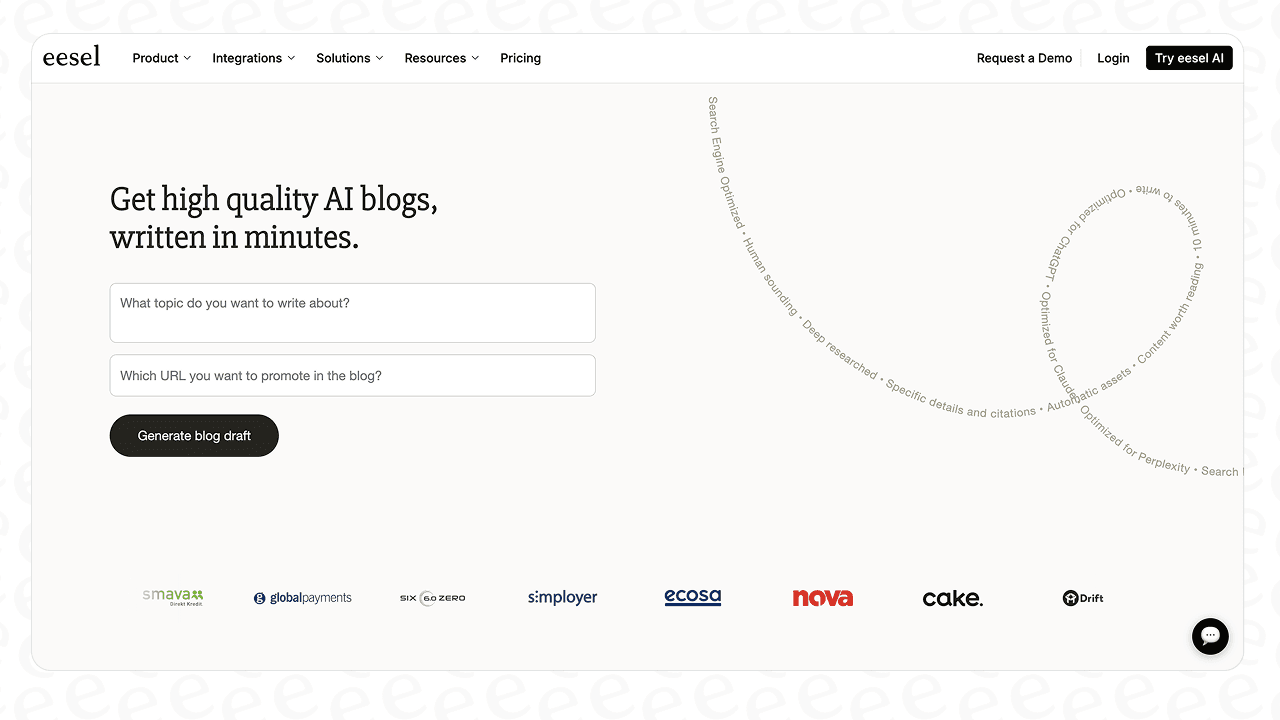
How an AI automated blog turns a single keyword into a comprehensive article
The eesel AI Blog Writer was designed to do one thing really well: turn a single keyword into a complete, well-researched article. It doesn't just spit out a wall of text. It gives you a full content package, including SEO-friendly titles, a meta description, an FAQ section for AEO, and even a few social media posts to get you started, all from one prompt.
Deep AI automated blog research that goes beyond keywords
What really makes the eesel AI approach different is how it tackles the "robotic content" problem. Before writing a single word, our AI analyzes the top-ranking pages for your keyword to figure out what’s already working. Then, it creates an article that’s better and more thorough. It also finds unique assets that other tools ignore, like relevant YouTube videos to make the content more engaging and real quotes from Reddit threads to add some authentic social proof. The result is content that people actually want to read and share.
We use our AI automated blog ourselves, and it works
We didn’t just build this tool to sell it; we built it for our own team. At eesel, we used this exact blog writer to grow our organic traffic from 700 to 750,000 impressions a day in just three months. It completely changed the game for our content strategy.
And the best part? The tool is currently free to use. We're in the process of gathering feedback from early users to make it even better, which gives you a chance to try it out with zero risk.
Choosing the right AI automated blog tool for you
When it comes down to it, the best tool is the one that aligns with your goals. Are you just trying to pump out as much content as possible, or are you trying to build a reputation as a trusted authority in your space?
As search engines continue to get smarter, things like content quality, depth, and authenticity (what Google calls E-E-A-T) are becoming more important than raw quantity. A long-term strategy that relies on generic, high-volume content is not just a gamble; it’s likely to backfire.
For teams who want to build real authority and drive traffic that matters, the focus has to be on scaling high-quality content. The eesel AI Blog Writer is built for exactly that, helping you create deeply researched, engaging, and authentic articles without the manual grind. Give it a try for free and see what you think.
Frequently asked questions
How is an AI automated blog different from just using a standard AI writer like ChatGPT?
An AI automated blog is a complete system that manages the entire content workflow, from keyword research and topic generation to writing, optimization, and sometimes publishing. Basic AI writers, like ChatGPT, primarily focus on generating text from a prompt and handle only one part of the overall content puzzle.
What specific benefits can my content team expect from adopting an AI automated blog?
Your team can expect significant time savings by automating repetitive tasks, a boost in SEO performance through optimized content, and the ability to scale content production without increasing headcount. It helps establish your brand as an expert and drives organic traffic more efficiently.
Can an AI automated blog truly create content that meets Google's E-E-A-T guidelines for quality and expertise?
Yes, but it depends on the platform's approach. Tools like eesel AI are designed to produce high-quality, deeply researched content, incorporating unique assets and social proof to align with E-E-A-T. Volume-focused tools may struggle to consistently meet these higher quality standards.
How does an AI automated blog handle research and keyword planning before writing an article?
The best AI automated blog platforms analyze search results and identify high-potential keywords and topics. They go beyond simple keyword suggestions by understanding user intent and creating a comprehensive outline based on what's already ranking well, ensuring the content is relevant and competitive.
Is it possible for an AI automated blog to integrate directly with my website's content management system for publishing?
Many top-tier AI automated blog platforms offer direct integration with popular CMS systems like WordPress or Shopify. This feature streamlines the publishing process by automatically sending generated drafts to your website, eliminating manual copy-pasting and reformatting.
Given the rise of AI-generated content, how can an AI automated blog ensure my articles stand out and aren't flagged as generic?
To stand out, an effective AI automated blog should focus on deep research, incorporate unique assets like relevant videos or real-world quotes, and be trained to write in a distinct brand voice. This approach helps create content that is valuable, engaging, and perceived as authentic by both readers and search engines.