The 8 best Teammates.ai alternatives in 2026

Riellvriany Indriawan

Katelin Teen
Last edited July 17, 2026

Why people look past Teammates.ai
Let me be fair first, because Teammates.ai gets a few things right that most of this list doesn't.
It's one of the only vendors here with fully public, self-serve pricing. Its customer-service agent, Raya, works across chat, voice, email, WhatsApp, Slack, and Teams in 50+ languages, with native Arabic dialect handling that's rare in this category. And the whole thing sets up in about ten minutes. If you want one platform that also does sales outreach (Adam) and candidate interviews (Sara), the multi-role angle is a real selling point.

So why do teams keep shopping around? A few honest reasons:
- It's very new. The company closed its funding round and rebranded from Uktob.ai in January 2025, led by Hustle Fund. That's exciting, but it means there's almost no verifiable review history on G2, Capterra, Trustpilot, or Reddit yet. The headline claims (78% of tickets resolved with no human, average resolution time cut from 26 hours to 38 minutes) are all vendor self-reported, and right now you mostly have to take them on faith.
- It's a generalist, not a support specialist. Support, sales, and recruiting in one suite is convenient, but if customer support is your whole job, specialists tend to go deeper on the things that matter: helpdesk-native workflows, ecommerce actions, QA, and testing.
- Credit-wallet billing gets fuzzy at volume. One credit buys about 10 support replies, which is cheap per message. But a chatty, multi-turn ticket spends several credits, so your real cost-per-resolution is harder to predict than a flat per-ticket or per-resolution price.
- It's a standalone platform. With 30+ integrations it connects to Zendesk, Salesforce, and HubSpot, but if you already live inside one helpdesk, you may prefer an agent that layers into that queue instead of asking your team to work somewhere new.
None of these are dealbreakers. They're just the reasons a support-led team ends up comparing Teammates.ai against the eight tools below.
How I picked these alternatives
I weighted the things that actually decide whether an AI agent for customer service survives contact with a real queue:
- Autonomy you can trust: can it resolve tickets end-to-end, and can you test it before it goes live? This is the line between a real AI agent and a rule-based chatbot.
- Helpdesk fit: does it layer into Zendesk, Freshdesk, or Gorgias, or does it want to replace them? The wider AI customer service software market splits hard on this.
- Pricing you can actually see: public and predictable beats "book a demo."
- Depth for your use case: ecommerce, enterprise, regulated industries, and physical products all pull in different directions. If you want the full field, my best customer service AI roundup goes wider.
Here's roughly how the shortlist sorts out. The self-serve, layers-onto-your-helpdesk corner is surprisingly empty, which is where most support teams actually want to be.
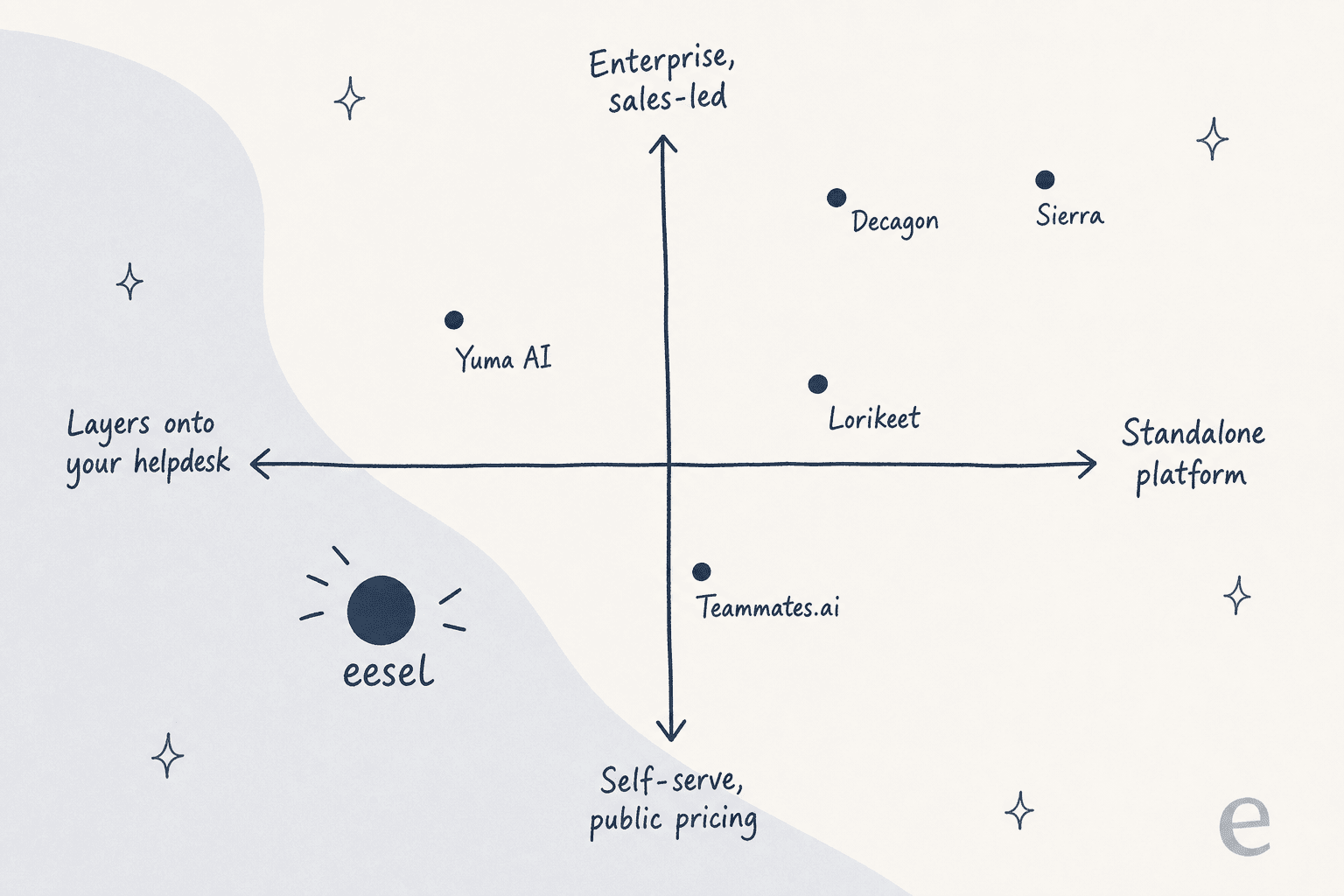
The 8 best Teammates.ai alternatives at a glance
| Tool | Best for | Pricing model | Entry price | Free trial | Deploys as |
|---|---|---|---|---|---|
| eesel AI | Layering AI into your existing helpdesk | Fixed monthly credit plan, public | From $299/mo (500 credits) | Yes, 100 free credits | Layer on your helpdesk |
| Teammates.ai | A multi-role AI "employee" suite | Credit wallet, public | $25/mo | Free plan | Standalone platform |
| Decagon | Large enterprise CX | Quote only | Custom | No | Standalone platform |
| Sierra | Enterprise, outcome-priced | Quote only (outcomes) | Custom | No | Standalone platform |
| Forethought | Existing helpdesk deflection | Quote only | Custom | POV, not free | Layer on your helpdesk |
| Lorikeet | Complex, high-stakes support | Per resolution, public | $1,500/mo | Demo | Standalone platform |
| Netomi | Enterprise omnichannel | Quote only | Custom | No | Standalone platform |
| Yuma AI | Ecommerce and Shopify | Per resolution, quote-gated | Custom | 30-day trial | Layer on your helpdesk |
| Mavenoid | Physical-product support | Quote only | Custom | Demo | Standalone platform |
Prices are entry/list figures pulled from each vendor's own pages in July 2026. Quote-only means there's no public number, so you'll need a sales call.
Which one actually fits you?
Skip the scrolling. Pick the priority that matters most and this points you at the item worth reading first.
<style>
.tmt-picker { background:#fff; border:1px solid #e4e4dd; border-radius:14px; padding:24px; font-family:-apple-system,BlinkMacSystemFont,'Segoe UI',Roboto,sans-serif; color:#474739; max-width:680px; margin:0 auto; }
.tmt-picker h4 { margin:0 0 16px; font-size:1.05rem; color:#45556C; }
.tmt-picker label { display:block; border:1px solid #e4e4dd; border-radius:10px; padding:13px 16px; margin-bottom:10px; cursor:pointer; transition:all .15s ease; font-size:.95rem; }
.tmt-picker label:hover { border-color:#45556C; }
.tmt-picker input { position:absolute; opacity:0; pointer-events:none; }
.tmt-picker .tmt-out { display:none; margin-top:8px; padding:16px 18px; border-radius:10px; background:#eef0f3; border-left:4px solid #45556C; font-size:.95rem; line-height:1.5; }
.tmt-picker input:checked + .tmt-out { display:block; }
.tmt-picker label:has(input:checked) { border-color:#45556C; background:#f4f5f7; font-weight:600; }
.tmt-picker .tmt-out a { color:#45556C; font-weight:600; }
</style>
<div class="tmt-picker">
  <h4>What matters most for your team?</h4>
  <label>I want AI inside the helpdesk I already run
    <input type="radio" name="tmt">
    <span class="tmt-out">Start with <strong>eesel AI</strong>. It layers onto Zendesk, Freshdesk, Gorgias, and more, learns from your past tickets, and you can simulate before going live. <a href="https://www.eesel.ai/ai-helpdesk-agent">See how it works</a>.</span>
  </label>
  <label>I run a Shopify or ecommerce store
    <input type="radio" name="tmt">
    <span class="tmt-out">Look at <strong>Yuma AI</strong> for deep ecommerce actions (returns, WISMO, refunds), or eesel if you want to stay helpdesk-agnostic.</span>
  </label>
  <label>I'm a large enterprise with a procurement process
    <input type="radio" name="tmt">
    <span class="tmt-out">Shortlist <strong>Decagon</strong> and <strong>Sierra</strong> for scale, or <strong>Netomi</strong> for regulated, omnichannel deployments.</span>
  </label>
  <label>My tickets are complex, regulated, or high-stakes
    <input type="radio" name="tmt">
    <span class="tmt-out"><strong>Lorikeet</strong> is built for the hardest 20% of tickets in fintech and healthtech. eesel is the lighter-touch option if you also want self-serve setup.</span>
  </label>
  <label>I sell physical products (hardware, appliances)
    <input type="radio" name="tmt">
    <span class="tmt-out"><strong>Mavenoid</strong> specializes in product troubleshooting with visual, model-specific guidance.</span>
  </label>
</div>
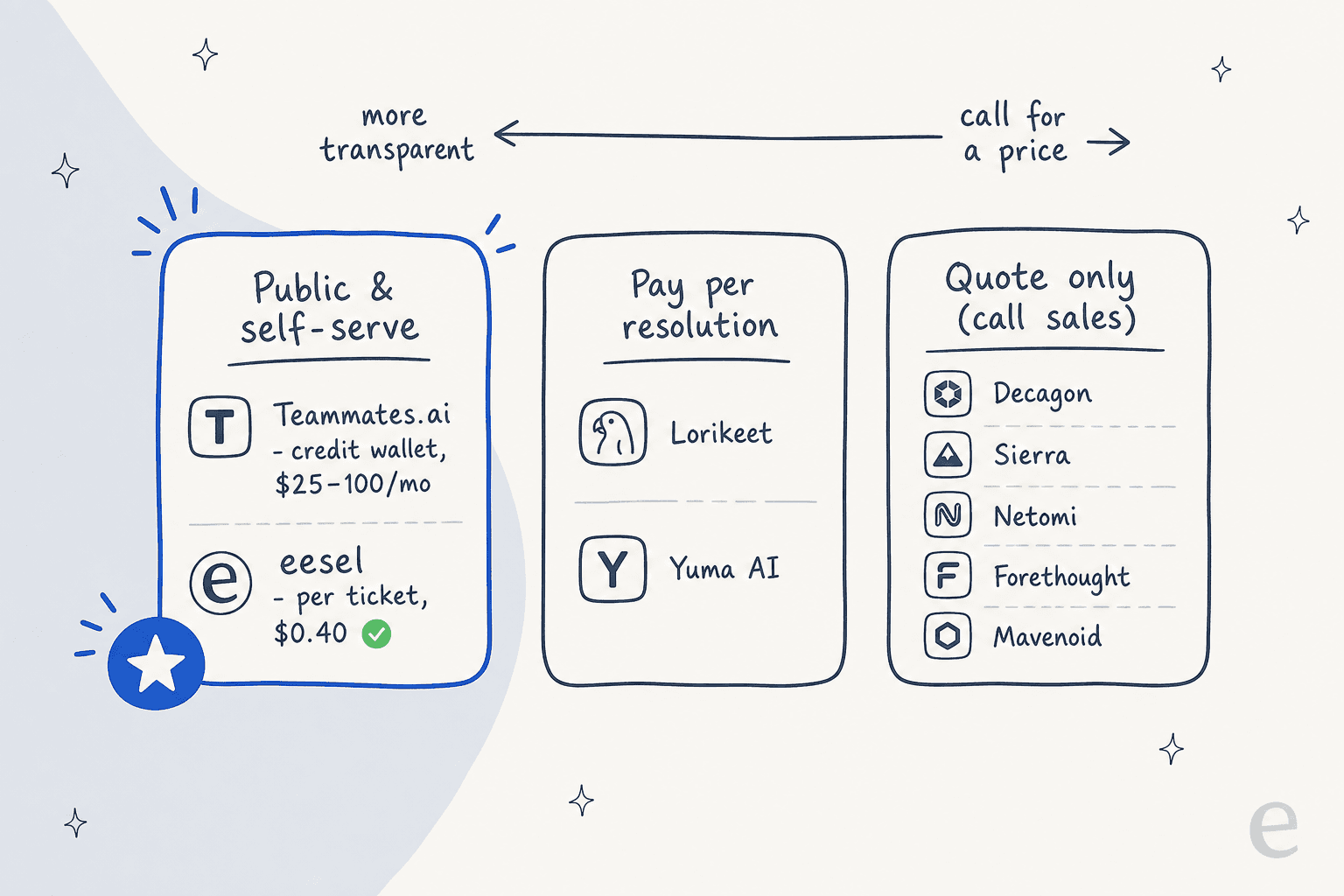
One more thing worth seeing before the list: how differently these tools charge. Only two of the nine publish a self-serve price you can act on today.
1. eesel AI
Best for: teams that want autonomous AI support inside the helpdesk they already run, without a sales call.

I'll declare the bias up front: I'm on the eesel team. But the reason it leads this list is the same reason teams pick it over Teammates.ai, so let me show my work.
Where Teammates.ai is a standalone platform your team logs into, eesel is an AI teammate that lives inside the helpdesk you already have. It learns from your past tickets, help docs, and macros on day one, then drafts replies, triages, and resolves tier-1 tickets right in Zendesk, Freshdesk, Gorgias, or HubSpot, across 100+ integrations and 80+ languages.
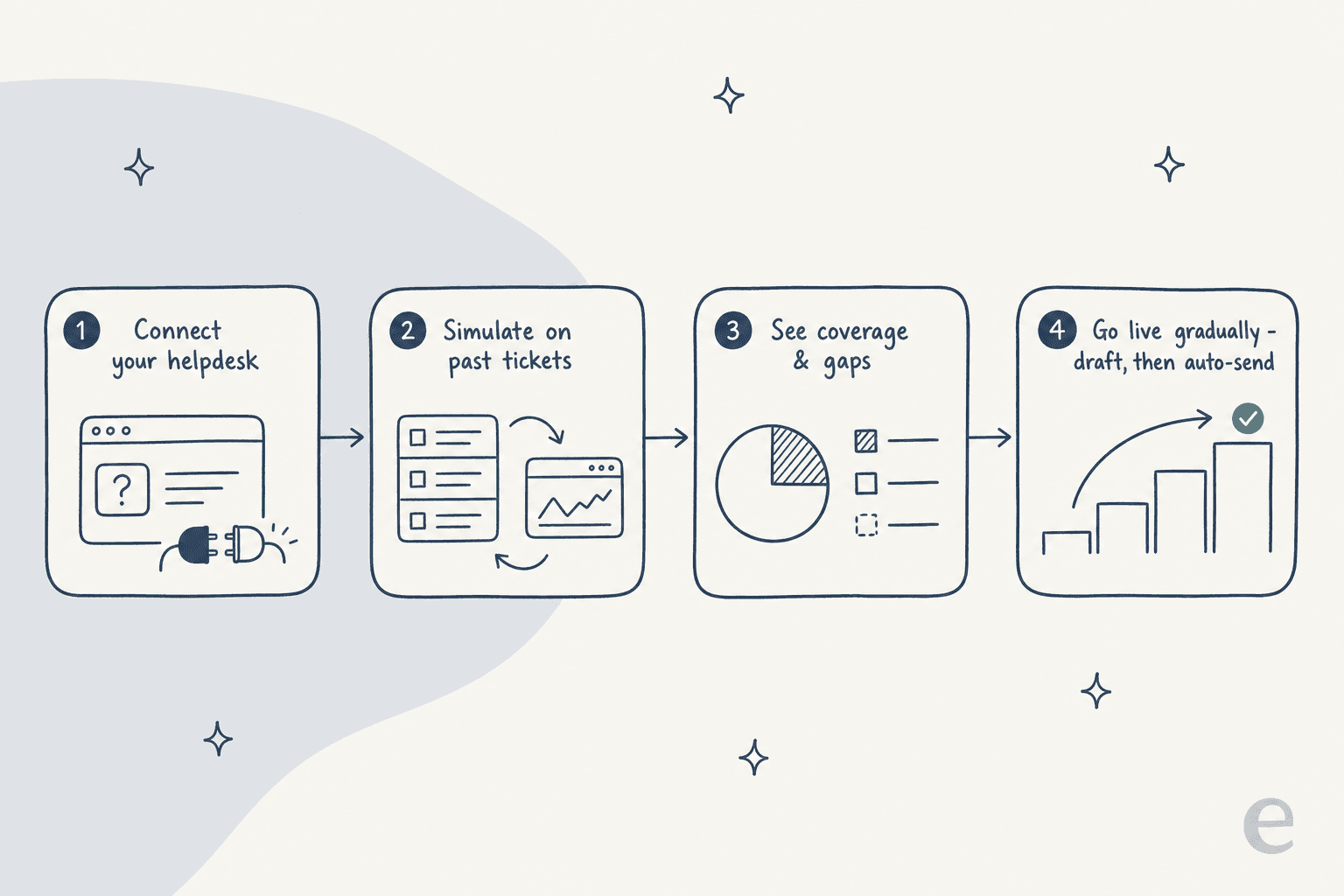
The part I'd actually flag as the differentiator is the rollout. Before eesel answers a single customer, you can simulate it against thousands of your real past tickets, see exactly what it would have said, measure coverage by topic, and find the gaps. Then you go live gradually: draft mode first, auto-send on the easy stuff once you trust it. That's the workflow that stops the "confident bot, wrong answer" problem I mentioned up top.
The results back it up. Gridwise hit 73% tier-1 resolution in the first month, and Smava runs a fully automated agent handling 100,000+ German-language tickets a month.
Pros
- Layers into your existing helpdesk instead of replacing it.
- Simulation mode lets you test on real history before going live.
- Fully public, fixed monthly pricing with no per-seat fee.
Cons
- Focused on support, content, and ecommerce roles, so it doesn't do recruiting the way Teammates.ai's Sara does.
- Deepest value comes when you already have a helpdesk and ticket history to learn from.
Pricing: one fixed monthly price from $299/month for 500 credits (1 credit per ticket or chat, however long), no platform or per-seat fee, with 100 free credits to start. Pay a year upfront and get two months free. SSO and MFA, data residency, and priority support are available as add-ons.
Our take: if you run a helpdesk and want AI that improves it rather than a new tool to migrate to, eesel is the most natural Teammates.ai alternative. Pick something else only if you specifically need the sales-plus-recruiting bundle.
2. Decagon
Best for: large enterprises replacing a brittle vendor bot with a serious AI concierge.
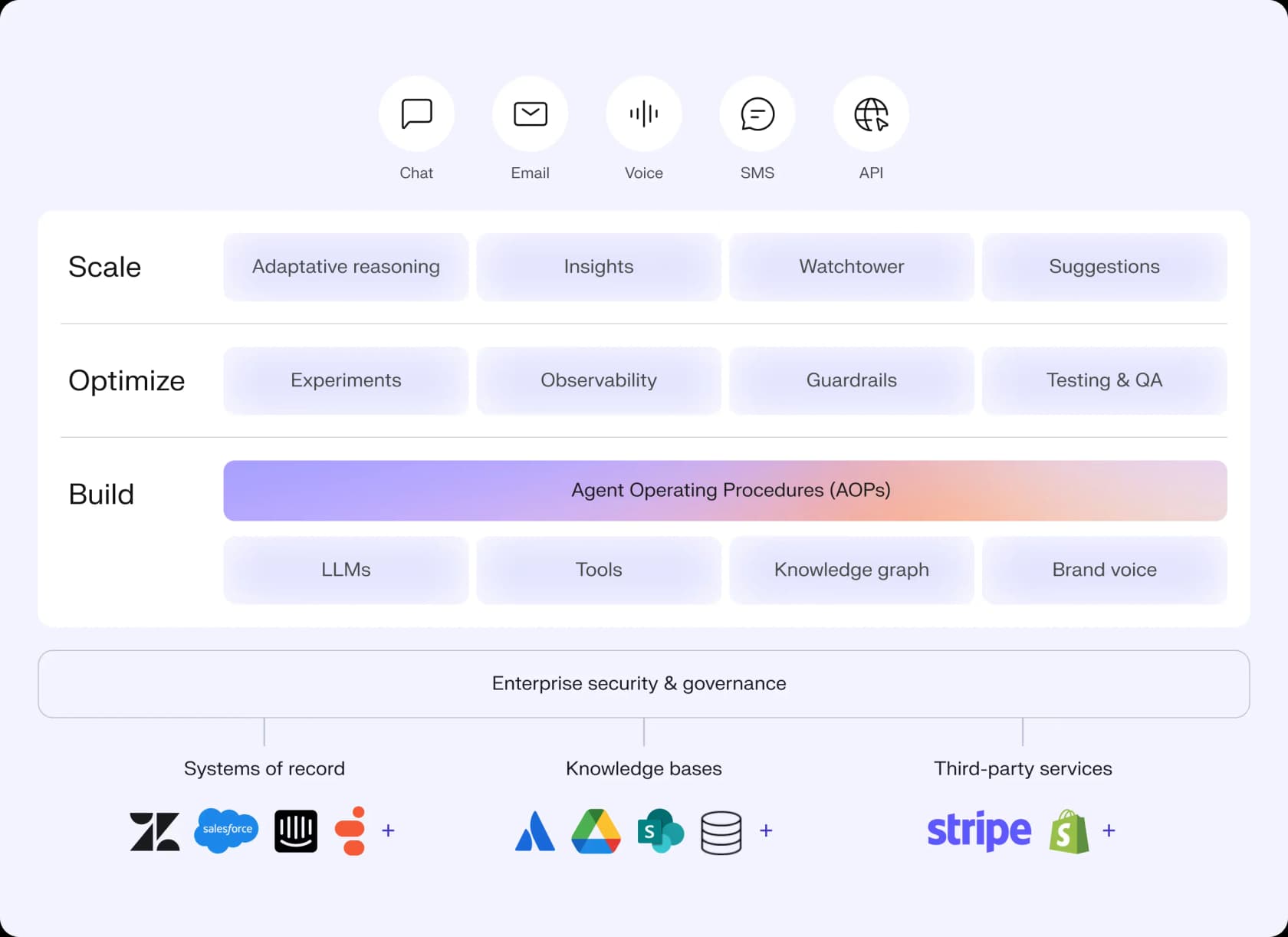
Decagon is the heavyweight of this list. It's an AI-native CX platform running across chat, voice, email, SMS, and API, and it's raised serious money: a $250M round in January 2026 tripled its valuation to $4.5B. Its wedge is Agent Operating Procedures, natural-language instructions that compile into executable agent logic, so CX ops can iterate without waiting on engineering.
The customer roster tells you who it's for: Chime, Hertz, Duolingo, Notion. Published results include Duolingo at 80% deflection and ClassPass cutting costs 95%.
Pros
- True omnichannel from one agent runtime, voice included.
- Natural-language agent authoring (AOPs) instead of rigid decision trees.
- Deep enterprise observability and guardrails.
Cons
- No public pricing and no self-serve trial; every path is a demo.
- Overkill (and over-budget) for small and mid-size teams.
Pricing: quote-only, sold as an annual contract bracketed by monthly ticket volume. No free tier.
Our take: if you're an enterprise with a big volume and a procurement team, Decagon is a top pick. If you wanted Teammates.ai partly because you could just sign up and pay $25, Decagon is the opposite experience.
3. Sierra
Best for: enterprises that want outcome-based pricing and top-tier founder credibility.

Sierra is the other enterprise giant, co-founded by Bret Taylor (ex-Salesforce co-CEO, current OpenAI board chair) and Clay Bavor. It hit a $15.8B valuation in May 2026 and lands regulated-industry logos most AI-native vendors can't, like Rocket Mortgage, SoFi, and Sutter Health.
Its calling card is outcome-based pricing: you pay when the agent achieves the contracted result, which shifts risk onto Sierra. It also ships both a no-code Agent Studio and a full Agent SDK, so engineering and CX ops both get a lane.
Pros
- Outcome-based pricing aligns cost with results.
- Unusually strong compliance footprint, including ISO 42001.
- Deploys across chat, voice, SMS, WhatsApp, and even ChatGPT.
Cons
- Enterprise-only, no public pricing, no self-serve.
- Outcomes are defined per contract, so setup is a negotiation, not a signup.
Pricing: quote-only, outcome-based. No free trial.
Our take: a fantastic fit for Fortune 500 CX teams. For everyone smaller, it's aspirational, and the polar opposite of Teammates.ai's just-sign-up model.
4. Forethought
Best for: mid-market and enterprise teams that want to boost deflection inside their current helpdesk.

Forethought is a multi-agent CX system: Solve handles customers, Assist works as an AI copilot for customer service agents, and Discover surfaces knowledge gaps and drafts articles. Its Autoflows reasoning engine runs action-based workflows rather than just answering FAQs, and it connects to 70+ helpdesks.
Like Teammates.ai, it leans hard on deflection-rate stats (YAZIO at 80%). One honest caution: deflection rate is a vanity metric unless it's paired with CSAT, so track the customer service metrics that actually matter and ask about both.
Pros
- Multi-agent coverage across customer, agent, and analytics.
- Broad native helpdesk integrations.
- Runs true action workflows, not just answers.
Cons
- Quote-only pricing (a blend of platform fee plus outcome cost).
- A proof-of-value project instead of a free trial, so time-to-value is slower.
Pricing: quote-only. No free trial; you run a POV against your own data.
Our take: a solid layer-on option for larger teams, but the sales-led motion makes it a heavier lift than a self-serve tool like eesel or Teammates.ai.
5. Lorikeet
Best for: fintech, healthtech, and other teams whose hardest tickets are the whole problem.
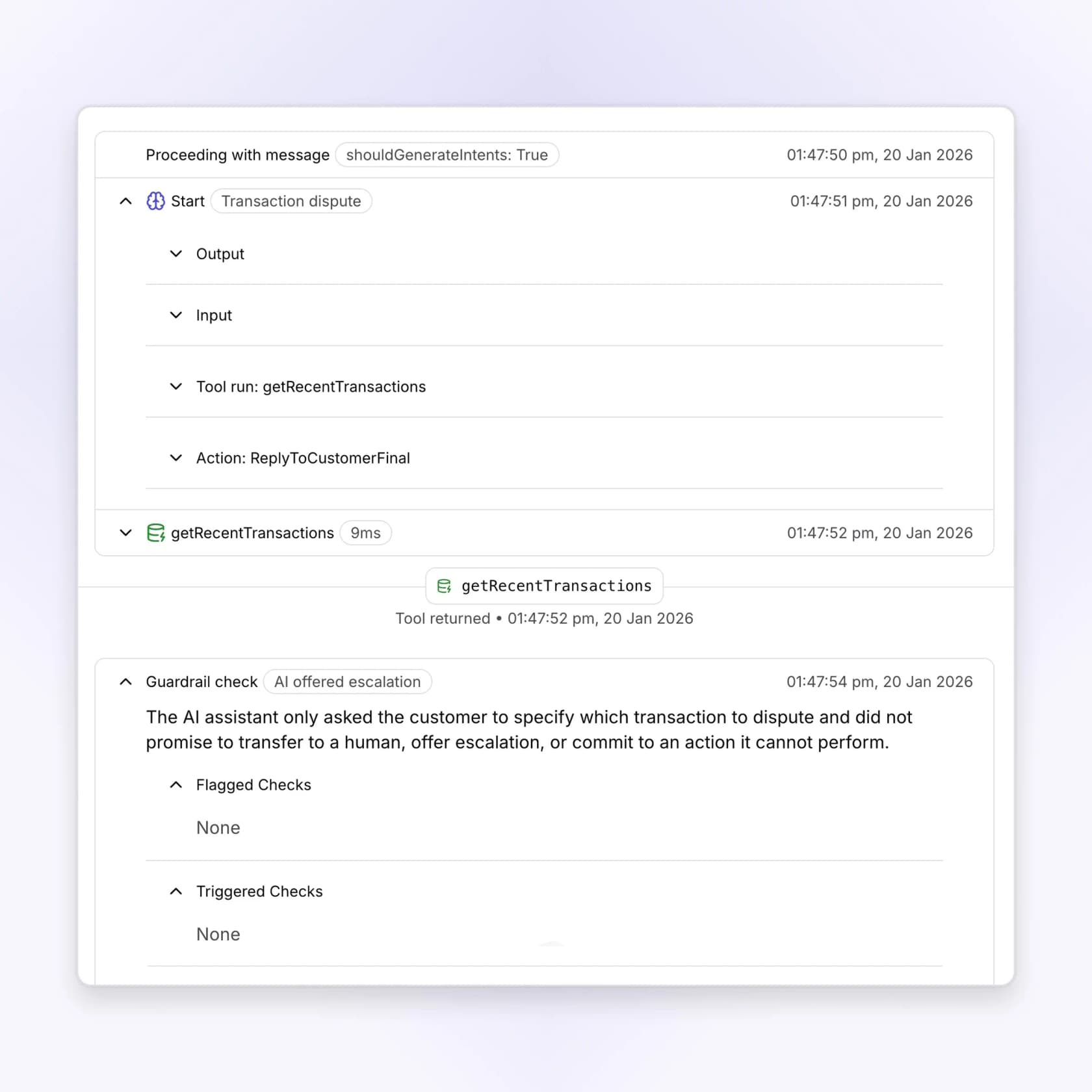
Lorikeet positions itself as an AI concierge for complex companies, built to take on the hardest 20% of tickets that drive 80% of support effort. Where other agents deflect, Lorikeet leans into high-stakes problems with deterministic guardrails and fully transparent reasoning, which is why regulated fintechs and healthtechs trust it. Its "Show Reasoning" view (above) makes every model choice and action auditable.
Pros
- Purpose-built for complex, regulated, high-stakes support.
- Transparent, auditable reasoning and deterministic guardrails.
- Public resolution-based pricing: you only pay for resolved tickets.
Cons
- Entry price of $1,500/mo makes it a poor fit for small teams.
- It's a standalone platform, not a helpdesk add-on.
Pricing: Start at $1,500/mo (18,000 credits/yr), Scale at $4,000/mo, Enterprise custom. No per-seat or platform fees.
Our take: if your support is truly complex, Lorikeet is one of the sharpest picks here. For everyday tier-1 volume, it's more machine than most teams need.
6. Netomi
Best for: large enterprises running high-volume, omnichannel support in regulated verticals.
Netomi is an agentic AI platform built for "what comes after the pilot," aimed at enterprises that can't afford to get it wrong. It runs voice, chat, email, SMS, and social, with a strong governance layer (Duty of Care, response validation, custom policy guardrails), and it's backed by $110M with Accenture and Adobe as strategic investors. Named customers include Delta, United, and MetLife, and it holds a 4.8/5 on G2.
Worth noting from reviews: the standout praise is usually the hands-on customer-success team, and the most common gripe is weak analytics and reporting.
Pros
- Production-grade governance and guardrails for regulated industries.
- Genuine omnichannel, including voice and social.
- Strong, hands-on implementation team.
Cons
- No public pricing, enterprise-only.
- Reviewers flag limited analytics and slow time-to-value.
Pricing: quote-only; both the pricing and plans pages are unpublished. No free tier.
Our take: a credible choice for Fortune 500 CX. If you're a small or mid-size team that liked Teammates.ai's price transparency, Netomi will feel like a different world.
7. Yuma AI
Best for: Shopify and ecommerce brands that want deep post-purchase automation.
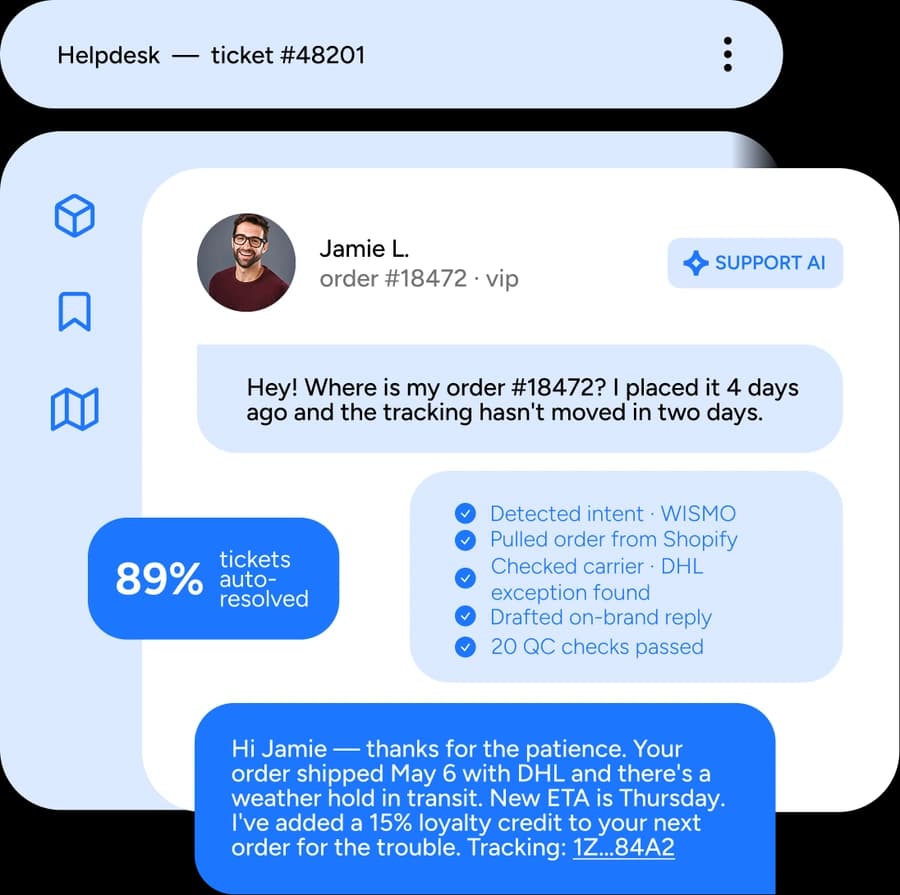
Yuma AI is a support agent built specifically for ecommerce. It plugs into your helpdesk and resolves the post-purchase tickets that dominate DTC volume: where-is-my-order, returns, refunds, and subscription changes, taking real actions in Shopify, Gorgias, and Recharge. Named results include EvryJewels at 89% automation and 63% cost savings. If Yuma isn't the fit, my best Gorgias alternatives list covers the rest of the ecommerce field.
Like eesel, Yuma lets you replay historical tickets to validate before going live, and it rolls out gradually. One caution from G2 reviews: occasional accuracy misses are the most-cited con.
Pros
- Deep ecommerce actions (returns, WISMO, refunds) out of the box.
- Native Shopify, Gorgias, and Recharge integrations.
- Performance-based pricing with a 30-day trial on your live site.
Cons
- Ecommerce-only, so it's a poor fit outside retail.
- Pricing is quote-gated and needs real ticket volume to pencil out.
Pricing: quote-gated, performance-based (you pay for fully resolved tickets), with a 30-day free trial and an ROI guarantee.
Our take: for a Shopify store, Yuma is a stronger fit than Teammates.ai's generalist agent. If you're not ecommerce, look at eesel instead, which is helpdesk-agnostic.
8. Mavenoid
Best for: brands that sell physical products and need real troubleshooting, not just chat.
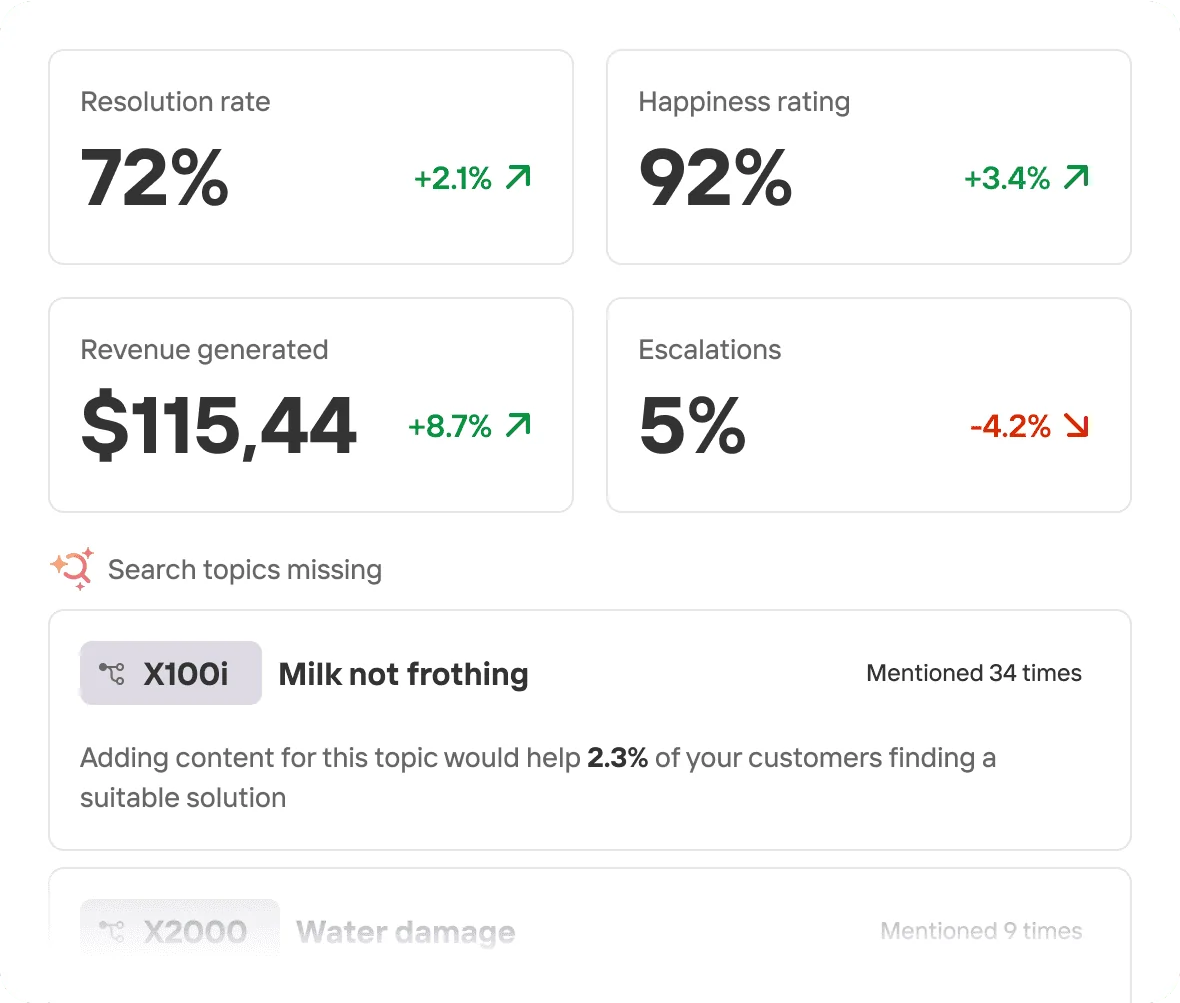
Mavenoid is the specialist for hardware. It's built for companies that sell physical products (electronics, appliances, power equipment) and it leads on resolution, not deflection, diagnosing why a device isn't working and walking customers through visual, model-specific fixes across text, voice, image, and video. Proof points include Stanley Black & Decker resolving 41% of contacts, and it holds a 4.8/5 on G2.
Pros
- Purpose-built for physical-product troubleshooting.
- Vision Assist can auto-identify a product from a phone-camera photo.
- Strong, no-code visual flow builder.
Cons
- No public pricing; enterprise, quote-based, and reviewers rate perceived cost high.
- Not a fit for software or SaaS support.
Pricing: quote-only; there's no pricing page at all. G2's user data pegs it as a high-cost, roughly 2-month implementation.
Our take: if you make hardware, Mavenoid solves a problem generalists like Teammates.ai barely touch. For software support, it's the wrong tool.
Try eesel AI
If you got this far mostly because you want AI to take tier-1 support off your team's plate, eesel is the Teammates.ai alternative I'd start with. It works like a new hire that plugs into your existing helpdesk in a few minutes, already knows your help center and past tickets, and can be tested against your real history before it ever replies to a customer. Pricing is public, from $299/month for 500 credits (1 credit per ticket or chat) with no per-seat fee, and you can start for free.
The bigger point across this whole list: the tool that wins isn't the one with the flashiest demo, it's the one you can trust on a live queue. Simulate first, roll out gradually, and measure resolution against real tickets, not slideware.