


Teammates.ai pricing (2026): plans, credits & real cost

Kurnia Kharisma Agung Samiadjie
Written by

Kurnia Kharisma Agung Samiadjie

Katelin Teen
Reviewed by

Katelin Teen

Last edited July 17, 2026

Expert Verified
Illustrated hero banner for a breakdown of Teammates.ai pricing in 2026

What is Teammates.ai?

Quick context before the numbers, because it shapes the pricing. Teammates.ai is a Dubai-based platform that sells three autonomous "AI teammates" on one account: Raya for customer service, Adam for sales calls, and Sara for recruiting interviews. The company rebranded from Uktob.ai in January 2025 after a Hustle Fund-led round, so it's very new.

That three-in-one design is why the pricing is a shared credit wallet rather than a per-seat or per-ticket fee: the same balance has to pay for whichever teammates you use. It's a clever model, and it's the reason you have to do a little math to know your real support cost.

Raya, the Teammates.ai customer-service agent persona, as shown on teammates.ai

What will Teammates.ai actually cost you?

Plug in your monthly support volume and how chatty your tickets are. This estimates the credits you'd burn, the smallest plan that covers them, and your real cost per resolved ticket, so you can see past the per-reply sticker price.

Teammates.ai pricing plans at a glance

Here's every public plan, straight from the Teammates.ai pricing page in July 2026. All four paid tiers include the three teammates, native integrations, and basic analytics; what changes is credits, seats, and the enterprise-grade controls.

PlanPriceMonthly credits≈ support repliesTeam membersStandouts
Free$0/mo10~1001Try Raya; no personas, API, or analytics
Pro$25/mo50~5001Same limits as Free, more credits
Business$50/mo100~1,0005ROI dashboard; most popular tier
Scale$100/mo200~2,000TeamPattern analyzer, SSO/SAML
EnterpriseCustomCustomCustomUnlimitedBYO LLM, Arabic tuning, SOC 2, data residency, CSM

There's no annual discount, and plan credits reset monthly rather than rolling over. That's a fair, simple ladder, and it's more than most rivals like Decagon, Sierra, or Netomi will tell you without a sales call.
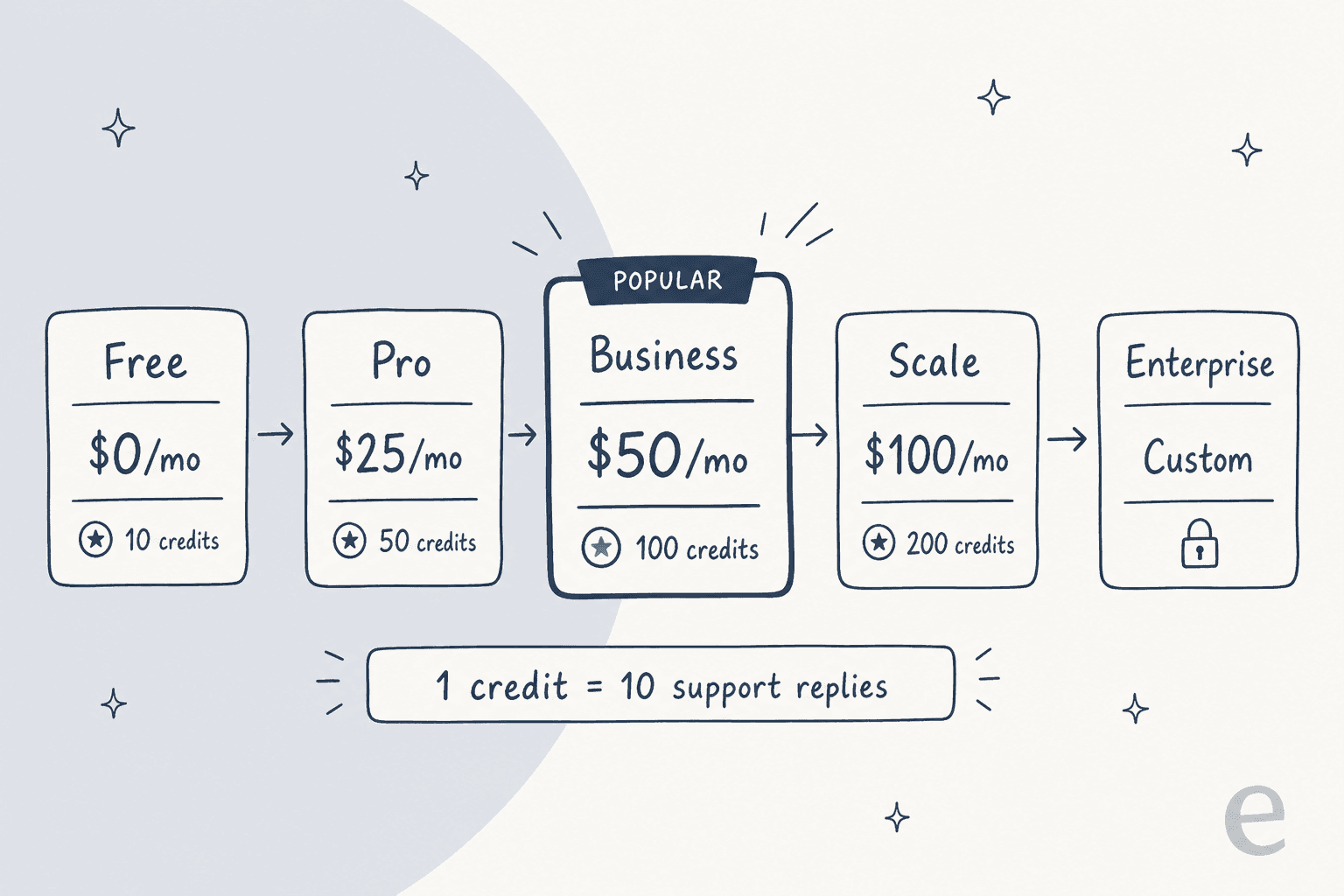
Teammates.ai pricing ladder from Free to Enterprise, showing monthly credits per plan

How the Teammates.ai credit system works

This is the part worth understanding before you pick a plan, because credits are the real currency, not dollars. One wallet is shared across all three teammates, and each activity has its own rate:

  • Raya (support): 1 credit buys ~10 complete replies.
  • Adam (sales): 10 credits buys ~30 voice minutes.
  • Sara (recruiting): 10 credits buys 1 full interview.
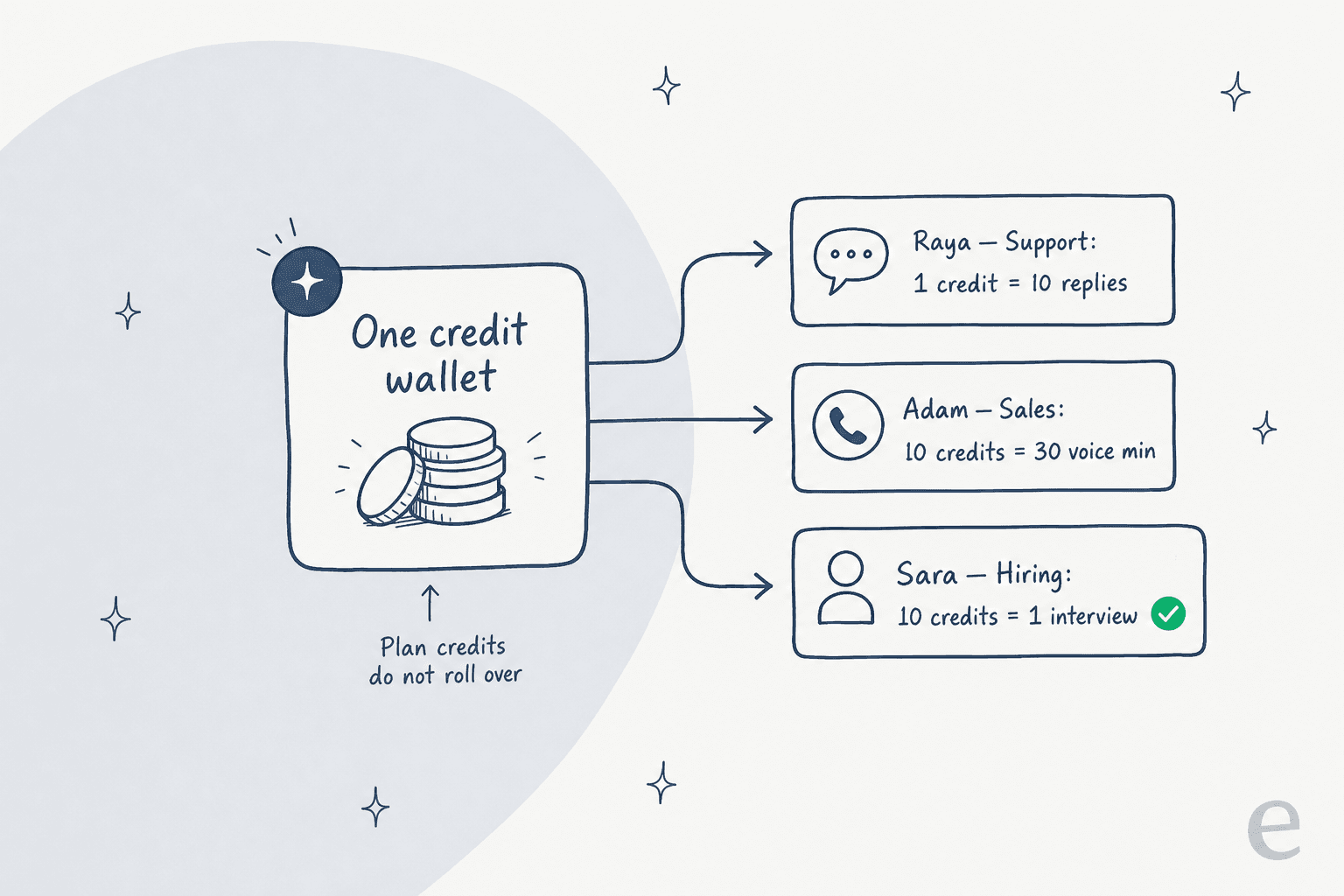
How the Teammates.ai shared credit wallet splits across Raya, Adam, and Sara

A few mechanics that catch people out:

  • Plan credits don't roll over. Your monthly allowance resets, so a quiet month is wasted headroom, not banked savings.
  • Top-ups are separate. Purchased credits are drawn oldest-first and expire after 90 days.
  • Zero means pause. When the wallet hits zero, Raya's chat widget hides and the teammates stop until you refill. In-progress work finishes, but nothing new starts.

The shared-wallet design is convenient if you use all three roles. But if you only run support, you're budgeting in a currency that sales and recruiting can also spend, which makes forecasting a support-only bill harder than a flat per-resolution price.

The catch: per-reply price vs per-resolution cost

Here's the honest math the sticker price hides. On paid plans, 1 credit = 10 replies works out to about $0.05 per reply. That's genuinely cheap.

But customers don't send one reply. A real support ticket is a conversation. If your average resolved ticket takes:

  • 2 replies, you're at ~$0.10 per resolution.
  • 5 replies, ~$0.25 per resolution.
  • 10 replies (common for troubleshooting or ecommerce WISMO), ~$0.50 per resolution.

So the per-reply headline is real, but your actual cost of AI customer service scales with how chatty your queue is, and you won't know it until you've run a month. That's the opposite of a per-resolved-ticket model, where a two-message ticket and a ten-message ticket cost the same flat amount, because you pay for the outcome, not the chatter.

This isn't a knock on Teammates.ai specifically; it's true of any per-message AI agent for customer service. It's just the single number I'd want nailed down before signing, and it's why the calculator above asks for replies-per-ticket, not just ticket volume.

How Teammates.ai pricing compares

Against the field, Teammates.ai's real edge is transparency. Most serious AI customer service software hides its price behind a demo:

ToolPricing modelPublic entry priceSupport-only?
Teammates.aiShared credit wallet$25/moNo (also sales + recruiting)
eesel AIPer resolved ticket~$0.40/ticketYes
DecagonQuote onlyCustomYes
SierraQuote only (outcomes)CustomYes
NetomiQuote onlyCustomYes
Yuma AIPer resolution, quote-gatedCustomYes (ecommerce)
ForethoughtQuote onlyCustomYes

Two tools here publish a self-serve number you can act on today: Teammates.ai and eesel. The difference is what you're paying for. Teammates.ai spreads one wallet across three job functions; eesel charges only for resolved support tickets and layers into the helpdesk you already run, so if support is the whole job, it's the easier bill to forecast. If you want the ranked field, my Teammates.ai alternatives roundup goes deeper, and the best AI agents list goes wider.

Is Teammates.ai worth it?

It depends entirely on how many of the three teammates you'll actually use.

Worth it if: you're a small or growing team that wants support, sales, and recruiting automation from one transparent, self-serve tool, and you value one bill over best-in-class depth. The Business plan at $50/mo is a lot of capability for the money, especially with strong multilingual and Arabic handling.

Look elsewhere if: customer support is the whole job. A support specialist that plugs into your Zendesk, Freshdesk, Gorgias, or HubSpot queue, learns from your ticket history, and prices per resolution will usually give you deeper helpdesk automation and a more predictable bill. It's also the honest line between a real AI agent and a rule-based chatbot.

One more thing I'd insist on regardless of vendor: test before you trust. The reason I keep coming back to simulate-first tooling is that a confident bot giving a wrong answer costs far more than a pricing plan. Teammates.ai is new enough that there's little third-party review history to check its self-reported numbers against, so run your own volume through a trial before you commit budget.

Try eesel AI

If you got here because you want AI to take tier-1 support off your team and you want a bill you can actually forecast, eesel is the Teammates.ai alternative I'd start with. It works like a new hire that plugs into your existing helpdesk in minutes, already knows your help center and past tickets, and can be tested against your real history before it answers a single customer. Pricing is public at about $0.40 per resolved ticket, with no per-seat fee, so a chatty ticket and a quick one cost the same, and you can start for free.

eesel AI resolving tickets inside Zendesk

Real proof over slideware: Gridwise hit 73% tier-1 resolution in its first month, and Smava runs a fully automated agent on 100,000+ German-language tickets a month. The tool that wins isn't the one with the cheapest per-message sticker; it's the one you can trust on a live queue and forecast on a spreadsheet.

Frequently Asked Questions

How much does Teammates.ai cost?
Teammates.ai has four public plans plus Enterprise: Free ($0/mo, 10 credits), Pro ($25/mo, 50 credits), Business ($50/mo, 100 credits), and Scale ($100/mo, 200 credits). Credits are shared across all three teammates, and for support one credit buys about 10 replies. If you want a support-only price you can predict, an AI agent for customer service priced per resolved ticket is easier to model.
What is Teammates.ai pricing per ticket?
There's no per-ticket price. Teammates.ai charges per credit, where one credit is roughly 10 support replies. A one-reply question costs about $0.05 on paid plans, but a multi-turn ticket that takes five replies costs closer to $0.25, so your real cost-per-resolution depends on how chatty your tickets are. eesel AI charges about $0.40 per resolved ticket regardless of how many messages it takes.
Does Teammates.ai have a free plan?
Yes. The Free plan is $0/mo with 10 monthly credits (about 100 support replies), one team member, and no custom personas, API access, or analytics. It's enough to try Raya, the support teammate, but you'll hit the ceiling fast on real volume. See the wider AI customer service software field for other free-to-start options.
Do Teammates.ai credits roll over?
Your monthly plan credits do not roll over; unused plan allowance resets each month. Purchased top-up credits are different: they're drawn oldest-first and expire after 90 days. When your balance hits zero, the teammates pause, so heavy months can leave you topping up mid-cycle.
Is Teammates.ai worth it for customer support?
If you want one tool that also does sales and recruiting, the bundle is appealing and the price is transparent. If customer support is the whole job, a specialist that layers into your Zendesk or Gorgias queue and lets you test on past tickets first usually goes deeper. It's the difference between a real AI agent and a rule-based chatbot.
What are the best Teammates.ai alternatives?
For support-led teams, eesel AI is the closest self-serve match. Enterprises look at Decagon or Sierra, ecommerce stores at Yuma AI. See the full Teammates.ai alternatives roundup for the ranked list, or the broader best customer service AI comparison.
How does Teammates.ai pricing compare to eesel?
Both publish real prices, which already puts them ahead of quote-only rivals. Teammates.ai bills a shared credit wallet ($25–$100/mo) across support, sales, and recruiting. eesel bills only support, at roughly $0.40 per resolved ticket with no per-seat fee, which is simpler to forecast if support is all you need.

Share this article

Kurnia Kharisma Agung Samiadjie

Article by

Kurnia Kharisma Agung Samiadjie

Kurnia is a software engineer and writer at eesel AI with two years of SEO experience, writing about AI tools, helpdesk software, and customer support. He pairs a developer's understanding of how these products are built with search-driven research into what actually ranks and resonates with the people searching for them.

Related Posts

All posts →
Manus AI pricing 2025: A deep dive into its controversial credit system
Guides

Manus AI pricing 2026: The real cost of its credit system

Is Manus AI's innovative agent platform worth the high and unpredictable cost? This guide dives deep into Manus AI pricing, its credit system, and how it compares to more transparent and reliable alternatives for your business.

Stevia PutriStevia PutriOct 8, 2025
Kaiber pricing 2025: Is it worth it? A complete guide to plans & credits
Guides

Kaiber pricing 2026: Plans, credits, and is it worth it?

Wondering about Kaiber pricing? Our 2025 guide dives deep into every plan, from Flex to Pro. We'll break down the confusing credit system, reveal hidden costs like upscaling, and help you calculate the true price of creating AI videos. Before you subscribe, read this detailed analysis to see if Kaiber is really worth the investment for your creative projects and how its pricing model compares to business-focused AI tools.

Stevia PutriStevia PutriSep 25, 2025
A complete guide to Salesforce Flex Credits in 2025
Guides

A complete guide to Salesforce Flex Credits in 2025

Is the new Salesforce Flex Credits model right for your team? This guide breaks down the new pricing, how it works, and what challenges you might face.

Kenneth PanganKenneth PanganNov 24, 2025
AI pretraining
Guides

AI pretraining

Ever heard that AI is "trained on the whole internet"? That's AI pretraining, the foundational step for models like GPT. But for customer support, this general knowledge isn't enough. This guide breaks down what pretraining really is and explains why specializing an AI on your company's knowledge is the key to unlocking its true potential.

Kenneth PanganKenneth PanganOct 23, 2025
Rabbit AI pricing explained: The real cost of the $199 AI gadget
Guides

Rabbit AI pricing explained: The real cost of the $199 AI gadget

Is the Rabbit R1's $199 price tag with no subscription too good to be true? This guide analyzes the real Rabbit AI pricing, its performance limitations, and compares it to practical, software-first AI solutions you can use today.

Stevia PutriStevia PutriOct 1, 2025
Nouple io: A complete 2025 overview of Coupler.io
Guides

Nouple io: A complete 2025 overview of Coupler.io

Explore our deep dive into Coupler.io (nouple io), the no-code platform for data reporting. Learn about its features, pricing, and see how it compares to action-oriented AI tools.

Kenneth PanganKenneth PanganOct 19, 2025
BigQuery pricing explained: A simple guide to controlling costs in 2025
Guides

BigQuery pricing 2026: On-demand vs flat-rate cost guide

Tired of surprise BigQuery bills? This guide demystifies Google BigQuery pricing, explaining compute and storage costs in simple terms. Learn the difference between on-demand and capacity models and discover practical strategies to control your spend without sacrificing performance. We'll walk you through everything you need to know to manage your BigQuery budget effectively.

Stevia PutriStevia PutriSep 29, 2025
EngageBay pricing in 2025: A complete overview and cost analysis
Guides

EngageBay pricing in 2025: A complete overview and cost analysis

Thinking about EngageBay? Our 2025 guide dives deep into EngageBay pricing, features, and plans to help you decide if it's the best value for your team.

Stevia PutriStevia PutriNov 12, 2025
The 6 Best Generative AI Tools in 2025: A Detailed Guide
Guides

12 generative AI tools tested in the real world (2026)

A clear, practical breakdown of the top generative AI tools on the market. We compare what each one does best, who it's for, and how much it costs to help you find the right tool for the job.

Kenneth PanganKenneth PanganDec 24, 2025

Ready to hire your AI teammate?

Set up in minutes. No credit card required.

Get started free