

Why people leave Missive in the first place
Let me be fair to Missive before I pick it apart, because the honest version of this post starts there. Missive does one thing, the collaborative shared inbox, really well. You get internal comments on a thread, real-time collaborative drafts that feel like a shared Google Doc, clear assignment and ownership, and a deep rules engine. It's rated 4.7/5 across 846 G2 reviews and 4.9/5 on Capterra, and that's earned. One Reddit power user who'd tried nearly every email client put it well:
"Missive is the first one that combines fast UX, strong rules, multi-account support, and actually useful AI (especially AI inside rules)… The standout feature for me is the ability to combine AI prompts inside rules. That's a game changer."
u/Professional_Put9295, r/Missive (March 2026)

So why look elsewhere? A few patterns come up over and over, and they're worth naming because they map directly to which alternative you should pick.
The first is price for what you get. Missive runs $14 to $36 per user per month, and for an email client that stings as the team grows. The same power user above admitted, "I'd pay significantly more for this product," but plenty of others are, in their words, "privately salty about having to pay SO MUCH for an email client".
The second is the AI ceiling. Missive's AI is a drafting assistant. It writes a reply in your tone, translates, summarizes a long thread, and can classify a message inside a rule. That's useful, but a human still reads and sends every response. If you're drowning in repetitive tickets, a faster way to type the answer isn't the same as not having to answer at all.
The third is the missing pieces: no email open tracking (the single most-cited gap), a search that struggles with older messages, a mobile app that lags the desktop, and no real helpdesk scaffolding like SLAs, a customer-facing knowledge base, or deflection reporting. Missive is a collaborative email client, not a helpdesk, and it never pretended to be one.
How I picked these alternatives
I build support AI for a living, which shapes how I read this category. At eesel we've spent years putting AI agents on live support queues, and the hard lesson we keep relearning is that a confident-sounding bot that quietly gives wrong answers is worse than no bot at all. That's why I weight a few things more heavily than a typical roundup:
- Collaboration first. Missive's whole appeal is working on email together. Any alternative has to nail shared inboxes, assignment, and internal notes, or it's not a real replacement.
- What the AI actually finishes. Drafting is table stakes now. The question I keep asking is whether the AI can resolve a ticket end to end, and what happens on the ones it can't.
- Honest pricing, including the AI line item. Per-seat sticker price is only half the story once you add AI per resolution or per conversation. I flag the total, not the teaser.
- Channels and scale. Email-only Gmail teams and omnichannel ecommerce brands need different tools. I note who each one is really for.
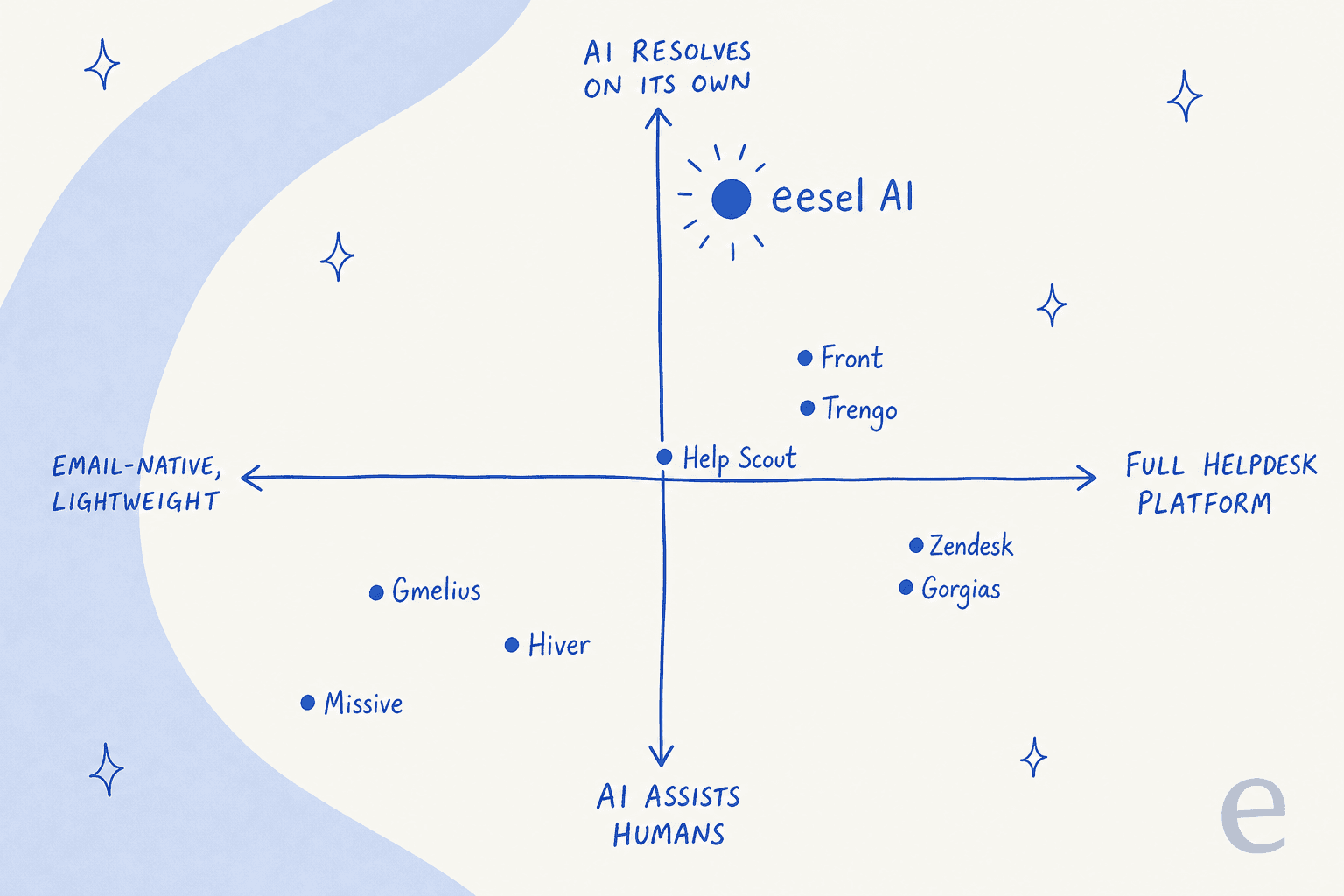
Here's the map I landed on. Lightweight Gmail-native inboxes sit bottom-left, full helpdesks sit right, and the AI-resolution axis runs bottom (assists humans) to top (resolves on its own).
The 8 best Missive alternatives at a glance
| Tool | Best for | Starting price | Billing unit | Autonomous AI? | Free tier | Channels | Top security | Rating |
|---|---|---|---|---|---|---|---|---|
| eesel AI | Adding AI resolution to an existing inbox | $0.40 / resolution | Per resolved ticket | Yes, with confidence routing | Trial credit | Layers on any helpdesk | SOC 2 (in progress), HIPAA/BAA | New |
| Front | Closest like-for-like collaborative inbox | $25 / seat / mo | Per seat | Add-on (Autopilot) | 14-day trial | Omnichannel | SOC 2, GDPR | 4.7 / 2,500+ |
| Help Scout | Relationship-driven small support teams | $25 / user / mo | Per user | Add-on (AI Answers) | Yes (5 users) | Email, chat, social | SOC 2, GDPR | ~4.4 / 400+ |
| Hiver | Teams that live in Gmail or Outlook | $25 / user / mo | Per user | Yes (Growth+) | Yes | Email, chat, WhatsApp, voice | SOC 2, ISO 27001, HIPAA | 4.6 / 1,283 |
| Gmelius | Gmail-only teams wanting automation | $25 / user / mo | Per user | Assist only (Meli) | Trial | Gmail / Google Workspace | HIPAA (Enterprise) | 4.4 / 776 |
| Trengo | WhatsApp-heavy and ecommerce teams | €299 / mo (10 users) | Bundled users + conversations | Yes (AI surcharge) | No | WhatsApp, chat, email, social, voice | 2FA, RBAC | 4.3 / 246 |
| Zendesk | Scaling into a full support platform | $19 / agent / mo | Per agent + AI usage | Yes (per resolution) | No (trial) | Full omnichannel + voice | SOC 2, ISO 27001, HIPAA | 4.3 / 6,000+ |
| Gorgias | Shopify and ecommerce brands | $10 / mo (50 tickets) | Per ticket + AI usage | Yes (per resolution) | No (trial) | Email, chat, SMS, social | SOC 2, GDPR | 4.3 / 500+ |
Now the detail, starting with the one I know best and being honest about where it isn't the answer.
1. eesel AI
Best for: teams whose real problem isn't the inbox, it's that they're still answering every ticket by hand.
Here's the reframe I promised. Every other tool on this list is somewhere you move your inbox to. eesel AI is different: it's an AI layer that plugs into the helpdesk or inbox you already run (Front, Help Scout, Zendesk, Gorgias, Freshdesk, Gmail, Slack, and 100+ integrations), learns from your past tickets and help docs on day one, and starts resolving the repetitive stuff on its own.
That last word is the whole point. Missive's AI drafts a reply for a human to send. eesel's agent closes the ticket. This is the distinction the rest of the category blurs, so it's worth drawing clearly:
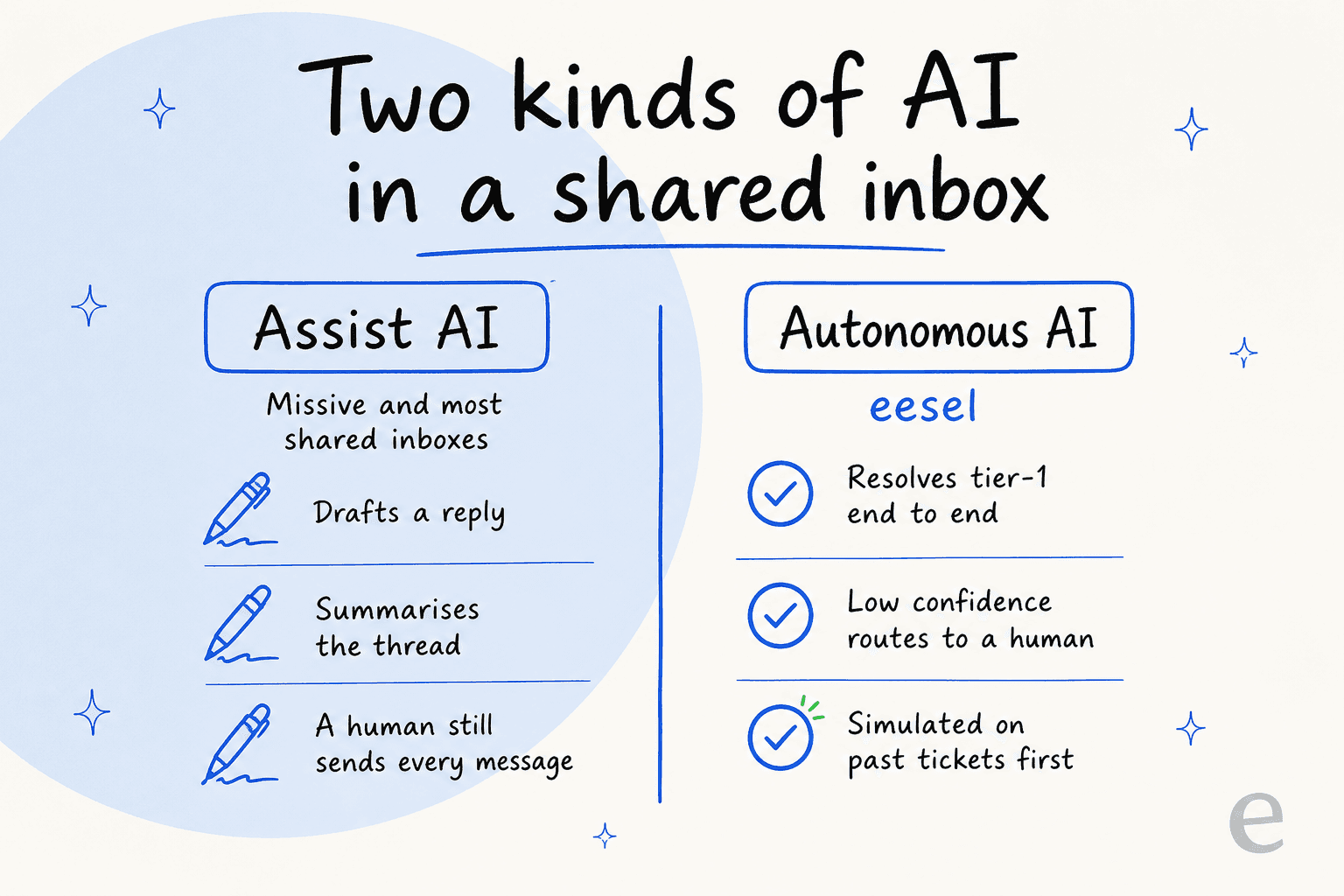
Where it's good. Because it sits on top of your stack, there's no migration, which removes the scariest part of leaving Missive. You can run it in simulation mode against thousands of your historical tickets and see the exact resolution rate, by topic, before a single customer talks to it. When confidence is low, it drafts instead of sending or routes to a human, which is our answer to the hallucination fear that stops most teams from trusting AI. One CX lead we work with framed the bar perfectly: they wanted "an AI who is only handling the tickets that it's confident to handle, and all the other ones, leave them alone." Gridwise saw it resolve 73% of tier-1 requests in the first month, with signal during a 7-day trial.
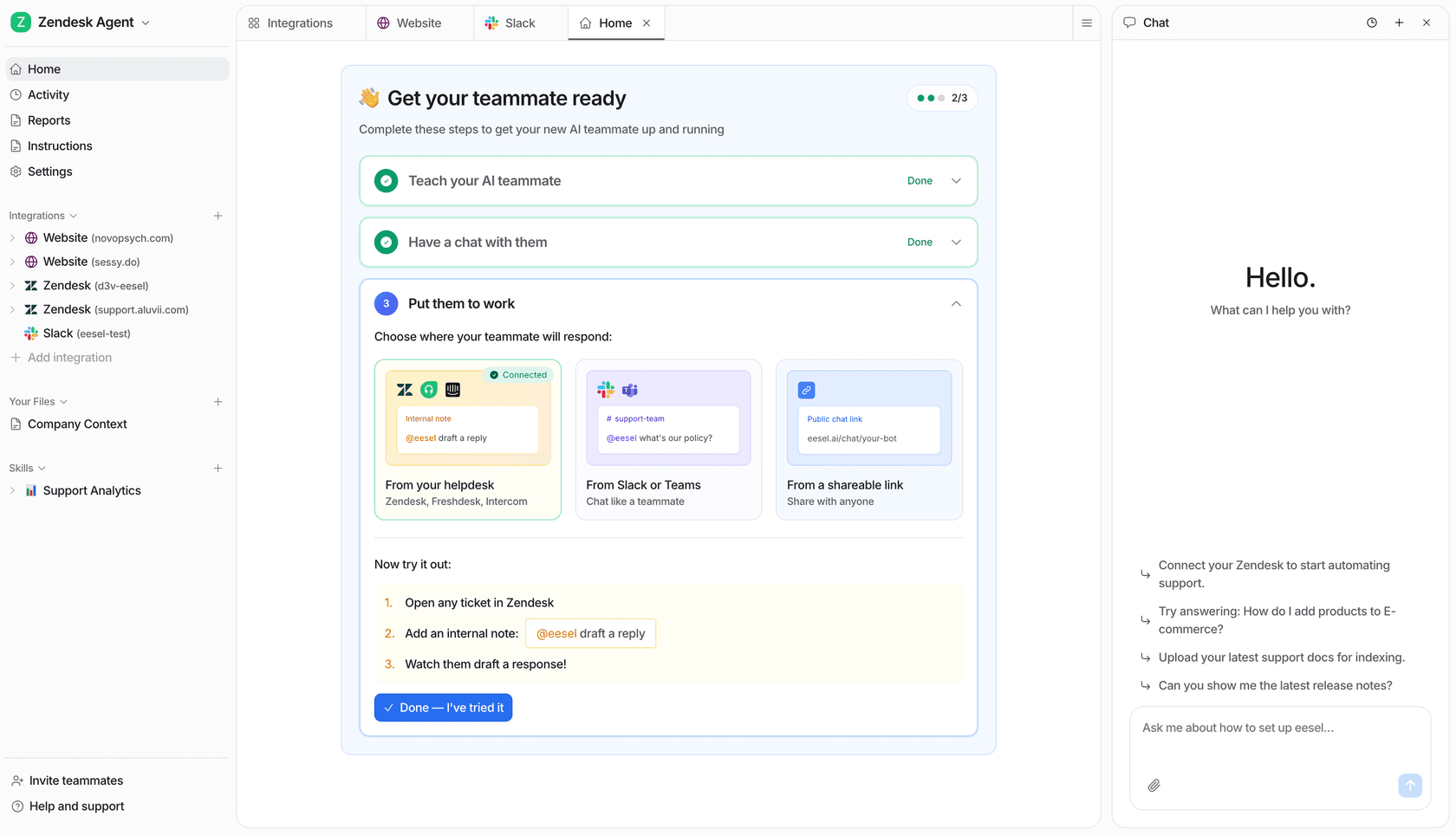
Where it falls short. I'll be straight: eesel is not a collaborative inbox. If what you want is a place for two people to co-write an email with comments in the margin, eesel doesn't replace that, it sits behind it. It also assumes you already have a helpdesk or inbox to connect to. And our SOC 2 is in progress rather than certified (HIPAA and a BAA are available on Enterprise), which matters if you're in a regulated vertical.
Pricing. Usage-based, starting at $0.40 per resolved ticket, with no per-seat fees and no platform fee on the self-serve tiers. A heavier task like a drafted knowledge base article costs more, lookups are free, and Enterprise adds a flat $1,000/month platform fee. The point of the model: you pay when the AI does the work, not for every seat that might use it.
Verdict: Pick eesel if the thing wearing you down is ticket volume, not collaboration. Keep your inbox, add an agent that actually finishes the easy 60-70%, and put your humans on the hard ones. If you want the inbox itself replaced, read on.
2. Front
Best for: teams that want Missive's collaborative inbox, just more of it.
Front is the alternative people compare Missive to most, and for good reason: it's the same idea, scaled up. Shared inboxes, internal comments, shared drafts, assignments, and a polished omnichannel layer that handles email, chat, SMS, social, and WhatsApp. It's trusted by 9,300+ companies and leans into "complex customer operations" that span multiple teams. If you've ever seen a Reddit thread where someone switched from Front to Missive or back, it's because these two genuinely overlap.
Where it's good. Collaboration is the standout, same as Missive, and Front's reporting and workflow automation go further. Front AI can resolve up to 70% of requests, and its analytics are deep enough for larger teams. It's the most natural step up if you want the Missive feel without the Missive ceiling.
Where it falls short. Price climbs fast, and AI is mostly an add-on. Autopilot (the autonomous agent) starts at $0.05/conversation, Copilot is $20/seat/mo, and the good stuff bundles into Enterprise at $105/seat. The Starter plan is single-channel only, which surprises teams expecting omnichannel out of the gate. Our Front alternatives and Front vs Hiver breakdowns go deeper.
Pricing. Starter $25/seat/mo, Professional $65/seat/mo, Enterprise $105/seat/mo, all billed annually, plus AI add-ons.
Verdict: The safest like-for-like swap. Pick Front if you love what Missive does and just want a more powerful version of it, and you're comfortable paying for AI on top.
3. Help Scout
Best for: relationship-driven small teams that want a helpdesk that still feels like email.
Help Scout is where you go when you want a touch more helpdesk than Missive offers without the enterprise bloat. It pairs a clean shared inbox with a real knowledge base (Docs), an embeddable widget (Beacon), and live chat, and it's deliberately fast to learn, "a power user in less than a day." It's used by 12,000+ companies and its AI agent resolves around 73% of interactions.
Where it's good. The cleanest inbox-meets-helpdesk on this list, with a knowledge base that feeds the AI. For a small team that wants self-service and a human touch, it hits a nice middle.
Where it falls short. Two things. The AI Answers add-on is $0.75 per resolution on top of seat pricing, which stacks up fast at volume. And Help Scout has whiplashed its pricing model, moving from per-seat to per-interaction and back, which burned trust. One migrating user was blunt:
"HelpScout changed back to user-based pricing. Guess too many people cancelled including me… Helpscout lost all trust with this flip-flopping on pricing."
r/Freescout (HelpScout to FreeScout migration thread)
Pricing. Free (up to 5 users), Standard $25/user/mo, Plus $45/user/mo, Pro $75/user/mo, all annual, plus AI Answers at $0.75/resolution. More in our Help Scout alternatives and Help Scout vs Front guides.
Verdict: A strong pick for small, relationship-led teams, especially if a knowledge base matters. Just model the AI cost before you commit, and know the pricing has moved before.
4. Hiver
Best for: teams that already live in Gmail (or Outlook) and don't want to leave.
Hiver layers shared inboxes, ticketing, SLAs, analytics, and an AI suite directly onto Gmail and Outlook, so your team works inside the email client they already know. It's trusted by 10,000+ teams and rated 4.6/5 across 1,283 G2 reviews. The near-zero learning curve is the whole pitch, and it's a real advantage over Missive's "feature-rich but dense" reputation.
Where it's good. It runs inside Gmail, so adoption is fast and there's no new app to learn. Unlike most of this list, AI (both an assist Copilot and autonomous AI Agents) is bundled from the Growth tier up rather than metered per resolution, which makes the bill more predictable.
Where it falls short. Per-seat cost climbs as you add inboxes and users, and there's a 2-seat minimum. The harshest community critique is that you're "paying for a thin layer on Gmail," and independent testing of Hiver's AI accuracy is still thin. We compare it head to head in Front vs Hiver and round up Hiver alternatives.
Pricing. Free, Growth $25/user/mo, Pro $55/user/mo, Elite $85/user/mo (annual; monthly is higher).
Verdict: The best straight switch for Gmail and Outlook teams. If "we just want it inside our inbox" is the brief, Hiver is hard to beat.
5. Gmelius
Best for: Gmail-only teams that want shared inboxes plus serious automation.
Gmelius is the other Gmail-native option, and it skews toward automation and process. Shared inboxes for support@ and billing@, shared Gmail labels, kanban boards (it pioneered email kanban back in 2018), email sequences, and an AI assistant called Meli that runs on Google Gemini. It's a Y Combinator alum rated 4.4/5 from 776 G2 reviews, with the French Red Cross running 8,000 shared inboxes on it.
Where it's good. The Gmail-native experience plus automation and sequences is the recurring praise: it enhances Gmail rather than replacing it, and the round-robin assignment and SLA rules save real time. It requires a Google Workspace account, so it's purpose-built for that world.
Where it falls short. The loudest complaint is speed and reliability, with repeated reports of slow email loading and Chrome-extension conflicts. The mobile app is described as buggy, and Meli assists rather than resolving autonomously. Long-time users also gripe that Gmelius "pivoted away from solo power users" toward teams.
Pricing. Meli (AI-only) $19/user/mo, Growth $25/user/mo, Pro $40/user/mo (or $45/seat monthly), Enterprise custom. Google Workspace required.
Verdict: Pick Gmelius over Hiver if automation and email sequences matter more than polish, and you're all-in on Gmail. If you want to add AI to Gmail without changing inboxes, our best AI apps for Gmail guide covers the layering approach.
6. Trengo
Best for: WhatsApp-heavy and ecommerce teams that need real omnichannel.
Trengo takes the shared-inbox idea and pushes hard into messaging. WhatsApp Business, live chat, email, Instagram, Facebook, and voice all land in one workspace, with AI Agents and no-code AI Journeys on top. As an Official WhatsApp Business Partner trusted by 9,000 businesses, it's strongest for ecommerce, travel, and hospitality teams whose customers live on WhatsApp.
Where it's good. The multichannel consolidation, especially WhatsApp, is the standout, and the inbox is easy to onboard. If most of your conversations happen on messaging apps rather than email, Trengo fits in a way Missive never could.
Where it falls short. Pricing is the dominant complaint, and it's a serious one:
"i'm kinda done with the unexpected changes in pricing… plus I don't get it why their mobile app keeps glitching, i'm using a higher end phone."
u/shrimpthatfriedrice, r/MarketingAutomation (Dec 2025)
Reviewers report sudden hikes (one cites a 300% increase) and a structure that penalizes small teams. AI is bundled but metered by a surcharge of €0.25 to €0.30 per AI-handled conversation, and shoppers comparing unified inboxes sometimes name Missive as the tool they switch to.
Pricing. Boost €299/mo (10 users, 6,000 conversations/year), Pro €499/mo (20 users, 18,000/year), Enterprise custom. Priced in EUR with an AI surcharge on top.
Verdict: Worth it if WhatsApp and omnichannel are central. Go in with eyes open on pricing volatility, and budget the AI surcharge.
7. Zendesk
Best for: teams ready to graduate from a collaborative inbox to a full support platform.
If you've outgrown the collaborative inbox entirely, Zendesk is the obvious enterprise destination. Ticketing, omnichannel messaging, voice, a knowledge base, QA, workforce management, and self-improving AI agents, all under one roof, trusted by 22,000+ service teams. It's the opposite end of the spectrum from Missive: heavier, more configurable, and built for scale.
Where it's good. Breadth. Almost anything a large support org needs is in the box or the 1,800+ app marketplace, and its AI agents resolve autonomously and bill per Automated Resolution. For high-volume operations it's a genuine platform, not just an inbox.
Where it falls short. It's a lot, and it costs a lot. Small teams find it overkill, the per-agent seat price plus per-resolution AI adds up, and the collaborative, email-native feel that drew you to Missive is mostly gone. Our Zendesk AI alternatives and Zendesk vs Freshdesk posts cover the trade-offs, and notably, eesel layers onto Zendesk if you want its inbox without its native AI bill.
Pricing. Support Team $19/agent/mo, Suite Team $55, Suite Professional $115 (annual), plus per-resolution AI and add-ons.
Verdict: The right call only if you're genuinely scaling into a support operation. For most teams leaving Missive, it's a size too big.
8. Gorgias
Best for: Shopify and ecommerce brands where support drives revenue.
Gorgias is the ecommerce specialist. It's built around a native Shopify integration so deep that orders, refunds, and subscriptions are actionable right inside the ticket, and its AI Agent is trained to drive sales, not just deflect questions. It powers support for 40% of Shopify brands and 17,000+ stores.
Where it's good. Nothing else pulls Shopify data into the conversation as cleanly. If you run a store and a big chunk of your tickets are "where's my order" and refund requests, Gorgias automates the actions, not just the replies, and attributes revenue to conversations.
Where it falls short. It's ecommerce-only, so it makes no sense for a law firm or an internal IT team. Pricing is ticket-based and runs high (roughly 3x Zendesk for similar volumes), and the AI Agent is a usage add-on at $0.90 per resolved conversation, where each AI interaction also counts as a billable ticket. See our Gorgias alternatives and Gorgias vs Zendesk for ecommerce breakdowns.
Pricing. Starter from $10/mo (50 tickets), Basic $50 (300), Pro $300 (2,000), Advanced $750 (5,000), Enterprise custom, plus AI Agent at $0.90/resolution.
Verdict: A clear winner for Shopify brands and a non-starter for everyone else. If you sell online and support is revenue, it earns its premium.
So which Missive alternative should you actually pick?
Strip it back and the decision is simple once you name your real frustration:
- You like Missive but want more of it. Go with Front. Closest like-for-like, just bigger.
- You want to stay in Gmail. Hiver for polish and bundled AI, Gmelius for automation and sequences.
- You want a helpdesk with a human feel. Help Scout, with the AI cost modeled in.
- Your customers live on WhatsApp. Trengo, with eyes open on pricing.
- You're scaling into a real support operation. Zendesk for breadth, Gorgias if you're on Shopify.
- Your problem isn't the inbox, it's the volume. Keep your inbox and add eesel AI on top.
That last one is the case I think most people miss. If you're shopping for a shared inbox because support feels overwhelming, swapping inboxes rarely fixes the overwhelm. A faster way to type the same answers is still you typing the answers. The thing that changes the math is AI that resolves the repetitive 60-70% so your team only sees what actually needs a person.
Try eesel AI on the inbox you already have
If the reason you started reading was that Missive's AI drafts but never finishes, that's exactly the gap eesel AI closes. It connects to Gmail, Front, Help Scout, Zendesk, Gorgias, and 100+ other tools, learns from your past tickets and help docs, and resolves tier-1 conversations on its own, routing anything it's unsure about to a human.
The part that makes it safe to try: you can simulate it on thousands of your real past tickets and see the resolution rate by topic before any customer is involved, and it's free to start with usage-based pricing, so you only pay when it actually resolves something. No migration, no new inbox to learn, no per-seat commitment. Keep the collaborative inbox you like, and let the AI take the volume you don't.
Frequently Asked Questions
What is the best Missive alternative?
Is there a free Missive alternative?
How much does Missive cost compared to alternatives?
What is a collaborative inbox and how is it different from a helpdesk?
Can a Missive alternative actually resolve tickets with AI, not just draft replies?
Which Missive alternative works inside Gmail?
How do I switch from Missive without losing my workflow?


Article by
Kurnia Kharisma Agung Samiadjie
Kurnia is a software engineer and writer at eesel AI with two years of SEO experience, writing about AI tools, helpdesk software, and customer support. He pairs a developer's understanding of how these products are built with search-driven research into what actually ranks and resonates with the people searching for them.