

How I picked these
I've spent the last two years doing SEO and running eesel's content pipeline, so my bar isn't "which homepage has the slickest demo." It's which tool I'd actually trust to ship landing page copy I'd attach a brand name to, then test until it pays for itself.
Three things separated the shortlist from the noise:
- Does it write for the page, or just write? A landing page is a tight, structured argument: one promise, a few proof points, one ask. General writers ramble; the best landing page tools keep copy punchy and modular.
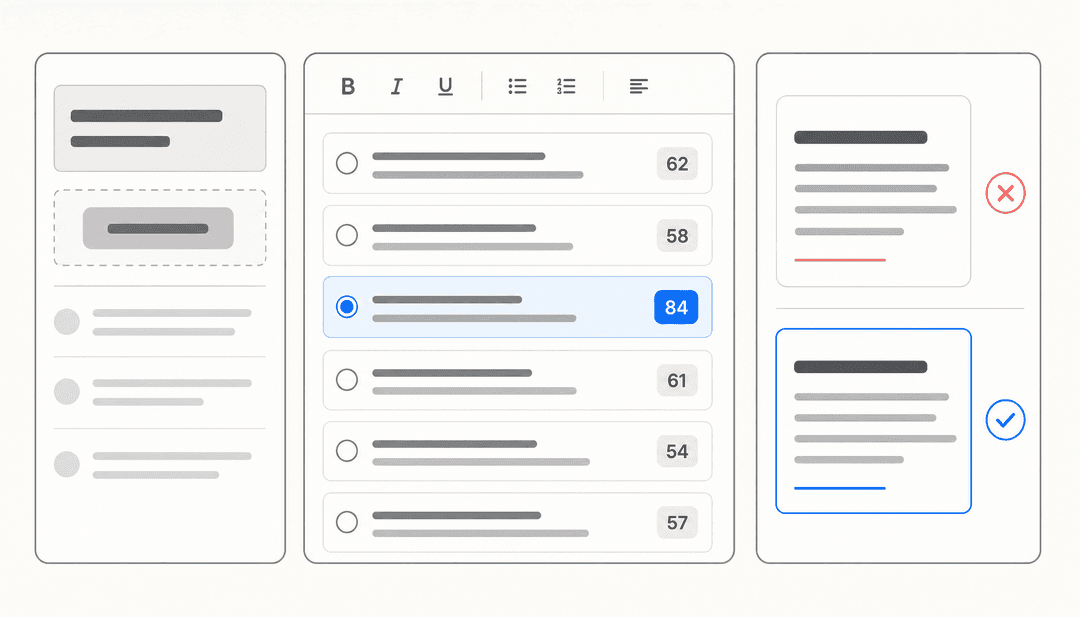
- Does it help you convert, or just generate? A draft is cheap. The tools that earn their price connect writing to testing, whether that's Anyword's predictive score or Unbounce's Smart Traffic.
- What does it really cost to do the job? Not the sticker price, the price of the plan where the useful feature lives. That gap is where buyers get burned.
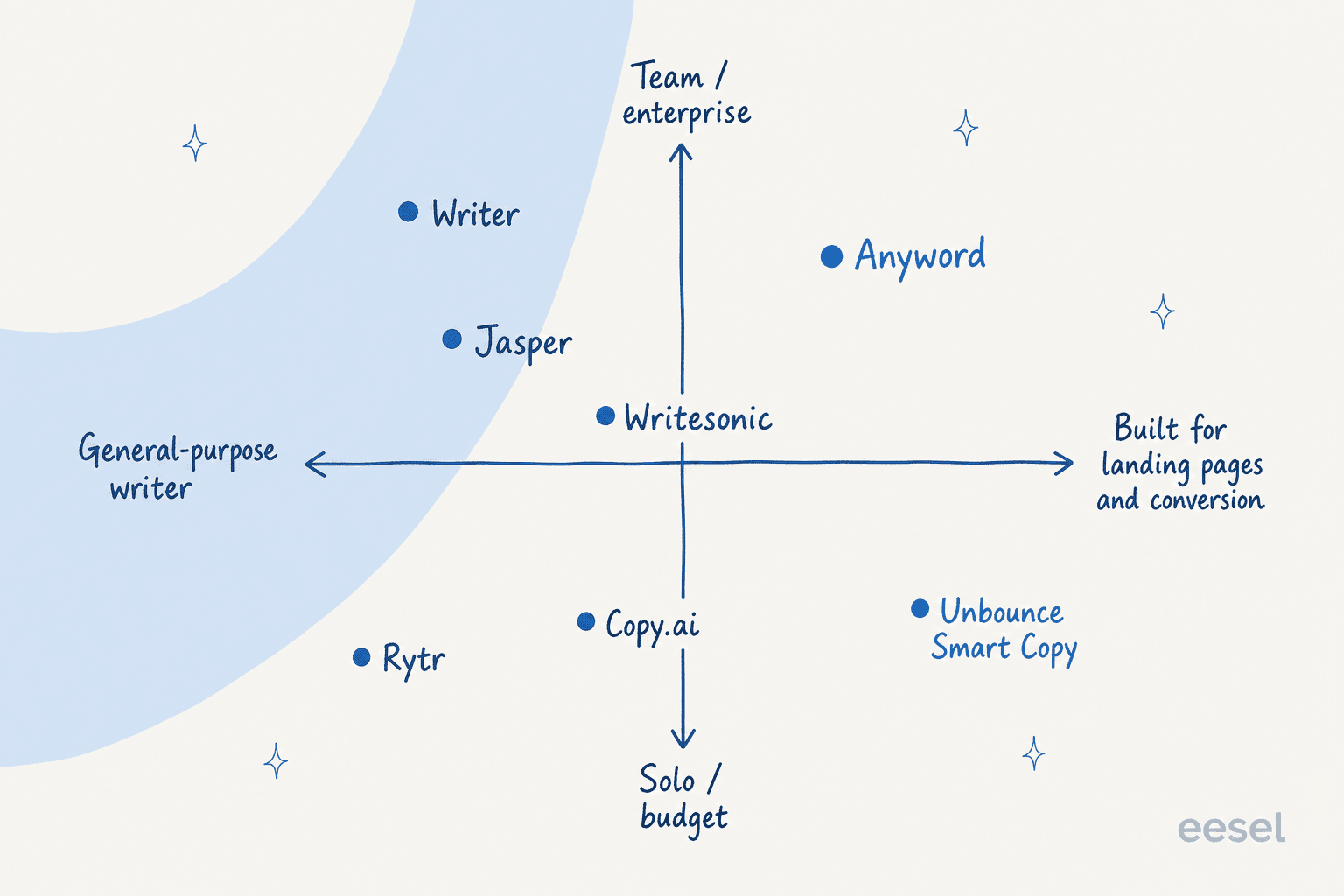
A quick word on what didn't make it. A couple of well-known names have quietly pivoted away from copywriting (more on that under Writesonic), and I'd rather tell you that than pretend a GEO tool is still a copy tool. Here's the lineup at a glance.
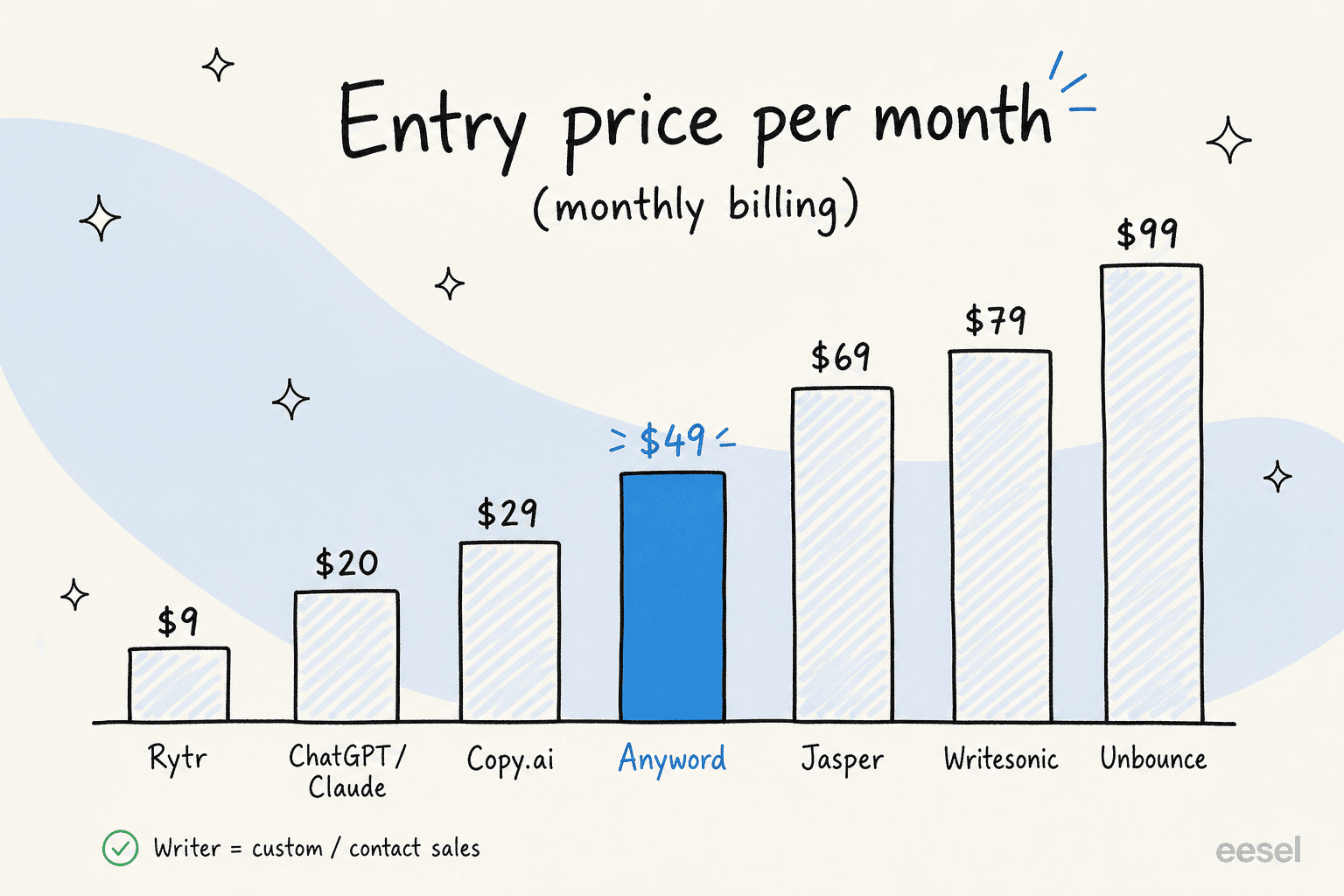
| Tool | Best for | Entry price (monthly) | Conversion feature | Free tier | Standout limit |
|---|---|---|---|---|---|
| Anyword | Conversion-led copy | $49/mo | Predictive performance score | 7-day trial | Real-time scoring starts at $99 |
| Jasper | Brand-consistent teams | $69/mo per seat | Brand IQ governance | 7-day trial | Scale features are Business-tier only |
| Copy.ai | Fast first drafts | $29/mo | Workflows (bulk) | Legacy free words | Bulk jumps to $1,000/mo |
| Unbounce Smart Copy | In-builder pages | $99/mo (Build) | Smart Traffic routing | 14-day trial | Locked to Unbounce pages |
| Writer | Enterprise governance | Custom | Voice profiles + guardrails | 14-day trial | No public pricing |
| Rytr | Solos on a budget | $9/mo | None (writing only) | Free forever | Output reads generic unedited |
| Writesonic | AI-search visibility | $79/mo | Citation optimization | 7-day trial | Pivoted away from copy |
| Claude / ChatGPT | Best raw writing, cheap | $20/mo | None (you steer) | Free chat | No landing-page structure built in |
1. Anyword: best for conversion-led landing page copy
Most AI writers generate copy and leave you to guess which version works. Anyword is the one that guesses for you, with a number attached. Its predictive performance score rates each variant against a target audience, channel, and goal before you publish, which is exactly the loop a landing page lives or dies on.
The claim is specific, which I like: Anyword says its prediction picks the better of two variants with 82% accuracy versus 52% for a generic model like GPT-5, per its homepage. A second, more conservative framing on the same page puts it at 70%, so the honest range to quote is 70 to 82%. Either way, it's the closest thing in this list to writing and A/B testing in one motion, and it shows up in how people use it. One verified reviewer put it plainly:
"Yesterday, I executed an entire landing page strategy in 1 day. It would have taken several weeks... before Anyword."
Verified reviewer, Software Advice
Pros
- Predictive scoring turns "which headline?" into a ranked answer, not a hunch.
- Strong on paid-acquisition copy too, claiming a 15 to 30% ROAS lift for ad variants.
- Genuinely well-liked: 4.8/5 from 1,226+ reviews on G2.
Cons
- The headline feature is gated. One-click scoring is on Starter, but real-time scoring as you write starts on Data-Driven at $99/mo, a point G2 reviewers flag often.
- It learns from your own campaign data, but those performance rows only scale on the custom-priced Business tier.
- No free-forever plan, just a 7-day trial.
Pricing
| Plan | Monthly | Yearly (per mo) | Predictions/mo |
|---|---|---|---|
| Starter | $49 | $39 | 50 |
| Data-Driven | $99 | $79 | 100 |
| Business | Custom | Custom | 250 |
| Enterprise | Custom | Custom | 500+ |
My take: If conversion is the point of the page (and on a landing page, it always is), Anyword is the tool I'd reach for first. Just budget for the $99 Data-Driven plan, because the entry tier hides the feature you came for.
2. Jasper: best for brand-consistent marketing teams
Jasper stopped being a "write me a paragraph" tool a while ago. It's now a marketing platform built around Brand IQ (your voice, knowledge, and audiences in one place) and Jasper Grid, which turns one brief into "emails, social posts, ad variations, landing page copy, and supporting visuals at scale," per its retail solution page. For a team running many pages that all need to sound like the same company, that governance layer is the whole pitch.
It's also where Jasper gets honest reviews. A paying customer was blunt about the core brand-voice job:
"The output quality was very very bad. We ended up using chatGPT (using 4o) to create our landing page... because it could follow our brand voice perfectly."
Verified user, G2

That's one review against a 4.7/5 average from 1,270 reviews, so don't over-index on it. But it captures a real tension: Jasper's polish lives on the Business tier, and a solo user on Pro gets capped at 2 brand voices.
Pros
- Best-in-class brand governance once you're on Business.
- Templates and agents make multi-asset campaigns fast.
- Mature, marketer-friendly workspace (Canvas) that teams actually adopt.
Cons
- The at-scale features (Grid, unlimited brand voices, API) are all Business-tier, custom-priced.
- $69/mo per seat is the steepest per-seat entry here.
- G2's own summary notes output "can occasionally feel generic or repetitive."
Pricing
| Plan | Monthly (per seat) | Yearly (per seat) | Notes |
|---|---|---|---|
| Pro | $69 | $59 | 2 brand voices, 5 knowledge assets |
| Business | Custom | Custom | Grid, unlimited voices, API |
My take: Jasper earns its keep for marketing teams who need every landing page on-brand without policing it by hand. Solo? You'll feel the Pro-tier caps fast, and the G2 quote above is a fair warning to trial it on your real voice first.
3. Copy.ai: best for fast first drafts
Copy.ai is the tool people reach for to beat the blank page, and it's genuinely good at it. With 17 million users and a deep template library, it spits out landing page hooks, value props, and CTA variants in seconds. If your bottleneck is "I have a blank canvas and a deadline," the $29/mo Chat plan clears it.
The wrinkle is that Copy.ai has repositioned itself as an "AI-native GTM platform" built around Workflows and Tables, not a copywriting suite. The self-serve plan is essentially a smart prompt box; the bulk and automation machinery lives much higher up. The most-cited buying reason on the community side is still tone control, with one recent Reddit thread on AI copy tools opening on exactly that: that the better tools "seem to remember brand voice and tone."
Pros
- Excellent for rapid first drafts and variant brainstorming.
- Brand Voice plus Infobase keep output reasonably on-message.
- The $29/mo Chat plan is a fair price for what most solos need.
Cons
- The jump from Chat ($29) to the first real workflow tier ($1,000/mo) is the steepest in this lineup.
- The GTM pivot means landing page copy isn't the headline use case anymore.
- Third-party reviewers flag occasional reliability gripes.
Pricing
| Tier | Seats | Public price (annual) |
|---|---|---|
| Chat (self-serve) | 5 | $24/mo ($29 monthly) |
| Growth | 75 | $1,000/mo |
| Scale | 200 | $3,000/mo |
| Enterprise | Custom | Not published |
My take: For an individual or small team that just needs strong drafts fast, Copy.ai is a solid, affordable pick. Just know the price cliff above Chat is real, and you'll likely outgrow Chat before you can justify Growth.
4. Unbounce Smart Copy: best for in-builder landing pages
Every other tool here writes copy somewhere else and leaves you to paste it into your page. Unbounce Smart Copy is the one that lives inside the page builder. It rewrites, expands, and summarizes copy right on the canvas, returning several test-ready options you apply with a click, so you see each change against the actual design.
What makes it interesting for conversion isn't the writing, it's the loop it feeds. Smart Copy spins up variants, Unbounce's A/B testing pits them against each other, and Smart Traffic (trained on "over two billion conversions," per Unbounce) auto-routes each visitor to the version they're most likely to convert on. That's writing, testing, and optimization in one motion, which no standalone copy tool can match.
Pros
- The only pick where writing, testing, and traffic routing are one system.
- On-page editing means copy is always sized to the real design.
- Conversion narrative is backed by an enormous test dataset.
Cons
- It's a refinement tool, not a from-scratch generator: it needs "a starting point."
- Smart Copy isn't on the entry Starter plan; the cheapest plan that includes it is Build at $74/mo annual ($99 monthly).
- Completely locked to the Unbounce ecosystem, so it's only worth it if you build pages there.
Pricing
| Plan | Monthly | Yearly | AI copywriting? |
|---|---|---|---|
| Starter | $29 | $22 | No |
| Build | $99 | $74 | Yes |
| Experiment | $149 | $112 | Yes (adds unlimited A/B testing) |
| Optimize | $249 | $187 | Yes (adds Smart Traffic) |
My take: If you already build landing pages in Unbounce, Smart Copy is a no-brainer add. If you don't, it's not a reason to switch builders, and you'd be better served by a standalone writer plus your own testing.
5. Writer: best for enterprise brand governance
Writer isn't really a landing page tool, and it isn't really for individuals. It's a full-stack enterprise AI platform (think Vanguard, Salesforce, Qualcomm as logos) built around its own Palmyra models, a governance layer, and voice profiles that enforce brand and compliance rules across every department. For a large company where a landing page has to clear legal and sound like the brand, that control is the entire reason it exists.
Reviewers consistently name brand-voice enforcement as the wedge against general models, and just as consistently flag two things: enterprise-only gating that frustrates smaller users, and slow performance on large knowledge graphs. There's no public dollar figure on either of its two plans, so expect a sales conversation and five-to-six-figure territory.
Pros
- Best-in-class brand and compliance governance at organization scale.
- In-house Palmyra models plus a hardened security posture (SOC 2 Type II, HIPAA, PCI).
- Voice profiles keep copy consistent across many teams and writers.
Cons
- Contact-sales only; no transparent pricing and no real self-serve path.
- Overkill (and over-budget) for anyone who just needs landing page copy.
- Reviewers report multi-minute query times on big document sets.
My take: Writer is the right answer to a question most readers of this post aren't asking. If you're an enterprise standardizing AI across marketing, legal, and support, put it on the list. If you're a marketer who needs a converting hero section by Friday, look elsewhere.
6. Rytr: best for solos on a tight budget
Rytr is the value pick, and it doesn't pretend otherwise. A free-forever tier (10,000 characters a month, no card), a $7.50/mo Unlimited plan, and 40+ templates make it the obvious starting point for a solopreneur or freelancer writing the occasional landing page. With 8 million+ users and a 4.7/5 from 819 G2 reviews, it's no toy.
The trade-offs are exactly what you'd expect at the price. Reviewers love that it's cheap and consistently note two things: tight usage caps, and output that reads generic unless you edit it. The pattern from happy users is telling: people who use Rytr to augment (autocomplete, expand, reword) get more out of it than people generating a full page end-to-end.
Pros
- A real free tier, then $7.50/mo, makes it the cheapest credible option.
- 20+ tones and custom tone matching on paid plans.
- Light, fast, and genuinely easy for non-writers.
Cons
- Output reads generic without a human edit pass.
- Character caps are the most common complaint, even from fans.
- No team workspace, no SOC 2 mention, and a marketing site with some 404s and "under construction" pages.
Pricing
| Tier | Price (yearly) | Headline limit |
|---|---|---|
| Free | $0 | 10K characters/month |
| Unlimited | $7.50/mo | Unlimited characters, 1 custom tone |
| Premium | $24.16/mo | Unlimited + 35 languages, 5 tones |
My take: For a side project or a first landing page, Rytr is the smart, low-risk way in. Just treat it as a drafting assistant you'll edit, not an autopilot, and you'll get your money's worth many times over.
7. Writesonic: best for landing pages you want AI search to cite
Here's the one I owe you the most honesty on. Writesonic used to be a template-rich copy tool, and plenty of older reviews still describe it that way ("great for quickly creating stuff like blogs, ads, landing pages"). In 2026 it's repositioned as an "AI Search Growth Engine," focused on getting your pages cited inside ChatGPT, Gemini, and Google AI Overviews. The legacy product-description and ad-copy template library is gone; that URL now returns a 404.
So why include it? Because "landing page copy" increasingly means copy that AI search engines will surface and cite, not just copy a human reads. Writesonic's content-optimization angle (rewriting pages with FAQ blocks, schema, and "self-contained passages AI engines cite") is a real, defensible job if your landing pages need to win in generative engine optimization. Just don't buy it expecting a classic copy generator.
Pros
- Genuinely strong at AI-search visibility and citation optimization.
- Tracks your presence across up to 10 AI platforms.
- Solid reputation: 4.7/5 from 2,114 G2 reviews.
Cons
- It has pivoted away from copywriting; the template library is retired.
- Pricing starts at $79/mo and the useful tiers climb fast ($199, $399).
- A blunt Reddit verdict: a user cancelled because "the AI results were not as good as their competitors."
My take: If your real problem is "my landing pages are invisible to AI search," Writesonic is a thoughtful pick. If your problem is "I need a converting page written," this isn't that tool anymore, and I'd rather you know before you pay.
8. Claude and ChatGPT: best raw writing for the least money
I'd be lying if I left these off. A general large language model like Claude or ChatGPT writes the best raw copy in this whole list, for $20/mo, full stop. Remember the Jasper reviewer above who ditched a dedicated tool and used ChatGPT to match their brand voice "perfectly"? That's not rare. The catch is that a chat model gives you a blank box, not a landing-page workflow: no built-in scoring, no variant testing, no brand-voice memory unless you build it yourself with a custom GPT or a saved project.
So the honest trade is convenience versus control. The dedicated tools wrap structure, scoring, and governance around the model. The raw model gives you the cleanest writing and the lowest price, and asks you to bring the structure. If you're a strong editor who can write a tight brief, you'll often beat the purpose-built tools for a fraction of the cost.
Pros
- The best raw writing quality here, for the lowest flat price.
- Endlessly flexible: brief it like a copywriter and it adapts.
- Free tiers exist on both for casual use.
Cons
- No landing-page structure, scoring, or A/B testing out of the box.
- Brand voice is on you to engineer and re-paste each time.
- Easy to get generic output if your brief is lazy.
My take: For anyone willing to learn to brief well, a general model is the highest-leverage $20 in marketing. For teams who'd rather buy the workflow than build it, that's exactly what the seven tools above are selling.
Try eesel for the content that earns the visit
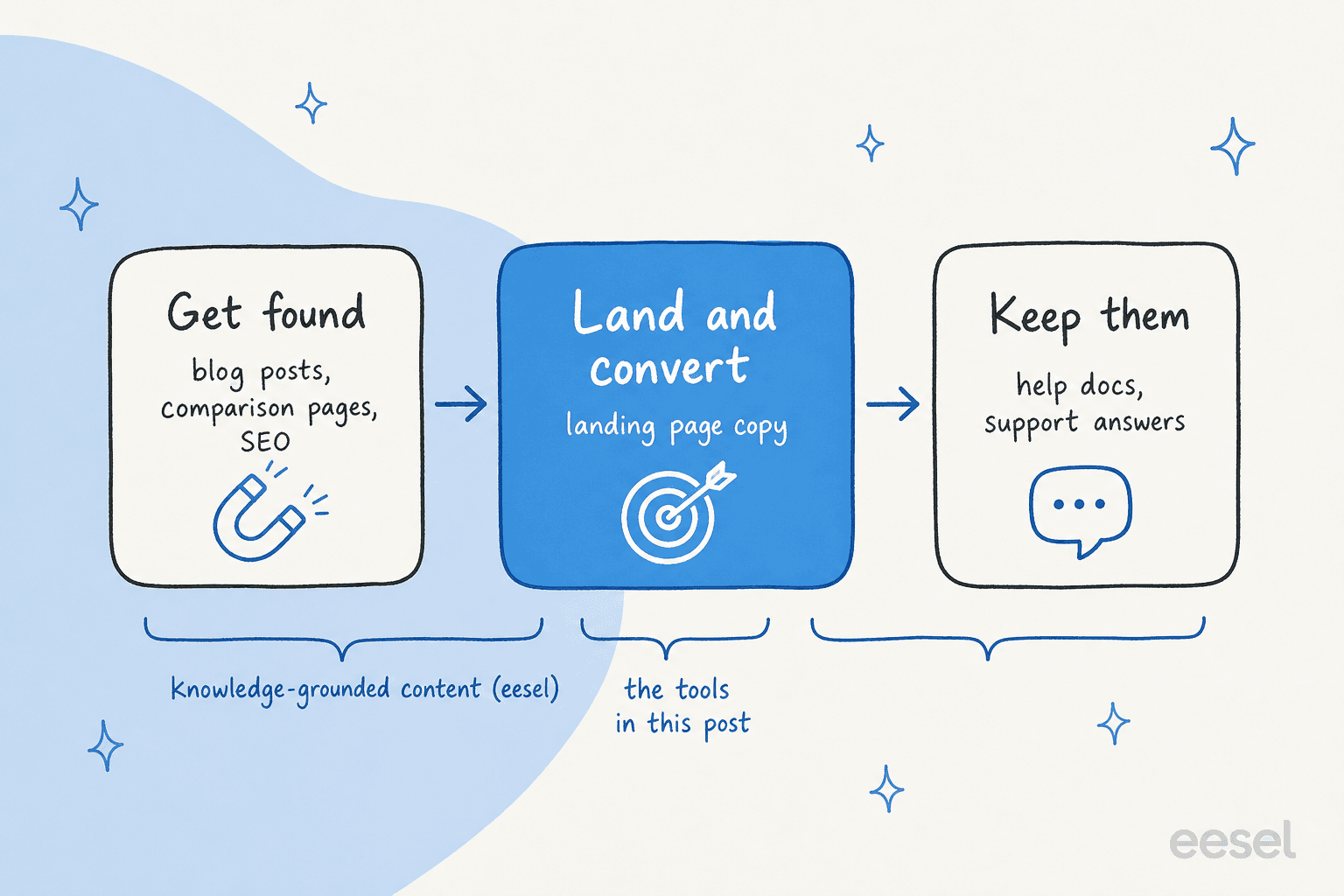
Every tool above writes the landing page, the copy that converts a visitor who's already arrived. But a landing page can't convert traffic it never gets. The copy that brings people to the page (the blog posts, comparison pages, pillar pages, and help articles that rank and earn the click) is a different job, and it's the one eesel AI is built for.
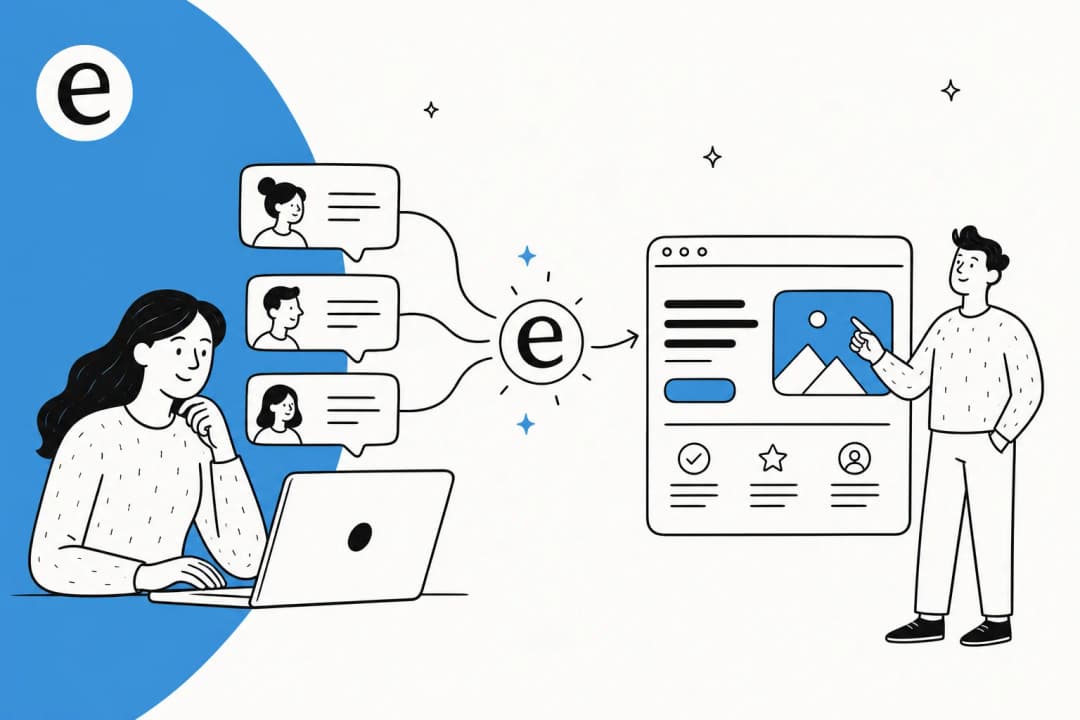
eesel's AI blog writer isn't a prompt box. It's framed as a teammate that does keyword research, reads real sources, drafts in your voice (it claims a knowledge base-grounded "94% voice match from day one"), and even optimizes your page metadata, so the content that feeds your funnel stays consistent with the pages it points to. It also runs a suite of free tools no sign-up required, including a meta description generator and an SEO keyword generator that fill the exact gap most copy tools above leave open. Full disclosure: eesel's writer drafted the first pass of this very post, which is the most honest test I can give it.
If you want the landing page itself, pick from the eight above based on the job: Anyword to convert, Unbounce to test in-builder, a general model to write cheaply and well. If you want the engine that keeps those pages fed, that's eesel.
Frequently asked questions
What is the best AI for landing page copy in 2026?
Is there a free AI tool for writing landing page copy?
How much do AI landing page copy tools cost?
Can AI write a landing page that actually converts?
Do I still need a copywriter if I use AI for landing pages?


Article by
Kurnia Kharisma Agung Samiadjie
Kurnia is a software engineer and writer at eesel AI with two years of SEO experience, writing about AI tools, helpdesk software, and customer support. He pairs a developer's understanding of how these products are built with search-driven research into what actually ranks and resonates with the people searching for them.