Most AI writing tools will generate text that sounds reasonable. That's not the same thing as copy that converts.
Conversion copywriting is a narrower brief: it means writing ad headlines that get clicked, email subject lines that get opened, landing page CTAs that get tapped. The gap between "decent copy" and "copy that performs" is where a lot of AI-generated content falls flat, and it's why a separate category of tools has emerged specifically for this job.
What separates these tools from general AI writers isn't just templates. The ones worth using have some combination of: performance prediction scores that tell you how a variant is likely to perform before it runs, A/B variant generation built into the workflow, persuasion frameworks like AIDA (Attention-Interest-Desire-Action) and PAS (Problem-Agitate-Solution) baked into prompts, and channel-specific optimization for Google ads vs. Facebook vs. email vs. landing pages.
This list covers six tools that have genuine strengths in that territory. The keyword itself isn't on the list. The focus is on tools built, at least in part, around the idea that copy should be tested and measured, not just generated.
How to pick the right tool
Before the list, a few questions worth answering honestly:
Do you primarily write short-form ad copy or long-form landing pages? Short-form ad copy (Google RSAs, Facebook headlines, email subjects) rewards tools with performance scoring and fast variant generation. Long-form (landing pages, email sequences) rewards tools with strong brand voice enforcement and framework templates.
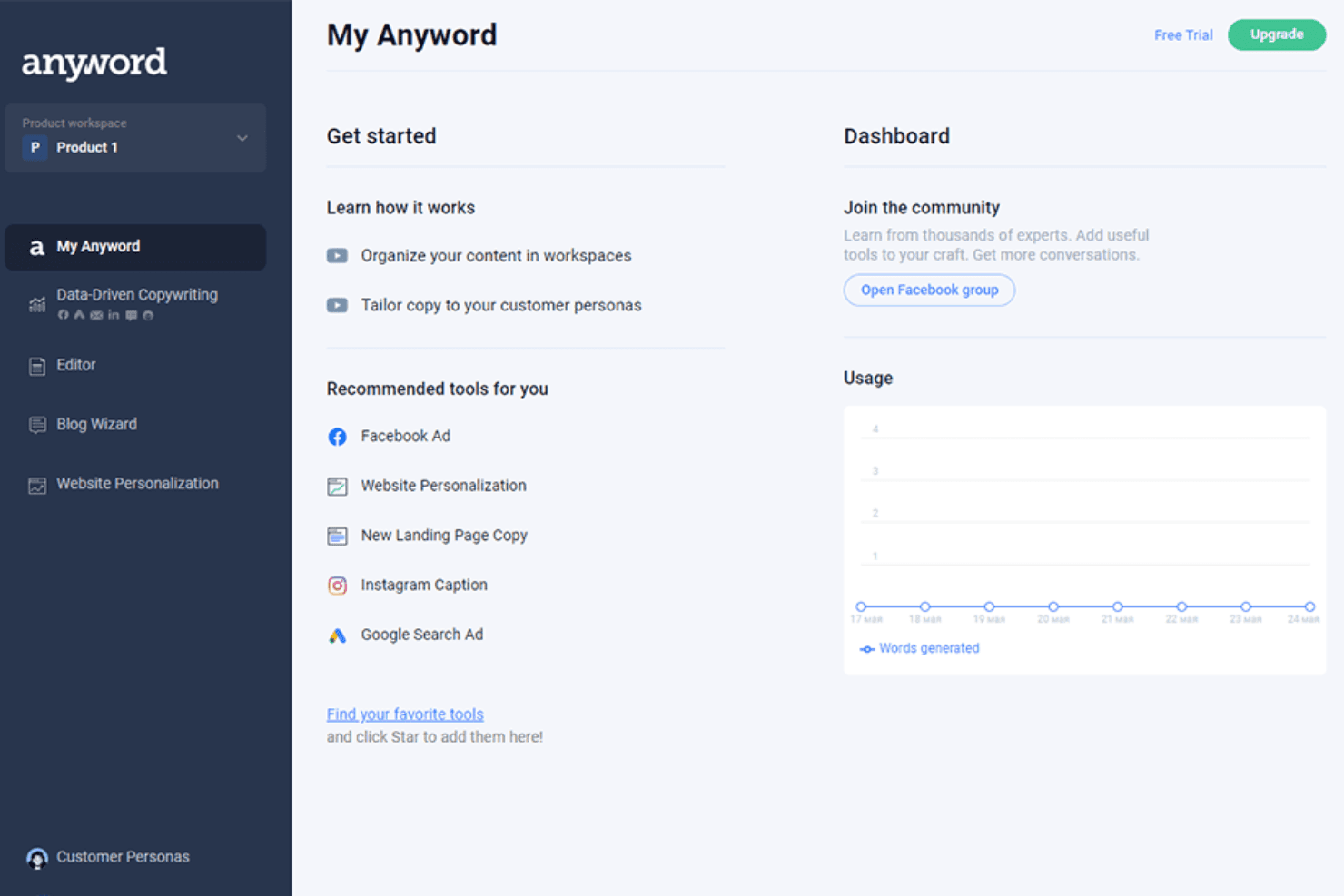
Are you a solo marketer or part of a team? Seat counts and collaboration features matter more than they might seem. Anyword's Data-Driven plan gives three seats at $99/month; Rytr doesn't officially support multi-user team accounts at all.
Do you need visual ad creatives as well as copy? AdCreative.ai is the only tool on this list that generates both ad images/video and copy in one platform.
What's your volume? If you're producing hundreds of ad variants monthly, Jasper's Jasper Grid and Copy.ai's Workflows are designed for that. If you're producing 10-20 pieces a week, any tool here will handle it.
Comparison at a glance
| Tool | Best for | Performance scoring | A/B variant gen | Frameworks (AIDA/PAS/etc.) | Starting price |
|---|---|---|---|---|---|
| Anyword | Paid media teams, email marketers | Yes - scored by channel/audience | Yes | Yes (100+ templates) | $49/mo |
| Jasper | Marketing teams, content at scale | No | Yes (content variations) | Yes (50+ templates) | $59/mo (annual) |
| Copy.ai | GTM teams, sales copy | No | Yes (Workflows) | Yes (90+ templates) | $29/mo |
| AdCreative.ai | Ad creative + copy combined | Yes (Creative Scoring AI) | Yes | No explicit frameworks | $39/mo |
| Writesonic | Content teams + SEO/GEO | No | Yes | Yes | $99/mo |
| Rytr | Freelancers, solo marketers | No | Yes | Yes (40+ use cases) | Free / $7.50/mo |
1. Anyword - best for performance-scored conversion copy
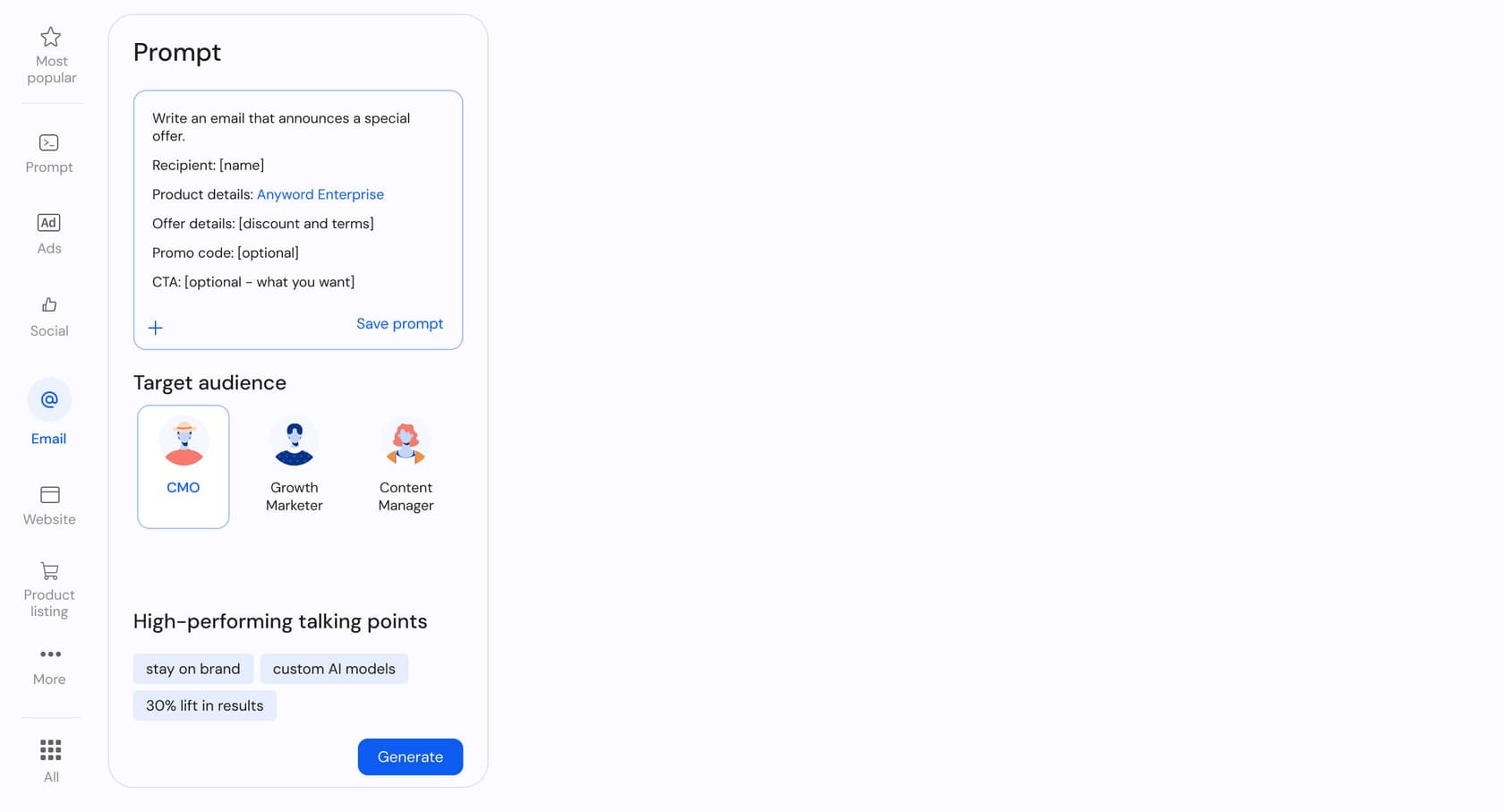
Anyword is the only tool on this list that treats performance prediction as its primary feature, not an add-on. The platform trains on A/B-tested marketing data and assigns a numerical score to any copy variant based on how similar copy has performed for that channel and audience combination.
The headline claim: 82% accuracy in predicting which of two copy variants will outperform the other. For comparison, they benchmark GPT-4o without Anyword at 52% - barely better than guessing. That's a substantial accuracy gap for a marketer who needs to know which Facebook headline to run.
The Data-Driven Editor is where this becomes practical day-to-day: it updates performance scores in real time as you type, so editing a headline shows you whether your changes are improving or degrading its predicted performance character by character. This is available from the $99/month Data-Driven plan and above.
The Business plan goes a step further with custom AI models trained on your own historical campaigns. If you've been running ads for two years and have performance data from thousands of past creatives, Anyword can incorporate that data to make predictions specific to your brand and audience, not just industry averages.
One customer result that stood out in their case studies: Freya Smale, a director of marketing in automotive, reported going from 2.5% to 8% CTR on emails - more than tripling click-through rate - after adopting Anyword's copy approach. A demand gen manager at a Fortune 500 cloud platform put it more bluntly: "We no longer A/B test Anyword copy vs. original copy. Now, we just go with Anyword copy."
Capterra rates Anyword 4.8/5 across 391 verified reviews. Melissa Tyndall, a Content Developer Manager, noted it's "more intuitive and easier to use... I love the scoring and integrated SEO tools". The main complaint from lower-rated reviews: the Starter plan's 50 performance predictions per month runs out quickly for high-volume teams.
Pros:
- Best-in-class performance prediction (82% accuracy on variant selection)
- Real-time scoring in the Data-Driven Editor - feedback as you type
- Business plan trains on your own historical campaign data
- SOC 2, ISO 27001, GDPR, and HIPAA certified
- Chrome extension brings scoring into other tools (ChatGPT, Notion, Gemini)
Cons:
- Performance predictions are capped monthly (50 on Starter, 100 on Data-Driven)
- Business plan pricing is opaque - requires sales contact
- Better for marketing copy than long-form editorial content
Pricing:
| Plan | Price | Seats | Performance predictions | Notes |
|---|---|---|---|---|
| Starter | $49/mo | 1 | 50/mo | 7-day free trial, unlimited copy generation, 1 brand voice |
| Data-Driven | $99/mo | 3 | 100/mo | Real-time scoring as you edit |
| Business | Custom | 3+ | 250/mo | Custom AI models, 5,000 performance data rows, A/B testing |
| Enterprise | Custom | Custom | 500+/mo | Private LLM, SSO, full API, 10,000+ data rows |
Annual billing saves up to 50%.
Who it's for: Performance marketers running paid ads, email marketers who want data-backed copy decisions, and marketing teams large enough to benefit from AI trained on their own campaign history.
2. Jasper - best for teams producing conversion copy at volume

Jasper started as a template-driven writing tool and has become a full-blown content platform for marketing teams. It's not narrowly optimized for conversion copy the way Anyword is, but it's built for the context where conversion copy gets made: marketing teams with brand guidelines, multiple channels, and high output requirements.
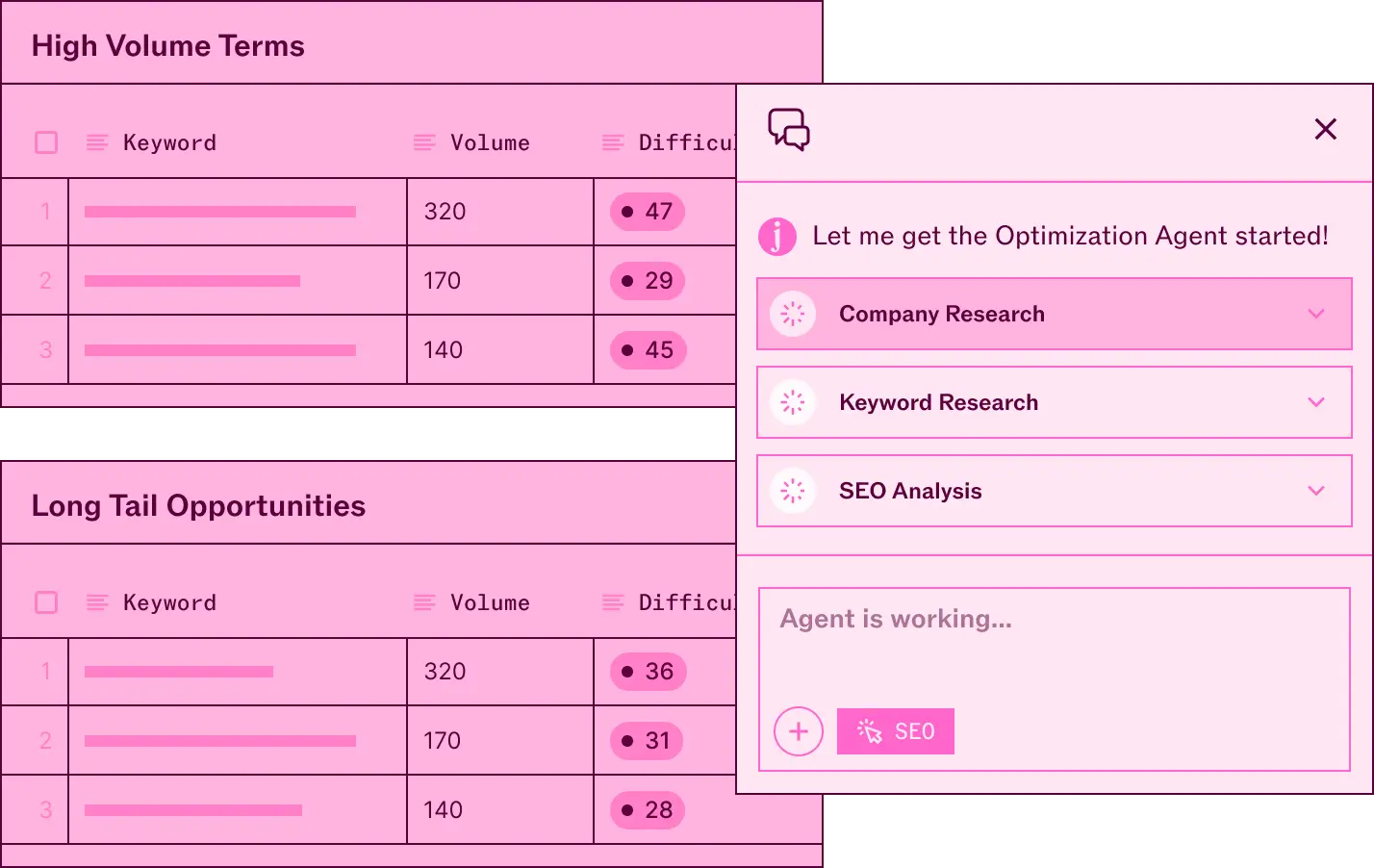
The conversion-relevant parts of Jasper come from Brand IQ, which centralizes brand voice, style guides, and audience profiles across every output, and from the optimization-focused AI agents. The Optimization Agent specifically handles copy improvement, performance-oriented rewrites, and variant generation for paid channels. One user described Jasper's multi-variant workflow as turning "a one and done piece into a twelve and done piece" - their team produces over 500 pieces of original content yearly and uses Jasper to generate channel-adapted variations from each source.
Jasper doesn't score copy for predicted conversion performance the way Anyword does. What it does instead is enforce brand consistency at scale - so the copy that gets generated across landing pages, ads, and email sequences actually sounds like the same company. For teams whose conversion problem is inconsistency rather than lack of variant testing, that's the more relevant capability.
Capterra ratings: 4.8/5 across 1,855 reviews. The reviews are broadly positive on efficiency and content quality, with the most common criticism being that initial setup (training Brand IQ with reference docs) takes time investment before the tool delivers on its potential.
Pros:
- 100+ purpose-built marketing templates covering ads, emails, landing pages
- Brand IQ enforces voice consistently across all generated copy
- AI agents for optimization, personalization, and research
- Jasper Grid for bulk systematic content variation
- 4.8/5 on Capterra (1,855 reviews) - one of the highest-rated AI writing platforms
Cons:
- No native performance prediction scores
- Pro plan limited to 2 Brand Voices and 5 Knowledge Assets
- Business plan requires custom pricing (no transparent per-seat costs for teams)
- Some users report it takes significant upfront work to get Brand IQ calibrated
Pricing:
| Plan | Price | Seats | Brand Voices | Knowledge Assets |
|---|---|---|---|---|
| Pro | $69/mo ($59/mo annual) | 1 | 2 | 5 |
| Business | Custom | Scalable | Unlimited | Unlimited |
7-day free trial available. Business adds API access, Jasper Grid, AI App Builder, SSO/SCIM, and a dedicated CSM.
Who it's for: Marketing teams that produce high volumes of copy across multiple channels and need brand consistency enforced automatically. Strong fit for agencies managing multiple clients.
3. Copy.ai - best for sales and GTM-focused conversion copy
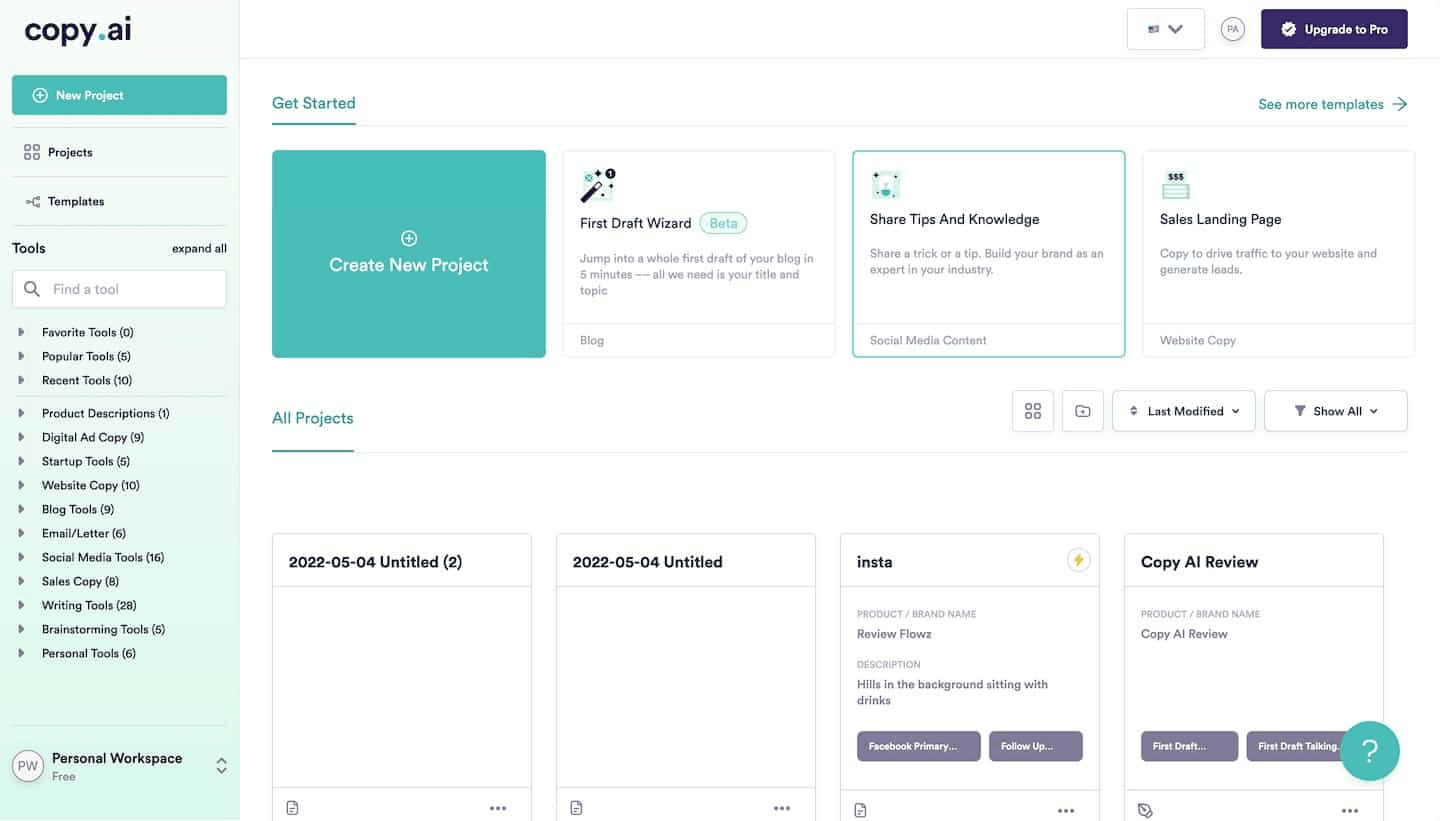
Copy.ai started as a quick-hit copywriting tool and pivoted in 2024 to a Go-To-Market AI platform focused on sales, demand gen, and marketing operations. That pivot shapes what it's good at today: conversion copy in the context of GTM workflows, not standalone writing.
Its 90+ templates cover the AIDA and PAS frameworks, along with templates specific to cold email sequences, LinkedIn outreach, product launch announcements, and landing page sections. Where Copy.ai goes beyond simple template filling is in its Workflows - no-code multi-step processes that can chain together lead research, audience insight, and copy generation into a single automated pipeline.
The reported results at enterprise scale are striking: Lenovo reportedly saved up to $16 million by automating GTM workflows through Copy.ai, and Juniper Networks generated 5x more meetings using AI-personalized outreach. The company reported 480% revenue growth in 2024 following this pivot.
A Capterra reviewer described it as "user friendly and fast for short content generation" but noted it requires "heavy fact checking and edits for long form writing". That tracks with the platform's current positioning - Copy.ai is at its strongest in short-to-medium form conversion copy (ads, emails, outreach sequences) rather than deep long-form content.
Pros:
- 90+ templates with AIDA, PAS, and sales-specific frameworks
- Workflow automation connects research, insight, and copy generation
- Strong at personalized outreach and sales email sequences
- Infobase for storing company-specific knowledge
- Integrates with Salesforce, HubSpot, and 2,000+ tools via Zapier
Cons:
- 4.4/5 on Capterra (67 reviews) - fewer and somewhat lower-rated than Jasper and Anyword
- Long-form content needs more editing than short-form
- Free tier not listed on the current pricing page; enterprise pricing not transparent
- Now a subsidiary of Fullcast - future product direction less certain
Pricing:
| Plan | Price | Seats | Notes |
|---|---|---|---|
| Chat | $29/mo ($24/mo annual) | 5 | Unlimited words in Chat, multi-model access (OpenAI/Anthropic/Gemini) |
| Enterprise | Custom | Unlimited | Custom workflows, API, 20+ integrations, SOC 2 |
Who it's for: Sales and GTM teams running personalized outreach at scale, demand gen teams who want copy generation embedded in multi-step prospecting workflows.
4. AdCreative.ai - best for conversion-optimized visual ads with copy
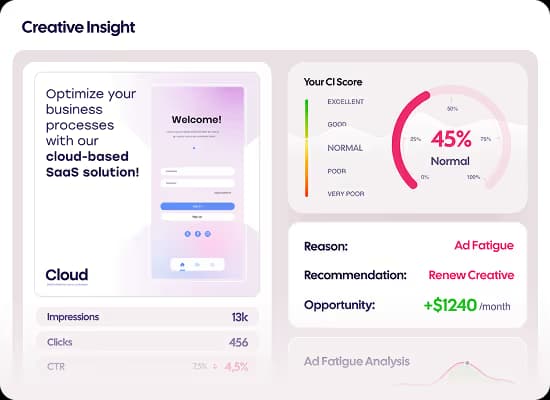
AdCreative.ai occupies a different niche from the other tools here. It's not a text editor - it's an ad creative platform that generates both visual ad assets (static images, video ads, UGC-style content) and the copy that goes with them, with conversion scoring built in.
The differentiator is the Creative Scoring AI, which rates each generated creative by predicted conversion performance before you run it. That scoring is trained on patterns from $35B+ in ad spend data, making it one of the largest training datasets in the ad-specific AI category. The Competitor Insights AI adds another layer: it surfaces competitors' best-performing ad creatives across platforms, so you can understand what's working in your category before generating your own.
AdCreative.ai claims 4.2 million businesses use the platform and markets itself as "#1 most used AI tool for advertising." User sentiment is mixed: a Reddit review from r/AIToolTesting noted that "speed is impressive - can generate 20+ ad variations in under 5 minutes" and that "copy quality is decent - headlines and ad text are usually on point", while an older thread from 2023 raised concerns about billing and cancellation practices.
The major friction point is pricing structure. At $39/month, the Starter plan gives you static ad creatives and basic copy - but the Creative Scoring AI is locked to the Professional plan at $249/month, a 6x price jump. Video generation (UGC-style, product videos, storytelling ads) is also Professional-only. If the conversion scoring is the reason you'd choose AdCreative.ai over a general writing tool, the $249/month entry point is the realistic one.
Pros:
- Only tool here that combines visual ad creative generation with copy
- Creative Scoring AI predicts conversion performance before running ads
- Trained on $35B+ in ad spend data
- Competitor Insights AI shows what's working in your category
- 20+ ad variations in under 5 minutes per user tests
Cons:
- Creative Scoring AI locked behind $249/mo Professional plan (Starter at $39/mo doesn't include it)
- Video features also locked to Professional
- Credit-per-video costs not published - total cost of video ads opaque
- Billing and cancellation complaints noted in community (primarily older reviews from 2023)
- Focused on ad creatives, not email or landing page copy
Pricing:
| Plan | Price | Credits | Creative Scoring AI | Video | Notes |
|---|---|---|---|---|---|
| Starter | $39/mo | 10 | No | No | Static creatives only |
| Professional | $249/mo | 50 | Yes | Yes | UGC video, batch creatives, custom templates, compliance checker |
| Ultimate | $999/mo | 100 | Yes | Yes | Full feature set |
Annual plans ~40% discount per G2.
Who it's for: Paid media managers and performance marketing agencies who need both visual ad assets and conversion-scored copy from one platform, particularly for Facebook, Instagram, and Google Display campaigns.
5. Writesonic - best for content teams bridging SEO and conversion copy
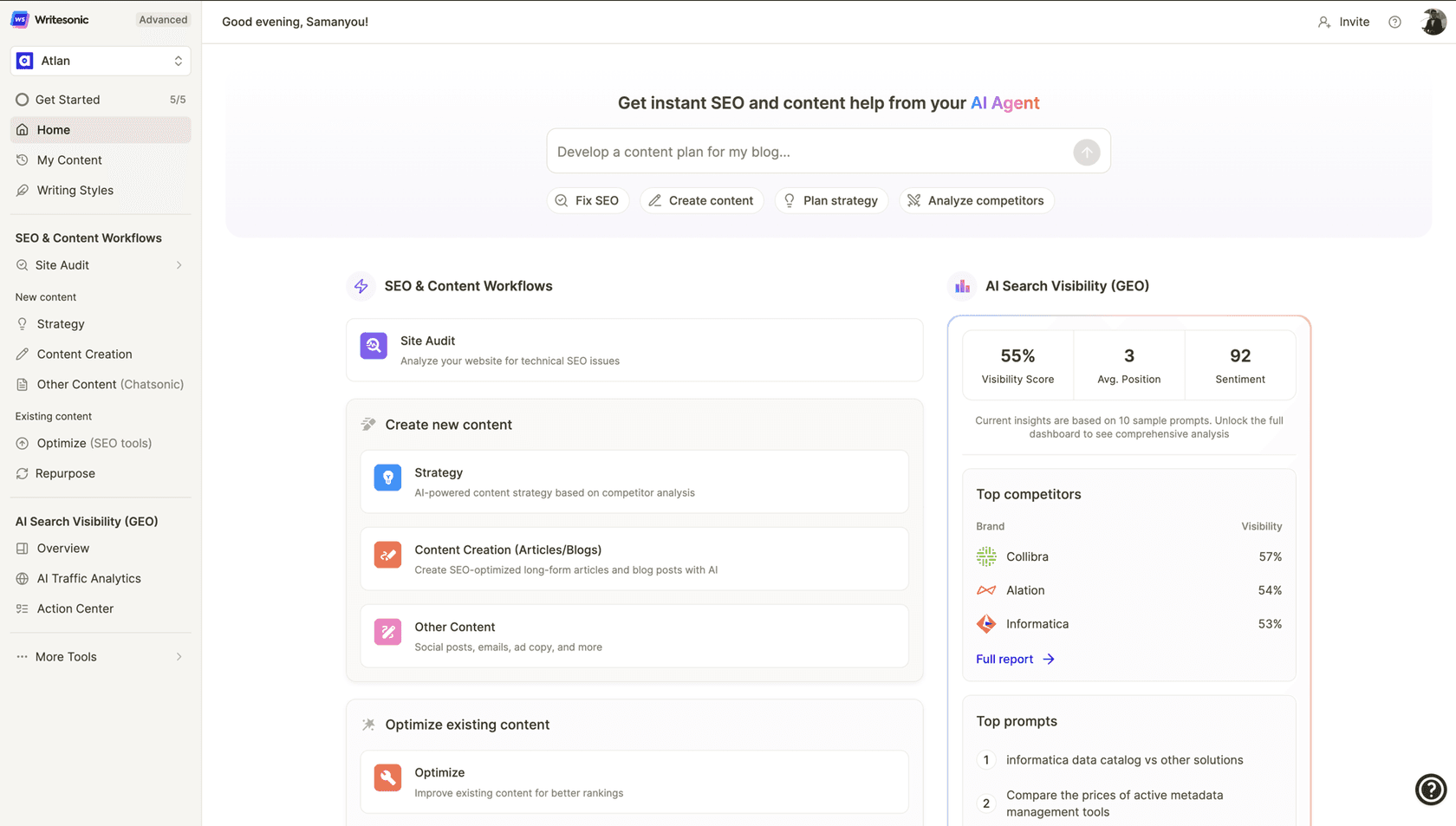
Writesonic has evolved significantly from its roots as a general AI writing tool. It now centers on what it calls Generative Engine Optimization (GEO) - tracking and improving brand visibility within AI search platforms like ChatGPT, Gemini, and Perplexity. That's a different angle from conversion copy, but the same platform also handles ad copy, email, and landing page writing, making it a practical choice for content teams who need both.
The conversion copy toolkit inside Writesonic includes Chatsonic, a multi-model AI assistant that switches between GPT-4o, Claude 3.5, and Gemini 1.5 Pro depending on the task, plus an Article Writer and templates covering ads, emails, product descriptions, and CTAs. G2 rates Writesonic 4.7/5 across over 2,100 reviews - one of the higher aggregate ratings in this category.
The user sentiment on G2 consistently praises speed: reviewers describe it as a tool that "removes writing friction" and generates "usable drafts for ads, emails, and SEO content in a fraction of the time." The main criticism is pricing - at $99/month for the Starter plan, it's the most expensive entry point on this list, and some users note that essential features are gated behind higher-cost tiers.
Writesonic's results with customers focus on reach and visibility: a 25% increase in AI-driven traffic for Viscaweb, $200,000 in revenue for Blitzmetrics through improved AI visibility, and 3x faster content output for Best Arctic. These are content marketing metrics more than conversion metrics specifically, which reflects the platform's current positioning.
Pros:
- 4.7/5 on G2 (2,100+ reviews) - highest-rated tool on this list
- Chatsonic switches between multiple LLMs (GPT-4o, Claude, Gemini) in one interface
- Strong SEO and GEO features alongside copy generation
- 7-day no-questions-asked refund policy
- Free trial with no credit card required
Cons:
- $99/month Starter is the most expensive entry point on this list
- GEO/AI visibility focus means the product roadmap is pulling toward SEO rather than pure conversion optimization
- Some users report quality variability on technical content
- GEO tracking limited to 50 queries/month at Starter
Pricing:
| Plan | Monthly | Annual | AI Queries Tracked | AI Articles/mo | Users |
|---|---|---|---|---|---|
| Starter | $99/mo | $79/mo | 50 | 15 | 1 |
| Basic | $249/mo | $199/mo | 100 | 25 | 2 |
| Growth | $499/mo | $399/mo | 200 | 50 | 3 |
| Enterprise | Custom | Custom | Custom | Custom | Custom |
Who it's for: Content marketing teams who need both conversion-focused ad and email copy and ongoing SEO/GEO visibility work, and want one platform for both.
6. Rytr - best budget option for solo copywriters
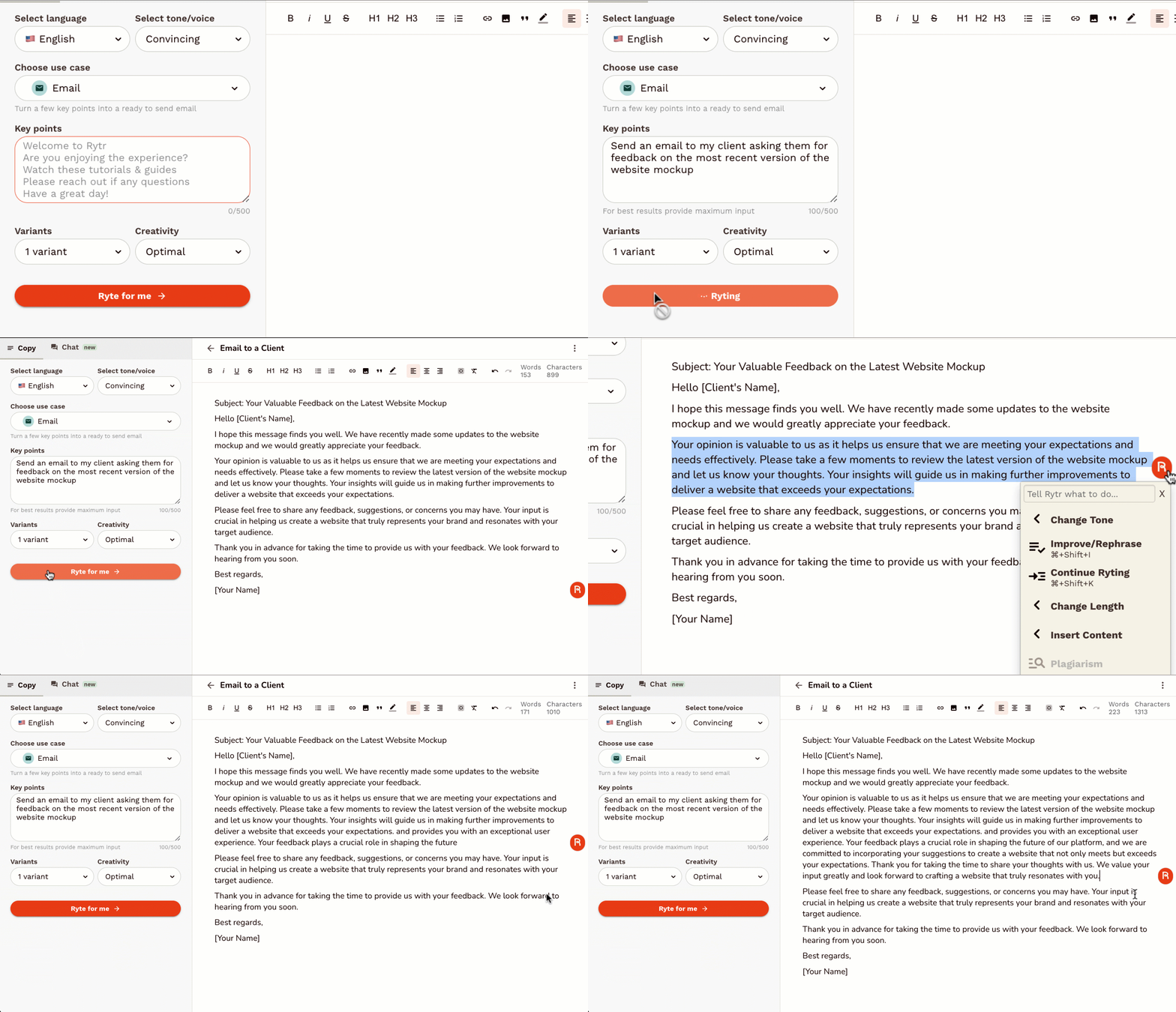
Rytr is the simplest and cheapest tool on this list. Its premise is direct: a writing tool that matches your tone of voice and generates copy across 40+ use cases, with a free plan and a paid plan starting at $7.50/month.
The conversion copy coverage is real. The 40+ use cases include Facebook ads, Google ads, email sequences, product descriptions, landing page CTAs, and value propositions - all with built-in persuasion frameworks. The tone-of-voice matching differentiates Rytr from general LLMs: the platform analyzes a sample of your writing and mirrors it in generated outputs, which helps the copy feel less generic than vanilla ChatGPT output.
There's no performance scoring, no A/B testing infrastructure, and no predictive analytics. What you get is fast, affordable variant generation for a copywriter who knows what good looks like and needs speed rather than data-backed selection. G2 rates Rytr 4.7/5 across 820+ verified reviews, consistently praised for ease of use and value.
A few things to know before committing: Rytr's free plan is limited to 10,000 characters per month - roughly 1,500-2,000 words, or maybe 8-10 short ad variants. The Unlimited plan at $7.50/month removes that cap but restricts you to one language and one custom tone. The Premium plan at $24.16/month adds 5 custom tones and 35+ languages, which matters for agencies managing multiple clients. Rytr has no official multi-user team accounts - agencies with multiple writers would need separate purchases per user.
Pros:
- Free plan available (10,000 characters/month)
- Cheapest paid option: $7.50/month for unlimited generation
- Tone-of-voice matching across 40+ use cases
- Chrome extension for writing anywhere
- 4.7/5 on G2 (820+ reviews)
Cons:
- No performance prediction or conversion scoring
- No multi-user team accounts
- Free tier restricted to 1 language; 35+ languages locked to Premium ($24.16/mo)
- Limited context window relative to full-featured platforms
- Not designed for complex GTM workflows
Pricing:
| Plan | Monthly | Annual | Characters | Custom Tones | Languages | Plagiarism checks |
|---|---|---|---|---|---|---|
| Free | $0 | $0 | 10,000/mo | 0 | 1 | 0/mo |
| Unlimited | $7.50/mo | $90/yr | Unlimited | 1 | 1 | 50/mo |
| Premium | $24.16/mo | $290/yr | Unlimited | 5 | 35+ | 100/mo |
Who it's for: Solo copywriters and freelancers who need a fast, affordable writing assistant for conversion-focused copy and don't need analytics or team collaboration. Good first step before committing to a more expensive platform.
How these tools fit into a content workflow
A common pattern with conversion copy is: generate variants quickly, evaluate them, pick a winner, test it. Most teams that see real results from AI conversion tools aren't using one tool for everything - they're combining a fast generation tool (Rytr, Copy.ai templates) with a scoring layer (Anyword) on the variants that matter.
If you're trying to understand what AI copywriting is and how it works, Anyword's performance scoring approach is the clearest practical demonstration of what separates "write me an ad" from "write me an ad that's likely to perform."
For teams already using helpdesk or customer support tools, worth noting that tools like eesel AI take a different approach to the same underlying problem - using AI to draft, improve, and adapt copy in customer-facing contexts like support tickets and chat conversations, with knowledge-base grounding rather than A/B-test scoring. It's a different use case (support rather than advertising), but the same basic principle: copy that's grounded in what you know about your customer performs better than copy written in a vacuum.
If your primary channel is email, the best AI tools for email marketing guide covers tools with more email-specific features than this list. If you need writing tools across a broader marketing stack, our AI tools for marketing roundup covers the full picture.
For the budget-conscious, see free AI copywriting tools for a more granular look at no-cost options including Rytr's free tier, Copy.ai's Chat plan, and other entry points. And if you want to understand what to look for before picking any AI writing tool, what is AI copywriting walks through the fundamentals.
Bottom line
No single tool wins across every conversion copy use case, which is why five answers appear below instead of one.
If you run paid ads and want data-backed copy decisions, start with Anyword - the performance scoring is genuinely differentiated and the $49/month Starter is a reasonable test.
If you're a marketing team producing high volumes of on-brand content and need rigorous brand voice enforcement, Jasper is the most mature platform for that workflow at $59/month (annual).
If your conversion copy problem is primarily in outbound sales and GTM sequences rather than paid ads, Copy.ai's Workflows are built for that at $29/month.
If you need visual ad creatives and copy together in one platform, AdCreative.ai is the practical choice - just budget for the Professional plan at $249/month to unlock the scoring features that justify the subscription.
If you want both SEO visibility and conversion copy from one tool, Writesonic covers the most ground at $79/month (annual).
And if budget is the constraint and you need a solo writing assistant, Rytr at $7.50/month is the most accessible starting point in this category.