
So, can AI write ad copy? The honest answer
Short version: yes, with a big asterisk.
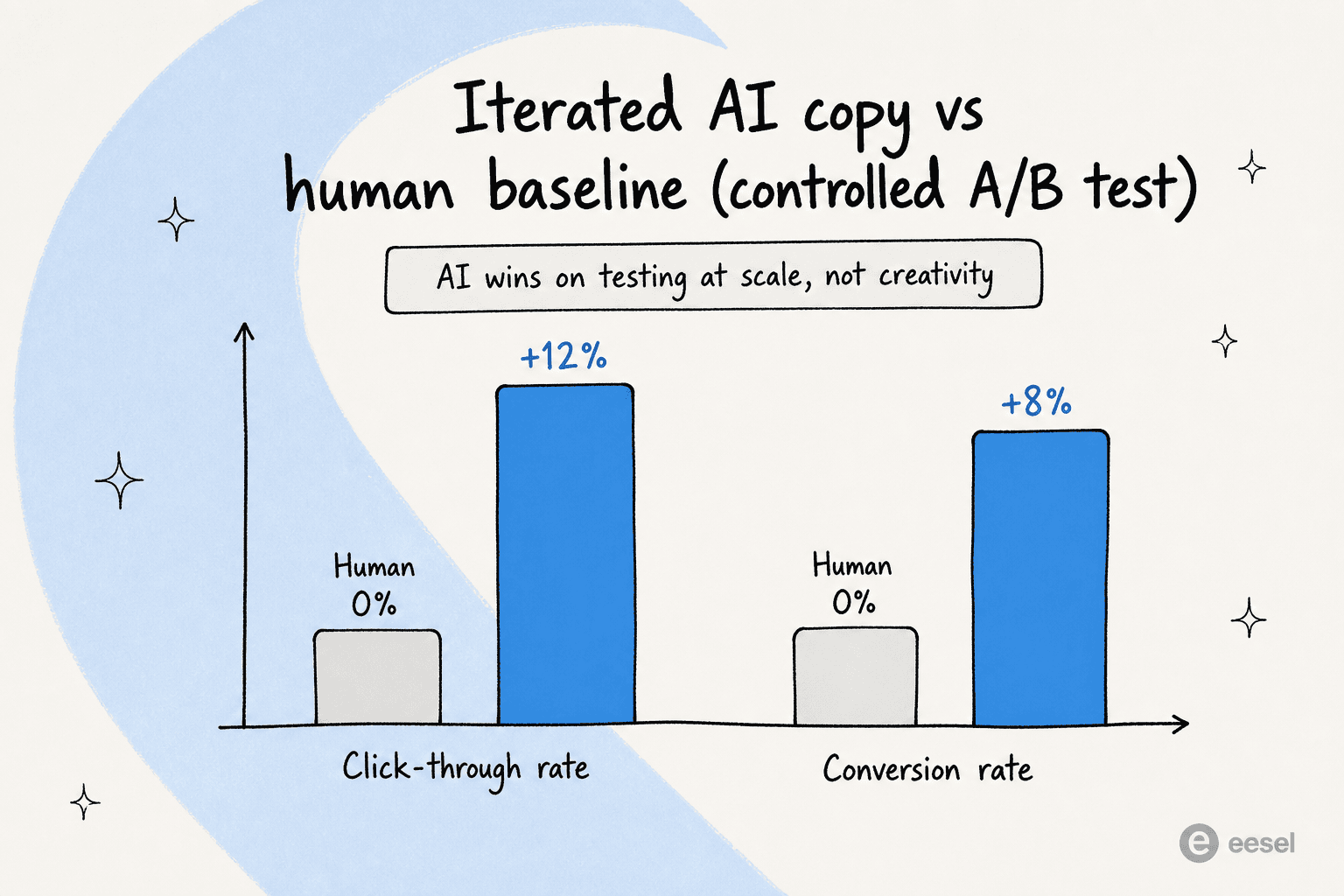
The most quotable number I found comes from marketer Josh Decaire, who ran controlled A/B tests pitting GPT-4-written ecommerce ads against human-written versions. The AI copy drove "+12% higher click-through rate, +8% higher conversion rate." That's a real lift on the metrics that actually matter.
But read his explanation of why, because it reframes the whole question:
"AI doesn't outperform humans because it's smarter or more creative. It outperforms because it enables testing and iteration at scale... The best results came when humans edited tone and clarity, not when the AI output was left unchecked. Consistent improvement came from iteration, not inspiration."
So the answer to "can AI write ad copy" isn't really yes or no. It's "yes, if you treat it as a drafting-and-testing engine instead of a vending machine." Even the skeptics agree on the narrow case. In a long r/copywriting thread titled "AI Copy Sucks?", the working copywriter who started it still conceded: "for headlines and sub headlines and shorter form (couple sentences MAX), AI isn't too bad." Short-form, high-volume, testable: that's the exact shape of ad copy.
Where AI ad copy falls flat
Let's start with the failure mode, because it's the one most people hit first and then conclude "AI can't write ads."
The number one complaint is the generic "AI voice." One copywriter put the tell perfectly in r/copywriting: "I've now reached the point where I can identify AI-created copy at a glance: 'Elevate' this, 'Experience' that, 'Elevate Your Sleep Journey With The...'". If your ad opens with "Elevate your" anything, a chunk of your audience has already mentally filed it as filler.
It goes deeper than vocabulary, though. In a thread on the shortcomings of AI text, one marketer nailed why generic copy doesn't sell:
"AI copy lacks the psychological nuance that drives conversions. It produces technically correct text but misses the subtle emotional triggers and persuasive elements that make copy actually sell. The voice feels generic and corporate, even when you specify a brand personality."
There's a second, quieter risk: sameness. Kathleen Booth of Sequel.io framed it well on LinkedIn: "Every competitor can now generate ad copy, emails, and social posts in seconds. The result: your audience sees the same message from ten [companies]." If everyone prompts the same models the same lazy way, everyone's ads converge on the same bland middle.
And automation alone is no guarantee. Dave Chaffey shared brutal comparative data on Google's AI Max, which auto-rewrites ad copy: after four months, his cost-per-conversion actually went up ($43 to $53 per conversion depending on match type). "AI label" does not mean "better performance."
What actually makes AI ad copy convert
Here's the good news, and it's the core of this whole post. The marketers getting real results all converge on the same insight: the model is commodity, the input is the moat.
The clearest statement of this came from a marketer in r/DigitalMarketing who ran roughly $4M/month in ecommerce ad spend before starting an agency:
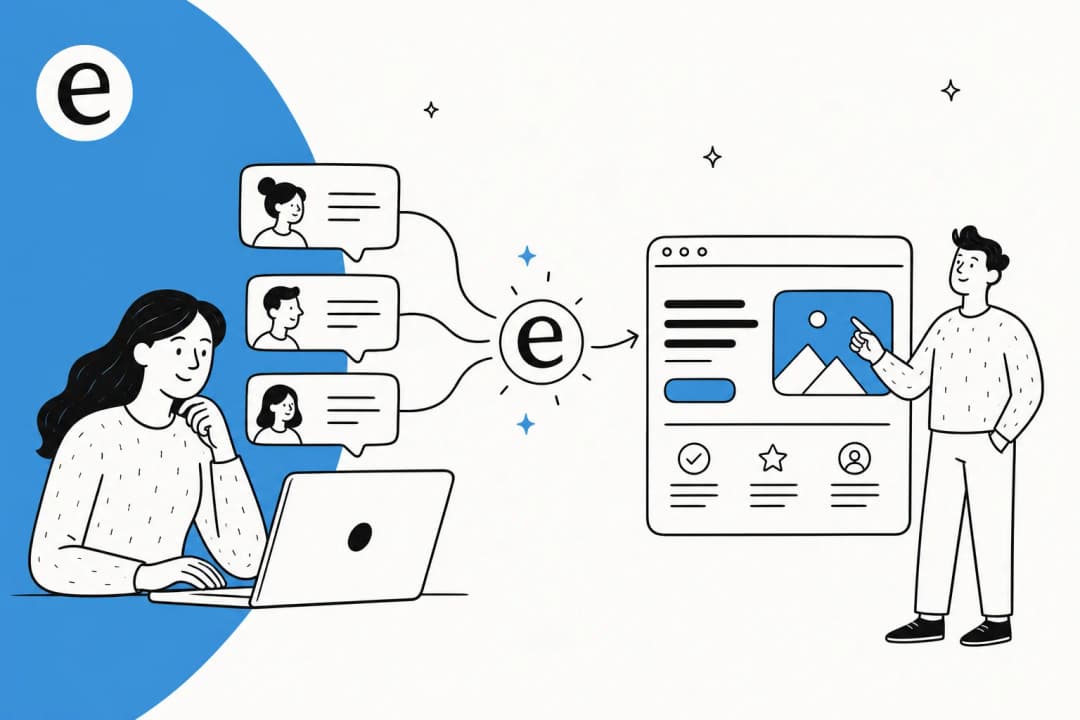
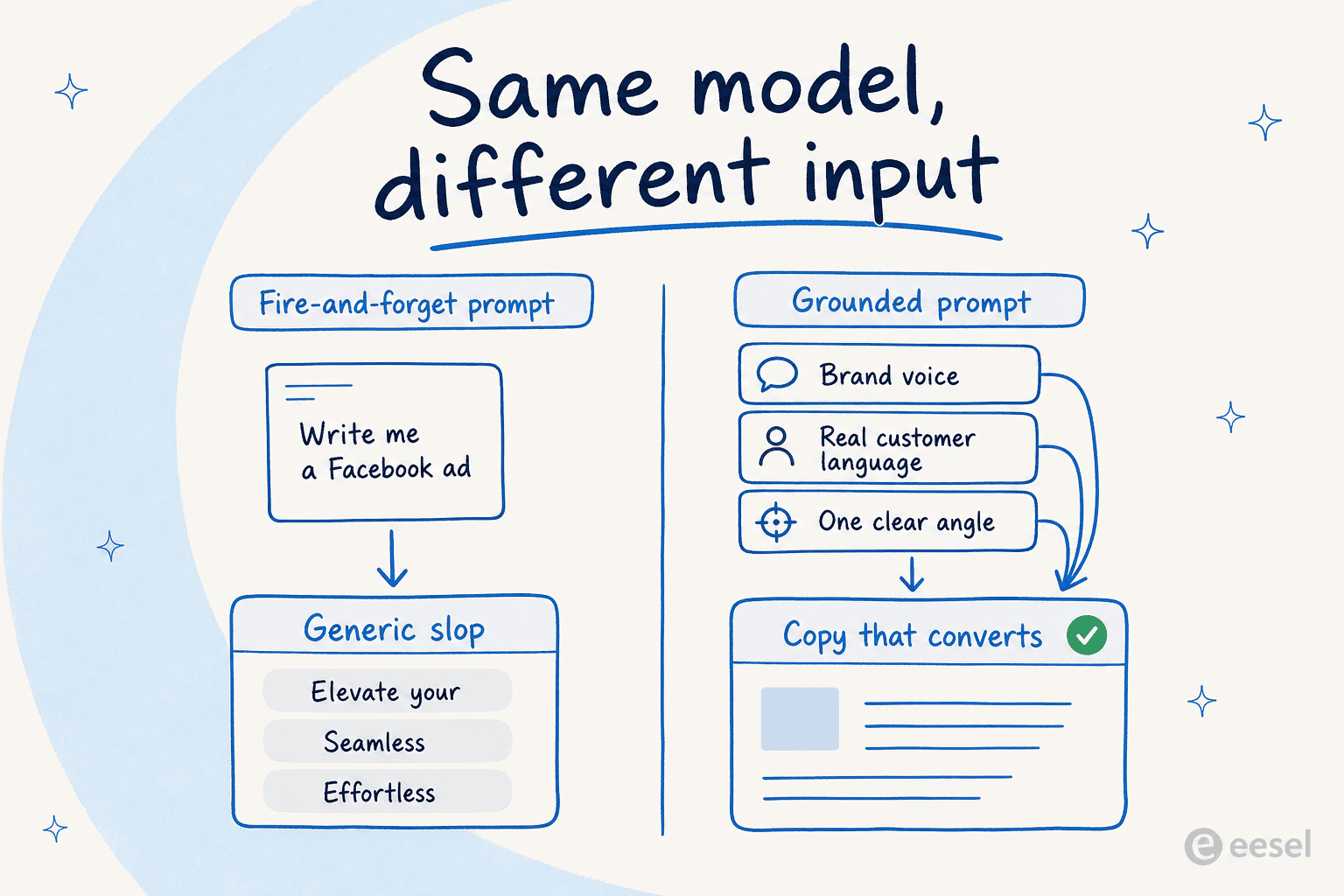
"context matters way more than people think. if you give it weak input, you still get slop. if you give it proper brand context, website inputs, a clear ad angle, and some real customer language, the quality jumps a lot."
Same model, completely different output. The difference is entirely in what you put in front of it.
Three inputs do the heavy lifting:
- Real customer language. The exact words customers use in reviews, support tickets, and sales calls beat anything you'd invent. This is the single most underused input, and it's why grounded copy reads human while invented copy reads corporate.
- One clear angle. "Write an ad" gives the model nothing to commit to. "Write an ad for busy parents who don't have time to cook, leading with the 10-minute promise" gives it a spine.
- A list of bans. The same $4M-spend marketer's advice: "tell the model what not to do... it helps a lot to ban that kind of generic language upfront." Ban "seamless", "effortless", "elevate", and the em-dash-heavy cadence, and half the AI tell disappears.
This is exactly the principle I lean on running eesel's AI writer as our own content engine. The posts that perform aren't the ones from the cleverest prompt; they're the ones where the writer is grounded in real source material first, the same way a good AI content writer should pull from your knowledge rather than guess. If you want to go deeper on stripping the robotic tone, our guide on making AI content sound human covers the editing side.
The real superpower: testing at scale, not creativity
If you take one thing from this post, take this. AI's edge in ad copy is volume, not genius.
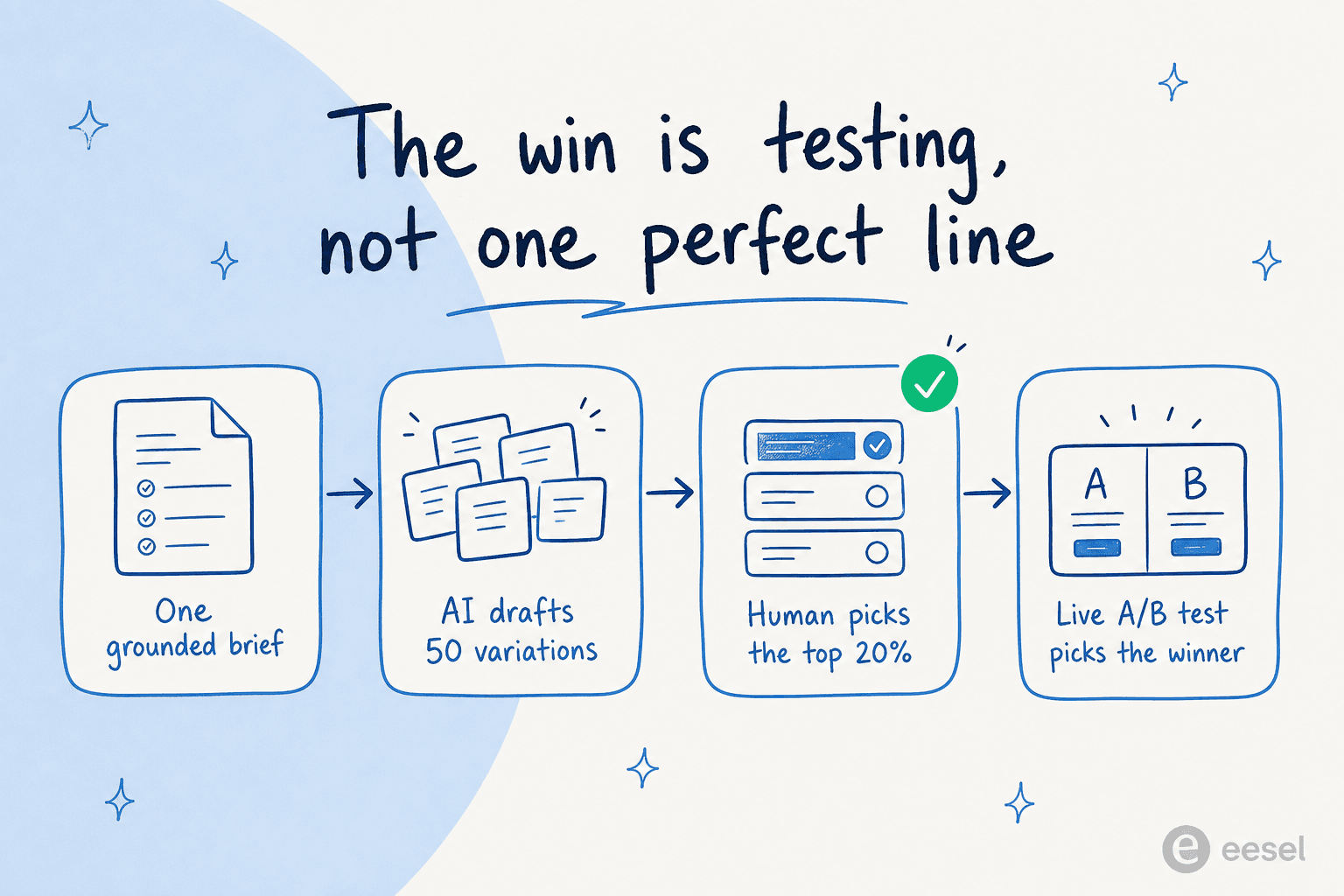
A human copywriter might write one or two strong ad concepts a week. AI can draft 50 in an afternoon. That changes the game, because ad performance is mostly a numbers game: the winner is usually a variation you wouldn't have predicted, and you only find it by testing.
The most convincing real-world workflow I came across was from an r/FacebookAds operator who spent $1.4M on AI-generated ads. He's blunt that the off-the-shelf "AI ad" tools "don't work. They're just optimized to get you to enter the free trial." His actual process is the interesting part:
"We generate around 50 variations per batch. The top 20%... move forward into our testing campaigns. This process is good, but it's not perfect, so you still need the human touch to pick out the best ones."
That workflow, sometimes outperforms his human-made creatives. Note the shape: AI for breadth, human for judgment, the market for the final verdict.
This is also why the per-draft cost matters. If generating variations is expensive or slow, you ration them and lose the whole advantage. It's part of why we moved eesel to usage-based pricing with no per-seat fees: the math for "test 50 angles instead of 1" only works when drafting is cheap.
What today's AI ad copy tools actually do
"AI" in this context isn't one thing. Here's what the main categories of tools genuinely offer, grounded in their own product pages, so you can match a tool to your situation.
| Tool | Best for | Standout capability | The honest limit |
|---|---|---|---|
| Frontier models (Claude, ChatGPT) | Raw copy + idea generation | Flexible, follows rich briefs; one operator rates Claude highest for ad copy | No built-in scoring; "finicky" without good prompting |
| Jasper | Campaign-grade workflows | Structured pipeline: campaign context, platform copy, headline variants | Concedes output "still requires human input" |
| Anyword | Pre-launch confidence | Predictive Performance Score (0 to 100) vs a database, before you go live | Vendor-stated "30% increase" is a claim, not a guarantee |
| AdCreative.ai | Paid social at volume | Trained on high-converting ads; AIDA/PAS frameworks; Conversion Score | Claims "up to 14x" conversions; treat as marketing |
| Copy.ai | Short-form variations | Template library for ad variations and sales emails | Short-form focus; thin on full campaigns |
A couple of patterns are worth naming. First, the high G2 ratings (Jasper and Anyword both sit at 4.7 out of 5) reward speed and first-draft velocity, not untouched conversion. Second, notice that both Anyword and AdCreative monetize a predictive performance score. That exists precisely because raw output quality is variable and needs a filter before you spend money on it. The scoring tools are an admission that the copy itself isn't reliable on its own.
If you're shopping the wider category, our breakdowns of AI copywriting tools and the free options go tool by tool.
A workflow for AI ad copy that doesn't read like AI
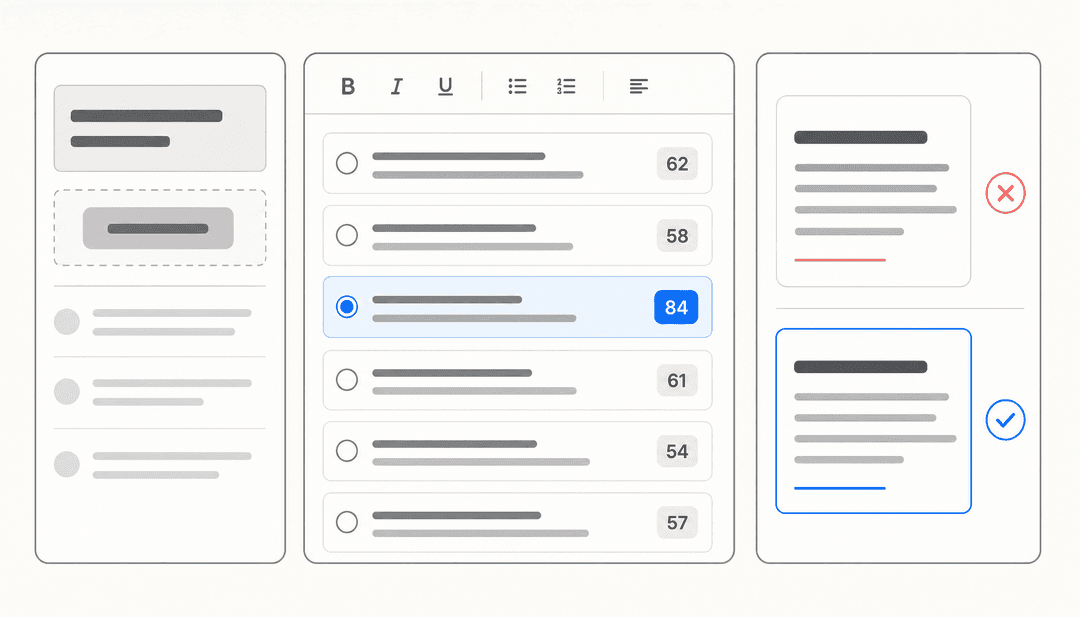
Pulling the research together, here's the process the people getting real lift actually follow. Use the checklist below to see how grounded your own setup is.
In plain steps, here's what that looks like in practice:
- Brief the model like a new hire. Paste your brand voice examples, the product page, and a clear angle. Spend more time here than on anything else.
- Hand it real customer language. Pull the exact phrasing from reviews and support conversations. This is what makes copy sound like a person.
- Ban the tells. List the clichés you never want to see. It's a one-line instruction that saves a dozen edits.
- Ask for volume. Generate 20 to 50 variations, not one. The whole point is breadth.
- Cut to the best 20%, by hand. This is the irreplaceable human step. You're the taste filter.
- Test, then let data decide. Put the survivors live and let click-through and conversion crown the winner.
That loop is also how you'd write any high-stakes asset, from a landing page to a sales email to a full blog. The medium changes; the grounding and the test loop don't.
Try eesel for grounded AI content
eesel is built on the exact principle this whole post lands on: AI content works when it's grounded in your real knowledge, not a blank prompt. Our AI writer trains on your own site, docs, and past content first, so what it produces sounds like you instead of like every other AI tool reaching for "elevate your workflow."
It's not a one-off ad-copy box; it's a content engine teams use to scale grounded, on-brand writing (one customer runs it to 360+ SEO posts a month). Pricing is usage-based with no per-seat fees, and there's a free trial, so testing whether grounded AI beats your current generic output costs you nothing but an afternoon. If ad copy is your starting point, the same approach that fixes generic AI blog posts is what fixes generic ads.
Frequently Asked Questions
Can AI write ad copy that actually converts?
Why does AI ad copy sound so generic?
What is the best AI for writing ad copy?
Do I still need a human if I use AI for ad copy?
Is AI ad copy worth it for a small marketing team?


Article by
Kurnia Kharisma Agung Samiadjie
Kurnia is a software engineer and writer at eesel AI with two years of SEO experience, writing about AI tools, helpdesk software, and customer support. He pairs a developer's understanding of how these products are built with search-driven research into what actually ranks and resonates with the people searching for them.