Service desk
A service desk is the single point of contact between an organization and its users for logging, tracking, and resolving requests and incidents.
What a service desk means
A service desk is the single point of contact between an organization and the people it serves, where requests, questions, and incidents are logged, tracked, and resolved through a managed process. It centralizes intake so that nothing arrives by random email or hallway conversation, and gives every request a record, an owner, and a status from open to closed. The concept comes from IT service management (the ITIL framework), where the service desk is the front door to all IT support.
In customer support, the same idea applies to external users: a service desk is the structured layer where customer tickets are captured, prioritized, assigned, and worked through to resolution, rather than handled ad hoc. It is the operational hub that turns a flood of incoming requests into trackable, accountable work.
What makes a service desk different
A service desk is more than an inbox or a chat window, because it adds process and accountability on top of communication:
- Single point of contact. Every request enters through one channel of record, so nothing slips through and every interaction has a history.
- Request and incident tracking. Each item becomes a ticket with a status, an owner, and a timeline, which makes workload and bottlenecks visible.
- SLA enforcement. Response and resolution targets are attached to tickets so the team can be held to a measurable SLA rather than vague promises.
- Routing and prioritization. Requests are sorted by urgency and type and sent to the right person or queue, often through ticket routing.
- Knowledge and self-service. A service desk usually sits on top of a knowledge base so common questions can be deflected before they ever become a ticket.
The result is a system you can report on and improve, not just a place where messages land.
Set next to a help desk, the difference in scope is what stands out.
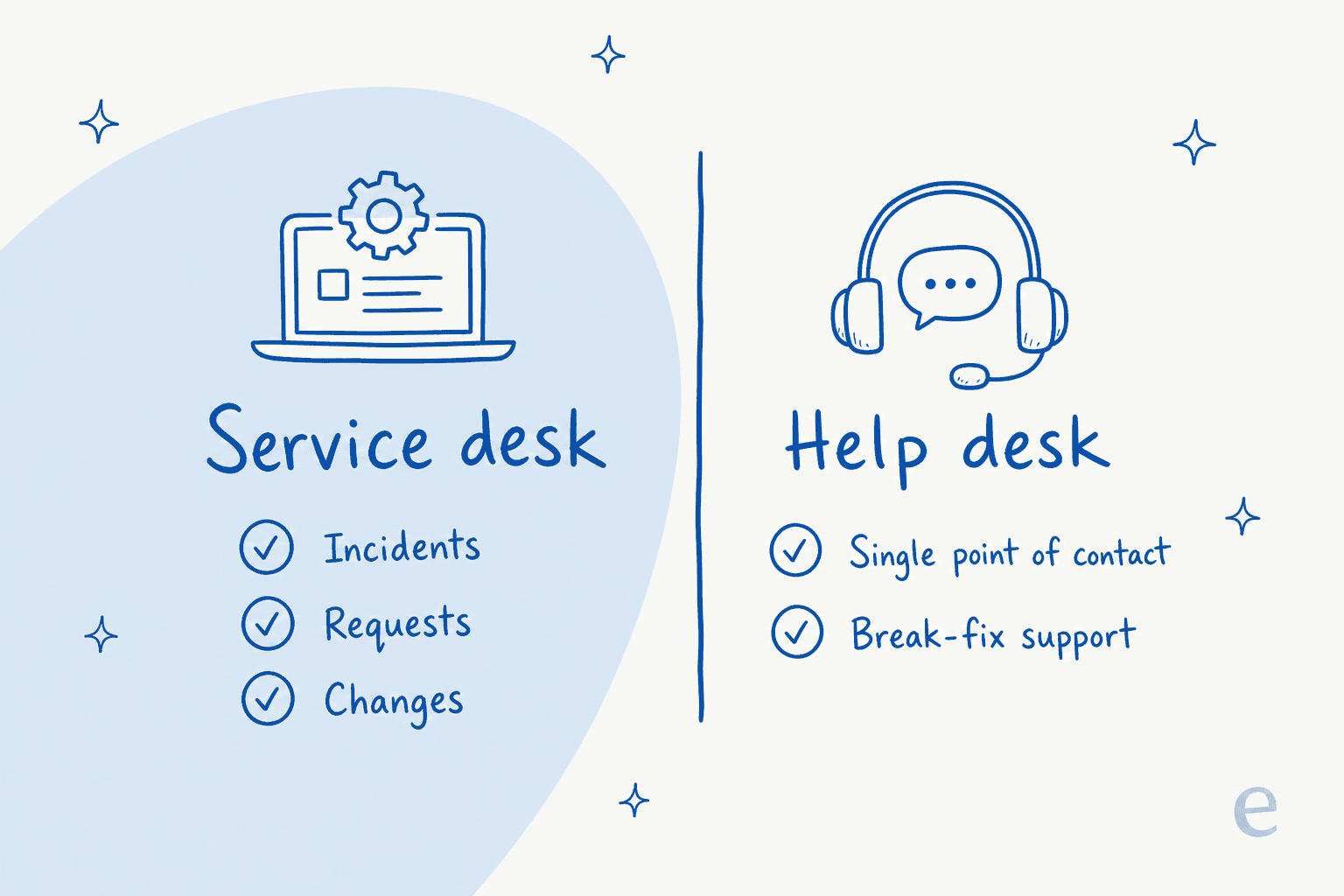
A service desk carries the wider ITSM remit: incidents, service requests, and changes all run through it. A help desk is the narrower idea, a single point of contact aimed at break-fix support, which is why the two terms overlap but are not interchangeable.
How a service desk works
A typical service desk follows a predictable flow:
- Intake. A user submits a request through a portal, email, chat, or phone, and it becomes a ticket.
- Categorize and prioritize. The ticket is tagged by type and urgency so it can be handled in the right order.
- Route and assign. It goes to the agent, team, or queue best suited to resolve it.
- Resolve. An agent (or an automated system) works the ticket, drawing on knowledge sources and connected tools.
- Close and learn. The ticket is resolved, the user is notified, and patterns feed back into knowledge and process improvements.
An AI layer like eesel AI plugs into this flow at the resolve step: it grounds answers in your help center and past tickets, resolves the repetitive requests on its own, and escalates with full context when a request needs a person.
A service desk in practice
The hardest part of running a service desk is not the software, it is keeping the knowledge behind it current and the routing rules honest. A service desk with a stale knowledge base quietly pushes work back onto agents, and over-eager automation that resolves the wrong tickets erodes trust fast. Teams that get it right treat the service desk as a living system: they watch where tickets pile up, prove out any automation against real ticket history first, and widen what they automate only once the basics are reliable.
For a hands-on walkthrough, read our guide to the AI powered service desk.
Put an AI agent on your service desk
eesel AI reads each ticket, finds the answer in your own knowledge, resolves what it can, and routes the rest with full context.