Canonical URL
A canonical URL is the version of a page that a site declares as the master copy when the same or similar content is reachable at more than one address.
What a canonical URL means
A canonical URL is the single address a website designates as the authoritative, master version of a page when the same or near-identical content can be reached at multiple URLs. It is declared with a rel="canonical" link element in the page's HTML head (or an HTTP header), and it tells search engines which version to index and credit when several look the same.
Duplicate addresses are everywhere on real sites: example.com/shoes, example.com/shoes?color=red, example.com/shoes/, and an https versus http variant can all serve the same content. Left alone, search engines have to guess which one to rank, and the ranking signals (links, clicks, freshness) get split across the copies. A canonical URL collapses that ambiguity by naming the one version that should accumulate all the value. In content marketing, this matters most when the same post is syndicated, tagged into multiple category paths, or reachable through campaign parameters: the canonical keeps the original page as the one that ranks.
Why a canonical URL matters
- It consolidates ranking signals. Links, engagement, and authority that would otherwise scatter across duplicate addresses are credited to one URL, so the page ranks on its full strength.
- It prevents duplicate-content dilution. Search engines do not penalize most duplication, but they do pick one version to show. A canonical lets you make that choice instead of leaving it to chance.
- It controls syndication. When a post is republished on a partner site, a canonical pointing back to the original keeps the source page as the one that earns the rankings.
- It tidies parameter sprawl. Filter, sort, and tracking parameters generate endless URL variants. Canonicalizing them to a clean base keeps the crawl budget focused on pages that matter.
- It pairs with clean internal links. Consistent canonical targets and consistent internal linking reinforce each other, so the site sends one coherent signal about which URL is primary.
Picturing it side by side helps the idea stick:
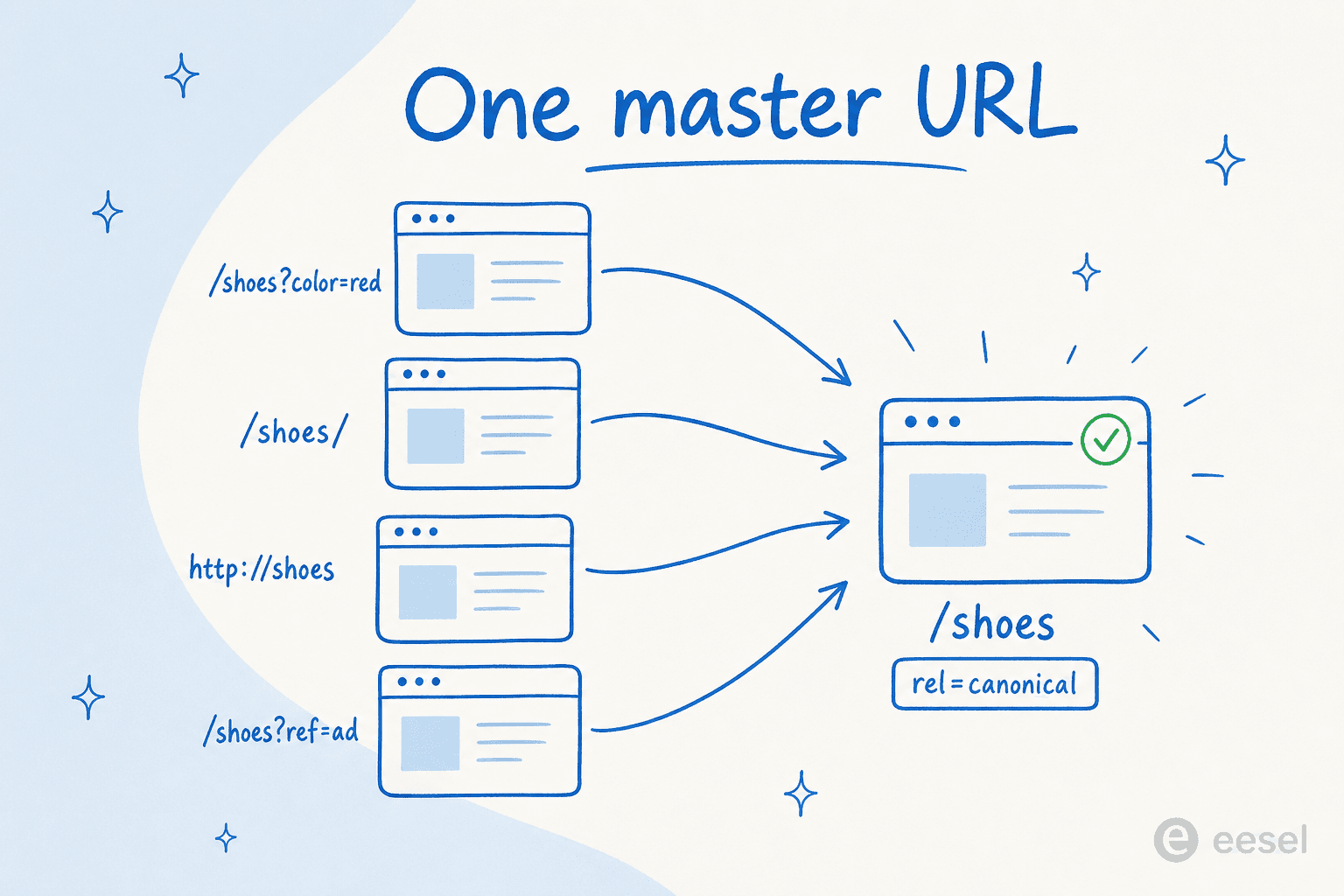
Every parameter, slash, and protocol variant of the same content funnels into the one address you declared as the master. The duplicates stay reachable for users, but search engines credit only the canonical version.
How a canonical URL works
- Identify the master version. Pick the cleanest, most complete URL for a piece of content, usually the one without parameters or duplication.
- Add the canonical tag. Each variant page includes a
rel="canonical"element pointing at the master URL. The master page points at itself. - Search engines read the hint. During crawling, the engine notes the declared canonical and treats it as a strong signal for which URL to index.
- Signals consolidate. Over subsequent crawls, the engine credits the canonical version and typically drops the duplicates from results.
For content-led sites, the connection is practical rather than central: well-written posts still need clean URL handling to rank. A draft from eesel's AI blog writer produces a single canonical post, but the site around it still has to canonicalize the tag pages, paginated archives, and parameter variants that wrap it.
Canonical URLs in practice
The most common failure is a canonical that quietly points at the wrong page: a template that hardcodes the homepage as the canonical for every URL, or a staging-domain canonical that ships to production. Both can de-index large sections of a site while traffic erodes for weeks. Because the tag is a hint and not a command, the safest approach is consistency: make the canonical, the internal links, and the sitemap all agree on the same primary URL, then watch the indexing report to confirm search engines actually honored the choice.
Pages worth pointing a canonical at
eesel's AI blog writer drafts clean, single-source posts, so the pages you canonicalize are content a search engine wants to index.