Crawl budget
Crawl budget is the number of pages a search engine will crawl on a given site within a certain timeframe.
What crawl budget means
Crawl budget is the number of URLs a search engine is willing and able to crawl on a particular site within a given timeframe. It is shaped by two forces: the crawl rate limit, which is how fast a search engine can fetch pages without straining the server, and crawl demand, which is how much the engine actually wants to crawl based on a site's popularity, size, and how often its content changes.
For most websites this is a non-issue, because search engines crawl small and medium sites in full without ever running short. It becomes a real constraint on large sites: e-commerce catalogs with millions of variant URLs, news archives, or content libraries where new pages appear faster than crawlers can keep up. On those sites, crawl budget is finite, and every fetch a crawler spends on a duplicate, a redirect chain, or a dead end is a fetch it did not spend on a page that matters. In content marketing, the concept surfaces once a blog grows past a few thousand posts and tag pages, parameter variants, and paginated archives start competing with real articles for the crawler's attention.
Why crawl budget matters
- It gates indexing on large sites. A page that is never crawled cannot be indexed, so on big sites the cap on crawling becomes a cap on what can rank.
- Wasted crawls have a cost. Redirect chains, soft 404s, infinite parameter spaces, and duplicate URLs all consume budget that should go to canonical, valuable pages.
- Freshness suffers when budget is thin. If a crawler is busy chasing low-value URLs, it recrawls updated pages less often, so a content refresh takes longer to register.
- Server health feeds back into it. Slow responses and errors lower the crawl rate limit, shrinking the budget; a fast, stable site earns a higher one.
- Site structure changes the math. Flat architecture, clean internal links, and a focused XML sitemap steer the available budget toward the pages worth indexing.
The whole idea comes down to where a crawler's limited visits actually land:
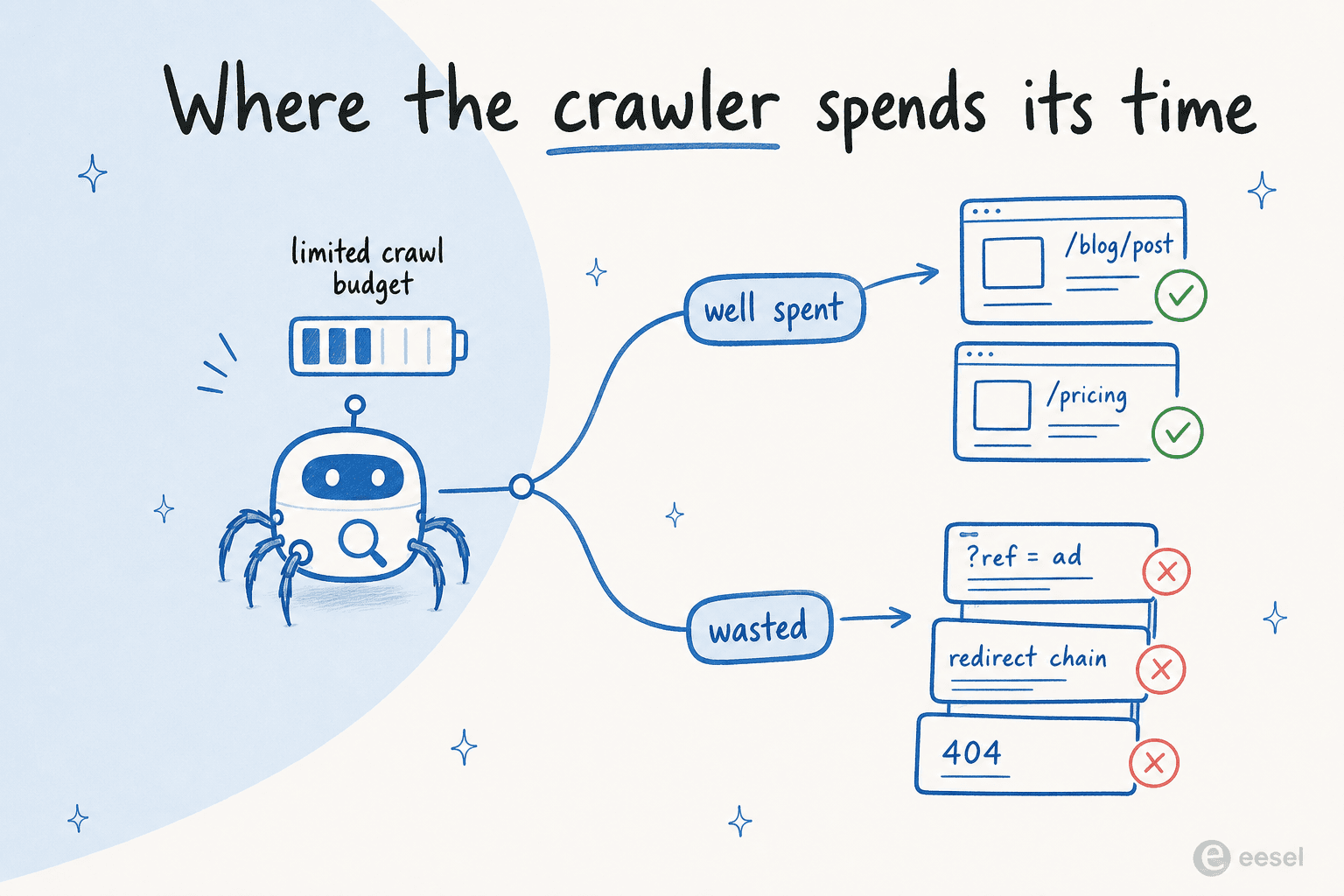
A crawler only has so many fetches to spend on your site. Every one it burns on a parameter variant, a redirect chain, or a 404 is one it never spends on the pages you actually want indexed.
How crawl budget works
- The crawler sets a rate. Based on server response times and error rates, the search engine decides how aggressively it can fetch pages without causing problems.
- It estimates demand. Popular, frequently updated, and well-linked sites generate more crawl demand than stale or low-traffic ones.
- It allocates fetches. Within that rate and demand, the crawler works through the URLs it knows about, prioritizing by importance signals.
- It revisits and adjusts. As pages change and the site grows, the crawler re-evaluates how much to crawl and how often, raising or lowering the effective budget.
The connection to content work is indirect but real: crawl budget rewards sites that publish pages worth crawling and punishes those that bury good content under URL clutter. A long, substantive post from eesel's AI blog writer is the kind of page a crawler is glad to spend budget on; the surrounding job is to make sure the site is not spending that budget on thin or duplicate URLs instead.
Crawl budget in practice
The teams that manage crawl budget treat it as a hygiene problem, not a growth lever. They watch the crawl-stats report for spikes in crawling of useless URLs, prune or canonicalize parameter sprawl, fix redirect chains, and keep error rates low so the rate limit stays high. The goal is never to maximize crawling for its own sake; it is to make sure that when a search engine does crawl, it spends its limited visits on the pages that should be discovered, indexed, and ranked.
Spend crawl budget on content that earns it
eesel's AI blog writer produces substantial posts worth crawling, so the pages competing for crawl budget are ones a search engine wants to index.