


"OpenAI Agents API alternatives" is really two searches wearing one coat. Either you want to keep the same shape of agent but run it on a different model, or you want to stop being tied to one model at all. Once you see that split, the shortlist sorts itself.
If you want a different provider's models, the real rivals are the Claude Agent SDK, Google's ADK and Gemini Enterprise Agent Platform, the Microsoft Agent Framework with Foundry, Amazon Bedrock AgentCore, and Mistral. If you want to keep model choice, the model-agnostic frameworks are LangChain / LangGraph, CrewAI, and LlamaIndex.
One thing to keep in front of you the whole way down: every option here is still infrastructure. You are choosing which loop, eval harness, and monitoring stack you want to build and own. If the agent is a means to an end, like customer service handled well, the honest alternative is to not build one, which is the trade eesel makes, on a fixed monthly price from $299 for 500 credits.
Why people leave the OpenAI Agents API
Let me be fair first, because most people looking to switch actually like the thing they are leaving. The OpenAI Agents API is a good place to build an agent. The Responses API is a clean primitive, the Agents SDK handles the loop and handoffs well, the hosted tools save real work, and GPT models are strong. If GPT is where you want to live, you should probably stay.
The reasons to look elsewhere are usually specific, not sweeping:
- Model lock. The whole stack assumes OpenAI models. The second your evals say Claude or Gemini wins on your task, you want a way to switch the model without rewriting the agent.
- Where your data has to live. If your buyer needs EU-only data residency or a self-hosted deployment, a US hosted API is a hard constraint, not a preference.
- The stack you already run. A team deep in Azure, AWS, or GCP wants the agent to sit inside the same identity, billing, and governance it already has.
- The wind-down signal. OpenAI is retiring its no-code Agent Builder and Evals on November 30, 2026, which nudges no-code teams toward Workspace Agents in ChatGPT or something else entirely.
I build on these APIs for a living, shipping eesel's integrations, so I will say the quiet part: none of these tools is magic. An agent is a model you have handed a job, a set of tools, and permission to keep calling itself until the job is done. Every option below is just a different answer to who runs that loop, on which model, and where.

The two camps, at a glance
Before the individual reviews, here is the map I keep in my head. The alternatives fall into two piles, and which pile you want tells you most of what you need to know.

Swap the model provider keeps you on a hosted, batteries-included stack, you just change whose models and cloud you are on. Swap the orchestration layer trades some convenience for the freedom to point the same agent code at any model. Neither is better in the abstract. A team that has already picked Claude wants the first; a team that wants to A/B models forever wants the second.
Here is how the eight compare on the dimensions a buyer actually weighs.
| Tool | Camp | Model choice | Open source | Languages | Managed runtime | Starting price | | --- | --- | --- | --- | --- | --- | | LangChain / LangGraph | Orchestration | Any provider | Yes (MIT) | Python, JS/TS | LangGraph Platform | Free framework; LangSmith Plus $39/seat | | Claude Agent SDK | Model provider | Claude only | Yes (SDK) | Python, TS | Managed Agents (separate) | Model tokens; Sonnet 5 $2/$10 per 1M | | Google ADK | Model provider | Gemini + 200+ catalog | Yes (ADK) | Python, TS, Go, Java, Kotlin | Agent Runtime | Model tokens; Gemini Flash ~$0.75/$3.75 | | Microsoft Agent Framework | Model provider | 11,000+ catalog | Yes (SDK) | .NET, Python, Go | Foundry Agent Service | Consumption; ACU packs from $19,000 | | Bedrock AgentCore | Model provider | Any model, any framework | No (managed) | Any | AgentCore Runtime | Harness free; $0.0895/vCPU-hour | | CrewAI | Orchestration | Any provider | Yes (MIT) | Python | Control Plane | Free (50 runs/mo); Enterprise custom | | LlamaIndex | Orchestration | Any provider | Yes | Python, TS | LlamaCloud | Free 10k credits/mo; then $1.25/1k credits | | Mistral Agents API | Model provider | Mistral (open-weight) | Weights (Apache 2.0) | Any (API) | Mistral Studio | Model tokens; Small 4 $0.15/$0.60 |
Now the individual takes. Every item follows the same shape: what it is, what stands out, pricing, and a plain verdict on who should pick it.
1. LangChain / LangGraph
Best for: teams that want to keep model choice and are willing to run their own stack.
LangChain is the default answer when someone leaves a single-provider API, and it earns that spot by being aggressively neutral. Its pitch is to swap models, tools, and databases without rewriting your app, backed by 1000+ integrations. The same agent code can run on GPT today and Claude tomorrow, which is exactly the lock the OpenAI Agents API can't unlock. It is one of the most-cited names in any roundup of the best AI agents.
It helps to separate the pieces, because the marketing blurs them. LangChain is the high-level framework, and its headline primitive create_agent gives you a proven ReAct pattern in a few lines. LangGraph is the lower-level orchestration runtime underneath, where you drop down for multi-agent and hierarchical control flows with built-in persistence, checkpointing, and human-in-the-loop. Both are MIT-licensed and free. LangSmith is the commercial layer, tracing, evals, and deployment, and it is where all the money lives.
Pricing. The frameworks are free; you pay when you adopt LangSmith. Developer is $0 per seat with 5,000 traces a month, Plus is $39 per seat with 10,000 traces and one free small deployment, and Enterprise is custom. Under the hood it meters in two units: a LangChain Compute Unit at $1.50 and a Storage Unit at $1.00, with extra traces at 0.005 LSU each.
Our take: if model freedom is the reason you're leaving OpenAI, start here. Just go in clear-eyed that "free framework" and "free to run in production at scale" are not the same sentence, the day-2 platform is a real, metered SaaS bill. It's worth reading the LangGraph vs AgentKit comparison if you're weighing it directly against OpenAI's no-code route.
2. Claude Agent SDK
Best for: teams standardizing on Claude, especially for coding and agentic operations.
The Claude Agent SDK is the rebrand of the Claude Code SDK, and that lineage is the whole story. It gives you the same agent loop and context management that power Claude Code, as a library that runs the loop in your own process. Unlike most agent frameworks, this one is the productized version of a real, shipped coding agent, not a fresh abstraction, so it arrives with file and bash tools, subagents, hooks, permissions, sessions, and first-class MCP already wired in.
It is Python and TypeScript only; to drive the same loop from another language you run the CLI as a subprocess. If you want a fully hosted version instead of running the loop yourself, Anthropic points you at its separate Managed Agents product.
Pricing. You pay standard Claude API token rates. Claude Opus 5 is $5 in / $25 out per million tokens, Claude Sonnet 5 is $2 / $10 (notably cheaper than the older Sonnet 4.6 at $3 / $15), and Claude Haiku 4.5 is $1 / $5. Because an agent re-sends its system prompt and history on every turn, prompt caching matters here, a cache hit costs 10% of the standard input price.
Our take: the strongest pick if you have already decided Claude wins your evals, and the natural home for agentic coding work. Two honest limits: you are model-locked to Claude, and third-party products must use API-key authentication, there is no claude.ai login to hand your users. For a direct cost read against OpenAI, our OpenAI API vs Anthropic API piece runs the numbers.
3. Google's ADK and Gemini Enterprise Agent Platform
Best for: teams already living inside Google Cloud.
Google recently renamed Vertex AI Agent Builder to the Gemini Enterprise Agent Platform, so keep the old name in mind for searching, but the current product is different. The open-source piece is the Agent Development Kit (ADK), and it is broader than people expect, available in Python, TypeScript, Go, Java, and Kotlin. A minimal ADK agent is a handful of lines: an Agent with a model, an instruction, and a list of tools like google_search. ADK 2.0 adds graph-based workflows for mixing deterministic code with model reasoning.

Around ADK sits the managed platform: a low-code Agent Studio, a REST-first Managed Agents API, and one managed Agent Runtime that hosts agents built with ADK or other frameworks, with Sessions and a Memory Bank for state. You are not stuck on Gemini either, the Model Garden carries 200+ models including Claude and Gemma. Google also leans on two open protocols, MCP for tools and A2A for agent-to-agent comms.
Pricing. You pay Gemini tokens plus separate runtime compute. From the pricing page: Gemini 3.1 Pro is $2 / $12 per million tokens, and the current Flash models run at introductory $0.75 / $3.75 through December 31, 2026, rising to $1.50 / $7.50 in 2027. Grounding with Google Search includes 5,000 free queries a month, then $14 per 1,000.
Our take: the obvious choice if your data, identity, and billing already live in GCP, and the multi-language ADK is a real advantage for Java and Go shops that Python-first frameworks leave out. The catch is the usual cloud gravity, the managed runtime's compute is priced separately from tokens, so budget both.
4. Microsoft Agent Framework and Foundry
Best for: Microsoft and .NET enterprises that want the widest model catalog.
Microsoft's answer is two products that click together. The Microsoft Agent Framework is an open-source SDK in .NET, Python, and Go, and it is the merge of AutoGen's multi-agent orchestration with Semantic Kernel's enterprise features into one supported library. It is new, the .NET package still installs with a --prerelease flag, so treat it as stabilizing rather than settled. The Foundry Agent Service is the managed runtime you deploy onto, with prompt agents for the fast path and hosted agents for full control.
The headline is model breadth. Foundry advertises access to more than 11,000 models spanning OpenAI, Anthropic, Meta, Google, and xAI, plus a model router that picks per task. It also earns a mention in a way its rivals don't: Foundry will host agents built with the OpenAI Agents SDK and the Anthropic Agent SDK, so it is a runtime under those SDKs, not only a competitor to them. The .NET support is the real differentiator for the large Microsoft developer base that Python-first tools skip.
Pricing. Consumption-based, with no flat per-agent number published, you pay the underlying model's tokens plus tool and container compute. The one concrete figure is the Agent Commit Unit pre-purchase: 20,000 units for $19,000 (5% off), 100,000 for $90,000 (10%), or 500,000 for $425,000 (15%), where 100 units roughly equal $100 of retail usage.
Our take: the right call if you are an Azure and .NET shop, the per-agent Entra identity, VNet isolation, and Purview governance are things a framework can't give you. Just know it is the newest option on this list, and the exact per-token rates sit behind more clicks than they should.
5. Amazon Bedrock AgentCore
Best for: AWS teams that have already built an agent and now need to run it in production.
Bedrock AgentCore reframes the problem. Its pitch is that building an agent is fast, and the slow part is connecting it to your systems, securing tool calls, and scaling without a rebuild. So it is deliberately framework- and model-agnostic: it runs LangGraph, CrewAI, Strands, Google ADK, and even the OpenAI Agents SDK, on Claude, Nova, Llama, Mistral, Gemini, or OpenAI models. You bring the agent; AWS brings the plumbing.

That plumbing is a set of à la carte services: a serverless Runtime with true session isolation, short and long-term Memory, a Gateway that turns APIs and Lambdas into MCP tools, Identity that plugs into Cognito or Okta or Entra, a headless Browser tool, a Code Interpreter, and Observability into CloudWatch. Worth noting: the older Bedrock Agents is now "Classic" and closed to new customers, with AWS pointing everyone to AgentCore instead.
Pricing. The harness is free; you pay for the resources under it. Runtime is $0.0895 per vCPU-hour and $0.00945 per GB-hour, billed per second, and AWS makes a point that idle I/O wait time is free, which matters because agent workloads spend most of their time waiting on model and tool calls. Web search is $7 per 1,000 queries, short-term memory is $0.25 per 1,000 events, and new customers get $200 in free credits.
Our take: the best fit when you are already on AWS and the agent needs enterprise infrastructure around it, the IAM-grade Identity and Cedar policy guardrails are things most frameworks make you assemble yourself. The tradeoff is complexity: it is a dozen separately-billed services, and several sub-services are still in preview, so read the rate card closely.
6. CrewAI
Best for: quickly standing up a multi-agent workflow, especially for a demo or prototype.
CrewAI comes at agents from the multi-agent angle. You define a Crew of role-playing agents that collaborate and delegate, plus deterministic Flows for the steps you want under explicit control, which maps neatly onto a real customer service workflow. It is an open-source Python framework, model-agnostic, and built independently of LangChain. The traction is real: about 58,000 GitHub stars and a claim that it is used by 65% of the Fortune 500, on top of an $18M round. The commercial platform adds a visual Studio and a Control Plane that sits in the execution path for tracing and governance.
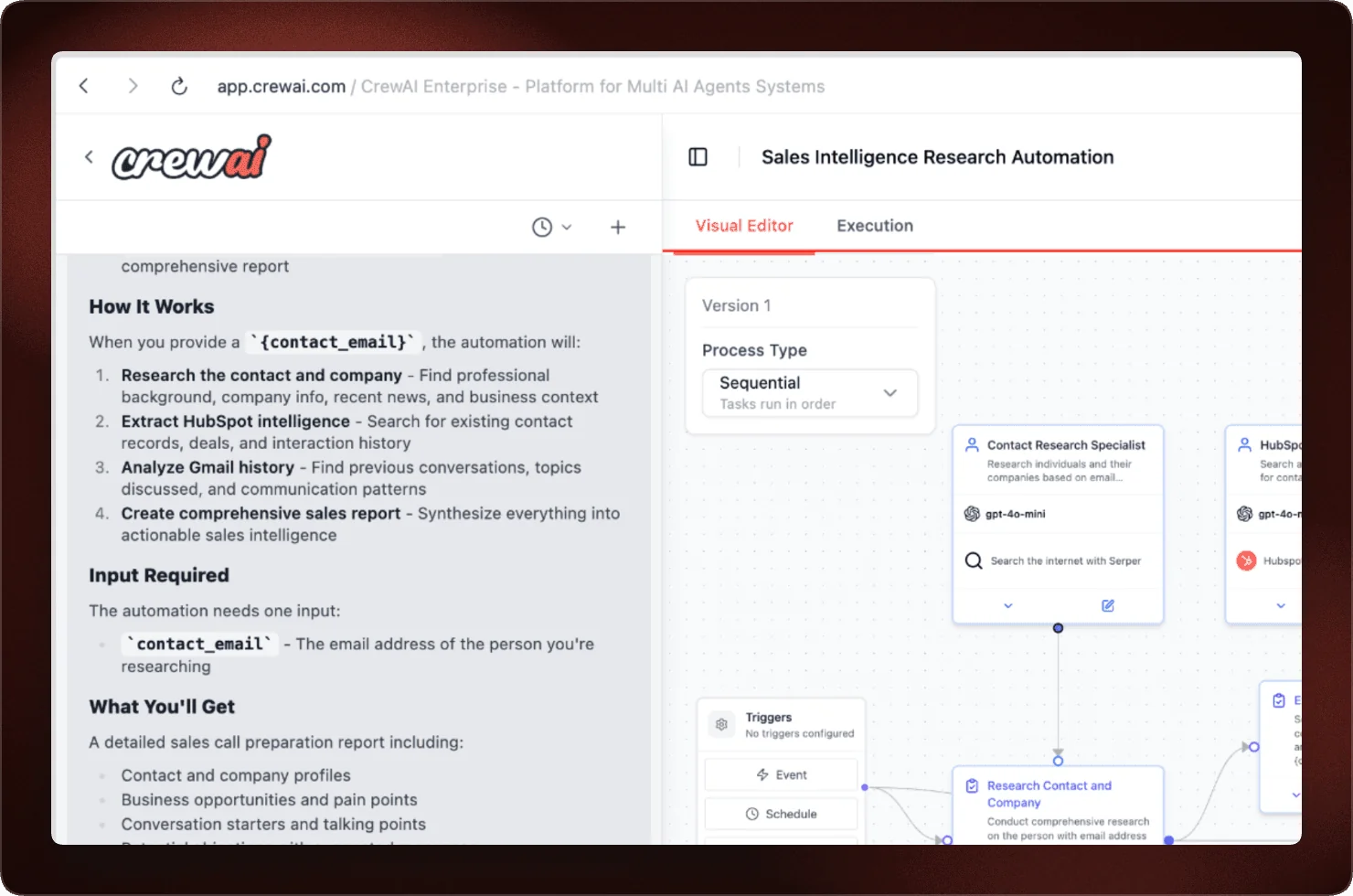
The community is candid about where it bites once you go past a demo, which is exactly the signal you want before adopting:
"I started with langgraph and always felt its too manual (in the age of AI)... while CrewAI felt like a fast way to get something up and running especially for a demo."

"With CrewAI, it honestly feels like an immature framework right now: No proper out-of-the-box observability (at least in the free version)... Debugging is painful because engineers don't know what's being sent to the LLM."
Pricing. Only two published tiers. Basic is free with 50 workflow executions a month, which is also the hard cap, and 2 automations. Enterprise is quote-only and adds SSO, RBAC, PII redaction, VPC deployment, and flexible overage. There is no self-serve middle tier.
Our take: the fastest way to get a multi-agent flow running, and great for prototyping. But take the production caveats seriously, the free tier's thin observability and the 50-run cap mean the real cost of running it at scale is the quote-only Enterprise plan, so price that in before you commit.
7. LlamaIndex
Best for: agents that live or die on retrieving from your own messy documents.
LlamaIndex is the pick when the hard part of your agent isn't the loop, it's getting good context into it. It is an open-source, model-agnostic data framework, strongest at RAG, and its gravity is ingestion and retrieval: parsing complex documents, indexing them, and exposing query engines that an agent calls as tools. On the agent side you get FunctionAgent, AgentWorkflow for multi-agent orchestration, and a Workflows engine with branching, parallelism, and human-in-the-loop.
The commercial layer is LlamaCloud and LlamaParse, its managed document parsing and indexing, which is where the real differentiation sits for anyone dealing with scanned PDFs, tables, and multi-modal files. It ships in Python and TypeScript, and the repo carries about 52,000 GitHub stars.
Pricing. Credit-based, where 1,000 credits equal $1.25. Free gives you 10,000 credits a month (roughly 1,000 pages), Starter adds pay-as-you-go up to $500 a month, and Pro goes up to $5,000 a month with higher limits. Basic parsing can be as low as 1 credit per page; layout-aware agentic parsing costs more.
Our take: if your agent's job is really "answer accurately from this pile of documents," LlamaIndex is the sharpest tool here, and it composes nicely with other frameworks rather than replacing them. The honest framing is that it is a data and retrieval layer first and an agent runtime second, so many teams pair it with something else rather than run everything on it.
8. Mistral Agents API
Best for: teams that need EU data residency, open weights, or a cheaper bill.
The Mistral Agents API is the European option, and geography is the real pitch. It is built on top of Chat Completions with added persistent, server-side state, and it ships four built-in connectors, code execution, web search, image generation via FLUX, and a document library for RAG, plus MCP support and agent handoffs for multi-agent work. On paper the primitives match what you'd expect from OpenAI, so a move is largely a model, region, and cost decision.
The differentiators are concrete. Mistral's models are open-weight and Apache 2.0-licensed, so you can self-host and keep data in your perimeter, and you can pin inference to EU endpoints for a 10% surcharge. That combination is something a US hosted API can't natively match for EU-only-data buyers. One practitioner put the strategy well:
"Their strategy doesn't make sense to you because you're looking for a technical feature that differentiates them... geography is their key differentiator. They'll get a lot of contracts in Europe simply because they're European."

Pricing. The models are cheap. From the API pricing page: Mistral Medium 3.5 is $1.5 / $7.5 per million tokens, Mistral Large 3 is $0.5 / $1.5, and Mistral Small 4 is $0.15 / $0.60. The built-in connectors bill separately, web search and code execution are $30 per 1,000 calls and image generation is $100 per 1,000, so heavy tool use adds up faster than the low token rates suggest.
Our take: the clear pick for EU data residency and for anyone who wants open weights they can run themselves, at a real, lower token price. Watch the per-call connector fees, they are where a cheap-looking bill quietly grows.
Which one should you pick?
If you want the short version, work backwards from the one thing that matters most to you.

- Want to keep model choice? LangChain / LangGraph, with CrewAI or LlamaIndex if your shape is multi-agent or RAG.
- Prefer Claude? The Claude Agent SDK, especially for coding and agentic ops.
- Already on a cloud? Google ADK on GCP, Microsoft Foundry on Azure, Bedrock AgentCore on AWS.
- Need EU data residency or open weights? Mistral.
- Building an agent over documents? LlamaIndex.
But there is a question underneath all of these that the list itself can't answer, and it is worth saying plainly.
When the real answer is "don't build one"
Every tool above is infrastructure. Picking one means signing up to build and own an agent loop, an eval harness, and a monitoring stack, forever. That is the right call when the agent is your product and you want control down to the token.

It is the wrong call when the agent is a means to an end. If what you actually need is customer service handled or a working AI helpdesk agent, a framework is the scenic route to a job you could have just hired for. That is the distinction to hold onto: these APIs are the raw material, and there is a whole other category of product that is the finished employee.
Try eesel, the teammate instead of the toolkit
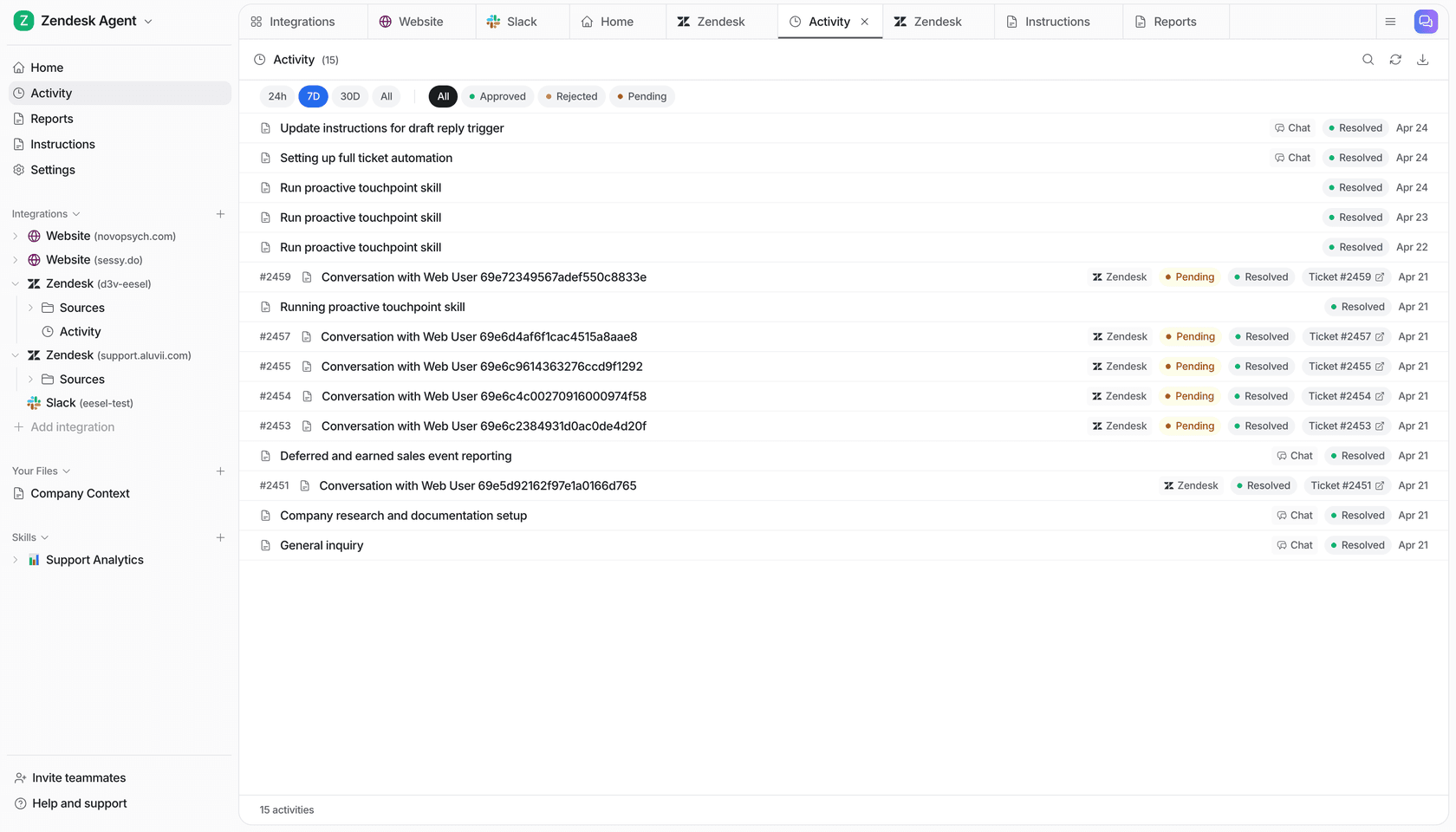
Here's the honest framing to end on. The OpenAI Agents API and every alternative on this list are infrastructure, the pieces you assemble an agent from, plus the loop, evals, and monitoring you maintain yourself.
eesel is the other end of that trade. It is an AI teammate platform, and you hire ready-to-work teammates for specific jobs rather than build one from parts. The current roster is an AI support teammate that plugs into your helpdesk and an AI blog writer. Each arrives already knowing your company, from your past tickets and help center, so there is no loop for you to build. We have spent years putting AI agents on live support queues, which is why every rollout is simulated against your historical tickets before it answers a single real customer. The price is fixed, from $299 a month for 500 credits, where 1 credit is one ticket or chat however many model calls or tool hops it took. The unpredictable loop is our problem, not yours.
And if it was the programmatic control that drew you to an agents API, eesel keeps it. There is a real public CLI (@eesel/cli) plus an MCP server, webhooks, and network access, so you can connect an integration, edit the teammate's instructions, list and approve human-in-the-loop actions, and read the run-by-run activity log from a terminal or a script. The docs put it plainly, everything on the site can be done from the terminal, and coding agents like Claude Code and Cursor can drive it directly. You get the agent-friendly surface without building and babysitting the agent underneath it.
If you're building an agent because you want to own every token, pick one of the eight above and enjoy it. If you're building one because you need customer service handled, start a free trial and let the teammate do the job instead.