
Your IT helpdesk ticket queue looks roughly the same in 2026 as it did five years ago. Password resets. VPN errors. Software provisioning. Access requests. The work is predictable and it still eats your team's time.
AI can handle most of it - but "AI for IT helpdesk" now means at least a dozen different things. There's the overlay approach (drop AI on top of your existing Zendesk or Freshdesk without touching your stack). There's the purpose-built ITSM approach (Freshservice, Jira Service Management, ManageEngine - platforms that bake AI into incident management, change management, and self-service from the ground up). And there's the enterprise platform approach (ServiceNow, which acquired Moveworks in December 2025 and now pitches an "Autonomous Workforce" that it claims handles 90% of internal IT requests).
This post compares six tools across those three categories. I looked at what the AI actually does - not just the brochure version, but the mechanics - and pulled verified numbers from primary sources. The six are: eesel AI, ServiceNow, Freshservice, Jira Service Management, ManageEngine ServiceDesk Plus, and Zendesk.
What to look for in IT helpdesk AI
Before diving into the tools, a few things that separate useful AI from expensive noise in an IT helpdesk context:
Ticket deflection without false automation. The stat most vendors lead with is deflection rate - "66% of tickets deflected" is Freshservice's claim. But deflection counts differently across tools. Some count it only when the employee marks the issue resolved. Others count it when the conversation ends. Understand how each vendor measures before trusting the headline.
Knowledge grounding. IT AI is only as good as what it's trained on. The best tools draw from your past ticket history, runbooks, KB articles, and system configuration data - not just a generic knowledge base. Tools that do this well resolve subtler questions like "why is the VPN dropping on macOS Ventura since the update last Tuesday" rather than just "how do I connect to VPN."
Escalation with context. When the AI can't resolve something, it should hand off to a human with everything gathered so far - not restart the conversation. This is where most budget chatbots fail.
Pricing model. Seat-based, resolution-based, or usage-based pricing all have different economics at different ticket volumes. A $0.40/ticket model works very differently from $49/agent/month depending on whether you have five agents handling 5,000 tickets or fifty agents handling 500.
eesel AI
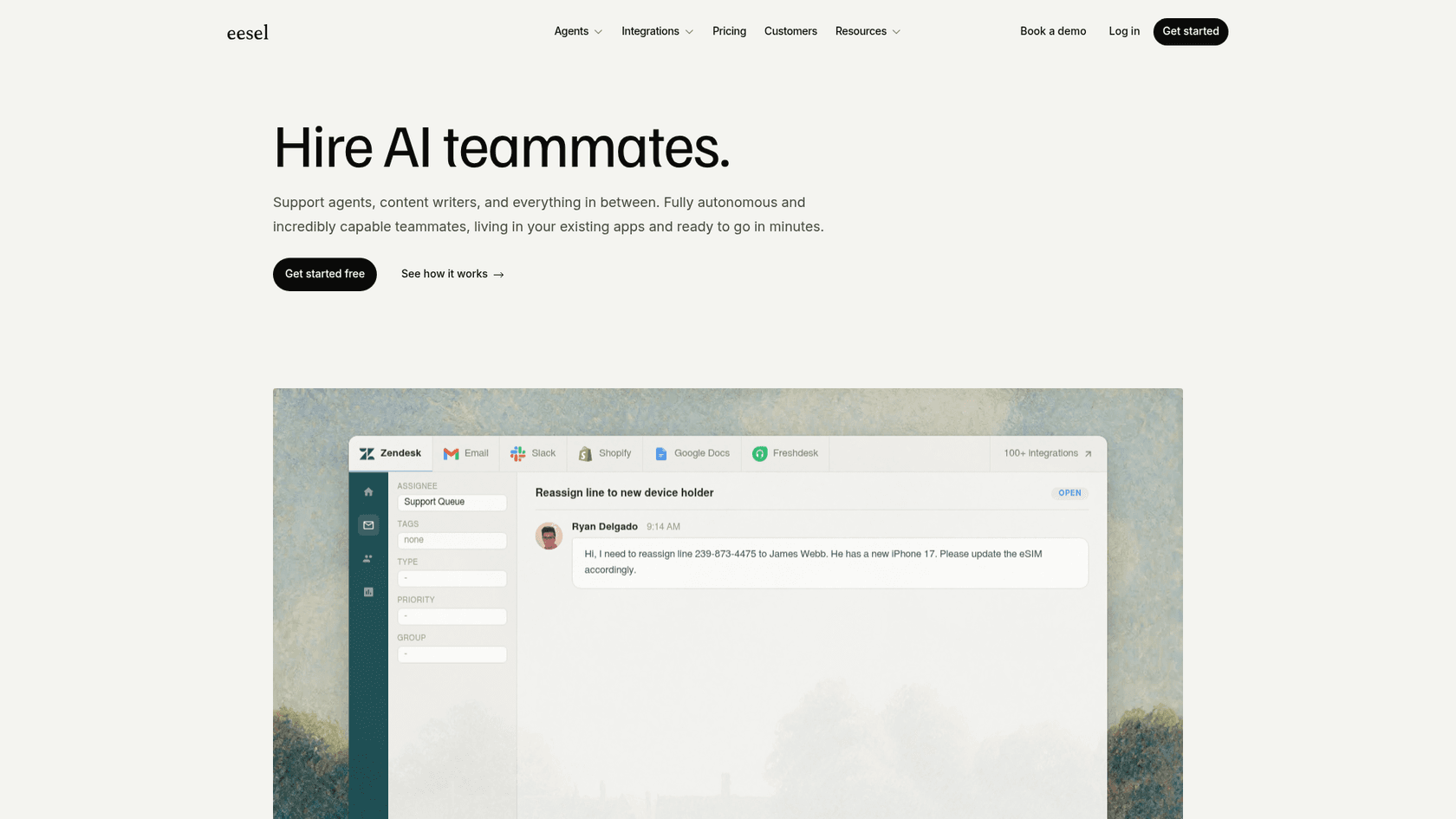
eesel AI is an AI layer that sits on top of your existing helpdesk rather than replacing it. Connect it to Zendesk, Freshdesk, Gorgias, or Help Scout, point it at your knowledge sources (past tickets, Confluence, Google Drive, Notion, SharePoint, website URLs), and it starts handling tickets as a native agent in your helpdesk queue. It is purpose-built for teams that want autonomous AI without a platform migration.
If you're already running Zendesk or Freshdesk and the idea of switching to a new ITSM system doesn't appeal, eesel is the fastest path to meaningful AI deflection. The setup time is under 15 minutes for basic connection and knowledge ingestion.
The AI uses a simulation mode before deployment - you run it against thousands of past tickets and get a breakdown of predicted performance by ticket category, confidence scores, and knowledge gaps. That pre-deployment data is rare among tools in this category. Most require you to go live and watch the error rate in production.
Once live, eesel routes on confidence. High-confidence responses go out autonomously; low-confidence ones queue as drafts for human review. Escalation rules are configured in plain English - "escalate anything about billing over $1,000 to the senior team" - without needing a visual workflow builder. Gridwise reported 73% of tier-1 requests resolved in the first month.
The internal knowledge agent works the same way but for your IT team itself - deployed in Slack as a @mention bot that answers questions from runbooks, internal docs, and past tickets. IT staff can ask it how to troubleshoot a specific issue and get a sourced answer without leaving Slack.
Pricing
| Task type | Cost |
|---|---|
| Light tasks (dashboard questions) | Free |
| Helpdesk tasks (tickets, chats) | $0.40 each |
| Heavy tasks (blog post drafts) | $4.00 each |
| Enterprise add-on | $1,000/month + usage |
No platform fee, no seat fee. Start with $50 in free credits, no credit card required. Annual commitment: commit to $300+/month and pay 25% less.
Best for: Teams already on Zendesk, Freshdesk, or similar who want AI deflection without switching platforms.
ServiceNow (with Moveworks/EmployeeWorks)
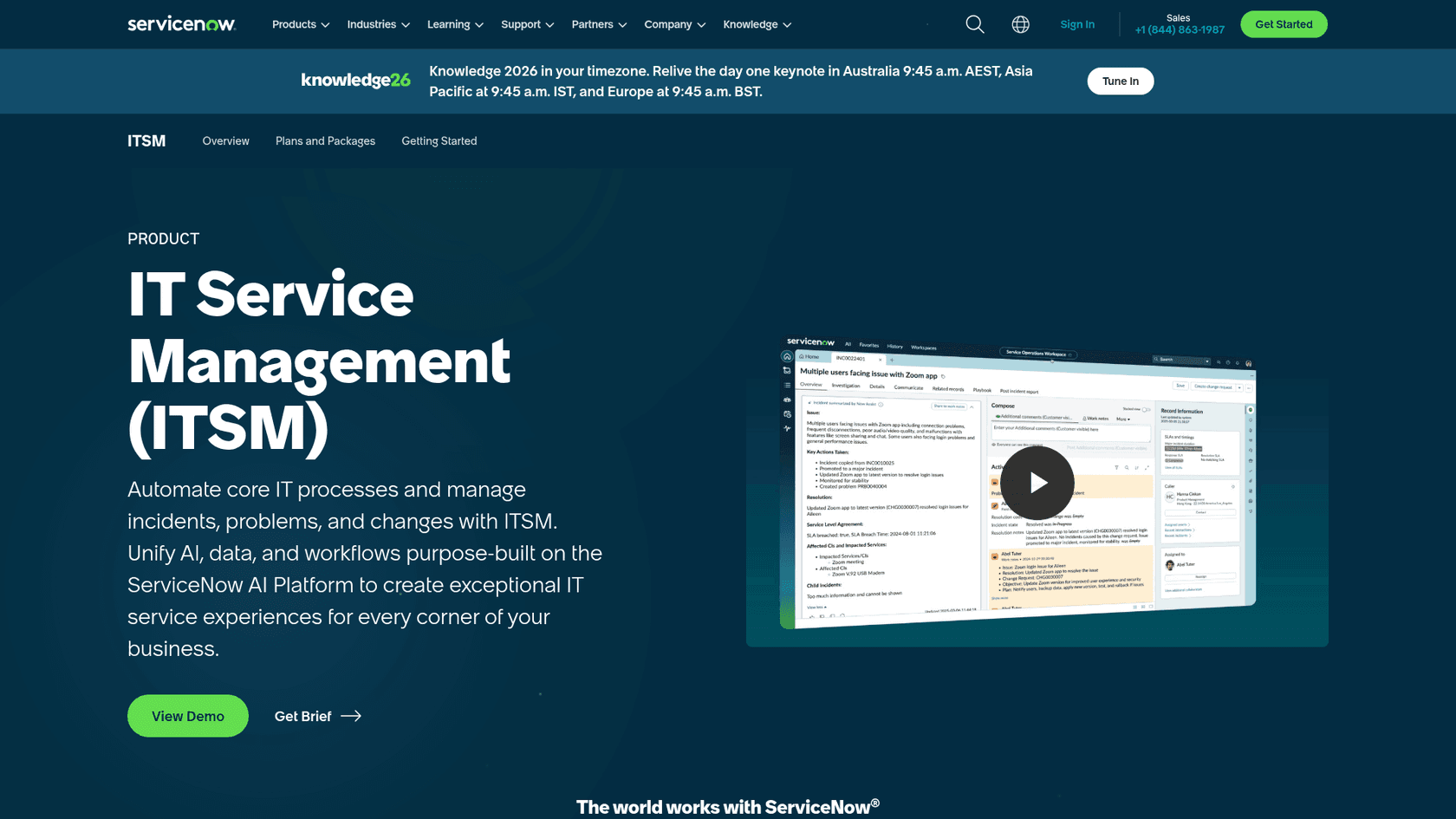
ServiceNow is the incumbent enterprise ITSM platform, used by 85% of the Fortune 500. In December 2025, it completed its $2.85B acquisition of Moveworks, the AI employee service platform. In February 2026, it rolled out the result: the Autonomous Workforce, a team of AI specialists with defined IT roles bundled into every ITSM tier.
The anchor product for IT helpdesk is the L1 Service Desk AI Specialist - an AI that autonomously diagnoses and resolves common IT support requests end-to-end using enterprise knowledge bases, historical incident data, and proactive remediation workflows. Unlike copilot-style tools, it's meant to work without a human in the loop for Tier 1 volume. ServiceNow says its own internal deployment handles 90%+ of employee IT requests.
Now Assist is the GenAI layer: summarization, conversational exchanges, content creation, and custom AI skill development. AI agents read from historical incidents and cases via Workflow Data Fabric, so they're grounded in your specific environment rather than generic knowledge.
Customer outcomes posted on the ITSM page: Fonterra achieved 92% improvement in MTTR for high-priority incidents, Griffith University saw 87% increase in self-service rate, USI reported >47% decrease in MTTR with AI.
The tradeoff is real: ServiceNow is powerful, but complexity and cost are consistent themes in G2 reviews from IT administrators. Top cons include "Learning Curve (72 mentions)", "Expensive (60 mentions)", "Complexity (56 mentions)". One reviewer: "Pricing is another concern, since the platform is relatively expensive and the ROI tends to be clearer for larger organizations than for smaller teams."
A note for anyone writing AI comparison posts about ServiceNow: the L1 AI Specialist does explicitly draw from historical incident data. It learns from outcomes and feedback over time. The claim that "Now Assist doesn't learn from past tickets" is not accurate and contradicts ServiceNow's own documentation.
Pricing
ServiceNow does not publish dollar figures publicly. The ITSM pricing page shows three tiers - ITSM Foundation, ITSM Advanced, and ITSM Prime - each terminating in a "Get Custom Quote" CTA. Every Moveworks-for-ITSM SKU is bundled into the matching tier. Contact sales for actual numbers.
Best for: Large enterprises already in the ServiceNow ecosystem, or organizations that need a single platform to run all enterprise workflows (IT, HR, finance, legal) under one AI layer.
Freshservice
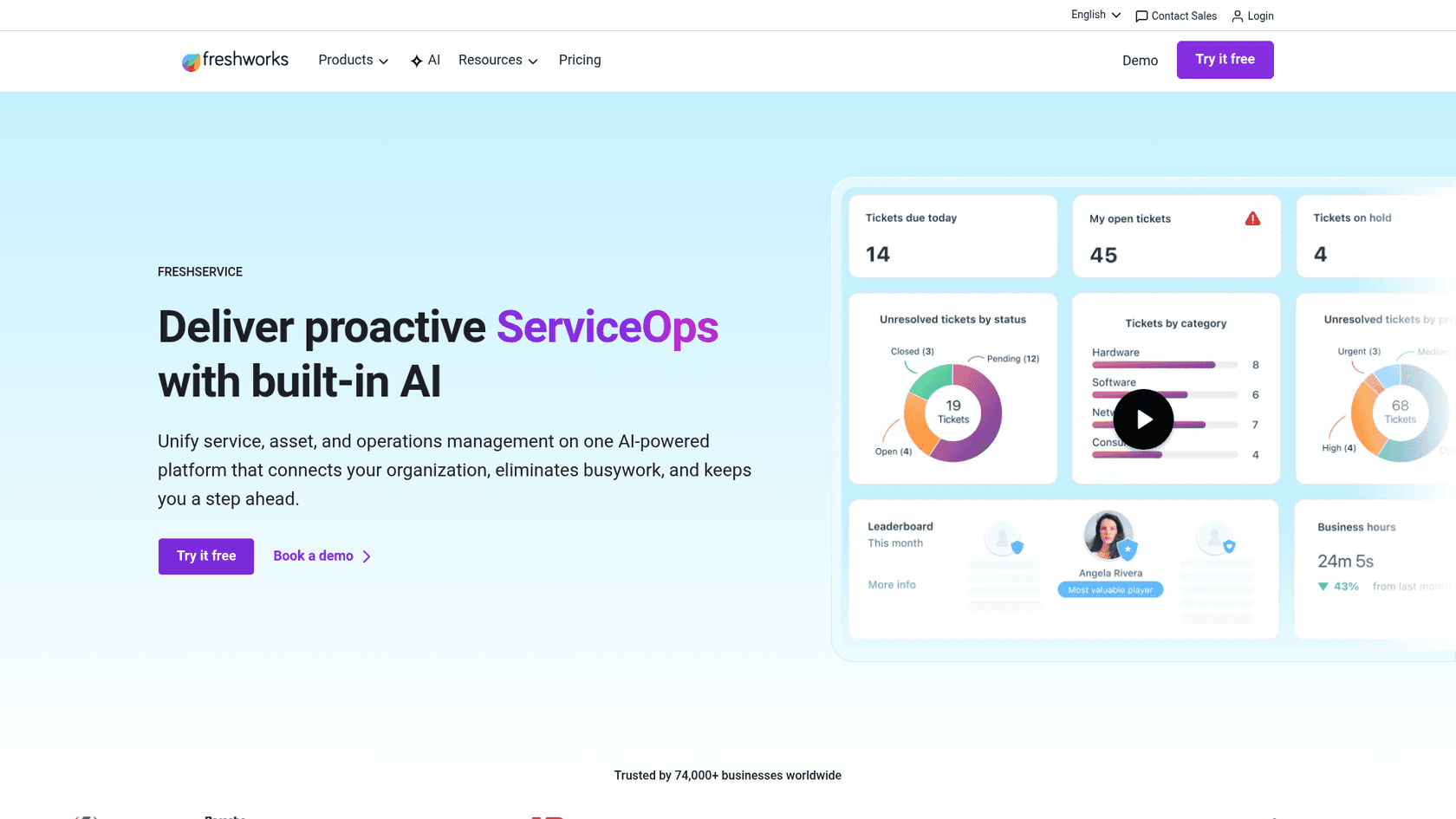
Freshservice is Freshworks' ITSM platform - distinct from Freshdesk (customer support). It is purpose-built for internal IT service delivery and covers the full ITIL stack: incident, problem, change, release, and asset management. 74,000+ businesses use it, with a strong mid-market presence.
The AI suite is called Freddy AI and has three components:
Freddy AI Agent handles employee self-service 24/7. It runs across Microsoft Teams, Slack, the employee portal, and Microsoft 365 Copilot, supporting 40+ languages. It's the deflection engine: Freshservice claims 66% of incoming tickets deflected by Freddy AI Agents.
Freddy AI Copilot assists service agents working on tickets. It suggests responses, summarizes tickets, identifies related incidents automatically, and recommends smart fields. Freshservice reports 41% faster first response time and 77% decrease in average resolution time with Copilot enabled.
Freddy AI Insights surfaces analytics proactively for IT leadership: anomaly detection, trend analysis, and conversational reporting. Ask it for the top incident categories this week and it will surface a breakdown without you building a report.
A Forrester Total Economic Impact study put Freshservice ROI at 356% in under 6 months. Customers include ITV, Carrefour, Porsche, University of Oxford, and Databricks. The setup timeline is materially faster than ServiceNow, and the ticket deflection story for IT is well documented.
One limitation worth knowing: Freddy AI Agent's 1,200 sessions/year (100/month) included on Enterprise plan may not be enough for mid-to-large IT teams at full automation. Beyond that allowance, sessions are billed as add-ons.
Pricing
| Plan | Price | Notes |
|---|---|---|
| Starter | $19/agent/month (annual) | Basic incident and SLA management |
| Growth | $49/agent/month (annual) | ITSM foundations + automations |
| Pro | $99/agent/month (annual) | Unified service management |
| Enterprise | Custom | Includes Freddy AI (1,200 sessions/year) |
14-day free trial, no credit card required. Freddy AI Agent available as add-on on lower tiers.
Best for: Mid-market IT teams wanting a modern ITIL-aligned ITSM with built-in AI that doesn't require a ServiceNow-scale implementation.
Jira Service Management
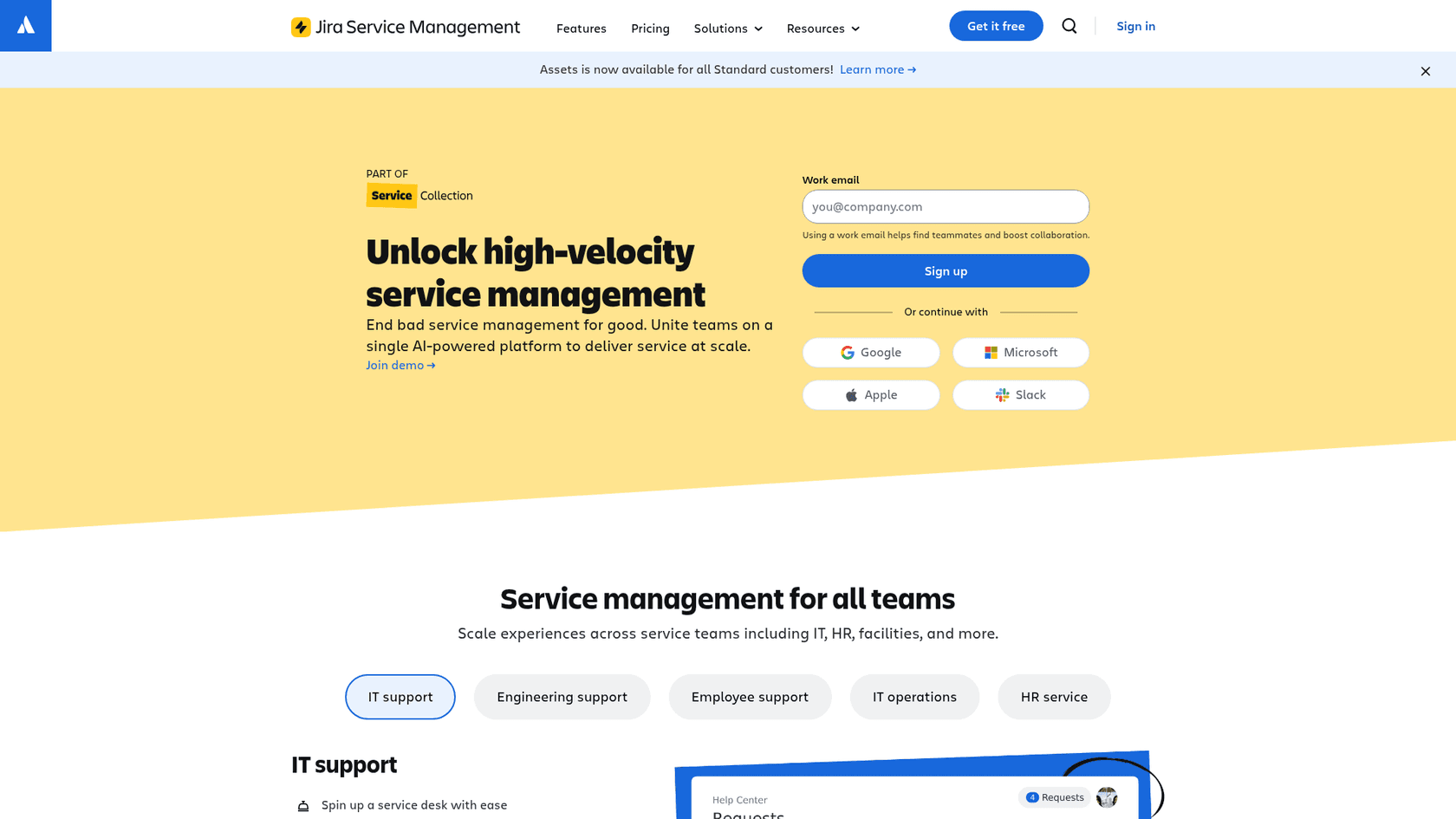
Jira Service Management (JSM) is Atlassian's ITSM platform, built on top of Jira. It covers incidents, problems, changes, assets, and CMDB - and it has the tightest native integration of any ITSM with a software engineering workflow. When a P1 incident fires, JSM connects directly to the engineering Jira board. That connection matters in orgs where IT and engineering overlap significantly.
60,000+ customers use JSM, with a 4.5/5 Gartner Peer Insights rating from 1,458 verified reviews and a 275% three-year ROI per Forrester.
The AI platform is called Rovo, available on Standard, Premium, and Enterprise cloud plans. It's not available on Free or Data Center. Rovo has three main components for ITSM:
Rovo Search gives unified enterprise search across all Atlassian products and connected third-party tools (Slack, Splunk, Microsoft Teams, Confluence). When an engineer is debugging at 2am, they can search across runbooks, past incident records, and Confluence docs from one place.
Rovo Agents are pre-built AI agents for specific workflows: the Rovo Service agent handles common requests end-to-end including zero-touch workflows like automated new hire onboarding. The Rovo Ops agent detects and resolves incidents by analyzing logs, changes, runbooks, and past incidents.
Virtual Service Agent is the Tier 1 deflection engine - available on Premium and Enterprise only. It runs primarily through Slack, handles intent-based flows (password reset, VPN issues, equipment requests), and uses Atlassian Intelligence to answer questions from Confluence directly. 1,000 assisted conversations included per month at Premium, with overage at $0.30/conversation.
One critical note: Atlassian AI does not train on customer data. It can also be fully deactivated by org admins. For regulated environments, note that JSM requires complete AI deactivation on HIPAA-tagged sites - the same constraint applies here as in the healthcare use case.
The Atlassian Teamwork Graph is worth understanding. It's the data layer that connects Confluence, Jira Software, Bitbucket, JSM tickets, and third-party tools so Rovo has real context to work with. The AI doesn't need manual training - it reads the context already flowing through your Atlassian ecosystem. There's a worthwhile comparison of ITSM tools for AI use cases if you want to go deeper on how JSM stacks up.
Pricing
| Plan | Price | Notes |
|---|---|---|
| Free | $0 | 3 agents, 2 GB storage, no Rovo AI |
| Standard | $20/agent/month | Rovo AI available (25 credits/user/mo), no Virtual Service Agent |
| Premium | $51.42/agent/month | Rovo AI (70 credits/user/mo), Virtual Service Agent, AIOps, 99.9% SLA |
| Enterprise | Contact sales | 150 credits/user/mo, 150 sites, 99.95% SLA |
Customers (people submitting requests) are always free and unlimited.
Best for: Engineering-heavy organizations in the Atlassian ecosystem where IT and software development are tightly coupled.
ManageEngine ServiceDesk Plus
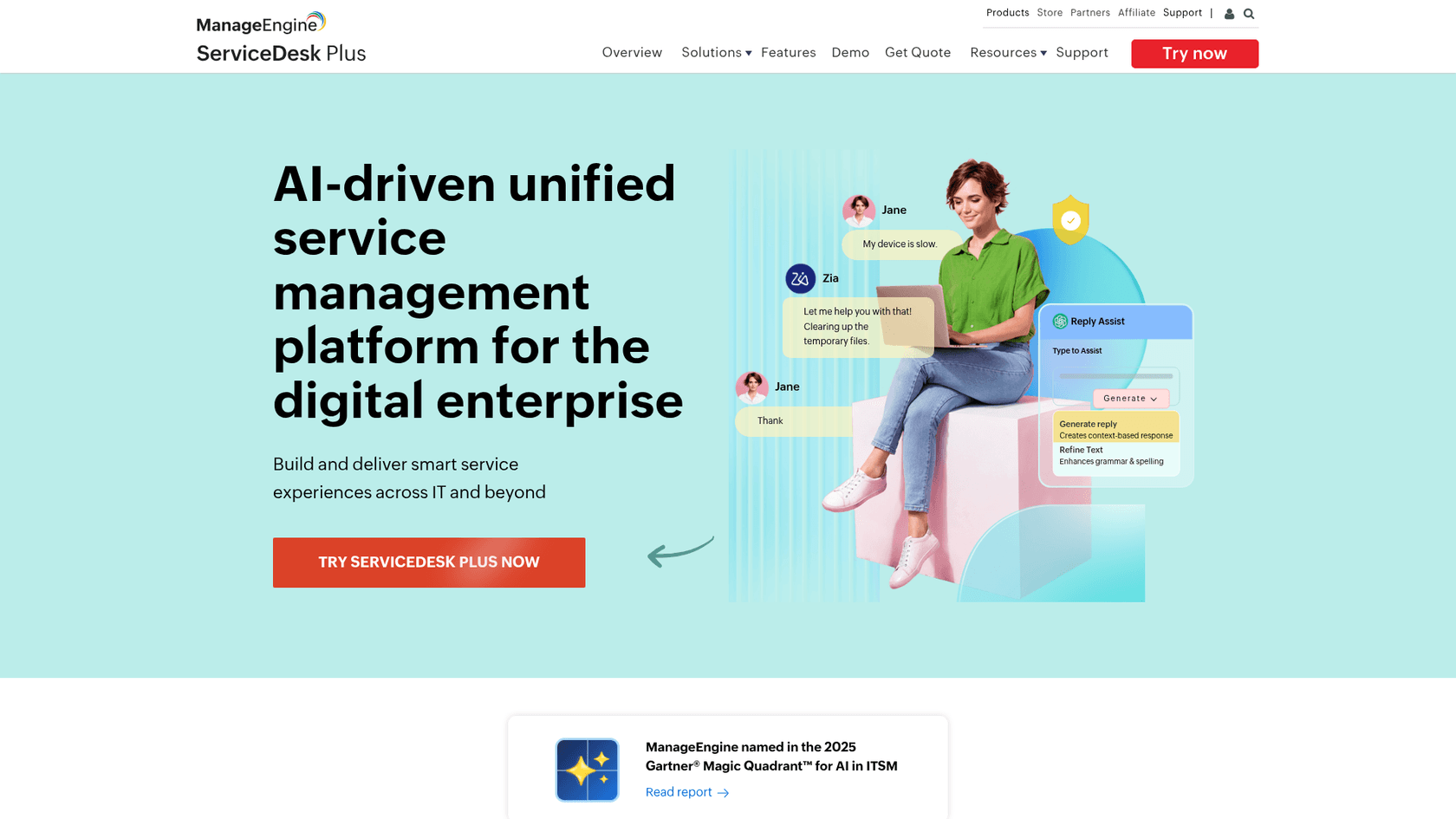
ManageEngine ServiceDesk Plus is the ITSM platform you don't see discussed as often in AI roundups, despite being a solid product with a distinctive angle: it's the only tool in this list offering genuine on-premises deployment alongside a cloud option, and its AI assistant Zia is included at no additional cost on any paid tier.
ManageEngine is the enterprise IT division of Zoho Corp. ServiceDesk Plus covers the full ITIL stack and was named in the 2025 Gartner Magic Quadrant for AI Applications in ITSM. It has 4.4/5 on Gartner Peer Insights from 1,465 verified reviews.
Zia combines three distinct AI types on one platform:
Predictive AI is trained on your organization's own historical ITSM data. It predicts ticket categories, assigns the best-fit technician based on workload and skill history, estimates priority automatically, runs sentiment analysis (flags frustrated users before they escalate), and clusters similar incidents to surface emerging problems before they become outages. Change risk prediction uses historical change data to automatically score new changes - no manual risk assessment required.
Generative AI covers ticket reply drafting, conversation summarization, post-incident review generation (automatically documented from incident timeline data), KB article generation from resolutions, and workflow generation from natural language or even a hand-drawn sketch. Code generation for custom automation scripts is included.
Conversational AI is Ask Zia - a multi-modal chatbot that employees and technicians use to request services, check ticket status, or pull reports. It handles L1 requests end-to-end (password reset, VPN access) and maintains context across multi-turn conversations. Available via the self-service portal, Microsoft Teams, and other channels.
The LLM is your choice. You can use ManageEngine's own Zia LLM (runs within their data centers, data does not leave their servers) or bring your own key for OpenAI ChatGPT, Azure OpenAI, or Google AI Studio. Different capabilities can use different providers.
The on-premises option is genuinely useful for regulated industries like government, banking, and defense - sectors where cloud hosting of IT asset and incident data isn't an option. The cloud version gets new features first, and some reviewers note support quality inconsistency, but for organizations that need on-prem, ManageEngine is one of very few viable ITSM options with this level of AI depth.
A note from the sysadmin community: reporting and cross-module analytics have historically been a weak point. The Analytics Plus integration adds NL-driven reporting, but requires configuration.
Pricing
| Edition | Cloud (per tech/month, annual) | On-Premises |
|---|---|---|
| Standard | From $13 | Free up to 5 techs |
| Professional | From $27 | Contact sales |
| Enterprise | From $67 | Contact sales |
Zia AI is included at all tiers. No separate AI add-on. Free tier available for Standard up to 5 technicians (cloud and on-premises).
Best for: Mid-market and enterprise IT teams that need on-prem deployment, or organizations that want full AI features without paying an AI add-on fee on top of their ITSM license.
Zendesk
Zendesk is not a purpose-built ITSM platform - it's a customer support tool that many IT teams also use for internal service delivery. If your organization runs IT support through Zendesk rather than a dedicated ITSM tool, the AI features are worth understanding in that context. Read eesel's comparison of IT helpdesk tools for a broader view of where Zendesk fits.
In March 2026, Zendesk acquired Forethought, an agentic customer service AI startup. Forethought is now sold as "Forethought AI agents by Zendesk" and is also available standalone for non-Zendesk customers. The acquisition strengthens Zendesk's AI agent capability, particularly for complex multi-step workflows.
The AI setup has two tiers. Essential AI Agents are included in all Suite plans: generative replies from connected knowledge sources, customizable personas, instruction and escalation configuration. Advanced AI Agents (paid add-on, price by sales quote) unlock the visual AI agent builder, API integrations that let the AI take actions in third-party systems, reasoning controls, and advanced language support (80 languages). The "80% automation" headline that Zendesk publishes requires the Advanced tier.
Billing for AI is outcome-based: you pay per "Automated Resolution" (AR) - a case closed without human intervention. Included ARs per agent vary by plan; overage is $1.50/AR on a committed plan, $2.00/AR pay-as-you-go.
For Zendesk ITSM or IT support specifically, the AI Agents integrate with the Zendesk knowledge base and connected external sources (Confluence, SharePoint, Notion). They handle first-contact resolution for common requests. The Copilot tool then helps IT agents close anything the bot escalated. Customer outcomes: Jigsaw saw 35% ticket volume reduction and 20% faster response times.
What Zendesk lacks for serious ITSM is the ITIL structure: no native change management, no CMDB, no asset management. Teams that need those add on a separate tool. For ServiceNow alternatives that go deeper on ITSM structure, Freshservice or JSM are better comparisons.
Pricing
| Plan | Price | Included ARs |
|---|---|---|
| Suite Team | ~$55/agent/month (annual) | 5 ARs/agent/month |
| Suite Professional | ~$115/agent/month (annual) | 10 ARs/agent/month |
| Suite Enterprise | Custom | 15 ARs/agent/month |
AI Agents - Advanced is a separate add-on. Overage ARs: $1.50/AR committed, $2.00/AR PAYG.
Best for: Organizations already running Zendesk for both customer support and IT support, who want AI without switching platforms.
Side-by-side comparison
| Tool | AI approach | Pricing model | On-prem? | Ticket deflection claim | Setup speed |
|---|---|---|---|---|---|
| eesel AI | Overlay on existing helpdesk | $0.40/ticket, no seats | No | 73% tier-1 (Gridwise) | ~15 minutes |
| ServiceNow | Full ITSM platform + Autonomous Workforce | Enterprise, custom | No (cloud only) | 90%+ (internal claim) | Weeks to months |
| Freshservice | Built-in Freddy AI suite | $19-$99/agent/mo + Enterprise | No | 66% (Freddy AI Agent) | Days to weeks |
| Jira Service Management | Rovo AI on Atlassian platform | Free to $51.42/agent/mo | Data Center option | Not published | Days to weeks |
| ManageEngine ServiceDesk Plus | Zia AI (built-in, no add-on) | $13-$67/tech/mo cloud | Yes | Not published | Days |
| Zendesk | AI Agents + Copilot add-on | ~$55-$115+/agent/mo | No | 80%+ (with Advanced tier) | Days |
How to pick
A few honest decision rules:
You're already on a helpdesk and don't want to change stacks. eesel AI is the obvious answer. Fifteen-minute setup, no migration, pays per ticket. Works on Zendesk, Freshdesk, and others. The simulation mode gives you real data before going live rather than guessing at deflection rates. See how eesel compares to other AI ticketing options for more detail.
You're building an ITSM function from scratch and want modern tooling. Freshservice is the most practical choice for mid-market teams. Strong Freddy AI, genuine ITIL alignment, real customers with documented outcomes. Jira Service Management is the better pick if your team is deep in the Atlassian ecosystem or if engineering-IT collaboration is a priority.
You need on-premises deployment. ManageEngine ServiceDesk Plus is the only realistic option here. The AI depth is real (Zia is not an afterthought), the pricing is accessible, and the on-prem deployment matches regulatory requirements in sectors where cloud isn't viable.
You're an enterprise team and already in ServiceNow. The Autonomous Workforce launch (February 2026) is the most significant ITSM AI development in the first half of 2026. If you're already paying for ServiceNow ITSM, you have Moveworks for ITSM bundled in your tier now - evaluate what the L1 AI Specialist actually covers for your ticket mix before buying any additional AI.
Your IT team also handles customer support. Zendesk is worth considering if you're already running it for external customers. The shared knowledge base and unified workspace make the cross-functional setup more manageable than running two separate tools.
For teams trying to sort through which AI it helpdesk approach makes sense before committing, the overlay vs. platform decision is the most fundamental one. Overlays move faster and require no migration. Purpose-built platforms give you more ITIL structure, more native change and asset management, and a better eventual ceiling - at the cost of implementation time.
If your IT team is already stretched and you need AI deflection running this quarter, not this year, the overlay approach (eesel AI, or Zendesk AI if you're already on Zendesk) is the pragmatic path. If you're planning an ITSM investment anyway and AI is part of that scope, one of the purpose-built platforms makes more sense in the long run.
Frequently Asked Questions
What is IT helpdesk AI and how does it differ from a regular chatbot?
Which IT helpdesk AI tool is best for a small IT team with a tight budget?
Can IT helpdesk AI integrate with Slack or Microsoft Teams?
How long does it take to set up IT helpdesk AI?
Does IT helpdesk AI train on your company's private data?


Article by
Riellvriany Indriawan
Riell is a designer and writer at eesel AI with about two years of experience researching CX platforms, AI chatbots, and helpdesk software. She combines her design background with a sharp eye for how these tools actually look and feel in practice — making her comparisons unusually visual and user-focused.