
What emotional intelligence actually means in a support role
Emotional intelligence was popularized by psychologist Daniel Goleman, whose framing in What Makes a Leader? (Harvard Business Review, 2004) argues that EQ, not raw IQ or technical skill, is "the sine qua non" of any role built around managing people under pressure. Goleman's model breaks it into five components:
- Self-awareness - recognizing your own emotions and moods before they leak into a reply.
- Self-regulation - the thing that stops a rep from mirroring a customer's anger back at them.
- Motivation - drive that isn't purely dependent on external praise or a CSAT score.
- Empathy - understanding what someone else is feeling, and factoring it into the response.
- Social skill - reading the room and communicating in a way that actually lands.
The distinction between empathy and emotional intelligence trips people up constantly, and it's worth being precise about. Per HubSpot's own framing for support managers: "empathy refers to your ability to relate to misfortune, emotional intelligence is your ability to interpret and respond to other people's emotions." Empathy is one ingredient. EQ is the full skill of using it well.
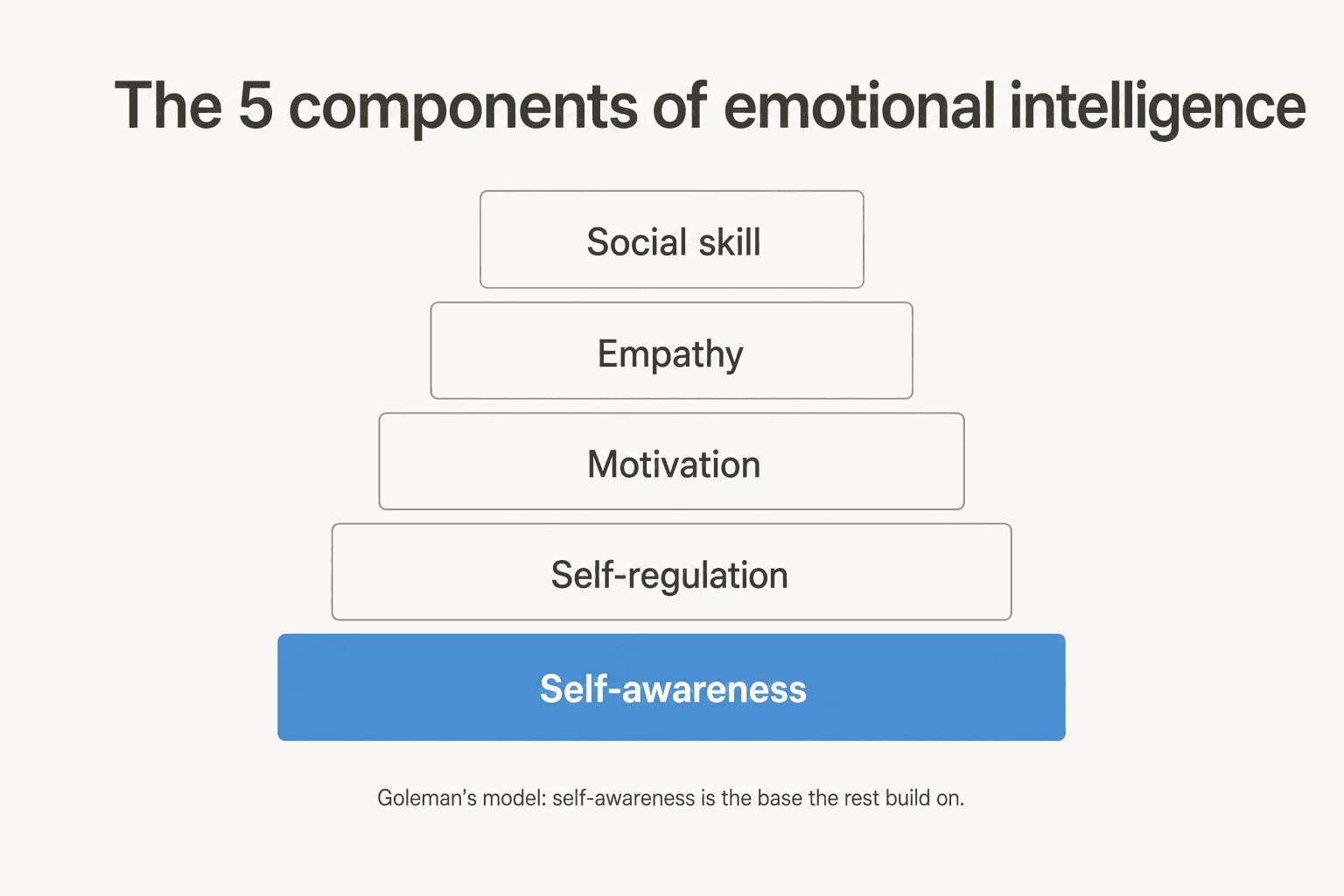
Goleman's central claim, the reason this model has stuck around since his 1995 book, is that these are learned competencies, not fixed personality traits. That matters for a support org: it means EQ can be coached and QA'd like any other skill, not just selected for at the hiring stage.
Why EQ became a support skill, not just a soft skill
Customer service is unusual among knowledge-work roles because nearly every interaction starts emotionally loaded. A customer reaching out is very often already frustrated, confused, or anxious before the conversation even begins. Help Scout's guide to customer service skills makes the point directly: "the best support pros know how to watch and listen for subtle clues about a customer's current mood, patience level, personality, etc., which goes a long way in keeping customer interactions positive."
A few reasons EQ shows up as a named, trainable skill rather than a personality trait you either have or don't:
- Reading the actual emotional state, not just the stated problem. The words in a ticket ("this is broken") often say less than the tone does. Reps with EQ, per Help Scout, "instead of taking things personally... intuitively understand where the other person is coming from."
- De-escalation and trust-building. The same interaction can end with a customer feeling merely placated or actively pleased, and the difference is usually whether the rep managed their own reaction and correctly read the customer's.
- It scales into retention, not just individual tickets. HubSpot ties it directly to churn: "emotional intelligence will help you understand the customer's short- and long-term needs, preventing potential churn." The New Science of Customer Emotions research (Harvard Business Review, 2015) found fully emotionally-connected customers are 52% more valuable than merely satisfied ones, and a bank's emotion-led credit card redesign drove 70% higher usage and 40% new-account growth in its target segment.
- Rising expectations under channel shift. Zendesk's own research on empathy at scale argues that as more support moved digital-first, "demonstrating empathy for new and existing customers has become essential" precisely because the channel itself strips out a lot of the emotional cues a phone call would carry.
What AI is actually taking off agents' plates
The framing that AI is coming for customer service jobs wholesale doesn't match what leaders are actually reporting. Gartner's survey of 321 customer service and support leaders (December 2025) found 91% are under executive pressure to implement AI, and while over 80% expect some headcount reduction within 18 months, nearly 80% plan to transition existing agents into new roles, with 84% adding new skills to agent profiles. Gartner frames this explicitly as preparing agents "to deliver higher-value, more complex, and empathetic customer interactions," not replacing the empathetic part of the job.
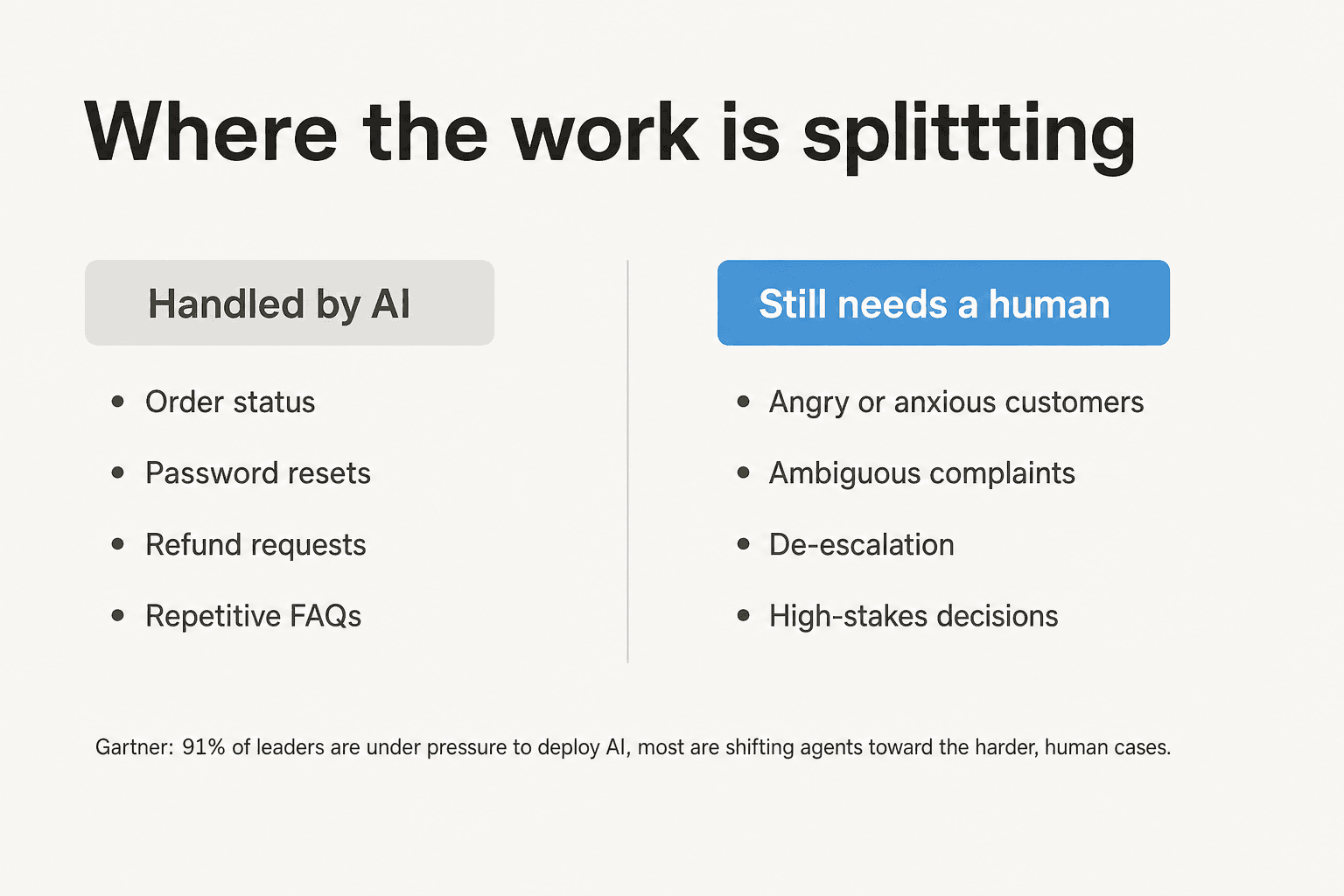
That split matches what we hear directly from teams before they adopt an AI helpdesk agent. Jon Miron, Director of Support & Operations at Yellowdig, put it plainly: "as a fast-growing startup with a small team, our customers far outnumber our employees. It's crucial that we have robust self-service solutions as well as tools to supercharge the efficiency of our client-facing teams." That's not a wish to remove the human element, it's a plea for the repetitive 60-70% of volume to stop eating the hours a rep needs for the harder 30%.
We see the same pattern in eesel's own usage data. In one live customer rollout, agents sent an AI-drafted reply exactly as written only 12% of the time. The dominant behavior was "glance and rewrite," turning an 8-15 sentence draft into 1-3 sentences. When we broke down why agents were editing, about two-thirds of the changes were pure tone and length, not fact corrections, and only around 5% of edits were fixing something the AI actually got wrong. The AI was usually factually fine. What it wasn't doing, and what the agent was doing every time, was matching the emotional register the customer needed.
Community sentiment on this is more nuanced than "workers hate AI." One r/technology commenter, discussing AI-assisted QA scoring, said consistency actually helps: "employees will likely prefer the AI vs. slanted evaluators who may perceive things differently call to call." The recurring line practitioners draw isn't AI-versus-human, it's task-versus-relationship, as one r/CallCenterWorkers commenter framed it: "AI will handle tasks, not relationships. Emotional labor will be the true differentiator."
What customers actually want when a human isn't answering
Customers aren't asking AI to disappear from support either, they're asking it to be honest about its limits. Zendesk's own customer research, published by Head of AI Cristina Fonseca, found 71% of customers actually believe AI can make experiences more empathetic, if it's built to notice mood at all: 67% want AI that adjusts tone based on how they're feeling, and roughly three in four feel their emotional state is currently ignored on digital channels.
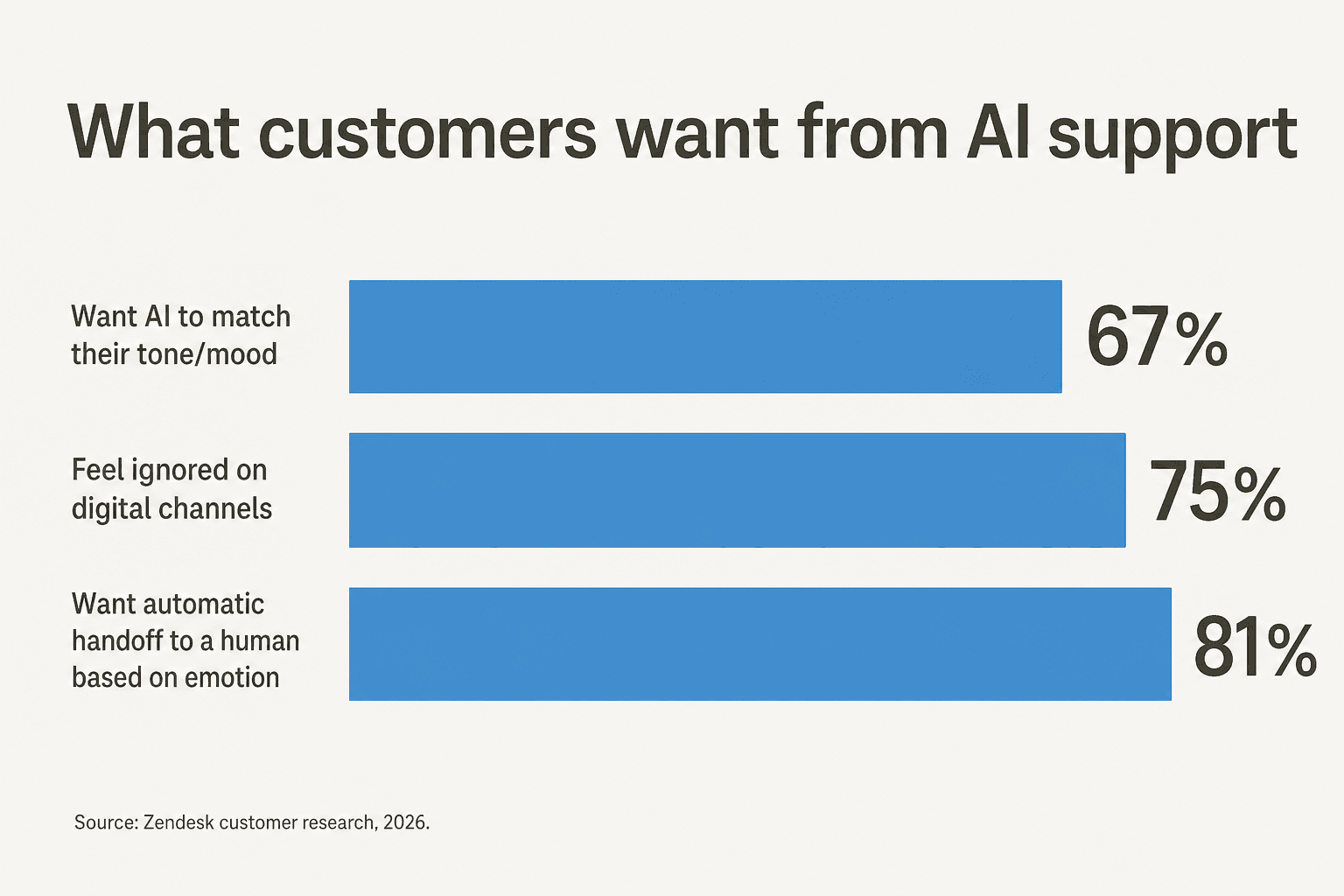
The standout number is the last one: 81% of customers want AI to automatically hand them off to a human based on how they're feeling, not based on a rigid keyword rule or a "type AGENT to escalate" menu option. That's an explicit customer-side vote for AI to know its own boundary rather than try to fake its way through an emotionally loaded conversation.
That tension shows up in the wild, not just in survey data. David Lavenda's LinkedIn post on the state of automated support captured the frustration directly: "the rush to push customers into chat and automation may save companies money, but it makes service worse," landing not on an anti-AI stance but on a practical split, automate the routine, keep a real human path open for anything complex. When Intel and Salesforce both made public moves toward AI-heavy support, the commentary converged on the same open question. As tech analyst Evan Kirstel put it about Intel's shift: "the big question: can an AI truly replicate the empathy and problem-solving of a human?"
How to actually build emotional intelligence on a support team
EQ is coachable, which means it belongs in onboarding and QA, not just in a hiring rubric. The two techniques that come up repeatedly in support-org guidance:
| Technique | What it looks like in a ticket | How to train it |
|---|---|---|
| Active listening | Reading (or re-reading) the full message before drafting a reply, instead of pattern-matching the first sentence | Have new reps summarize the customer's actual concern back before writing a response, even in async written support |
| Behavioral cue-reading | Adjusting formality, emoji use, and pacing based on signals in the customer's own message (punctuation, signature, word choice) | Pair QA reviews on tone-match, not just accuracy, and share real examples where a rep calibrated well |
| De-escalation scripting | Acknowledging the emotion before addressing the problem ("that's frustrating, here's what I'll do") rather than jumping straight to a fix | Roleplay genuinely angry tickets, not just neutral ones, during onboarding |
| Escalation judgment | Recognizing when a ticket needs a human decision-maker rather than a scripted answer | Build explicit criteria (sentiment, account value, ticket history) into your escalation process rather than leaving it to gut feel |
None of this is abstract. HubSpot specifically recommends active listening as "one of the most effective ways to improve emotional intelligence," and it's a habit, not a talent, which is exactly why it fits into a training program.
Where AI fits without replacing the human part
The workable split isn't "AI versus empathetic agents," it's AI handling the volume that doesn't require EQ at all, so the humans on the team have the hours to spend it where it counts. That's the model behind eesel's AI helpdesk agent: it triages incoming tickets, drafts replies grounded in your own help center and past tickets, and takes routine actions directly in tools like Zendesk, Freshdesk, and Front, rather than trying to fake its way through the tickets that need real judgment.
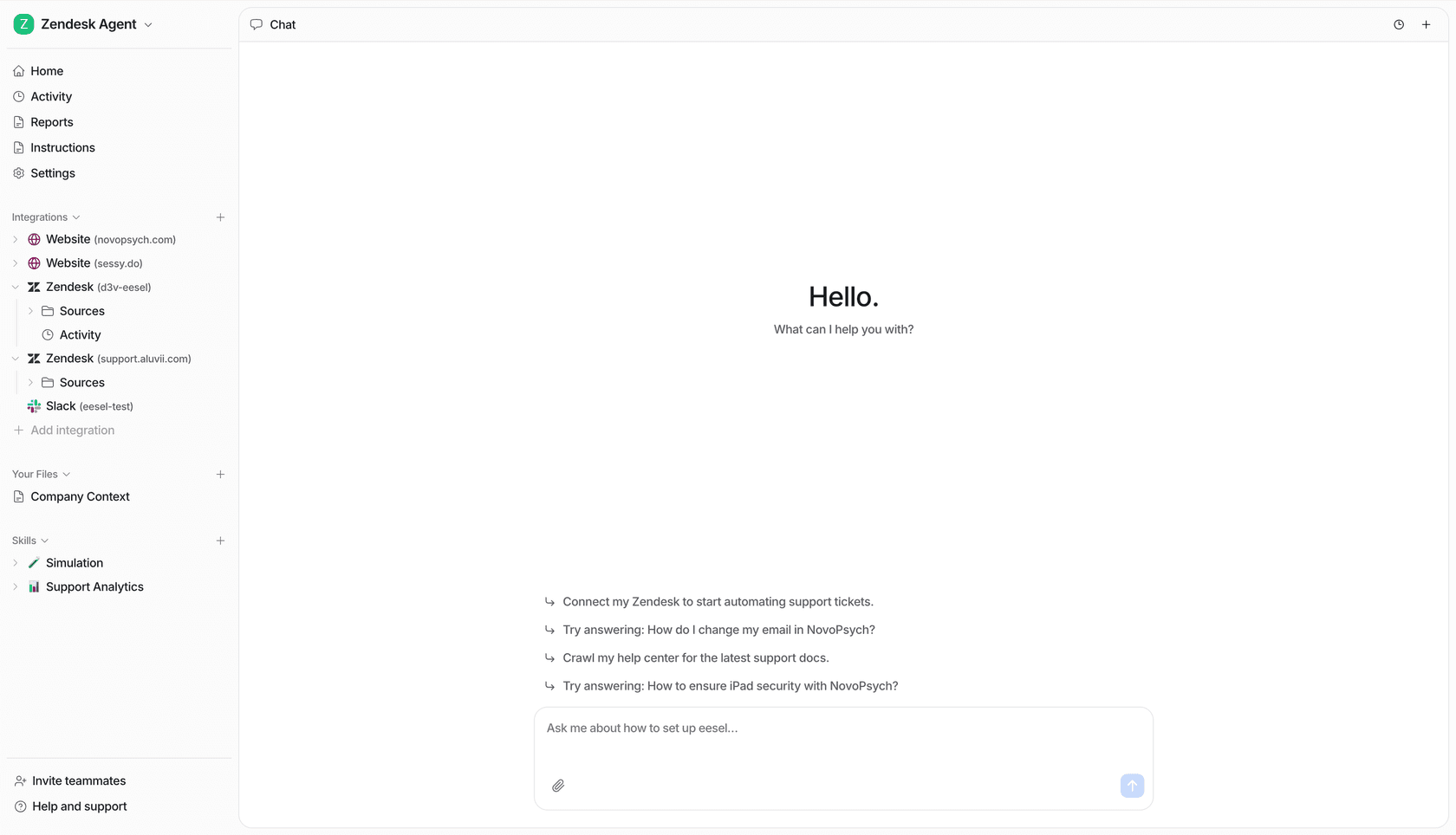
That's also why confidence-based routing matters more than blanket automation. A customer who's already annoyed doesn't want to discover they're arguing with a bot that has no idea it's out of its depth. The right design leaves ambiguous, angry, or high-stakes tickets with a human by default, and only automates the volume that's genuinely low-stakes, which is closer to what ai agent handoff best practices actually recommend, and part of why we built escalation management around sentiment and context, not just keyword triggers.
Try eesel for emotionally-aware support triage
We built eesel's AI helpdesk agent around the same split this whole post argues for: let AI absorb the repetitive volume, and hand anything emotionally loaded, ambiguous, or high-stakes to a human with full ticket context attached, not a stripped-down summary. It learns from your own past tickets and help center from day one, drafts replies inside the helpdesk you already use, and routes by confidence rather than a blunt keyword rule, so the tickets that need a real person land with one, fast.

If your team is drowning in repetitive tickets and losing the hours it needs for the harder, emotionally-loaded ones, try eesel free and see what it triages off your plate in the first week.
Frequently Asked Questions
What is emotional intelligence in customer service?
Is emotional intelligence the same thing as empathy?
Can AI have emotional intelligence?
Will AI replace the need for emotional intelligence in support teams?
How do you train customer service agents on emotional intelligence?
Where does AI actually help with emotionally difficult tickets?


Article by
Riellvriany Indriawan
Riell is a designer and writer at eesel AI with about two years of experience researching CX platforms, AI chatbots, and helpdesk software. She combines her design background with a sharp eye for how these tools actually look and feel in practice — making her comparisons unusually visual and user-focused.