
Why "be more customer-focused" isn't a training objective
Search "customer service training objectives" and you're usually one of two people: a support lead building a curriculum from scratch, or someone who inherited a training deck full of goals like "improve customer satisfaction" and needs to turn it into something a new hire can actually work toward. Neither goal survives contact with a real ticket queue.
Zendesk frames the underlying discipline plainly: customer service training is "a strategy businesses use to improve the competency of your support team," and it only works when it's tied to something specific - product knowledge, customer communication, or the software agents use every day. The stakes are real: 73% of consumers switch to a competitor after multiple bad experiences, and more than half switch after just one, per Zendesk's own benchmark data. A vague training objective doesn't just waste a training budget - it shows up in churn.
The Association for Talent Development (ATD) makes the same point from the other side of the whiteboard: "misalignment rarely announces itself; it shows up as familiar symptoms. There's overreliance on activity metrics (enrollments, completions, smile sheets) without behavioral or business indicators." Their fix is to map every learning objective to a real business KPI - revenue, retention, or a quality metric - so training's value is "explicit, visible, and testable," not a line item on an HR dashboard nobody checks again.
Even experienced hires need this. A rep might already "know how to provide good customer service," Zendesk notes, but "they don't know how to provide good customer service for your business" - its specific tools, its target customer, its escalation rules. That's what a training objective is actually for.
The SMART framework, applied to customer service training
SMART - Specific, Measurable, Achievable, Relevant, Time-bound - traces back to a 1981 article by Washington Water Power's director of corporate planning, and it maps onto support training almost too cleanly:
| Letter | What it means | Applied to training |
|---|---|---|
| Specific | Focused on one problem, not a general aspiration | "Decrease call transfer occurrence by 30% over six weeks," not "improve customer satisfaction" |
| Measurable | Tied to a single tracked metric | A knowledge-base training goal gets measured via first call resolution rate, since better knowledge should mean fewer transfers |
| Achievable | Grounded in a real baseline, not a number "pulled out of thin air" | Zendesk's Sam Chandler warns against goals with no baseline - "understand what your customers need... and your metrics should be built off of that" |
| Relevant | Serves the customer, the rep, and the business at once | Check the objective against all three before locking it in |
| Time-bound | A fixed deadline with checkpoints | Weekly sub-goals ("each rep writes one article a week") beat one distant annual target |
Here's what that looks like as a single sentence, built from Zendesk's own worked examples:
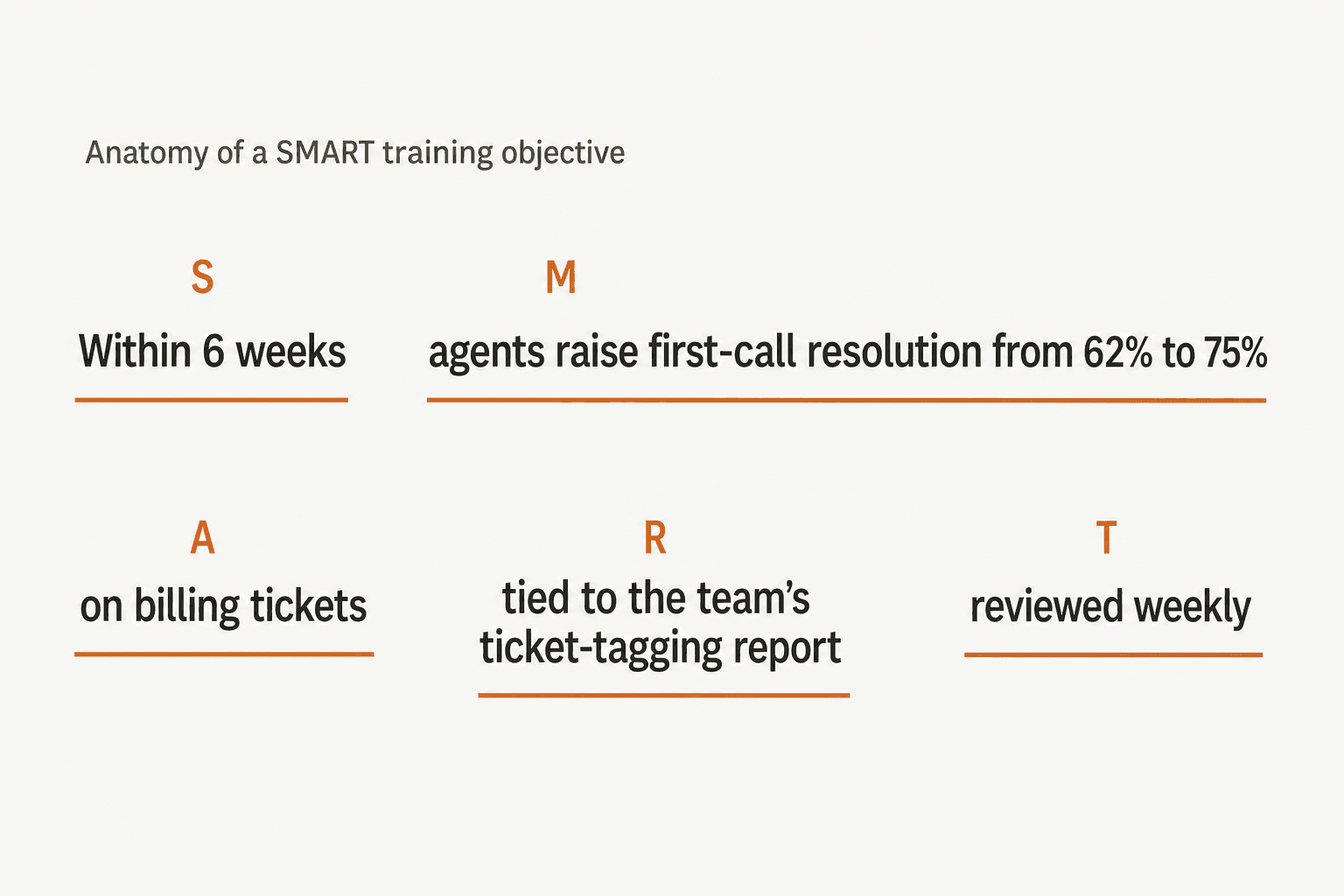
That one sentence hits all five criteria at once: one named problem, a single tracked metric with a real baseline, a stretch-but-realistic target, a tie-in to team KPIs, and a fixed window. Compare that to "make agents better at resolving issues" - same intent, but nobody can tell you in six weeks whether it worked.
ATD's own framework arrives at a near-identical structure from the strategy side: Discover the outcome and behaviors that move it, Design learning objectives that mirror the KPI, Deliver in the flow of work with real coaching tools, then Measure against business signals - and ATD names first call resolution directly as one of those signals. HubSpot's QA guide leans on the same SMART entry point before grading even begins: "objectives might range from reducing error rates to improving CSAT or training new hires... use SMART customer service goals to turn vague ideas into clear, measurable targets."
The five categories every training program needs
Across Zendesk, HubSpot, and Help Scout's own published frameworks, training objectives cluster into five recurring categories.
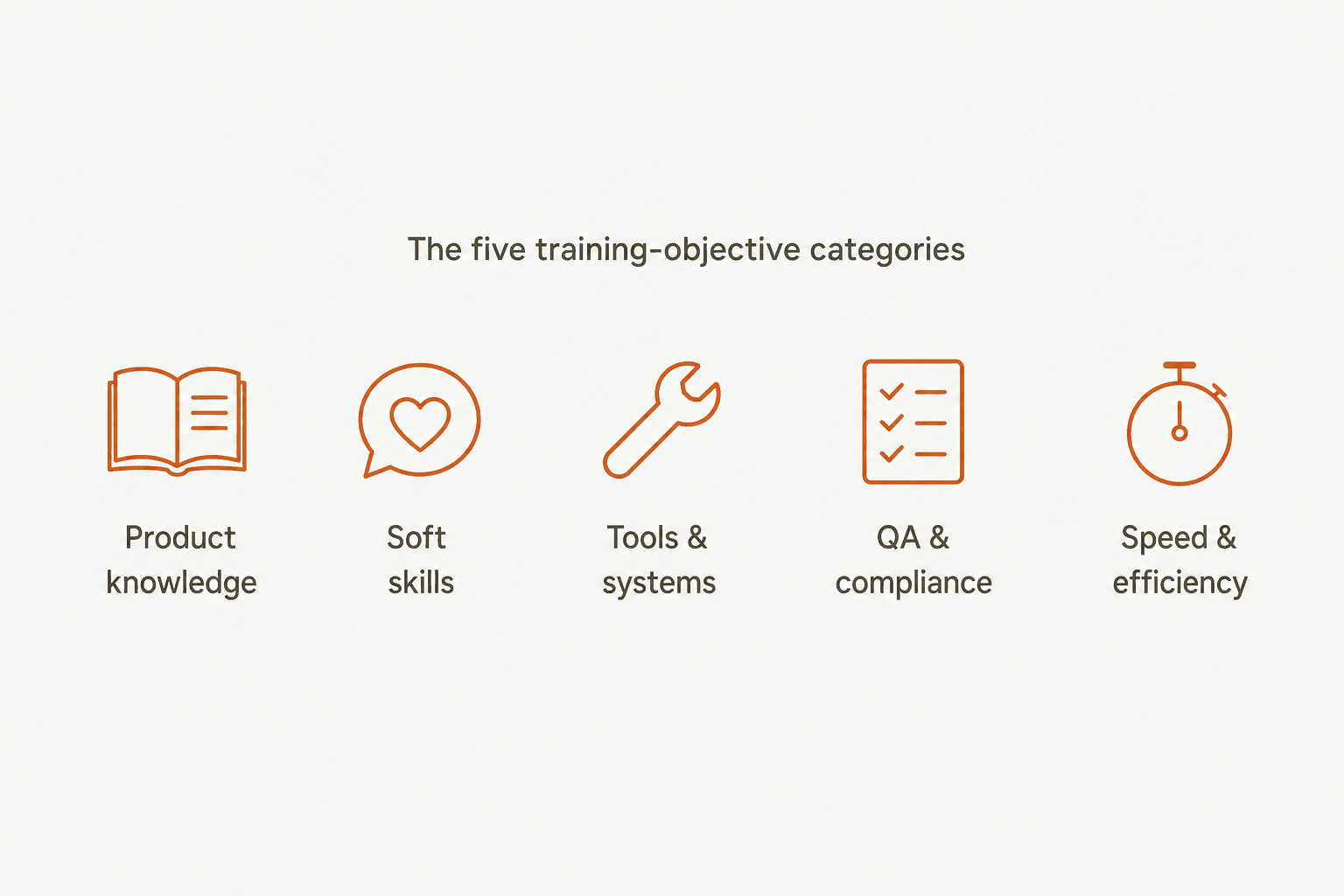
Product knowledge. Zendesk classifies this as a hard skill - "abilities that you can measure" - because agents "must give fast and accurate answers" to "inspire trust." A new-hire objective might be completing an onboarding module covering company culture, software, and product knowledge within four to six weeks; an ongoing one is passing a refresher check when skills "get rusty with time." HubSpot's QA rubric ties this straight to accuracy scoring, since "confidence without correctness is worse than hesitation."
Soft skills, empathy, and de-escalation. Zendesk names seven trainable soft skills, including active listening ("essential for making customers feel recognized and de-escalating stressful situations") and conflict resolution. HubSpot operationalizes empathy as a scored, trainable dimension separate from tone - "the agent's ability to recognize and validate the customer's emotional experience, not just the issue they reported" - and Help Scout's own rubric bakes in the same objective under "empathy and helpfulness." If your team handles a lot of upset customers, our guide on dealing with angry customers walks through the specific scripts that back this objective up.
Tools and systems proficiency. Zendesk lists "empower your team with the right tools" as a standalone objective, separate from product knowledge - training agents to use software efficiently "so they can find information in seconds." For teams building this out, our breakdowns of help desk automation and AI knowledge base tools cover what "efficient" actually looks like in a modern stack.
QA and compliance adherence. HubSpot draws a sharp line here: "Quality Control is reactive... Quality Assurance is proactive. It focuses on the process." Its scorecards "often weight soft skills at 25-30% and resolution accuracy at 30-35%," and a training objective can target hitting that weighted bar. Help Scout's own rubric frames the same category as "procedures and best practices" - were the right tags applied, were knowledge base links included. Our call center quality assurance and QA feedback examples guides go deeper on building the scorecard itself.
Speed and efficiency. First call resolution is "a company's ability to handle a customer's... complaint during their first outreach," with a benchmark of 70-75%. Average handle time is the average time to resolve a request, phone formula "Talk + Hold + Follow-Up ÷ Total Calls." HubSpot's own guidance for improving both starts with "train your staff" - but with a caveat worth its own section, below.
Why your QA scorecard might be undermining your training objectives
Here's the part most training-objective guides skip, and it's the one that actually changes how you should set them.
"Me. Tue Søttrup. 20 years in customer service. And that one question I asked over 1,000 times: 'How do you know your agents are ready before they go live?'"

Søttrup's answer, after two decades running support orgs, is that most teams can't answer it - QA scores "look fine" while new cohorts still drag AHT and CSAT for weeks before catching up to tenured-agent baselines. The scorecard isn't catching the real readiness gap, because the scorecard and the training objective were never built to check the same thing.
It gets sharper. A viral thread from contact-center platform ujet.cx tells the story of a supervisor coaching one of his best agents down in a 1:1:
"A supervisor told us about one of his best agents last quarter. She had spent 25 minutes on a healthcare retention save. Customer was crying-grateful by the end but her AHT got WRECKED. He had to coach her DOWN in a 1:1."
The follow-up post names exactly why: "AHT: rewards throughput, punishes the long retention save. Deflection Rate: rewards keeping customers away from agents. Script Adherence: punishes the creative save." Three metrics, all still common in QA scorecards, all built for an admin-heavy era of ticket work - and all actively penalizing the judgment-driven behavior you'd want a training program to build.
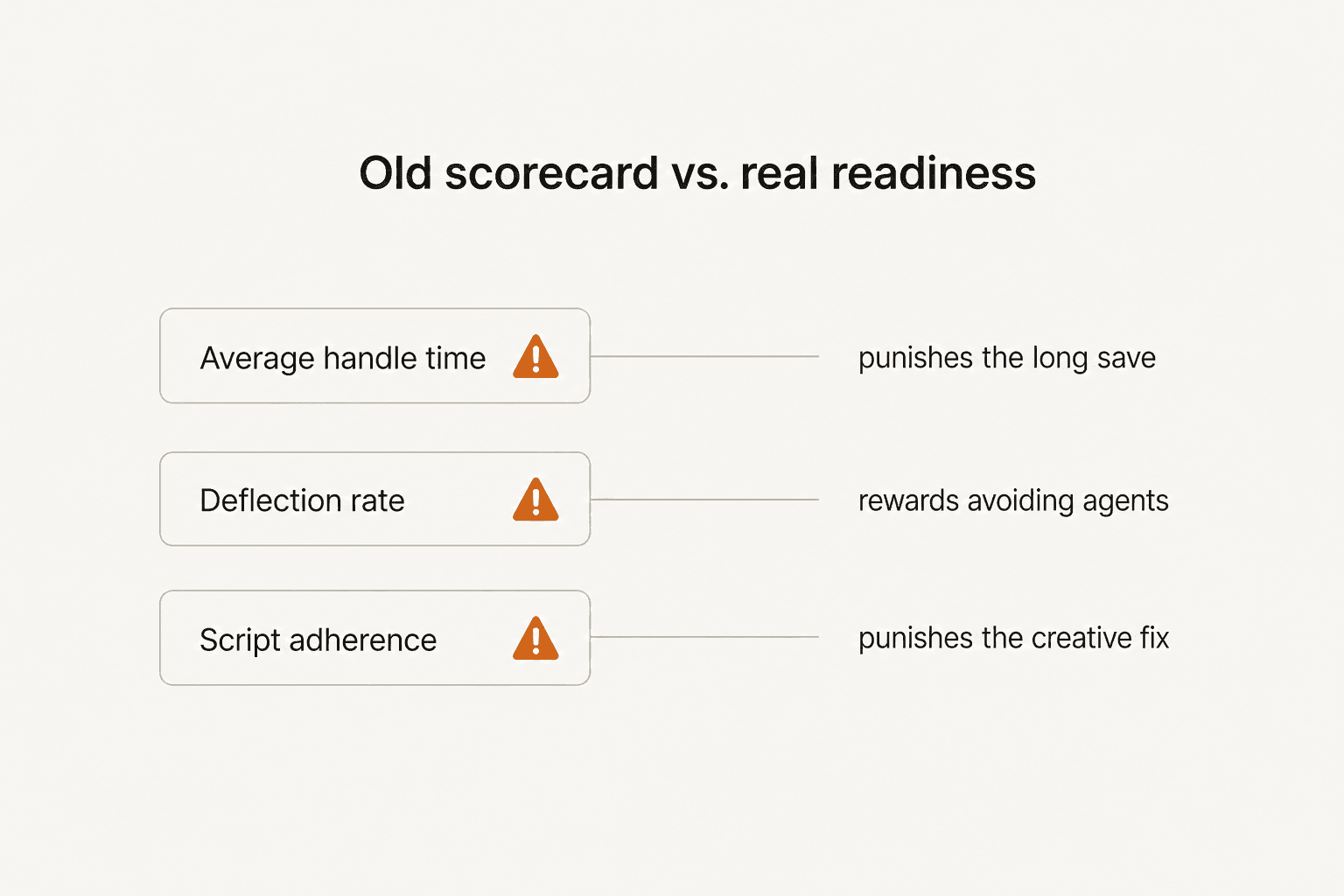
Agents feel this from the other side, too. Reddit's r/callcentres is full of it:
"Your manager isn't trained/focused on the quality guidelines as much as a dedicated QA team is. Managers are mainly there to manage, they are ..."

A companion thread on r/CallCenterWorkers names the exact scorecard categories that trip agents up - "restate, relate, reassure" checkboxes that are easy to fail on a technicality even when the call went well. Rajeev Kumar, a BPO training-and-quality manager, argues the root cause is structural: QA teams "treating evaluation forms like a checklist instead of a coaching tool" - which is exactly the gap between what training teaches and what QA actually scores.
The fix isn't to drop metrics. It's to pick the objective first, then check whether the number attached to it actually rewards what you trained for. If a training objective is "handle billing escalations with patience and accuracy," don't grade it purely on AHT - pair it with a QA line-item that specifically checks whether the agent slowed down for the hard case, the way Help Scout's rubric checks for anticipated needs, not just resolution speed.
How to actually write and roll out training objectives
- Pick one problem per objective. Not "improve support" - "reduce first-response time on shipping questions" or "raise QA scores on tone for escalated tickets." One metric, one owner.
- Find your real baseline before setting a target. Zendesk's own caution applies here: a goal "pulled out of thin air" with no baseline isn't achievable, it's a guess. Pull the actual FCR or AHT number from your helpdesk report first.
- Match the metric to the behavior, not the other way around. If the objective is about judgment on hard calls, don't measure it with a speed metric. Run the metric-mismatch check from the section above before you lock anything in.
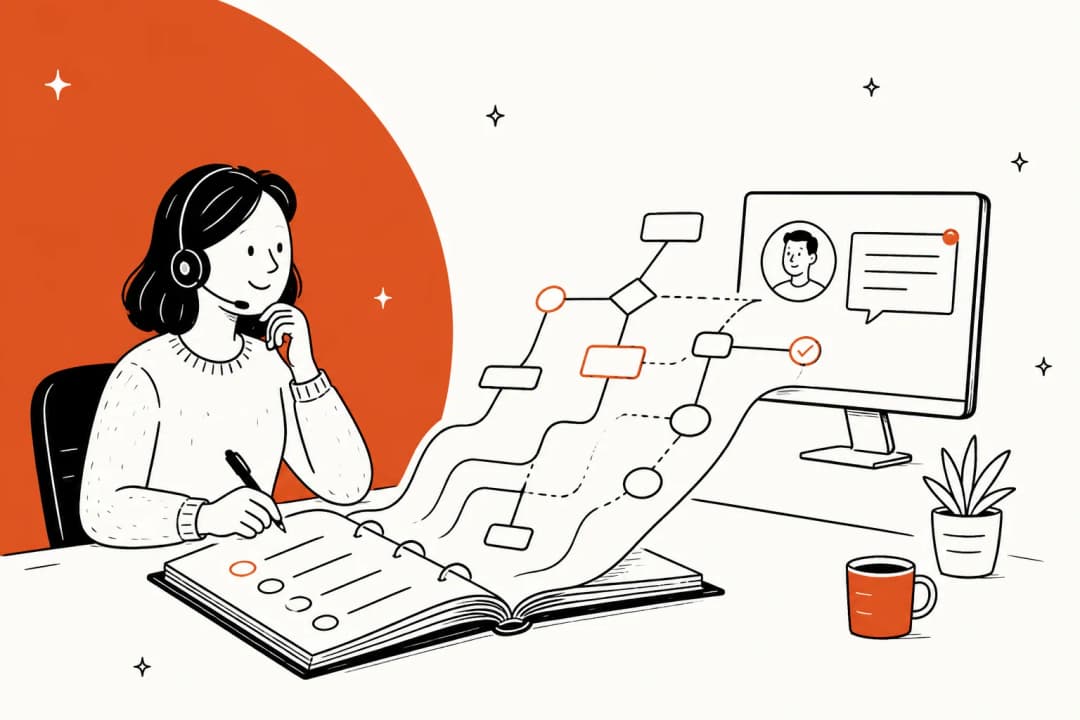
- Structure the ramp, don't just schedule a training day. Reddit's r/callcentres describes what a properly resourced onboarding looks like in practice: three weeks in the classroom, then a month "nesting" - new hires sitting alongside seasoned agents on live calls before they're graded solo.
- Build a low-resource enablement plan if you don't have a training budget. Kristi Serrano, a CS advisor who builds support functions at SaaS companies, opens her own framework with the exact problem most small teams have - hiring discipline gets undone by handing a new rep a laptop and a login with no ramp plan:
"You need intention. A simple enablement plan for new CSMs (even with limited resources): 1️⃣ Onboarding Buddy - Pair new hires with an experienced [rep for shadowing and shared calls]..."
- Review the objective against real tickets, not a role-play. A supervisor sign-off after watching five live tickets catches more than a written quiz - this is what closes Søttrup's "are they ready" gap.
The mistake that kills most training objectives: writing them too soft
Dr. Ari Zelmanow, a performance consultant with a doctorate in cognitive psychology and adult learning, names the single most common failure mode directly:
"Most training objectives are useless. 'Participants will understand the importance of customer service.' Understand. The importance."
"Understand" isn't observable. Neither is "appreciate," "be aware of," or "value." A training objective needs a verb someone can watch a rep actually do: draft a reply, tag a ticket correctly, resolve a billing question on the first contact. If you can't picture watching someone fail your objective, it isn't specific enough to pass yet.
The r/msp community shows the flip side of this: an MSP owner asked for a basic, off-the-shelf customer service training program because "social aptitude and customer service skills seem to be all over the place" across new hires - a real signal that plenty of small teams have no formal objectives at all, not just soft ones. If that's you, start with the five categories above rather than trying to write the perfect SMART goal on the first pass.
Training an AI teammate follows the same rules
I spend a lot of time watching support teams set these objectives, and the pattern holds even when the "trainee" isn't human. At eesel, the single most consistently requested thing across sales calls isn't a feature - it's past-ticket training, not a generic script. As one of our team put it after another week of demo calls:
"People really, really, really want to train on past tickets."
Amogh, eesel (internal team observation, 2026-03-18)
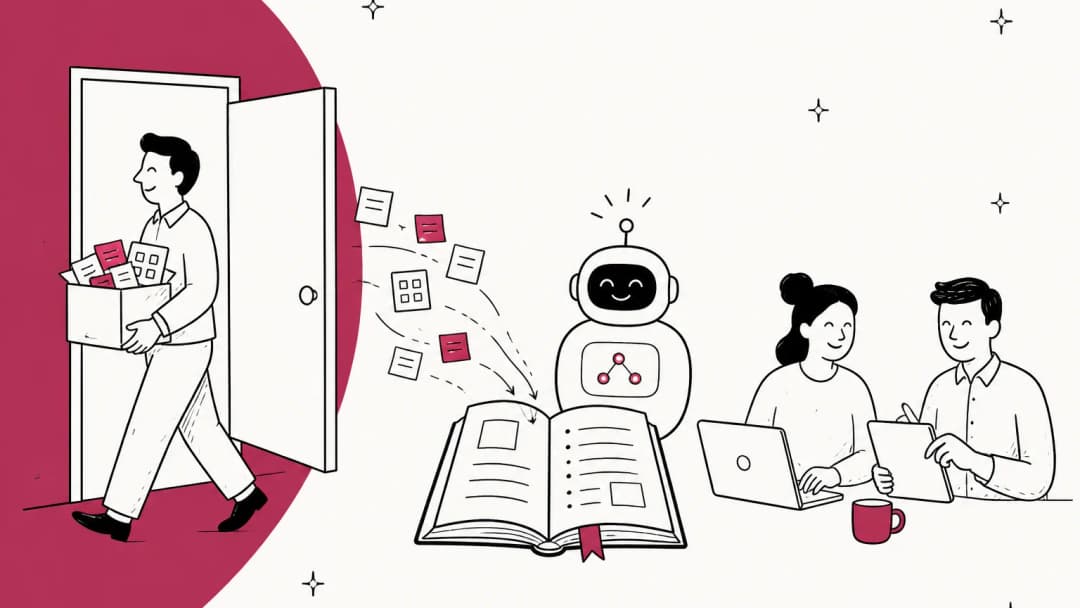
That's the same objective a human training program sets - "handle it the way we actually handle it," not the way a manual says to - just aimed at an AI teammate instead of a new hire. The training happens the same way you'd coach someone in real time: type the correction directly into the chat, and the instruction updates immediately instead of waiting for the next classroom session.
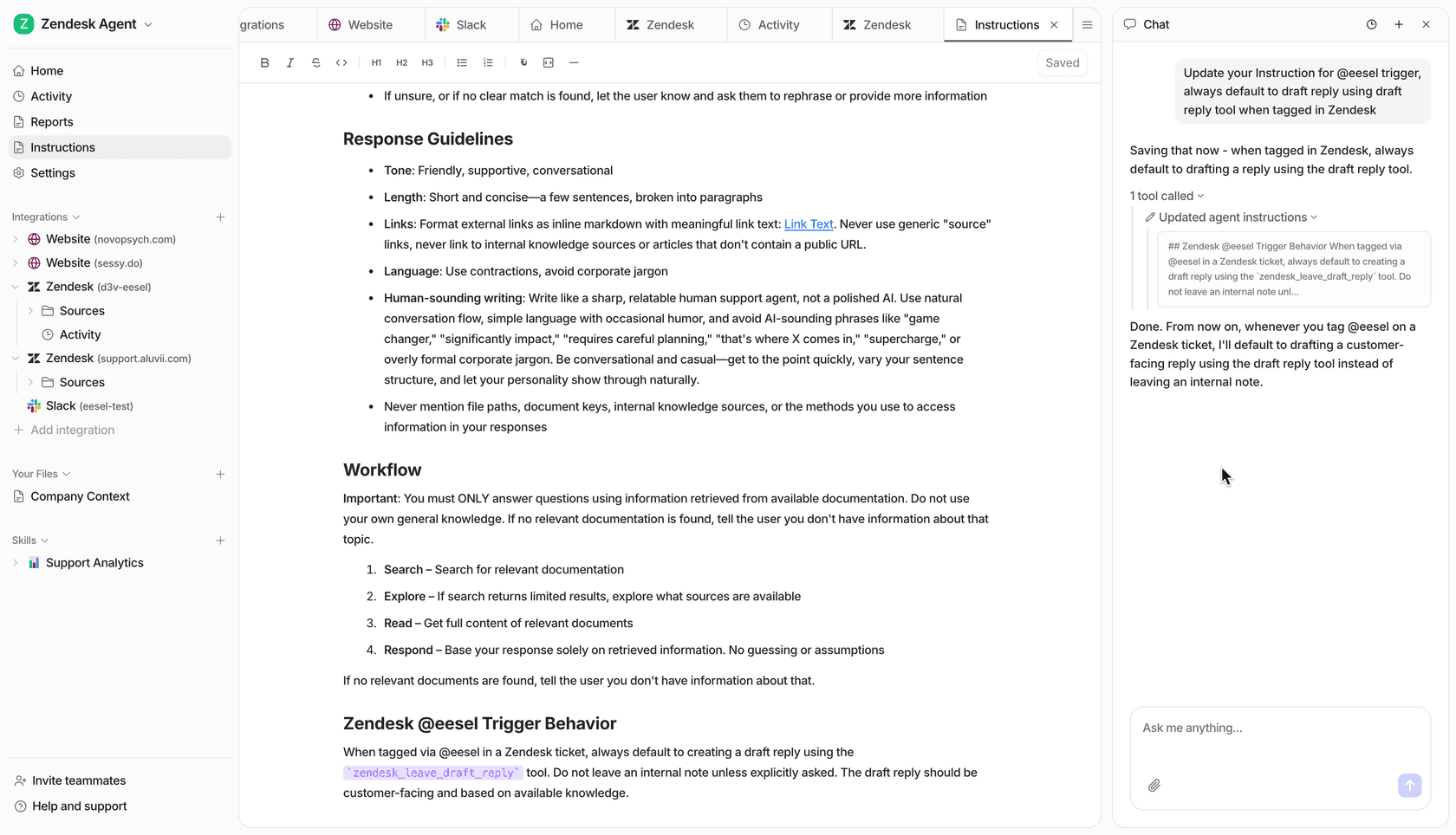
We've also seen what happens when that training step gets skipped: teams that expect an AI teammate to perform on day one with no correction cycle run into the exact same "looked fine on paper, wasn't ready live" gap Søttrup describes for human hires. It's why eesel runs new agents through simulation mode against a team's actual historical tickets before it ever touches a live queue - the same "nesting" instinct Reddit's r/callcentres users describe for new agents, just automated.
Try eesel for the tickets your training can't scale to
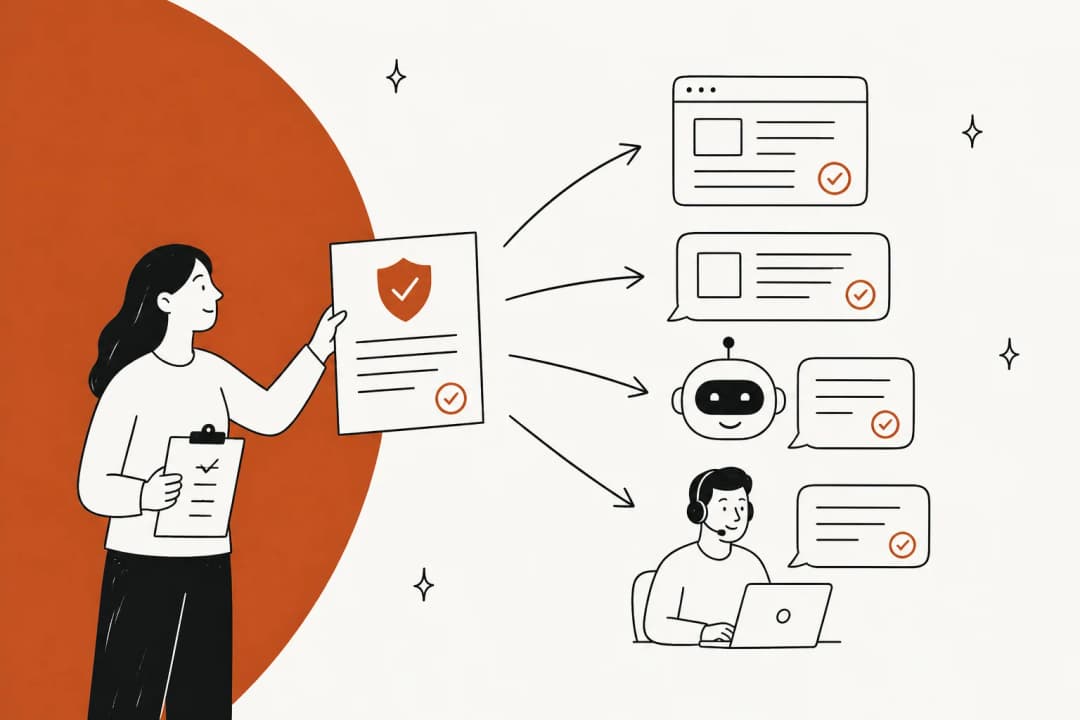
Even the best-trained team hits a ceiling: agents can only handle so many repetitive tickets before the queue backs up, no matter how sharp their training objectives are. eesel is an AI teammate that learns from your team's own resolved tickets and help docs - not a generic script - and drafts or sends replies inside Zendesk, Freshdesk, Help Scout, and HubSpot, among 100+ other integrations.
The onboarding mirrors the same objective-setting logic as this whole post: step one on the setup checklist is literally "teach your AI teammate," using your own tickets as the curriculum before it ever goes live.

One customer, Gridwise, saw eesel resolve 73% of tier-1 requests in its first month - a number that only means something because it was measured against real ticket outcomes, the same discipline this whole post has been arguing for. If your team is drowning in the repetitive questions that never needed a human's judgment in the first place, that's the gap eesel is built to close, freeing your training budget to focus on the calls that actually need a trained human.
Setting the objective is half the job. The other half is making sure the number you use to prove it worked doesn't quietly reward the opposite behavior - whether the trainee is a new hire, a tenured agent picking up a new queue, or an AI teammate learning your helpdesk for the first time. Get call center quality assurance and performance review goals built around the same objective, and the two stop pulling in different directions. For related reading, see how scaling customer support and building a customer service team both lean on the same SMART-objective discipline, and how measuring customer satisfaction closes the loop once training is live.
Frequently Asked Questions
What are the main objectives of customer service training?
How do you write a SMART goal for customer service training?
How long should customer service training take for new hires?
Why do customer service training objectives fail?
Should AI training objectives look different from human agent training objectives?



Article by
Kurnia Kharisma
Kurnia is a software engineer and writer at eesel AI with two years of SEO experience, writing about AI tools, helpdesk software, and customer support. He pairs a developer's understanding of how these products are built with search-driven research into what actually ranks and resonates with the people searching for them.