


Cohere Parse 5 pricing at a glance
Here's every published price for Parse 5 (parse-v5.0) in one place, straight off Cohere's pricing page:
| Plan | Price | Billed by | Rate limit | Best for |
|---|---|---|---|---|
| Trial API key | Free, 1,000 calls/month | n/a (evaluation only) | 500 req/min | Testing and prototypes |
| Production API | $1.50 / 1,000 pages | Page | 500 req/min | Most production workloads |
| Model Vault, Medium | $4.00/hr, $2,500/month | Dedicated instance | Instance-bound | ~1.7M+ pages/month |
| Model Vault, XL | $7.00/hr, $4,300/month | Dedicated instance | Instance-bound | Very high volume |
A quick read of that table: the trial key is genuinely free but hard-capped and off-limits for production, the API is a simple per-page meter, and Model Vault swaps the meter for a flat rent. Everything else about pricing is a variation on those three lines.
What you're actually paying per "page"
Parse bills per page, which sounds obvious until you look at what a page is today. The live Parse endpoint accepts image inputs only. The docs list PDF, PPTX and JPEG, but the request wants document.type=image_url, so in practice you send one page image at a time and each one is a billable page. Raw PDF ingestion isn't wired up yet, which means the "pages" in your bill are page images you've already rendered.
What you don't get charged extra for is the useful part: Parse returns Markdown with tables as inline HTML, image placeholders, and bounding boxes for tables and images, all inside the same per-page price. There's no premium tier for structured output and no separate OCR add-on. There are real limits to know before you budget: 20MB per file, 50 megapixels, 200MB decoded, an 8,192-token context window, and nine stable languages (Arabic, English, French, German, Italian, Japanese, Korean, Portuguese, Spanish). If you want the full capability rundown, I went deep on that in the Cohere Parse 5 review.
API or Model Vault: where the crossover sits
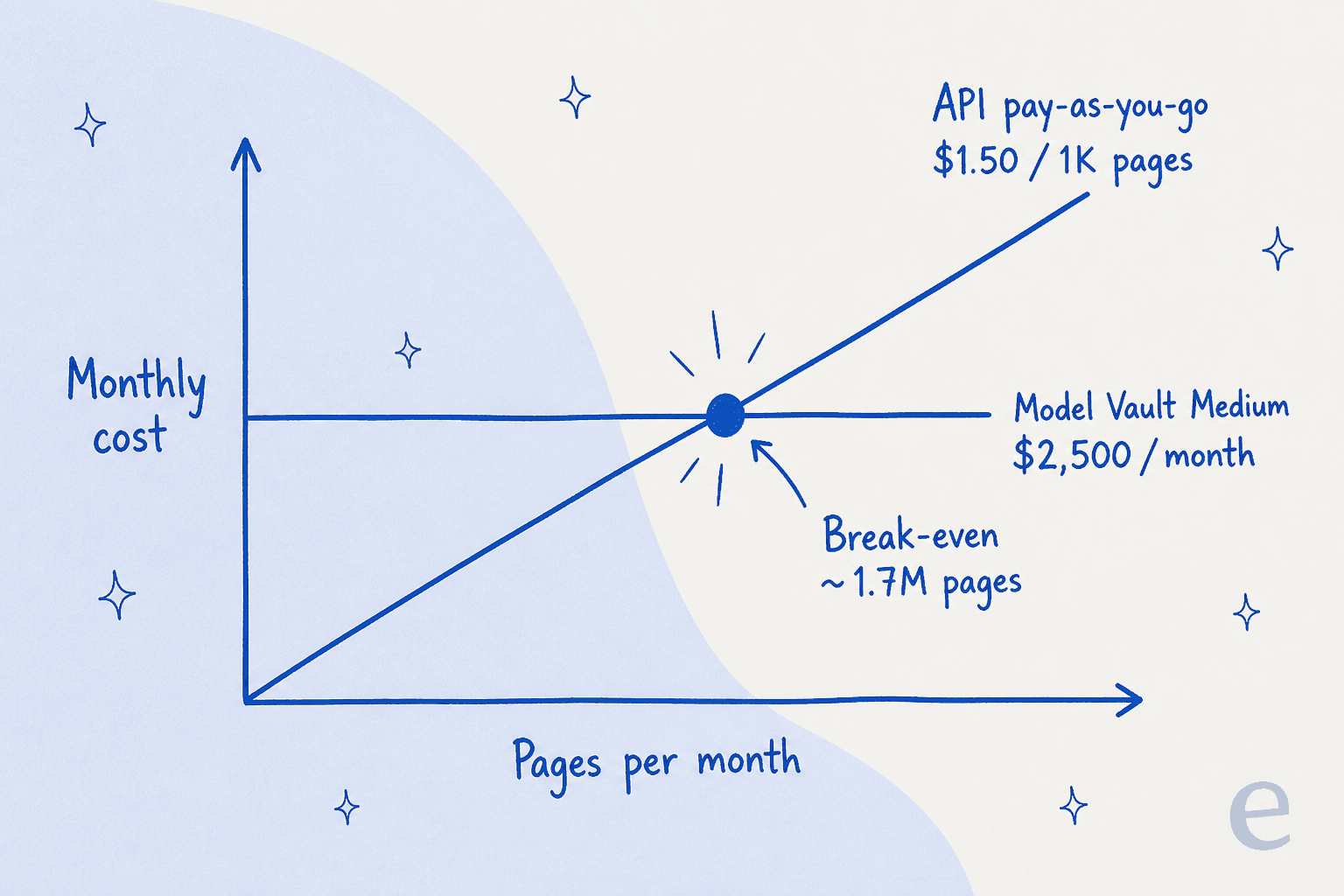
This is the one calculation that actually changes your bill. The API is $1.50 per 1,000 pages, so a Medium Model Vault instance at $2,500/month pays for itself at exactly $2,500 ÷ $0.0015 = about 1.67 million pages a month. The XL instance at $4,300/month crosses over near 2.87 million pages.
Below those numbers, the per-page API is cheaper and you avoid paying rent on idle capacity. Above them, the dedicated instance wins, and Cohere claims the dedicated route runs 23-61% cheaper per page once you're saturating an instance. Model Vault also buys you single-tenancy (no shared queue) and predictable spend, which for some regulated teams matters more than the raw math.
Plug your own volume in here before you commit to either path:
The cost the pricing page doesn't show
Here's the part that trips up budgets. Parse 5 is a parser, and parsing is step one of maybe four. If you're building this so an AI can answer questions from your documents, the $1.50 per 1,000 pages is just the ingestion line. You still pay for the rest of the RAG pipeline: Embed 4 to vectorize the text ($0.12 per 1M tokens), Rerank 4 to sort the matches ($2.00 per 1,000 searches), and a generative model to actually write the answer, billed separately again.
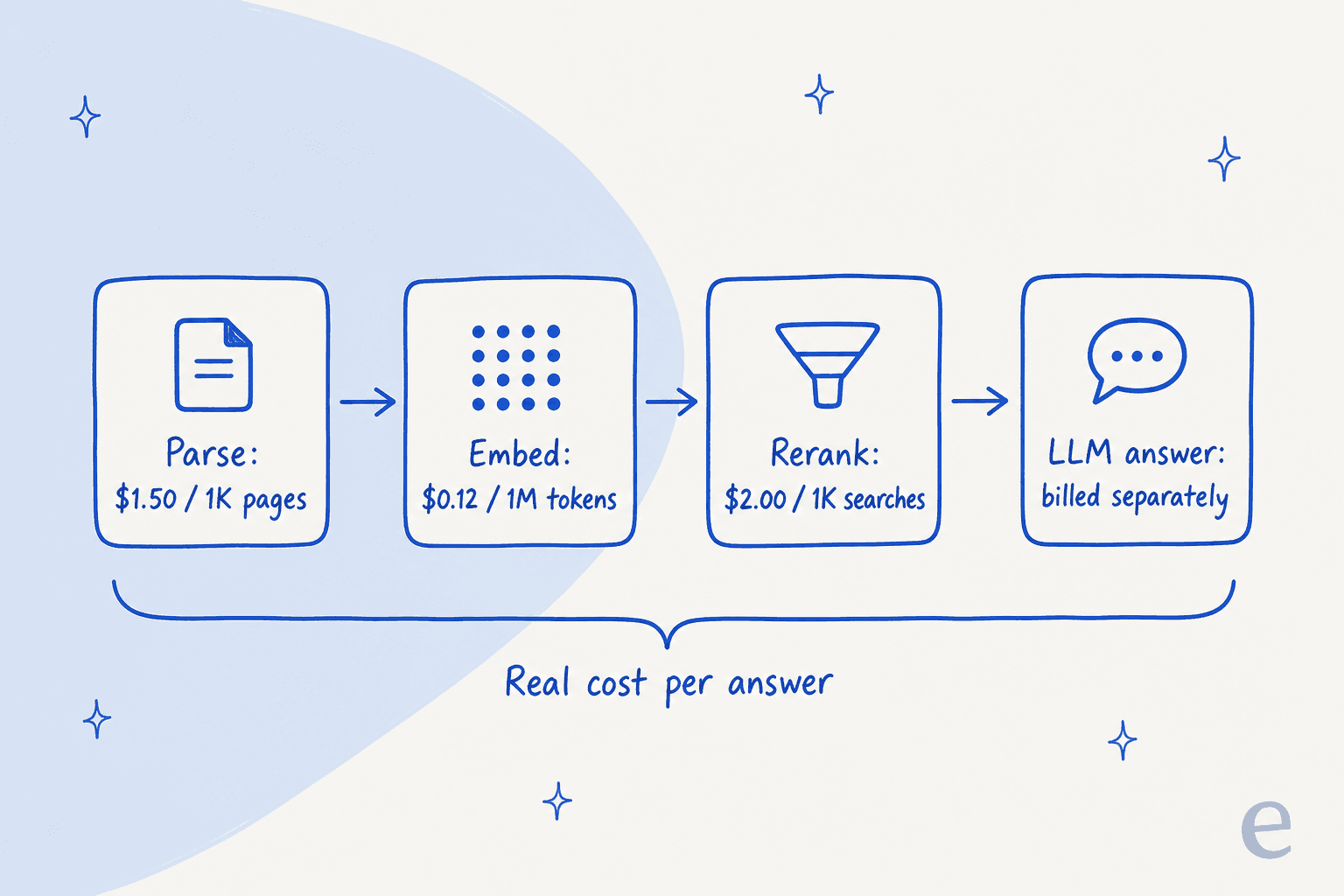
None of those numbers are scary on their own. The point is that "Parse 5 costs $1.50" and "answering customer questions from documents costs $1.50" are very different sentences, and it's easy to quote the first while budgeting for the second. If you want to understand how those layers fit together, we broke it down in hybrid search for support AI and in the wider RAG vs LLM explainer, plus a rundown of knowledge retrieval tools that sit downstream of a parser.
Worked examples: what a real team pays
Abstract per-page rates don't mean much until you attach a volume. Here's what the API line looks like at three sizes, using the $1.50 per 1,000 pages rate:
| Monthly volume | API cost | Model Vault Medium | Cheaper option |
|---|---|---|---|
| 50,000 pages (small KB ingest) | $75 | $2,500 | API by a mile |
| 500,000 pages (mid-size docs product) | $750 | $2,500 | API |
| 2,000,000 pages (large enterprise RAG) | $3,000 | $2,500 | Model Vault Medium |
| 5,000,000 pages (very high volume) | $7,500 | $4,300 (XL) | Model Vault XL |
The pattern is clear: almost everyone should be on the per-page API, and only genuinely high-volume ingestion pipelines cross into Model Vault territory. If you're evaluating Parse for a support knowledge base that's a few thousand articles, you're firmly in "$75 a month" land, and the pricing debate is mostly moot.
How Parse 5's price compares
Parse 5's whole pitch is cost, and it earns it. On Cohere's own ParseBench, Parse scores 79.2, which sits behind GPT-5.5 (84.4), Claude Opus 4.8 (84.3) and Gemini 3.5 Flash (81.8), but comfortably ahead of open-weight parsers like LlamaParse (78.3) and Mistral OCR 4 (74.5). The trade is deliberate: give up a few accuracy points, win big on price per page.
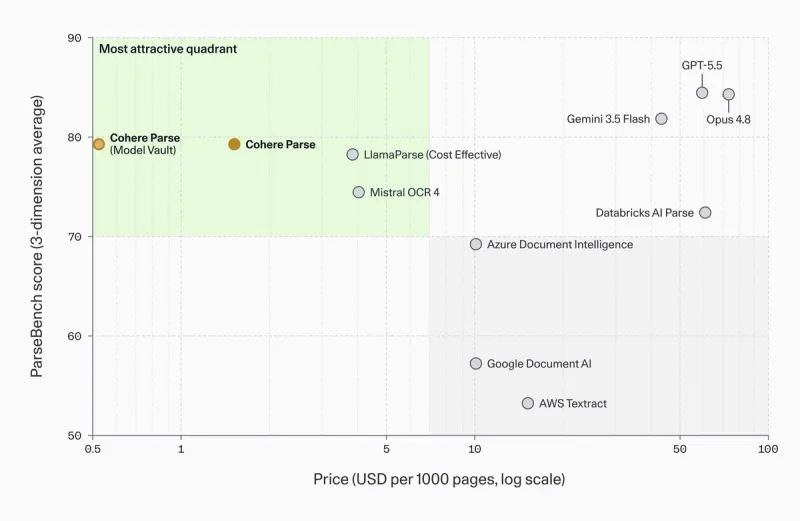
That framing is more or less the entire conversation about Parse 5. As enterprise-tech journalist Sean Kerner put it:
"Text, document parsing should be a solved problem at this point right? But it's not.. every few weeks there is another option that claims to make it better. This week it's @cohere Parse 5. 'Document parsing isn't solved because the hard part isn't reading text, it's preserving…"
So the price is real and the value is real, as long as you can live with parsing accuracy that's good rather than best-in-class. For a fuller side-by-side of the Cohere model family and where it lands against rivals, the Cohere AI alternatives post has the wider map.
Which Parse 5 pricing path fits you
Boiling all of the above down, the choice is usually one of three:
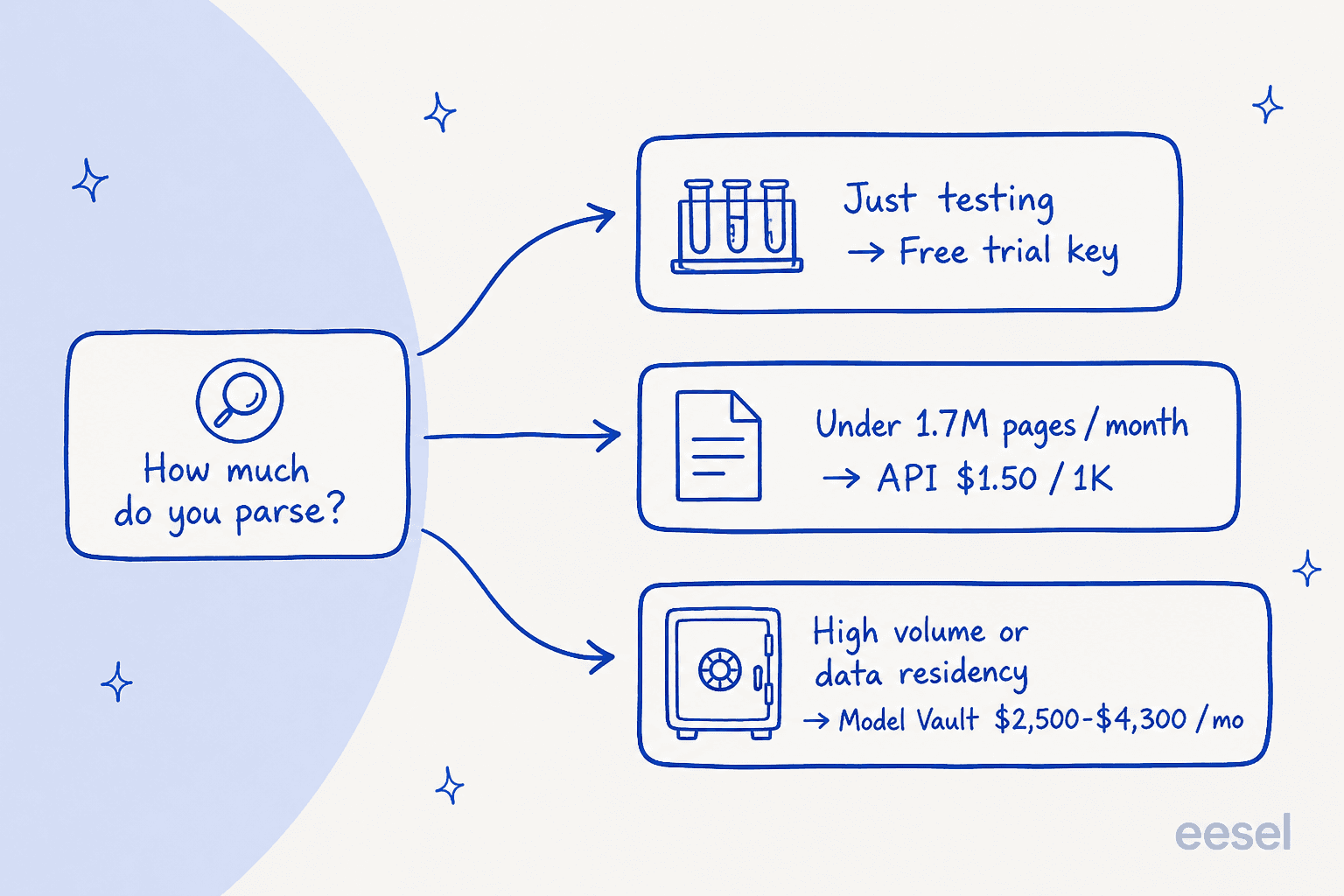
- Just kicking the tyres? The free trial key covers 1,000 calls a month, enough to see if Parse handles your document types before you commit a card.
- Running production under ~1.7M pages/month? The $1.50 per 1,000 pages API is the right default. Simple, metered, no idle rent.
- High volume, or you need data residency and single-tenancy? Model Vault's flat $2,500-$4,300/month starts to pay off, both on price per page and on control.
Try eesel for support answers, not just parsing
One honest framing before you build: Parse 5 is infrastructure. It's a very good, very cheap way to turn a page into Markdown, and if you're a team that wants to assemble your own document-AI stack, it's a strong first brick. But a parser doesn't answer a ticket, and the $1.50 line is the start of a bill that keeps adding embeddings, reranking, and generation.
eesel sells the other end of that. Instead of a model you wire into a pipeline, you hire an AI helpdesk teammate that already knows how to read your help center, past tickets, and internal docs, then drafts or auto-resolves support tickets inside Zendesk, Freshdesk, Gorgias and the rest. The parsing, retrieval, and answering are all one price, and you can run it in simulation against your own historical tickets before it ever touches a live customer. It's free to try.

If your goal is a document parser you'll integrate yourself, Parse 5's $1.50 per 1,000 pages is one of the best deals going. If your goal is answered tickets, that's a teammate, not a parser, and it's worth pricing both before you build.