ChatGPT for Freshdesk: 4 ways to add AI to your helpdesk in 2026

Rama Adi

Katelin Teen
Last edited September 4, 2026

First, a scar worth sharing
I build integrations for a living, so my instinct when someone asks "can I just point ChatGPT at Freshdesk" is to say yes, technically, you can. The OpenAI API is a few lines of code. The Freshdesk API is well documented. Wiring them together is a weekend.
The part that is not a weekend is everything that keeps it from embarrassing you.
We have spent the last three-plus years running AI on live support queues, and the lesson that stuck came from our own product. Early on, before we had a hard fallback when knowledge-base retrieval came back empty, one customer's bot invented subscription details about solar cells and shipped them to real customers. Another, asked a question it had no answer for, cheerfully replied "Oxygen" from the periodic table. The models were fine. The plumbing around them was not.
That is the whole story of ChatGPT for Freshdesk in one paragraph. The model is the easy 10%. The grounding, the guardrails, and the "only answer what you are confident about" logic are the 90% that decides whether the thing helps your team or creates new tickets. Keep that in mind as we walk the four routes.
What "ChatGPT for Freshdesk" actually means
When someone searches for this, they usually want one of two outcomes: an AI that drafts replies for agents to review (a copilot), or an AI that resolves tickets end to end (an agent). Both are possible on Freshdesk. Neither requires an app literally called "ChatGPT."
Here are the four real paths, from lightest to most hands-off.
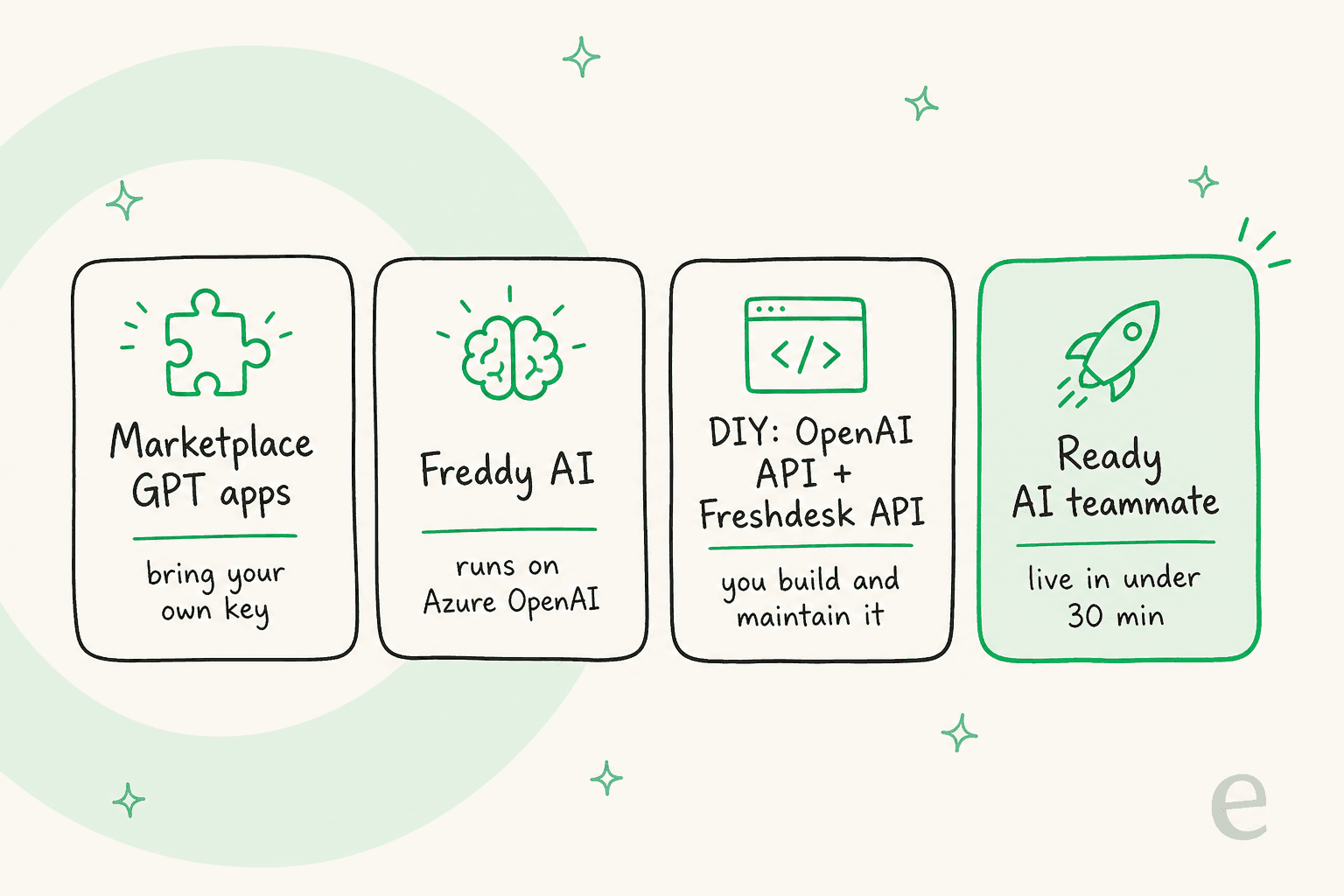
Route 1: marketplace GPT apps (bring your own key)
The Freshworks Marketplace has a whole shelf of GPT-powered apps for Freshdesk, all published by independent developers rather than by OpenAI. The common ones include ChatGPT Assistant (rated 3.7 out of 5 across 9 reviews), AI Smart Assist, TicketGPT, and ChatGPT Freshdesk.
Almost all of them work the same way: you install the app, paste in your own OpenAI API key, and the app calls GPT to do a narrow job inside a ticket, usually summarising a thread, rephrasing a reply, or translating. A few, like Support Assist AI, let you pick the provider (OpenAI, Anthropic Claude, Google Gemini, or Azure OpenAI) and pay the model cost directly.
Where this fits: these are copilot-style helpers for individual agents. They are cheap and quick to try. What they are not is an autonomous agent grounded in your knowledge base, and the review scores hovering in the 3-to-4 range tell you they are handy accessories rather than a support strategy. If your goal is "help my agents type faster," Route 1 is fine. If your goal is "resolve tickets without a human," keep reading.
Route 2: Freddy AI (you may already have ChatGPT and not know it)
Here is the reframe I promised. Freshdesk's native AI, Freddy AI, is not powered by some in-house model. Per Freshworks' own Freddy AI Trust FAQ, its "generative capabilities are powered by enterprise-grade Azure OpenAI models." That is the same GPT family that sits behind ChatGPT. So if you already pay for Freddy, you are already running ChatGPT inside Freshdesk.
Freddy comes in three parts: the Freddy AI Agent (customer-facing, resolves queries), Freddy AI Copilot (agent-facing, drafts and summarises), and Freddy AI Insights (analytics). You build agents no-code in AI Agent Studio, set a persona and escalation rules, and point it at your knowledge.
Two honest limits worth naming, because they shape the decision:
- You cannot choose the model or bring your own key. Freddy runs on Freshworks-selected Azure OpenAI models. There is no model selector and no LLM field in AI Agent Studio. If part of your reason for wanting "ChatGPT" was control over the model, Freddy does not give you that.
- The pricing is per session, and it adds up. More on the exact numbers below, but the short version is that Freddy AI Agent bills $49 per 100 sessions once your free allowance runs out, and a session is billed whether or not the AI resolved anything.
Freddy is the path of least resistance if you are happy staying inside the Freshworks ecosystem. For a full breakdown, our Freddy AI review and Freddy AI pricing guides go deeper.
Route 3: Build it yourself with the OpenAI API
This is the route the search term literally describes: take the OpenAI API, take the Freshdesk API, and connect them. It is real, and for a genuinely custom workflow it can be the right call.
There is even a newer, cleaner way to do it. Freshworks now ships its own Model Context Protocol (MCP) server (in early access for Enterprise customers), which lets AI tools connect to Freshdesk over a standard interface. The docs name Claude Desktop, Cursor, and Microsoft Copilot Studio as clients, and a custom GPT or agent can talk to the same server. There are also community MCP servers like effytech/freshdesk_mcp (66 stars) if you want to start from open source.
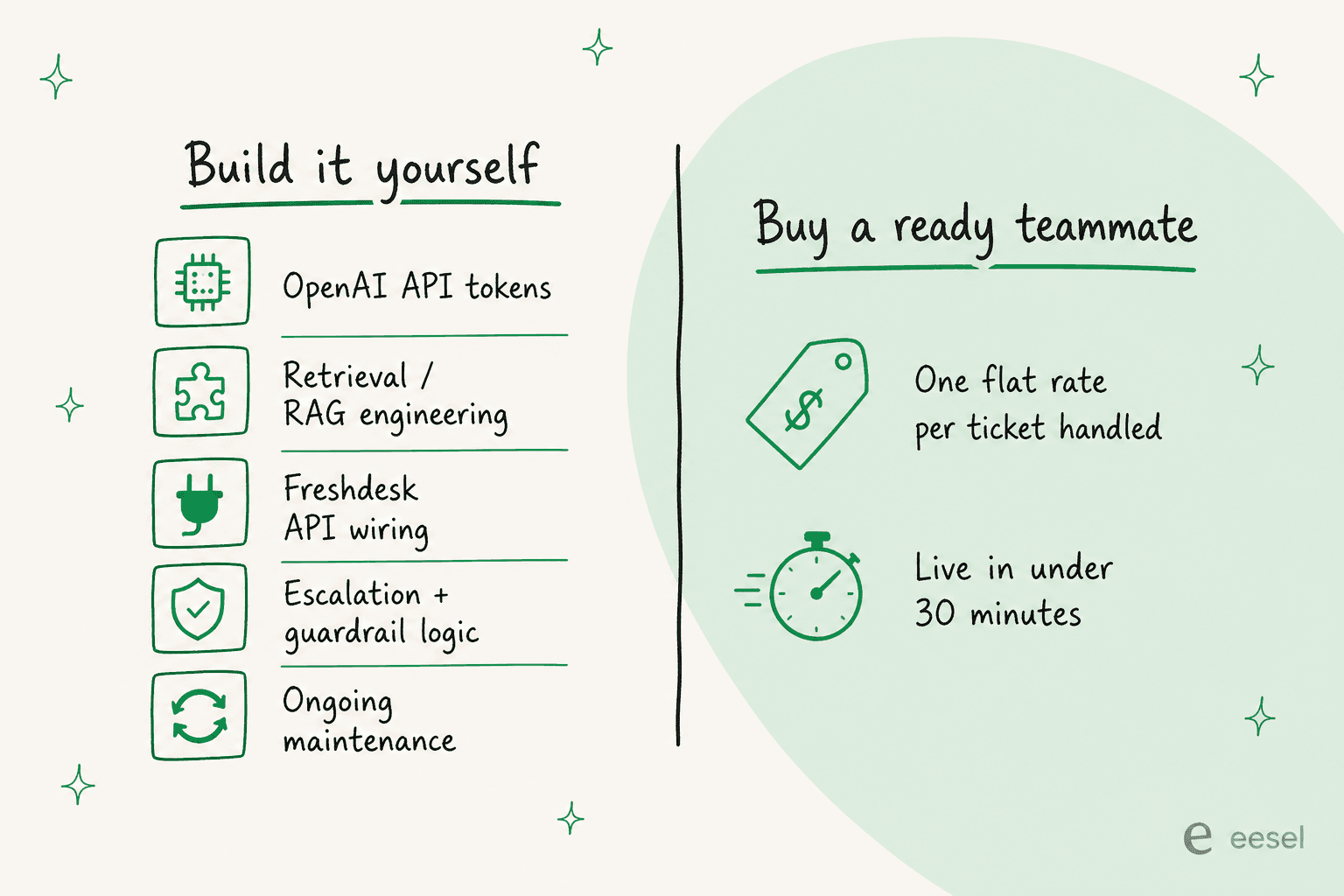
So what is the catch? The catch is that "connect ChatGPT to Freshdesk" is the smallest line item on the real bill. The rest is:
- Retrieval. ChatGPT does not know your refund policy. You have to build a pipeline that pulls the right solution articles and past tickets into each prompt, or the model will confidently make things up (see the scar above).
- Actions. Drafting a reply is easy. Updating ticket fields, routing to the right group, and respecting SLA policies means writing and testing Freshdesk API calls for every action.
- Guardrails. You need logic that makes the AI answer only what it is confident about and hand off the rest, not guess like a rule-based bot would.
- Maintenance. Every prompt change, every model upgrade, every new edge case is now your team's job, forever.
I hear this trade-off from real buyers constantly. One engineering lead we worked with put the whole calculation in a single sentence:
"We could try to write our own LLM application but we didn't want to invest our time into that. We wanted something that we would not have to maintain."
Karel, GENERAL BYTES (case study)
That word, maintain, is the one that gets underestimated. Building the demo is fun. Owning it at 2am when a model update quietly changes behaviour is not. If your team has the engineering appetite and a workflow no product covers, build it. Otherwise, Route 4 exists precisely so you do not have to.
Route 4: Drop in a ready AI teammate
The buy option skips the build entirely. Instead of stitching ChatGPT to Freshdesk yourself, you install an AI agent that already knows how to work inside Freshdesk on day one. This is the category eesel AI sits in, and it is worth being precise about what "works inside Freshdesk" means, because it is the whole point.
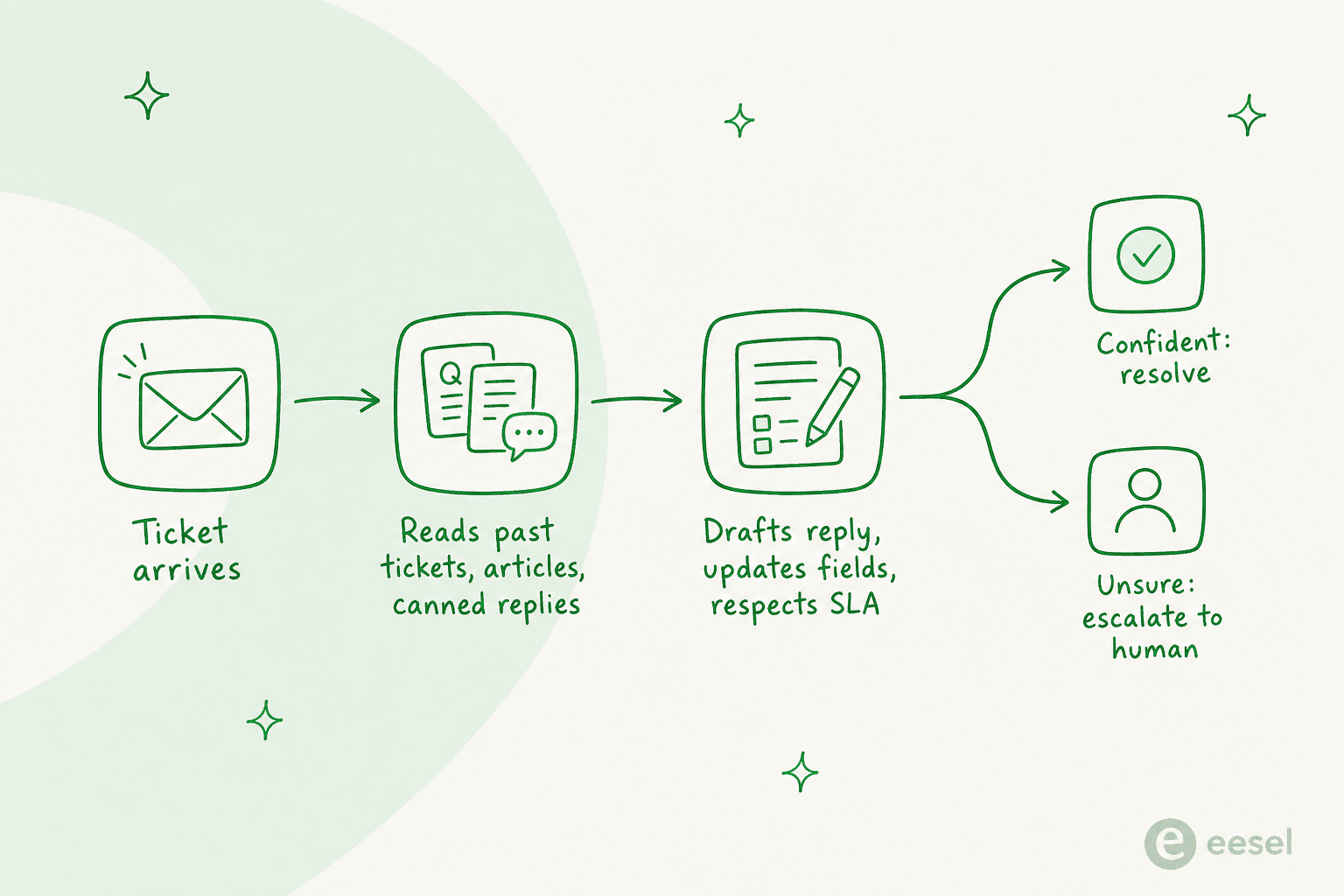
eesel joins as a real AI Agent inside your Freshdesk, not a separate chat widget or inbox. It reads your past Freshdesk tickets, solution articles, and canned responses automatically, then can "draft and send replies, add private notes, route tickets to groups, update ticket fields, and manage SLA timelines," exactly like a human agent would. It respects your existing dispatch rules, business hours, and workflows, and answers in the channel the customer used.
A few things that address the exact fears a build-it-yourself reader has:
- It answers only from your knowledge. Buyers ask us, unprompted, whether a raw general model is answering their customers. It is not: eesel is grounded in your approved sources, which is the fix for the hallucination problem that makes DIY builds risky.
- You configure it in plain English. Change how it writes, which tickets it handles, and when it escalates by describing what you want. There is no rules engine to wrangle and no prompt file to redeploy.
- You can test it before it goes live. eesel runs a simulation against your own past tickets first, so you see how it would have handled real history and where your docs have gaps, before a single customer talks to it. This is the direct answer to "I cannot check all 7,000 of my tickets to see if the AI made a good call."
Common adoption pattern: start in draft-reply (copilot) mode so your team reviews everything, then flip on autonomous resolution for the easy tickets once you trust it. The Freshdesk page claims 85%+ average tier-1 resolution within a week and setup in under 30 minutes, with customers like Design.com running 50,000+ tickets a month on Freshdesk through it.
To be fair about limits: eesel is not the pick if you want to hand-pick the underlying LLM on a self-serve plan (that control is Enterprise-only), and it is a specialist support agent, not a general-purpose ChatGPT you chat with about anything. If you want a raw model to brainstorm with, that is not this.
What each route actually costs
Cost is where the routes diverge most, so here is the honest comparison. Freddy meters AI usage per session on top of your Freshdesk seats; eesel sells a fixed monthly plan of credits (1 credit per ticket) with no seat fee; a DIY build trades predictable software cost for engineering time.
| Route | What you pay | The gotcha |
|---|---|---|
| Marketplace GPT app | App fee (often a flat monthly) + your own OpenAI API usage | Narrow scope; you manage the key and the model bill |
| Freddy AI Agent | Freshdesk seat + $49 per 100 sessions after 500 free | Billed per session regardless of outcome; Copilot is a separate $29/agent/mo add-on |
| DIY OpenAI build | API tokens + engineering + maintenance time | The build is 10% of the cost; owning it is the other 90% |
| eesel AI | From $299/mo (500 credits), no per-seat fee | 1 credit per ticket handled, however long, whether or not it resolves; self-serve can't pick the model |
A worked example makes the Freddy math concrete. On standalone Freshdesk Pro, 10 agents with Copilot and 1,000 AI sessions in a month runs 10 x $55 in seats, plus 10 x $29 for Copilot, plus 10 session packs at $49, which is $1,330 a month on annual billing. Route the same 1,000 tickets to eesel and it is a $499 a month plan for 1,000 credits (1 credit per ticket), and you are never charged for the tickets your humans handle. The units are not identical (a Freddy session versus an eesel credit), so treat it as a directional comparison, but the shape of the difference is real. Our Freshdesk AI pricing guide breaks the meters down further.
How to actually set it up
If you have decided you want a real agent rather than a copilot accessory, the setup is genuinely short. Here is the flow for the drop-in route, which is the one most teams land on:
- Connect Freshdesk. Install eesel AI from the Freshdesk App Marketplace and authorize it in two clicks from the eesel dashboard. No code.
- Let it learn. It imports your past Freshdesk tickets, solution articles, and canned responses automatically. Add external sources like Confluence, Google Docs, or a website crawl if you want.
- Scope it. Decide which tickets it touches, by group, tag, channel, or condition, and write its tone and escalation rules in plain English.
- Simulate. Run it against your past tickets to see resolution rate and knowledge gaps before go-live. This is the step DIY builds usually skip and regret.
- Go live gradually. Start in draft mode, review the replies, then switch the easy ticket types to autonomous once you are confident.
That is the same shape whichever route you pick: connect, ground it in your knowledge, scope it, test it, roll out slowly. The routes only differ in how much of steps 2 through 4 you build versus buy.
Try eesel AI for Freshdesk
If the goal behind "ChatGPT for Freshdesk" was really "an AI that resolves tickets without making things up," a ready teammate gets you there faster than wiring the OpenAI API yourself. eesel AI plugs into Freshdesk as a real agent, trains on your own tickets and help articles, and lets you simulate the whole thing on historical tickets before it answers a single customer. It starts at $299 a month for 500 credits (1 credit per ticket), no per-seat fee, and setup takes under 30 minutes.
You can start free, connect your Freshdesk, and watch the simulation tell you exactly how it would have handled last week's tickets. That preview, before any risk, is the part no DIY build gives you on day one.