One-touch resolution
A support outcome where a customer's issue is fully resolved in a single interaction, with no follow-ups, transfers, or repeat contacts.
What one-touch resolution means
One-touch resolution is a support outcome in which a customer's issue is fully resolved within a single interaction, with no follow-ups, transfers, callbacks, or repeat contacts needed afterward. The "one touch" refers to one continuous handling of the request, the customer asks, the issue is solved, and the conversation closes for good. It is measured as the share of interactions that close on the first touch out of all interactions handled.
In customer support, one-touch resolution is a tight proxy for an efficient, low-effort experience. When an issue is solved in one go, the customer spends the least possible energy, the agent does not re-open or re-handle the ticket, and the queue does not carry the same request twice. It sits close to first-contact resolution, with the extra emphasis that the single contact also involved no internal handoffs.
Why one-touch resolution matters
A high one-touch rate quietly improves almost everything downstream of it:
- It minimizes customer effort. One interaction and done is the lowest-effort path, which produces a strong customer effort score, the metric most tied to loyalty.
- It cuts cost. Each repeat contact, transfer, or callback adds handling time, so resolving on the first touch directly lowers cost per ticket.
- It shrinks the queue. Issues that close in one touch never come back as a reopen rate statistic or a second ticket clogging the backlog.
- It reflects real capability. A one-touch close means the person or system handling it had the knowledge and the permission to finish the job, not just to acknowledge it.
- It speeds everything up. Fewer handoffs means lower average handle time across the operation, not just per ticket.
Picture the same ticket arriving and splitting into two fates depending on what the handler can do:
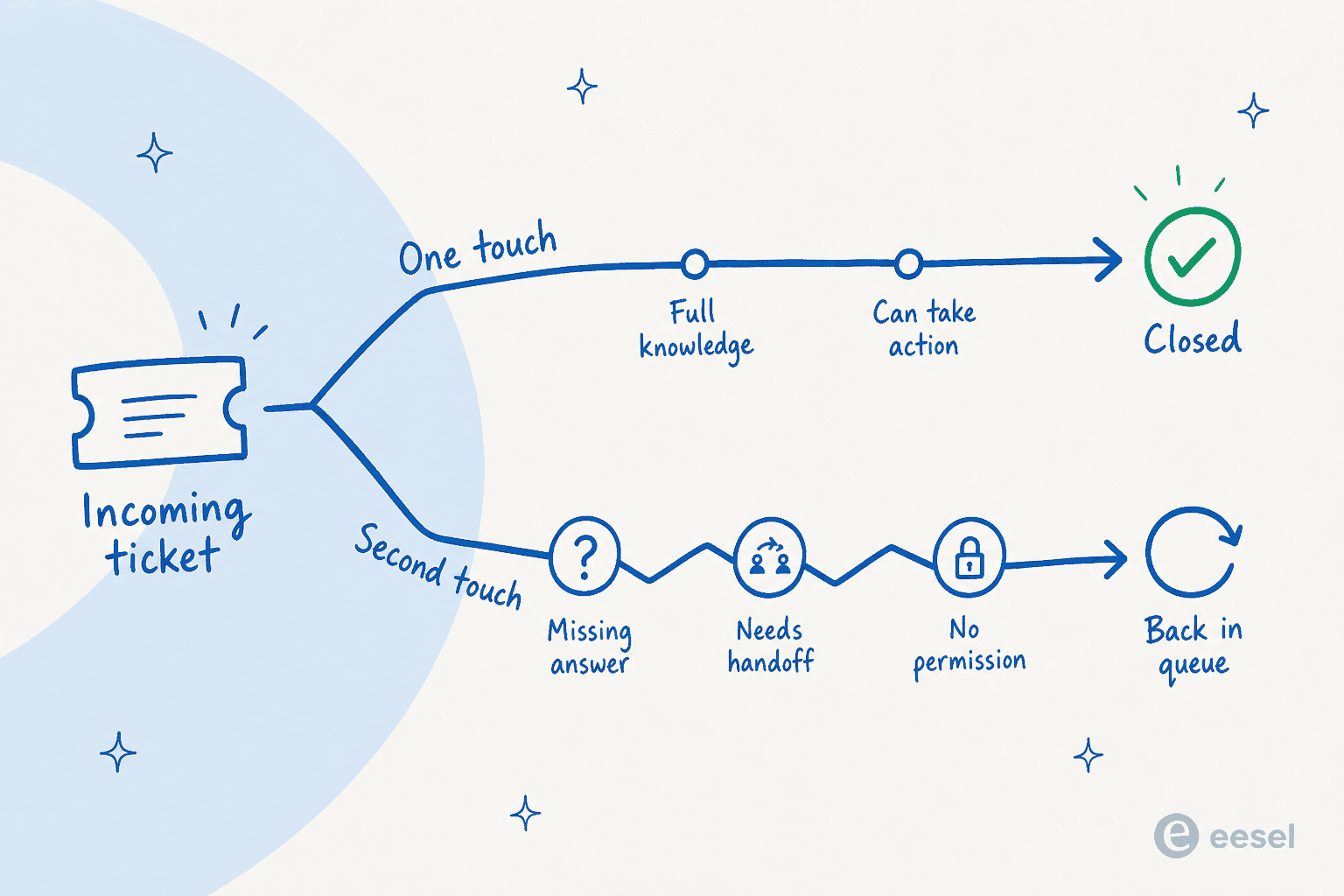
The top path closes cleanly because the handler has the full answer and the right to act on it. The bottom path is where one-touch resolution breaks: a missing answer, a forced handoff, or a permission gap each adds a second touch and risks sending the issue back into the queue.
How one-touch resolution works
Achieving one-touch resolution depends on removing the reasons an issue would need a second touch:
- Reach all the knowledge. The handler needs every relevant source at once, the help center, internal docs, and past tickets, so there is no "let me check and get back to you."
- Hold the right permissions. Resolving in one touch often means taking an action, issuing a refund or updating an account, not just answering, so the handler must be allowed to act.
- Avoid the handoff. Each transfer to another team or tier risks splitting the resolution across touches, so the goal is to finish where the request lands.
- Escalate cleanly when needed. If an issue truly needs a person, hand it off once with full context rather than bouncing the customer around.
An AI support agent like eesel AI is built around exactly this: it grounds answers in your full knowledge base and past tickets, takes the actions you allow directly inside your helpdesk, and escalates cleanly when there is no safe answer. Because it can read the knowledge and perform the action in the same interaction, more requests close on the first touch instead of becoming a chain of follow-ups.
One-touch resolution in practice
The honest caveat is that not every issue should be a one-touch resolution, and chasing the metric blindly can backfire. Complex, multi-party, or high-stakes cases really do need more than one touch, and forcing a premature close to protect the number just produces a reopened ticket and an angrier customer. The teams that use the metric well treat it as a target for the requests that should never have taken more than one interaction, and they fix one-touch failures by closing knowledge and permission gaps, not by rushing the cases that deserve care.
We go deeper on this in our guide to AI first contact resolution.
Resolve it on the first touch
eesel AI pulls answers from your full knowledge and takes the action inside your helpdesk, so more issues close in a single interaction.